I preached this sermon on Sunday, August 9 at St. Anne Episcopal Church, West Chester, OH. The lectionary text cited is Matthew 14:22-33.
About halfway across the lake, I knew we should never have gotten into the boat.
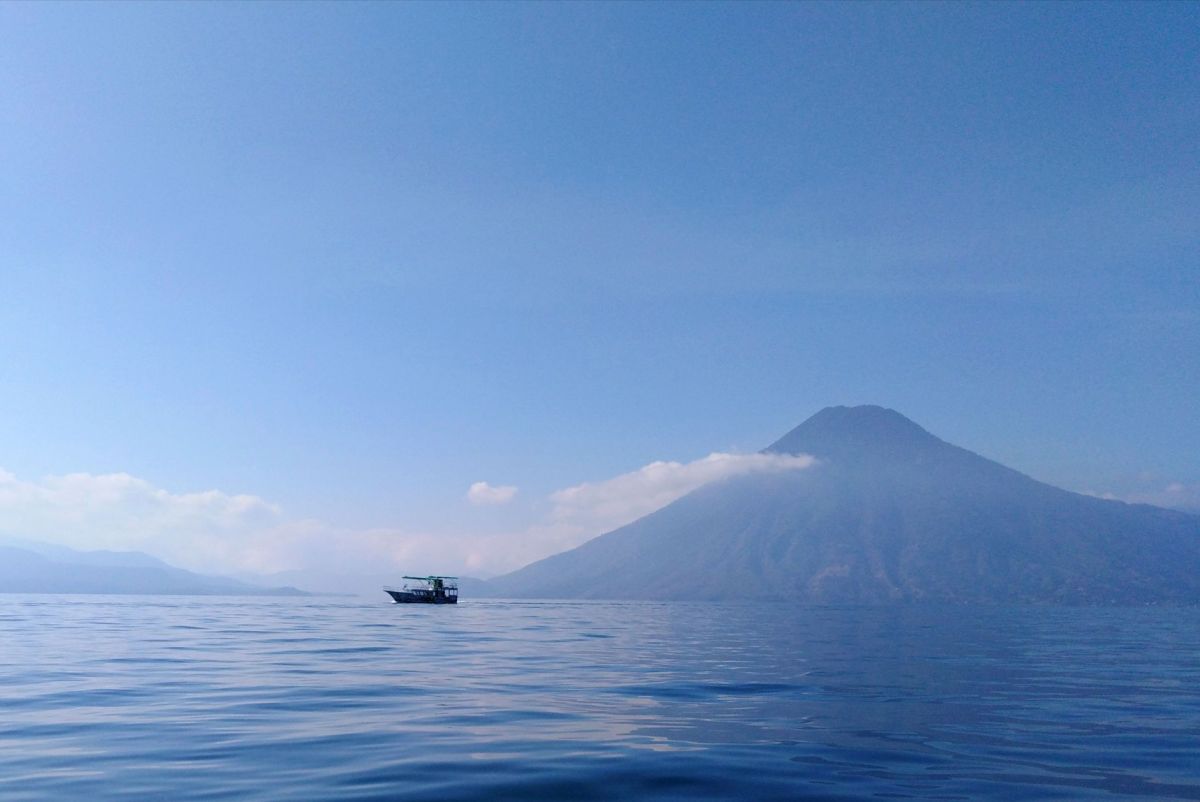
It was late December, and my mom and I were traveling through the mountain highlands of Guatemala, where she was living at the time, teaching in an international school in the capital city. Just after Christmas, we’d made the popular trip up to Lake Atitlán, one of the most beautiful lakes in the world. Its deep waters are flanked by precipitously high volcanic mountainsides, and there are small villages sprinkled along the shore, and one afternoon we found ourselves needing to cross over to the other side.
And so we got into the boat.
It was a lancha, a small motorboat used regularly as a water taxi across the lake since the mountain roads are narrow and dangerous in that area. And at first, the trip was lovely—the broad blue water, the high clouds and the breeze and the green slopes arcing upward into the vault of the sky.
But somewhere about halfway across, far too late to turn back, the choppy waves started to turn into swells, and the boat was tossed around and water started coming over the low sides, and I realized three things at once.
First, we were the only two passengers on this boat, when usually they should be packed with people. Second, I saw no lifejackets. And third, as I looked around us across the wide, turbulent waters, there were no other boats making the crossing. We were alone. And the landscape that had looked beautiful and exciting just a few minutes prior was suddenly wild and terrible and we were very, very small upon it.
If you’ve ever had a moment where you had to stare your own mortality in the face, perhaps you can imagine the hollow-in-your-belly, eyes-wide-open feeling that hits you when there is no illusion of safety left to hide behind, and there is only you and this moment and the terrible, fearsome power of being alive and wanting to stay that way.
And if you can imagine this, then you can also imagine what the disciples are going through this morning in our Gospel reading.
Because they are in their own little lancha, crossing to the other side of a stormy lake. We focus a lot on Peter’s part, but we shouldn’t skip past that initial, understandable feeling of terror as the waves tossed them around in the boat. We might even wonder whether they felt a little betrayed—didn’t Jesus tell them to make this crossing? Why would he send them out and leave them alone in this dangerous place?
It is the perplexity that comes when we realize a godly life is no guarantee of a comfortable life.
Because ultimately, friends—and you probably don’t need me to tell you this—we can all be very good little boys and girls, we can follow all the Lord’s commandments, and yet we will all end up in the lancha at some point in our lives—we all find ourselves in a moment when the waves are high and the sides of the boat are low and we forgot our lifejacket somewhere and it is far too late to turn back.
It may come in the form of a death or a divorce or a diagnosis or simply a sense of lostness, loneliness or regret. But we all end up there eventually. As do communities and countries, in their own cycles of flourishing and floundering. We cannot evade the storm forever. We pray to God, lead us not into temptation, but oh, the tempests still come of their own accord.
And when they do come…this is where a lot of popular takes on Christian theology sort of fall apart for me.
Have you ever been in the middle of a really hard moment or season of your life and heard it said: don’t worry! Just have more faith! Just pray a little harder! God won’t give you more than you can take! And they might even cite Gospel stories like today’s. You of little faith, why did you doubt?
It’s the spiritual equivalent of someone giving you a pat on the head and saying “there, there.” There, there, you’re overreacting. There, there, everything works out for the best. There, there, don’t rock the boat. Don’t disturb the peace for the rest of us, those of us who are trying really hard to pretend the storms only come for somebody else. There, there.
I don’t have much use for that type of Christian comfort.
Because our story today indicates something far more profound than a pat on the head. In stories like this, God does not say, there, there. No, to the disciples, Jesus says, here, here. He says I am here, here with you, in the midst of the worst. I am here, here, precisely where you didn’t want to end up. I am here, when the waves are too high and your heart is breaking and you have nothing left to hide behind. I am here, here, right here, and I am asking you to be here with me, too.
As we mature, we come to see that entering the storm is not an impediment to following Jesus. It is a requirement of following Jesus.
Because faith is about looking hard at life and choosing to revere its often frightening beauty. It’s about holding onto each other through the rise and fall of the times. Faith is about facing the darkness and speaking peace into it. It is about standing in the storms we prayed would never come and still whispering words of trust on our trembling lips.
And when we do…here, here, God says. Life and death and heaven and earth are here, here, now. Come out and stand here with me.
Why? What does it do for us?
Well, for one, it makes us vividly grateful. Some of the times I have felt closest to God and neighbor were not the good times, but the tough ones. Facing the storm also makes us, hopefully, less petty and critical of one another, a bit gentler with them and with ourselves, too, because we realize that we are all just in this little lancha together, making our way through the waves.
And hopefully that helps us get clear on the things that matter most and choosing them, day by day. The things that Jesus constantly shows us: Mercy. Compassion. Ethical clarity. Charity of heart and generosity of spirit. Careful discernment and bold conviction that love is the only truly saving power there is. These are virtues born of the storms of life, not the avoidance of them. Here, here, where it is indeed possible to sink beneath the waves, is the only place you can learn them.
You might wonder why I haven’t dwelt much on the fact that Jesus walks on water. That’s usually the headline of this story. But it can be a stumbling block, too, because I think we tend to equate walking on water with somehow transcending the problems and the limitations of this life and thinking that’s what Christian life is about—that having “enough” faith will allow us to escape the waves, to never sink.
But if you hear nothing else today, I need you to hear this. I need you to remember something important about Jesus. Something radical and transformational in my understanding of him. Something that is the opposite of a pat on the head and a “there, there” and a blithe dismissal of the storm.
It is this: Jesus does sink beneath the waves. Not here, but soon, he sinks. On the Cross, amid the tempest of our brokenness and rage, he willingly sinks.
He surrenders to the storm. He gives himself over to the chaos and descends down, down, into the deepest places of fear and sorrow. He goes down, down, down…all so that he can say to you, here, here.
Oh yes, even here, I am here. There is nowhere I will not go for you, to be with you, to find you, to bring you back, even from the very bottom.
Walking on water is a wonder. But you of little faith, why did you doubt that even if you do sink, I will be there. Wherever you go, I am already with you.
As for my Guatemala story, you can guess the ending—we made it to the other side. The lancha managed to ride the swells and we got off, seasick and teary-eyed, weak-kneed and deliriously grateful. The meal we ate that night was, perhaps, the most joyful meal I ever experienced, because it tasted like life.
And that, when you think on it, is the journey for us on this Jesus-shaped path.
We face death, and we taste life.
We huddle together among the waves and we stumble, wide-eyed, onto the shore.
We are passengers on the ship of grace, you and I, and some days we have enough faith and many days we have not nearly enough, but somehow, somehow, God keeps showing up anyway.
And he says, always, the same thing. The one true thing that can always be said of God and by God, no matter how high the waves get:
Here, here. I am here.