
I preached this sermon on Sunday, July 19, 2026 at St. Anne Episcopal Church, West Chester, OH. The lectionary text cited is Matthew 13:24-30, 36-43.
This morning I am going to offer you a disclaimer right up front: this is a sermon about God’s judgment.
Judgment is not a word we enjoy hearing very much, and many of us, perhaps, came to a church like St. Anne because we were exhausted by hearing about it too much in other faith communities. Believe me, I get that. But before you run for the exits, stick with me for a minute. Because today I am hoping we can reengage the idea of judgment rather than run from it.
And in order to do that, first I need to tell you about picking strawberries.
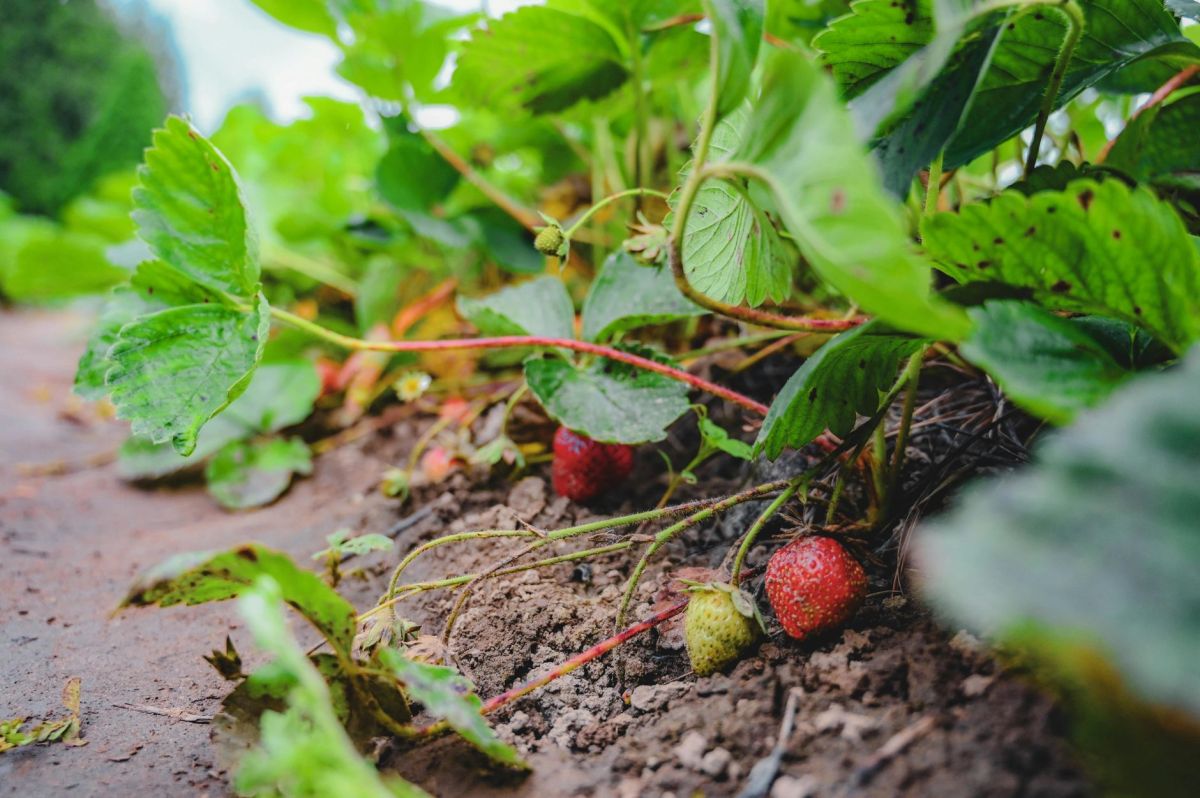
Just like the 4th of July rituals I described a couple weeks ago, another certainty of summer in rural Michigan is strawberry picking. Every year, on some particular July morning, my grandpa would announce it was time to go out to get our annual haul of berries for the many pies and jams and strawberry shortcakes that would soon fill the kitchen.
And so a bunch of us, young and old, would load into the pickup truck with visions of strawberry pie in our heads and travel way out past town, down an old country road to Kudwa’s strawberry farm. It was an old family farm with thousands of ripe berries beckoning from the low-growing plants just waiting to be plucked up into our buckets.
Now I was a city kid and didn’t really know much about how things grow, but I find you don’t have to be an expert to recognize a good strawberry. The big, fat red ones—into the bucket! The small, green ones, or the mushy overripe ones, you leave behind for some future berry picker or for the deer. And did a few especially perfect looking strawberries get popped in my mouth on the sly? Absolutely!
The point is that, when you’re strawberry picking, you must judge between which ones are worth it and which are not. And that type of judgement is a useful, necessary thing. It’s how we sort through all kinds of matters in this life.
And so, when it comes to talk of God’s judgment in Scripture, rather than avoid it, I want you to hold onto that image of the strawberry patch, where “judgment” is not indiscriminate condemnation but careful discernment. Judgment is God saying, this over here is good and necessary and life-giving. And this other thing over here is not.
I think we make a great error in the church if we forego any discussion of God’s judgment in our well-meant attempt to be welcoming and loving people. I think we miss out on the particular type of ethical clarity that God is asking us to speak and to practice as followers of Jesus. We say love God and love our neighbor, always, yes, and we push back against the ways judgment is misused to demonize whole groups of people, but it remains that there are things in this world that are good and sweet and nourishing, and those that are best left behind. And in following Jesus we are expected to get clear about which is which.
So which is which? That is the question. Unlike strawberry picking, it gets tricky.
I bring all of this to your attention this morning because of our Gospel passage from Matthew, where Jesus regales us with yet another agricultural parable. This time it’s about wheat and weeds and how they spring up together in the same field. Somewhat surprisingly, the owner of the wheat fields says, just let the weeds grow and someday it will all be sorted out at the harvest.
Now there is a lot that can be taken from this, but in its simplest terms, this parable is about God’s capacity for judgment. Because at any given time there is both good and evil in the world and a judgment—a choice—between them must be made. In nearly every situation we’ll ever experience, if we wish to live fully and well, we have to discern between what is life-giving and what is not.
The problem is that often we mere mortals can get confused by these choices, and overwhelmed by having to constantly navigate the thicket of wheat and weeds growing up all around us.
People get all mixed up and think that we should judge according to our biases and cultural norms or our personal points of view or our political allegiances. That type of judgment rarely ends well. We end up standing lost amid the fields, amid the ruins of our former certainties, crying out for clarity.
But thankfully God is not lost. God does not get confused. And God is not overwhelmed. God has always been crystal clear about what leads to abundant life and what does not.
God has been clear about this since that first fruit was picked from the tree in Eden, and God is clear about it in the words of the prophets, and God is clear about it, above all, in Jesus, the “first fruits” of the resurrection, as Paul calls him.
And this is why we need God—we have always needed God—to come and help us see, and to follow, and to persist in the truth of his capacity for judgment, not ours. In the “Te Deum,” one of the most ancient Christian hymns, we sing to Christ:
We believe that you will come and be our judge.
Come then, Lord, and help your people.
And yet you might still be wondering, how do we tell which is which? What is the ultimate criteria of Jesus’ judgment—that ancient and eternal clarity of God which can tell the good from the bad, the right from the wrong, the sweet fruit from the bitter? What does he see as the one true measure of things that we struggle to see?
Friends, I suspect you actually already know the answer. It is love. Love is the fundamental criteria of God’s judgment—of his sorting between what will last and what is best let go.
And no matter the choice you must make in any particular situation in your life, if you claim to follow Jesus, if you claim Jesus as your judge, then love is the side you must be on.
Love—by which I mean a self-giving, goodwill-seeking, justice-building, peace-making, reconciliation-building, fault-admitting, circle-widening, inclusion-orienting, humility-accepting, mercy-sharing, good-humor-celebrating, creation-honoring, reverence-offering, sweet-summer-berry-picking kind of love—this love, God says, time and again, is the only choice worth making.
And if that’s what we’re talking about when we talk about God’s judgment—and make no mistake, in this place we are—then I am going against the Episcopal grain, I suppose, friends, because I WELCOME God’s judgment. I welcome God’s enduring ability to tell me what is worthwhile in those moments when I am afraid or have forgotten.
In this world where the weeds are grown so high, I cry out for that good judgment, because I believe in the goodness of God, the love of God, the generosity and the beauty of God, and I WANT the world to be held accountable to generosity and beauty and love and goodness.
In fact I refuse to settle for a world in which nobody can separate what is life-giving from life-degrading and where anything is ok simply because someone can get away with it. That’s not any kind of good news at all, and I am hungry for Good News. Hungrier for it, even, than strawberry pie, and that’s saying something!
So if we are anything at all, let us be a community where we are not afraid to speak of God’s judgment—God’s clear judgment between love and its many impostors, God’s wise judgment between those who build up and those who tear down, God’s saving judgment between the sweet and the bitter fruits of this life.
Let us be an Episcopal church who is unafraid to say that anything less than a spacious and generous and inclusive love is, in fact, unacceptable in the kingdom of God. Let us be a people who, in word and action, demonstrate that we do indeed know the difference between truth and a lie, and we are choosing, Lord help us, we are choosing love’s truth.
Because, as former Presiding Bishop Michael Curry often says, “if it’s not about love it’s not about God.” And that’s the sort of judgment call I am glad to hear proclaimed.
As far as I know, that strawberry farm in Michigan is long gone. But oh, that summer harvest taught me some lasting things, and on a July morning like this I think we who gather here are still picking berries in our own sort of way —all of us down on our knees, working as one, reaching out for those sweet, perfect gifts. No confusion or fear, just clarity…and a hunger for the feast to come.
And while I don’t claim to know the mind of God, as best I can judge…if that’s what we’re up to, it sounds pretty much like heaven.