
The Church that is Willing to Die: A Sermon

I preached this sermon on June 21, 2020 for the online services at Trinity Episcopal Church, Fort Wayne, IN. The lectionary text cited is Matthew 10:24-39

What does it mean to be the church in a time such as this? At this turning point in our national life, when old values, old practices, old ways of being are called into question, when the mythic landscape of American history is being challenged and reordered by pandemics, protests, and political turmoil, when certainties are few and far between, here and now we are urgently led to revisit this question: what does it mean to be the church? Who are we Christians in this fraught moment: this moment of lament, this moment of reckoning with the unjust systems we have built and sustained, this moment of questioning the bedtime stories with which we have comforted ourselves about blessing and destiny and progress? 

What is the church now when the wind comes howling in through the open window, when the doors to the building are locked and the bottom drops out and we are falling, falling down into the gloom of an unknown tomorrow? What are we then? Who are we then?

For so much of our nation’s history, to be part of the church has been a designation of institutional membership, a cultural practice encoded in spiritual language handed down from generation to generation; an elegant packaging of some laudable core values, and a safe, enclosed space in which to work out the meaning of life according to those values. In this understanding of church as institution, which patterns itself according to the societal contexts in which it operates—the world outside the walls—there are usually a number of factions, organized along political, liturgical, or ideological spectrums, and whoever dominates in numbers or funding tends to dictate what we stand for and the ways in which we do so. It’s not that we ignore the gospel in this mode of church; it’s simply that the “good news” we share often sounds like the good news we want to hear, or more specifically, the good news that the powerful want to hear. 

For many, being church in this way feels very navigable—it maps rather neatly onto the rest of our lives, it absorbs the language of the zeitgeist like a sponge, such that the progressive and the conservative, whatever those labels happen to mean in a given moment, have equal opportunity to bedeck themselves in Scripture and silk vestments, to continue their eternal struggle via the proxy wars of theology and church politics. 

This is not a new thing, and perhaps, for much of our history, this mode of being the church felt sufficient for the majority of people. Since the peace of Constantine in the 4th century, when Christianity became legalized in the Roman Empire and later adopted as the religion of that Empire, there has been little distinction between the idealized values of citizenship and the  core teachings of the sacred in dominant Western culture—especially for those of us who enjoyed the privileges and powers that such citizenship affords. The easy mix of civic and ecclesial agendas was simply a given. Church was, in effect, where you learned how to be a good and loyal participant in the realm, to support its structures, to promote the peace of the established order.

But established orders tend to fall apart eventually. Structures give way under their own weight. And what is the church, then? Who are we, then? 

Jesus in Matthew’s Gospel:

Do not think that I have come 

to bring peace to the earth; I have not come to bring peace, 

but a sword. (Matthew 10:34)

Jesus’ words today remind us that there is another choice when it comes to understanding the meaning of the church—a choice that is unsettling, a bit scary even—one that looks nothing like the established order in which we are tempted to become comfortably numb. He describes the cost of following him in the starkest of terms—it is to give up family bonds, it is to give up one’s safety, to give up one’s own life, even, in order to find and participate in whatever strange, magnetic sweetness he seems to carry within himself.  This is not a metaphorical invitation. It is quite serious.

To be church in this way—to relinquish, to descend, to die—has little to do with the striving and the strategies that characterize so much of public life in the West.  It is, instead, an intentional upending, a deconstruction of those values, especially whenver they deny life and dignity to the least among us. For, as Mary proclaims, He has lifted up the lowly and the rich he has sent away empty.

To be the church that responds to Jesus’ invitation is to search for the cracks in the veneer of decadence, to find them and to tear them open,  to name what is rotten underneath and, crucially, inescapably, not simply to name and to criticize, but to cast ourselves, with equal measure of grief and  hope, down into the rottenness, down to the places where we do not want to go, down to where we will finally see what is true, what endures, what refuses to die, even there. Blessed are those who mourn, for they will be comforted.

Here and now, in our present turmoil, some of that work has been done for us. The veneer is already cracked. Some of the rottenness is already exposed. But we still have to choose whether we will get down there and look at it. We still have to choose whether we will do something about it. Nobody will force us to, not even God; and the urge to look away, to go back to the old mode of being, will continue to be powerful. But what we decide will determine what sort of church we are part of. Are we an insitution of the present order, subject to the whims of history, or are we a community of disciples, of learners, of passionate lovers of God, seeking Holy Wisdom into the uncomfortable places she calls us?

Most days, I doubt that I have the strength and the courage to choose this latter vision. Most days, I just want to roll over and go back to sleep. It would be so much nicer to stay on the surface of my Christian identity, to let church function as an ornament, as a daydream where we talk about forgiveness and love in hazy terms without ever submitting to the fierce demands that such things actually require. 

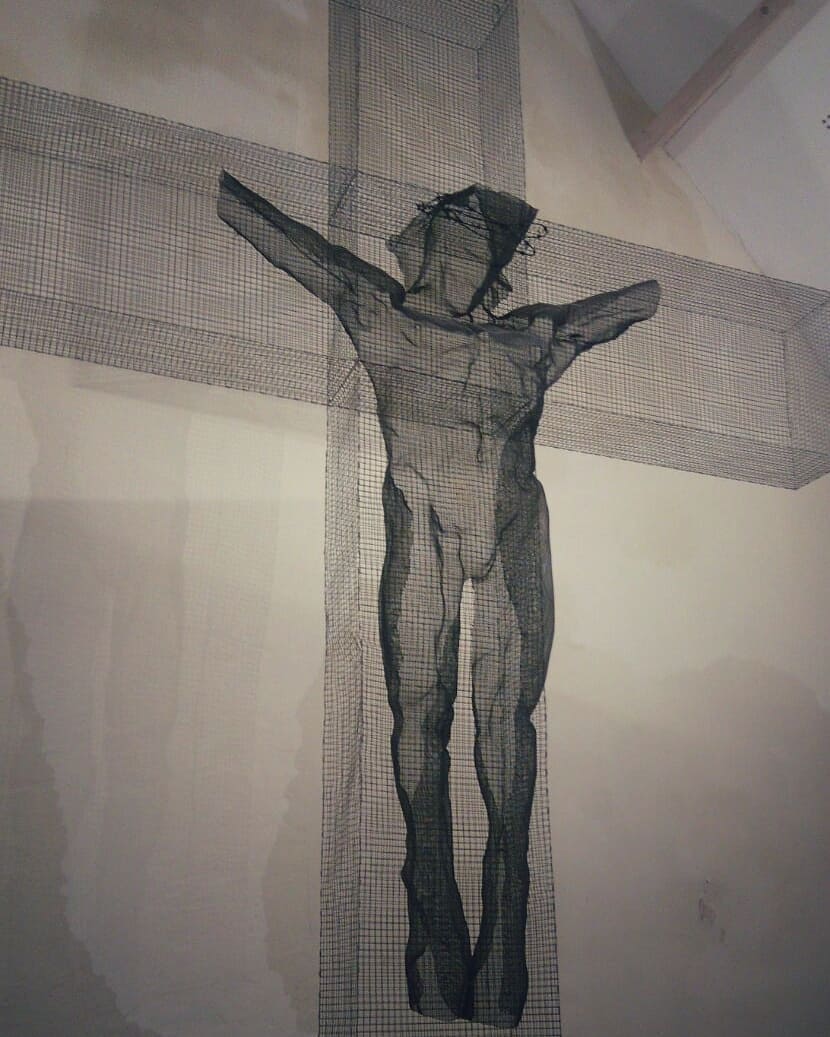
But then, always, there is Jesus, with his unsettling words and his compelling gaze that cuts through me like a sword. I see him looking back at me from the cross, forgiving my weakness, unimaginably patient with my fear. I see him in the faces of my homeless neighbors, my black and brown neighbors, my lgbtq neighbors, my conservative neighbors, my liberal neighbors, my neighbors of every background and belief, and I hear his voice: 

Follow me. Follow me wherever it might take you. Follow me out past the church you thought you knew, out beyond a brittle, compromised peace, follow me out past certainty and cynicism, follow me into the heart of the world’s sorrows and see what lies on the other side of fear and lamentation. I promise you, everything real, everything joyful, everything good, is there. I am there. 

If we listen to Jesus, if we really listen to him, what other choice can we make?

Holy Week at Home #8: Easter Day

The final installment of my “Holy Week at Home” posts; a meditation on happiness and joy in a season when both feel harder to inhabit. Yet still we say: Christ is Risen! Alleluia!

Something I am continuing to discover is how joy and happiness are not the same thing. And on this particular Easter, when the usual signs of celebration are absent or muted by grief, understanding that distinction feels more important than ever.

Happiness is precious and usually comes, in its purest form, unbidden, from humble things. A flower blooming, a familiar voice, a gentle hand outstretched. But happiness also vanishes as quickly as it comes, and cannot be pursued. We must learn to hold it gently, and then let it go.

Thus I think of Mary Magdalene encountering Jesus in the garden on Easter morning. There is a flower and a voice and an outstretched hand, yes, but also this: “Do not hold onto me, because I have not yet ascended to the Father, to my God and your God.” This happiness is only momentary. Resurrection is not just reunion. It’s also letting go.

So, we must consider what we mean by joy, and Easter joy in particular. Not mere happiness, but perhaps, instead, a fullness. Fullness of life. Fullness of presence, both God’s presence and our own. A fullness that contains happiness, yes, but also grief, and confusion, and wonder, and mercy, and everything else that emanates from the deep heart of Life. A fullness that sustains us even when our pleasures feel meagre, as they sometimes do.

As we live into the reality of this unusual Eastertide, I find myself kneeling in the garden with Mary Magdalene, having experienced such a collision of grief and happiness that my soul feels stretched beyond its capacity. But I am choosing to trust that in the stretching, there is the shape of joy. In the stretching, Christ is forming me into something new. Something that can contain a bit more of the vastness of God’s dream, wherein Resurrection finds its source and endpoint.

Blessed Easter, dear friends. I wish you happiness to soothe your spirit. And I wish you joy, that each of us might become who God made us to be.

Holy Week at Home #7: Holy Saturday

A continuation of my “Holy Week at Home” posts; on Holy Saturday we are caught in that space between grief and hope. I have a particular love for the Virgin Mary on this day, who is known on Holy Saturday as Our Lady of Solitude. She has been with me through many seasons of waiting and wondering, including this one. I dedicate this poem to her.

In between beginnings, I must learn to live in interims.

And today I am here, in that shadow-place at the intersection of memory and hope,
The dove-grey moment
when the past ebbs, unreachable
and the cloud bears no hint of light.

Where have you gone, my beloved?

I wait, and yes, I grieve
the yet-unsatisfied promise
But I also find that

shadows cast their own illumination over those who pause to consider–
who ponder in their heart–
the saintliness of not knowing;
The beatitude of contingency.

And as the night enfolds understanding
As your absence drapes over me like a mantle of fog
I perceive how needed it is
To say goodbye, and to mean it

To let this waiting be its own solace
Its own teacher
Its own revelation of the
unchanging liminality
at the heart of my restless heart.

After the going and before the coming
There is simply this,
The sufficient poverty of now,
And that must always be enough
Or nothing ever will.

Son, behold your mother
in repose
in recollection
in the resilience you required of her
wild as the sea-grass
Bending
in solitude
But rising
in strength.

Holy Week at Home #6: Good Friday

A continuation of my “Holy Week at Home” posts; on Good Friday we stand at the foot if the Cross as Jesus is crucified. 

Look up.

He is unfurled
aloft,

Like a flag of surrender,
So that you might see, and know
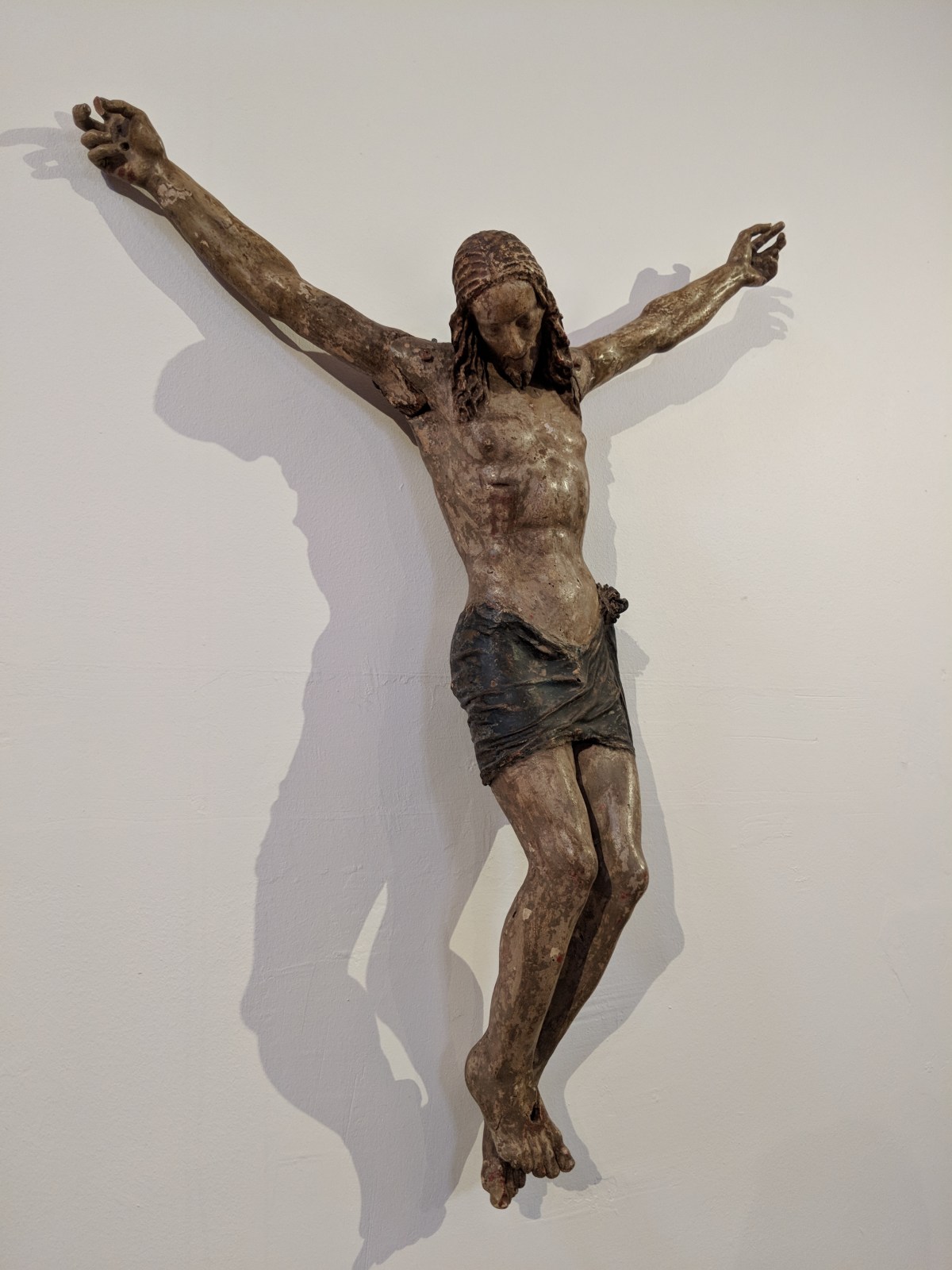
It is finished.

Like a scroll,
So that you might read the lines on his skin and find the place
where it is written in rivulets of tears:
The Spirit of the Lord is upon me.
I have been anointed to proclaim release.
And I am releasing—
I am giving up
my spirit.

A broken body
Arched like a question
inquiring into your frailty;
testing whether it is tolerable
For love to cost this much.

But if you will stay
In this place without answers
Then you will learn that the
rending and the mending of the world
are two notes of the same song.

You will learn that there is no such thing
as dispassionate salvation
or tentative redemption.

And how in the Divine economy
everything is given
And returned
Eternally.

You will learn that nothing is ever wasted
even when waste is the only credible conclusion.
Even when all the evidence suggests defeat.

You will learn that victory is not the same as winning;
that truth is not the same as certainty;
And that peace is not the same as pleasure.

But all of this is offered now, only now,
On this desiccated and necessary hill,
The final bequeathment of a dying God
Who cannot teach you the secrets of eternity
Without entering finitude.

Look up, into his face.

Look up, and see how he is grieving all of your endings.

Look up, and see how he is dying all of your deaths.

Look up, and see the world pass into something new.

Look up. 

Holy Week at Home #4: Spy Wednesday

A continuation of my “Holy Week at Home” posts; on Holy Wednesday, also known as “Spy Wednesday” we focus on Judas Iscariot’s betrayal of Jesus. His reasons for doing so have been long debated in the Christian tradition; the Gospels leave a number of possibilities open to interpretation. 

Facades are so tempting; they promise to make us presentable to the world, maybe even impressive. We plaster all the cracks, drape over the torn fabric of the heart. We adorn ourselves with fear and fig leaves, trembling and hidden like Adam and Eve in the cool of the evening, terrified of being truly seen. 

Thus we find Judas, the “spy” of Spy Wednesday, peering out from behind his mask of virtue while rage, or jealousy, or longing, roils deep within. We don’t know precisely why he betrays Jesus, and that unknowability, that unbreakable facade is, itself, part of his tragedy–and ours. Empathy is only possible when we see below the surface. Without it, we are lost to one another, as Judas is lost to us.

But we should not dispose of him so easily, lest we exempt ourselves from the questions his story poses. Do any of us fully understand why we harm one another? Can we ever discern the exact balance of love and fear that motivate our daily choices? Is there a way to break free from the artifice, the suffocating ornamentation, under which we have burdened and betrayed ourselves?

Following Jesus is partly an attempt to reckon with those questions, even if our answers are fumbling. He stands there in the night, ready to receive our kiss, asking whether we know why we offer it. He stands there, forgiving us for the paltry silver we’ve gathered to justify our unexamined lives.

And here, finally, in the cool of another evening, we experience the ultimate futility of hiding from him; there is no more time for our pitiable facades.

He understands, even when we do not: only love and death, now. Only the integrity of naked flesh, and wood, and stone, now. In them, we will finally face ourselves. In them, all truth will be revealed.


Holy Week at Home #3: Holy Tuesday

Our entire life can be spent waiting for something to happen. Waiting for *that* thing to happen, the one we can’t quite name: the consummation of an unarticulated desire; the answer to a half-posed question, caught in our throat like a crumb of daily bread.

It is all-too-easy, though, to let this waiting be sufficient. To exist in a state of vague expectancy, neither starved nor nourished, having grown accustomed to glancing at life–at ourselves and one another–indirectly, furtively, never head-on.

But today we must let that go. We must risk an encounter with the emerging fullness of God’s purpose for us.

In Tuesday’s Scripture, Jesus does this. He accepts his own, pivotal role in that mysterious purpose: to be lifted up and poured out, revealing an unending effusion of mercy sourced in the headwaters of creation.

It is not the answer he wanted. Not the path he might have chosen. But we come to understand, in time, that our lives, lived most deeply, are not completely our own. And when the hour comes and the wait is over–when that existential answer arrives–it will inevitably lead us out, beyond the familiar and deadening malaise, beyond safety, to the place where our heart will be pierced and our eyes will be opened. The place of pure, unmediated Life.

Holy Week at Home #2: Holy Monday

A continuation of my “Holy Week at Home” posts; on Holy Monday the Gospel reading depicts Mary of Bethany anointing Jesus with precious ointment (John 12:1-9).

Spring is a season of guileless generosity. The trees and flowers cry abundant, blossoming tears of gratitude for the gentle return of warmth to the earth. The soft evening air feels gently magnanimous, like new love, or a reconciliation.

On Holy Monday we are told of Jesus’ anointing at Bethany; how Mary, the sister of Martha, pours precious fragrance on his feet and wipes them with her hair. Extravagant and unnecessary, says Judas, who cannot see beyond the imperatives of his limited, grasping imagination.

No, says Jesus, she has done this out of deep wisdom, for my burial approaches.

Extravagance is only harmful when it gathers bounty toward oneself, into the bottomless void of a misunderstood hunger. The extravagance of giving is the only possible satiation.

So, like springtime, like the exuberant wildflowers bending to kiss the dark soil, with the gratitude of one who has perceived the true cost of Love, thus has Mary poured out her gift. Thus has she anointed God with her necessary offering, for his necessary offering which is to come.

Help me now, Lord, in my fear of your Cross, and of my own. Allow me to rest at your feet. Allow me to gather what beauty I can, and then to offer it back; to let the blossoms loose and fall, as they must: an anointing of the earth, a making way, so to bear the fruit not yet tasted.

Holy Week at Home #1: Palm Sunday

With liturgies suspended for this (most unusual) Holy Week, I wrote some brief daily meditations/reflections/poems on social media as a way to navigate the passage from Palm Sunday to Easter without the usual guideposts of communal worship. 

The process of daily writing and posting was a reminder for me that our praise of God is just as much about what we offer–the oblation of our hearts–as it is what we receive. So even now, when we are separated by circumstance and the usual blessings of the liturgy feel distant, we can still present our humble gifts with gratitude. With this in mind, here are the posts I shared last week.

PALM SUNDAY: 

You know that anxious feeling of entry into something unfamiliar and inevitable, like the first day of school or that difficult conversation you simply can’t put off? The dry mouth and the churning gut? The sweat on the back of your neck?

Such is Palm Sunday. Bright, dizzying, crystallized, expectant, palm leaves that scratch your own palms, cries of praise that leave you hoarse. The big event that doesn’t quite satisfy.

Palm Sunday has a feverish quality, like infatuation that has convinced itself that it’s love. It is desire without generosity. Longing without trust.

As we stand at the roadside, or peer from our windows, at the man who enters our midst on a donkey, let us be mindful of all that we still project onto him, all the ways we demand him to solve the heartbreaks and hatreds of our own creation. He comes to illuminate suffering, but not to erase it. He comes to show us life, but we must still traverse through the narrow gate that leads there. When we cry Hosanna, when we wave the branch, we are greeting a very different sort of salvation than the one we privately hoped for. If we truly understood it, its magnitude and its cost, we would likely fall silent as he passed by.

Palm Sunday is                                                                                                                                   the irony of ripping branches                                                                                              zealously;                                                                                                                                                to kill the tender green                                                                                                    prematurely–                                                                                                                                         a misguided homage to the One
Who would not break a bruised reed.
In our plundering jubilation we are convicted–
but soon
he will gather the trampled fronds and
mend the broken branches back
onto the Tree of Life.


To Bite the Fruit: A Sermon

I preached this sermon on Sunday, March 1, 2020 at Trinity Episcopal Church, Fort Wayne, IN. The lectionary texts cited are Genesis 2:15-17; 3:1-7 (Eve & Adam’s temptation in the garden) and Matthew 4:1-11 (Jesus’ temptation in the desert). 

It is Lent, and Eve is standing in the garden. 

Eve, our primeval mother, the original bearer of our human bodies and our human longing, has paused under the leafy boughs of a tree laden with promises; the tree that offers the one thing she and her companion Adam do not already have: the ability to share fully in the mind of God. The ability to understand, from God’s perspective, the nature of all things. The ability, as the serpent suggests, to not simply be in relationship with God, but to be like God.

And although in the Eden narrative we often focus on themes of wickedness and disobedience, we should not forget that in this crucial moment of decision–as her hand reaches out toward the tantalizing object of her desire–Eve still loves God. She loves God so much, in fact, that she wants something beyond intimacy, something that can never be taken away. As she and Adam bite into the ripe flesh of the fruit, they are hungering for God’s very being to become part of them. They are seeking a perfect, indissoluble union with their Creator. 

There is a problem, though, with trying to consume the things we love: they tend to get destroyed in the process. And in a flash of insight, all too late, Adam and Eve realize a fundamental truth: loving God is not the same as possessing God.

How often we confuse these two things: loving and possessing. If we are to speak of original sin, we might consider it as the seemingly irresolvable void between the two—the former being the dynamic truth of a relational God, and the latter the constricting delusion of the crafty serpent.

I think of the people in my life whom I have loved most deeply and enduringly, and I realize that one common thread in those relationships is a certain sense of freedom—a freedom to be myself, and for the other person to be themselves. No agenda of control imbuing our time together. No manipulation masquerading as affection. Just two people, supporting one another in our mutual growth and inevitable failings.  And, sometimes, parting ways when life makes that necessary.

To love like this is harder because it is far more uncertain. We can’t control its outcome. And I would be lying if I said that I had never seen fruit on the tree and longed to devour it. We are all Eve and Adam on some level; we are all caught in this tension between the need to love and the compulsion to possess.

This is partly what makes Lent so valuable. We enter into this season and we are invited to take a hard look at all the relationships that comprise our lives: our relationships with people, with things, and with habits. And in each instance, we might consider this question: where am I practicing love, true, selfless, life-giving love; and where am I merely trying to possess, to consume, in order to satisfy a deeper, insatiable hunger within myself? 

It is with these questions in mind that we must journey into the desert alongside Jesus in today’s Gospel, out to the place where the devil awaits him. 

When we hear the story of Christ’s temptations: to turn stones into bread; to throw himself from the pinnacle of the temple; to trade his relationship to God for earthly power; I think we would do well to picture him also, standing alongside Eve at the tree in the garden, as the eternal, fundamental questions reverberate between them and down to us through the ages:

Do you love God, or do you want to be God?

Do you love the world, or do you want to possess the world?

And maybe, just maybe, in his hunger and his isolation, Jesus saw the fruit of the tree, and perceived how good it would be to bite it, to possess it, to rule the world on his own terms, to be a king like other kings, to feed people with the bread they already knew.

Perhaps for a moment he, like Eve, thought that loving God and claiming God were the same thing. 

And perhaps, for a moment, every creature in the garden held its breath, waiting for a recapitulation of the original mistake.

But then, he speaks:

       ‘One does not live by bread alone,  but by every word that comes from the mouth of God.’

        ‘Do not put the Lord your God to the test.’

        ‘Worship the Lord your God, 

        and serve only him.’

With these ancient words, drawn from the depths of the Law, Jesus is saying: It is in relinquishing power that I find true strength. I only need to trust, and to serve, for this is what love looks like: mutuality, freedom, vulnerability. A hand outstretched, not to take, but to offer itself. 

He says: I do not need to control the world in order to love the world; in fact, loving it means the exact opposite: it means accepting creation in all its finitude, serving humanity in all its frailty, and giving my life for its healing, and its redemption.

And in that moment the devil departed, for he knew that that this time the fruit would remain on the tree. This time, this Son of Man, this Firstborn of All Creation, had made the proper distinction between love and its counterfeits. 

We are, each of us, through our baptism, both children of Eve and Adam and children of God. That ancient temptation still pulses in our veins every time we feel the longing of desire and reach out to grasp at things not meant for us. And in today’s world, with its many promises and perils, giving into this impulse can feel quite natural, acceptable, even noble.

But in Lent, at the edge of Eden and deep in the desert, we are invited, instead, to let go. To leave the fruit untouched. To let the stones remain stones. To turn and face the world in all its terror and promise trusting in God alone. And trusting that somehow, at the end of our long journey, we will be ushered into someplace altogether new.  Another garden, perhaps, but one with an open gate, and an empty tomb. The garden where Eve stands once more, singing a song of redemption, basking in a love that feels, finally, like freedom. 


In the Water: A Sermon

I preached this sermon on January 12, 2020, the Baptism of Our Lord, at Trinity Episcopal Church, Fort Wayne, IN. The lectionary texts cited are Isaiah 42:1-9 and Matthew 3:13-17.

Jesus came from Galilee to John at the Jordan, to be baptized by him. John would have prevented him, saying, “I need to be baptized by you, and do you come to me?” But Jesus answered him, “Let it be so now; for it is proper for us in this way to fulfill all righteousness.” Then he consented. And when Jesus had been baptized, just as he came up from the water, suddenly the heavens were opened to him and he saw the Spirit of God descending like a dove and alighting on him. And a voice from heaven said, “This is my Son, the Beloved, with whom I am well pleased.” (Matthew 3:13-17)


So there is John, fueled by God and by his diet of locusts and wild honey, baptizing in the River Jordan, calling people into repentance, into preparation, for the coming Messiah. Prepare the way, Make straight the paths! Repent, for the kingdom of heaven is ever nearer to to you!

We might imagine a group of his followers gathered there on the banks at dawn, sharing a simple meal as they wipe the sleep from their eyes, praying fervently, glancing over at the river, moody and turgid, the water both beckoning and menacing to them, just like John himself. To climb down into to those chilly depths, to be submerged in them by this eccentric prophet: will it change them? Are they ready to repent, to receive a new vision? Can someone ever be ready for a thing that is beyond comprehension?

And yet the river is flowing, and a raspy voice is crying out in the wilderness, and the bruised reeds at the waters edge are trembling, whispering amongst themselves, and they know that today, yes, surely today, is the day their lives will change forever.  Today they will slip into the water and be cleansed of their sin. Today they will prepare the way of the Lord, whatever that might mean. 

But there is one man in their midst, a stranger from Galilee, who isn’t so tentative. He keeps to himself, mostly, but he seems to know what he is doing there. He looks at the water with a sense of determination and acceptance, like the face of one who suddenly understands what must be done, and it is clear that whatever has drawn him here, he will not be deterred.

The group approaches the riverbank, and one by one they wade out alone into its chilly embrace where John awaits them, hurling enticements and warnings. Words thundering across the water, and then a submersion, and a gasp of breath and sunlight, and the reeds in the water are whispering, still whispering—he is coming.

He is almost here. 

Prepare the way.

Prepare the way. 

The man from Galilee steps forward.

Did Jesus know what was about to happen as he approached the river? Did he fully understand what it meant to be plunged deep down into the water, that same water that he, the Eternal Word, breathed over at the beginning of time? Did he realize, as he crested the surface, that his life was now what it was always meant to be? That the time of preparation was over?

We have some idea that he did. “Let it be so now,” he tells the Baptizer. “For it is proper for us in this way to fulfill all righteousness.” 

In other words, this is God’s will, John: 

You and I, the one before, and the one after, and the one who encircles all things. Let us go down into the deep together, baptize me with your cleansing water and I will baptize you with the fire of God’s  descending Spirit, and you will see—we will see together—how the two are inextricable from each other. 

Washed and illuminated and transformed and yet fundamentally ourselves. This is what will fulfill the emergence of God’s righteous purpose.

For this is precisely what the Baptism of Our Lord signifies: emergence. Rising up from the water, we behold the emergence of Jesus, the humble man of Nazareth, into his public revelation as the Son of God; the one who arrives like the Servant heralded in Isaiah:

My chosen, in whom my soul delights

I have put my spirit upon him

He will bring forth justice to the nations. (42:1)

In his baptism, Jesus is revealed as an embodiment of this servant, the one who will be in total obedience to the will of his heavenly Father, and who, through his self-giving service, will inaugurate a kingdom characterized by peace, redemption, and healing. A new world is revealed that morning in the River Jordan—a world with the Triune God at its center, and with Christ as its servant king.

And so when the voice from above says, “this is my Son, whom I love” and when the Spirit descends like a dove upon him, it is not that Jesus becomes something he wasn’t already. It’s that now he is seen more fully for who he always was. He is God,  who has come to us in our frailty, to live as we live, and who calls us into a path of service, so that we might live as God lives.

 What a thing to have witnessed on that day beside the river. 

And what a thing we are witnessing today, in this place, as we baptize two people into the very same experience of God’s enveloping love and concern. 

Because we must remember: our baptism draws us into the reality that Jesus experienced at his own baptism. Just as he emerged from the water to hear himself named as the Beloved, the Servant, the One called to embody his Father’s will, so do we. 

Whether in the river or at the font, the water and the Spirit do their work on us—they name us as God’s children, they incorporate us into God’s household, and they propel us forward into lives that are patterned after Jesus’ own life. Lives of service, and justice, and peace, and self-giving.

For those who will be baptized today, as for each of us who have been marked by the sacrament of baptism, this is the moment when the wait is over. The way has been prepared. A new life in Christ begins now. And they are ready; as ready as anyone can be for something that is beyond comprehension.

So rejoice, this day, my friends, for the Savior has come to the river. He has waded down into the water with us; he is standing in solidarity with us as we cry out for healing, for cleansing, for consolation. He is treading gently amidst the bruised reeds and he is guiding them back upright. 

And when we plunge into the depths and feel what it’s like to die, he will be there; 

and when we emerge into the morning light and breathe in the fulness of life, he will be there; 

there, in the water, calling us Beloved,

calling us onward,

calling us home.