Love’s Enclosure: A Sermon

This sermon was preached on Sunday, September 6th, 2020 at Trinity Episcopal Church, Fort Wayne, IN. The lectionary text cited is Romans 13:8-14.

“Owe no one anything, except to love one another,” Paul urges today in his letter to the Romans, and it sounds so simple doesn’t it? How liberating, how wonderful, that the only thing we have to worry about in this life is loving each other. No long lists of rules and regulations for us, thank you very much—just love, for all of the people, all of the time. 

But experience teaches us that choosing love is often far from easy or straightforward, and we might at times wish there WAS a clearly outlined set of rules and instructions from God about how to do this thing called life. For all its truth and wisdom, though, Scripture is less of a how-to manual and more of an illustration—a vivid image of love’s redemptive entanglement with frailty.

And so, we must stand alongside one another, scrutinzing the image, discerning, together, often messily, what love mandates, here and now, and somehow reproduce it in our own lives.

At times, especially in this hard, angry, suspicious age in which we find ourselves, it can feel nearly impossible to love everyone and everything we encounter. When faced with the brokenness and the meanness of the world, we are tempted to retreat, to run away in horror and frustration. In such moments the idea that we must always be governed by love, in all times and places, can feel like a cruel joke. For it is a certainty that no matter how kind we are, no matter how gracious, not everyone will love us back.

And yet, that is indeed what is depicted, time and again, in Scripture. We are told that love is the through-line of every commandment Moses grapsed on stormy Mt. Sinai. We are told that choosing to love, despite all evidence to the contrary, builds the type of life that bears the imprint of eternity. “Love,” Paul says, “is the fulfilling of the Law.” In other words, Love is the fulfilling of God’s plan for creation.

You already know the stakes of this if you have ever cared for someone deeply—a partner, a parent, a child, a friend. Love’s requirements, when taken seriously, are all-encompassing. It demands everything we have to give. Love, as a rule of life, encloses us. It limits the scope of our freedom to some degree, as we commit to the care and nurture of this person, this place, this time. Sure, we could choose to run away, but love keeps us grounded, and in doing so, it helps us become what God intended.

I think our society needs a reminder of this, especially now, when it seems as though the pursuit of the common good has gone out of fashion. Without the grounding of a generous love, we risk becoming lost in the maze of our own private desires and impulses, wandering, like prodigal sons and daughters, into the “quarreling and jealousy” Paul warns us against, believing ourselves liberated, but in truth, enslaved by our own selfishness.

That is not how God designed the world to work. So we must constantly return to that image we have been given—the image of Love—and let our hearts be mended by it.

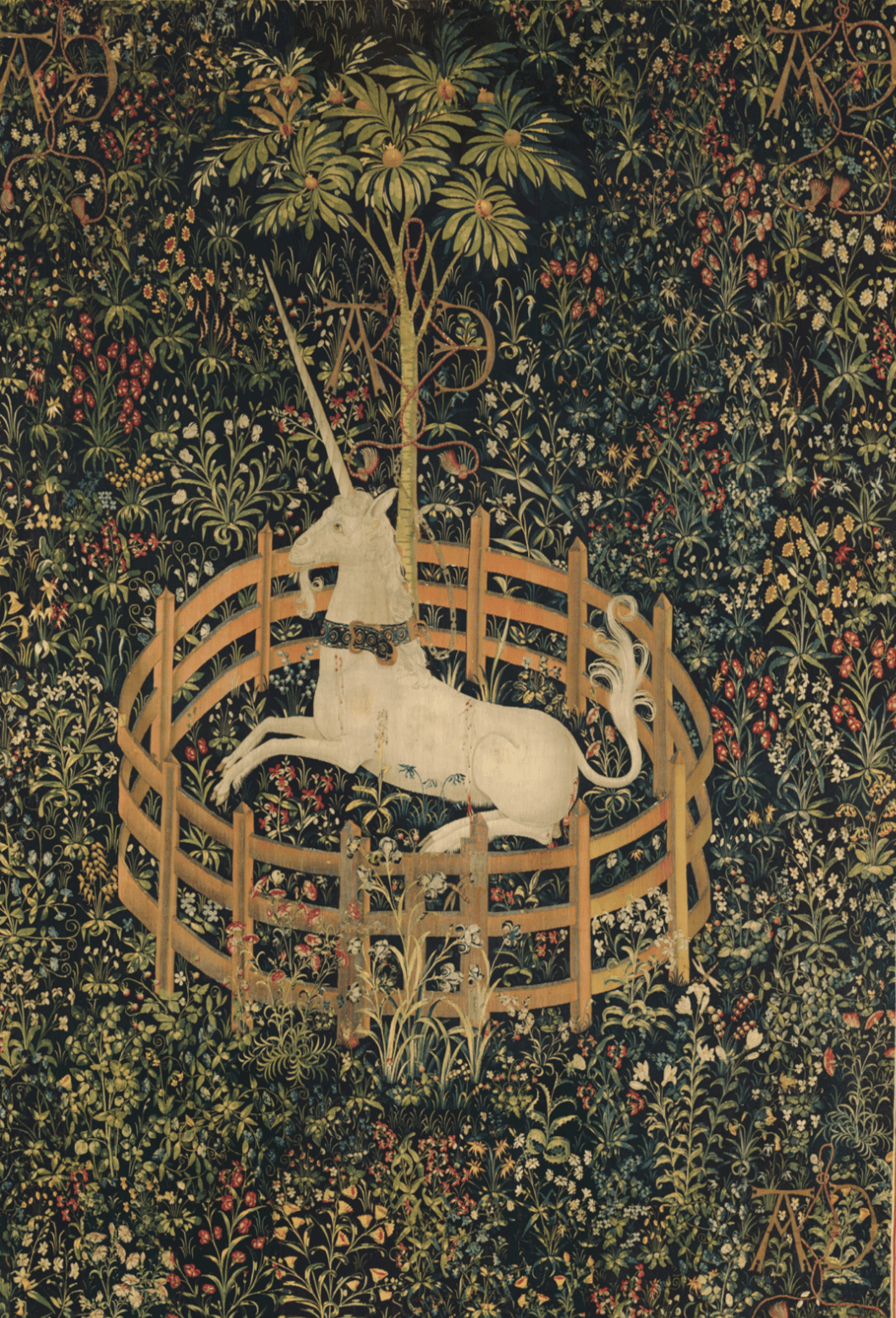
Speaking of images, the one included in your service bulletin (or viewable here) is one panel of the famous Unicorn tapestries, which can be found at The Cloisters museum in Manhattan.

These particular tapestries date from the late middle ages/early Renaissance, sometime around 1500, and they are massive, covering the walls of the large room in which they reside. They are also something of a mystery—nobody knows exactly who made them or where they came from, and art historians have spent a lot of time speculating as to what they mean. 

In various scenes, as you move around the gallery, the unicorn is discovered in a forest, then hunted, then killed, and then brought back to a castle by a large crowd of lords and ladies. Then, finally, quite strangely, there is the image that you see before you: the unicorn alive again, resting peacefully in a fenced enclosure, as the ripe fruits of a pomegranate tree drip their blood-red nectar onto its white coat.

We do know that the unicorn loomed large in the imagination of medieval European culture; it was a remnant of the writings of antiquity, a pagan symbol that combined equal measures of ferocity and gentleness, and as such became associated with the figure of Christ. The original King James Bible even translated the Hebrew word for wild oxen, re’em, as unicorn.

But what intrigues me most for our purposes today is the fence that surrounds the unicorn in this tapestry. Notice how low it is, how easy it would be for the creature to jump over it and escape. It begs the question, why does the unicorn stay there, when it could so easily leave? Why does it have such a tranquil expression, after having been hunted and confined within this absurdly small space? 

Imagining the Unicorn as an image of Jesus, the Scottish clergyman Harry Galbraith Miller, in a meditation he wrote many years ago on this very same tapestry, gives this answer:

“we come to sense that [the unicorn] is only held there because that is what it itself wishes. It is its own love that holds it, and in all its beauty, restrained power quivering in every limb, it rests there captive. The captive of love…love draws it in self-sacrificing gentleness.”

The captive of love—yes, this is indeed our Lord and our God. And as followers of Jesus, we, too, are invited to be love’s captives. We, too, are asked to lay down amid the fruits of this bloodstained paradise, and to let the bonds of charity hold us fast to this heartbroken earth, even when we would rather run away.

The majesty of the unicorn here is that it chooses to remain within our grasp, we who can grasp so little. It chooses to stay so that we might gaze upon it and be changed by it, we who did nothing to deserve its startling beauty, who will never fully comprehend it.

The unicorn, as the image of God, invites us into love’s enclosure, invites us to lay down our swords, invites to live for something other than ourselves.

For you and I, right now, that might mean wearing a mask to protect our neighbors. It might advocating for justice and reconciliation. It might mean offering forgiveness to one who has wronged us, or making amends if we have wronged someone else.

Every time we do these things, every time we accept the responsibilities of love, we are, as Paul says, putting on the armor of light—the dazzling garment of the gentle warrior, a figure not unlike the unicorn itself, proud and strong and free, yet choosing to stay, choosing to fight for love, despite the odds.

We might not always get it right. We will probably make plenty of mistakes. But how good it is try. How good it is to lay down within this enclosure, where the fruits of the Spirit drip nectar onto our skin, where the Law of Love grows up around us like wildflowers.

That is where we are meant to be. That is who we are meant to be.

Love Made Strange: A Sermon

This sermon was preached on August 9, 2020 at Trinity Episcopal Church, Fort Wayne, IN. The lectionary text cited is Matthew 14:22-33, wherein Jesus walks upon the sea. 


One of the most frightening things in life is when the familiar, the comforting, becomes strange to us. 

10 years ago, I remember the horrific shock of seeing my father intubated in a hospital bed after his first major heart attack. Here was a person I knew better than almost anyone else—the man who had held my hand on the sidewalk as a child, the man whose voice was the very sound of warmth and safety—here he was draped in shadow and blinking lights, in dreamless slumber, his skin slick with sweat, his features empty. 

He was not yet gone, but he was far from me, and seeing him there as a figure unreachable, uncomprehensible, was a formative moment of terror—the last gasp of my childhood, the unraveling of certainties, the perilous thinness of the boundary between what is given and what is taken away. 

If in our gospel passage we are speaking of voyages across stormy seas, then in that moment for me there was no shoreline in sight—only the roiling waves, the wind, the deep, and the realization that as much as I loved him and as much as I needed him, my father’s fragile life did not belong to me and never had; he did not exist solely to provide me with security—his soul had its own wild freedom, and I could only stand there and behold it, suspended in the wind, at the outset of its own new journey.

We all have to reckon with this realization at some point in our lives—that the things we cherish are always slightly beyond our grasp, like a sunset we cannot make stay. 

Perhaps you, too, have felt that same mixture of suprise and fear at some point, when you realize that the person or the thing you love most is not entirely your own—standing beside a hospital bed, as I did, or waving goodbye as the car pulls out of the driveway, or in the evasive eyes of a lover whose love has left, or even in the daily news headlines that suggest the world is far more complex, unpredictable, and frightening than you thought it was. 

These are the destabilizing revelations, the mini-apocalypses of our lives—the inbreaking of awareness that everything we thought we knew, everything that felt within our grasp, was never actually within the parameters of our control. 

And this is what terrifies the disciples on the boat in the middle of the Sea of Galilee—not the storm itself, but the vision of Jesus approaching them through the storm, his feet suspended above the raging depths, an enigma and an impossibility. 

How beyond understanding he has become, their humble teacher: the one they love and trust and rely upon, the one they thought they knew. How very strange he seems now, a ghostly image striding across the waters, no longer the benevolent offerer of bread and fish and a healing touch, but the embodied and eternal voice speakign out of the whirlwind, the untamed majesty of the transcendent I AM who parted the Red Sea and called from the flaming bush, as free as the wind and as inscrutable as the depth of night. 

This is the very same Jesus, yes, but it is an overflowing manifestation of his fullness that defies the disciples’ comfortable assumptions, despite the miracles they have already witnessed. And he has a lesson for them, and for us.

One of the greatest temptations we will ever face is to feel threatened by that which we cannot understand. When we are afraid, we can reject the unfamiliar becasue it undermines our sense of an ordered and safe world. And in this singular impulse we can trace a myriad of tragedies throughout human history—the othering of minorities, the persecution of the innocent, the viciousness of groups, both religious and cultural, who insist upon the purity of their own moral vision. The institutional church is not exempt from this, as we are all painfully aware. 

In ways large and small, each of us has likely participated in this tendency, every time we try to fashion another person into our image, every time we assume that our own social location, our own priorities, are the universal standard of judgment. In our fearfulness, you might say that we are all in the same boat, and, scared of what we glimpse in the tempest, we close our eyes, rowing desperately toward the familiar shoreline of our understanding. 

But Jesus would not have us look away from him so easily. He is not simply the God of the comfortable shoreline, but also the one who emerges de profundis, from the deep places of our lives, who beckons with an authority that calls us, like Peter clambering out of the boat, to move toward that which frightens us. He shows up as God In the Storm, reaching to us across the waves, so that we will know he is there, so that we will not hide from the storms in our own lives. 

Jesus is the one who asks us to let go of our fear, not because the world is a paticularly safe place—it isn’t— or because our lives will always be comfortable—they won’t—but because he is the one who sustains us despite our fear; he is, as 1 John describes, the perfect Love who casts out our fear. He is the silent stillness beneath the waves, the ground of certainty who persists in his pursuit of us, in all conditions. 

We need a God who startles us a bit, if only to remember that we don’t have God all figured out. We need to let Jesus surprise us from time to time; we need to let him be just a bit more than we are comfortable with him being, so that we can learn to trust in a goodness that transcends mere pleasantness. 

He remains the familiar, gentle Savior who calms the winds, yes, but he is also the wild Holy One who dances upon the storm and invites us to dance with him. When we allow Jesus to be all of this, to be both friend and stranger, both familar and new, then we begin to perceive how everything and everyone we love is also both of these things—forever ours…and forever free. 

Because that was the thing about seeing my father that day in the hospital—beyond the shock, beyond the fear, beyond the strangeness, there was still love. Changed, perhaps, nuanced by grief and impending loss, but love nonetheless, spacious enough and strong enough to withstand circumstances beyond my understanding.

A love enduring, unkillable, and true. A love all-encompassing, as deep as the raging sea.

In the Marketplace: A Sermon

This sermon was preached online for Sunday, July 5, 2020 at Trinity Episcopal Church, Fort Wayne, IN. The lectionary text cited is Matthew 11:16-19, 25-30.

Jesus said to the crowd, “To what will I compare this generation? It is like children sitting in the marketplaces and calling to one another,

‘We played the flute for you, and you did not dance;
we wailed, and you did not mourn.’  (Matthew 11:16-17)

Outdoor markets are vibrant, wonderful places. If you have ever had the chance to visit one, especially a market in another country, I am sure you know what I mean. Whether you are wandering the mountain-town markets of Guatemala or the urban night markets of Hong Kong, or even spending a Saturday morning at the Fort Wayne Farmer’s Market, to visit one is to be surrounded by the smell of ripe fruit and spices and grilled meat; the sounds of haggling customers and music; a profusion of colors and textures spilling out into your field of vision, each stall offering an invitation to trail your fingers along the contours of the earth’s abundance and of human creativity. 

And, at the very same time, marketplaces are confusing, intimdating places, as well. The rules of negotiation are sometimes cryptic, the languages spoken might not be your own, the crowds can close in, and there is always the chance that you might take a wrong turn and end up lost amid a maze of counterfeit goods and beckoning strangers.

In their jumbled offering of both the delightful and the dangerous, markets are a microcosm of our common life—their sights and sounds represent the enticement of the ideas and experiences people exchange with one other, but they also signify the inherent risk of venturing beyond home, the vulnerability of relying on the trustworthiness of strangers, the calculated risk of enmeshing ourselves into a deep system of interdependence–one that extends far beyond simply finding a fair price for honey and housewares. 

In the commerce and connections we foster in the marketplace, we belong to one another; we take our place in the unpredictability and fluidity of life, and who we are and how we are in that space conveys–and ultimately shapes–the kind of world we wish to see prosper. Are we people of curiousity and fairness? Or of suspicion and exploitative self-interest? Do we engage in just and sustainable practices, or is the cheap bargain more alluring to us?

The marketplace reveals every option and allows us the freedom to choose. We might also say it places upon us the responsibilty of choosing, because our conduct in the public square is never just about ourselves; it has broad impact. 

And so we hear Jesus, this morning, comparing his generation to children, “sitting in the marketplaces and calling to one another,” children who say “we played the flute for you, and you did not dance; we wailed and you did not mourn.”

These children in Jesus’ analogy are disappointed because their companions have not engaged in the interplay of mutuality that a vibrant communal life requires; the signals of both celebration and grief, of flute and funeral dirge, have gone unheeded by those too busy, too distracted, or perhaps too self-conscious to respond to the opportunities that beckon in the public square. Their chiding reminds us that it is not enough to simply be present in the world—we must also choose how we are going to respond to it. Will we be attentive to the signs around us and shape our actions accordingly, or will we scurry through the market with our heads down, lost in our own impulses and hesitations?

In its immediate context, Jesus is using his market imagery to critique the crowd’s inability (or unwillingness) to discern the prophetic and proclamatory missions of John the Baptist and himself—like unresponsive children, Jesus sees them as a people who refuse to hear or respond to the signals given that the Kingdom of God is at hand, and that they should therefore listen and follow him, adopting the radically compassionate values of the new, Divine economy which he teaches and embodies.

But I would also say that Jesus’ critique continues to resonate for us today. Right now, in an historical moment when the marketplaces we inhabit are both physical and digital, we must continue to ask ourselves how we are showing up in those spaces—in every space wherein we take part in our expressions of common life. Our social media feeds. Our grocery stores and other businesses. Our political forums. Our parishes and our civic organizations. Although our physical presence has been limited in some of these places lately, we might take this as an opportunity to ponder the values which we will carry with us as we return.

And principal among those values, according to today’s Gospel? A willingness to listen, and look, and learn, and respond. We are asked to be brave, responsive participants in the marketplaces of the world—people who dance with the joyous and grieve with the injured. People who look for the signs of the Kingdom and take action to support its emergence. We are asked, in short, to be people who are all in for the world, who are so attuned to the colors and the sounds and the smells surrounding them that their love for God’s creation is, ultimately, the currency by which they trade. 

We just celebrated Independence Day in the United States, and given the strained fabric of our national life, you might feel a poignant mixture of gratitude and discomfort this year. In the current environment, celebration is tinged with grief and concern. Many of us in this country have been blessed with abundance and freedom, and others among us have been prevented from receiving their share of that same vision.

But imperfect as our union might be, this is nonetheless the marketplace in which we find ourselves. This is the world that requires our loving response. This is the moment we are given, both to dance and to mourn. Let us do both, and tomorrow, and the day after that, let us begin again.

The Church that is Willing to Die: A Sermon

I preached this sermon on June 21, 2020 for the online services at Trinity Episcopal Church, Fort Wayne, IN. The lectionary text cited is Matthew 10:24-39

What does it mean to be the church in a time such as this? At this turning point in our national life, when old values, old practices, old ways of being are called into question, when the mythic landscape of American history is being challenged and reordered by pandemics, protests, and political turmoil, when certainties are few and far between, here and now we are urgently led to revisit this question: what does it mean to be the church? Who are we Christians in this fraught moment: this moment of lament, this moment of reckoning with the unjust systems we have built and sustained, this moment of questioning the bedtime stories with which we have comforted ourselves about blessing and destiny and progress? 

What is the church now when the wind comes howling in through the open window, when the doors to the building are locked and the bottom drops out and we are falling, falling down into the gloom of an unknown tomorrow? What are we then? Who are we then?

For so much of our nation’s history, to be part of the church has been a designation of institutional membership, a cultural practice encoded in spiritual language handed down from generation to generation; an elegant packaging of some laudable core values, and a safe, enclosed space in which to work out the meaning of life according to those values. In this understanding of church as institution, which patterns itself according to the societal contexts in which it operates—the world outside the walls—there are usually a number of factions, organized along political, liturgical, or ideological spectrums, and whoever dominates in numbers or funding tends to dictate what we stand for and the ways in which we do so. It’s not that we ignore the gospel in this mode of church; it’s simply that the “good news” we share often sounds like the good news we want to hear, or more specifically, the good news that the powerful want to hear. 

For many, being church in this way feels very navigable—it maps rather neatly onto the rest of our lives, it absorbs the language of the zeitgeist like a sponge, such that the progressive and the conservative, whatever those labels happen to mean in a given moment, have equal opportunity to bedeck themselves in Scripture and silk vestments, to continue their eternal struggle via the proxy wars of theology and church politics. 

This is not a new thing, and perhaps, for much of our history, this mode of being the church felt sufficient for the majority of people. Since the peace of Constantine in the 4th century, when Christianity became legalized in the Roman Empire and later adopted as the religion of that Empire, there has been little distinction between the idealized values of citizenship and the  core teachings of the sacred in dominant Western culture—especially for those of us who enjoyed the privileges and powers that such citizenship affords. The easy mix of civic and ecclesial agendas was simply a given. Church was, in effect, where you learned how to be a good and loyal participant in the realm, to support its structures, to promote the peace of the established order.

But established orders tend to fall apart eventually. Structures give way under their own weight. And what is the church, then? Who are we, then? 

Jesus in Matthew’s Gospel:

Do not think that I have come 

to bring peace to the earth; I have not come to bring peace, 

but a sword. (Matthew 10:34)

Jesus’ words today remind us that there is another choice when it comes to understanding the meaning of the church—a choice that is unsettling, a bit scary even—one that looks nothing like the established order in which we are tempted to become comfortably numb. He describes the cost of following him in the starkest of terms—it is to give up family bonds, it is to give up one’s safety, to give up one’s own life, even, in order to find and participate in whatever strange, magnetic sweetness he seems to carry within himself.  This is not a metaphorical invitation. It is quite serious.

To be church in this way—to relinquish, to descend, to die—has little to do with the striving and the strategies that characterize so much of public life in the West.  It is, instead, an intentional upending, a deconstruction of those values, especially whenver they deny life and dignity to the least among us. For, as Mary proclaims, He has lifted up the lowly and the rich he has sent away empty.

To be the church that responds to Jesus’ invitation is to search for the cracks in the veneer of decadence, to find them and to tear them open,  to name what is rotten underneath and, crucially, inescapably, not simply to name and to criticize, but to cast ourselves, with equal measure of grief and  hope, down into the rottenness, down to the places where we do not want to go, down to where we will finally see what is true, what endures, what refuses to die, even there. Blessed are those who mourn, for they will be comforted.

Here and now, in our present turmoil, some of that work has been done for us. The veneer is already cracked. Some of the rottenness is already exposed. But we still have to choose whether we will get down there and look at it. We still have to choose whether we will do something about it. Nobody will force us to, not even God; and the urge to look away, to go back to the old mode of being, will continue to be powerful. But what we decide will determine what sort of church we are part of. Are we an insitution of the present order, subject to the whims of history, or are we a community of disciples, of learners, of passionate lovers of God, seeking Holy Wisdom into the uncomfortable places she calls us?

Most days, I doubt that I have the strength and the courage to choose this latter vision. Most days, I just want to roll over and go back to sleep. It would be so much nicer to stay on the surface of my Christian identity, to let church function as an ornament, as a daydream where we talk about forgiveness and love in hazy terms without ever submitting to the fierce demands that such things actually require. 

But then, always, there is Jesus, with his unsettling words and his compelling gaze that cuts through me like a sword. I see him looking back at me from the cross, forgiving my weakness, unimaginably patient with my fear. I see him in the faces of my homeless neighbors, my black and brown neighbors, my lgbtq neighbors, my conservative neighbors, my liberal neighbors, my neighbors of every background and belief, and I hear his voice: 

Follow me. Follow me wherever it might take you. Follow me out past the church you thought you knew, out beyond a brittle, compromised peace, follow me out past certainty and cynicism, follow me into the heart of the world’s sorrows and see what lies on the other side of fear and lamentation. I promise you, everything real, everything joyful, everything good, is there. I am there. 

If we listen to Jesus, if we really listen to him, what other choice can we make?

To Bite the Fruit: A Sermon

I preached this sermon on Sunday, March 1, 2020 at Trinity Episcopal Church, Fort Wayne, IN. The lectionary texts cited are Genesis 2:15-17; 3:1-7 (Eve & Adam’s temptation in the garden) and Matthew 4:1-11 (Jesus’ temptation in the desert). 

It is Lent, and Eve is standing in the garden. 

Eve, our primeval mother, the original bearer of our human bodies and our human longing, has paused under the leafy boughs of a tree laden with promises; the tree that offers the one thing she and her companion Adam do not already have: the ability to share fully in the mind of God. The ability to understand, from God’s perspective, the nature of all things. The ability, as the serpent suggests, to not simply be in relationship with God, but to be like God.

And although in the Eden narrative we often focus on themes of wickedness and disobedience, we should not forget that in this crucial moment of decision–as her hand reaches out toward the tantalizing object of her desire–Eve still loves God. She loves God so much, in fact, that she wants something beyond intimacy, something that can never be taken away. As she and Adam bite into the ripe flesh of the fruit, they are hungering for God’s very being to become part of them. They are seeking a perfect, indissoluble union with their Creator. 

There is a problem, though, with trying to consume the things we love: they tend to get destroyed in the process. And in a flash of insight, all too late, Adam and Eve realize a fundamental truth: loving God is not the same as possessing God.

How often we confuse these two things: loving and possessing. If we are to speak of original sin, we might consider it as the seemingly irresolvable void between the two—the former being the dynamic truth of a relational God, and the latter the constricting delusion of the crafty serpent.

I think of the people in my life whom I have loved most deeply and enduringly, and I realize that one common thread in those relationships is a certain sense of freedom—a freedom to be myself, and for the other person to be themselves. No agenda of control imbuing our time together. No manipulation masquerading as affection. Just two people, supporting one another in our mutual growth and inevitable failings.  And, sometimes, parting ways when life makes that necessary.

To love like this is harder because it is far more uncertain. We can’t control its outcome. And I would be lying if I said that I had never seen fruit on the tree and longed to devour it. We are all Eve and Adam on some level; we are all caught in this tension between the need to love and the compulsion to possess.

This is partly what makes Lent so valuable. We enter into this season and we are invited to take a hard look at all the relationships that comprise our lives: our relationships with people, with things, and with habits. And in each instance, we might consider this question: where am I practicing love, true, selfless, life-giving love; and where am I merely trying to possess, to consume, in order to satisfy a deeper, insatiable hunger within myself? 

It is with these questions in mind that we must journey into the desert alongside Jesus in today’s Gospel, out to the place where the devil awaits him. 

When we hear the story of Christ’s temptations: to turn stones into bread; to throw himself from the pinnacle of the temple; to trade his relationship to God for earthly power; I think we would do well to picture him also, standing alongside Eve at the tree in the garden, as the eternal, fundamental questions reverberate between them and down to us through the ages:

Do you love God, or do you want to be God?

Do you love the world, or do you want to possess the world?

And maybe, just maybe, in his hunger and his isolation, Jesus saw the fruit of the tree, and perceived how good it would be to bite it, to possess it, to rule the world on his own terms, to be a king like other kings, to feed people with the bread they already knew.

Perhaps for a moment he, like Eve, thought that loving God and claiming God were the same thing. 

And perhaps, for a moment, every creature in the garden held its breath, waiting for a recapitulation of the original mistake.

But then, he speaks:

       ‘One does not live by bread alone,  but by every word that comes from the mouth of God.’

        ‘Do not put the Lord your God to the test.’

        ‘Worship the Lord your God, 

        and serve only him.’

With these ancient words, drawn from the depths of the Law, Jesus is saying: It is in relinquishing power that I find true strength. I only need to trust, and to serve, for this is what love looks like: mutuality, freedom, vulnerability. A hand outstretched, not to take, but to offer itself. 

He says: I do not need to control the world in order to love the world; in fact, loving it means the exact opposite: it means accepting creation in all its finitude, serving humanity in all its frailty, and giving my life for its healing, and its redemption.

And in that moment the devil departed, for he knew that that this time the fruit would remain on the tree. This time, this Son of Man, this Firstborn of All Creation, had made the proper distinction between love and its counterfeits. 

We are, each of us, through our baptism, both children of Eve and Adam and children of God. That ancient temptation still pulses in our veins every time we feel the longing of desire and reach out to grasp at things not meant for us. And in today’s world, with its many promises and perils, giving into this impulse can feel quite natural, acceptable, even noble.

But in Lent, at the edge of Eden and deep in the desert, we are invited, instead, to let go. To leave the fruit untouched. To let the stones remain stones. To turn and face the world in all its terror and promise trusting in God alone. And trusting that somehow, at the end of our long journey, we will be ushered into someplace altogether new.  Another garden, perhaps, but one with an open gate, and an empty tomb. The garden where Eve stands once more, singing a song of redemption, basking in a love that feels, finally, like freedom. 


Dancing Alone: A Sermon

I preached this sermon on Sunday, February 16, 2020 at Trinity Episcopal Church, Fort Wayne, IN. The lectionary text cited is Matthew 5:21-37, wherein Jesus speaks about the radical demands of the Law upon the heart.

In the California desert, along a lonely highway that cuts through the merciless expanse of Death Valley, there is a town. It’s hard to call it a town, really; it’s more of an outpost—a cluster of low buildings huddling together in the searing, shimmering vastness of the Mojave, the only sign of human habitation for miles and miles in any direction.

Death Valley Junction, it is called—built in the 1920s by a mining company that has long since disappeared. There is an abandoned gas station, and a cafe that never seems to be open, and an old hotel with an empty parking lot. Driving past, you would be forgiven for thinking that it is just a ghost town, a dessicated relic, like so many other ruins that dot the western landscape of the United States.

And in some ways it is. On most days in Death Valley Junction, the only sound you will hear is wind raking over the scrub brush, whistling through the empty buildings. But I urge you: if for some odd reason you are ever passing through this place, stop the car and get out. In fact, if you are ever near Death Valley at all, make your way to this forgotten corner of the desert. Because hidden among those decaying buildings is a miracle.  A strange, wonderful miracle.

It’s called the Amargosa Opera House. From the outside it is unremarkable, just a white stucco structure in a dusty lot with a simple wooden sign above the doors. You won’t find any big headliners performing here, nor throngs of eager patrons lining up outside. But the Amargosa Opera House contains something better, something far more precious, inside its walls. Because when you step into it, as your eyes adjust to the dim light, you will encounter a vision: a vision of truth, a vision of authenticity, a vision of what I think love really looks like. 

You see, in the early 1960’s, a successful ballet dancer and artist from New York City by the name of Marta Becket was traveling through Death Valley with her husband on a camping trip. They got a flat tire and had to stop in Death Valley Junction. Even then it was a largely empty place, and as she waited for the car to get fixed, Marta wandered among the decrepit buildings, pondering their history.  And then something happened.

As she peered into the windows of an abandoned community hall, with its peeled paint and its battered old stage, she had a revelation.  Marta knew, in a flash of insight, that somehow she belonged there. 

“My life split in two at this junction,” she later told a newspaper reporter. “I looked at the stage and knew it was my future. I knew I’d perform here the rest of my life.”

And that’s exactly what she did. Marta left New York and moved to Death Valley Junction with her husband and fixed up the old performance hall. She rechristened it the Amargosa Opera House. She started performing one-woman ballets of her own creation. As you can imagine, given the location, the audiences were not large.  A local rancher or two; some workers from a nearby brothel; the occasional traveler. Sometimes, quite often in fact, no one would show up for the performance, but Marta would dance anyway–for an empty house, in the empty desert. 

Later, Marta and her husband divorced. And despite the protestations of her friends back east, she remained there alone in the Opera House, in the middle of Death Valley, now the sole inhabitant of the town, restoring buildings, welcoming the occasional visitor, and dancing, always dancing, through the decades, for anyone or no one at all. 

At some point, she had another inspiration: if no audience would come to her, she would create her own. And so she painted the interior of the Opera House with murals filled with people—huge, vivid murals that make you feel like you are standing inside a grand European theater, with gilded balconies and elegantly dressed figures and a big blue sky overhead with billowy clouds and laughing cherubs. 

And so, with her painted audience cheering her on, Marta danced, night after night, on her desert stage, dedicated fully to that vision, to the calling she felt when she first peered through the dusty window: unashamed, unafraid, utterly devoted to her singular vision of creative expression.  Utterly in love with her unusual life. Utterly authentic. 

I met Marta just a couple years before she died at the age of 92. She had continued dancing until she was 87. And ever since I stumbled upon the Amargosa Opera House, and saw her murals and learned about her story, it has been something of a beacon for me in moments when I feel lost. Each of us, in our own way, comes face to face with the question: who am I? What am I supposed to do with this life I have been given? How can I live purposefully, courageously, authentically?

I tell you this because I am convinced that’s what God desires from each of us, my friends: to be authentic. That doesn’t mean moving to Death Valley, necessarily. That was Marta’s story, her particular calling.

But God does ask us to show up in the world as fully and deeply ourselves as possible; to share our gifts for the betterment of the world; and to trust that this alone is enough, that we are enough, even if nobody else understands us, even if we end up dancing onstage alone.

That is what it means to be the bearers of God’s image: to discover what is true, what is sacred—in ourselves and in each other—and to love it, tenaciously. 

And so when we hear Jesus teaching in today’s Gospel about the intense, seemingly impossible demands that the Law places on our hearts—when we learn from him that the kingdom of heaven looks something like those rare moments when our inner motives are in perfect alignment with our outward actions—I believe we are hearing his invitation to a brave, self-giving, authenticity. 

It is not enough, Jesus tells us, to go through the motions of virtue if you are harboring fear and anger and covetousness deep within you. It is not enough to proclaim peace with your lips if there is war in your heart.  It is not enough to fulfill the legal and ceremonial obligations of your culture if you are not also attentive to the injustices that your culture perpetuates.

Because in that gap between the person God intends for us to be and the person we might have allowed ourselves to become—that is the void where sin and despair creep in. The Law, which Christ fulfills, beckons us beyond despair, into the glory of God, and, as St. Irenaeus writes, “the glory of God is the human person, fully alive.” Fully oneself.

True life, true blessedness, Jesus tells us, will only come when there is an integration between humanity’s heart and its hands; when we need not swear by any power beyond ourselves–by heaven or by earth— because we are so fully, authentically present to each other and to the world that Yes truly does mean Yes, and No truly does mean No.   To know ourselves, and to be ourselves, unvarnished, unapologetic, humble, rooted—this is what it means to know peace, and this is what it means to be a peacemaker.  This is what we are offered when we follow Christ.

But make no mistake; this much easier said than done. The embrace of authenticity always has a price in this broken world of ours. Sometimes a very steep one. The world is not always kind to the vulnerable, the meek, the open-hearted.

And each of us, looking back at our lives, can probably recognize a juncture when embracing the true and necessary thing might have cost us a great deal. Our sense of security. Or our livelihood. Or maybe friends and loved ones who have rejected us.

The road that leads deep into the heart of life can be lonely.

Like Jesus, and like Marta, it might lead us far out into the desert, where the evil one whispers in the Valley of Death that we are lost, that we are living with ghosts, forgotten, and that our fragile dreams are not worth tending, that nobody cares enough to come join us in the dance that we were born to do. 

But I have stood in the Amargosa Opera House, my friends. I have seen its vivid colors swirling and laughing defiantly in the heart of emptiness, and I can tell you that God shows up when we inhabit the places we fear the most. There is abundant life, abundant truth, when we allow God’s grace to form us into ourselves.

Because somewhere out there, in the vastness, in the kingdom of heaven, at the center of our deepest longings, Marta is still dancing, shrouded in lamplight and smiling mysteriously, knowingly, like a saint who has glimpsed the secret.

She is silent; silent as the desert. But her art, her life, her story speaks for itself. 

May the same be said for each of us, whoever we are called to be. 

In the Water: A Sermon

I preached this sermon on January 12, 2020, the Baptism of Our Lord, at Trinity Episcopal Church, Fort Wayne, IN. The lectionary texts cited are Isaiah 42:1-9 and Matthew 3:13-17.

Jesus came from Galilee to John at the Jordan, to be baptized by him. John would have prevented him, saying, “I need to be baptized by you, and do you come to me?” But Jesus answered him, “Let it be so now; for it is proper for us in this way to fulfill all righteousness.” Then he consented. And when Jesus had been baptized, just as he came up from the water, suddenly the heavens were opened to him and he saw the Spirit of God descending like a dove and alighting on him. And a voice from heaven said, “This is my Son, the Beloved, with whom I am well pleased.” (Matthew 3:13-17)


So there is John, fueled by God and by his diet of locusts and wild honey, baptizing in the River Jordan, calling people into repentance, into preparation, for the coming Messiah. Prepare the way, Make straight the paths! Repent, for the kingdom of heaven is ever nearer to to you!

We might imagine a group of his followers gathered there on the banks at dawn, sharing a simple meal as they wipe the sleep from their eyes, praying fervently, glancing over at the river, moody and turgid, the water both beckoning and menacing to them, just like John himself. To climb down into to those chilly depths, to be submerged in them by this eccentric prophet: will it change them? Are they ready to repent, to receive a new vision? Can someone ever be ready for a thing that is beyond comprehension?

And yet the river is flowing, and a raspy voice is crying out in the wilderness, and the bruised reeds at the waters edge are trembling, whispering amongst themselves, and they know that today, yes, surely today, is the day their lives will change forever.  Today they will slip into the water and be cleansed of their sin. Today they will prepare the way of the Lord, whatever that might mean. 

But there is one man in their midst, a stranger from Galilee, who isn’t so tentative. He keeps to himself, mostly, but he seems to know what he is doing there. He looks at the water with a sense of determination and acceptance, like the face of one who suddenly understands what must be done, and it is clear that whatever has drawn him here, he will not be deterred.

The group approaches the riverbank, and one by one they wade out alone into its chilly embrace where John awaits them, hurling enticements and warnings. Words thundering across the water, and then a submersion, and a gasp of breath and sunlight, and the reeds in the water are whispering, still whispering—he is coming.

He is almost here. 

Prepare the way.

Prepare the way. 

The man from Galilee steps forward.

Did Jesus know what was about to happen as he approached the river? Did he fully understand what it meant to be plunged deep down into the water, that same water that he, the Eternal Word, breathed over at the beginning of time? Did he realize, as he crested the surface, that his life was now what it was always meant to be? That the time of preparation was over?

We have some idea that he did. “Let it be so now,” he tells the Baptizer. “For it is proper for us in this way to fulfill all righteousness.” 

In other words, this is God’s will, John: 

You and I, the one before, and the one after, and the one who encircles all things. Let us go down into the deep together, baptize me with your cleansing water and I will baptize you with the fire of God’s  descending Spirit, and you will see—we will see together—how the two are inextricable from each other. 

Washed and illuminated and transformed and yet fundamentally ourselves. This is what will fulfill the emergence of God’s righteous purpose.

For this is precisely what the Baptism of Our Lord signifies: emergence. Rising up from the water, we behold the emergence of Jesus, the humble man of Nazareth, into his public revelation as the Son of God; the one who arrives like the Servant heralded in Isaiah:

My chosen, in whom my soul delights

I have put my spirit upon him

He will bring forth justice to the nations. (42:1)

In his baptism, Jesus is revealed as an embodiment of this servant, the one who will be in total obedience to the will of his heavenly Father, and who, through his self-giving service, will inaugurate a kingdom characterized by peace, redemption, and healing. A new world is revealed that morning in the River Jordan—a world with the Triune God at its center, and with Christ as its servant king.

And so when the voice from above says, “this is my Son, whom I love” and when the Spirit descends like a dove upon him, it is not that Jesus becomes something he wasn’t already. It’s that now he is seen more fully for who he always was. He is God,  who has come to us in our frailty, to live as we live, and who calls us into a path of service, so that we might live as God lives.

 What a thing to have witnessed on that day beside the river. 

And what a thing we are witnessing today, in this place, as we baptize two people into the very same experience of God’s enveloping love and concern. 

Because we must remember: our baptism draws us into the reality that Jesus experienced at his own baptism. Just as he emerged from the water to hear himself named as the Beloved, the Servant, the One called to embody his Father’s will, so do we. 

Whether in the river or at the font, the water and the Spirit do their work on us—they name us as God’s children, they incorporate us into God’s household, and they propel us forward into lives that are patterned after Jesus’ own life. Lives of service, and justice, and peace, and self-giving.

For those who will be baptized today, as for each of us who have been marked by the sacrament of baptism, this is the moment when the wait is over. The way has been prepared. A new life in Christ begins now. And they are ready; as ready as anyone can be for something that is beyond comprehension.

So rejoice, this day, my friends, for the Savior has come to the river. He has waded down into the water with us; he is standing in solidarity with us as we cry out for healing, for cleansing, for consolation. He is treading gently amidst the bruised reeds and he is guiding them back upright. 

And when we plunge into the depths and feel what it’s like to die, he will be there; 

and when we emerge into the morning light and breathe in the fulness of life, he will be there; 

there, in the water, calling us Beloved,

calling us onward,

calling us home.

Courage: A Sermon

I preached this sermon on December 22, 2019, the fourth Sunday of Advent, at Trinity Episcopal Church, Fort Wayne, IN. The lectionary texts cited are Isaiah 7:10-16 and Matthew 1:18-25.

I have discovered in recent months that one of the great privileges of a life in ordained ministry is the invitation to be present with people in those deep, delicate moments when life’s urgent mysteries present themselves:

In the act of placing our Lord’s body, hidden in bread, into an outstretched hand;

In the silence between a question asked and an answer given during a vulnerable conversation;

In the prayers offered beside hospital beds or when gathered around tables for meetings and meals;

In the tears and the jokes, the handshakes and the hugs.

There is, for me, no greater joy than to see the infinite iterations of love that flow in and through this parish—in and through each of us who gather here. 

And throughout this Advent, as I reflect on the many ways that love shows up here at Trinity, the word that keeps coming up in my mind is courage.  

Now, courage is perhaps not a word that we might typically associate with the quiet, expectant season of Advent, but courage is something that I see demonstrated in the lives of every person seated here today. As we learn one another’s stories and better understand each others lives, we often find out how much courage is contained in the people around us, in ways we couldn’t have begun to imagine beforehand. 

Courage is something of a misunderstood word. We tend to equate it with showy displays of bravery or strength, as if it is a quality reserved for the fearless and the bold. But the ancient root of the word courage, “cor” simply means “heart”—and so to be courageous is to be full of heart; to let whatever resides in our heart to overflow into our lives and into the world around us. 

And that is what you and I do in our lives as disciples of Jesus—we seek the heart of Christ and cultivate our own hearts to mirror his. We engage in a thousand small, daily acts of courage—of heart-centered action. Most of these acts the world will never notice, but they are, in fact, the very things upon which the flourishing of the world depends. The quiet gestures of attentiveness that sustain our common life.

So if you do not tend to think of yourself as courageous, I have news for you: you are. By getting up each morning and doing the thing that you must do—to offer the care that you must offer, to send up the prayer that you must send, to grieve what you must grieve—you are full of heart. You are full of courage. And, as our texts this morning reveal, God is with you in all of it. 

God with us. Emmanuel. This is the name we hear in Isaiah and in Matthew; and it is not just a name, it is a promise.

It is, in fact, the definitive promise of the entire Biblical narrative: that God is with God’s people, through everything. Through creation, through estrangement, through exile and restoration, through waiting, through weeping, through victory and vanquishment, through the thrill of love and the void of loneliness—God is with us. God is the one who gives us the courage—the hopeful, faithful heart— to face all of it, and God is the one who makes meaning out of all of it. 

For King Ahaz, who was ruling over the kingdom of Judah in a time of political instability, the name and the promise of Emmanuel was the sign he didn’t ask for. For whatever reason, he refused the prophet Isaiah’s offer of an assurance from God.  But God offered the sign anyway, in the form of a baby about to be born whose name-Emmanuel–literally bore the promise of God’s presence. And for the time being, anyway, the people of Judah were safe. God was with them.

Centuries later, as Matthew recorded the story of Christ’s birth, the moment that God appeared to us in human flesh, he drew on this ancient narrative of a baby carrying God’s eternal promise—God’s eternal “en-couragement,” if you will—and connected the name Emmanuel with the name of Jesus.  So it is a name we sing out to this day, especially at this time of year, with fervent hope and gratitude, offering it as the answer to every question that this troubled word might offer.

O come, O Come, Emmanuel. O, Come, O Come, God, to be with us.

This is the heart of our faith: that even when it seems otherwise, we believe that God is with us. That God will always be with us. The prophecy of Isaiah has been and continues to be fulfilled, especially and ultimately through Christ.

God’s name and God’s promise of presence is written on our hearts, and that name and that promise gives us the strength to do what we must do, those everyday acts of courage. Those small, unglamorous, but vital offerings:

the feeding of a hungry mouth,

the wiping of a tear,

the holding of a trembling hand,

the speaking of truth to power. 

In each of these, we find the presence of God.  In their accumulation, we find the significance of our entire lives. 

So yes, in Advent, we are reminded of the big, beautiful things: of God’s promises to us, and how the coming of Jesus Christ fulfills those promises for all time; how the birth of a child who we call Emmanuel will make the mountains sing and the stars dance in the night sky.

But we are also reminded, in Advent, of the humble things, the earthy things, the tender, powerful things that comprise our lives, that fill our periods of longing and waiting, and we are assured that these things are courageous enough, beautiful enough, just as they are. As the offerings of our hearts to God, as the demonstration of our courage, they tell the same story, they bear the same name: Emmanuel.

Because the God who will be with us as an infant in a bed of straw is also the God who is with us as we wait beside the hospital bed; 

the God who is with us as a thundering voice from on high is also the God who is with us when we cry silent tears into our pillow at night; 

the God who is with us as the sovereign of all creation is also with us as we stand in the lamplight of a familiar doorway, being welcomed home. 

So no matter where you find yourself in this season, and in the seasons to come, take courage. God is with you, and within you, working through you. In your waiting, in your wondering. In your pain and in your joy. In every act of love that you give or receive. 

In each of your names, I hear a whisper of his name, Emmanuel. In each of your faces, I see the face of Christ. What a gift we are given, to find God in one another. To be courageous for one another. To love one another. 

This–simply this–is enough.

This–simply this–is everything there is. 

To the Edge: An Advent Reflection

I delivered the following reflection at an Advent retreat I facilitated on Saturday, December 7th, 2019 at Trinity Episcopal Church, Fort Wayne, IN.

In western Scotland, there is an archipelago known as the Inner Hebrides—a collection of wild, sparsely populated islands that hug the coastline like an outcropping of jewels, ensconced in the swirling gray-green tides of the north Atlantic ocean. On a map, they appear easily accessible to the mainland, but to visit them is to enter a world apart.

The Inner Hebrides are home to wild birds—puffins, and rock doves, and golden eagles— and hardy, weather-beaten plants—heather, and thistle, and a host of insistent wildflowers. They contain small fishing villages and hillsides covered in roaming sheep, whiskey distilleries and ruined monasteries.  Some of the islands are vast and mountainous, a series of craggy cliffs and broad, low plains; others are barely a speck of gray rock, grazed by the wings of passing seabirds–namelessly residing amid the roiling waves. 

But for all their remoteness, streams of travelers make their way to this cluster of islands, over 100,000 people each year. They come for a variety of reasons: for hiking, or fishing, or whiskey tasting, or perhaps for a bit of windswept solitude; but they come especially to visit one place in particular: the tiny island of Iona, perched at the outermost edge of the Inner Hebrides, accessible only by boat. 

Iona is humble in size—only a mile wide and a few miles long, with a population of just 120 people—but it looms large in the imagination of many, for it was here that St. Columba arrived from Ireland in 563 CE and established a monastery that would become the center of what we now call Celtic Christianity—an ancient form of the faith, nourished in the misty hills and valleys of what is now Ireland and Scotland, and shaped by the cultures of their early people—a form of Christianity that long predates the establishment of a church in this region with any direct tie to the authorities in Rome. 

It was here, on little Iona, at the rocky edge of the known world, that for centuries monks and scholars and warrior-kings traveled for an encounter with the living God, the One who came to be among us as Jesus, the Christ. It was here, at the edge of the sea, where they dwelt and prayed and studied and died, seeking some whisper of God’s voice in the wind and in the silence. 

And so it is that, still, pilgrims go there, to visit the tiny village, and the crumbling ruins, and the reconstructed Abbey, and the ancient stone Celtic crosses with their inscrutable symbols. They travel by train, and then by boat, and then by bus, and then by boat again, to reach this holy place, this thin space, this island of craggy, rock-strewn grace because…because for some reason they must. 

Because for some reason, each of us is drawn in some way to these places that lie at the edge of knowing, these places where the land and the sea merge, these places where what we know is overwhelmed by that which we will never fully understand. We go to these places to be silent, to listen, to watch, and then to return home, perhaps a bit more awake, a bit more alive than we were before. 

Iona has that effect on people. 

Advent also has that effect on people. 

Advent, as you might know, is derived from the Latin word adventus—it means “to come”—and so this liturgical season is the one in which we focus our attention on a very particular coming—that of Christ, whose birth is proclaimed on Christmas and whose return is promised at the end of the age. 

It is a season of hope and expectation, but also of some severity—for we know that in these comings, our lives will never be the same. The world will never be the same. Arrivals of this magnitude require reflection. Preparation.

And for the same reasons that some make the journey across the moors and the shores to seek out a tiny abbey church on a Scottish isle, to seek the presence of God in a wild land, so each of us ventured here, today, to seek out the importance of this season and what it means to “prepare the way” for the coming presence of Christ.

That phrase, “prepare the way,” the theme of our retreat today, is taken from tomorrow’s Gospel lesson from the third chapter of St. Matthew:

“In those days John the Baptist appeared in the wilderness of Judea, proclaiming, “Repent, for the kingdom of heaven has come near.” This is the one of whom the prophet Isaiah spoke when he said,

“The voice of one crying out in the wilderness: 

‘Prepare the way of the Lord, 

make his paths straight.’”

Now John wore clothing of camel’s hair with a leather belt around his waist, and his food was locusts and wild honey. Then the people of Jerusalem and all Judea were going out to him, and all the region along the Jordan, and they were baptized by him in the river Jordan, confessing their sins.

It is worth noting that John the Baptist, in his mission to proclaim the coming Messiah, does so in the wilderness, not in the city—he is wandering across the uninhabited landscapes of Judea, crying out his message of repentance and preparation.

Matthew tells us that it is the people of Jerusalem and all Judea who come to him, leaving behind the security of their homes to seek something of God in an unguarded landscape, to be baptized by a wild man in a wild river, to embrace a salvation that is spoken of as a cleansing, a burning, a harvesting—an elemental experience, undomesticated and savagely beautiful. 

And like those Judeans, so we, too, venture beyond the familiar in Advent. We come here, not into a physical wilderness, but into the expansive, mysterious, silent heart of this season, a season whose core purpose is to instill in us a sense of Christ’s imminence, his urgent imminence—both in the form of a child, born unto us in a manger, and also in the form of a king, descending again one day in glory to judge and redeem creation at the end of all things. 

We enter this season by stepping beyond what is safe and predictable, into a liminal space—a space between knowing and unknowing, a space between the stories told and the stories yet to be told. 

We are drawn, like the Iona pilgrims, to stumble to the outer edge of the human heart, to gaze into the cloud-draped horizon and to be quiet, to listen, to watch for the One who is coming, like a wave, like a storm, like a still small voice speaking out of the whirlwind, surging over the coastline of our longings and carving them into his likeness, reshaping our hearts like stones polished by the sea. THY kingdom come, THY will be done.

Advent, it must be said, is not a season for the indifferent or the timid. If we go out to meet it, to answer its call, it will change us. 

But what does all of this talk of wilderness and pilgrimage and change have to do with our gentle program today, focused on silence and prayer? Quite a bit, actually. 

Because, you see, we spend our lives surrounded by noise; this is especially evident at this time of year, when the onslaught of saccharine commercialism joins forces with the pervasive noise of toxic online discourse, idle gossip, and media chatter to create a din that is, ultimately, numbing to the soul. 

We careen from one task to another, often with very good intentions, and yet we are often left, at the end of the holiday season, with a sense of depletion and disorientation. 

If Christ has indeed come into our midst through all of this, we run the risk of losing track of him, and thus we might end up cozy, perhaps well-fed and entertained, but unchanged. Untransformed. Untouched by the wonder of God, who gazes back at us through the eyes of an infant, who takes on our innocence and our frailty and imbues it with Divine Love, to show us how special, how good this life can be. 

So in order to break free, in order to find him, in order to find ourselves, we must venture elsewhere, as pilgrims tend to do.

We need not travel to an island. Silence and prayer and Scripture are our pathway on this journey. They invite us into the presence of God and shape our lives as God’s people. They require us to notice everything, both inside of ourselves and in the world around us—the good and the bad—so that we can discern God’s abiding presence in all of it. 

Because God is, indeed, present. God has come to us in the birth of Christ—the first Advent. God comes to us sacramentally in the Eucharistic life of the Church—the continuing Advent. And God will come again at the last day to redeem our turbulent history—the final Advent.  

Our prayer and study, then, remind us not simply that “Jesus is the reason for the season” while blithely going about our frantic business as usual. Our prayer and study instead suggest that the season of Christ’s coming actually asks something of us—no, demands something of us—something that has nothing to do with consuming or producing, nothing to do with the further commodification of our love. 

Advent requires, with its voice crying out in the wilderness, that we make space, that we clear out the noise and the haste, that we “prepare the way” in our hearts and in our societies for the cold, vivifying gust of salvation that will soon be borne on the wind, on the waves, on the breath of the One who approaches, toppling old injustices and healing old wounds.

The One whom John the Baptist proclaims. The One who, even now, hovers at the edge of our perception, like an island shrouded in mist, so close we can touch it, though we cannot quite see it, yet. The One who will make us, and our winter hearts, and our flagging, tired dreams, new again. The One who will bring us to life. 

Today you are making a journey of your own—a journey to the edge—into the realm of Advent, where nothing is resolved and yet everything is possible. You do not have to achieve anything today. You are simply invited to make the trip, to pray, to listen to the silence and to yourself, and to one another. 

Simply to do this is an act of courage, an act of pilgrimage. Simply to do this will help prepare the way for Jesus to enter your life more deeply. And when he comes—and he will come, as sure as the ebb and flow of the tide, a sure as the beating of your own heart—you will know that there is, ultimately, no wilderness in which you are alone. There is no distant shore where he cannot reach you. In Advent, he comes to us. In Advent, you will find that he is already here. 

Maker:S,Date:2017-11-9,Ver:6,Lens:Kan03,Act:Lar02,E-YFrom my own pilgrimage to Iona in April, 2018.

“Who Is This King of Glory?”: A Sermon

I preached this sermon on November 24, 2019, Christ the King Sunday, at Trinity Episcopal Church, Fort Wayne, IN. The lectionary texts cited are Luke 23:33-43 and Colossians 1:11-20

Recently, I enrolled in a weeklong evening workshop to learn how to paint an icon—those beautiful religious images that are especially associated with the Eastern Orthodox Christian tradition. We were tasked with creating an icon of Christ on the cross, and after nearly 20 hours of sketching, painting, applying gold leaf, and layering colors, the last step was to add Jesus’ name, in Greek, and a title above the cross: The King of Glory. This final act of inscribing the name and title, our instructor told us, gave the image its sacred quality. It defined who the icon was, and how it should be viewed by those who gaze upon it.

And it is this title which I carefully added to the icon, “The King of Glory,” that has been on my mind all week.

It is a designation found in only place in the entire Bible, in the 24th Psalm:

Lift up your heads, O gates!

and be lifted up, O ancient doors!

    that the King of glory may come in.

Who is this King of glory?

    The Lord of hosts,

    he is the King of glory.

And the question keeps presenting itself to me, like an insistent whisper: who is this King of Glory? Who is he indeed? Where is he to be found? What sort of king is he?

On this day, Christ the King Sunday, at the conclusion of the church year–at the threshold of Advent–we, too, are asked to open the gates and doors of our hearts and ask ourselves this question: who is this King to whom we have pledged our lives, our resources, and our trust? Who is this King whom we worship and wait for?

There is, perhaps, no more important question we will ever ask ourselves, because the nature of our King—the one in whom we place our identity and our destiny— tells us, fundamentally, who we are and how we are to live. To understand Him is to glimpse our ultimate significance as God’s people.

But truth be told, there is a strangeness in naming Jesus as king and ourselves as his subjects. Not just because you and I happen to live in a country where the concept of monarchy is foreign. But because humanity’s usual ideas about the nature of a king and of royal prestige are wrapped up in power dynamics that Jesus seems to undermine at every turn. 

Far from being a mighty ruler in the gilded halls of influence, our King is the one who walks dusty roads alongside the marginalized, the one who hangs pitifully on a cross, scorned and abandoned, and who, at the end, offers no satisfying retribution against his enemies; only forgiveness and a whisper of paradise. 

This is a far cry from the King whom the Psalmist describes; in the Psalm, the King of Glory is the Lord of Hosts, the Lord of mighty armies, charging into battle to defend his people with impressive strength. He is the one who subdues the nations and ensures his justice by the power of the sword. 

And frankly we know a lot about kings like that—too much, in fact; they haunt our violent history, and their successors are still rattling around among us, weaponizing power and treating the world like a playing field for their own deluded ambitions.

But this is not what we are given in Jesus, and I think it is a mistake when we attempt to fashion him in those terms. As revealed in today’s gospel, it is a Crucified King who reigns over us: a man of sorrows, whose earthly palace is the Place of the Skull; whose coronation is an execution; and whose royal title, “The King of the Jews,” is a cruel bit of imperial irony. There is no pomp and splendor here, no adoring crowd, no royal feast.

Christ is, in fact, revealed to us on the cross as the anti-king, the one who upends our entire notion of dignity and honor and power, who reveals himself to the world not in the heights of glory but in the depths of vulnerability and weakness. And this tender pathos is part of him always; even the risen Christ still bears the wounds of his humiliation.

So when we sing of thrones, we also sing of thorns, because in Jesus the two realities—the glory and the sacrifice—are bound up in one another. For our King, true power is revealed in the moment when power is given away for the good of others. For our King, it is a surrender to God’s will, not triumphalism, that leads to eternal glory. 

And all of this makes *Christ the King Sunday* a rather subversive occasion. 

Because just as the earliest members of the Church proclaimed that it was Jesus, crucified, risen, and ascended, who revealed the true nature of kingly authority, and not the passing tyrants of a declining Roman empire, so we, as Christians, must proclaim the same thing today to all the would-be leaders of our own time: that their power is contingent. That they are answerable to something greater than themselves, greater than all of us. That justice without mercy, and strength without humility, is an abomination.

This is an uncomfortable position, no matter where one falls on the political spectrum, because it requires each of us to relinquish the illusion that any one person or party or movement will save us, or any one earthly ruler, even those whom we admire. It requires us to challenge both those with whom we tend to disagree and those whom we desperately want to follow.

These leaders will not save us. They cannot save us.  Because the ultimate questions of power and destiny have already been resolved by another—by Jesus Christ, the King—the firstborn King of all creation and the Last King, who will return to us in a blaze of mercy. This is our King of Glory, the only authority who has ever mattered, and who reveals himself in a most unexpected way: born in a shed, living in obscurity, dying in shame, rising again in quiet, piercing light. 

In the end, our only duty is to seek him in the shadow of his cross and in the radiance of his love, and to live as he would have us live.  Our true identity is found only here—in Christ’s kingdom, where we are not merely passive subjects, but active citizens, patterning our lives after his own, proclaiming his mission of justice and reconciliation, and trusting that his eternal glory will belong to us as well.

This requires much of us—everything, in fact, that we have to offer. And as the cross reveals, it is not a life that guarantees comfort. But there is nothing more true, nothing more real, nothing more for which we were made. And so, as St. Paul prays in his letter to the Colossians, “may you be made strong with all the strength that comes from his glorious power, and may you be prepared to endure everything with patience.”

Who is this King of Glory?

For us it is Jesus, broken and yet eternal; wounded and yet wondrous; rejected and yet reigning supreme. It has always been Jesus, the Christ, Our King. And it always will be.