Worth It: A Sermon

I preached this sermon on Sunday, September 7, 2025 at St. Anne Episcopal Church, West Chester, OH, which was observing its “Faith in Action” ministry celebration. The lectionary text cited is Luke 14:25-33.

I mentioned “Scary Jesus” a couple weeks ago, and it seems he’s back with us today using very strong language to tell us something fairly self-evident: often in life you have to count the cost of something and decide if it’s worth it, whatever “it” is. But sometimes…sometimes you just can’t know in advance if it will be worth it, or how, but you know you have to do it anyway. And that’s when things get interesting. That’s when faith begins. 

So, for this Faith in Action Day we are observing, here’s a story, in three parts, about determining the worth of things.

Part 1:

It was love at first sight.

My father saw it sitting there in the parking lot with a bunch of other used vehicles, bathed in the promise of a perfect spring morning: a gleaming, goldenrod, vintage VW van—the kind that, when you see it, you feel lighthearted and adventurous, and you swear you can hear Hotel California playing on some distant radio, and you feel that open road unfurling from some point of origin within your deepest self. Oh yes, it was love, and he was all in. 

Never mind that he didn’t have much money. Never mind that the old man selling it was vague on its maintenance history. My dad saw that van and he knew he had to get it, he knew that it could carry us long and wondrous distances: California to Michigan and back again, or even farther, maybe, all the way to the promised land.

And so he plunked down some cash and, a few weeks later, once I was done with school, we threw what we had in the back and headed east, ready for anything. Well, maybe not anything.

Because the first time we made a quick stop, a few hours from home, the van wouldn’t start. And we were stuck in a rest area outside of Willows, California, on a 90-something degree day in June, unsure how to keep going. 

I don’t remember exactly how he figured it out—this was before cell phones and internet access—but somehow he determined that we had to manually spark the ignition to start the van again—I had to sit in the driver’s seat and turn the key, and he was out there, cussing in the heat, pressing some fuses together or something. Essentially we had to hotwire our own vehicle every time we started it. And so we did, all the way across the country, until we got to Michigan and he could afford to fix it. 

Was the van worth it? Depends on how you count the cost. It never really did work that well, and years later I think he sold it for next to nothing. 

But on the other hand, I can tell you that when I think of what it means to be free, and safe, and alive in this world, when I think of what hope feels like…what I remember is riding in that old VW van with the windows down somewhere in the Great Plains, eating a ham sandwich, singing an old song on the radio with my dad and I think: oh, maybe we did get to the promised land after all. 

Part II: 

It was love at first sight.

Those disciples had met Jesus in any number of ways, caught up in the various worries and occupations that constitute a normal life, but when they saw him, they saw Life with a capital L. They saw a different sort of road unfurling in front of them, one that carried with it all the promise of a spring morning. And how could they not follow, to see where they might go together? Wouldn’t that be worth just about anything?

And it’s true, that most of them didn’t have much to lose—no money or status. Maybe they thought that following Jesus would give them the dignity and the peace and the protection that are scarce resources in this life.

But then, we come to today’s Gospel passage, and somewhere at a rest stop along the way to Jerusalem, maybe in the 90 degree summer heat, Jesus has some difficult news for them: this journey is going to cost a whole lot more than they imagined.

The language of hating what is dearest to us and of giving up what is most precious—it lands hard on the ears, it makes a person sweat and second guess their choices. It suggests that whatever this love is, it is not the comfortable, cruising along smooth highways kind.

And its worth cannot be measured in the same way as those kings who wage war and build towers. Jesus, I think, talks about those things not to equate them with discipleship, but to contrast them. He is being ironic. He is saying, the book of True Life is not a ledger. The way of True Peace is not a negotiated settlement. 

Therefore, none of you can be my disciples unless you let go of all that. You have to follow me by faith and when they ask, on the other side of the cross, was it worth it, you will have discovered a new way to speak of worth.

And only then will you be free, and safe, and alive in this world. Only then will you reach the promised land. 

Part III:

I imagine, for many of us, it was love at first sight, or close to it—the first time we came through those red doors of St. Anne, or another door like it. The first time we heard the Spirit reverberate through an old hymn or felt Jesus press against our lips in the shape of bread. The first time we understood that we were welcomed just as we are, and felt the possibility of something new unfurling within us. 

And what a journey it is, to be in a church like this, to build a community like this, to see it grow and change and stumble and get back up again. To show up in the light of spring mornings, and on winter nights, too, and to know that something, that Someone, waits for us here, waits to huddle in close, to hotwire our hearts, to ignite something long dormant within our souls, to make us feel alive again. That is the gift of church at its best. That is the gift of a place like St. Anne. Its worth is hard to measure.

And yet, it doesn’t always go the way we think it might, or should. We’ve had our moments when we felt stranded on the side of the road, the world rushing past, and I imagine there have been times when it feels like we are getting by on a lick and a prayer, because, well, frankly, sometimes that’s the best anyone can do.

Which is why Faith in Action day is so much more than just a ministry fair or a sign-up event. It is an acknowledgment of the cost—the deep and continued and holy cost—of following Jesus, and of figuring out how we are going to bear it, and share it, and even rejoice in that costliness together. It is a moment to say thank you to one another for all of the ways, large and small, that we’ve shared in the cost of keeping this place going, mile by by mile. 

I hope, as we travel around the tables at coffee hour today, we will take time to say thank you to each other—for being here. For trying. For sweating in the summer sun and shoveling the snow and planning the programs and assembling the ham sandwiches. I hope we will taste the goodness of all of it, and recommit ourselves to the love that drew us in, that draws us out, that keeps us here and keeps us going. 

Because it’s funny, when you consider the value of our life together here: it is not “useful” in any traditional sense of the word. We are not building towers and waging culture wars. We are not “winning” anything. We are just loving everything, and everyone. 

What a miracle that this is enough—more than enough. What a miracle that this is everything.

What a miracle that we persist in the foolish, extravagant experiment of a life founded on chasing after Jesus, wherever he goes, for no other reason than this: that it was love at first sight.

And, as with all great love stories, perhaps, when all is said and done here at St. Anne, if someone were to ask us if all of this was worth it—all the false starts and the broken engines, all the hard questions and the hellos and the goodbyes—I hope that we will be able to look up and say: depends on how you count the cost. 

But we can tell you this much: here, we were free. Here, we were safe. Here, maybe for the time, we were alive in this world. 

And yes, oh yes, every now and then, I think we even saw the promised land. 

Greeting Cards: A Sermon

I preached this sermon on Sunday, February 23, 2025 at St. Anne Episcopal Church, West Chester, OH. The lectionary text cited is Genesis 45:3-11, 15 and Luke 6:27-38.

I was heartened during last week’s sermon when our preacher, Baker, confessed that he, too, has a penchant for accumulating books. It helped me feel a little bit better about my own endless accumulation! Though I like to say that am a collector of books, because that sounds so much more elegant than “hoarder of books” or “person who is constructing the leaning Tower of Pisa with books.” No, no, I’m a collector. So it’s fine.

Well, with that in mind, I’ll tell you there is something else I am a collector of—and I have stacks of them, too, squirreled away here and there—and that is old greeting cards. I have a tough time letting go of the cards that I’ve received. Whether it’s those I’ve been given as a priest, or for birthdays, or even the occasional thank you note…every so often I’ll open a drawer or a folder and there they’ll be, little bundles of time and relationship and memory. 

And just when I think, oh, I probably don’t need to hold onto these anymore, I’ll open one up and suddenly I am reading about how proud my dad was at my high school graduation, or some half-forgotten in-joke from a long lost college friend, or a Christmas greeting from a beloved parishioner who has since died. And I just slide them all back into the drawer. Really, I suppose I am a collector of heartfelt sentiments, but I am not ashamed of that. 

Because we need reminders sometimes, don’t we, of all the things that we have been to other people, and of all that they have been to us. And really, when you think about it, those greeting cards and other such notes are one of the few tangible signs we ever receive that this is indeed the case. They are evidence that we’re not, in fact, just isolated figures navigating the surface of the earth, but that we are of something, that our hearts and our bodies have been tethered to something, to someone. And in a lonely age, any such reminder is a precious, even sacred thing. 

Think about it: when we die, if a stranger were to go through our house and clear out most of our belongings—the clothes and the pots & pans and yes, even the books—it is only a few items, maybe just the greeting cards and the letters and the photos—that would actually tell the story of the love that has shaped our lives. Sobering thought, maybe, but clarifying, too, about what actually matters in this life. What is worth holding onto and what is worth saying to one another in the bit of time we are given.

And for me, few scenes in Scripture capture the preciousness and power of what is said to one another more so than this morning’s Old Testament reading. To set the scene, we are with a handful of isolated figures navigating the face of the earth—the elder brothers of Joseph, who have come to Egypt in the midst of a famine searching for food. Instead, they end up finding Joseph himself, whom they secretly sold into slavery many years before. Joseph is now a powerful figure in Pharaoh’s household, and at first the brothers don’t recognize him. 

But as we hear today, Joseph reveals his identity to them and, instead of exacting righteous revenge or punishment, he does something quite astounding. He pours out words of love. He forgives them and welcomes them and weeps upon them, and what he says is tender and generous and full of unexpected grace.

I’ll admit, sentimental as I am, Joseph’s decision here can still sound a bit unrealistic, the stuff of greeting card verses rather than real life. And that’s fair enough. Accountability for harm done is a real and important facet of healthy relationships, and there are plenty of examples of it in Scripture, too.

But what we might want to take away from this story is not simply that Joseph was a very nice person who did a very nice thing by letting his brothers off the hook, but that this narrative represents something deeper and more profound for the people who wrote it down. It captures something of Israel’s own fundamental, fragile hopes. 

They, too, often felt like people isolated on the face of the earth, and like those elder brothers consumed by hunger and regret, Israel prayed that they might one day hear God again saying to them: “come down to me, do not delay…you shall settle in the land…and you shall be near me, you and your children and your children’s children.”

And so what Joseph offers his brothers is what Israel itself longed to receive, and maybe what we all long to receive at our core—a word, an assurance, direct from God’s own heart, that says, “you are not an isolated figure, because you are mine, and I am yours and I, the one who Created you, weep for the love of you. And so no matter what has happened before, no matter what is broken, I your God will make it all fit together somehow. No matter how you have failed, no matter how far you’ve wandered, we are not lost to one another.”

This is not just sentimentality, but the reality of grace. And I think we wait our whole lives hoping to hear some version of it. It is why Jesus came as God Incarnate, to deliver the same message in person through his life, death, and resurrection. 

But there’s a twist with Jesus, of course (there always is)—because he invites us not just to receive the word of grace, but to live it. Jesus asks us to become the very word we long for. 

And that’s important to keep in mind when we hear Jesus’ seemingly impossible instruction on forgiveness and loving our enemies. Just as we might be incredulous at Joseph, so we might find ourselves skeptical of this teaching. Doesn’t Christ, of all people, know that the world is not so simple? How can we turn the other cheek and resist judgment, when there is so much hate and harm?

And Jesus looks at us and says, because that is what God does. And I, your Lord, have come for one thing: to invite you to participate in the life of God. 

And in that Life, God weeps for the love of you. God forgives you. God turns the other cheek to you. God refuses to give up on relationship with you, with anyone. And so if you would dare surrender to the fullness of the life of God…then so it will be for you. For all of us. For at last, in Christ, we will see as God sees and we will love as God loves.

You might even say we will become the people that our stacks of greeting cards say we are–that all of those thank you notes and letters of apology and kind greetings are what will endure of us, once everything else is stripped away.

To become the words we long to hear: this is, at its heart, what discipleship is. Like Joseph and Jesus before us, this is our participation in the life of God. It is God’s sentimental, foolish, stubborn, unabashed, greeting-card-worthy love, now pouring out of us. We who are so used to being strategic in our affections, careful in our compassion….Jesus says, no, the Christian life is something else. It is becoming an unashamed collector of heartfelt sentiments. It is stumbling over teetering stacks of forgiveness. It is letting grace accumulate in your desk drawers. It is to die with nothing but little bundles of faithfulness left behind as our legacy. It is the opposite of the way the world works, and that is the entire point.

So with this in mind, I have a proposal for you. It’s rather simple, maybe even silly, but so be it. This week, I propose that you go out and buy a greeting card and send it to someone. Maybe someone in this community you want to acknowledge. Maybe a friend or a family member whom you haven’t talked to in a while. Maybe even to someone you need to forgive,

Whoever it is, send them a card with a little note, saying whatever it is that you need to say. I wonder what would happen if you did. 

It might be that years from now, when most of our other things have fallen apart or been given away, that this part of you will endure. It might be that your notes will still be tucked away somewhere, precious and sacred, a reminder that you were tethered to something, to someone for this brief moment while we navigated the face of the earth together. And that somehow, even with all that is broken all around us, we still fit together, and wept upon each other for love, and at last became the words we longed to hear.

Because God knows: that’s the one thing worth holding onto.

Visitor: An Advent Sermon

I preached this sermon on Sunday, December 1, 2024, the First Sunday of Advent. The lectionary text cited is Luke 21:25-36.

If you are relatively new to the Episcopal Church, one thing you will learn very quickly at this time of year is that Episcopalians really want you to know that Advent is not the same as Christmas. And once you begin to profess, in hushed, knowing tones, your particular love for Advent…I guarantee you are well on your way to becoming a bonafide Episcopalian!

The world around us might be playing Christmas carols at full volume and decking the halls with boughs of holly, but we, by God, we are the select few who know that Advent is not all fun and games. It’s serious business. It has apocalyptic Scripture readings for us to enjoy(!) and hymns about the Second Coming of Christ(!) and a decided lack of frivolity.

And for all that, I do love it. Advent is the slow, thoughtful descent into winter darkness, as candle flames tremble in the night and our souls reach out towards the cold, silent stars, looking for a sign of hope.

But let’s be honest with ourselves—a lot of us sort of do Advent and Christmas at the same time. We alternate between cozy cheer and prayerful pondering depending on when and where we find ourselves. Matt and I put up our Christmas tree this past weekend and we did some Black Friday shopping with the best of them.

And yet he is engaged to an Episcopal priest, the poor guy. As we were driving, Matt put on some cheerful Christmas tunes and then it was my turn to pick a song and I put on that absolute Advent banger, “Lo! He Comes with Clouds Descending.” I wildly waved my arms around in the car, conducting the unseen choir of King’s College, Cambridge while Matt patiently drove and listened. And…that really sums up our relationship, now that I think about it.

But I do find it restful and gratifying that here, in church, we embrace a bit of reflective, anticipatory energy in these weeks. We let Advent be what it is- we let it be its intense, quiet self. We allow it to make us squirm a bit with wonder and and longing and even a little fearfulness, if only so that when Christmas does arrive, we are fully prepared to be undone by the simple, gentle loveliness of a baby in a manger.

I think the pairing of these two seasons right alongside each other is helpful in developing our spiritual palates, because, to be honest, life is an acquired taste…most often bitter and sweet on the tongue at the same time. And we are learning, as we grow in faith, to appreciate the more complex flavors. 

As I was thinking the other day about the bitter and the sweet, and the peculiar blessings of Advent, all of the sudden I thought of my great uncle Dick—my grandma’s brother. Now, Dick was a unique character. I think I would describe him as Advent in the flesh—pale and slim and serious; a man of very few, yet very deliberate words. And when Dick came to visit, it always made me a little nervous because, although a kind man, he was not like other people. You would come into my grandma’s kitchen and suddenly there he’d be, sitting in the lamplight at the kitchen table with a cup of weak coffee, surveying the room, saying nothing. If I’m honest, Uncle Dick was a complete mystery and as a kid he scared me a little— I just didn’t know what to make of him. 

Then one day, without any explanation, when I was about 8 or 9, he told me to come with him, and we walked down the street to a little restaurant and he bought me a strawberry shortcake and we ate it in silence. And on the way home, we stopped at the dime store and he bought me a package of those old fashioned Ticonderoga pencils, the kind you have to sharpen. The whole time he said almost nothing at all.

I can’t tell you why, but of the many gifts I’ve received in my life, for some reason that outing with the shortcake and the pencils sticks with me. It haunts me with its quiet sweetness to this very day. 

I think Advent is sort of like that—kind, stern, a bit hidden from view, and very precious as the years go by, especially once you realize that life is more than just bright lights and loud noise. Because it is the quiet moments and the quiet people and the quiet revelations of love that often make everything else make sense.

We need those Advent people, the Uncle Dicks of this world, to tether us to the value of that which is unadorned and profound. For it is their arrival which prepares our hearts for the winter seasons of life, when we cannot see clearly and when we need to rely on that something which is deep and dim and cool, long buried in our souls beneath the striving and the haste.

And this is exactly what Jesus is trying to convey to his disciples in this morning’s Gospel and what he wants us to realize, too. We might hear all of the imagery he speaks of—the roaring sea and the shaken heavens—and think that the apocalypse is the part of the story that matters most to Jesus. We might think that war and ruin are his chosen manner of appearing. But that is a misreading of his words. 

Jesus is not apocalyptic noise; he is the quiet revelation who comes afterwards. That’s why Jesus tells his disciples over and over again to stay alert, aware, attentive, suggesting that, just like when he came the first time as a baby in a manger, perhaps his second coming will also be easy to miss. Like a thief in the night or a light in the darkness or…like a quiet visitor who slips in unannounced, gazing at you across the kitchen table over a cup of weak coffee. We must be ready to recognize him when he comes.

Because here’s the thing—apocalypse and noise are always around us. They’re nothing special. No, it is the cool, clear, quiet of grace and peace and the advent of those who bear these things which is transformative. It is ones such as these who reveal to us something worth knowing: that God will conquer the world and will conquer our hearts not through sword and terror but through strawberry shortcakes. And Ticonderoga pencils. 

Jesus is many things, and he asks us to be many things, but above all he wishes for us to be unprovoked by fear and satisfied by the simplicity of love. Heaven and earth will pass away, but my words will not pass away, he says to us. My authority will not crumble like a temple, my hope will not decay like a body in the tomb, because true authority and true hope is here, in the advent of another sort of kingdom. The kind we are baptized into. The kind that indeed comes descending upon the clouds and lo, it is quiet, and it is gracious, and it is love.

Which is exactly what I hope each of us will seek, in our own way, during the next few weeks. It’s ok—do Advent and Christmas all at once if you need to. Go ahead and listen to all the songs and trim your trees and attend your parties and engage in whatever deeds of goodwill you can.

But also stop, every once in a while, and be quiet, and tend to that hidden corner of yourself where festiveness gives way to something deeper, something more substantive and kind than anything that can be written on a greeting card. Learn to savor that bittersweetness at the bottom of your heart, that mixture of weak coffee and shortcake, where God abides in us. 

My Uncle Dick died years ago, but every time I happen to a sharpen a pencil, I am reminded of him, and I feel a twinge of gratitude for his grave, lonely gentleness. Thanks to him, I know what Advent looks and feels like. And thanks to him and his visits, I think that, should God come again in my own life, my heart will be attentive and ready and a little less afraid of an unexpected visitor. 

And we’ll stare at one another across the table, God and I, as the winter shadows lengthen, and the lamplight burns and the world at last comes home to itself. And we’ll pour another cup of coffee. And no words will be necessary. 

Photographs

A sermon preached on the Fifth Sunday after Pentecost, June 23, 2024 at St. Anne Episcopal Church, West Chester, OH. The lectionary text cited is Mark 4:35-41.

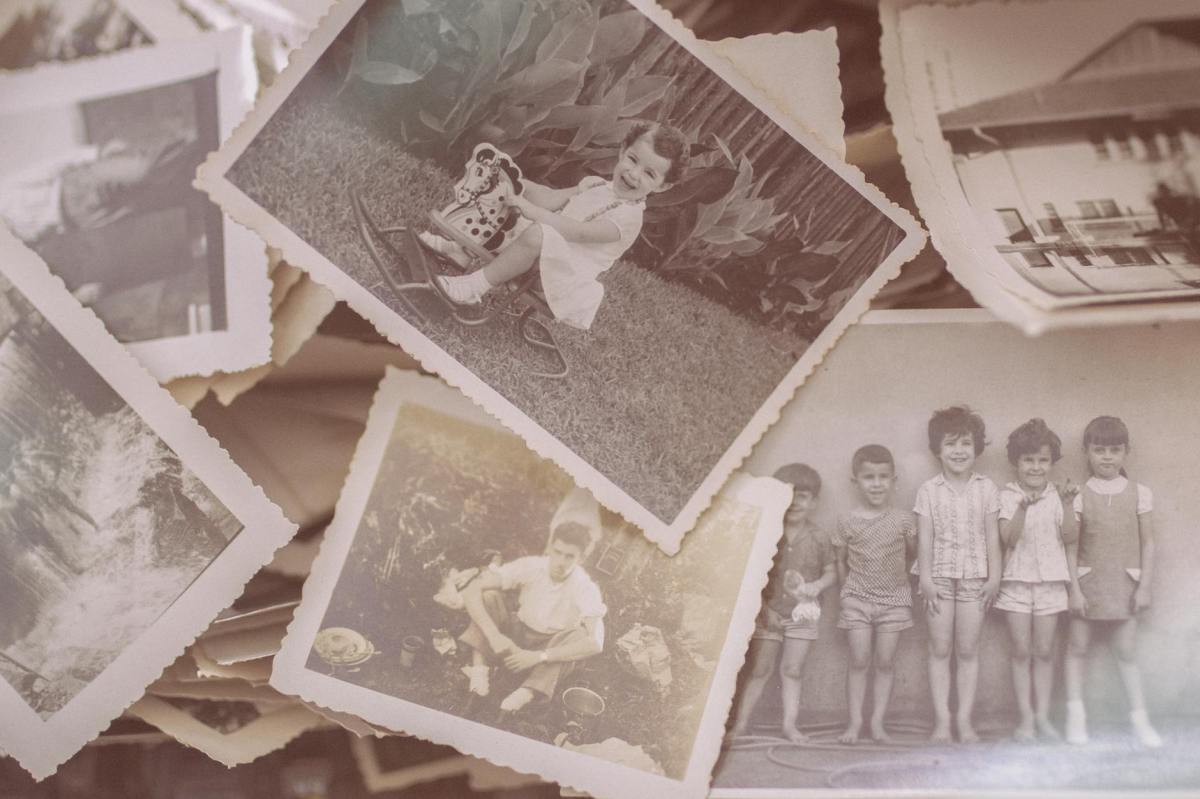
My fiancé, Matt, and I have been in the process of moving into our new apartment over the past few weeks, and combining all of our belongings and finding space for all of our stuff is an adventure. As with any time you move, we are realizing how much stuff we all carry around with us as we go through life. And some of that stuff can be pared down or donated or sold, but there are always those things that you hold onto, no matter what. And among these, probably for almost all of us, are boxes of old photos. 

I have a big plastic tub of family photos that I keep swearing I’m going to sort through and organize…and I’ve been saying this for the past 15 years. Every so often, usually when I move, I will drag out that tub and open the lid and gasp in horror at the mixed up stacks and envelopes. Then I close it up and slowly back away. 

But I could never give them up, of course, because our photos are valuable in a different sort of way than other belongings. They are like a pathway through the forest of memory that thickens as we grow older… a pathway that guides us back to other homes, other times, other faces, other versions of ourselves that would otherwise be lost from view in the shadow of the passing years. We pull them out to show others—and ourselves—all that we have known, all that we have been.

In my own collection, I see many things. Here is my mother, sitting on the back of a pony when she was two years old..land here is my father as a young man, laughing in his college dorm room…and here is my great-grandmother, her smiling face obscured by a wide brimmed hat in the summer heat, and here—oh goodness—here is a child that was once me, dancing on the sand on some forgotten beach, yelling something into the wind. 

Memories and mysteries, all of these photos. Perhaps we carry them with us, wherever we go, both to remind ourselves of where we’ve come from and to reassure ourselves that whatever we have become, we were also, this. And this, and this. And that life is, somehow, holding together all these layers, finding the truth not in any one picture, but somewhere in the sum of them, in the shape of what they reveal.

It might sound odd, but I think it’s helpful to think of Scripture the same way, almost like a box of jumbled snapshots. Because our sacred texts, too, are repositories of memory and mystery, and just like a single photograph, no single Scripture passage can ever reveal the whole truth about the life of God. Remember that when someone tries to cherry-pick a verse to use against…whomever. No, we must gather all of these verses together, all these little glimpses of God’s face, and ponder the bigger story they tell. 

With this in mind, then, I think the most striking image of God’s face we are handed this week is Jesus asleep in the storm-tossed boat, his disciples as panicked and furious as the sea itself. You can practically close your eyes and see it. So let’s pull that one out of the box and ponder it together, shall we?

It is dark. Bands of rain and wind are lashing against a small boat on a stormy sea. The disciples are looking at their teacher, sleeping in the tumult, and they are bewildered—they can’t begin to imagine why Jesus isn’t awake, why he isn’t helping them fix the situation, giving them direction, something, anything. And so they wake him up and, at a word, he uses his mighty power to still the storm.

Is it easy to see what’s going on here? Just a scary storm and a God who will make it stop? Look a bit closer.

As is often the case, there is much more to this image than what immediately meets the eye. Because it’s interesting—Jesus, after calming the wind and the waves, doesn’t look at them and offer soothing reassurance. He doesn’t say what we might expect God would say, “there, there, I fixed it for you, don’t worry, you’re fine.” 

No. Instead, a better Greek translation of his words to them might be, “why are you so timid? Do you not trust?”  And the Gospel says then, and only then, after the storm, that the disciples “ephobethesan phobon megan” — they feared with a great fear — not because of the storm, but because of the One who stilled it.

You see, in that moment, the disciples have a brief encounter with enlightenment—they realize, right then, that Jesus is more than just a sleeping teacher who can fix their problems—more, even, than the prophetic miracle worker they’d been following around.

You might say that it was as though a collection of old photos suddenly appeared before them, and for the first time they could really see Jesus—all of him—and there he was, sitting on the back of a donkey, escaping to Egypt with his mother. And there he was, laughing as a young man in the Temple, astounding the scribes in his Father’s house. And there he was, dancing on the sand of some forgotten wilderness, rebuking the temptations of Satan, yelling something into the wind. And there he was, too, even farther back, before time and image and memory itself, the Eternal Son, like light looking up from the brim of deep darkness–the original Creator of the water and the wind now riding with them on the waves.

And for them, in this moment, to see Jesus—to see all the images that make up who he is and what he is—is to realize that loving him and following him is not about fixing their problems..it is about re-creating the entire world in the image of Love.

We are the inheritors of that same encounter, you and I, that same collection of images. We, too, are reminded that Jesus will not remain the flat, convenient, utilitarian image that might suit us best. 

If we want him to appear as a mere teacher, we must also discover that he is Lord. And if we want him to appear as the victorious one, we must also see that he is the crucified one. And if we want him to bless our health and our wealth, we will also find that he makes his home among the poor and the sick and the forgotten.

And he is all of these things–this whole jumbled stack of images, this whole collection of memories and mysteries–not to make our faith an impossible task, but to make impossible our tendency to render God in our own image–our propensity to make God as small as our own fears and misgivings. He asks, ‘why are you so timid?’ because he wants the disciples, and us, to see that God’s love is so much bigger than we can envision, so much bigger than our fear.

And so, even now, this Jesus asks us— today, here, in The Episcopal Church; here, in the United States; here, on a planet on fire; here among all of us who have tried to be diligent, polite, welcoming people of faith—he asks us, as we fear that the church is shrinking and the world is raging and the ship is sinking, he asks again, Why are you so timid? 

Do we not trust that love is the strongest force on earth? Because it is.

Do we not believe that the world needs this good news more than anything else? Because it does.

Do we not feel that love raging in us like a storm of life giving water? Because it’s there, waiting to be set free. 

And all of this—the storm of love and the memory and the mystery, and the countless revelations of eternity—if it is part of Jesus, we must let it become part of who we are, too. We must let this undaunted, unfaltering, fearless type of love become the shape of us, the sum of all the images we are, the precious treasure that we can never give away, no matter how many years go by.

And maybe, if we were to look for this in ourselves, and in others, we would brush up against enlightenment, too. Maybe we would see that every person we meet also carries with them a box of old photos. That they were once two years old on the back of a pony, or laughing with their friends or dancing on the sand or shouting into the wind or smiling in the light of the sun.

Maybe if we saw all of one another, we would be less timid, less overwhelmed by the storms we are navigating, because we would realize that Jesus isn’t asleep while the world falls apart. He is dreaming a new world into being and inviting us to dream with him. A world in which, instead of fearing with a great fear, we will love with a great love

It’s a beautiful image, isn’t it? I think I’ll hold onto it. 

Breakwater: A Sermon

I preached this sermon on Sunday, March 17, 2024 at St. Anne Episcopal Church, West Chester, OH. The lectionary text cited is John 12:20-33.

If you have spent any time traveling up around the Great Lakes, you might have observed the structures called breakwaters, which are a feature of many cities with harbors and bays along the lakeshore. Their construction varies, but essentially they are a thin wall or barrier that juts out into the lake in order to do exactly what the name implies—to break the waves that move in toward the shore, creating calm, navigable water on the inner side of the wall for ships and other small craft, while the swells and breakers roll and rage in the great expanse beyond. 

Growing up, every summer we would spend time in Marquette, Michigan, which sits right at the edge of Lake Superior, the largest and wildest of the Great Lakes. There is a breakwater that extends out from the shore there, and when I was young, my family and I would walk out onto it, taking in the views of the water and the city. 

The breakwater in Marquette has been there since the 1800s, reconstructed a few times due to storms, and the first half of it is a sturdy concrete structure, flat easy to walk on in good weather. You can stroll out in this narrow path, the calm harbor to your right, the endless waves to your left, and as a kid it was a thrill to be there on the breakwater, bathed in summer breezes, dancing and skipping out, out, out along the thin line between home and the world beyond, between familiarity and the eternity of blue water stretching toward an unseen shore.

But then there was a point on our walk where we would always stop. About halfway, the breakwater turns at an angle and keeps going farther out into the lake, but this second portion is only comprised of large boulders; the concrete wall ends and from there the going gets slick and treacherous as the waves collide with the bare stone. The only way forward is to scramble and leap and crawl along the rocks. 

My cousins and I always wanted to go onto the rocks all the way out to the end, the very end, where a light tower marked the edge of the breakwater. But the adults wisely said no, it wasn’t safe. So we would turn back. 

And what I could not have perceived then, but that I do now—more and more so with every passing year—is that life is much like that walk along breakwater. When we are younger, setting out into the wide expanse of the world is deliriously exciting, and, if we are blessed with a kind and caring childhood, we take for granted, perhaps, the solid structures beneath our feet. Stay on the straight and solid path, we are told, and all shall be well, and if you are careful, the waves will not break over you, and you will go as far as you need to go. 

But then, somewhere along the way, we get to the place in our lives where the solid footing ends, and we realize, with some surprise and trepidation, that we are no longer children, and that now we are expected to keep going. 

We discover that growing up and growing wise means that the journey does not, in fact, end at the bend in the path, but that life keeps going, going out where there are only rocks to traverse, where the water licks at our heels and sometimes threatens to sweep us away, out where we must indeed scramble and leap and crawl on our knees, and the walls we relied upon for safety suddenly seem much more permeable than they once did. 

One of the times I realized this was when my father had his first major heart attack in late spring, several months before he died. As it happens, I flew into Marquette, where he was in the ICU, and I remember seeing the lake as we drove through town in between hospital visits, and I remember seeing the breakwater, too, curling like a question mark out into the blue expanse, a reminder of simpler springs. 

And I remember feeling, in that moment, like my own solid path had ended, but that I was now required to keep moving forward out where there were only rocks ahead, with no one there to call me back.  I suspect most of us have had experiences like that.

And, in our passage from John’s Gospel today, this is also such a moment for Jesus, where the solid path he has been traveling since the day he was born comes to a precarious place , and when he, too, accepts that he must still keep going, out, out, onward, to where the footing is uncertain and where there is no guarantee of safety. 

“Now my soul is troubled,” he says. “And what should I say—‘Father, save me from this hour’? No, it is for this reason that I have come to this hour.”

Just as the other Gospel authors record his struggle in the Garden of Gethsemane, here John depicts Jesus at the edge of his own understanding, wrestling to reconcile the deep love he shares with his Father with the dawning sense that this love is no guarantee of preservation. Quite the opposite, in fact—this love for the Father is now clearly an invitation, a call, out onto the rocks where certainties end and faith alone must guide him. 

This love that has been growing in Jesus, that has been manifesting in his deeds and his teachings, this love that has bathed him in clear, calm living water, is now rolling in like a wave, rolling in from the unseen shore, and he knows, now, that to be all that he must be, to do all that he must do—for himself, for us—the wave must break over him, come what may, and the rock must be the place where he plants his feet and carries his cross and builds his church, the rocks where the walls of safety, the walls between heaven and earth, the walls between familiarity and eternity, seem much more permeable than they once did. 

It’s interesting, too, that this moment occurs alongside Andrew and Philip, who have been asked by some Greek believers to come and “see” Jesus, echoing Andrew and Philip’s own encounter with Jesus at the beginning of John’s text. Because inasmuch as this passage is Jesus reckoning with the nature of his own journey, it is also a moment for his disciples—including us—to reckon with ours. For “where I am, there will my servant be also.” If we are to follow Christ, then the rocks and the waves beckon us all. 

And our reaction to this realization might depend on where we stand. If we have become too comfortable in our faith, if we have become accustomed to solid ground beneath our feet, if we have not dared to venture out to the places where love requires us to risk something, then we, too, might feel our souls troubled by Jesus’ call. 

If so, then today we are being asked to take one small step outward onto the rocks—one small step towards admitting that we don’t have all the answers, ones step towards being vulnerable, towards embracing new ideas, new relationships, new ways of opening our hearts, new ways of standing with the poor and the forgotten and the storm-tossed—so that we might follow the path that Jesus has already traversed.

But if you are already out there on the rocks, somewhere between scrambling and leaping and crawling on your knees; if you already know all to well what it feels like to have left your certainties and safety behind, then perhaps Jesus’ call will be a consolation, because you will come to understand that even when the path crumbles under your feet, you are not lost. For this, too, is part of the path. 

And this is, in fact, the part of the path that we must travel if we ever want to grow up, if we ever want to grow, to reach that place where familiarity and eternity meet, where home and heaven lap up against one another: out, out at the outermost edge where Jesus abides, where he burns like a light at the end of the breakwater, at the end of every journey, drawing all people to himself, blessing every rocky path you have walked, every crashing wave that has washed over you, and every weary heart, including yours.

I have not been out on that breakwater in Marquette for many years, now, but I hope to go back someday. I still have a little bit of my father’s ashes, and if I can, I’d like to sprinkle a few into the lake there. But I am no longer a child, now, so I think that when I go, I’ll venture out a bit farther out onto the rocks to do so, to let his ashes mix with the water and the wind. It feels right, somehow, that this is how it must be, and where it must be, on that thinnest of lines between home and the world beyond. 

And though my feet might be a little unsteady, and my eyes might sting, I think my heart will still dance and skip like it once did.

It will not be entirely safe. Life never is. Love never is.

But it is still part of the path. And God will be there. 

Screen Door: A Sermon

I preached this sermon on Sunday, February 11, 2024 at St. Anne Episcopal Church, West Chester, OH. The lectionary text cited is Mark 9:2-9, an account of Jesus’ transfiguration.

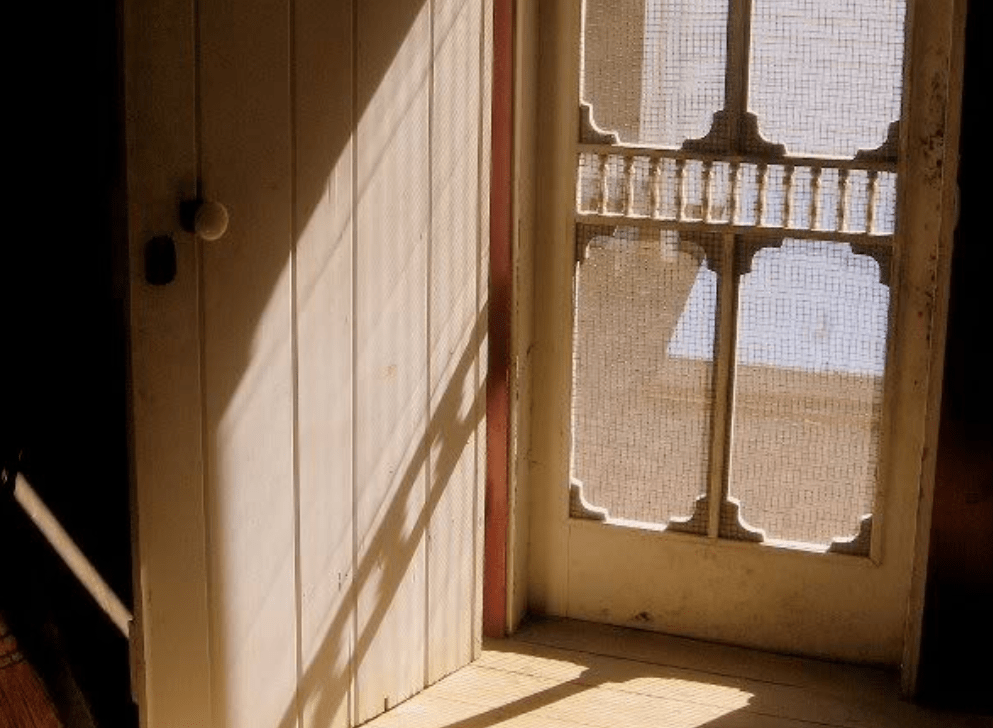
It has been many years, but I can still remember the sound of the screen door opening and slamming shut in the back porch of my grandparent’s house. The door was old and worn and yet amazingly resilient given the infinite number of times that people had passed through it on their way in and out. You see, in that house, nobody ever came in the front door, through the living room—it was always, always through the old screen door out back, and then a few steps through the porch, and on into the kitchen, the room where, as with most Midwestern families, all the truly important stuff took place. 

Maybe you remember a home or a place or a time like this—a season in your own life when the doors were always open. And so it was for us—that loud screen door was never locked, it was always at work, announcing the in-breaking  of the world that lay out beyond the warm cloister of the dim and fragrant kitchen. 

If we happened to glimpse anyone approaching the door from far off, they would emerge first as a glimmer of color and moving light out beyond the wire mesh of the screen and then—creak, rattle, slam!—there they would be, standing in our midst, in the flesh, stomping their boots, commenting on the weather. Friends and family members often showed up like this unannounced, a stream of visitors seeking to share a meal or a moment’s company, bearing news and stories. 

And I am sure someone, at some point, must have knocked, but I don’t remember it. I don’t recall the sound of knocking at all—only the familiar opening and closing of that screen door and how normal it was that people would come right in—how natural it felt for there to be a permeable boundary between what is already known and what comes to make itself known. 

There is an odd sort of paradox in a screen door, when you think about it. It is a barrier, but it’s one that is flimsy by design. It may have the shape of something absolute but it is rather ambiguous in its purpose, used to shield what is within it, but also to receive what is beyond it—the cooling breezes and the beams of light and the birdsong that travel through the screen to mingle with the inside smells of dinner and dish soap. 

It is not much of a safety measure, the screen door, but rather a way for two unique worlds to coexist alongside one another and to reveal themselves to one another. The screen door teaches us that the practice of passing back and forth between privacy and welcome; between domesticity and wildness; between the familiar and the unknown; is a good and necessary thing to do. 

And it seems to me that we have arrived at our own sort of screen door moment today, on the Sunday in the year when we see the Transfiguration, when the familiar and the unknowable commingle on the top of a mountain, when the human and the divine aspects of Jesus reveal themselves in a collision of time and light and cloud, of terror and belovedness. 

We, alongside Peter and James and John, are drawn into the strange paradox of looking at two realities at once—God’s and humanity’s—and realizing that, in Jesus, the boundaries between them are shockingly permeable. 

Today we conclude the seasons of Incarnation and Epiphany, where we have seen how the Son of God has been born and made his way into the world, approaching us, a glimmer of color and light beyond the mesh of our familiar understanding, and yet now—creak, rattle, slam!—here he stands, in his fullness, the eternal God come to pass through our door, to share a meal or a moment’s company, bearing good news and stories. 

And this, I think, is one of the most important things to understand about the Transfiguration—it’s not simply that Jesus revealed himself in a particularly magnificent way in this one moment to a handful of disciples, but that in all of our life with God, in worship and discipleship and service, transfiguration is always ready to reveal itself—the boundaries between our lives and the life of God are as permeable as a screen door through which the breeze of heaven blows.

I have seen and heard and felt him in so many different places. In moments of prayer and song. Beside a deathbed. Last week at the laundromat with the Outreach team. In conversations shared with many of you. Gathered around this table, week by week. And certainly, gathered around a kitchen table.

As we prepare for a long and thoughtful journey through Lent, to the Cross and beyond it, we are reminded today, right before we set out, that there is no aspect of human experience—even the most difficult and despairing ones—where Jesus is not able to come and be with us, to enter through the back door to sit a while, to remind us that he is separated from us by only the thinnest, most pliable boundary, if we are willing to look and listen and receive him.

Which begs the question—if the Kingdom of God is approaching us from the other side of the screen, then what must we do on our side to be ready, to greet this new world when it reveals itself? What does a screen door faith look like for us who desire a glimpse of the transfigured world beyond?

And in that, I think my grandparents were on to something simple, but essential: their door was always open. Part of what we practice here, week after week, in liturgy and in hospitality and in service and in formation, is a permeable, open-door way of life, a blurring of the demarcations between personal and communal, finite and eternal.

First, we engage in the pattern of the Eucharist so that we will go out into the world beyond our red doors and replicate that same pattern elsewhere, giving away our own selves for the sake of love, just as Jesus has done for us.

We practice welcoming visitors and strangers into the doors here at St. Anne because being open to new faces, new stories is how we cultivate openness to the presence of God whenever and however God comes into our lives—which is quite often in the form of visitors and strangers. 

We serve our neighbors, approaching the threshold of their experiences and getting to know them so that we begin to see how little separates us from anyone else; how their well-being is bound up in our own; and how the differences we perceive, while real, are not a barrier to meaningful relationship. 

And we pray and learn and study and challenge our assumptions and expand our perspectives, so that we can be attuned to the infinite number of ways that God passes into our world and abides with us, because Jesus, in that transfigured collision of flesh and light, of time and eternity, has broken down the division between heaven and earth, or at the very least he has made it like a door that will never be locked, a door to eternity that is flimsy by design, a door that is, in fact, like a screen door, where the commingling of two realities finally meet—God’s heart and our heart, God’s life and our life, the beams of light and the birdsong, the dish soap and the dinner, and all of it is God’s and all of it is ours and all of it is sacred.

And so as we approach Lent, and whatever you decide to do or not do in that season, most of all I want you to consider this: how you will stay present to the thin and permeable boundary between you and God? How will you stay open to the life that lies on the other side of the screen? Will you glimpse heaven at the laundromat, in the food pantry? Will you look for the glimmer of color and light that dance behind the words of Scripture? Will you bring good news to your neighbor, share your story with them, proclaim a word of peace to a hurting world? Will you set the table? Will you unlock the door?

Because what we do know is that God will indeed come to see us. We may not know when or how, but in every moment, on every mountain and in every valley, God is always there, ready to be with you , ready to enter in, so eager that he might not even knock, so wondrous that even if you hear his approach—creak, rattle, slam!—you may never be the same once you look up and see him: glorious, stomping his boots and commenting on the weather, seeking to share a meal, a moment; seeking, ultimately, to stay forever in you, in your heart, where, at last, he is transfigured into your flesh, your life.

And then, everything will be both familiar and new; safe and free; and you will be in heaven and you will be at home, all at once. 

Free: A Sermon

I preached this sermon on September 17, 2023 at Saint Anne Episcopal Church, West Chester, Ohio. The lectionary text cited is Matthew 18:21-35.

As I have shared with many of you, when I was a kid, I would spend the summers in Michigan with my dad and my grandparents. There were a number of things about those vacations that I looked forward to all year long, and a lot of them had to do with food. First there was my grandma’s cooking and baking, which filled the house with mouth-watering fragrances throughout the day. Her fresh strawberry pie was the stuff dreams are made of. But another thing was the little general store that was just down the block, an old-fashioned kind of place that sold a few groceries and sundries, but in which the main attraction, at least for an eight year old, was the selection of ice cream and penny candies and trading cards.

My cousin, Mike, and I were particularly interested in that selection of trading card packets, and it was our singular mission each year to get our hands on enough money to buy them. Now, of course, we could have just asked our family for spare change, but at some point we decided to get a bit entrepreneurial. 

So, for several summers we would take over the enclosed, rarely used front porch of my grandparents’ house and we turned it into a couple of “shops” of  our own, cobbled together with odds and ends from some spare room of the house, and offering what was, in retrospect, a rather underwhelming selection of goods and services. One iteration was a restaurant that served plastic play food and real glasses of water, 10 cents a piece. Another, perhaps my most efficient business model, was simply setting up a desk in the porch and declaring that the house was now a hotel, and that our family members now had the privilege of paying 25 cents a night to sleep in their own beds. 

But our parents and our grandparents were dutiful customers, and so we collected up our coins day by day and ran down to the general store, and spent them all on cards and candy, quite pleased with ourselves. 

This is a very happy memory, of course, but I was thinking about it this week because it occurred to me that for all those summers, while my cousin and I were focused on the nickels and dimes and quarters that would buy us all of those treats we daydreamed about, we were less aware of the most wondrous thing of all: that when we got tired of playing and scheming and striving for coins, we could just go down the hall to our grandma’s kitchen, and there would be more food and more love than we knew what to do with. And in the end, that was the truly priceless treasure. I don’t have much use for those trading cards anymore, I don’t even know what happened to them, but I would give just about anything for another bite of my grandma’s strawberry pie at that kitchen table, surrounded by loved ones who are now long gone. 

We spend so much of our lives, I think, in a similar posture—so focused on the measurement and acquisition of the things we want (or think we want) while failing to sit up and recognize the immense—but less quantifiable—blessings in our lives: the relationships that shape us and sustain us and guide us forward, the simple gifts of time and care freely given by the ones who love us. And if we’re not careful, we might spend our whole existence scrounging for penny candies while the true feast sits, beckoning yet unappreciated, just down the hall. 

For me, at least, this image has helped me think about the parable that Jesus offers us in today’s Gospel, which is also, at its heart, about a person who doesn’t really understand what he is being given. 

A king forgives the debt of a slave, or a servant, as some translations put it, but then this servant refuses to do the same for someone in debt to him, and is thrust back into the fear and scarcity with which he started. 

We are told that this is a parable about forgiveness, and that somehow it should model for us what the Kingdom of Heaven is like. The tricky part is that this King, who many of us interpret to represent God, ultimately rescinds the forgiveness originally offered. So is this a “be good or else” type of story, such that we should be forgiving others out of fear of eternal punishment?

I don’t think so. I don’t think God’s mercy has conditions like that, and I don’t think forgiveness under duress is a healthy or life-giving way of understanding human relationships. No, I think this parable is suggesting that the heart of forgiveness—and the heart of really every virtue we try to embody—is rooted in a proper understanding and appreciation of what is truly important in life. And it is not the things that can be counted. 

We are not hearing this parable in Jesus’ own time and place, so we might miss the key point that the amount of debt forgiven by the king, 10,000 talents, is not just a big amount, it is an absurd amount—it is more money than any empire had, more money than someone could conceive of. And so the king in this parable is not just telling the servant he can walk away from his debts. He is essentially saying to the servant, walk away from the entire notion of indebtedness. I am uninterested in measuring it anymore. You are free now. Everything is free now. Live as if this is true.

This is good news, but it is also strange news, for we are all too accustomed to counting the cost of everything, both literally and figuratively. And so the real mistake that the servant makes is that he does not comprehend the gift that has been given. The servant doesn’t understand that he is living in a kingdom where there is no longer any need for calculation, where there is no grasping and groveling, where there is no currency at all. Just the current of goodwill that encompasses all things, all people. 

He doesn’t see it,  or he refuses to see it, and so he keeps on counting the cost, he keeps on demanding payment from others, because that is what he knows how to do, and his inability to understand that another way is possible, his refusal to trust that another way has been given to him, sends him right back to the dead end where he started, back to the world that is easier to believe in, where Kings torture and no payment is ever enough. And to the extent that we have treated love and forgiveness and grace as commodities to be bought and sold and bartered, the same will be true for us. We will have missed the point. We will have squandered the true gift. That other realm, where everything is possible, will be lost to us. 

So no, Jesus is not just saying be kind and forgiving or else. Jesus is saying, if you would enter into the Kingdom of God, if you would understand mercy, if you would know what it truly feels like to love and be loved, to forgive and be forgiven, then look up from your games, beloved children, stop playing shopkeeper.  You have to realize that the important stuff is all free. You don’t have to spend your life scrounging for coins to purchase paradise. 10,000 talents are worthless in my sight; your heart is the true treasure.

Because this Kingdom is not, in fact, a hotel with a 25 cent nightly rate; it’s just the house we get to call home, if we choose it, and the light is always on in the front porch, and there’s a feast at the end of the hallway, luscious as strawberry pie, a slice for everyone, free of charge.

That’s what forgiveness is, when you get down to it: love without a price tag. And when we realize it is all free, then we will be free, too. Forever.

Small Things: A Sermon

I preached this sermon on Sunday, October 9, 2022 at Trinity Episcopal Church, Fort Wayne, IN. The lectionary text cited is 2 Kings 5:1-3, 7-15 and Luke 17:11-19.

I don’t know why, exactly, but fall is a season when I start to reflect on the past — something about the approach of holiday traditions and the winding down of the year and the brilliance of the autumn leaves lends itself to the sharpening of particular memories. These recollections waft on the air like woodsmoke, sweet and sharp, occasionally stinging the eyes. 

And it’s interesting—I don’t know if this is true for you, but I have noticed that when I am looking back on life and remembering things and people and places that are long gone, long past, my most vivid memories are of very small things, very particular little details, rather than one big grand narrative playing out in my mind. 

I might suddenly recall the sound of my dad’s laughter one afternoon in late September when I was 15, or the particular way my grandmother carved a chicken on Sunday afternoons, or the scent of the gardenias my mom used to buy on the way home from work when I was a little boy. 

All ordinary things, unremarkable, perhaps, to an outside observer, but nonetheless these are the little things that stick, that signify meaning, long after the worries and speculations and fantasies of the past have faded away. I don’t remember most of the conflicts and longings and unsatisfied desires that seemed so important when I was 12 or 22, but I can recall with crystalline specificity the small moments of beauty and kindness and care that have been strewn along the path of my life.

This suggests to me that it is, in the end, these small things that imbue our lives with significance, with holiness, with hope. And it is these small things that are vessels of God’s grace, far more than the big concerns and bold plans that so often preoccupy our imaginations.

We may have great expectations, but it is the small things that sustain us. It is the small things that save us. 

But this isn’t always easy to see. Naaman, the mighty general seeking a cure for his leprosy in today’s reading from 2 Kings, doesn’t quite understand the value of small, ordinary things, or perhaps he has simply forgotten it in all of his conquering and striving to be important. He is a man burdened by disease, but he is also burdened by the sense of his own significance, and so he presumes that any healing he might receive from the prophet Elisha will come at great cost and will arrive with great dramatic impact. No humble, commonplace treatments for this man. And so he loads up his treasures and his servants and his other accumulated defenses and brings them to Elisha’s door, ready for anything. 

For anything, that is, except for the rather anticlimatic thing that actually happens. Elisha, in his wisdom, doesn’t even come outside, and instead simply sends out a message Naaman: go take a bath in the river. 

Imagine having come all that way, with so much build-up, with your whole entourage looking on expectantly, and then being asked to take a dip in an unremarkable, muddy body of water. Naaman, who expects so much more of himself and of the world, is offended by the simplicity of it all. Surely that can’t be it? Surely this God of Israel, if he is so powerful, would reveal his works in a more impressive way? Surely healing requires something more than this? Surely, after I have suffered so much and traveled so far, salvation cannot come from such a small thing?

We might laugh a bit at Naaman’s pride and his self-importance, but I also have to say I relate to his disappointment a little bit. I look back at my life, and I look around at the problems facing our world today, and I know what it feels like to be overwhelmed by the magnitude of longing for a big and decisive answer. I know what it feels like to want a dramatic solution, to yearn for God to appear in glory and make it all better, make it all clear, to lift us up from the mud and the misery. 

So maybe I, too, would be frustrated by the instructions to go bathe down in that mud instead. Maybe I, too, would just want to pack it in and go home. Because I confess that some days I get tired of meager solutions to big problems. I get tired of relying on small things when the grief of the world is so big. 

Maybe somedays you get tired, too. Naaman would certainly understand if you do. 

But then, at the moment when all hope seems to be lost, another small thing: this time it is the voice of one of Naaman’s servants, the voice of practical wisdom—

“if the prophet had commanded you to do something difficult, would you not have done it? How much more, when all he said to you was, `Wash, and be clean’?

In other words, yes, the journey has been long, and the outcome may be uncertain. But it can’t hurt to do the small thing that is asked of you in this moment. And, in fact, it may be that finding hope in such small things, believing in the power of small things, is more reflective of God’s purposes than any dramatic solution. Why that might be, I cannot say for sure. I only know that I remember my father’s laughter, and my grandmother’s hands, and the scent of my mother’s gardenias in the cool of the evening, and that these things matter more than I can say. 

They matter in the same way that it matters that God offers us himself in the frail body of a man, and in a morsel of bread and in a sip of wine. It seems that he longs for us to love the small things, to submit ourselves to their humble grace. He asks us, like Naaman, and like the grateful Samaritan healed by Jesus, to remember that when we encounter love and beauty, no matter how simple or small, we are seeing God. 

He is in the muddy waters and in mended bodies. He is in the gifts we share with one another. He is in the moments when we remember to say thank you.  He is in everything, every small thing, holding the universe together with love. 

Naaman does, of course, eventually take Elisha’s advice. He strips off his many layers of armor and submerges himself in that muddy water and emerges, the text tells us, with flesh appearing as it did long ago, skin gleaming like when he was a young boy. When he himself was a small thing: bright, laughing, free.

And perhaps that is the mystery of love: not only that it flourishes in small things, but that it distills us back down to smallness ourselves, like children, sloughing off our grief and our delusions of grandeur, leaving only our essence, our innoncence, our intense and enduring joy. 

Can you remember what that felt like, back when you were small, too? Can you remember that version of yourself, back through the turning of the seasons? Can you remember when you believed in simple things, when love was not a memory, but an ever-present gift, as numerous as the autumn leaves? 

God, help us to remember.