Ghost Town: A Sermon

I preached this sermon on August 21, 2022 at Trinity Episcopal Church, Fort Wayne, IN. The lectionary texts cited are Isaiah 58:9-14 and Luke 13:10-17.

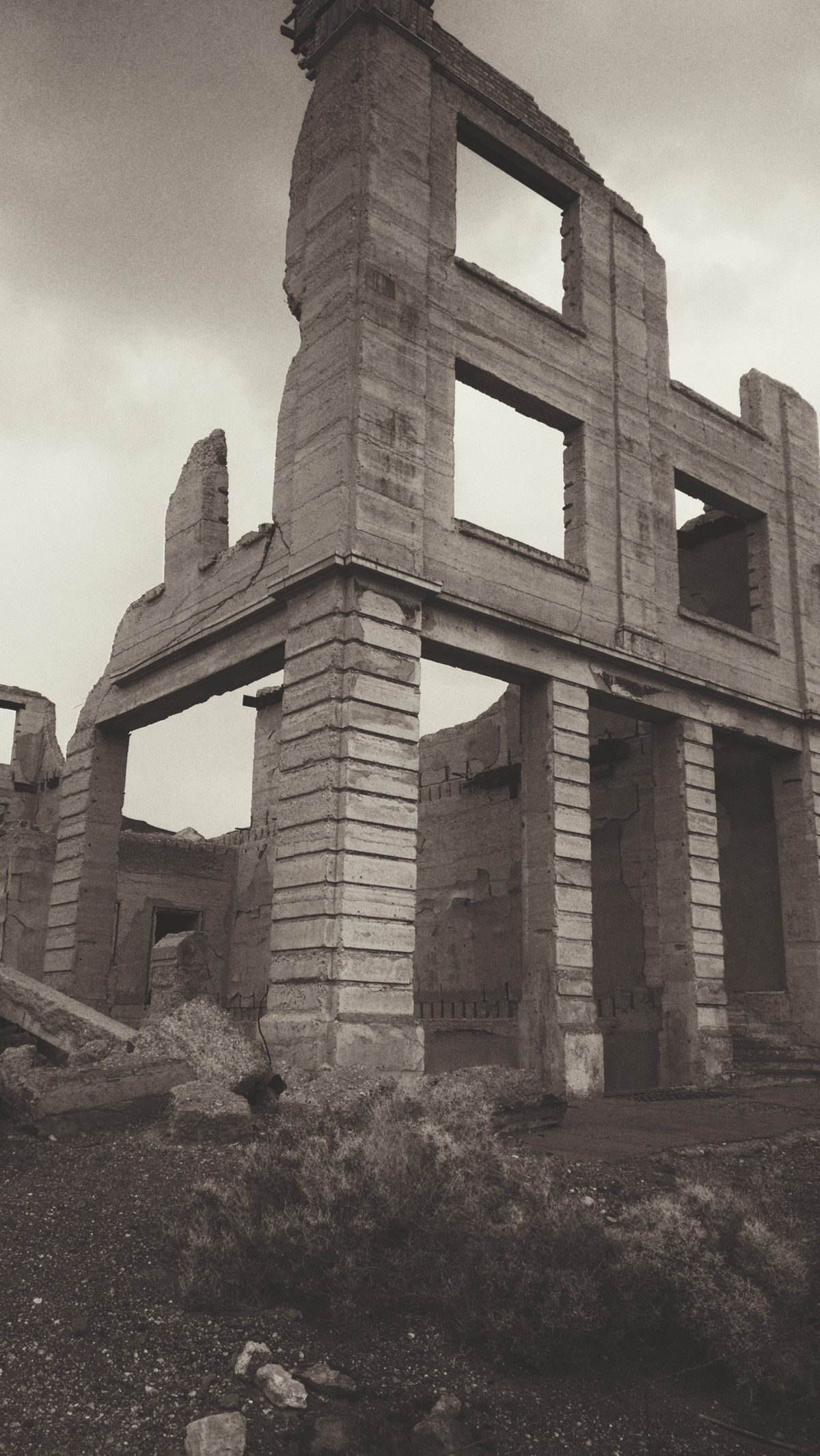
Out in the western part of the United States, one thing that you will often come across is a ghost town, tucked into some forgotten valley or huddled along a lonely highway. If you have ever traveled out there, perhaps you have heard of or even visited one—Bodie, California, famous for its gold mines and its lawless inhabitants; Rhyolite, Nevada, which boomed and went bust over the course of just five years; or, one of my particular favorites, Glenrio, Texas, an abandoned town on Route 66, bypassed by the interstate, in which you can wander down the middle of the abandoned highway, where the only remnants are a crumbling gas station, a shuttered diner, and an empty motel in which the only guests are the occasional wild animal and the desert wind blowing through the cracked windows. 

What is it about ghost towns that captivate our attention, maybe even send a chill up our spine? Most of them, as far as I know, don’t have a ton of actual ghost stories associated with them—they are less haunted place than they are haunting places—haunting us with their faded memories of something that was once vibrant but is now only a shadow of itself. A place that, for one reason or another, has outlived its usefulness. 

I think ghost towns compel us and scare us a bit because, we, too, live with the prospect of loss, of dereliction, the fear of what it might feel like to watch the years go by as one forgotten, to wait for visitors that no longer come. They remind us of the fragility of things, of ourselves, even, and they teach us that communities are not inevitable—they must be built and tended and invested in, lest we all find ourselves cut off from one another, living with ghosts. 

The Scriptures are full of people who are themselves cut off from the living, from any sense of community. Think of the Gerasene demoniac we heard about several weeks back, the man who was plagued by demons and who lived among the tombs, an outcast in a literal city of the dead. 

Or the woman in today’s Gospel lesson, who has been afflicted with an unnamed illness for 18 years, bent over, unable to stand up straight, in a time and culture in which disease and disability isolated one socially as much as it did physically (not that much has changed in that regard). She herself, like so many who are burdened by physical limitations, is treated as a ghost within her community, practically invisible, unheard, disregarded and forgotten, perhaps even thought of as someone who has outlived her usefulness, such that her healing by Jesus is received more as an affront to religious order than as a miracle of restoration. 

Because this is the accepted way of things, isn’t it? Whether its with towns decaying along the side of the road or people decaying along the side of the road—there is a certain measure of acceptance that this is just the way it is, that perhaps that place or that person just couldn’t keep up with the pace of society, perhaps it’s just the sad state of affairs in a competitive and changing world that some communities must die, and that some people must be left behind. It’s tough out there. Can’t save ‘em all. 

And so we visit ghost towns with their broken buildings and we see the haunted faces of our broken neighbors and we shudder at the brokenness but we accept it. We accept it all as part of the landscape, because, what else can we do? Ruined cities and ruined people, always there, always just beyond the edge of where we dare to look. 

But God looks. God sees them, the fallen cities, the stooped over women and men. God sees them. And God does not accept it. God says: no, another life, another world is possible.

God says,

Your ancient ruins shall be rebuilt; you shall raise up the foundations of many generations; you shall be called the repairer of the breach, the restorer of streets to live in.

Where we see a ghost town, where we see a lost soul, a regrettable curiosity, God sees and speaks of possibility, of healing, of hope. 

This is why the healing power of Jesus, and the perspective of God that it signifies, is so radical, so shocking, so powerful, because it flies in the face of all our expectations, all of our resignation to the decline and decay of people, of places, of ourselves. 

“Woman, you are set free from your ailment,” Jesus says, and he speaks the same word to all who will hear him. Rise up, daughter of Abraham. Rise up and reclaim your place among the living. Stand tall again and know that you were not meant to be forgotten, that you cannot outlive your usefulness, because to God you are infinitely precious, and there is never an expiration date on your belovedness nor on your promise.

As Isaiah proclaimed, 

The Lord will guide you continually, and satisfy your needs in parched places,  and make your bones strong; and you shall be like a watered garden, like a spring of water, whose waters never fail.

So rise up again, you who have accepted your home among the ghosts. Rise up and be who you always were, inhabit your life fully once more, for in the reign of God you are not collateral damage to progress, you are not lost to time, you are part of a life, a community, a story that will never die. All you have to do is accept that this is possible, despite what the world seems to suggest, despite the ruins all around us. That is faith. Have faith that life—your life, our life together, the life of this earth—will find a way.  With God’s help, it can. It will. We were never destined for dereliction. We were never meant to be ghosts. 

In one of the places I mentioned earlier, Rhyolite, Nevada, there are actually some sculptures in the desert just beyond town. An artist put them there decades ago in a sort of open air museum. And one of them is called the Last Supper—its a platform of life-size figures in a tableau, all draped in white shrouds, like ghostly disciples waiting for the meal to begin in the middle of the wilderness. 

It is a haunting piece of art, but when I look at it, it is also strangely encouraging. For it seems to say that there is nowhere—not even in the most remote, most forgotten place, not in the most remote, most forgotten life—nowhere that God will fail to show up and prepare a feast. There is nowhere, n one that God will pass by. God will find us. God will not forget. God will lift us up.

And on that day the ruins will be rebuilt. 

And on that day we will stand tall, and we will live. 

The Last Supper, 1984, Charles Albert Szukalski, Goldwell Open Air Museum, Nevada

Kindness: A Sermon

I preached this sermon on July 10, 2022, at Trinity Episcopal Church, Fort Wayne, IN. The lectionary text cited is Luke 10:25-37, Jesus’ parable of the Good Samaritan.

As we speak, a deputation from our Diocese is in Baltimore at the General Convention of the Episcopal Church. It is a major gathering that happens every three years for the discussion of important issues facing the church and the broader society and for addressing all the business of legislation and governance that pertain to our denomination. Some conventions are witness to monumental changes in the life of the Episcopal Church, and some are relatively less eventful. We will see how this one turns out, especially given the pandemic-related delays and cuts made to the agenda. 

But I think it is safe to say that at every General Convention there is one question, often unspoken, that pervades all of the conversations and debates. It is a question that hovers like a ghost at the back of the meeting halls, and asserts itself implicitly in every resolution that is passed or defeated. It is the big, lingering question underneath all of the urgent questions of the day, in the Church as a whole and here at Trinity. And it is simply this:

In an era that feels so uncertain, so perilous, what must we do?

What must we, the Church, do to meet the moment? What must we do to survive, or even to flourish, when the challenges before us are so many? What must we do, right now, to be who and what God would have us be? What must we do to inherit and embody the fullness of God’s undying love? 

Now, because we are an institution, we tend to think in institutional terms and so we might wonder, is it a new formation program that will save us? A new structure? A better marketing platform? A stronger response to the issues of the day? Undoubtedly all of these things will be discussed in Baltimore, and I commend those who gather there for their sincere and earnest investment in debating such things. The process is part of our shared call to build a more just and life-giving Church body.

But I must confess that none of those things feel like the whole answer. Because if we Episcopalians were redeemed and renewed by systems and programs and public statements alone, then we’d have reached the promised land a long time ago. 

So maybe we’re a little bit like the lawyer who questions Jesus in today’s Gospel passage. He might be trying to ‘test’ Jesus, true, but maybe he is also looking at the world around him—perilous, turbulent, angry—and truly wondering: what must I do to inherit eternal life? What must I do to feel like things are actually going to be ok? What must we do to feel and know, deep in our souls, that God has not forsaken us? 

What must we do? 

Well, as our Lord has so effectively modeled for us today with the parable of the Good Samaritan, I will respond to this question not with a tidy answer, but with a story of my own.

About 17 years ago, when I had just graduated from college, I took off for Mexico with almost no savings and with a very flimsy plan. I had decided to get a certificate to teach English as a foreign language, and so I went to the Yucatan Peninsula and spent a month taking the necessary courses, interspersed with a lot of time on the beach and nights out with my classmates. I was not quite the prodigal son, lost in dissolute living, but I definitely had more optimism than good sense. 

After the course I took a bus to a large city in central Mexico, Queretaro, where I knew no one and nothing. I had heard that it was a good place to find a job teaching English but I had no solid leads. I just showed up and stayed in a cheap motel near the center of town, unsure of how to actually find a job, still a bit rusty in my Spanish. As the days went by and I made little progress, and my funds started getting lower and lower, my sense of dread began to escalate. And it came to pass that one evening I found myself sitting on a park bench in the main plaza of the city with absolutely no money to pay for another night in a hotel and no easy way for me to reach my family for help. The shadows gathered around me, the night was quickly encroaching, and I felt a sense of panic. I had never been in such a precarious situation. In my naivety, it just hadn’t occurred to me that I would actually end up without any options. I wasn’t attacked by robbers or lying naked in a ditch on the side of the road, like the man in Jesus’ parable, but I was lost in a sort of wilderness, and the passersby did not know me, and did not stop, and I was alone. 

And then, quite suddenly, a young man came walking past me, probably about my age at the time, dressed in a work suit. Why he stopped and approached me I will never really know. But he did, and he had a kind, gentle smile, and he asked (in Spanish—he spoke almost no English) “are you ok? Do you need anything?” And I greeted him in my broken Spanish, and we had a conversation. 

Long story short, his name was Julio, and he was a law student from that city, and when I described to him both my reason for being there and my continued search to find a job, he said, without any hesitation: my family has an empty house on the outskirts of the city. It’s not very nice, but you can stay there if you want until you find what you need. 

Now, mind you, I had not even told him about my financial straits. He just knew, somehow, that that was what I needed. And I accepted, with profuse gratitude, and I moved into that little dusty house and I lived there for almost two weeks until I was able to find a job teaching English and eventually get into a small rented place of my own. 

I saw Julio once before I moved back to the United States and I asked him, why did you help me that night in the plaza? And he said, simply, “you looked like you needed a friend.”

My friends, I have traveled many places, I have seen many beautiful things both near and far, but I will tell you that few moments in my life were more miraculous, more mysterious, more salvific, than that moment when a man stopped what he was doing to help a lost stranger who had run out of options. 

So while I am no expert in church governance or budgets or fancy programs for this initiative or that one, when I wonder “what must we do” as a Church, as followers of Jesus, to meet the uncertainties of this or any age, I keep coming back to that encounter. 

And I think the answer, in the end, is as profound and as simple as it has been since the very beginning: we will be saved by kindness. We will be saved by the kindness that God has shown to us in Christ, and in this life we will experience God’s salvation in the daily, ordinary acts of kindness that we show to one another.

Not the flashiest answer, I know. It probably won’t make any headlines. It doesn’t even have a program budget attached to it. But still, I would guess that, at the end of our long journey through this life, it is those moments of kindness—the ones given, and the ones received—that will be the true measure of all things. And it will be the kind people, like Julio, who will linger in our memories long after more impressive figures have faltered and faded away. 

So, what must we do to inherit eternal life? More than anything, we must simply be kind. 

Because, when you think about it, the whole arc of Scritpure, the impenetrable mystery of grace and salvation might be summed up just like this:

That we were sitting on a park bench as the evening shadows stretched around us, and the night was encroaching, and we were out of options and didn’t know what to do. And suddenly a stranger with a gentle smile approached us, and sat with us, and gave us shelter, and when we could not understand how or why, he simply said, with infinite kindness, “you looked like you needed a friend.”

Maps: A Trinity Sunday Sermon

I preached this sermon on Trinity Sunday, June 12, 2022 at Trinity Episcopal Church, Fort Wayne, IN. The lectionary text cited is John 16:12-15.

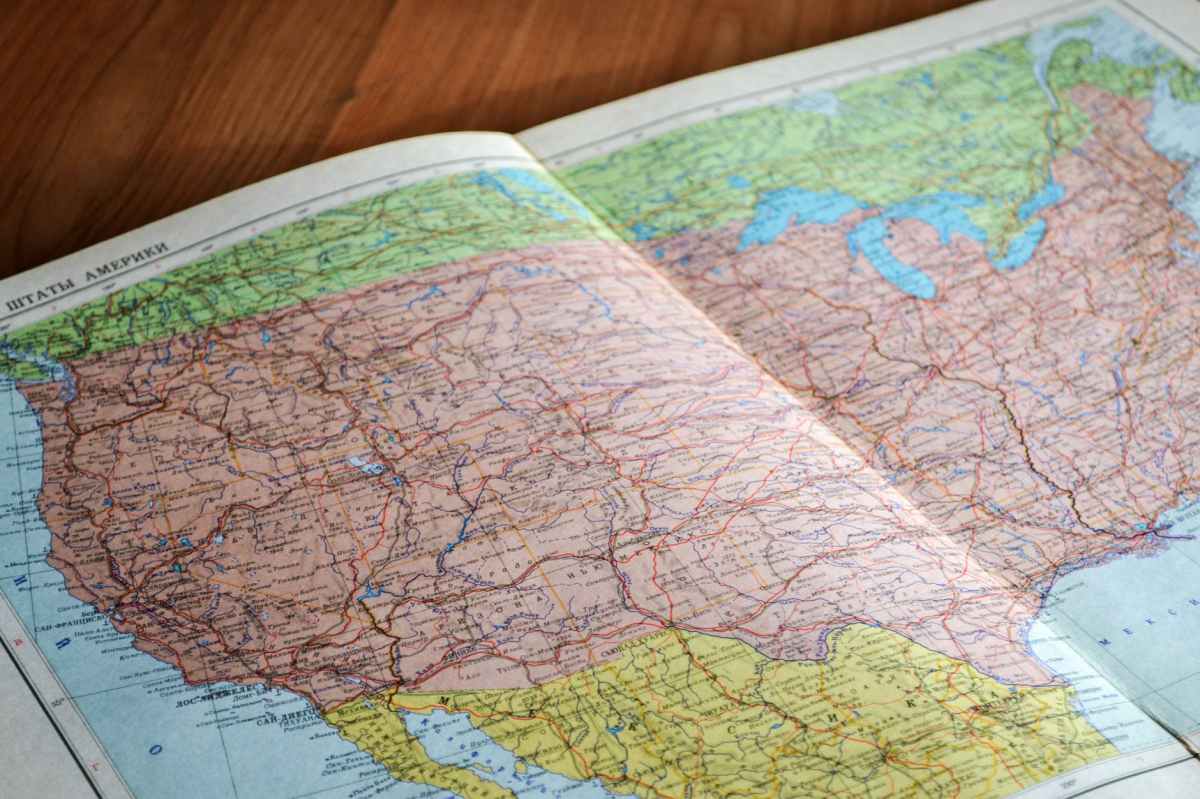
Ever since I was a little kid, I have loved looking at maps. Our family went on lots of road trips, and there was a sort of weighty, sacred significance in the big printed road atlas that was usually kept somewhere in the car. Even if we weren’t going anywhere in particular, we would get it out and we would look at it together, and I would trace my finger along the blue and red and green roads and highways crisscrossing the printed page like ribbons, or rivers, or veins, each one an invitation, a daydream, a path leading somewhere, towards a place just over the horizon of the present moment. A place that, to my young mind, was mysterious. A place that was beautiful. 

To this day I still love looking at maps and pondering places to explore, both near and far. And so it happened that this weekend I was scrolling on my phone across the map of this area and I noticed the place, about an hour from here, where the state lines of Indiana, Ohio, and Michigan converge. As best I could tell, it was just a spot along a country road pretty far from anything, with a little stone marker.  Worth driving an hour each way? I’ll let you be the judge of that, but the map was calling out to me, and so I hopped in my car on an impulse and headed north. 

After getting off of the interstate, I ended up on one of those beautiful two-lane country roads that we have in abundance around here. The land rose and fell gently, like the belly of a sleeping giant. The clouds were big and voluptuous, the trees an insistent shade of green, the red barns and the farmhouses nestled among the fields. And still I kept driving, and driving some more, far past any town, out to where the roads arent quite yet dirt, but where they’re starting to think about becoming dirt. 

And suddenly, there it was. Just off the road, with a little place to pull off: a stone marker perched on a small rise, which indicated that 130 feet to the south, the three states meet in one spot. And so I parked the car and walked a little ways, and there it was—not much to see, I’ll admit—just a little metal plaque embedded into the middle of the road with the letter “M.” So I’m guessing Michigan got to put it there.

And as you do when you drive over an hour to see a letter in the middle of the road…I stood on it. And then I took a couple of pictures of my feet standing on it. And I looked around at the loveliness of that quiet road, accompanied only by the birds and the breeze rustling the flowers and the wild grass, and I thought about how strange and yet oddly thrilling it was to be standing upon the precise intersection of three places, each with their own unique character, each with their own people and histories and hopes, and yet here, together, gently resting up against one another, hidden away in the middle of nowhere, or, depending on how you look at it, in the middle of everywhere. 

And while it was not quite as glamorous as some of the places on the map I’d daydreamed about as a kid, it was mysterious. And it was beautiful.

Now, given that today is Trinity Sunday, that day in the Church year when we preachers try, however imperfectly, to ponder and speak about the God revealed to us in Scripture who is both three and one, you might already see where my imagination is going with this. And although I admit any attempt to reduce the Trinity to a tidy analogy or image is destined to be insufficient, I couldn’t help but think about it as I stood on that spot in the road, trying to imagine where exactly on that little plaque one state ended and the other started, searching for the infinite vanishing point between uniqueness and unity. 

Uniqueness and unity. We could say something similar about the Triune God, a theological mystery which is itself perhaps marked with an M, somewhere out beyond the cosmos, in the backroads of heaven, among the fields of wheat and the wildflowers and the swooping doves. Theologians and preachers and all kinds of other people have written a lot of words trying to map the Trinity, to describe its contours and characteristics and the best way for us mere mortals to approach it. We all want to “get it” or get close to it. And yet as close as we might get, we can never quite reach the center of what or where or how the Trinity is. It is hidden from us, just out of reach, that infinite vanishing point where Father, Son and Spirit touch and intertwine, beyond the limited scope of our perception. It is nowhere, and it is everywhere. It is mysterious. And it is beautiful.

How thrilling and humbling it is, when you really think about it, that as Christians we give our lives, our whole selves, over to something—to Someone—whom we can’t quite understand. But that’s what love is, in the end, isn’t it? A headlong leap into mystery. 

And so today, on Trinity Sunday, we honor that mystery of God’s love, not trying to solve it like a riddle or simplify it into a diagram, but instead to celebrate the journey that we make together in its general direction, like travelers with a map in our hands—longing for the promise that lies beyond the horizon of the present moment, searching for that place at the end of the long road, the place where all of our unique stories, all of our hopes and our homelands meet, gently resting up against one another— a place we know is real because Jesus has revealed its possibility to us, even if we can’t quite describe it or see it yet.

But that’s the whole point—we haven’t fully arrived. We haven’t plotted the precise coordinates of the Kingdom—no, not a single one of us. And we as the Church are at our best when we acknowledge that our journey toward understanding God is still a work in progress. The depth of the Trinity, that is to say the depth of God’s grace-filled self, is still being revealed to us. And admitting this prevents us from all manner of ills: legalism and self-satisfaction and complacency and hardened certainties. It keeps us tender, open to being surprised, open to admitting that perhaps God is even more wondrous, more loving, more liberating than we—or anyone—has ever dared to hope. 

“I still have many things to say to you, but you cannot bear them now,” Jesus says in today’s Gospel passage. “When the Spirit of truth comes, he will guide you into all the truth…he will declare to you the things that are to come.” 

This story—this revelation of the divine life of the Trinity—is not over yet. The Spirit is still working within us and within the present moment; the Son is still journeying with us, even to the end of the age; and the Father stills waits to greet us, his prodigal children, at the end of our travels, running across the field, arms open wide, a feast heavy upon the table. The Trinity is all of this, and more. It is mysterious, and it is beautiful.

Our only task is to keep going. Keep going, even when we stumble. Keep going, even when it feels like we’ve lost the path. Keep going, even when nobody else seems to want to come with us. Keep going, even when the map is stained with our tears and the lines bleed together. Keep going.

Because if nothing else, to speak of the Trinity, the way it moves and holds and calls us, is to speak of God’s ongoing invitation to keep going. It is the proclamation that God was, and God is, and God will be with us as we do so, and that wherever we are going, we will meet him in the end. We will converge, somewhere on that hidden road, into that infinite vanishing point of uniqueness and unity, of God and of creation, of flesh and blood and bread and wine and breath and wind and flame. We will stand right there at the intersection of eternity, and finally, we will know. Finally, we will be known.

I still keep an atlas in my car, by the way. Every once in a while I’ll take it out and trace the roads on the map with my finger, dreaming of what more there is to see. There’s always more to see. The only difference is that now, I have come to know that you don’t have to travel very far to see wondrous things. The infinite mysteries of the universe—of love, of life, of God—are close to you, closer than you can imagine. 

Sometimes, if you know how and where to look, they’re just under your feet. 

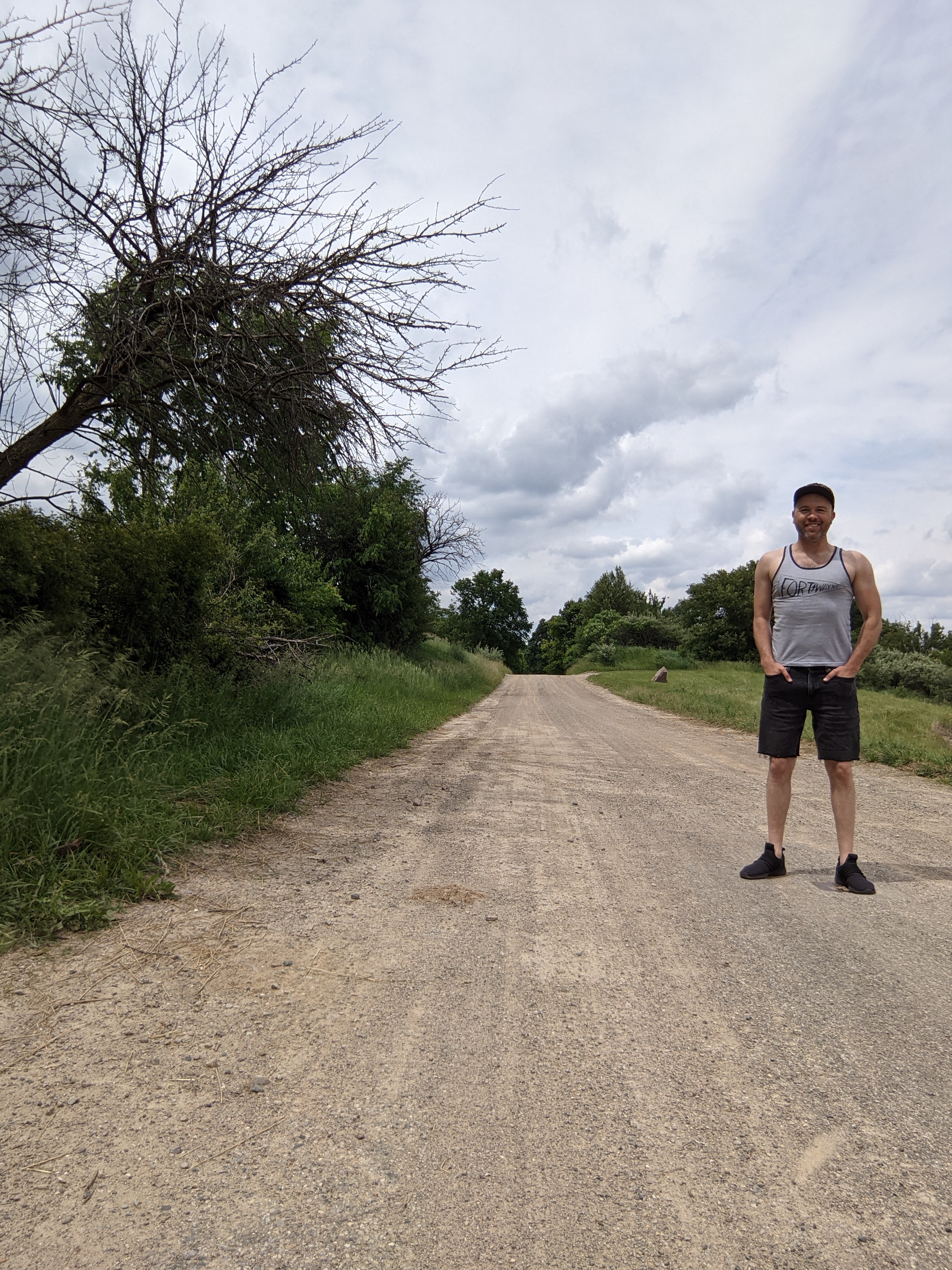
Standing on the spot where Indiana, Ohio, and Michigan converge.

The Language of Our Hearts: A Pentecost Sermon

I preached this sermon on Pentecost, June 5, 2022, at Trinity Episcopal Church, Fort Wayne, IN. The lectionary text cited is Acts 2:1-21, the descent of the Holy Spirit onto the Apostles.

A few weeks ago I traveled up to South Bend to attend a conference for all of the Episcopal Churches in Province V, which is a region that roughly encompasses the midwestern United States. It was a wonderful time, both for the workshops and other sessions offered, and also, just as importantly, for the chance to connect with new people and reconnect with some familiar ones—friends and colleagues that I hadn’t seen since well before the pandemic started. As we know from gathering together here at Trinity each Sunday, there is something heartening and healing about being together in person, seeing each other’s faces, hearing each other’s voices.  

When we celebrated the Eucharist at the conference, we were invited to do something that perhaps you’ve experienced before if you’ve attended a large Episcopal gathering or convention, especially one with a diversity of attendees: at that moment in the liturgy when we all join together to say the Lord’s Prayer, we were asked to pray it in “the language of our heart.” The language of our heart. I love that phrase.

And so, after a brief pause, a cacophony of voices rose up in prayer—some praying in the traditional English language version that is so dear and familiar to us here; some in the more contemporary English translation; but also in Spanish, and in other languages—a seminary friend of mine who was there offered prayers in Lakota. The cumulative effect was messy, but beautiful—a collision of hearts and tongues naming God, praising God, asking God for protection and provision. 

Maybe it was because I hadn’t heard the Lord’s Prayer offered that way in a little while, but it touched me deeply, it gave me a different sense of the vastness of that prayer, the billions of times it is offered up each day, in grand churches and in homeless shelters, on mountaintops and on commuter trains, by people we will never meet, people so different from us and yet so fundamentally connected to us, each crying out in the language of their deepest heart. Our Father, who art in heaven. Padre nuestro. Ate unyanpi. (That last one is in Lakota, if you’re curious). 

One of the great tragedies of Christian history has been the idea that being one in Christ means being exactly the same as one another. The idea that being part of the universal Church is more about fitting in than it is about becoming the fullness of who God made each of us to be. That pressure to conform, to get in line, to deny the parts of yourself deemed different or unacceptable—that is a particular cultural force at work, not the Gospel itself. That urge to suppress diversity is the work of tyrants and empires, not the work of God’s Kingdom. Because the Spirit of God speaks in every language, shows up in every type of person and place and circumstance, the Spirit radiates out of every color of the rainbow. 

And, to put it more bluntly for those of us here in the United States: God does not only speak in or understand English. God does not only work through people similar to us. And I thank God that we are part of a church that recognizes the joy and the strength of diversity of every type—social, economic, political, theological, racial, linguistic, and every other sort, too. We are messy, but we are beautiful, this collision of hearts and tongues that we call The Episcopal Church. 

By not simply tolerating our differences but striving to cherish them and learn from them, we live into the reality of the Church that was born on that first Pentecost, when the Apostles were caught up in the whirlwind of the Spirit and were able to proclaim the gospel in the native tongues of the immigrants to whom they spoke. 

There is a nuance here that is essential for us not to miss: the miraculous gift of the Spirit was not that these immigrants could suddenly understand the Apostles speaking in one universal language—which would likely have been Greek or Latin, the dominant languages of the Roman Empire. It was that the gospel was carried to their ears in the language of their hearts—the language of their blood, the language of their native soil, the language their parents sang to them in lullabies, the language by which they learned to count the stars and name the creatures of the earth. 

On this day the gospel–the fiery incandescence of God’s love–was transformed on the lips of the Galilean preachers and rendered into the particular poetry of the hearers’ innermost self. This is the day God called out to each of them not in the language of empire, of conquest, of sameness, but in a voice that was as familiar as their own.

There is a crucial lesson in that, a fundamental Christian truth, especially as we grapple with our own challenges of living in a diverse society where some would still have us give up our God-given uniqueness, would have us mute our stories, our perspectives, our voices, in favor of a monolithic, lifeless consensus masquerading as peace.

That is not what we were made for. That is not what Jesus died for. That is not the type of peace he leaves with us. And that is not what the Spirit came for at Pentecost. The Spirit came to fill each of us with life abundant, to winnow away with fire all the lies we tell ourselves, leaving the clarity and the particularity of our divinely-made selfhood, and the Spirit came to catch us up into a bond of fellowship that honors our differences while uniting us in common practice, in common mission. 

Authenticity and courage and truth, that is our peace. And that is not just who we can be or hope to be, that is who we are when we surrender our fear and our bitterness and our prejudice to the expansiveness of God’s Spirit. A people reborn, a people who are unafraid to speak in the languages of our hearts and yet somehow still understand one another in the wordlessness of grace, the ultimately unspeakable mystery of life and of love. 

Let that Spirit of love be yours today. Let it shape all of your days. Let it shape the work that we do together in this community, in this nation, on this planet. None of the challenges that we collectively face can be met without this Spirit—a Spirit that honors difference, and yet demands from us the discipline of remaining together IN that difference. No retreating into corners; no demonizing one another; no insistence that God only speaks in ways that we alone understand. 

For if the Spirit of God is like fire, like wind, then it is elemental, and limitless, and free—it is available to everyone, kindled in hearths unknown to us, blowing across landscapes we will never see, speaking in languages we will never understand. Today we honor that vast freedom of the Spirit, we put our hope in it, because it means that we, too, might yet be free. We, too, might yet be liberated from the language of empire and speak, instead, the living language of our hearts.

Come, Holy Spirit. Only speak the word, and we shall live. Speak the word, and we shall be healed. 

Names: A Sermon

I preached this sermon on Sunday, May 8 2022 at Trinity Episcopal Church, Fort Wayne. The lectionary text cited is Acts 9:36-43, in which Peter raises a woman from death.

How many names do you have?

The immediate answer to that question might seem obvious—many of us have a first, a middle, and a last, with maybe one or two more thrown in for good measure by our parents. But it’s not always that straightforward—some of us also have old nicknames, the recollection of which might make us squirm with delight or embarrassment; affectionate names given by friends and romantic partners; and names that we have claimed for ourselves later in life as we have better understood who we are and how we wish to be known to the world. There might be other names, too, that we’d rather not hear—the hurtful, insulting ones that were hurled at us at one point or another, the ones that still rattle around in our memory like heavy stones. 

There is great power in the names we carry; power to heal and to harm; to remember who we are and to be reborn. It should not be surprising, then, that much of Scripture is taken up with the giving and the changing and the remembering of names, including the ones we have applied, with the limitations of human language, to the unspeakable name of God. 

We might say that, in some way, the entire story of God’s people thoroughout the Bible is the search for a name—a name by which to know ourselves, a name by which to address the ineffability of divine truth, a name to call out into the silent infinitude of the stars—a name that is sufficient to say what life is, a name that can capture in full something that is ultimately beyond words.

I got to thinking about names because of today’s passage from Acts, where Peter restores to life a woman in the city of Joppa, a woman who bears two names, Tabitha and Dorcas. As the writer of Acts informs us, Dorcas is the Greek translation of the Aramaic name Tabitha, which means “gazelle.” Now, it would be easy to pass right over this detail as we read about her miraculous resurrection, but I think we would miss something important if we did so. 

Commentators note that Tabitha/Dorcas, in addition to being a woman of some financial means who was able to support the widows in her community, was also a woman that straddled two worlds. Joppa is a port city, and given her two names, it is likely that this disciple of Jesus was a Greek-speaking Jewish woman who occupied a liminal space between her Israelite identity and her ties to the Hellenized world of the Roman empire. Her two names suggest that she had learned to traverse the ambiguous territory between colonized and colonizer, between membership in an oppressed nation and the society of the imperial oppressor.

We do not know how she managed this interplay of names and identities, but we do know that in the midst of them, this woman who was both Tabitha and Dorcas dedicated her life to service in the name of Jesus. And perhaps, for her, the name of disciple–follower of the Way, sheep in the flock of the Good Shepherd–was the thread that bound her disparate roles in a fractured world. 

But then note what happens in the passage. Peter (himself another bearer of two names) comes to see the body of the woman, and in raising her back to life, he says, “Tabitha, get up.” Not Dorcas, but Tabitha. Her first name, the name that was with her from the beginning, the name spoken in her people’s original language: this is the name by which she is called back to herself, this is the name that inaugurates her resurrected existence. It is Tabitha, tzvia in ancient Hebrew, the same word that names the gazelle leaping on the mountainside in the Song of Solomon, that is the name of life for her. That is the name by which God, through Peter, breathes life back into her body. And while the Scriptures do not tell us anything about her life after this miracle, I can’t help but imagine that, for the rest of her days, she remembered the sacred power of being brought back to life by the sound of her original name. Tabitha, get up. 

What is the name by which God would call you? What is the name that encapsulates your deepest self, the name that is life to you? And, conversely, what names have been put upon you that no longer work, that no longer tell the whole story of who you are called to be?

I speak not only of given names and surnames, but also of the roles and identities by which we are known and named, which, while important, are too often over-simplified, objectified, and used to label and limit our complexity—old, young, healthy, sick, parent, child. Priest, layperson, spiritual wanderer. Gay, straight, trans*, Black, Brown. American. Foreigner. Pro-Life. Pro-choice. Democrat. Republican. Do these names actually tell you who you are, or who your neighbor is?

Or is there a deeper name, an original name, by which you must identify yourself and those whom you encounter if we will ever hope to actually know one another? Is there a name for ourselves that will bring the dying parts of this world back to life?

There is, in fact.

And it turns out that the woman known as Dorcas heard that it day as she awoke from the sleep of death. Because a funny thing about the name Tabitha—tzvia. That word, in its original language, doesn’t only mean gazelle, but also, simply this: beautiful. Her name was beauty. 

Beautiful one, get up. 

This is the name by which God knows each of us. This is the name that God has called us from the moment the world began. And this is the name by which God, in Christ, desires us to know one another—the name underneath our names, the name beyond every label and slur and stereotype. The name that will bring anyone back to life. 

Beautiful one, get up.

And this is the only name that can heal us, that can see us through the divisions and the suspicions that have plagued not only our recent history but the entirety of the human story. It is only when we know ourselves as beautiful, as beloved, and when we see that same thing in the face of our neighbors, in the face of our enemies, as Jesus taught us to, that we will begin to move back from the brink.

It is only when we see and name the inherent beauty and dignity of all creation and develop a reverence for what God has made and called good that we will move closer toward the kingdom wherein we were meant to dwell. It is only when we stop name-calling and start naming each other as beautiful, when we start noticing the beauty we see, even in the places and people where it’s not first apparent—it is only then that we will finally speak our own true names, and it is only then our mortal tongues will begin to utter something that approaches the one true name of God. 

The God who woke Tabitha from the dead.

The God who woke Jesus from the dead.

The God who will wake each of us, on the last day, saying, quite simply:

Beautiful one, get up. 

The Cup: A Sermon

I preached this sermon on Maundy Thursday, April 14, 2022 at Trinity Episcopal Church, Fort Wayne. The communion cup, which had been suspended in our parish during the COVID-19 pandemic, was restored at this service.

There isn’t a general confession in tonight’s liturgy, so allow me a bit of time for a very minor confession of my own. While I generally try to embrace material simplicity, there is one area in which I have grievously failed, and it is this: I have an embarrassingly large collection of cups and mugs in my kitchen at home. Far more than any one person should have. Perhaps you can relate to this. When I open up my cupboard, there they are, stacked on top of one another, balanced precariously, mismatched, the designs a bit faded in spots, but comforting—a jumble of memories. 

There is the juice glass I used to use every morning as kid visiting my grandma’s house. There is the coffee mug from a monastery I visited when discerning the priesthood. There is a cup that my mom and I picked up while driving Route 66. There is the 175th anniversary coffee mug from Trinity Fort Wayne. There is a wine glass I bought in Europe. There is yet ANOTHER coffee mug that I don’t especially love but that was given to me by someone whom I do love. You get the idea. 

In terms of problems to have, it’s a very silly one. But it reminds me that there is something very evocative about cups. For some strange reason we are drawn to them; they mean more to us, somehow, than just a receptacle to hold a beverage.They hold memories, too, they tell a story about where we come from, the things we have seen, and what our life has been about. When we bring them to our lips, we kiss the past and we hold a part of ourselves. The cups reveal, in some small way, who we are. 

Maybe that’s why it has been so disorienting, these past two pandemic-shaped years, to have no cup offered during the Eucharist. The Church decided, out of an abundance of caution, to suspend this aspect of Holy Communion, and while we’ve certainly been on solid theological ground receiving only the bread during this time, I admit I have still felt a bit lost at sea without that other component of the Eucharistic feast: the common cup shared among us, the sweetness on the lips, and those words that satisfy our deepest thirst: the blood of Christ, the cup of salvation.

It is fitting, deeply fitting, then, on this Maundy Thursday when we remember and celebrate Jesus’ institution of the Eucharist, that the common cup is returning to our communion offering. This evening when you come forward to be nourished by Christ’s body in the form of bread, the chalice of his blood will be offered to you as well, and if you feel comfortable doing so, you are invited to drink, and remember what this particular cup reveals about where we come from, the things we have seen, and what our life together is about. 

But this cup that we drink from is special, it is singular, because unlike the mugs and the glasses stacked on our shelves, each holding our own private histories, this Eucharistic vessel also reveals something essential about about God’s history, about who God is and what God has done. In truth, the Eucharistic cup is God’s cup first and foremost, not our own. It bears the story of God’s journey alongside and among humankind.

In the Hebrew Scriptures the prophets and the Psalmist speak often of the cup: the cup of consolation, the cup of wrath, the cup of trembling, the cup of astonishment—a cup that holds the strange mix of grace and fury that is God’s complex and unfolding relationship with the world. And tonight we come to realize that it is this same cup that Jesus must reckon with in Gethsemane—Father, if it be possible, let this cup pass from me. Ultimately he does what God has always done: he accepts the cup as the price of loving his wayward creation, drinking in the sweetness and the bitterness of his solidarity with the children of the earth.

And so I imagine that if we were to go to heaven and rummage through the cupboards, we’d open them up and find, in quiet repose, this one cup, ancient, gleaming, heavy with significance, hallowed by its use, held aloft at a thousand feasts, emptied out upon a thousand battlefields, stained with the blood and the salt-tears of our Creator. The same cup that, in the mystery of Eucharistic grace, is handed to us on this night, that we might take hold of its heavy glory. No longer God’s cup alone, but also ours.

“I received from the Lord what I also handed on to you,” Paul tells the church at Corinth, recounting the words of Jesus at the Last Supper—a meal, of course, at which he himself was not present, but which, we must conclude, he must have come to know as part of the all-encompassing, all-consuming revelation of Christ he experienced on the Damascus road. 

Paul understood, somehow, in the lifelong aftermath of his conversion, that this particular meal, this particular bread and cup, reveal the truth about God’s deepest self—and that as often as we eat this bread and drink this cup, we are taking part in God’s own feast—the banquet prepared from the foundation of the world. In so doing, God’s story, God’s sustaining life becomes ours as well. 

And so, tonight, like the disciples who gathered in the lamplight of the Upper Room, we glimpse salvation upon this table, and we drink from this cup—the cup of memory, the cup of sorrow, the cup of laughter, the cup that holds the fermentation of finitude and eternity, the cup that holds ALL THINGS in the costly covenant of love—we drink from this cup tonight for Jesus’ sake because he drank from it for our sake. He drank it to the dregs, knowing what it meant to do so, knowing that living also means one must die, knowing that it was worth dying for us in order to live for us. 

All of that significance, all of that history, all of that costliness, all of that promise, all held in a single sip. A sip he now asks us to take as well, so that at last, we might know him for who he is. 

I know all of this is true, I know it is real, but I cannot really comprehend it. And yet, like you, I will hold that cup in my hands, I will receive it with wonder and gratitude, trusting that even if I never really understand the mystery of death and life, even if I never understand the depth and breadth of God’s love, at least I will know what it tastes like. 

And that will be enough.

For as we will discover repeatedly throughout these holy days, words can only take us so far. Ultimately we must do a thing for it it be real. The feet must be washed. The bread must be broken. The cup must be poured out. 

These actions are both a question and their own sort of answer, because they are the pieces of God’s story that speak best for themselves, like a cupboard full of jumbled vessels, passed down, love-worn, inexplicably precious, infinitely capable of holding our own stories—the old stories, the ones we are living through today, and the story that God, with us, is only now beginning to tell.

Tonight is the night that story begins, again. 

Drink it in, beloved children of God. Drink it all in. 

The Church is Crumbling: A Sermon

I preached this sermon on Sunday, April 3rd, 2022 at Trinity Episcopal Church, Fort Wayne. The lectionary text cited is John 12:1-8, when Mary of Bethany anoints Jesus with precious nard.

Now, I don’t want to alarm anyone inordinately on a Sunday morning, but I have to tell you that the church is crumbling.

I’m actually not making a dire prediction about the future of the institutional church (plenty of others are doing that these days). I mean, quite literally, there are bits of Trinity’s building that are crumbling on the outside that will need a little maintenance. Fr. T.J. and I were walking back from lunch the other week when he noted a spot on the exterior of the nave that needs some repair to the mortar work. Such things are to be expected in a building nearly 160 years old, and don’t worry, the members of the Vestry are keenly aware of the ongoing project list to care for these old stone walls. It is part of our collective labor of love as stewards of this community for future generations. 

In every age, as the ones entrusted with the care of the present moment, it is our task to keep an eye out for the cracks in the world around us: the broken bits of buildings and of hearts, the accumulating dust of neglect, the water streaming down in rivulets from leaking roofs and from tear-filled eyes. All of us, both building and people, get a bit tired and careworn eventually. All of us need tending. And so we patch each other up, we put mortar into each others’ broken spots, we carry one another and we carry on. This is our shared responsibility in life, as it always has been.

The tendency towards decay and disorder, whether in church walls or in other human endeavors, has a name derived from science. It is called entropy. The word was coined in the 19th century by the German physicist Rudolf Clausius, who was a leader in the study of thermodynamics. Clausius observed that the energy in heat-powered systems, like steam engines, was not all harnessed; some of it was lost and dispersed, no matter how efficient the system. This unavoidable tendency towards loss and disintegration of energy, he concluded, was the default mode of the material universe.  In other words, entropy suggests that when left to their own devices, things tend to fall apart.

The idea of entropy has since been applied to many aspects of human life, not just physics. And intuitively, I think it makes a lot of sense, even in non-scientific terms. Ideological, cultural, and political movements change and decline over time. Relationships, when we don’t invest in them, drift apart. All the seemingly solid markers of fame, prestige, and strength that we might accumulate in our life eventually diminish. And, eventually, each of us will die and, as we were reminded at the outset of this Lenten season, to dust we shall return, to mix with the crumbling stones and the memories of a thousand generations. 

Holy Scripture is full of the idea of entropy, even if it doesn’t name it as such—think of the Book of Ecclesiastes: “vanity of vanities, all is vanity!” Or the Psalmist, who says “those of high degree are but a fleeting breath, even those of low estate cannot be trusted. On the scales they are lighter than a breath, all of them together.”

The question is, what do we do with this knowledge? If everything in the universe has a tendency towards disintegration, towards chaos, towards loss, then why bother? Why not let the walls come tumbling down?

This is, essentially, the question that this Gospel passage from John asks us. It is the question that Judas and Mary of Bethany are both faced with in those final days leading up to Jesus’ passion and death, and their diverging responses are instructive for us. 

First, there is Judas, who is outraged and offended by Mary’s display of deep devotion—the anointing of Jesus’ feet with precious nard, the intimacy of her hair wound around him in tendrils like branches clinging to the vine. Whether it is out of pure greed or, as I suspect, a whole host of more complicated emotions and motivations, Judas thinks all of this is shameful, wasteful. 

I wonder, though, if this is not so much a matter of Judas misunderstanding what’s going on, but in fact understanding all too well what is about to transpire in Jerusalem. Perhaps Judas has taken Jesus’ prediction of his own death seriously. Perhaps Judas has already given up on him. Perhaps he has seen the cracks in the mortar, if you will, and is ready to walk away from the whole thing.

“Why was this perfume not sold…and the money given to the poor?” he asks, but there is bitterness underneath his words, not generosity. They are the words of a man who has given up on dreams, on love, on friendship, because the entropy of the world and the looming failure of Jesus’s mission has caused Judas to retreat into himself, into his own protective self-righteousness, into his own understanding of how things ought to be.

How hard our hearts become when we try to keep them from breaking. And so Judas decides to break Jesus, instead. He decides to tear down the walls rather than wait for them to fall. 

If we are honest with ourselves, that same tendency is in each of us. Afraid of loss, we run away. Afraid of vulnerability, we slam the door shut. Afraid of being a fool, we become a cynic, with entropy the only news we have to proclaim to the world.

But then there is Mary of Bethany, who is sometimes conflated with Mary Magdalene, but in this moment we will let her be herself. Mary is not naive in her gift-giving. She, too, knows what is coming. She knows that Jesus is approaching an ending. She knows that the nard is costly, and that anointing her Lord will not prevent the pain or loss that is to come. But she does it anyway. She does it because it is what she can do. She does it because she loves him. She does it because she knows, in a way that Judas does not, that in loving someone, nothing is ever wasted. 

Mary, and all of us who would follow in her footsteps, do not deny that death and decay are real. We are not ignoring the fact that things tend to fall apart, that chaos is always at the doorstep. We know that it is. We see the crumbling stones, and we witness the crumbling hopes of too many in every generation. But we show up anyway. We try to mend the cracks anyway, even if we are taken as fools, even if it never seems to amount to very much, because it is what we can do. It is what love requires of us. 

What Mary knew–and what Jesus reveals–is that while entropy might be the most pervasive force in the universe, the most powerful force is love. It is only love that will dare to bind up what is broken. It is only love that can gather in what is lost. It is only love that refuses to give up even when things keep going wrong. And no matter how things disintegrate and scatter, no matter how our own lives fall apart, no matter if these walls do keep crumbling down, no matter if the entire universe breaks apart, God will always be bigger than our brokenness. God holds us. God refuses to give up on us. 

And so we must do the same. What God has said to us, and what Mary says back to God, we must also say:

I will hold what is broken. I will bless it with my deepest tenderness. I will spend all of my love on the things that are doomed to decay, which is, in fact, everything. And though I may weep, though my heart might break at the seeming futility of love, I know in a way beyond knowing that it will all make sense some day. That it will have been worth it.

It is worth it. That’s the good news.

So if you get a chance this week, take a walk around the church building. You might spot the broken bits I mentioned or the places where the garden needs tending after a long winter. You might notice a crack in the plaster here and there. Our work continues, always. But notice, too, the patches, the repairs, and the additions of those who came before us—the small acts of care by generations of people, some of whom we will never know, but who did what they could even as the walls crumbled in their own time. 

And perhaps, like me, you might offer a prayer of thanksgiving for those people–those with the heart of Mary of Bethany–for the sweetness of their offerings, the memory of which still lingers like perfume in the air.  Perhaps, like me, you might marvel at the fact that because of them, and because of us still trying our best, despite the entropy of the world, we are still standing, and these stones are still standing, held together by love as much as by mortar. 

And perhaps, like me, you will find strength in knowing this: that even if everything else turns to dust, this love will remain. It is the one thing that cannot break. It is the one thing that will never go away.

No Regrets: A Sermon

I preached this sermon on Sunday, March 6, 2022, the First Sunday in Lent. The lectionary text cited is Luke 4:1-13, Jesus’ temptation in the wilderness.

We inhabit an unsettled moment. That statement is true on many different levels, but in this instance I am referring to something deeper and more elemental than the news headlines. I am thinking instead about the changing of the seasons that accompanies our entry into Lent in the northern hemisphere.  Amid the turbulent moods of early spring, when we are caught up in the vacillating space between ice and dewdrops, between dirt and blossom, between the cradle and the Cross, there is a keener sense perhaps, of the fertile mix of decay and growth that characterizes our lives on this earth. On Ash Wednesday, the cold mud of winter was imprinted on our brows, and eventually on Easter Day we will convulse with joy among the fields of lilies, but for now we are held in the tension of the time-being, suspended in the middle of frost and flower, mortality and miracle. 

Lent is the pungent season when life and death speak to one another. Too often we keep these two realities isolated in separate corners of our minds, so it is good for us to listen to their conversation over the next several weeks, to notice how life and death layer upon and fertilize the other, both in the Liturgy and in the world around us. Lent is when this life—the delicate, earthy existence we have been given—is brought into clarity and focus by accepting its brevity and, indeed, sometimes its cruelty and brokenness. But it is also a season for celebrating that life, for rediscovering the urgency of living deeply and well while we have the chance, before it is too late, and we go down to the dust once more. 

There was an article that became popular online several years ago, written by a hospice nurse. In it, she reflected on the conversations she’d had with the countless people she’d cared for in the final weeks and days of their lives, and she shared the top five regrets that people expressed as they prepared to die. They were as follows:

1. I wish I’d had the courage to live a life true to myself, not the life others expected of me.

2. I wish I hadn’t worked so hard.

3. I wish I’d had the courage to express my feelings.

4. I wish I had stayed in touch with my friends.

5. I wish that I had let myself be happier.

And while these five regrets might not be true for every person in every time and place, I think they are striking, because they point to the heart of the things that matter when everything else falls away, when there are no illusions left to hide behind, when the wind blows cold across the bare fields and we remember the trace of that muddy cross on our brow. We might say they are the insights of a Lenten spirit, from the passage between life and death, the unadorned space between the seasons of the soul. 

And they reveal that when we die, the thing we might grieve the most is simply that we never allowed ourselves to truly live. That we didn’t connect with others. That we didn’t connect with our deepest selves. And that, having been tempted by other distractions, we might face the great mystery of eternity without having deeply savored the great mystery of now.

God knows this is our struggle. God has always known this. And that is why, I suspect, we see the same struggle woven through God’s own life among us in Jesus. Consider today’s gospel passage from Luke, when Jesus is compelled by the Holy Spirit to enter the wilderness and submit to the temptations that humanity has always faced—the temptation to control our own destiny rather than trust in God’s providence, to adorn ourselves with the false security of power and prestige and material comfort; to laud safety and strength rather than vulnerability and humility. 

These were the same temptations that Israel faced in the wilderness and again when they reached the Promised Land. They are the same temptations that each of us must contend with in our own particular way. And if and when we succumb to them, the result is the same—disconnection, distrust, inauthenticity, the cultivation of a brittle and strident spirit, and then, at the end, a litany of sorrows that might sound something like:

I wish I’d had the courage to live a life true to myself. I wish I hadn’t worked so hard. I wish I’d expressed my feelings. I wish I had stayed in touch with my friends. I wish that I had let myself be happier.

But Lent is an opportunity to pull back from this trajectory in our own lives. And Jesus, in a Lenten moment of his own in this Gospel, shows us how to do so. He faces the temptations of the devil—those temptations to pattern his life in self-serving ways, to become something that he is not, and he chooses, instead, to be exactly who he is, exactly who his Father wills him to be. Which is to say, he chooses relationship, he chooses simplicity, he chooses depth, he chooses trust, he chooses love. And the words he speaks are a ray of light burning away the frost, a budding promise to us, even now, as we wait for the spring:

One does not live by bread alone.

Worship the Lord your God, and serve only him.

Do not put the Lord your God to the test.

Simple, ancient words, drawn from the Hebrew Scriptures. True words. Words that are almost like a death, in that they remind us of the fleeting nature of most of the things we fixate upon and obsess over, and instead call us back to what is eternal. These are the words that allowed Jesus to stay focused on who he was, and they can do the same for us whatever our journey looks like. They are the words that invite us to a life—and a death—that is the opposite of regret.

How do we get there? How do we live as Jesus chose to live? How do we die as Jesus chose to die?

1. Have the courage to be yourself. Abide deeply in the love that is inside of you, the love that God gave you to share with others.

2. Don’t work so hard, at least not for the things we usually give away our lives for. Work for God’s kingdom, and rest in knowing that you don’t have to do it all by yourself. You were created for wonder and praise more than you were for achievement. 

3. Express your feelings. Jesus certainly did. Don’t be afraid to be vulnerable, to be wrong, to show your weaknesses, because they are part of what will save you. We worship a God who was crucified before he was glorified. 

4. Stay in touch with your friends, and with all of the important people in your life. They are the most likely place where you will experience the love of God firsthand, and are thus the true treasures of this world. 

5. Let yourself be happy. Let yourself love this imperfect world, whether it’s deep winter or glorious spring or the messy middle with all of its unanswered questions. Let yourself be dazzled by the mystery of existence, by the mystery of God’s love, embrace it while you live, and then you will regret nothing, because you will experience everything. 

This is the life Jesus chose in the wilderness. This is the life he invites to choose. And this is the strange, holy, in-between season where we must make our choice. This is Lent. 

And so here we stand, with a trace of mud on our brow, leaning into the light; children of the broken earth, children of God. Tempted, yes. Stumbling, sometimes. Seeking, always. 

But loved, always loved, in death and in life, in winter, and in spring, and in the glorious mystery that is beneath and beyond all seasons.

And with a love that powerful, that eternal, that true, there is nothing to regret. 

The Island: A Sermon

I preached this sermon on Sunday, February 13, 2022 at St. Paul’s Episcopal Church in Mishawaka, IN. The lectionary text cited is 1 Corinthians 15:12-20.

I spent most of the summers of my childhood in the Upper Peninsula of Michigan, where my dad’s side of the family lived for generations. Now here in Mishawaka, you all live relatively close to Lake Michigan, so you have a good sense of the beauty of the Great Lakes, and if you have ever gone way up north, you know how rugged and beautiful it is on the shoreline of Lake Superior—rock formations and dense forests colliding with the open expanse of the water in its many shades and moods. 

And although there are any number of places along the shore of Lake Superior where one might be struck by its wild beauty, there is one particular spot we would visit as a kid that always stayed with me—the type of place that impresses itself upon your psyche, such that you might recall it out of nowhere while absentmindedly washing the dishes or just before drifting off to sleep at night—a pleasurably haunting memory, a dream, a landscape pregnant with unspoken meaning. 

It is a rocky, forested point of land, stretching out into the lake, with a small sandy beach at its tip and then, across a churning channel of  water, an island—so close that you can see it clearly, and, when the waters are calm, even dare to wade across to its shore. I have a distinct memory of doing so, by myself, as a child—scrambling through the water and ending up on the other side, giddy with freedom—just a couple hundred feet from the mainland but a world apart.

The point of land, the channel of water, the island—the image of that place stayed with me through many long and parched seasons of my life—chronic illness, the uncertainties of young adulthood, the sudden death of my father and, then, later, my grandparents. And although I had not been back to visit Michigan for nearly a decade and hadn’t been back to the lake for even longer than that, when I moved to Indiana nearly three years ago to serve at Trinity Fort Wayne, one of the first things I did was make the long drive north through the landscape of my past, through the mining towns and the forests. Eventually I ended up at Lake Superior, and I found the point of land again, and I walked out to the edge of it.

What struck me, though, was how deep the waters were this time—choppy waves and wind blowing in off the lake, no rocks visible to scramble on, no chance of crossing over. All I could do was stand and stare at the island, that childhood dreamscape, so close, but just beyond my reach. 

As we grow up and grow older, we tend to experience life as a sort of expanding distance from the solidities of the past. Sometimes we are grateful for that increased distance, and other times we mourn it, but either way, I think that there comes a time in each of our lives when we stand at the edge of what we know and glimpse the islands of youth and memory as beloved, yet inaccessible kingdoms. And we might despair how death consumes what was once so present to us—the places, the faces and the voices of another time.  And perhaps we start to believe that this is simply our portion in a fragile and fleeting world.

But there is another choice. There is another way to see this. 

“How can some of you say there is no resurrection of the dead?” Paul asks the church at Corinth. “If there is no resurrection of the dead, then Christ has not been raised; and if Christ has not been raised, then our proclamation has been in vain and your faith has been in vain.”

Apparently there were some among the Corinthians who accepted that Christ indeed had risen from the dead, and that this was a miraculous act of God, but they could not accept the idea that all of the rest of us were destined for the same undying life. In a world where it is self-evident that everything and everyone dies and decays, perhaps it felt foolish to them, naive, even, to claim such a possibility.  They were content, it seems, for Jesus to be the inaccessible island, beautiful to behold but not part of their actual lived reality—not a place they themselves could ever dare to venture. 

But Paul will have none of this. For he understands that we are not just people who have beheld the resurrection of someone else, of Jesus, but we are, ourselves, resurrection people. Where Jesus goes, we go too. And if the chasm between where we stand and where he has risen seems impassable, that is because we have still bought into the lie that death wins. It does not. Not any more. With Jesus, death is not the last word of any story. “If for this life only we have hoped in Christ, we are of all people most to be pitied,” because then we have missed the actual endpoint, the actual telos of following Jesus. Follow me, he says, not just through this world but onward, onward, “further up and further in” as C.S. Lewis wrote, to the undying life of God that makes everything possible.

I think sometimes as good, reasonable Episcopalians, we are hesitant to really lean into this paradigm of resurrection, of life eternal. We don’t want to think so much about heaven that we discount the beauty and the urgent need of this world. But the danger is that we go too far the other way—that we become so focused on our present reality that we forget that we are inheritors of the resurrection—that another world is not only possible, it is promised, and it is already making itself known in our midst. 

And when we see that, it changes EVERYTHING, because death is no longer the precipice over which our love inevitably vanishes. Death is no longer an impassable, stormy channel separating us from God’s life. For God’s Son has calmed the waters, he has made it passable. And so the island beckons once more; its golden shores are a place we were meant to stand; the kingdom beyond death where Jesus stands, welcoming us back into life.

What does this mean for us, here and now, to be Resurrection people? It means that we can be people of joyful courage. We don’t have to stand wistfully on the shore, mourning what once was. Because to believe in Resurrection is to believe that nothing is truly lost; that every good thing is still possible. Even when we are poor, hungry, grieving, or lonely, even when the world is changing, even when the church is changing—every good thing is possible. This is our proclamation and our practice.

And here at St. Paul’s, and down at Trinity Fort Wayne, and in every parish and faith community that comes together in the name of Jesus, we have an opportunity to practice at this together—to practice being Resurrection people. Everything we do in our faith communities—serving, donating, tending to one another, worshipping, studying, feeding, mending, advocating—all of it is a way of saying yes to God’s aliveness, it is a step out into the water, confident that we can reach the other side, that that Divine life awaits us, as long as we hold onto each other and keep our eyes on Jesus.

I know it has been a long hard couple of years, but don’t turn back. Don’t give up. We can get there.

I haven’t been back up to to Lake Superior since that day, and I don’t know if or when I will make it there again. But I think that the island will remain in my mind’s eye forever—a reminder that I have a choice—that life can be viewed either as a wistfully inaccessible, passing dream or it can be viewed as a promise that lies on the other side of death. Every day, with God’s help, I mean to choose the latter. I mean to choose the promise. 

And perhaps, one distant day, when the waters have been stilled forever, I will cross that channel and stand on the other side once more, and life will feel new, and nothing will be lost, ever again. Perhaps that’s where we’re all headed in time. I pray that we are.

And on that day, Resurrection will be not just a promise glimpsed far off, but the ground upon which we stand. 

Porches: A Sermon

I preached this sermon on Sunday, January 30, 2022 at Trinity Episcopal Church in Fort Wayne, IN. The lectionary text cited is 1 Corinthians 13:1-13.

Since moving to Fort Wayne a few years ago, I have discovered one of the simple, perfect pleasures of life in the Midwest (during the warmer months, at least): strolling through the neighborhood at dusk, fireflies blinking in the humid air, as people sit out on their front porches watching the encroaching twilight.

Growing up largely out west where the houses look very different, I have to say that there is nothing like a good front porch. They are a thing of beauty, especially in the older neighborhoods where they sit broad and benevolent, ensconced amidst leafy green trees, the warm glow of a lamp spilling out into the gathering night. And always a rocking chair or a swing, inhabited in the cool of the evening by some friendly neighbors.

I walk past and we wave to one another, remark on the weather; just a moment of encounter, a little reminder of the permeability of the barrier between our lives and the lives of the people around us—between our homes and the larger home that is our community. Front porches facilitate that somehow.

One evening last spring I was walking through the neighborhood as the blossoms fell and gathered on the streets, and the silhouette of a man on his porch greeted me. “It’s a beautiful night,” he said. “It feels like hope.”

It feels like hope. What an unexpected yet wonderful thing to say to a passing stranger. But he was right, that moment did feel like hope—both the beautiful evening and his poetic greeting.

Early on in the most isolating phase of the pandemic, those porch greetings were sometimes the only real face-to-face interaction I might have in a day, and it was a balm for the loneliness of uncertain times. You might recall that there were stories in early 202 from around the world of people going out on their front porches or their balconies to wave to one another, to dance and to sing, as if to say: yes, we’re all still here. We’re still together, even if we don’t always realize it. 

When we’re out on the front porch, the world is a bit kinder, a bit gentler—we suddenly realize that we live amidst a thousand open thresholds rather than row upon row of closed doors. A thousand open hearts; a thousand possibilities to stop and say hello, maybe even pause together in the night and smell the blooming flowers, to watch the stars come out.

I know, of course, that not all of us live in neighborhoods with front porches, but I hope that at some point in your life you’ve experienced what I am describing—and if you haven’t, then some evening in late spring or summer, park at the church and come take a walk through my neighborhood, and let yourself experience what it is like to see your neighbors again. I promise they’ll be out there on those stately old porches, and you will be greeted, and you will go home feeling a bit more like you belong to this world.

So why all this talk of porches? Because actually I think that they’re a great way of thinking about our life of faith.

Here’s what I mean: It can be tempting to think of our faith as something very private, something that is done behind closed doors, in the seclusion of our church sanctuaries or during our bedside prayers. 

Perhaps we’ve just always done it that way, or perhaps we are suspicious of certain folks who practically chase you down the street with their religious views. Either way, we might start to act as though our Christianity is like eating alone or singing only in the shower—just something between us and God. And while there is indeed a deeply personal dimension to our relationship with Jesus, there is also something else that he asks of us—a willingness to step outside of our domesticity, to seek his face in one another and among the rest of our neighbors–especially the ones we don’t know very well. 

We don’t have to parade ourselves through the streets every day—but we can’t keep the joy of our salvation sequestered either. Our faith needs to exist in that liminal space between indoors and out, neither zealously private nor zealously overbearing. 

And so, it occurs to me that we need a front porch kind of faith. 

Deeply personal, yes, deeply grounded, but also open, inviting, hospitable, and a bit vulnerable—a faith that breathes out in the open air, a faith that is ready to meet whoever comes along and to bless them. A faith that is ready to love our neighbors in Christ’s name. 

The struggle to find this balance is as old as the church itself. Paul, in today’s famous passage from the first letter to the Corinthians, has a lot to say about love, and it is beautiful to hear, but we are well-served to remember why he was writing this letter in the first place. You see, the church in Corinth had some wealthy and worldly members in it—people who tended to think rather highly of themselves. As such, they had a tendency towards insularity—the wealthier members kept to themselves and didn’t share table fellowship with their poorer brothers and sisters. And some of them saw Christianity as, essentially, another Greek mystery religion—a pathway to further wealth and health and wisdom for themselves, rather than a dramatic reordering of their value system and their conduct in the broader community. 

And so when Paul speaks of the preeminence of love over and above all other virtues and achievements, he is telling the Corinthians—and us—that far more than cultivating eloquence or wisdom or impressive piety, we are called to simply take care of one another, and to especially take care of those who need us the most. We are called to recognize our interdependence upon one another. We are, in other words, called to have a front porch faith—a faith that is outward facing, open, and neighborly.

Someone once said, after all, “you shall love your neighbor as yourself.”

Neighbors. That’s who we are in this whole thing. To be a neighbor is our primary vocation as Christians. Not heroes on our own personal quest, not would-be saviors, not judges, nor rulers—just neighbors. Neighbors sitting on the front porch, in joyful proximity to one another, calling out blessings into the summer night, watching the fireflies, waiting for the stars.

Each of us will live out this vocation differently—whether we have an actual front porch or not. For some of us, it might look like getting to know our broader community and its needs a bit better. For others it might be delving more deeply into the ministries and the offerings of this parish. For some it might be writing a letter of encouragement or making a long overdue phone call. There is no bad place to begin. There is only the invitation to do so—to step out, to greet the world and discover that Paul was right–yes, indeed, love does abide, everywhere, in everyone, and the bravest, most impressive thing we can ever do is to live as if this is true.

And when we do so, may we discover the deep satisfaction of being a neighbor and of having one.

May we encounter the joy of remembering that each of us is an integral part of all things.

And at the end of all our journeys, may we find the front porch that waits for us, a lamp glowing in the darkness, and a voice to welcome us home. A voice that says,

It’s a beautiful night. It feels like hope.