Screen Door: A Sermon

I preached this sermon on Sunday, February 11, 2024 at St. Anne Episcopal Church, West Chester, OH. The lectionary text cited is Mark 9:2-9, an account of Jesus’ transfiguration.

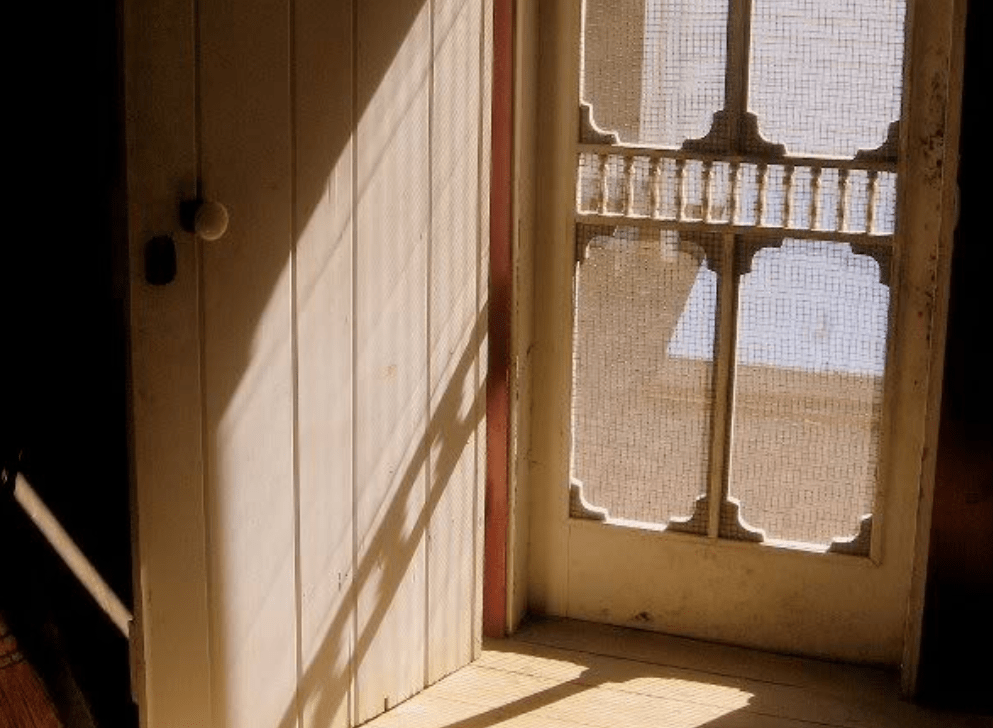
It has been many years, but I can still remember the sound of the screen door opening and slamming shut in the back porch of my grandparent’s house. The door was old and worn and yet amazingly resilient given the infinite number of times that people had passed through it on their way in and out. You see, in that house, nobody ever came in the front door, through the living room—it was always, always through the old screen door out back, and then a few steps through the porch, and on into the kitchen, the room where, as with most Midwestern families, all the truly important stuff took place. 

Maybe you remember a home or a place or a time like this—a season in your own life when the doors were always open. And so it was for us—that loud screen door was never locked, it was always at work, announcing the in-breaking  of the world that lay out beyond the warm cloister of the dim and fragrant kitchen. 

If we happened to glimpse anyone approaching the door from far off, they would emerge first as a glimmer of color and moving light out beyond the wire mesh of the screen and then—creak, rattle, slam!—there they would be, standing in our midst, in the flesh, stomping their boots, commenting on the weather. Friends and family members often showed up like this unannounced, a stream of visitors seeking to share a meal or a moment’s company, bearing news and stories. 

And I am sure someone, at some point, must have knocked, but I don’t remember it. I don’t recall the sound of knocking at all—only the familiar opening and closing of that screen door and how normal it was that people would come right in—how natural it felt for there to be a permeable boundary between what is already known and what comes to make itself known. 

There is an odd sort of paradox in a screen door, when you think about it. It is a barrier, but it’s one that is flimsy by design. It may have the shape of something absolute but it is rather ambiguous in its purpose, used to shield what is within it, but also to receive what is beyond it—the cooling breezes and the beams of light and the birdsong that travel through the screen to mingle with the inside smells of dinner and dish soap. 

It is not much of a safety measure, the screen door, but rather a way for two unique worlds to coexist alongside one another and to reveal themselves to one another. The screen door teaches us that the practice of passing back and forth between privacy and welcome; between domesticity and wildness; between the familiar and the unknown; is a good and necessary thing to do. 

And it seems to me that we have arrived at our own sort of screen door moment today, on the Sunday in the year when we see the Transfiguration, when the familiar and the unknowable commingle on the top of a mountain, when the human and the divine aspects of Jesus reveal themselves in a collision of time and light and cloud, of terror and belovedness. 

We, alongside Peter and James and John, are drawn into the strange paradox of looking at two realities at once—God’s and humanity’s—and realizing that, in Jesus, the boundaries between them are shockingly permeable. 

Today we conclude the seasons of Incarnation and Epiphany, where we have seen how the Son of God has been born and made his way into the world, approaching us, a glimmer of color and light beyond the mesh of our familiar understanding, and yet now—creak, rattle, slam!—here he stands, in his fullness, the eternal God come to pass through our door, to share a meal or a moment’s company, bearing good news and stories. 

And this, I think, is one of the most important things to understand about the Transfiguration—it’s not simply that Jesus revealed himself in a particularly magnificent way in this one moment to a handful of disciples, but that in all of our life with God, in worship and discipleship and service, transfiguration is always ready to reveal itself—the boundaries between our lives and the life of God are as permeable as a screen door through which the breeze of heaven blows.

I have seen and heard and felt him in so many different places. In moments of prayer and song. Beside a deathbed. Last week at the laundromat with the Outreach team. In conversations shared with many of you. Gathered around this table, week by week. And certainly, gathered around a kitchen table.

As we prepare for a long and thoughtful journey through Lent, to the Cross and beyond it, we are reminded today, right before we set out, that there is no aspect of human experience—even the most difficult and despairing ones—where Jesus is not able to come and be with us, to enter through the back door to sit a while, to remind us that he is separated from us by only the thinnest, most pliable boundary, if we are willing to look and listen and receive him.

Which begs the question—if the Kingdom of God is approaching us from the other side of the screen, then what must we do on our side to be ready, to greet this new world when it reveals itself? What does a screen door faith look like for us who desire a glimpse of the transfigured world beyond?

And in that, I think my grandparents were on to something simple, but essential: their door was always open. Part of what we practice here, week after week, in liturgy and in hospitality and in service and in formation, is a permeable, open-door way of life, a blurring of the demarcations between personal and communal, finite and eternal.

First, we engage in the pattern of the Eucharist so that we will go out into the world beyond our red doors and replicate that same pattern elsewhere, giving away our own selves for the sake of love, just as Jesus has done for us.

We practice welcoming visitors and strangers into the doors here at St. Anne because being open to new faces, new stories is how we cultivate openness to the presence of God whenever and however God comes into our lives—which is quite often in the form of visitors and strangers. 

We serve our neighbors, approaching the threshold of their experiences and getting to know them so that we begin to see how little separates us from anyone else; how their well-being is bound up in our own; and how the differences we perceive, while real, are not a barrier to meaningful relationship. 

And we pray and learn and study and challenge our assumptions and expand our perspectives, so that we can be attuned to the infinite number of ways that God passes into our world and abides with us, because Jesus, in that transfigured collision of flesh and light, of time and eternity, has broken down the division between heaven and earth, or at the very least he has made it like a door that will never be locked, a door to eternity that is flimsy by design, a door that is, in fact, like a screen door, where the commingling of two realities finally meet—God’s heart and our heart, God’s life and our life, the beams of light and the birdsong, the dish soap and the dinner, and all of it is God’s and all of it is ours and all of it is sacred.

And so as we approach Lent, and whatever you decide to do or not do in that season, most of all I want you to consider this: how you will stay present to the thin and permeable boundary between you and God? How will you stay open to the life that lies on the other side of the screen? Will you glimpse heaven at the laundromat, in the food pantry? Will you look for the glimmer of color and light that dance behind the words of Scripture? Will you bring good news to your neighbor, share your story with them, proclaim a word of peace to a hurting world? Will you set the table? Will you unlock the door?

Because what we do know is that God will indeed come to see us. We may not know when or how, but in every moment, on every mountain and in every valley, God is always there, ready to be with you , ready to enter in, so eager that he might not even knock, so wondrous that even if you hear his approach—creak, rattle, slam!—you may never be the same once you look up and see him: glorious, stomping his boots and commenting on the weather, seeking to share a meal, a moment; seeking, ultimately, to stay forever in you, in your heart, where, at last, he is transfigured into your flesh, your life.

And then, everything will be both familiar and new; safe and free; and you will be in heaven and you will be at home, all at once. 

On Facebook: A Sermon

I preached this sermon on Sunday, February 4, 2024 at St. Anne Episcopal Church, West Chester, OH. The lectionary texts cited are Isaiah 40:21-31 and Mark 1:29-39.

Today, February 4, 2024, is a somewhat significant anniversary. Do you know what it is?

It’s the 20th anniversary of Facebook. 

On February 4, 2004, Facebook, or “The Facebook” as it was originally known, was launched by a team of students at Harvard as a sort of high-tech student directory and then began its long, seemingly unstoppable march towards changing the way we interact with one another and the world around us. Two months after launching, in 2004, it had 70,000 active monthly users. Now it has over 3 billion, or 37% of the world’s population. As with many types of anniversary dates, reflecting on who we were then, before Facebook, and who we are now might bring up some mixed feelings. 

I was a senior in college when Facebook started, and I still remember hearing about it from some friends and signing up for the website in my dorm room in early 2005, uploading a grainy picture of myself and hunting for my real-life friends on there, when there were no links to news articles, no “like” buttons, no videos or vindictive comment sections. 

It was, back then, a novel and gently thrilling thing to be able to connect (or reconnect) with so many people at once, almost as if everyone you had ever known had moved back into your neighborhood, their lives and their stories no longer obscured by time and distance. Maybe you, too, if you ever signed up for Facebook, felt that same sense of promise, of an infinite horizon somehow drawn close enough to touch. 

But 20 years on, even if we continue to be active users of Facebook or other social media platforms, I think it’s safe to say that we have come to experience the shadow side of such a vast network of connections. And I am not just referring to the casual vitriol that seems to infect so much online discourse or the amount of time we spend staring at screens, though those are major challenges of their own. 

But even more fundamental than these, I think, and something that we might overlook, is that the vastness of information and awareness that is available via digital social networks is more than any one person is equipped to process and integrate. It might be wonderful to reconnect with lost friends, but it is also true that we only have so much bandwidth to invest in deeply meaningful, mutual relationships. 

And it is indeed valuable to have access to information about other people’s experiences, especially those whose lives are very different from our own, but the unceasing avalanche of content of all kinds, means that we also run the risk of becoming numb from overexposure, or that we end up spend a great deal of energy arguing and posturing around areas of social concern without actually engaging them in our off-screen realities.

But it makes sense that this would happen. It is not simply a failure of the will, but the reality of our limited capacity as mortal beings who, despite our deep hunger for knowledge and our inherent sense of empathy, cannot know everything, cannot respond to everything in the world with the depth and nuance it requires.

And running up against our limitations in the face of the seemingly infinite need and infinite possibility of the world–transmitted to us online–can lead us to rage, or despair, or cynicism, or some strange mixture of the three. Thinking of this through a scriptural lens, every day we bite the bitter fruit of the tree of knowledge of good and evil, and the truth is as it always has been: it was not meant for us; we cannot digest it. 

And here we are, 20 years on. 

But lest we get too down on ourselves and the ills of a digital age, we must acknowledge that this wrestling with our capacity for knowledge and compassion is as ancient as existence itself. It is a tension that is woven into all of Scripture, including our readings this morning. 

The prophet Isaiah, in a passage of both comfort and gentle reproach for Israel, asks the people whether they have forgotten the incomparable scale of God–not only that God is acting on their behalf, to care for and deliver them, but that God alone has the capacity to do so. They, by themselves, cannot conceive of or effect their own salvation. Only God can do that. God alone is able to hear and understand the many cries of the people, to bear the pain and the longing of all creation and discern a path toward healing and reconciliation. God alone can do that, because God alone has a heart large enough to break open and hold all things, and to beat and to burn with determination for the rescue and restoration of all things. 

Have you not known? Have you not heard? Has it not been told you from the beginning? It is he who sits above the circle of the earth…his understanding is unsearchable…he does not grow faint or weary. 

In other words, only God can digest the fruit of the tree of knowledge. Only he can bear the fullness of knowing and loving all of us and each of us. And God does not give in to rage or despair or cynicism in the face of our infinite need. Our hope is found in the One who can do what we ourselves cannot: to be the agent of infinite compassion, of unyielding justice, of uncompromising charity. This is who God is for us. 

And yet this truth about God sets up a deep and striking irony in the Gospel passage from Mark, where Jesus, picking up from last week, continues his ministry of healing and exorcism and in so doing, draws out the desperation and the hope and the curiosity of everyone in his vicinity, such that “the whole city was gathered around the door.” The whole city was gathered around the door. Much like reading the news online, when it can feel like the whole world is at our door, it was surely more than any one person could keep up with or even comprehend. Even Jesus.

Because unlike the infinitely expansive capacities of God spoken of in Isaiah, Jesus is–like us–just one man. Despite his eternal power, he is as finite as we are, and he can only take in so much need, so much information. And this is perhaps why, whether out of exhaustion or frustration, or both, he decides to evade the clamoring crowds, trying to stay focused on his mission to proclaim the Kingdom. 

It is as though God, in the flesh, had his own epiphany: the needs of the world are too numerous for any of us to comprehend, much less to solve on our own. We children of the dust cannot bear the fullness of what it means to be alive, to suffer, to dream. And we need something more than help. We need some measure of God’s mind, God’s heart, God’s body to mingle with our own if we ever hope to digest the bitter fruit of the tree and know what to do with it. 

And that, of course, is what Jesus ultimately gives us—not just help, but transformation into his likeness. This is my body, given for you. My peace I give to you.

So I think of Jesus, sometimes, when I struggle on Facebook and elsewhere with the enormity of the world’s grief and anxiety and the endless profusion of the world’s ideas. I think about how he, too, struggled to take it all in, and had to figure out what to do. I think about how his decision, in that moment, was not to try and understand everything or solve everything, nor to reject everything, but to love everything.

I think about how he showed up as one of us and how he blessed our finitude; how he demonstrated that true wisdom is less about an infinite capacity for knowledge or strength and more about getting in touch with the deep well of compassion that forms and sustains the cosmos. 

And I think about how we are invited—when we are overwhelmed by waves of information and endlessly expanding networks of connectivity—to neither ignore them nor to be subsumed by them, but, like Jesus, to find the still, small center of love that abides at the core of our immensely complex world and to hold fast to it no matter what. To observe and bless the ground beneath our feet; to pray; to heal whom we can heal; to love whom we can love; to proclaim what we have been sent to proclaim–the Kingdom of incarnate love; to trust that this will be sufficient. 

And to realize that, as we do so, even in our limited capacity, we are taking part in the infinite; that we are part of the broken, beating, burning heart of the One who will gather us all in and hold us; the One does not grow faint or weary, the One who will someday carry us up on eagle’s wings into the vast interconnectedness of heaven and creation, of time and eternity. Into something far better than a social network–into the very fabric of life itself, where we will be truly known and understood, where our infinite stories and endless longings will finally make sense, and where the fruit of the tree of knowledge, at long last, will be for us, and we will eat of it, and it will be sweet.

River Towns: A Sermon

I preached this sermon on Sunday, January 28, 2024, the date of the annual parish meeting at St. Anne Episcopal Church, West Chester, OH. The lectionary text cited is Mark 1:21-28.

It’s somewhat customary, when preaching on the Sunday of a parish’s annual meeting, to focus on the state of things in our faith community and to explore what it looks like to follow Jesus in this place. And I will get to that, but first, of course: a little story. 

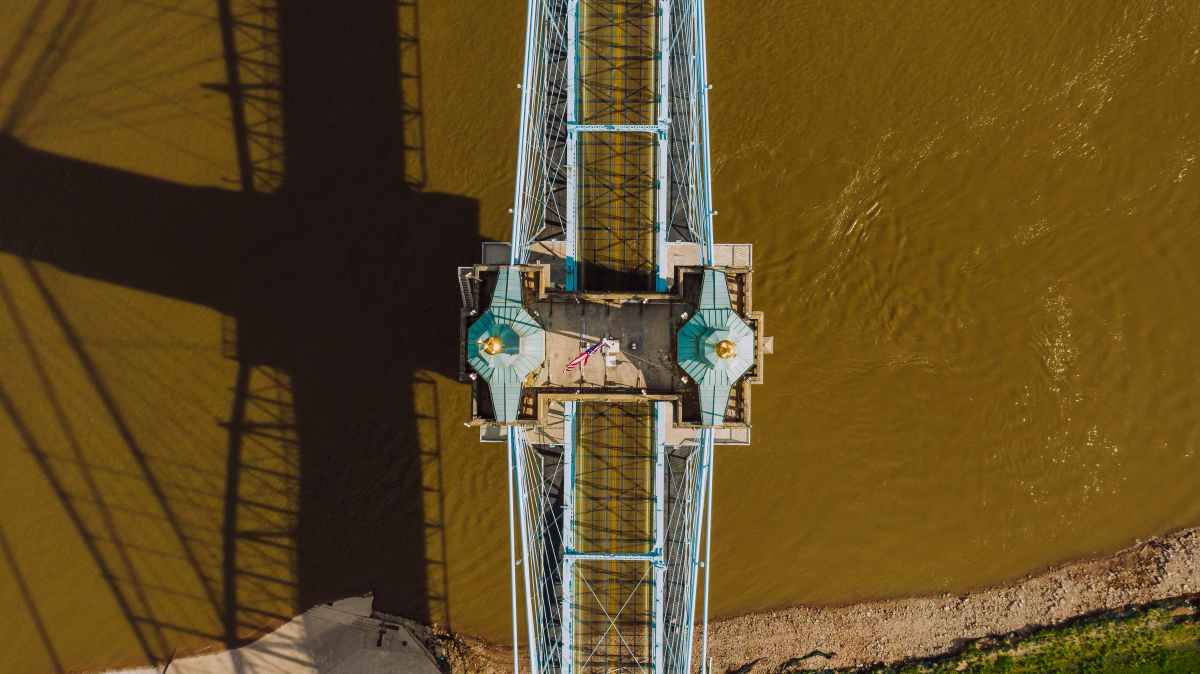
Last September, on my 40th birthday, Matt and I took a drive out from Cincinnati and along the Ohio River, first down the Kentucky side and then crossing the river by boat on one of the region’s last remaining car ferries, and then down the Ohio side of the river and eventually back up again. Surely many of you have made this trip. And if you have, you know it’s a meandering journey through a number of river towns, some of decent size, some no more than a cluster of quietly deteriorating houses. 

But what you notice in all of these places, no matter their size or condition, is that the river always looms large, just at the edge of vision and consciousness. Even if the broad water is hidden by trees or the swell of a hill, you know it is there, flowing swiftly, quietly, with determination, and the towns along its edge have conformed to the river’s temperament; they have been indelibly formed by its moods and its movement. 

I later read a book by a local author reflecting on the history of these river towns, the ones large and small, and he noted that, because there is both great opportunity and great risk in choosing to dwell at the river’s edge, people must learn to coexist with its power rather than trying to control it. 

Because when you live alongside a mighty force like the Ohio, it provides both sustenance and danger; it offers both a point of connection with the rest of the world and an ever-present possibility of inundating you. To build alongside the river, and to stay there, season after season, requires a particular blend of pragmatism, irrational hope, and surrender.

And in that sense, those river towns are a perfect metaphor for a life of faith, for a community of faith like the one that has been built here at St. Anne. To build up a church is an act of vision and of great trust in something much larger and more powerful than ourselves. We do not sit at the edge of a literal river here, of course, but we have planted ourselves alongside the living waters that comprise God’s movement through our individual lives and through the course of human history, and here at our particular bend in the stream, we must continuously live in that same precarious, energizing balance between preparedness and vulnerability, never knowing exactly what God will do next.

And while this sense of unpredictability might feel especially disorienting because of contemporary politics or technology or culture, in truth it is not a new thing—it is as old as the church itself, older even than that. It is, in fact, bound up in the very reality of God in our midst, who is always both sustaining us and overwhelming us all at once. We cannot domesticate this God any more than we can tame the power of the river, even as we are drawn to build our community upon his holy banks. 

Did you know, St. Anne, that simply by building this place, and by tending to it, and welcoming others into it, you have bravely staked a claim in close proximity to the infinite, outpouring majesty of heaven? And the whole purpose of what we do here is to learn how to live faithfully in the presence of such a force, to arrive at a knowledge of God that is born of a direct encounter with his immense and dynamic vitality. How incredible that you have done this. How wondrous that we get to continue doing this together!

And this wondrous proximity is exactly what our Gospel passage today speaks of. Consider this: Jesus, when he goes to the synagogue in Capernaum and begins to teach, impresses those present because he has what is termed “authority,” somehow unlike the wisdom of the scribes. The scribes, remember, were very learned interpreters of the law—they knew a lot of stuff—but Jesus spoke and acted as one with direct, unmediated understanding of the living force that pulsed beneath the letter of the law. 

Whatever he offered in that synagogue, however he conveyed God’s activity in the now-imminent Kingdom of Heaven, it was not just a lecture or a study guide; it was like a familiar riverbed of understanding suddenly swelling up with a previously unseen fullness—recognizable in its shape, but newly enthralling in its force, and perhaps a bit scary, too. If you have ever stood near a river that threatens to crest its banks, you might imagine what it felt like to be in the presence of Jesus. And that image might be a useful one for us to think about how God shows up to transform us and the world around us.

If you have ever witnessed a piece of art or oratory that made you well up with tears because it is so urgently true, God was there. And if you have ever stood amidst an undulating sea of protestors crying out for justice, God was there. And if you have been overcome by the beauty of a song or a thunderstorm or the silence between two kindred hearts, you might know what this looks and feels like, this torrent of God’s presence. Let justice roll down like waters and righteousness like an ever-flowing stream, says the prophet, and so we come down to the river and pray for it to roll and flow through us. 

And so it does in the synagogue at Capernaum, because Jesus does not simply teach via dry explanation or interpretation. He is the lesson. He washes away the clinging roots of demonic forces, he floods the space with holiness, he saturates the crowd with divine possibility and this is a new teaching indeed, this is authority indeed, for like a river that will not be contained, the Son of God is on a course not fixed by human machinations or timelines but is One who flows freely, with a wild, unruly peacefulness, towards the vast and hidden depths of the Father’s will. 

And the invitation—and the challenge—both for those in Capernaum back then and those of us sitting here today—is to dive in after him. To decide how we will bear witness and bear within ourselves this unmediated current of divine love and justice. How we will let our lives become the riverbeds that hold God’s life, how we will coexist, in humility and hope, with the Kingdom of God that rolls down through our cities and through our lives like those mighty waters, sustaining us and sweeping us away all at once. How will we, as the church, be like those who dwell alongside the river, building our common life with that same blend of pragmatism, irrational hope, and surrender?

Practically speaking, those are questions we will have to answer together in this new season of life at St. Anne, but they are questions we are well equipped to answer because this community knows how to build wisely and well, and this community knows how to love courageously in the face of challenge, and this community knows how to welcome the surprising in-breaking of the Spirit. 

And I am so grateful that God’s providence has led us all to be here, on the proverbial riverbank, at the outset of a new year, in that precarious, energizing balance between preparedness and vulnerability, figuring it out together. 

And so we will, this year and in the years to come, continue to construct a community that looks outward, that understands how deeply our well-being and our liberation is bound up in the well-being and the liberation of our neighbor. We are going to go deep into the riches of our spiritual life, in prayer and worship and study. We are going to welcome, with intentionality and care, every single person brought to our doors by the currents of the Spirit, so that no one here ever feels like a stranger. We are going to proclaim to all who will listen that God’s love is the most unstoppable force in the world, and that the way of love, though it can make life challenging, is the only way to truly be alive. 

On some level, we cannot know exactly how this will play out or what the future will bring. But what I do know is that all of this—what we do here, how we adapt, how we flourish, how we navigate the rise and fall of the years—is the most beautiful and courageous and necessary thing we will ever do. 

I am so excited to walk with you as we do so, because this way of life draws us into the presence and the power and the authority of the living God, whose sole purpose is to inundate the world with grace and mercy and truth. May we build faithfully at the water’s edge; may we be swept away; and may we, like all who dwell beside the mighty river, choose each day–with determination and love–to do it all over again. 

Pinky Promise: A Sermon

I preached this sermon on Sunday, January 7, 2024, the Baptism of Our Lord, at St. Anne Episcopal Church, West Chester, OH. The lectionary text cited is Mark 1:4-11.

This may not be a very popular opinion, but I actually love new year’s resolutions. Every December, in that odd lull between Christmas and New Year’s Eve, I find myself pondering what I might want do more or less of in the coming year. And I know for some this is a tiresome custom, but it honestly never gets old for me. When we are able to spend the holidays together, my mom and I have a tradition of writing down our resolutions on a scrap of paper on December 31st, reading them aloud, signing our names at the bottom, and then doing that most sacred gesture of commitment, a pinky promise, and then we tuck the piece of paper away into a wallet or bag for future reference. 

Now, truth be told, I usually find the scrap of paper sometime around June and have a look and a good laugh at my own expense, because undoubtedly my record at that point is mixed at best. I think I’ve been resolving to take up jogging for the past 20 years, and so far I’ve managed a fast walk. But I like to think of this less as a disappointment and more as persistent optimism. And 2024 is a new year—I did jog for about a minute on the treadmill the other day. Anything is possible!

But the thing that helps me—the thing that I have to remind myself, sometimes, in order to stay optimistic—is that while the goals and resolutions we have might indeed be worthwhile, and even drastically improve our lives, they do not impact our fundamental worthiness or value. 

What I have come to realize is that my mom and I are able to relax and enjoy making our lists and our pinky promises together, even if we know we will likely stumble along the way, because we know that even if we have fallen short of every single resolution by next December, it will still be ok, because it is the dreaming together and the trying that matter. 

The pinky promise that we make, I think, is more about saying—we promise we’re in this together, for good or ill, come hell or high water, no matter what happens through the turning of the seasons. It’s the sort of promise that is stronger and more enduring than any failure, because it is rooted in love. 

I think we sometimes have a complicated relationship with resolutions because it can start to feel like they are a checklist that must be accomplished IN ORDER for us to be good enough, to become, somehow, worthy of love, rather than the other way around—knowing that we are already loved, and then figuring out what to do with that knowledge. Love comes first, always.

And what shocks me, sometimes, is that even after two millennia of Christian practice and storytelling and worship and prayer, there are so many people who refuse to recognize that this is also the whole message of the Gospel: that love comes first, always. 

People so easily forget that the entire story of our existence is rooted in an unshakeable love. That, as we heard this morning in Genesis, God ventured into the chaos of primordial darkness and created the world precisely so that he could love it all—and not just the easy stuff, but the light and the darkness together. All of it. Always.

People forget that God’s promise to love us—and everyone, and everything—is itself stronger and more enduring than any failure, and that there is nothing that we can do to alter or diminish this. Some folks like to say hate the sin, love the sinner, forgetting, first, that this statement is not actually in the Bible, and second, that our greatest commandment is to not hate anything, but to love foolishly, indiscriminately, without calculation or agenda or expectation or condition. And to let ourselves be loved in that same way. 

In a world that is so shaped by contracts and conditional promises and careful measurements and demarcations, maybe this unreserved, unabashed, unbounded sort of love is inconceivable. Maybe it is a scandal. And maybe it always has been. 

It would seem so if we consider the Baptism of Jesus, which is itself, when you ponder it, a rather scandalous act, at least for our good friend John the Baptist. We don’t get as many details in Mark’s version that we just heard a few minutes ago, but in other accounts John is actually quite dismayed that Jesus—the one he was waiting for his whole life, the one coming after who is so much more powerful, so much greater—that this Holy One submits himself to a ritual cleansing from sin and failure. Where was the fire and the winnowing fork and the judgment and the display of great strength? 

Whatever John was expecting, this, apparently, was not it. He had proclaimed a Messiah who would shake the foundations of the earth, and yet this promised One comes forward like a simple man, not so different in appearance from the countless others baptized in the River Jordan, with their unmet resolutions and their faltering hopes. Jesus comes forward like one eager to love, eager to be among us, eager to confound us with his humility. 

He comes from within us, content to step down and be submerged in the current of our human frailty, content to love us precisely as we are, not as he is. Jesus’ baptism is God saying to us, we’re in this together, for good or ill, come hell or high water.

And that, essentially, is what Jesus hears, too, when he emerges from the river: this is my Son, whom I love. With him I am well pleased. Since the day the world began, God has desired for us to know and claim our belovedness, and now he has come to show us in the flesh what it looks like.

This belovedness, we begin to see, is not conditional on Jesus’ failure or success. It is woven into the very core of his being. It is this belovedness that will propel  forward into everything that will follow—the temptations and the miracles and the everyday moments.  It is this belovedness that will sustain him even when things get hard, when things fall apart, when he falls apart. And it is this belovedness that he has come to declare as both the birthright and the purpose of all people—of all creation. 

Judgment and punishment are easy to understand. But this is the incomprehensible scandal of the Gospel that no one—maybe not even John—expected: that God is love, and that God loves you and everything and everyone, and that, try as you might, nothing will change this. And once we realize this essential truth—this epiphany–we must begin to live in a new way, with the mercy and tenderness of someone who no longer needs to prove themselves worthy, and who understands the inherent worthiness of everyone else. 

But still we struggle to understand or accept this, even 2,000 years on. Still we think that somehow we must earn our place in the cosmos. But we do not. We need not. We cannot. Because love came first. 

And even if we crawl over the finish line of a particular year, and even if we crawl over the finish line of our lives, God will still say, you are my child, the beloved, with you I am well pleased. And even if we have failed and made a mess of everything, somehow, even then, I think he will be there saying we’re in this together, for good or ill, come hell or high water. 

Because God is not out there somewhere waiting for us to measure up, waiting for us to figure it all out before he loves us fully and comes alongside us. He already does. And he already has.

He has stepped down into the water with us. He has taken note of everything we’ve tried and the things we were afraid to try. The ways we have succeeded and the ways we have fallen short. The resolutions kept and the ones we still keep writing with foolish optimism on a scrap of paper. And through it all, I think he simply delights in our willingness to dream together, to try—our willingness to keep showing up, year after year, to share in a hope that is stronger and more enduring than any failure. The kind that only comes when you know that you are truly, eternally beloved.

Because you are. And that’s a pinky promise. 

Emperor: A Sermon

I preached this sermon on Sunday, October 22, 2023 at St. Anne Episcopal Church in West Chester, OH. The lectionary text cited is Matthew 22:15-22. This sermon was offered as part of the parish’s annual pledge/fundraising campaign.

Over the past couple of months, I’ve gotten together with many of you at a series of meet-and-greet events. I’ve loved the opportunity for us to learn more about one another and to hear from you about your hopes and dreams for St. Anne. There are still a couple more of these on the calendar, so I hope to see you soon if you haven’t made it to one yet. 

At a few of these, I have been able to share a bit of my own story—how I came to be in The Episcopal Church and how that eventually led me into the priesthood. I am not going to retell that whole story this morning, but a piece of it has been on my mind this week as I’ve been reflecting on both our Gospel for today and our annual pledge campaign to fund St. Anne’s mission and ministry in the coming year, because one common thread in all of these things—my own story, the Gospel story, and in St. Anne’s ongoing story—is that sometimes we discover that God is not at all who we thought God was, or that God does not in any way resemble our longstanding assumptions…and that this can be very good news. 

When I was in college, I drifted away from church; or it might be more accurate to say I ran away. My reasons were personal, but not entirely unique; I think many of us, at one juncture or another, begin to question our foundational understandings of who we are and how the world works and what is ultimately true. And that is exactly what happened to me. 

And so, in my mid-twenties, I found myself in an awkward position: I had spent a number of years feeling very unsure about everything I had been taught about faith and religion, and yet the hunger for meaning, for purpose, for belonging to something greater than myself, would not leave me alone. I longed to be part of a community that was committed to something deeper than just a hobby or a political opinion or a worldview; I wanted to engage the big questions of life and death and love and eternity, but I didn’t want to be given an ultimatum as to how best to answer those questions, and I had always understood religion as a place of ultimatums—believe this, think this, be like this, or else you are not part of this. 

And yet, despite my trepidation, God still haunted me, like the lingering memory of a lost love, and so one day I found myself slipping into the back pew of an Episcopal church near my house, tentative, uncertain, hopeful. I followed along as best I could; I stood and sat and kneeled like Episcopalians do. When it came time to recite the Creed, I only said parts of it, because I didn’t know what I believed anymore, and I didn’t want to lie. 

And yet, when the time came, I nonetheless went up to the rail for communion, praying that if there was a God who still loved me, that he would forgive my confusion and my reticence and still meet me there in the bread and the cup. I prayed that I would not be punished for having so many doubts, for being wayward and unsure of my commitments. And I reached out my hands, almost breathless, waiting to see what would happen.

I think that the stakes of that moment, at least as I perceived them, were similar to the stakes of the question posed by the Pharisees and the Herodians to Jesus in this morning’s gospel passage. They have ulterior motives, of course, but they are asking, fundamentally, where Jesus’ loyalties lie, and whether he is all in for God or for Caesar, as if the two are comparable forces competing for the same spiritual and material resources. 

Although they don’t say so explicitly, there is, woven into their question, the idea that God, like Caesar, is an emperor of sorts—a figure or a force demanding fealty and submission. And to be fair to them, this is an image of God that is embedded in much of our Scripture, since these are texts that were shaped and recorded by a society accustomed to rulers with absolute authority. 

This is the same understanding of God that I had when I approached the communion rail: a God who literally sat on a throne, ready to suss out whether I had been loyal, whether I was willing to pay the price of my authenticity in order to receive his beneficence. 

But what Jesus knew, and what he came to proclaim to the world, is that God is not comparable to Caesar. God is not like an emperor at all; God’s power is from the ground up, not from the top down. And though we still try to put a crown on God’s head and though there are still those who try to fashion God’s Word into a sword rather than a healing balm, Jesus continues to dismiss such posturing. And he continues to console those among us who fear that we are too doubtful, too wayward, too lost to be part of this. 

He says, render unto Caesar your questions of punishment and debt and power.

But render unto God what is God’s—the deepest longing of your heart to be welcomed unconditionally, to be loved without reservation, to be invited into building and sustaining something kind, something beautiful, something true. 

And so you know what happened when I reached out my hands to receive communion on that Sunday so many years ago? Nothing. In the best possible way, nothing. God did not send down a thunderbolt and smite me for having run away. God did not send an angry Episcopalian to berate me for not reciting the whole Creed. God did not punish me for having doubts and questions.

God simply fed me, and that was its own sort of answer. 

Because, as I realized, perhaps for the first time that day, God is not Caesar, demanding conformity and unthinking allegiance, asking “are you worthy, are you certain, are you pure?” No, the God revealed in Christ is more like a person standing on the front porch to welcome you home, saying, “I’ve missed you. Come on in; you look like you need something to eat.”

And I did eat, and I am still eating, responding to that hunger that could not be satisfied anywhere else. And from that first Sunday onward, I knew that if this was what church could be, then it was worth everything I had to give. 

I know, from hearing so many of your stories already, that some of what I am talking about overlaps with your experience of the Episcopal Church and of St. Anne in particular. I know that in this place, many of you have come to the realization that God is not that which we were once taught to fear, and that the point of all this is not to arrive at some untroubled belief in God, but to discover that God believes in us, and that God always will, no matter how far we run or how long we wander.

And I want you to consider what a rare and precious treasure this is—that there is a place in this world, as polarized and fractured as it is, where people are welcomed to come as they are, to be held in community, to be invited to grow in faith while still leaving space for tough questions, for doubt, for mystery, and for a certain acceptance that we don’t have all the answers. 

I know that, because of what I discovered about God that first Sunday in an Episcopal church, I decided to pledge my life to this vision and embodiment of Christianity. And because of the ways that St. Anne so joyfully and passionately pursues that same vision, both within our walls and beyond them, I will be pledging a substantial amount to help fund the mission of this parish in the coming year. 

I want to do that not just because of all the good things already taking place here, but because I know that somewhere out there, maybe just down the road, there are people just like I was on that Sunday so long ago—no longer able to endure the notion of the God of empire, yet still longing to find a place of welcome, longing to belong to and to help build something kind and beautiful and true. Longing to hear a voice saying, I’ve missed you. Come on in. You look like you need something to eat.

This is that place. Let’s make sure they find it. Let’s be ready for them when they do.

The Law: A Sermon

I preached this sermon on Sunday, September 10, 2023 at Saint Anne Episcopal Church, West Chester, OH. The lectionary text cited is Romans 13:8-14.

One night when I was in my early 20s, I was out with a couple of people at a pub. One of them was the man whom I was dating at the time, and at some point in the evening we must have held hands or in some other way indicated that we were together. I got up to use the restroom, and as I was washing my hands, I suddenly heard a group of people who had assembled outside the bathroom door; it was clear that they were talking about me and that they were unhappy with my presence in their midst. As I opened the door, a group of about 8 people, men and women, surrounded me and started yelling at me. They called me names and said a number of things that were very hard to hear, but the thing I heard that has stuck with me in the years since is when one of the women yelled, “you’re breaking God’s law! You’re breaking God’s law!”

I was able to make my way through them somehow and I made a beeline for the front door. The people I was with followed me out and we quickly put some distance between ourselves and that place. Thankfully no one followed us.

Later that night after walking around and calming our nerves a bit, we paused by the river. The city we were in was near the coast, the air was warm and still, and as we rested and watched the moon reflecting upon the water, suddenly out of nowhere we saw a dolphin leaping out of the water, glistening in the dim light. 

It was so perfect, so surreal, that it felt like a dream, and we fell silent with awe. And what struck me was how strange it was that a vision of such perfect beauty and an experience of such shame and fear could all exist in the span of one evening. And I knew, in a way that I couldn’t quite explain, that whatever God’s law was, whatever it meant to follow that law, it had more to do with this moment of silent wonder and unexpected beauty than it did with whatever those people had been screaming at me about inside. 

I share that story with you not out of a sense of self-pity nor to vilify anyone. We all have our harms and our hurts to account for, and so I’ve tried my best to let that experience in the pub be an instructive one. And what it has taught me, what I fiercely believe because of it and because of other stories I’ve heard from people who are different in one way or another, is that we must continue to wrestle with the meaning and the purpose of the law recorded in Scripture as it has been received in Christian tradition. We must continue to ask ourselves what the Judeo-Christian law is meant to look like and sound like and the fruits that it is meant to bear in our own lives and in our world. 

Because although it might be tempting sometimes, when confronted with the violence or prejudice perpetuated in its name, we cannot ignore the law or dismiss it as irrelevant to modern life. Because we are followers of Jesus, and earlier in Matthew’s gospel he says quite clearly: “Do not think that I have come to abolish the law or the prophets; I have come not to abolish but to fulfill.” 

Such a conundrum: how do we honor what the Law represents—God’s eternal, unchanging desires for how we are to live—while also recognizing that the original writers of the Law were speaking to the needs and concerns of a highly particular culture and geography and context?

How do we arrive at a place where the Law by which we pattern our lives is both substantive and kind, both a defense against harm and yet also a gateway to liberation? How do we conceive of the Law in a way that guards against our most dehumanizing tendencies and yet is as beautiful and elemental and free as that dolphin cresting the shimmering water? Can such a Law be found and followed? 

Yes.

Owe no one anything, Paul says this morning, owe no one anything except to love one another; for the one who loves another has fulfilled the law. The commandments, “You shall not commit adultery; You shall not murder; You shall not steal; You shall not covet”; and any other commandment, are summed up in this word, “Love your neighbor as yourself.” Love does no wrong to a neighbor; therefore, love is the fulfilling of the law.

Love is the fulfilling of the Law. If you take nothing else away from this sermon, I hope you will take that. Love is the fulfilling of the Law. 

Or another way of saying it: the only true measure of the Law is love. The only true measure of whether we are obeying God’s Law is how well, how deeply, how broadly we are embodying love. 

And so if you have, in your life, ever been told that you are unworthy, or if you have ever felt lost or forgotten, or if you have ever struggled to figure out how to be good enough, how to to be strong enough, how to simply be enough in a world that too often fixates on how we fall short, I want you to remember: love is the fulfilling of the Law.

And if you have witnessed the endless debates about what makes a person truly Christian, what makes a church truly Christian, what it means to follow God’s Law, then I want you to remember, love is the fulfilling of the Law. 

And, yes, we can study the history and the context of Scripture to understand how and why the Law took the form it did in that time and place where it was first recorded. But we can also honor the truth that love takes on new contours, new understandings to meet the realities and the revelations of our present moment. And this is not weak or permissive-on the contrary, to love unreservedly is the bravest thing we can do. 

Because if love is the true fulfillment of the law, well, love is scary. Love is risky and strange and it doesn’t always go the way you planned, it doesn’t always look the way you expected. And love demands things of you, it demands you to bend and grow and weep and dance. It requires you to sit beneath the moon and hold pain and beauty alongside one another and still say yes, yes, I will still believe in love, even when the world is ugly and cruel. I will still believe in Love Incarnate, even though he was crucified. And I will still believe that love endures, that it persists beneath the surface of life, cresting unexpectedly to dazzle us, to save us, to remind us of what is true. 

How will love show up for us this year at Saint Anne? How will we discover it amidst the pain and promise of our own lives? How will be give ourselves over to its invitation as we begin a new season of ministry and worship and community? I urge you to listen to how God is stirring your heart into action. 

Whether it is offering a word of support to someone who is struggling with grief, or a word of hope to a society struggling with injustice; whether it is tending the lawn or tending to the shattered fragments of someone’s spirit; whether it is learning to sing or helping others find their own voice; studying Scripture or simply sitting in awe beneath the moon—no matter what you do, if it is offered in love, then it is one more indication of the coming Kingdom, and it is one more revelation of the unchanging truth that will guide us and sustain us in any age:

Love is the fulfilling of the law. And love is the one thing that can never truly be broken.

Do-Over: A Sermon

I preached this sermon on Sunday, August 20, 2023 at St. Anne Episcopal Church, West Chester, OH. The lectionary text cited is Matthew 15:21-28, Jesus’ interaction with a Canaanite woman.

Have you ever looked back at some moment in your life and wished you could have a do-over?  I know that it’s popular to say things like “no regrets” and “everything happens for a reason,” but if I’m perfectly honest, there are plenty of things I would change if I could. Some of them are a bit trivial, like my questionable fashion choices in high school (though some of these, as I approach 40, already seem to be coming back around).

But some of the regrettable things are a bit harder and heavier: the things in my life done and left undone, the things said and left unsaid. They jangle around in my memory like a set of keys—keys for doorways that can no longer be opened—tarnished and jagged and yet hard to throw away. 

Truth be told, though, I am mostly ok with that. While I don’t think it’s helpful to myself or anyone else to wallow in regret, I do think there is value in remembering what has not gone well, what has been broken within us and broken by us, because it informs how we can make different choices in the present and on into the future. 

This is true not just for individuals, but for communities and nations, too, all of whom must reckon with the more painful aspects of their histories if they ever hope to unlock the shackles that bind their greatest ideals, to liberate their deepest and most beautiful dreams. 

We don’t get a do-over, exactly, but we get an infinite number of opportunities, as long as we live, to do better, to discern and to grow in wisdom, informed by our past but never imprisoned by it.

And this not just a sort of humanistic self-improvement philosophy, but the fundamental arc of Scripture, a story of promise and regret and repentance and redemption, a story which is itself filled with the messy choices of people and of nations wrestling with a Divine presence and power only partially understood, and yet who are drawn, always, always, into a new revelation of the breadth and the depth of God’s infinite power and unfailing ability to redeem our complicated histories.

I’ve been pondering all of this about do overs and doing better because, I think, it will help us wrestle with our challenging Gospel text this morning. Not solve it, but wrestle with it. 

Let’s just name the hard thing up front: Jesus is, to say the least, not kind to the Canaanite woman; he associates her and her people with dogs, and seems uninterested, at first, in healing her daughter. And we could, as many have, spend a lot of time wondering whether he was having his own regrettable moment or whether he was, in some opaque Divine way, testing the woman’s faith. Given who Jesus is, neither of these two choices is particularly easy or comfortable. 

But it is also good for us to step back and consider that for the disciples, and even for the original hearers of Matthew’s gospel, the truly remarkable thing in the narrative is not Jesus’ commitment to the children of Israel, nor his verbal sparring with the woman, but the fact that, ultimately, she is a Canaanite who receives God’s blessing. 

For if Israel’s troubled collective memory is a set of old keys, their relationship with the Canaanites is a particularly heavy and sharp one—the Canaanites are the people who originally inhabited the Promised Land, they were the ones displaced and slaughtered by Joshua’s armies, they were among the ones subjugated by the Kingdom of Israel and even now, in Jesus’ time, under Roman rule, the Canaanites are still a people whose name evokes that strange mixture of pride and fear when we encounter those whom we have othered past the point of recognition.

And all of this, all of this spilled blood and rage and this faded ghost of empire is heaped upon the Canaanite woman—this woman who has surely knelt at her child’s bedside, eyes brimming with tears, praying for her to make it; this woman who shouts in the street; who cries out for help; who boldly kneels before Jesus and seeks her daughters survival. She is a woman of unquestionable courage, but as a Canaanite she is also a symbol of all that Israel has wrought, and all that they have lost. No wonder they want to silence here and send her away. We often try to ignore those who remind us of our own wounds.

But there’s something we have to understand about Jesus, something which both explains and underscores the significance of what happens next, the fact that he doesn’t send her away. 

From the very beginning, when he was born as the Son of David in Bethlehem, Jesus has carried both the burden and the promise of Israel within his flesh—their chosenness and their chastening. We might even say that throughout his life, Jesus has embodied and recapitulated the original story of Israel.

And thus, Jesus, like Israel, is exiled into Egypt and then brought back; and like Israel he is sent into the desert to be tested and formed; and like Israel he bears out the weighty tradition of the prophets in his teaching and his miracles. And in all of these instances, he gathers up the glory and the pain and the belovedness of his people to bring it into an ever deepening level of Divine intimacy, knitting Israel’s story of liberation into the very fabric of creation, that it might become everyone’s story, in every time, in every nation.

Which makes his encounter, today, with the Canaanite woman, all the more significant, because we cannot forget that Israel’s history, its journey, is political and territorial, not just theological. And so now Jesus stands here, as Israel once did when they crossed with their armies to the other side of the Jordan, he stands here once again holding the life of a Canaanite in his hands, bearing the ancient grudges and the ancient fears of his people on his shoulders, and….he lays them down. 

He lets this mother’s love, and her faith, and her fierce determination change the story. O Woman, he says, great is your faith, and while the past cannot be erased, somewhere a new has opened, and suddenly the Kingdom of Heaven is bigger than Israel alone, bigger than any one nation. And while the children of the ones who spilled each other’s blood cannot get a do-over, they can do better. They can tell a new story, a story in which the daughter of a Canaanite is as beloved and valued as anyone else, and in which the only conquering power is mercy, and where the only Promised Land is the one big enough for everyone. 

Can we tell that story, too? Can we show the world what it looks like to do better, even if we can’t get a do-over on the most painful parts of our own history? Can we lay down our own ancient enmities and fears and misplaced nostalgia so that the best of who we have been might inform who we yet might become? These are deeply personal questions as well as collective ones for our church and for our world. 

But the good news of the gospel is that the answer is always YES. Yes, there is something on the other side of regret. Yes, there is something on the other side of failure and fear. Yes, there is a place where we won’t need all those old keys jangling in our pockets after all, because in that place all the doors will be flung wide open, and no one will be shut out, and everything that has been lost will be found and made whole.

Call that place what you will: call it the Kingdom, call it the new Creation, or call it Canaan; by any name and by God’s grace we’re heading to that land of promise together, and when we arrive, I suspect it will feel like this: waking up to a mother’s face, brimming with joyful tears, saying, my child, all is well. I am here. You made it.

Stories: A Goodbye Sermon

I preached this sermon on Sunday, July 16, 2023, my final service as Associate Rector at Trinity Episcopal Church, Fort Wayne, IN. The lectionary text cited is Matthew 13:1-9, 18-23, Jesus’ parable of the sower.

I still remember quite clearly the first time I saw Trinity. It was late evening in early April of 2019, just over four years ago. I had flown into Fort Wayne from California that day for my interview weekend, and Fr. T.J. picked me up at the airport and dropped me off at my hotel after a welcome cocktail. But I was still wide awake, restless, a bit nervous, my body on west coast time. 

So I took a walk down Main Street in the dark, past the stately Courthouse, past the workers closing up shop at the Coney Island, past Henry’s, then left on Fulton Street, and suddenly there it was in front of me, lit up, its gold-hued stone walls illuminated by flood lights, a beacon in the still spring night. And I stood there on the corner, looking up at the steeple, and I felt a strange, thrilling sense of knowing, like when you fall in love, and I thought, maybe, just maybe, the long and winding road of my life has led me all the way here. 

And so it did. And the courthouse and the Coney Island and Henry’s and especially these old stone walls have come to hold all sorts of memories and meanings that I could not have imagined back then on that April night, back before I was a priest, before COVID, before I came to know and treasure your names and your faces and your stories, before we navigated the ups and the downs of these four years alongside one another, praising God and praying for each other and engaging, week by week, the graceful rhythm of the liturgy. I could not have imagined all the blessings and the lessons of these years, and how they would leave such an indelible mark on my heart. 

But here we are. And although four years go by so quickly, I know that the story that began on that April night and which ends, for me, on this July morning, will be one of the most cherished and enduring stories of my life. 

But one of the interesting and oddly comforting things that I have learned during my ministry at Trinity, and something that I think is true for all of us who spend time in this place, is that within these walls, our beginnings and our endings are all layered on top of one another, interlocking like those golden stones—time is a bit slippery, and what is seemingly lost to us lives on. 

Just as it is in the liturgy itself, where Alpha and Omega come together, where righteousness and peace kiss, I find that the past and the present commingle in these hallways. Priests and parishioners long gone, long dead, even, are still part of the living memory of this place. One can sit here in the nave on a quiet afternoon, the sunlight bathing the walls in color, and sense the presence of those who came before, the ones who are themselves carried, now, on the light, a thousand fragments of faith, hope, and love, still abiding here. 

And so when things change, when stories end, when people leave, or move away, or even die, these endings are gently incorporated into that which does not end. They are held in trust, like a precious volume added to the shelf, an entry into our one shared story. It is a story that began long before any one of us, and that will continue long after all of us. Each of us comes and contributes what we can while we can, and then we hand it off to God and to the future. 

And as hard as it is to leave, I find peace in the knowledge that my offering is just one of many; for there is something good and necessary and holy to feel, in this life, like you have been part of something far larger than yourself alone. Trinity is a place where each of us can be part of something large, something magnificent, something eternal, even, if we give ourselves over to it. 

And that is so, of course, not simply because of some magic within these stone walls, but because this is the house of God; it is the place where our individual stories collide not only with one another’s and those of our forebears but with the one timeless story of God’s passionate and undying love for us and for all of creation. 

And in a world and a culture that so often tells us that it is up to us alone to determine what is real and true, to wrest some scrap of meaning from the happenstance of our lives, to navigate our way between the lonely waystations of existence and find solace only in ourselves, in this place we learn that this is not so. We learn that we were not made to be alone and that we will not be alone, in the end. We learn that God has knit himself into our stories and has knit us into his own, all-encompassing story. 

I think this is part of the reason that Jesus, the incarnate God, loves to teach his followers in stories and parables. Not just to be obscure or confusing, but to remind us that the whole of salvation is the imaginative exercise of a Creator who longs to re-enchant the world. 

God longs for us to feel a sense of wonder, like the child we used to be, and so he tells us stories of sowers and seeds and soil and sunshine so that we might begin to realize that the Kingdom of God is as close to us as the ground upon which we stand, that this Kingdom grows, somehow, when we recognize that we are a part of everything and that everything is a part of us.

In parables like the one we heard this morning, the parable of the sower, Jesus is not telling us about various types of earth so that we can determine which soil sample fits our own individual story and circumstance—whether we by ourselves are rocky or thorny or rich and fertile.  Instead, he is asking us whether we can dream of and bring into existence a world where all might flourish of fertile ground; where all might be fed by the harvest of a righteousness deep and vibrant as the Indiana cornfields; where all might know the abundance that is possible when we love and care and tend to one another, as we have here. That’s the story God wants us to be a part of. That’s the story I have found here with you.

For God knows that too many of us, myself included, have felt what it is to be trampled down like the dust; to be caught among the thorns and stones. God knows how we have walked endlessly through the night, down unfamiliar streets, down long and winding roads, seeking our place in this world, and that sometimes we need a new promise, a new vision to illuminate the darkness, to dazzle us with its golden possibilities, to give us that strange, thrilling sense of knowing, like when you fall in love. Because God wants you to fall in love again–or for the first time–with him, with who he has made you to be, with this world and all who are in it, with the unique story that has brought you safe thus far, and with the new, shared story that is still being written. 

How good it is, my beloved friends, that our paths have converged in this place. How good it is that the story of God’s love, the one that brought us together, will never truly end. And if you ever find yourself feeling lost, or alone, or unsure about your place in this world, may I commend to you the simple reassurance of these old stone walls, softly glowing in the darkness, and the Spirit that abides herein, which will never forget you, nor me, nor any moment of what we have found and cherished in this place, even long after we are gone. 

So thank you. Thank you for letting me be part of your stories. Thank you, God, for letting me be part of Trinity’s story. And so, until we meet again, in that place and time where all our stories become one, world without end: my gratitude and my love.

The Language of Our Hearts: A Pentecost Sermon

I preached this sermon on Pentecost, June 5, 2022, at Trinity Episcopal Church, Fort Wayne, IN. The lectionary text cited is Acts 2:1-21, the descent of the Holy Spirit onto the Apostles.

A few weeks ago I traveled up to South Bend to attend a conference for all of the Episcopal Churches in Province V, which is a region that roughly encompasses the midwestern United States. It was a wonderful time, both for the workshops and other sessions offered, and also, just as importantly, for the chance to connect with new people and reconnect with some familiar ones—friends and colleagues that I hadn’t seen since well before the pandemic started. As we know from gathering together here at Trinity each Sunday, there is something heartening and healing about being together in person, seeing each other’s faces, hearing each other’s voices.  

When we celebrated the Eucharist at the conference, we were invited to do something that perhaps you’ve experienced before if you’ve attended a large Episcopal gathering or convention, especially one with a diversity of attendees: at that moment in the liturgy when we all join together to say the Lord’s Prayer, we were asked to pray it in “the language of our heart.” The language of our heart. I love that phrase.

And so, after a brief pause, a cacophony of voices rose up in prayer—some praying in the traditional English language version that is so dear and familiar to us here; some in the more contemporary English translation; but also in Spanish, and in other languages—a seminary friend of mine who was there offered prayers in Lakota. The cumulative effect was messy, but beautiful—a collision of hearts and tongues naming God, praising God, asking God for protection and provision. 

Maybe it was because I hadn’t heard the Lord’s Prayer offered that way in a little while, but it touched me deeply, it gave me a different sense of the vastness of that prayer, the billions of times it is offered up each day, in grand churches and in homeless shelters, on mountaintops and on commuter trains, by people we will never meet, people so different from us and yet so fundamentally connected to us, each crying out in the language of their deepest heart. Our Father, who art in heaven. Padre nuestro. Ate unyanpi. (That last one is in Lakota, if you’re curious). 

One of the great tragedies of Christian history has been the idea that being one in Christ means being exactly the same as one another. The idea that being part of the universal Church is more about fitting in than it is about becoming the fullness of who God made each of us to be. That pressure to conform, to get in line, to deny the parts of yourself deemed different or unacceptable—that is a particular cultural force at work, not the Gospel itself. That urge to suppress diversity is the work of tyrants and empires, not the work of God’s Kingdom. Because the Spirit of God speaks in every language, shows up in every type of person and place and circumstance, the Spirit radiates out of every color of the rainbow. 

And, to put it more bluntly for those of us here in the United States: God does not only speak in or understand English. God does not only work through people similar to us. And I thank God that we are part of a church that recognizes the joy and the strength of diversity of every type—social, economic, political, theological, racial, linguistic, and every other sort, too. We are messy, but we are beautiful, this collision of hearts and tongues that we call The Episcopal Church. 

By not simply tolerating our differences but striving to cherish them and learn from them, we live into the reality of the Church that was born on that first Pentecost, when the Apostles were caught up in the whirlwind of the Spirit and were able to proclaim the gospel in the native tongues of the immigrants to whom they spoke. 

There is a nuance here that is essential for us not to miss: the miraculous gift of the Spirit was not that these immigrants could suddenly understand the Apostles speaking in one universal language—which would likely have been Greek or Latin, the dominant languages of the Roman Empire. It was that the gospel was carried to their ears in the language of their hearts—the language of their blood, the language of their native soil, the language their parents sang to them in lullabies, the language by which they learned to count the stars and name the creatures of the earth. 

On this day the gospel–the fiery incandescence of God’s love–was transformed on the lips of the Galilean preachers and rendered into the particular poetry of the hearers’ innermost self. This is the day God called out to each of them not in the language of empire, of conquest, of sameness, but in a voice that was as familiar as their own.

There is a crucial lesson in that, a fundamental Christian truth, especially as we grapple with our own challenges of living in a diverse society where some would still have us give up our God-given uniqueness, would have us mute our stories, our perspectives, our voices, in favor of a monolithic, lifeless consensus masquerading as peace.

That is not what we were made for. That is not what Jesus died for. That is not the type of peace he leaves with us. And that is not what the Spirit came for at Pentecost. The Spirit came to fill each of us with life abundant, to winnow away with fire all the lies we tell ourselves, leaving the clarity and the particularity of our divinely-made selfhood, and the Spirit came to catch us up into a bond of fellowship that honors our differences while uniting us in common practice, in common mission. 

Authenticity and courage and truth, that is our peace. And that is not just who we can be or hope to be, that is who we are when we surrender our fear and our bitterness and our prejudice to the expansiveness of God’s Spirit. A people reborn, a people who are unafraid to speak in the languages of our hearts and yet somehow still understand one another in the wordlessness of grace, the ultimately unspeakable mystery of life and of love. 

Let that Spirit of love be yours today. Let it shape all of your days. Let it shape the work that we do together in this community, in this nation, on this planet. None of the challenges that we collectively face can be met without this Spirit—a Spirit that honors difference, and yet demands from us the discipline of remaining together IN that difference. No retreating into corners; no demonizing one another; no insistence that God only speaks in ways that we alone understand. 

For if the Spirit of God is like fire, like wind, then it is elemental, and limitless, and free—it is available to everyone, kindled in hearths unknown to us, blowing across landscapes we will never see, speaking in languages we will never understand. Today we honor that vast freedom of the Spirit, we put our hope in it, because it means that we, too, might yet be free. We, too, might yet be liberated from the language of empire and speak, instead, the living language of our hearts.

Come, Holy Spirit. Only speak the word, and we shall live. Speak the word, and we shall be healed. 

Names: A Sermon

I preached this sermon on Sunday, May 8 2022 at Trinity Episcopal Church, Fort Wayne. The lectionary text cited is Acts 9:36-43, in which Peter raises a woman from death.

How many names do you have?

The immediate answer to that question might seem obvious—many of us have a first, a middle, and a last, with maybe one or two more thrown in for good measure by our parents. But it’s not always that straightforward—some of us also have old nicknames, the recollection of which might make us squirm with delight or embarrassment; affectionate names given by friends and romantic partners; and names that we have claimed for ourselves later in life as we have better understood who we are and how we wish to be known to the world. There might be other names, too, that we’d rather not hear—the hurtful, insulting ones that were hurled at us at one point or another, the ones that still rattle around in our memory like heavy stones. 

There is great power in the names we carry; power to heal and to harm; to remember who we are and to be reborn. It should not be surprising, then, that much of Scripture is taken up with the giving and the changing and the remembering of names, including the ones we have applied, with the limitations of human language, to the unspeakable name of God. 

We might say that, in some way, the entire story of God’s people thoroughout the Bible is the search for a name—a name by which to know ourselves, a name by which to address the ineffability of divine truth, a name to call out into the silent infinitude of the stars—a name that is sufficient to say what life is, a name that can capture in full something that is ultimately beyond words.

I got to thinking about names because of today’s passage from Acts, where Peter restores to life a woman in the city of Joppa, a woman who bears two names, Tabitha and Dorcas. As the writer of Acts informs us, Dorcas is the Greek translation of the Aramaic name Tabitha, which means “gazelle.” Now, it would be easy to pass right over this detail as we read about her miraculous resurrection, but I think we would miss something important if we did so. 

Commentators note that Tabitha/Dorcas, in addition to being a woman of some financial means who was able to support the widows in her community, was also a woman that straddled two worlds. Joppa is a port city, and given her two names, it is likely that this disciple of Jesus was a Greek-speaking Jewish woman who occupied a liminal space between her Israelite identity and her ties to the Hellenized world of the Roman empire. Her two names suggest that she had learned to traverse the ambiguous territory between colonized and colonizer, between membership in an oppressed nation and the society of the imperial oppressor.

We do not know how she managed this interplay of names and identities, but we do know that in the midst of them, this woman who was both Tabitha and Dorcas dedicated her life to service in the name of Jesus. And perhaps, for her, the name of disciple–follower of the Way, sheep in the flock of the Good Shepherd–was the thread that bound her disparate roles in a fractured world. 

But then note what happens in the passage. Peter (himself another bearer of two names) comes to see the body of the woman, and in raising her back to life, he says, “Tabitha, get up.” Not Dorcas, but Tabitha. Her first name, the name that was with her from the beginning, the name spoken in her people’s original language: this is the name by which she is called back to herself, this is the name that inaugurates her resurrected existence. It is Tabitha, tzvia in ancient Hebrew, the same word that names the gazelle leaping on the mountainside in the Song of Solomon, that is the name of life for her. That is the name by which God, through Peter, breathes life back into her body. And while the Scriptures do not tell us anything about her life after this miracle, I can’t help but imagine that, for the rest of her days, she remembered the sacred power of being brought back to life by the sound of her original name. Tabitha, get up. 

What is the name by which God would call you? What is the name that encapsulates your deepest self, the name that is life to you? And, conversely, what names have been put upon you that no longer work, that no longer tell the whole story of who you are called to be?

I speak not only of given names and surnames, but also of the roles and identities by which we are known and named, which, while important, are too often over-simplified, objectified, and used to label and limit our complexity—old, young, healthy, sick, parent, child. Priest, layperson, spiritual wanderer. Gay, straight, trans*, Black, Brown. American. Foreigner. Pro-Life. Pro-choice. Democrat. Republican. Do these names actually tell you who you are, or who your neighbor is?

Or is there a deeper name, an original name, by which you must identify yourself and those whom you encounter if we will ever hope to actually know one another? Is there a name for ourselves that will bring the dying parts of this world back to life?

There is, in fact.

And it turns out that the woman known as Dorcas heard that it day as she awoke from the sleep of death. Because a funny thing about the name Tabitha—tzvia. That word, in its original language, doesn’t only mean gazelle, but also, simply this: beautiful. Her name was beauty. 

Beautiful one, get up. 

This is the name by which God knows each of us. This is the name that God has called us from the moment the world began. And this is the name by which God, in Christ, desires us to know one another—the name underneath our names, the name beyond every label and slur and stereotype. The name that will bring anyone back to life. 

Beautiful one, get up.

And this is the only name that can heal us, that can see us through the divisions and the suspicions that have plagued not only our recent history but the entirety of the human story. It is only when we know ourselves as beautiful, as beloved, and when we see that same thing in the face of our neighbors, in the face of our enemies, as Jesus taught us to, that we will begin to move back from the brink.

It is only when we see and name the inherent beauty and dignity of all creation and develop a reverence for what God has made and called good that we will move closer toward the kingdom wherein we were meant to dwell. It is only when we stop name-calling and start naming each other as beautiful, when we start noticing the beauty we see, even in the places and people where it’s not first apparent—it is only then that we will finally speak our own true names, and it is only then our mortal tongues will begin to utter something that approaches the one true name of God. 

The God who woke Tabitha from the dead.

The God who woke Jesus from the dead.

The God who will wake each of us, on the last day, saying, quite simply:

Beautiful one, get up.