A sermon preached on the Fifth Sunday after Pentecost, June 23, 2024 at St. Anne Episcopal Church, West Chester, OH. The lectionary text cited is Mark 4:35-41.
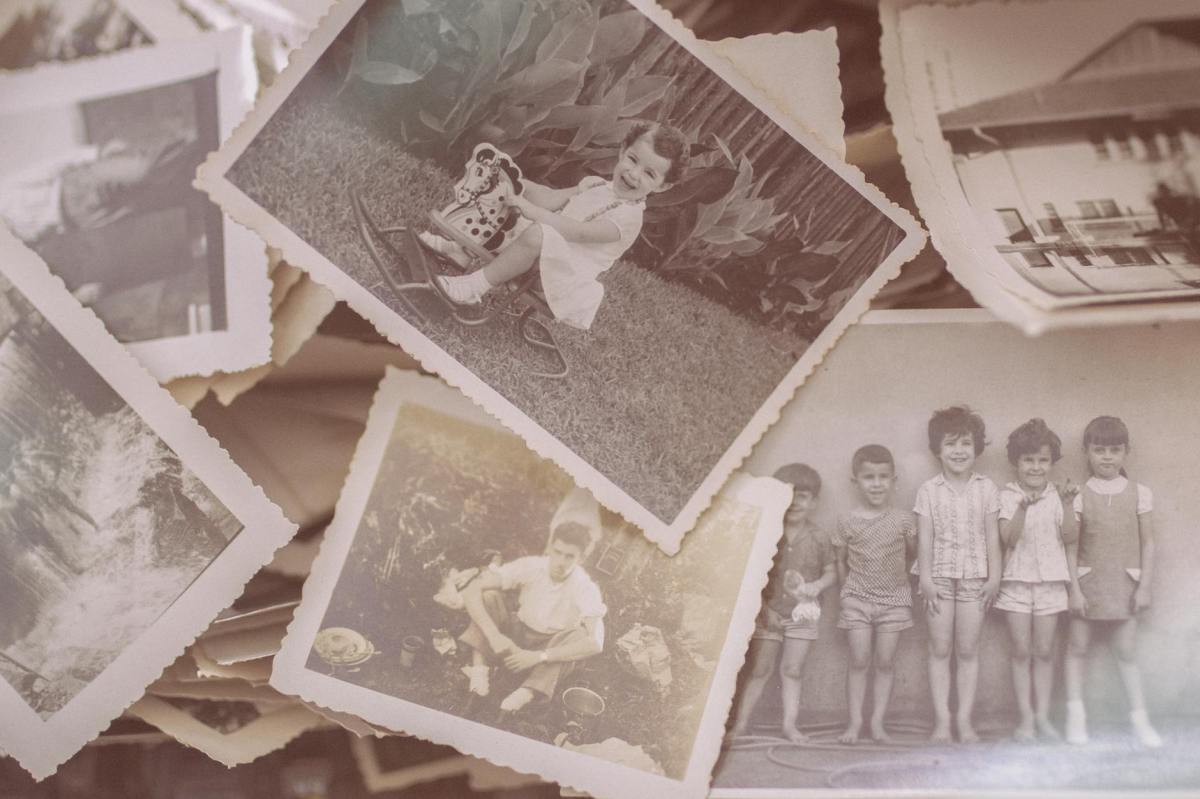
My fiancé, Matt, and I have been in the process of moving into our new apartment over the past few weeks, and combining all of our belongings and finding space for all of our stuff is an adventure. As with any time you move, we are realizing how much stuff we all carry around with us as we go through life. And some of that stuff can be pared down or donated or sold, but there are always those things that you hold onto, no matter what. And among these, probably for almost all of us, are boxes of old photos.
I have a big plastic tub of family photos that I keep swearing I’m going to sort through and organize…and I’ve been saying this for the past 15 years. Every so often, usually when I move, I will drag out that tub and open the lid and gasp in horror at the mixed up stacks and envelopes. Then I close it up and slowly back away.
But I could never give them up, of course, because our photos are valuable in a different sort of way than other belongings. They are like a pathway through the forest of memory that thickens as we grow older… a pathway that guides us back to other homes, other times, other faces, other versions of ourselves that would otherwise be lost from view in the shadow of the passing years. We pull them out to show others—and ourselves—all that we have known, all that we have been.
In my own collection, I see many things. Here is my mother, sitting on the back of a pony when she was two years old..land here is my father as a young man, laughing in his college dorm room…and here is my great-grandmother, her smiling face obscured by a wide brimmed hat in the summer heat, and here—oh goodness—here is a child that was once me, dancing on the sand on some forgotten beach, yelling something into the wind.
Memories and mysteries, all of these photos. Perhaps we carry them with us, wherever we go, both to remind ourselves of where we’ve come from and to reassure ourselves that whatever we have become, we were also, this. And this, and this. And that life is, somehow, holding together all these layers, finding the truth not in any one picture, but somewhere in the sum of them, in the shape of what they reveal.
It might sound odd, but I think it’s helpful to think of Scripture the same way, almost like a box of jumbled snapshots. Because our sacred texts, too, are repositories of memory and mystery, and just like a single photograph, no single Scripture passage can ever reveal the whole truth about the life of God. Remember that when someone tries to cherry-pick a verse to use against…whomever. No, we must gather all of these verses together, all these little glimpses of God’s face, and ponder the bigger story they tell.
With this in mind, then, I think the most striking image of God’s face we are handed this week is Jesus asleep in the storm-tossed boat, his disciples as panicked and furious as the sea itself. You can practically close your eyes and see it. So let’s pull that one out of the box and ponder it together, shall we?
It is dark. Bands of rain and wind are lashing against a small boat on a stormy sea. The disciples are looking at their teacher, sleeping in the tumult, and they are bewildered—they can’t begin to imagine why Jesus isn’t awake, why he isn’t helping them fix the situation, giving them direction, something, anything. And so they wake him up and, at a word, he uses his mighty power to still the storm.
Is it easy to see what’s going on here? Just a scary storm and a God who will make it stop? Look a bit closer.
As is often the case, there is much more to this image than what immediately meets the eye. Because it’s interesting—Jesus, after calming the wind and the waves, doesn’t look at them and offer soothing reassurance. He doesn’t say what we might expect God would say, “there, there, I fixed it for you, don’t worry, you’re fine.”
No. Instead, a better Greek translation of his words to them might be, “why are you so timid? Do you not trust?” And the Gospel says then, and only then, after the storm, that the disciples “ephobethesan phobon megan” — they feared with a great fear — not because of the storm, but because of the One who stilled it.
You see, in that moment, the disciples have a brief encounter with enlightenment—they realize, right then, that Jesus is more than just a sleeping teacher who can fix their problems—more, even, than the prophetic miracle worker they’d been following around.
You might say that it was as though a collection of old photos suddenly appeared before them, and for the first time they could really see Jesus—all of him—and there he was, sitting on the back of a donkey, escaping to Egypt with his mother. And there he was, laughing as a young man in the Temple, astounding the scribes in his Father’s house. And there he was, dancing on the sand of some forgotten wilderness, rebuking the temptations of Satan, yelling something into the wind. And there he was, too, even farther back, before time and image and memory itself, the Eternal Son, like light looking up from the brim of deep darkness–the original Creator of the water and the wind now riding with them on the waves.
And for them, in this moment, to see Jesus—to see all the images that make up who he is and what he is—is to realize that loving him and following him is not about fixing their problems..it is about re-creating the entire world in the image of Love.
We are the inheritors of that same encounter, you and I, that same collection of images. We, too, are reminded that Jesus will not remain the flat, convenient, utilitarian image that might suit us best.
If we want him to appear as a mere teacher, we must also discover that he is Lord. And if we want him to appear as the victorious one, we must also see that he is the crucified one. And if we want him to bless our health and our wealth, we will also find that he makes his home among the poor and the sick and the forgotten.
And he is all of these things–this whole jumbled stack of images, this whole collection of memories and mysteries–not to make our faith an impossible task, but to make impossible our tendency to render God in our own image–our propensity to make God as small as our own fears and misgivings. He asks, ‘why are you so timid?’ because he wants the disciples, and us, to see that God’s love is so much bigger than we can envision, so much bigger than our fear.
And so, even now, this Jesus asks us— today, here, in The Episcopal Church; here, in the United States; here, on a planet on fire; here among all of us who have tried to be diligent, polite, welcoming people of faith—he asks us, as we fear that the church is shrinking and the world is raging and the ship is sinking, he asks again, Why are you so timid?
Do we not trust that love is the strongest force on earth? Because it is.
Do we not believe that the world needs this good news more than anything else? Because it does.
Do we not feel that love raging in us like a storm of life giving water? Because it’s there, waiting to be set free.
And all of this—the storm of love and the memory and the mystery, and the countless revelations of eternity—if it is part of Jesus, we must let it become part of who we are, too. We must let this undaunted, unfaltering, fearless type of love become the shape of us, the sum of all the images we are, the precious treasure that we can never give away, no matter how many years go by.
And maybe, if we were to look for this in ourselves, and in others, we would brush up against enlightenment, too. Maybe we would see that every person we meet also carries with them a box of old photos. That they were once two years old on the back of a pony, or laughing with their friends or dancing on the sand or shouting into the wind or smiling in the light of the sun.
Maybe if we saw all of one another, we would be less timid, less overwhelmed by the storms we are navigating, because we would realize that Jesus isn’t asleep while the world falls apart. He is dreaming a new world into being and inviting us to dream with him. A world in which, instead of fearing with a great fear, we will love with a great love
It’s a beautiful image, isn’t it? I think I’ll hold onto it.

 By Another Road