
Everything Happens: A Sermon

I preached this sermon on Sunday, March 23, 2025 at St. Anne Episcopal Church, West Chester, OH. The lectionary texts cited are Exodus 3:1-15 and Luke 13:1-9.

So there’s a particular phrase that gets used a lot, one that most of us have heard or maybe used at one point or another. I’m sure that I have used it in the past. But it’s a phrase that, as I live longer and especially as I do ministry longer, I have become more and more troubled by. It’s this one: “everything happens for a reason.”

I’ll be honest, I really don’t like this phrase very much anymore. And if you use it in your own discussions of the big questions of life, I hope you’ll at least hear me out. Because as I have spent these years as a priest and have been invited into the vulnerable, sometimes painful and complex stories of people’s lives, the more I see how empty this phrase can be. 

Imagine if you will: a person comes to you and says they have been harmed in every imaginable way by their family, and now they deal with mental illness and addiction, and they struggle to keep a roof above their heads, and lately they’ve been sleeping in a tent in the park. But they come to you and want to know more about what God’s love could possibly mean for them. 

Or imagine this: you are visiting with someone who has lost their spouse of over 60 years, gone in the blink of an eye, and they tell you the stories of how they met, and show you old, beautiful photos of when they were both young and laughing and strong and unafraid of love’s deep costliness. And today, this person gazes at the photos with an unanswerable longing and wonders what the rest of life will look like. 

Would you, could you ever bring yourself to say to such a person, “well, everything happens for a reason”? Having sat with them, many times over, I can assure you with every fiber of my being: I could not. I would not. I will never.

Because even if we rightly acknowledge that we do not understand why things happen the way they do, this phrase, everything happens for a reason, is still just a flimsy band-aid over the deep wounds of life. It is attempt at naming something when a gentle silence would suffice. Better, I’ve learned, to just be present with that which we cannot understand. Better to offer quiet love than easy answers. Like that unspeakable name of the Living God who speaks to Moses from the burning bush, sometimes it is good for words to fail us. 

I was thinking about this because wrestling with “everything happens for a reason” is also, I think, a helpful way of wrestling with our Gospel reading this morning. It’s a reading which at first hearing sounds very severe. Someone at Bible study this week said this is a very “Lenten” reading, full of suffering and judgment. And that’s true, but I would offer that suffering and judgment are not the deeper message that Jesus is trying to convey to us here. His call to repentance is a call to a new understanding of God and the world we live in.

When these unnamed individuals come and let Jesus know about some Galileans—in other words, people who could have been Jesus’ neighbors—who have been killed by the imperial authorities and had their bodies desecrated, we can imagine that they want some answer from Jesus about why such a thing could happen. And although we don’t actually hear them say it out loud, we can imagine them wondering: did these Galileans do something to deserve this fate? Or is there some greater plan God has in mind by making these people suffer? Did all of this happen for a reason?

But Jesus’ answer to them is bracing and provocative, especially for those of us who need everything to fit together neatly. No, he says. Do not ascribe the suffering of the Galileans to God. And do not console yourself by secretly assuming it couldn’t happen to you. “Do you think that because these Galileans suffered in this way they were worse sinners?” In other words, are you, when confronted with the horrors of cruelty and injustice in this world, trying to convince yourself that everything happens according to God’s plan? That God instrumentalizes our suffering? If so, you are not yet understanding the nature of God. 

And, he goes on, those eighteen killed with the tower of Siloam fell…and those who were in the Twin Towers when they collapsed…and the generation of people lost to AIDS…and the children who are dying in Gaza and the hostages who haven’t come home…and our neighbors in West Chester who go to bed hungry at night…and the ones next to us in the pews who have suffered illness or deep loss—are they somehow “worse offenders than all the others living in Jerusalem?” If anyone says yes, they, too, are not yet understanding the nature of God. 

Because the awakened and transfigured heart can’t look at such things and hold onto “everything happens for a reason” or “they had it coming” or “at least it wasn’t me and mine.” The awakened and transfigured heart, the one that is grafted onto the heart of God, does not put band-aids on deep wounds; it does not offer platitudes that primarily serve to comfort the one who speaks them. No, the awakened and transfigured heart—the heart of Christ, the heart that beats in our own chest, too, if we will let it–chooses to offer love rather than easy answers. 

Jesus wants his disciples to understand, both in that age of Roman oppression and now in our own time of social and political disarray, that the Christian path is not paved with empty words and good intentions—that road leads…elsewhere. The Christian path is not characterized by shrugging our shoulders at the universe and saying “everything happens for a reason” and then going back to whatever it was we were doing.

No, the Christian path is the one gentle and courageous enough to look into the face of suffering and to simply say, yes, everything happens. Everything happens. Families hurt us sometimes, and loved ones leave us, and towers fall, and democracies struggle and times get tough, and it’s hard to know what to say. But what we can do is choose compassionate action. What we can do is plant the seeds of love and mercy and hope, defiant in the face of death and despair. And in fact we must do that if we hope to experience true salvation, to live as God lives, both in this life and beyond it. 

That’s why, after his challenging teaching and his call to a new way of life, Jesus gives us, today, a parting image—one that clarifies the alternative to empty words and flimsy band-aids. He shows us a gardener who refuses to give up on a fig tree. A gardener who refuses to shrug his shoulders at the fruitless branch, who refuses to say “everything happens for a reason,” and leave the quaking tree to its lonely fate. He shows us a gardener who bends down close, who chooses to stay, who chooses to care, who chooses to try, no matter what the next year brings. 

Because that turning around and leaning down into love, that’s repentance. And that’s the beginning of understanding the true nature of God. 

And to the extent we are doing that here at St. Anne—in our ministries, in our hearts, in our community—thank God, because that is the journey along the true Christian path, which indeed always leads back to a garden, back to what might yet grow—so that this hungry world might be fed something more than platitudes. 

After all, we ourselves are fed, week by week, by the God who does not often speak out loud with easy answers, but who prefers to simply show up in bread and wine and song and silence. Quiet, eternal, impossibly near. Thi is the God who asks us to do anything but give up on each other, and who refuses to give up on us, no matter how little we understand.

The God in Christ who, even when everything happens, as it too often does, prefers to give us the one thing better than a reason: himself. 

Lamentations of the People

I wrote these liturgical “Prayers of the People” a few weeks before the national protests in response to George Floyd’s killing, but they have taken on a new resonance for me now, and so I share them with you here.

Lamentations of the People

In grief and in undaunted hope, let us cry out to God, the undivided Trinity, saying:
Holy God, Holy and Mighty, Holy Immortal One, Have mercy upon us.

God, your Church is splintered and sorrowful. We are undone by the virulence of the age into which you have called us. We hunger for the bread only you can give; we long for the solace of an absent embrace. Gather us close, hide us under the shadow of your wings, and strengthen us to be your ministers amidst the uncertainties that lie ahead.

Holy God, Holy and Mighty, Holy Immortal One,
Have mercy upon us.

God, our nation is diseased. A pandemic has brought us to our knees, but we have been kneeling before false gods for too long: economic and environmental injustice, systemic racism, the death-dealing myth of white imperialism, the vainglory of unexamined consumption. We need you, the Divine Physician, to heal the heart-wounds we cannot see, so that we might heal the broken bodies and broken systems we can see.

Holy God, Holy and Mighty, Holy Immortal One,
Have mercy upon us.

God, the world is so vast, and so small. We are overwhelmed by its complexities, yet we are reminded how tightly our lives are knit together. The old lies of extraction and exploitation have laid waste to our planet and have oppressed our siblings in every land. Lead us out into the wilderness beyond self-satisfaction, beyond denial, beyond plunder, and teach us new ways to live simply, humbly, close to the earth.

Holy God, Holy and Mighty, Holy Immortal One,
Have mercy upon us.

God, our communities are being crushed by the yoke of sin: political enmity, economic inequality, gun violence, racism, xenophobia, disparities in health and education, pollution, loneliness, and despair. Our brothers and sisters are sleeping in the streets, weeping in the streets, bleeding in the streets, like strangers in their own land. And so many of us choose to look away. Give us, instead, your easy yoke, your light burden: to open the doors, to step out, to speak out, to trust one another, to be taken where we do not wish to go, to the foot of the Cross, to the tomb, where you will meet us, where real life begins.

Holy God, Holy and Mighty, Holy Immortal One,
Have mercy upon us.

God, our loved ones are sick and dying, from viruses and from violence. The silence of silenced bodies overwhelms our ears. The IV-drip of memories stings and burns as it works its way through our veins. We are weak and helpless, but don’t allow us to be hopeless. Make your presence known to us, especially when we cannot be present to one another. Heal our ailments and mend our hearts.

Holy God, Holy and Mighty, Holy Immortal One,
Have mercy upon us.

God, you have taken so many away. Their names tumble from our lips, a remembrance, an insistence, a plea. We say their names so that they won’t be forgotten. We say their names so that we won’t be the type of people willing to forget. As we grieve and grasp at the mystery of death, take their names and bind them to yourself; open your everlasting gates and welcome them home.

Holy God, Holy and Mighty, Holy Immortal One,
Have mercy upon us.

God of our Sorrows and our Joy, we lament today so that we might rejoice tomorrow in your promise of justice, of healing, and of never-ending life; for you are the One in whom all things are made new, and it is to you whom we turn in trust, through Jesus Christ our Lord, who lives and reigns with you and the Holy Spirit, One God, now and for ever.

Amen.

To the Edge: An Advent Reflection

I delivered the following reflection at an Advent retreat I facilitated on Saturday, December 7th, 2019 at Trinity Episcopal Church, Fort Wayne, IN.

In western Scotland, there is an archipelago known as the Inner Hebrides—a collection of wild, sparsely populated islands that hug the coastline like an outcropping of jewels, ensconced in the swirling gray-green tides of the north Atlantic ocean. On a map, they appear easily accessible to the mainland, but to visit them is to enter a world apart.

The Inner Hebrides are home to wild birds—puffins, and rock doves, and golden eagles— and hardy, weather-beaten plants—heather, and thistle, and a host of insistent wildflowers. They contain small fishing villages and hillsides covered in roaming sheep, whiskey distilleries and ruined monasteries.  Some of the islands are vast and mountainous, a series of craggy cliffs and broad, low plains; others are barely a speck of gray rock, grazed by the wings of passing seabirds–namelessly residing amid the roiling waves. 

But for all their remoteness, streams of travelers make their way to this cluster of islands, over 100,000 people each year. They come for a variety of reasons: for hiking, or fishing, or whiskey tasting, or perhaps for a bit of windswept solitude; but they come especially to visit one place in particular: the tiny island of Iona, perched at the outermost edge of the Inner Hebrides, accessible only by boat. 

Iona is humble in size—only a mile wide and a few miles long, with a population of just 120 people—but it looms large in the imagination of many, for it was here that St. Columba arrived from Ireland in 563 CE and established a monastery that would become the center of what we now call Celtic Christianity—an ancient form of the faith, nourished in the misty hills and valleys of what is now Ireland and Scotland, and shaped by the cultures of their early people—a form of Christianity that long predates the establishment of a church in this region with any direct tie to the authorities in Rome. 

It was here, on little Iona, at the rocky edge of the known world, that for centuries monks and scholars and warrior-kings traveled for an encounter with the living God, the One who came to be among us as Jesus, the Christ. It was here, at the edge of the sea, where they dwelt and prayed and studied and died, seeking some whisper of God’s voice in the wind and in the silence. 

And so it is that, still, pilgrims go there, to visit the tiny village, and the crumbling ruins, and the reconstructed Abbey, and the ancient stone Celtic crosses with their inscrutable symbols. They travel by train, and then by boat, and then by bus, and then by boat again, to reach this holy place, this thin space, this island of craggy, rock-strewn grace because…because for some reason they must. 

Because for some reason, each of us is drawn in some way to these places that lie at the edge of knowing, these places where the land and the sea merge, these places where what we know is overwhelmed by that which we will never fully understand. We go to these places to be silent, to listen, to watch, and then to return home, perhaps a bit more awake, a bit more alive than we were before. 

Iona has that effect on people. 

Advent also has that effect on people. 

Advent, as you might know, is derived from the Latin word adventus—it means “to come”—and so this liturgical season is the one in which we focus our attention on a very particular coming—that of Christ, whose birth is proclaimed on Christmas and whose return is promised at the end of the age. 

It is a season of hope and expectation, but also of some severity—for we know that in these comings, our lives will never be the same. The world will never be the same. Arrivals of this magnitude require reflection. Preparation.

And for the same reasons that some make the journey across the moors and the shores to seek out a tiny abbey church on a Scottish isle, to seek the presence of God in a wild land, so each of us ventured here, today, to seek out the importance of this season and what it means to “prepare the way” for the coming presence of Christ.

That phrase, “prepare the way,” the theme of our retreat today, is taken from tomorrow’s Gospel lesson from the third chapter of St. Matthew:

“In those days John the Baptist appeared in the wilderness of Judea, proclaiming, “Repent, for the kingdom of heaven has come near.” This is the one of whom the prophet Isaiah spoke when he said,

“The voice of one crying out in the wilderness: 

‘Prepare the way of the Lord, 

make his paths straight.’”

Now John wore clothing of camel’s hair with a leather belt around his waist, and his food was locusts and wild honey. Then the people of Jerusalem and all Judea were going out to him, and all the region along the Jordan, and they were baptized by him in the river Jordan, confessing their sins.

It is worth noting that John the Baptist, in his mission to proclaim the coming Messiah, does so in the wilderness, not in the city—he is wandering across the uninhabited landscapes of Judea, crying out his message of repentance and preparation.

Matthew tells us that it is the people of Jerusalem and all Judea who come to him, leaving behind the security of their homes to seek something of God in an unguarded landscape, to be baptized by a wild man in a wild river, to embrace a salvation that is spoken of as a cleansing, a burning, a harvesting—an elemental experience, undomesticated and savagely beautiful. 

And like those Judeans, so we, too, venture beyond the familiar in Advent. We come here, not into a physical wilderness, but into the expansive, mysterious, silent heart of this season, a season whose core purpose is to instill in us a sense of Christ’s imminence, his urgent imminence—both in the form of a child, born unto us in a manger, and also in the form of a king, descending again one day in glory to judge and redeem creation at the end of all things. 

We enter this season by stepping beyond what is safe and predictable, into a liminal space—a space between knowing and unknowing, a space between the stories told and the stories yet to be told. 

We are drawn, like the Iona pilgrims, to stumble to the outer edge of the human heart, to gaze into the cloud-draped horizon and to be quiet, to listen, to watch for the One who is coming, like a wave, like a storm, like a still small voice speaking out of the whirlwind, surging over the coastline of our longings and carving them into his likeness, reshaping our hearts like stones polished by the sea. THY kingdom come, THY will be done.

Advent, it must be said, is not a season for the indifferent or the timid. If we go out to meet it, to answer its call, it will change us. 

But what does all of this talk of wilderness and pilgrimage and change have to do with our gentle program today, focused on silence and prayer? Quite a bit, actually. 

Because, you see, we spend our lives surrounded by noise; this is especially evident at this time of year, when the onslaught of saccharine commercialism joins forces with the pervasive noise of toxic online discourse, idle gossip, and media chatter to create a din that is, ultimately, numbing to the soul. 

We careen from one task to another, often with very good intentions, and yet we are often left, at the end of the holiday season, with a sense of depletion and disorientation. 

If Christ has indeed come into our midst through all of this, we run the risk of losing track of him, and thus we might end up cozy, perhaps well-fed and entertained, but unchanged. Untransformed. Untouched by the wonder of God, who gazes back at us through the eyes of an infant, who takes on our innocence and our frailty and imbues it with Divine Love, to show us how special, how good this life can be. 

So in order to break free, in order to find him, in order to find ourselves, we must venture elsewhere, as pilgrims tend to do.

We need not travel to an island. Silence and prayer and Scripture are our pathway on this journey. They invite us into the presence of God and shape our lives as God’s people. They require us to notice everything, both inside of ourselves and in the world around us—the good and the bad—so that we can discern God’s abiding presence in all of it. 

Because God is, indeed, present. God has come to us in the birth of Christ—the first Advent. God comes to us sacramentally in the Eucharistic life of the Church—the continuing Advent. And God will come again at the last day to redeem our turbulent history—the final Advent.  

Our prayer and study, then, remind us not simply that “Jesus is the reason for the season” while blithely going about our frantic business as usual. Our prayer and study instead suggest that the season of Christ’s coming actually asks something of us—no, demands something of us—something that has nothing to do with consuming or producing, nothing to do with the further commodification of our love. 

Advent requires, with its voice crying out in the wilderness, that we make space, that we clear out the noise and the haste, that we “prepare the way” in our hearts and in our societies for the cold, vivifying gust of salvation that will soon be borne on the wind, on the waves, on the breath of the One who approaches, toppling old injustices and healing old wounds.

The One whom John the Baptist proclaims. The One who, even now, hovers at the edge of our perception, like an island shrouded in mist, so close we can touch it, though we cannot quite see it, yet. The One who will make us, and our winter hearts, and our flagging, tired dreams, new again. The One who will bring us to life. 

Today you are making a journey of your own—a journey to the edge—into the realm of Advent, where nothing is resolved and yet everything is possible. You do not have to achieve anything today. You are simply invited to make the trip, to pray, to listen to the silence and to yourself, and to one another. 

Simply to do this is an act of courage, an act of pilgrimage. Simply to do this will help prepare the way for Jesus to enter your life more deeply. And when he comes—and he will come, as sure as the ebb and flow of the tide, a sure as the beating of your own heart—you will know that there is, ultimately, no wilderness in which you are alone. There is no distant shore where he cannot reach you. In Advent, he comes to us. In Advent, you will find that he is already here. 

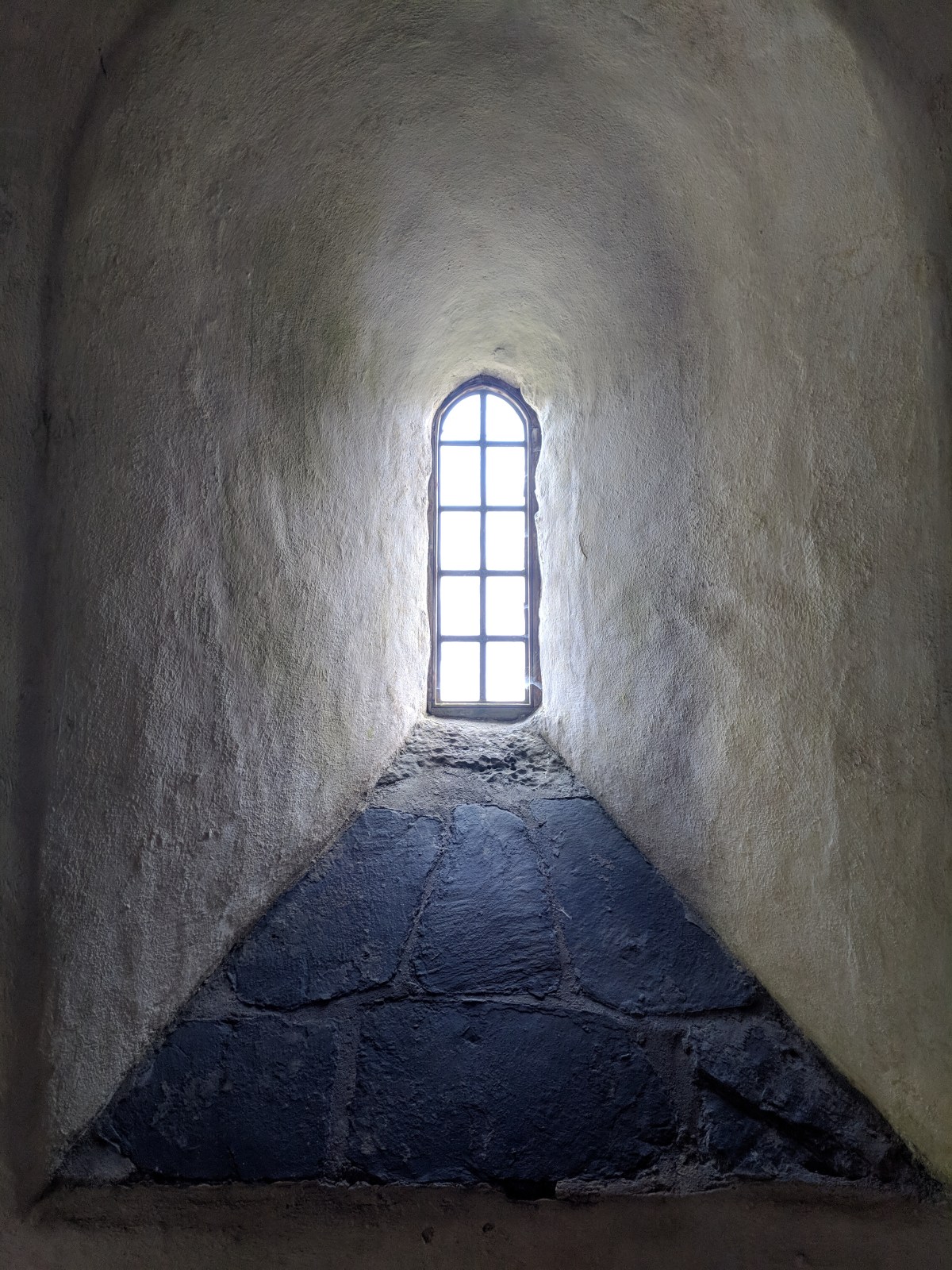
Maker:S,Date:2017-11-9,Ver:6,Lens:Kan03,Act:Lar02,E-YFrom my own pilgrimage to Iona in April, 2018.