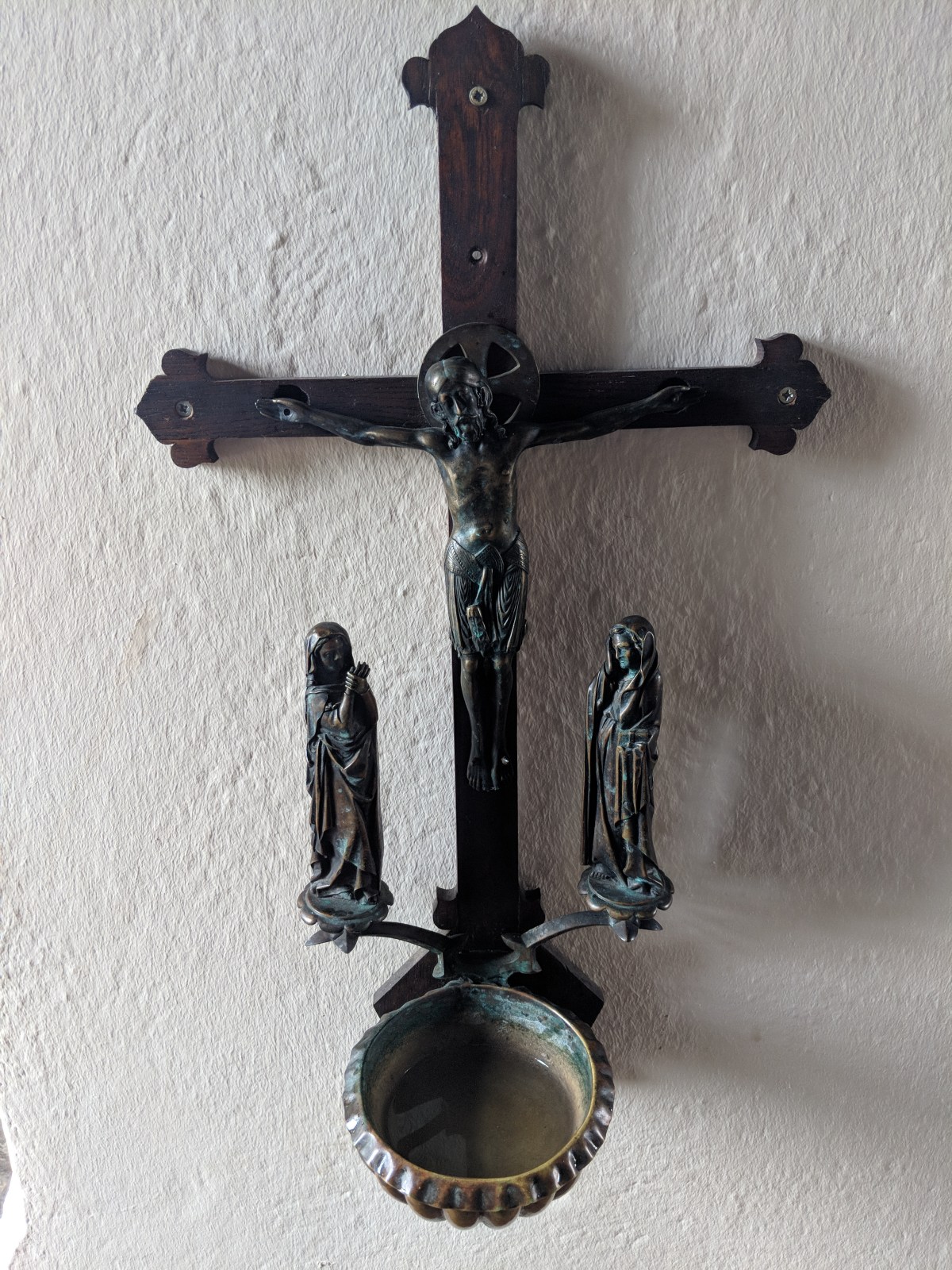
This sermon was preached on Good Friday, April 19, 2019, at Christ Episcopal Church in Alameda, CA.
Shortly before condemning Jesus to death, Pilate asks him–and thus unknowingly asks God–a bitter, heartbreaking , fundamental question, one that humanity has likely been asking from the very beginning: “what is truth?”
He receives no answer.
There is no answer to give that could be encapsulated into words. Truth, the very embodiment of Truth, is a bruised and battered face staring back into his own face, and it is beyond articulation.
Like Pilate and everyone else who participates in the crucifixion of God Incarnate, we are deep in a mystery now, a place where words are largely inadequate, where answers are few, where only questions prevail. We must tread carefully, for this is terrifying holy ground we stand upon today, Good Friday, and we should not profane it with endless speculation.
We are at the foot of the Cross, gazing up at Jesus, who in turn gazes back at us, blood and tears streaming down his face—and in this place, tidy, insightful observations about the nature of God and clever turns of phrase about sin and forgiveness and sacrifice all dry up like chaff and blow away in the wind.
The Cross rejects every attempt to understand it fully. It is not a place for self-assured theologizing or domesticated spiritualizing. It is a raw, awful, unspeakable place in which we find ourselves.
Last night, on Maundy Thursday, Jesus told us to love one another, and we did so. We washed one another’s feet and broke bread together with the best of intentions. We perceived that this was the proper way to live, to care, to be present in God’s kingdom. And on Easter we will no doubt come back together as a people renewed and forgiven for all the times we have failed to love, returning to our senses after this day of desperation and horror, and we will recommit ourselves to the fullness of life that God offers freely in the light of resurrection.
But today we are no-place. Today we have murdered the very best of our intentions to love. We have traveled to the Place of the Skull, the place where confidence is shattered like bone. Today we stand at the farthest point from comfort, the place where Jesus, God-With-Us, He who was the smiling babe in the manger, the youth in the temple, the wise teacher on the mountain, the Holy One, cries out to the Father for some sign of presence and receives…nothing. No answer. No words.
And in that silence we know what it is to forsake and to be forsaken.
Yes, we are deep in a mystery, one so strange and terrible that any attempt to sort it out, to prod at its depths, to explain it, results in cheap, brittle platitudes.
Think about of all the things that you should never, ever say when someone has experienced a great loss in their life: things like
“It’s all part of God’s plan.”
“Everythinghappens for a reason.”
“When one door closes, another one opens.”
These are things we say to each other that are usually more about soothing our own sense of confusion and fear rather than simply being present, deeply present, to the pain of another.
And yet these trite, hollow, inadvertently callous attempts at comfort are exactly what we so often apply to our encounter with Jesus on the Cross. We want to justify this awful thing, to make sense of it, to assure ourselves that God knew what God was doing the whole time. We approach Golgotha and see the crucified Christ writhing in agony and fear, and we say, to Him, as we do to others: “everything happens for a reason! Your suffering is part of God’s plan!”
And these words are like yet more nails, hammered and stammered into the endless void of His suffering.
The Church has done this since the beginning, in various ways. It’s only human, perhaps. We don’t like sitting with questions, and we rely too much on explanations.
Some of us want to reason the Cross away as God’s clever, elegant, brutal plan to atone for our sins, to make proper restitution for our brokenness, as if the cosmos were constructed like an accounting system or a court of law.
Or, equally tempting for some of us and yet equally limiting: we confine the Cross to the realm of human political drama, as if Jesus was nothing more than an enlightened social justice prophet murdered by “conservative” religious authorities and imperial forces—those bad, unenlightened others that of course look nothing like us. As if the Cross was merely an unfortunate byproduct of a backwards political system rather than what it actually is: the fundamental, unanswerable question at the core of all the pain which we experience and inflict upon each other.
Every time we try to reconstruct the Cross in a way that suits us, in a way that provides easy answers, in a way that excuses us from the narrative, we are simply building another instrument of torture to re-crucify that which we cannot understand.
No more of this, I ask you. No more. Lay down your easy theories of atonement that taste of sour wine; stop casting lots for your competing theologies of the Cross. For one day, let us stop trying to figure it out. Look into the face of Christ crucified and let Him be all that He is, uncertain and frightening and heart-rending, the face of Truth.
And let that wordless recognition of Truth, terrible as it may be, let it be enough today, because it is all we are given. Just as with Pilate, Jesus has no further answers for us.
It is called Good Friday because it is God’s Friday—the day in which God presents us with a mystery, a deep mystery, a Man who is on a cross for reasons so strange and intimate that they are as distant as an all-consuming black hole, and yet as close as our own breath.
And yes, we know in our hearts that there is more to the story, and that perhaps soon, very soon, we will fumble our way toward the answer of the empty tomb and the radiant joy of something entirely new. But not now. Not yet.
What is truth, we ask? Look at the Cross. It is staring us in the face, wordless and unutterable. Approach it cautiously, without certainty. Touch it if you dare; look into the void and see God staring back at you. Today, this is all we have.