
Annoying: A Sermon

I preached this sermon on Sunday, July 28, 2024 at St. Anne Episcopal Church, West Chester, OH. The lectionary texts cited are 2 Samuel 11:1-15 and John 6:1-21.

Now, I tend to think that I was a pretty nice, friendly kid growing up—I liked being around people, including my mom and dad and my other relatives. But there’s a funny thing that happens to most of us, somewhere around the age of 14 or so—we suddenly want our parents and the rest of our family members to leave us alone

I was not a very rebellious teenager, but still, somewhere around that age, I became totally uninterested in what the rest of my family was up to. I couldn’t drive yet, and this was long before the age of smartphones, but I would still check out and close myself up in my room, reading books or talking to my friends on the phone or surfing the internet (the kind that you had to connect to on a landline). 

And yet, for some reason, my family would keep pestering me! My dad would knock on the door to tell me dinner was ready, or my mom would call and want to know how school was going. One time my grandma got mad at me because I had been on the dialup internet for so long that no one could make calls in or out of the house. 

I was just convinced that their whole mission in life was to cramp my style. The nerve of these people. Didn’t they understand that I was my own person, that I needed space to do exactly what I wanted to do, when and how I wanted to do it?!

If you happen to be going through that right now as a teenager, I want to say, you’re not entirely wrong. There is something really important about figuring out who you are as a person and how that might be different from the expectations of all the people around you. Figuring ourselves out takes time and trial and error and you need a little space to do that. 

It’s also true, though, many years on from 14, that now I would give just about anything to have my dad knock on the door to call me to dinner or to hear my grandma fussing at me about the busy signal on the phone. Maybe it’s just a function of getting older—the prospect of being on one’s own loses a bit of its luster. 

Nonetheless, it strikes me that our relationship with God is a bit like the push-pull of growing up and feeling both grateful for and claustrophobic around the ones we love. 

I know it’s very pious to talk about how much we love to spend time with God, and we say a lot in church about how wonderful it is that God came to be with us in the flesh in Jesus, how he will never leave us, how he is always there when we call on him. 

But in the midst of all of that, I think we need to be honest with ourselves: there is a part of us that might prefer for our Lord to leave us alone once in a while. There is a part of us that finds it awfully exhausting and burdensome to have the Way, the Truth, and the Life constantly knocking on the door, reminding us we are spending too much time closed up in our rooms, asking us to get off our phones and come out and be part of the human family. 

The nerve of this Divine Person! Doesn’t he know that I need space to do exactly what  want to do, when and how I want to do it? It would be so much easier if we could just stay in our own little world rather than contend with the real world.

In this week’s reading from the Old Testament, David is caught up in this tendency towards self-isolation, and unfortunately for him it comes at great cost. The implication of the text we heard today is that, as King, he should have been out there in solidarity with the troops who are fighting his battles, but instead he chooses to stay home and take advantage of his newfound royal power, using it to exploit and manipulate others for no reason other than his own idle satisfaction. 

If that reading made you uncomfortable, good—that’s the point. David and those like him are not our savior; God is. We will return to this story next week and we will learn the grave cost of his actions, but for now we simply see in David the terrible danger of cutting ourselves off from a sense of responsibility to the people around us—of assuming that God doesn’t care what we do with our time. David will soon learn that, like any annoyingly persistent parent, God does indeed care, and God is not inclined to leave us to our own devices forever, even when we would rather he did.

And, at the risk of sounding really impious, there is no greater evidence of God’s annoying, parental persistence than the incarnation of Jesus. He just had to come down and get up in our business. He just had to come knock on our door to tell us to get off the internet for a minute and open our eyes and look at each other and listen to one another.

Yes, God becoming flesh and walking among us and revealing to us the urgent necessity of embodying the Father’s love—let’s get real for a minute here—it’s beautiful and revelatory, but it’s also quite inconvenient. 

Because, Lord, I don’t want to love my enemies! Lord, I don’t want to relinquish my own ambitions and self-interest for the greater good! Lord, I don’t want to face the suffering of the world and realize that I am expected to actually do something about it. I just want to be left alone! Stop knocking on my door, please. Stop calling me up and telling me that I was made for something more. Just let me put on my headphones and talk to the people I like and leave the rest for someone else to figure out!

Thankfully God doesn’t listen to me when I say that, anymore than my parents or grandparents ever did. Because Jesus is, as God always has been, the one who says, no, it’s time you come and have something to eat. It’s time you rejoined the land of the living. It’s time you remembered that you are, indeed, part of a family—the family of all of creation—and while we all need a bit of solitude and self-exploration from time to time, you were not made to be alone.

Jesus showing up here in our midst, week after week, in the form of bread and wine, showing up to knock on the door of your heart, is not just a pretty idea—it’s a reminder of that frustratingly persistent tendency of God to never leave us be, to never give up on us, to wait for us, all of us, however long it takes, until we realize that this—this love, this way of life, this relationship with God and with each other—is what we needed most all along, at age 4, and at 14, and at 104. 

Because there will be a moment that comes for each of us, at a certain age, when we look up and realize that, like those disciples on the Sea of Galilee, we have been rowing our boat alone on the waves for a bit too long, and the waters around us are stormy, and we are far from home, and now we would give anything to hear our father or our mother or our grandmother’s voices instead of the howling wind. And then, quite suddenly, there is Jesus, coming across the water, saying It is I, do not be afraid. 

Annoyingly, stubbornly, blessedly, miraculously, he has followed us the whole way, out past our pride, out past our loneliness and bewilderment. He has refused to leave us to our own devices, even when we thought we wanted him to. 

I hope that, following in Jesus’ footsteps, I can be just as annoyingly persistent in my own commitment to caring for others and the world around me. I’d like to think that this is what are about here at St. Anne, that this is what we are celebrating today on St. Anne Day. 

I pray that, as we do this more and more and more, there are folks out there in our community who might start to say, oh gosh, there go those St. Anne people again, always inviting everyone to come to the table, always advocating for justice and mercy, always going on about how much God loves everyone, always trying to call us back into relationship with one another. When will they let up with all of that? When will they leave me to my own devices? When will they give up on that annoying, persistent hope in something better for this world?

Never, my friends.

I pray the answer is never.

The Way of Peace: A Sermon for Troubled Times

I preached this sermon on Sunday, July 14, 2024 at St. Anne Episcopal Church, West Chester, OH. The lectionary text cited is Mark 6:14-29, the beheading of John the Baptist.

I sometimes wonder what John the Baptist thought about, just before the end of his life.

They say that sometimes the past comes back to us in our final moments, in visions and in fragments–that we can see people long dead, and that we can hear the music of songs long finished. And so I wonder what faces and melodies danced in the darkness of John’s prison cell.

Maybe it was the face of his mother, Elizabeth, who in her old age thought she’d never be a mother, looking upon him once more with a gaze of tenderness and wonder. Maybe he heard the song of his father, Zechariah, the song sung the day of John’s birth, the one even we might remember: and you, my child, will be called the prophet of the Most High, for you will go before the Lord to prepare his ways.

And so he did, all the way up to this moment in our Gospel text.And while I imagine he might have wept for that all that seemed lost, all that felt like it had been wasted, my hope is that all of God’s promises came back to John in the end, carried on a wind that smelled of wilderness and wild honey. A glimpse of heaven, even as he commended himself to the unseeing darkness. 

I hope so. I hope he knew that his efforts were not in vain, that he had done his part, that his voice had indeed cried out and been carried on the wind where it needed to go. That the paths had been made straight. 

I hope so because his actual death, and the circumstances that led up to it, are, like all political violence, so unbearably shortsighted and pointless and small. John, the prophet of the Most High, the one who bathed Jesus in the waters of baptism, the one who, his whole life, burned with the fire of the Holy Spirit, is here, today, snuffed out over a bit of palace intrigue, by the machinations of another petty empire. 

No dignified sacrifice, no farewell discourse—just a debauched party and an idle grudge and a series of terrible decisions and a swift, pitiful ending. Even the writer of Mark’s Gospel seems at a loss for words, unwilling or unable to describe anyone’s reaction to the senselessness of what has taken place. 

Because, as is always the case, what can you really say when rage and violence emerge, yet again, into our midst? Thoughts and prayers for your family, John. This is not who we are, John. We promise we’ll be nicer to each other in the future, John, so that your death meant something. 

And we keep on saying it, hoping next time it will be true.

Yesterday, another act of political violence struck at the heart of our civic life in what should be a peaceful political process in this country. The shooting at former President Trump’s rally in Pennsylvania, which resulted in the death of one bystander and which will likely have historic repercussions we cannot yet understand, is a stark and frightening reminder that we are all still subject to the same destructive tendencies that plagued our forebears. 

We pray for all victims of political violence, including those harmed yesterday. And we are reminded, yet again, how cultures and rhetorics of violence are self-perpetuating—that all the words and wounds we choose to inflict upon one another play out in predictable, terrible ways. I hate to say it, but this is who we are. At least, it’s who we choose to be, too much of the time. 

These forces of division, enmity, and the desire to eradicate those we deem as other are active and at work in our politics, in the broader world and, as hard as it is to admit, to some extent within each of us. We resist them, and build around them, and sometimes even seem to rise above them, but they are there. 

And from time to time, in seasons like the one we are living through now in this country, we are called to account for the persistence of violence. We are called to reckon with the warring impulses of the human heart, called to ask if another way is possible, if indeed our feet might actually be guided somehow into the way of peace. John certainly believed it could be so, but his life demonstrated that calling people prophetically into the way of peace is rarely a safe endeavor.

And so I wonder, as John sat in the darkness, waiting for the end, I wonder whether he finally understood that we need something more than just thoughts and prayers and the invitation to do better next time. That for whatever reason, at least on our own strength, we cannot be much better than we already are. 

I wonder, in those flashes of memory and music, in the fragmentary sum of his long and mysterious journey, if John could sense that Jesus, the One for whom he had waited and prepared the way, was not simply a new political leader strong enough or charismatic enough to enforce peace, but was, in fact, the Holy One who came to show us a truth both very new and eternal: that strength and force and violence will never achieve a redemptive end or guide us to a place of rest. That only love and peace and an embarrassing level of gentleness will do that. 

Because that is what Jesus is. He is the one who embarrasses the Herods of the world by his gentleness; the one who stops the dance of death in its tracks; the one who reveals not just violence’s depravity, but its futility, its weakness. He does this because although he was also killed senselessly, for pointless political ends, he comes to us as the Risen One, the Wounded One who stands in the midst of our fear and our cynicism and our despair and says, peace. 

He says, peace.

He does not say revenge or rage or retribution, but peace. And this is something altogether different from what we have been given to expect of this life or this world, or even of ourselves. Something different, even, than John expected–John who had once spoken of the Lord’s winnowing fork and fire.

And so I hope, somehow, before the end, he saw the truth in the darkness and smiled and said, yes, this, yes, peace, yes, we have warred and wept and wandered in the wilderness, and we may continue to do so for many more generations, but yes, another way is possible and it is here, now, insistently alive even in the face of all this senseless death, and its name is love, and its name is God and its name is Jesus. 

I hope we see this, too, every day, but especially on days like today, when those forces of violence and fear seem so strong, so palpable, and when forcefulness seems to be the only way forward. I hope we will see that there is something deeper and stronger than anger that animates our common life and our work and our faith, even after all that has been done and left undone.

Long before our own endings, long before we must gaze into the darkness, I hope we will glimpse that vision, fragmented though it might be…the one that is revealed in the faces of the ones we have loved and in the songs of peace we have sung and in the ways we have tried to practice tenderness and gentleness with each other in this place.

And then I hope we will go out and proclaim that vision in the world, costly as its might be to do so. Not to win a political or cultural battle, not to earn a spot in heaven, but simply because it is true. It is the only true thing there is to hold onto—that love and justice and peace and forgiveness are the only things which will endure in the end, long after our seemingly endless capacity for violence has consumed itself. 

Because this is the Gospel: that on that day, when everything is finished, when every game is played and ever last war is waged, God will still be there standing on the wreckage of our best intentions and worst impulses and God will still be saying, Peace, peace I give to you. My love I give to you. My life I give to you. Let the dawn from on high break upon you, my children. Let us begin again. 

We don’t have to wait til the end to begin, though. We can start right now. Because no matter what happens in the next several months in this country, or the next several years of our lives, or in the next several generations on this planet, I can tell you this: the things worth doing, the things that will survive and flourish long after we are gone, are the same things that John glimpsed in the dark: the face of love and the song of peace, and the courage to trust in something other than the hurt we’ve known.

God be with our country as we try to remember this.

God be with us as we try to live it. 

Photographs

A sermon preached on the Fifth Sunday after Pentecost, June 23, 2024 at St. Anne Episcopal Church, West Chester, OH. The lectionary text cited is Mark 4:35-41.

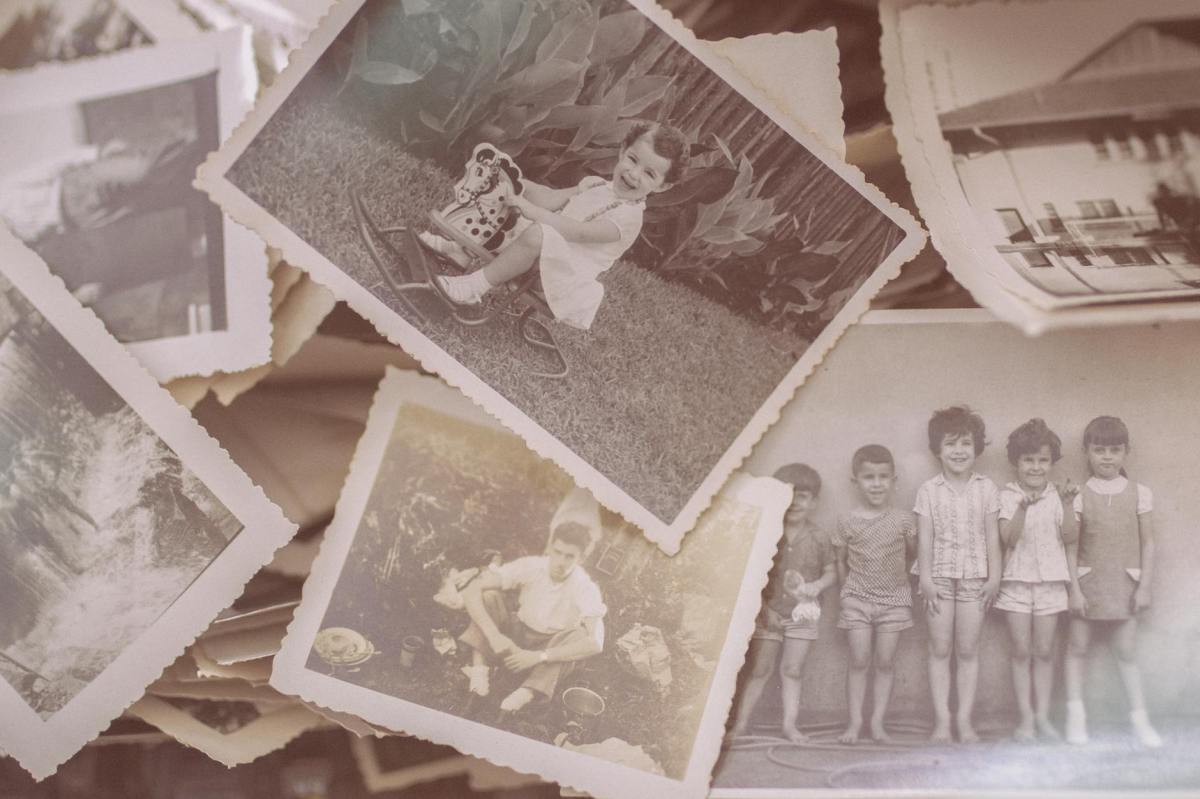
My fiancé, Matt, and I have been in the process of moving into our new apartment over the past few weeks, and combining all of our belongings and finding space for all of our stuff is an adventure. As with any time you move, we are realizing how much stuff we all carry around with us as we go through life. And some of that stuff can be pared down or donated or sold, but there are always those things that you hold onto, no matter what. And among these, probably for almost all of us, are boxes of old photos. 

I have a big plastic tub of family photos that I keep swearing I’m going to sort through and organize…and I’ve been saying this for the past 15 years. Every so often, usually when I move, I will drag out that tub and open the lid and gasp in horror at the mixed up stacks and envelopes. Then I close it up and slowly back away. 

But I could never give them up, of course, because our photos are valuable in a different sort of way than other belongings. They are like a pathway through the forest of memory that thickens as we grow older… a pathway that guides us back to other homes, other times, other faces, other versions of ourselves that would otherwise be lost from view in the shadow of the passing years. We pull them out to show others—and ourselves—all that we have known, all that we have been.

In my own collection, I see many things. Here is my mother, sitting on the back of a pony when she was two years old..land here is my father as a young man, laughing in his college dorm room…and here is my great-grandmother, her smiling face obscured by a wide brimmed hat in the summer heat, and here—oh goodness—here is a child that was once me, dancing on the sand on some forgotten beach, yelling something into the wind. 

Memories and mysteries, all of these photos. Perhaps we carry them with us, wherever we go, both to remind ourselves of where we’ve come from and to reassure ourselves that whatever we have become, we were also, this. And this, and this. And that life is, somehow, holding together all these layers, finding the truth not in any one picture, but somewhere in the sum of them, in the shape of what they reveal.

It might sound odd, but I think it’s helpful to think of Scripture the same way, almost like a box of jumbled snapshots. Because our sacred texts, too, are repositories of memory and mystery, and just like a single photograph, no single Scripture passage can ever reveal the whole truth about the life of God. Remember that when someone tries to cherry-pick a verse to use against…whomever. No, we must gather all of these verses together, all these little glimpses of God’s face, and ponder the bigger story they tell. 

With this in mind, then, I think the most striking image of God’s face we are handed this week is Jesus asleep in the storm-tossed boat, his disciples as panicked and furious as the sea itself. You can practically close your eyes and see it. So let’s pull that one out of the box and ponder it together, shall we?

It is dark. Bands of rain and wind are lashing against a small boat on a stormy sea. The disciples are looking at their teacher, sleeping in the tumult, and they are bewildered—they can’t begin to imagine why Jesus isn’t awake, why he isn’t helping them fix the situation, giving them direction, something, anything. And so they wake him up and, at a word, he uses his mighty power to still the storm.

Is it easy to see what’s going on here? Just a scary storm and a God who will make it stop? Look a bit closer.

As is often the case, there is much more to this image than what immediately meets the eye. Because it’s interesting—Jesus, after calming the wind and the waves, doesn’t look at them and offer soothing reassurance. He doesn’t say what we might expect God would say, “there, there, I fixed it for you, don’t worry, you’re fine.” 

No. Instead, a better Greek translation of his words to them might be, “why are you so timid? Do you not trust?”  And the Gospel says then, and only then, after the storm, that the disciples “ephobethesan phobon megan” — they feared with a great fear — not because of the storm, but because of the One who stilled it.

You see, in that moment, the disciples have a brief encounter with enlightenment—they realize, right then, that Jesus is more than just a sleeping teacher who can fix their problems—more, even, than the prophetic miracle worker they’d been following around.

You might say that it was as though a collection of old photos suddenly appeared before them, and for the first time they could really see Jesus—all of him—and there he was, sitting on the back of a donkey, escaping to Egypt with his mother. And there he was, laughing as a young man in the Temple, astounding the scribes in his Father’s house. And there he was, dancing on the sand of some forgotten wilderness, rebuking the temptations of Satan, yelling something into the wind. And there he was, too, even farther back, before time and image and memory itself, the Eternal Son, like light looking up from the brim of deep darkness–the original Creator of the water and the wind now riding with them on the waves.

And for them, in this moment, to see Jesus—to see all the images that make up who he is and what he is—is to realize that loving him and following him is not about fixing their problems..it is about re-creating the entire world in the image of Love.

We are the inheritors of that same encounter, you and I, that same collection of images. We, too, are reminded that Jesus will not remain the flat, convenient, utilitarian image that might suit us best. 

If we want him to appear as a mere teacher, we must also discover that he is Lord. And if we want him to appear as the victorious one, we must also see that he is the crucified one. And if we want him to bless our health and our wealth, we will also find that he makes his home among the poor and the sick and the forgotten.

And he is all of these things–this whole jumbled stack of images, this whole collection of memories and mysteries–not to make our faith an impossible task, but to make impossible our tendency to render God in our own image–our propensity to make God as small as our own fears and misgivings. He asks, ‘why are you so timid?’ because he wants the disciples, and us, to see that God’s love is so much bigger than we can envision, so much bigger than our fear.

And so, even now, this Jesus asks us— today, here, in The Episcopal Church; here, in the United States; here, on a planet on fire; here among all of us who have tried to be diligent, polite, welcoming people of faith—he asks us, as we fear that the church is shrinking and the world is raging and the ship is sinking, he asks again, Why are you so timid? 

Do we not trust that love is the strongest force on earth? Because it is.

Do we not believe that the world needs this good news more than anything else? Because it does.

Do we not feel that love raging in us like a storm of life giving water? Because it’s there, waiting to be set free. 

And all of this—the storm of love and the memory and the mystery, and the countless revelations of eternity—if it is part of Jesus, we must let it become part of who we are, too. We must let this undaunted, unfaltering, fearless type of love become the shape of us, the sum of all the images we are, the precious treasure that we can never give away, no matter how many years go by.

And maybe, if we were to look for this in ourselves, and in others, we would brush up against enlightenment, too. Maybe we would see that every person we meet also carries with them a box of old photos. That they were once two years old on the back of a pony, or laughing with their friends or dancing on the sand or shouting into the wind or smiling in the light of the sun.

Maybe if we saw all of one another, we would be less timid, less overwhelmed by the storms we are navigating, because we would realize that Jesus isn’t asleep while the world falls apart. He is dreaming a new world into being and inviting us to dream with him. A world in which, instead of fearing with a great fear, we will love with a great love

It’s a beautiful image, isn’t it? I think I’ll hold onto it. 

Greater Things: A Sermon

I preached this sermon on Sunday, January 14, 2024 at St. Anne Episcopal Church, West Chester, OH. The lectionary text cited is John 1:43-51.

This past week, we were in the process of finding a new person to clean our church buildings here at St. Anne, as our previous cleaner has moved on to other endeavors. And Greg, who graciously coordinated our interviews for someone new, joked to me in the midst of all of it that perhaps an exploration of cleaning services would work their way into this week’s sermon. 

So I was reflecting on this week’s Gospel passage, where Jesus is calling his disciples and then encounters Nathanael (who, by the way, most scholars agree is another name for the apostle Bartholomew)…and I know Greg was kidding… but I got to thinking…and yes, actually, there is a connection to be made. Really, when you come down to it, everything we do, everything that we encounter, for good or ill, the sublime and the mundane, is an opportunity to look for God looking back at us—you can indeed glimpse the Kingdom of heaven hidden among the mops and brooms and cleaning rags. 

My grandpa was a janitor for many years up in Michigan—he would clean the school buildings in the nighttime, when the halls were empty and the classrooms silent. He used to tell funny stories about some of his coworkers, and a few scary stories about things that went bump in the night in those old buildings. 

And even though, in that role, he was not necessarily seen or lauded by any of the students or teachers or administrators, and even though he never made a ton of money, it was clear that he took pride in his work, and that he knew that what he did was something that mattered—one of those hidden-yet-essential roles that keeps things going day after day, year after year.

The people like my grandpa, and like all those who clean up and repair and fix and tend—like our cleaning staff and like our sexton, Tim, and like many of you who volunteer to keep this place standing—these are the saints behind the scenes, the ones upon whom we all rely. 

Creation groans, and empires rise and fall, and the future might feel uncertain, and existential angst might swirl about like winter snow, but somewhere, at every hour of the day, there is someone who is nevertheless salting and shoveling the walks and mopping the floor and sweeping up the shattered pieces and doing all of the other little tasks that seem to say: this is what hope looks like. Because things may break, but it’s worth trying to put them back together again. And things may become a mess, but it’s worth scrubbing them down and starting anew each morning. 

My grandpa cleaned those school rooms knowing, of course, that they’d be dirty again the next day, but he also knew that future generations were being educated and formed in those hallways, and so I think he hoped to do his small part. He wanted those floors to gleam with the promise of what they carried. 

And it is a beautiful, sacred thing to care with such dogged persistence for some place, for some thing, to keep cleaning up the forgotten corners that gather dust and to mend the things that wear out.

We care for broken pipes and furnaces, just as we care for broken hearts and spirits—even though we know, in both cases, that the breaking is inevitable—because the caring itself is an act of resistance against the forces of decay and despair. It is a sign of our faith in a future time and place and reality where all of those small, loving, unremembered practicalities will have mattered, that they will have amounted to something greater than the sum of their parts, that they will be revealed, in truth, to have been the very foundation of the world.

For our lives have taken shape upon a thousand different floors that were mopped and swept by unseen hands. We have been  fed by the labors of people we will never see, liberated by the sacrifices of names we will never speak. Our world is sustained by so many things—so many gestures of care and selflessness and quiet courage—that we tend not to see. 

And in that sense, Nathanael in today’s Gospel is a bit like all of us. He is, we presume, a man who is keenly interested in knowing the Messiah, in experiencing for himself the way that God is going to act and manifest his glory in the world. 

But Nathanael, like many of us, is looking for the obvious, impressive sorts of signs. And upon hearing about this nobody named Jesus, from a small village in an unremarkable region of the country, Nathanael is decidedly not impressed. “Can anything good come from Nazareth?” he asks. Can the world be saved by a carpenter and his ragtag group of friends? Will oppressive empires fall to the power of the saw and the broom and the fishing net? Nathanael thinks not. 

It is only when he thinks Jesus has some superhuman psychic ability—claiming that he saw Nathanael sitting under a fig tree before they ever met—that he starts to get excited. Maybe this Jesus does have some impressive tricks up his sleeve after all. Maybe he is about to reveal himself as a mighty king in hiding, and the whole humble carpenter thing was a just a costume, a front for the real sort power that God’s Son must surely wield.

And then Jesus says to him, knowingly, lovingly, devastatingly—do you believe because I told you that I saw you under the fig tree? 

Do you still believe that God is like a magician?

Do you still believe that prayer is like a parlor trick?

Do you still believe it is the impressive, obvious forms of power that will save the world? 

Do you still believe that the Messiah will be like any other king, with swords and stratagems? 

Do you still believe that wars and the ones who wage them are the backbone of history or the gateway to an everlasting peace?

Do you still believe only in the world you can see in front of you? 

You will see greater things than these. 

You will see heaven opened you will begin to understand its true simplicity.

You will see the angels of God ascending and descending and the hidden, delicate interdependence of all creation and begin to understand true sustenance. 

You will see the tearstained faces of the oppressed and the marching of the peacemakers and the work of humble hands and the bravery of trampled hearts and you will begin to understand true blessedness. 

You will see the faith of the sick and the generosity of the widow and the fierce devotion of the parent and you will begin to understand true love.

You will see violence itself laid to waste, the nullification of the cross and the sword and the stone. You will see the dawn on the other side of death, and you will begin to understand true power.

You will see the unsung, unnoticed acts of care that renew the world each day and you will begin to understand true salvation. 

Do you believe because I told you that saw you under the fig tree?

Well, brace yourself.

Because you will see that, in the end, the world will indeed be saved by the carpenter, and the fisherman—and the janitor and the cook and the mechanic and the gardener. And empires will indeed yield to the power of the saw and broom and net and plow, because the most enduring thing in the world is the persistence of care, the unyielding dedication of the ones hidden in plain sight who clean up and patch over and refuse to let things fall apart—for they are the signs of the one true God, who is also hidden in plain sight, and who has been cleaning and patching and refusing to given up on us since the beginning of the world. 

The God who is, indeed, smiling back at us from amidst the mops and the brooms and the rags, who wants us to do nothing more than to care for what is in front of us, to fix what is broken, to make the world gleam with the promise of what it carries. 

Thanks be to God for the ones who already do this. Blessed are they. 

And, like Nathanael, blessed are we, when we finally see them.