
More than Welcome: A Sermon

I offered this sermon at the Diocese of Southern Ohio’s inaugural LGBTQ+ Ministry Summit on Saturday, March 29, 2025 at the Procter Camp & Conference Center . The text cited is John 4:5-26, Jesus’ encounter with the Samaritan woman at the well.

One of the indelible images of The Episcopal Church is that little sign posted here and there outside some of our church buildings: “The Episcopal Church welcomes you.” Maybe you’ve noticed them before. Maybe it even encouraged you to go inside an Episcopal Church. They are pleasant signs; I have no particular issue with them, other than that they are often so small that the welcome reads like a whisper. Pssst, yeah, you, come in here. Let’s all be quietly welcoming together. Very demure. Very mindful. We’ll be mindfully, quietly welcoming together.

I’m an introvert, so on some level, I can get into that. I love a sweet, reverent silence. 

But then I look up and I look around at the world today…and I look back at the history of violence and rejection inflicted upon LGBTQ+ people, and upon so many other groups, all supposedly in the name of Christ. And I look at how cheap, how rescindable are some of the promises of equity and inclusion in political and corporate spaces, and I begin to wonder: maybe we as the Church need to make those signs a little bit bigger. Maybe we need to speak a little louder. A little prouder. 

And maybe, too—and I realize I am going to verge on some Episcopal heresy here—maybe, after all this time, we also need to talk about something more than just welcome

Because here’s the thing, Church. Here’s the thing many of us in this room already know: welcome is lovely, welcome is important, but welcome is only step one towards building up the kingdom of God in our midst. A community can graciously, warmly welcome all sorts of people. It can slide over and create some space for them in the pews and show them how the liturgy works, and that’s good. 

But after a while, a person does not live on welcome alone. Eventually, we all want something more, something deeper than welcome—we want belonging. We want to feel like we belong among others, and that others want to belong with us. We want to feel that belonging in our bones. We want to know that all of us together belong to each other and to God. 

The hunger for belonging is deeper than a greeting and a handshake at the door. It is the acknowledgement that you need me, you need my gifts and my story and my insights, just as much as I need yours. The acknowledgement that loving our neighbor as ourself means something other than casual friendliness—that it means the risk of vulnerability, the risk of permeability, the risk of being changed. That is what I am seeking when I walk into a church. And to the extent that any of us have been settling for less than that, or giving less than that, well—we still have work to do, with God’s help. We need a church that doesn’t simply welcome quietly, but actively, vibrantly, fearlessly creates communities of belonging

The Samaritan woman in our Gospel passage experiences her own insight into welcome and belonging, too. This is a familiar scene for many of us, but let’s reimagine it together. This woman has come to draw water from the well in her own city. She is not the stranger here. Jesus is. And we can imagine that they are not necessarily hanging out the welcome sign for him and his followers. Despite their shared ancestry, the Samaritans and the Jews understand themselves as being at a religious and cultural impasse. Maybe they’ve used a few clobber passages against each other, who knows. 

But nonetheless there is Jesus, sitting by himself at the well, asking for water. Asking this woman, in effect, am I welcome here? Will you welcome me? Will you give me something from the deep well? 

And the woman is astounded by this. So astounded, you might notice, that we never hear whether she gives Jesus any actual water. 

But what she does give him is something even better than welcome, something that is indeed from the deepest well of all—she gives him back her own deep thirst for connection and truth. Because she, too, knows what it is to feel like a stranger. To be labeled as an enemy, a villain, a lonely figure making her way through the world. And she, too, like Jesus, wants to know what that thing beyond mere welcome feels like, what belonging feels like. She, too, wants to be more than the labels applied to her, more than the constraints of her history and identity. And she senses, perhaps, that this man sitting with her understands this better than anyone. 

Because God does. That’s the big reveal: that God, too, wants something more than just welcome and a little bit of space in our pews on Sunday morning. God wants to belong with us, God wants to belong within us, in the deepest well of our hearts. God wants to be the living water that is absorbed into our souls—not just a guest, but a part of the whole. That is why God came in the flesh, to satisfy the Divine thirst for communion with us. 

And some of us here who, like the Samaritan woman, know something of feeling like a stranger, an enemy, a villain, or who have felt like a lonely figure making our way through the world—we who are queer, we who have thirsted and wept, well, we have something to teach the Church about the necessity of true communion. 

Because we already know the insufficiency of a simple welcome when it doesn’t lead to something deeper. We know what it means to long for human kindness, and to risk our safety, even our lives, for the possibility of connection. And we have been drawing from the deep wells of inner knowing and vulnerability for our whole lives. To the extent that the rest of the church can see this and hear this and internalize this for itself, it will bless all of us together. Maybe it will help us all become something more than demurely welcoming. Maybe it will help us be brave. Brave for love’s sake. Brave in the way people can only be when they know they truly belong. 

This is what it means to worship God in Spirit and in Truth—to experience an intimacy and a trust that cannot be taken away by anyone or anything. No law, no leader, no single passage of Scripture. And that deep connection to God and each other is (if we will embrace it) the unfolding mission that Christ offers to the church. The Episcopal Church, and the whole church. And it begins by getting to the other side of welcome and beginning the good, scary, holy work of actually belonging to each other. 

That’s what we’ve been doing here this weekend. And that, I pray, is what all of us will bring back to our churches, and to our communities, and to the whole lonely, thirsty world. To unapologetically, joyfully, truthfully show them not just what it means to be LGBTQ+, but what it means to drink from the deep well of Spirit and Truth, where everyone—EVERYONE—Jew or Greek, enslaved or free, male or female or nonbinary, gay or straight or questioning, trans or Two-Spirit, of any color or heritage, of any orientation or ability, the one who knows God on the Mountain or in the city or only in the silence of their heart and the tears on their pillow—EVERYONE is part of the whole. For God says my house shall be called a house of prayer for ALL peoples. All peoples. All peoples who are are not just welcomed tentatively but BELONG in the household of the Living Word. It was already our home, because in God everyone is home. Thanks be to God, if we would only hear it and live it! Let’s hear it. And live it.

Ironically enough, outside my own current parish, I don’t think we ever actually had a sign that says, “The Episcopal Church welcomes you.” In our setting, nobody would have seen it driving by. But last year, instead, we put up a big banner by the side of the road. And it simply says, You Belong Here. I confess that I personally wanted to put it there because for so long in my past I needed that to be true. And so we pray–through the work of our hands and the openness of our hearts–that it may truly be so, for us and for all who come to the well seeking something deeper than mere welcome.

You are not just welcome here in the church, beloved, you belong here. You always did. And you always will. No matter who you are or who you are becoming. So drink deeply from the well of God’s love. It belongs to you. It belong to all of us.

And then let’s all of us show the world–not quietly–how beautiful belonging can be.

Shepherd/Lamb: A Sermon

I preached this sermon on Sunday, April 21, 2024 at St. Anne Episcopal Church, West Chester, Ohio. The lectionary text cited is John 10:11-18, Jesus speaking about the Good Shepherd.

I don’t remember the first time I saw an illustration of the Good Shepherd, but it’s one of those images that, even if you grow up with only a marginal relationship with Christianity, you just sort of know about. It’s been depicted in so many formats, in visual art, in music, more so than almost any other image of Jesus, other than perhaps the Nativity or the Cross. 

In the little Lutheran church in Michigan where my grandparents belonged and where I’d venture as a boy on summer mornings, there was a massive, colorful stained glass window above the choir with an image of the Good Shepherd, and if you close your eyes you can probably imagine it: the green trees and billowing clouds; the smiling shepherd and the snowy flock of lambs. 

As a young child, looking up at this image, bathed in the dappled sunlight that streamed through the window, I assumed that this is who God must be: a protector and guide; he of the watchful eye and gentle heart, the one who will not leave us, the one who is soft light and green grass and a warm, safe place to fall asleep when night falls.

But it’s difficult, because as time goes by, we are faced with reminders that life is not a stained glass window. Wolves still prowl the landscape, just out of the frame of those gauzy, glowing images of the Shepherd and his lambs, and sometimes they pounce. 

And when this happens, when the ones we love are snatched away, when we are scattered, and when we feel lost, suddenly the whole proposition of a shepherding God who hovers protectively behind us, ensuring our safety, preserving us from barren places, might feel like a cruel joke. 

If you have ever asked or been asked by someone, “where was God when ____ happened?” you know what I am talking about. In such moments, those stained glass images can lose their luster, and feel more like a fantasy than a promise kept. We would be lying to ourselves and to God if we did not admit that this is sometimes the case. And it’s ok to ask those questions, because God knows we have all had our share of dark nights and howling wolves at the door.

This week, St. Anne lost a beloved member of our own flock far too soon. This is not the first time our community has faced such a loss, but it is also true that when someone like our dear friend Spencer Pugh is taken away so suddenly, without any opportunity to say goodbye, it can feel disorienting, and all of our words about the God who protects and watches over us can feel a bit hollow. How could such a thing happen? Where was God when we needed him?

But all of us must grapple with these questions eventually, because these questions are what emerges when we get honest about faith, when stained glass windows can’t tell the whole story, when platitudes are no longer adequate to address the complex mixture of grief and joy that deep love and deep relationship require of us. 

We ask these hard questions when we grow up and realize that anodyne images of the Good Shepherd tending a flock of placid sheep do not tell the whole story of God’s presence and activity in our midst, nor do they fully capture the way of life that Jesus has offered us. 

Here’s what I mean. Think of that image of the Good Shepherd again. Call it to your mind. Ask yourself: where is God in that picture? 

Who is God in that picture? 

Who are you, in that picture? 

When we start out, as I did as a kid in that Lutheran church, this seems pretty obvious. God is the Shepherd, we are the sheep. And this is partly true. 

Because long before Jesus even came into the world, God was a shepherding God. When Jesus says, I am the Good Shepherd, as he does twice in this passage from John, notice that he is using the same name for God that was uttered to Moses, the unspeakable name usually translated as I AM WHO I AM. I AM the Good Shepherd. 

I AM, the ancient and eternal God, is the Good Shepherd, because God, from time immemorial, has always been the one hovering over creation, tending and watching and calling us by name, seeking to guide us through wilderness places and call us back even when we are stubborn or foolish or lost like sheep, stumbling under the weight of our waywardness and loneliness and our unanswerable questions.

But that’s not the whole story. That’s not all there is to this image. Because there’s something different about God in Jesus. Something surprising. 

What I have come to realize is that in the image of the Good Shepherd, Jesus is actually, ultimately, the lamb in the picture. He is the lamb who was slain. He is the lamb who lays down his life. The lamb who bears the wound of our waywardness and our loneliness and our questions. The lamb who gives himself over to the wolf. The lamb who takes away the sin of the world. The lamb who dies and yet lives again, so that all of the rest of us might do the same.

So where does that leave us in this picture?

I could not have understood such a thing as a child, when I simply needed a God who would always lead me beside still waters. But now, with every twist and turn in the stream, with every loss and hard question that comes along, I have come to see what I did not, what I could not back then:

That there is something far more serious and yet also more hopeful in this image of the Good Shepherd than platitudes about a God who will always keep us safe, when we know all too well that life and love are not always safe or certain.

Instead, we discover that in Christ, in our baptism, in our particular living participation in the aliveness of Jesus, God has done a new thing: he has traded places with us. He has made us the Shepherds, now.

And he, God, has entered into the small and the weak and the vulnerable parts of creation, he has become one with the lambs and the lost and he has now said to us, my children, my own precious heart, you will be saved, but not by means of a stained-glass window sort of faith. Not by easy answers and ever-gentle paths. 

You will be saved by the love of the least of these. You will be saved, day by day, by the care YOU give, by the protection YOU provide as a shepherd, as a guardian, as a companion and a friend. You will be saved by the number of small things you learn to call by name. You will be saved by taking your share, now, in the shepherding that God has always offered. 

You will be the one who says, now in Christ,  I AM the Good Shepherd. And I will stand up to the wolf at the door, and I will help tend to this fragile earth and its fragile creatures, and I will lay down my life for you, my sibling, my neighbor, my friend, because salvation is not a pursuit free from danger, but is the unfolding of a love stronger than death. And now we have been given a Shepherd’s heart, and the Lamb who is God is the one we carry with us on the road, and together, we pray, we will all get where we are going, and no one will be lost because we won’t abandon them.

People like Spencer lived their lives as shepherds like this. And even when they’re gone from our midst, they serve to remind us all of our shared calling, our responsibility to be part of the answers to those hard questions we ask, and to labor in the hope of that world first glimpsed in stained glass: the one with the green trees and the billowing clouds and the dappled sunlight, where the promise of life everlasting is not a cruel joke, where justice is realized, where love reigns, and where the wolf no longer prowls.

Are you ready for that work? Are you ready for that world?

As God once said, and as we are now invited to say back: I am.

Joy: A Sermon

I preached this sermon on the Third Sunday of Advent, December 17, 2023 at St. Anne Episcopal Church, West Chester, OH. The lectionary texts cited are Isaiah 61:1-4, 8-11, Psalm 126, and John 1:6-8, 19-28.

One of the great privileges of my vocation as a priest is when I am invited to spend time with people who are near the end of their life. For reasons that are both self-evident and yet hard to put into words, the dying and those who love them often find deep meaning and comfort in the simple rituals of familiar old prayers offered at the bedside, of oil traced in the shape of the cross on the brow, of meaningful silences and gentle hand-holding. 

And every time I am welcomed into such a space, to bear reminders of God’s love and to bear witness to it among families and friends, I think to myself: this is what it’s all about, when everything else is stripped away. This is what it’s all about.

This is the moment when the worries and the wondering and the pretensions and the half-kept promises and the striving and the stumbling that preoccupy so much of our days all give way to the spare essentials, and this is when we finally encounter what has always been true: that we have lived, that we will die, that we are loved in ways that surpass both living and dying. 

There is nothing more beautiful to me than the unadorned, earnest intimacy of such moments; few places that feel holier than when people see each other clearly and say what they mean to one other without hesitation or embarrassment.

Would that we experienced such vulnerability and gentleness and openness with each other throughout our lives, and not just near the end of them.

But we tend to lead cluttered, fragmented lives—disappointments jangling in our pockets like loose coins, stacks of should-have-beens and ought-to-dos crowding our peripheral vision, making it difficult to see the path in front of us, difficult to discern how to navigate the shattered landscapes of an equally fragmented world. 

The ruined cities of which the prophet Isaiah speaks, and the devastations of many generations—they are still with us and they are within us, and still we go out weeping, carrying the seed, and so it’s no surprise that we are terrified of tenderness, unable to embody it, unsure whether it is safe to do so. 

Because the truth is, it is not safe. Love never is. That’s probably why our tenderness towards each other too often shows up at the end, when at last there is nothing left to hide from, when there is no value left in posturing or pretending, when we have nothing to lose but time and when we can finally give voice to the hidden depths within us. When we can say, “I love you,” without a hint or irony or self-preservation, and hold the hand of the one we love and notice the miracle of how our fingers intertwine, like stitches in the fabric of the universe. 

What those moments at deathbeds have taught me is that good lives, true lives depend precisely upon a pervasive tenderness, a certain surrender to our need for one another, a relinquishment of the titles and the labels and the boundaries we so often construct in our haste to make sense of things or to protect ourselves. 

None of those things will matter much in the end, none of them will console us as we approach the hiddenness of eternity, and none of them will transform our relationships with one another. Only love will do that.

And other than Christ himself, no one in Scripture understands this better than John the Baptist. Nobody, more so than John, understood the liberating necessity of relinquishment, the power of naked vulnerability, the abandonment to the wild and honest tenderness of God. 

Given his stature in the tradition of the Church, greatest among the prophets, we might tend to think of John through the lens of strength and influence and force, but if we pay close attention to who he is and how he lives and what he says, what we actually discover is a man who has given away everything—including his own capacity to wield power—in order to be filled with the vast, meaningful emptiness of God’s Spirit. He is one whose whole life is lived in the borderland between heaven and earth, the same borderland we usually only glimpse towards the end.

Who are you? ask the priests and the Levites.  I am not the Messiah, he says. 

What then? Are you Elijah? 

I am not. 

Are you the prophet?

No.

Then who are you? What do you say about yourself?

I am the voice of one crying out in the wilderness, ‘Make straight the way of the Lord.’

I am the one who knows that titles do not convey true significance. 

I am the one who has stripped away all my defenses, who is brave enough to love foolishly. 

I am the one who is not lured by disappointments or distractions. 

I am the one who wears my burning heart on my sleeve.

I am the ruined city that is being rebuilt.

I am the other side of devastation.

John is the one who stands on the banks of the river, inviting us to be reborn, inviting the whole earth into that which we will discover on our deathbed: that the only kingdom that will last is the kingdom of love, and that this kingdom is coming and is now here, ready to conquer every human heart willing to be undone by tenderness, willing to be made new by vulnerability. 

John is us, if we dare to be him. He is the truest part of us, after everything else is stripped away. He is the reminder that beneath all of the things that scare us, all of the things that tempt us, all of the things that confuse us and confound us, there is something durable, something undaunted, something unafraid and alive within us that will assert itself if we let it, if we release the clutter and the fear and give ourselves over to its fierce and magnanimous possibilities. What is that something? Well, on the Third Sunday of Advent, we call it joy

But even more fundamentally, it is the image of God, yearning to reveal itself in us, waiting for us to say yes, waiting for us to say, let the light come into the world, and into me, and let me testify to it, let me be baptized in the fire of love and let me reach out to you, my brother, my sister, my sibling, my love, and let me clasp your hand even though we are dying and let that simple embrace be all of the truth that there ever was in this short life, let eternity erupt in the space between our palms, let heaven whisper in the silences that cannot be filled with words. 

And although we are afraid, and although yes, we go out weeping, remember that joy is our enduring harvest,  and so if we are courageous enough, if we are tender enough, may all of life look like its ending: spare and clear and urgent and gentle, love’s unstoppable advent, a deathbed and a birthing, a promise and a fulfillment, all at once, always. 

We do not have to wait til the end of our lives or til the end of time to experience these things. They are available to each of us, here and now, if we, like John, are ready to trust in that Kingdom we already know is coming, to give voice and shape to it wherever we find ourselves. And the cities may continue to smolder, and the devastations will continue to knock upon the door of each generation, but for those who follow in the footsteps of the Baptist, for those who know that a heart broken open is the most powerful thing on earth, for people such as this—for people such as us, we pray—there is another world, there is another way worth seeking, worth speaking, worth dying for, and worth living for, too.

That world, that way, that joy is almost here. Can you feel it?

Just Finish: A Sermon

I preached this sermon on Sunday, October 23, 2022, at Trinity Episcopal Church, Fort Wayne, IN. The lectionary text cited is 2 Timothy 4:6-18, 16-18.

When I was probably about 10 or 11 years old, my mom took up a new hobby — rollerblading. It was the 90s, so rollerblades were all the rage. And for those of you who know my mom, who is quite the adventurous person, you can imagine that she took on this new pastime with great enthusiasm. So much so that before long, she had signed up to compete in a local rollerblade race where you go in laps around an empty office park on a Saturday afternoon—yes, this was actually a thing back in the day (at least out in California in the 90s.)

Now, I will admit that I had little to no interest in rollerblades. I had a pair, and I would sort of wobble along in them around the neighborhood after school, but I was not then–nor am I now–the most athletic or graceful person. I wasn’t fast or agile or daring. Most weekends I would’ve rather been reading a book or singing along to the soundtracks of my favorite Broadway musicals. You know, we just are who we are. 

But my mom was so excited about this rollerblade race that she was bound and determined that I would also sign up and be in the kid’s competition, making it a sort of family activity. And for some reason I will never understand, I agreed to do so. 

We showed up that morning and I was in my little skates with my baggy jeans and knobby knees and thick glasses and a helmet askew on my head, and the other kids…I mean, they looked like they’d been training their whole short lives for this race. They were in lycra shorts and fancy rollerblades and they skated more gracefully than I could even walk. It was one of those moments when you realize you’ve made a very bad decision, but now it’s too late and you just have to roll with it. Literally, in this case.

We all gathered in a cluster at the starting line and they blew the horn and we took off, and the crowd was cheering, and….you can probably imagine exactly what happened next. Those other kids took off  on their skates like they were sprinting, and they went so fast around the course that they lapped me at least once, if not more, and meanwhile I was stumbling along on my skates, breathing heavily, trying to stay upright, telling myself “you just have to finish. Just finish.”

And I did. It wasn’t pretty, but I made it.

Eventually, long after the other kids were done, here I came, stumbling across the finish line by myself. 

But you know what? It was ok. Now, would I ever do it again? Not a chance. But it was ok. Because when I got to that finish line, some of the people were still there, my mom included, waiting to cheer for me. I was so relieved to be done that it felt like arriving in heaven, and people gave me hugs, and the sound of their encouragement was, in that moment, like the sound of angels rejoicing. 

I think of that rollerblade race once in a while, because it reminds me that on the other side of embarrassment, on the other side of disappointment, there is a strange sort of grace that you sometimes find in simply finishing what you set out to do. Especially when the road is long and challenging, just finishing can be its own sort of victory.

I think many of us spend our lives feeling like we need to jockey for a place at the front of the pack of whatever we’re doing—to win the contest, to be the best at whatever it is, or at least to feel like we’re not the worst. We’re afraid of falling behind, of stumbling and skinning our knees—of becoming an object of derision or pity as the race of life wears on. 

And it’s all too easy to approach our faith like this, too, somehow imagining Jesus as the leader at the front of the race, the one who runs fastest and hardest, the one we’re chasing, just out of the reach of us mere mortals with our aching joints and our eyes burning with sweat and tears. We know we can’t overtake him, but somehow we think we’re supposed to try. 

I wonder, sometimes, if this is how Paul first understood Jesus after his conversion on the Damascus Road. Paul, after all, was a Roman citizen who was well acquainted with the competitive spirit of the Empire and who loved using athletic metaphors in his writing. In his early letter to the Galatians, he expresses anxiety about his mission to the Gentiles, wanting “to make sure that I was not running, or had not run, in vain.” He uses similar language in his letter to the Philippians, and, though its authorship is uncertain, there is that famous line in the letter to the Hebrews which encourages believers to “run with perseverance the race that is set before us.”

So one can imagine a younger Paul, bursting with energy and determination, ready to win the race for the sake of the gospel—to be the best, to go the farthest, to conquer his opponents, to be right up in front, ahead of all the other apostles, trailing just behind Christ.

But then in today’s reading we meet Paul at the end of his life: an old and infirm man, sitting in prison, awaiting execution, writing to his companion Timothy, trying to make peace with the way his life has actually turned out:

“I am already being poured out as a libation, and the time of my departure has come. I have fought the good fight, I have finished the race, I have kept the faith. From now on there is reserved for me the crown of righteousness.”

Not, “I have won the race,” but simply “I have finished.” Not “the crown of victory”–the laurel wreath of the athletic champion–but “the crown of righteousness,” the crown of blessedness, the crown worn by those who finish last in this world—the crown worn by his savior, and ours. The crown of thorns.

Paul came to understand, as each of us must when we are inevitably humbled by life–when we finally see things as they are, not as we expected them to be–that winning was never the point. Coming in first was never God’s expectation for us. And Jesus, whom we try so hard to follow, to be like, to catch up to, was never, in truth, at the front of the pack, showing off his divine athleticism and daring us to match it. 

On the contrary, Jesus was (and remains) at the back of the pack, watching over those of us who are moving slowly, those of us who are just struggling to keep up. He’s back alongside the ones who were never graceful or impressive or strong. And he’ll stay there, bringing up the rear of the race until every last one of us has made it over the finish line, aching joints and skinned knees and all. 

And when we do, I imagine that he will say to us,

“It is enough that you finished. It is enough that you fought the good fight and kept the faith. It is enough. You were enough, just as you were, even if it took you a long time to get here. Even if you were in last place, I loved you from the first.”

And perhaps this is what Paul wanted to remind us at the end of his own race, in his final message to Timothy and to those of us who would one day come along, stumbling on our skates, breathing heavily, trying to stay upright.  Maybe he just wanted us to know:

You might not end up in first place. You might look like a total failure at times. It doesn’t matter. If you have stayed the course with gentleness in your heart, if you have cared for your neighbor along the way, if you have loved this broken world as you have travailed across it, you have already won.

So just finish the race. Just finish.

And when you do, when you stumble across that finish line, there will be arms outstretched to welcome you, and the angels will rejoice.

Pause: A Sermon

I preached this sermon on June 19, 2022 at Trinity Episcopal Church, Fort Wayne, IN. The lectionary text cited is Luke 8:26-39, in which Jesus heals a man possessed by many demons.

In 1899, the composer Jean Sibelius wrote a piece of music for a public concert in his native Finland, which at that time was under the control of the Russian Empire. Even if you are not that familiar with Sibelius or the history of that region, this particular music might still be recognizable to you—it is called Finlandia, and the main melody from it was used later for the hymn “Be Still My Soul,” as well as a few other anthems and folk songs. My grandma’s family was from Finland, so this piece of music was very special to me growing up. That melody is woven through my childhood memories.

If you’re curious, look up Finlandia and give it a listen; it’s only about 9 minutes long. And what is so interesting to me about the full symphonic piece is that it has two very distinct parts—the first two-thirds sounds nothing like that recognizable hymn. It is turbulent, tense, even militaristic at times—blaring horns, thundering drums, and mournful strings; it is the sound of a universe caught up in struggle and strife. 

But then, somewhat jarringly, at about 6 minutes in, all of that tension swells and then trails off, like an unfinished thought. And only then, after the briefest pause, does that famous melody come in: sweet and wistful and full of hope, completely unlike everything that came before it, as if the world had suddenly become something new, fresh and tender and smiling, even through its tears. It was a melody that, for Sibelius, held the dream of freedom for a subjugated nation—the dream that one day they might live in dignity and freedom.

But as much as I love that song (like, really love it: the hymn’s name is tattooed on my arm) it’s that pause in the music that I want to reflect on this morning. The pause between the old music and the new melody. It is so easy to miss, but upon it everything hinges. It’s that pause that arrives when the past is gone, when what’s done is done, but in which the future has not yet revealed itself. The pause that asks a question: what now? What next? What note lies on the other side of this still and pregnant moment? Is it, indeed, a new song that we will hear? Or will it be just more of the same old tune? 

You don’t have to be a musician to understand the significance of this pause. It shows up in life in many ways. 

There’s the long and disorienting pause that the pandemic has imposed upon our common life, and the sense that in this very moment we are suspended, somehow, between what used to be and whatever will be. 

There is that pause that stops us in our tracks—the one of stunned, sickening silence, as when we learn of yet another mass shooting—this week at an Episcopal Church in Alabama, with three of our sibilings in Christ murdered at a potluck. 

There is the pause just before you answer the phone call that comes at 3AM, when you know intuitively that everything is about to change. 

And there is the slow sort of pause when you wake up in the weak morning light, bleary eyed, when you feel like nothing has changed and never will.

And in each of these pauses, we ask ourselves: What now? What next? 

It is just such a moment that we discover in this morning’s Gospel story, in which Jesus travels to the country of the Gerasenes and heals a man tormented by demons. The pause is easy to overlook, though, given the dramatic content and imagery of the story. Listen for it. 

Then people came out to see what had happened, and when they came to Jesus, they found the man from whom the demons had gone sitting at the feet of Jesus, clothed and in his right mind. And they were afraid. Those who had seen it told them how the one who had been possessed by demons had been healed. Then all the people of the surrounding country of the Gerasenes asked Jesus to leave them; for they were seized with great fear.

Do you hear it there? Do you hear the pause? Right in between the healing of the demoniac and the people’s response.  What if I told you that this is in fact the most important moment in the entire story? 

For it is in that moment that the Gerasenes are faced with a choice. How will they respond to this new possibility embodied in their neighbor set free of his affliction? How will they respond to the wondrous power of this moment when God has acted decisively among them, when the parameters of what they know have been upended? We might ask: what song will they sing now that the old music—the music of pain and powerlessness—has been silenced?

We wait…and wonder…

But in this moment, they cannot hold onto the new melody that Jesus offers. It is too much for them. And so they ask him to leave. He might have demonstrated his power over the evil forces of the world, but it seems they have grown accustomed to those forces. They have made their uneasy peace with evil. They have, perhaps, accepted that some among us are simply destined to be lost to the wild places, to live among the tombs, to huddle naked in the shadows. They have accepted the idea that we are not all meant to live and flourish and stand upright. They have accepted that some suffering at the margins is bearable as long as we don’t have to see it or think about it too much.

In short, they have become, as people do, accustomed to the devil they know. 

And whatever Jesus signifies, whatever healing he offers, whatever strange, heavenly music he embodies, it is too unfamiliar, too uncertain, too costly. They are seized with great fear. And when we are afraid, it is hard to learn how to sing a new song. 

Those of us who have come to know Jesus as Lord and teacher and redeemer would probably like to see ourselves in this story as the man who has been healed, the one restored to himself, the one sent out to proclaim the good news of God’s power. And I pray to be that sort of person. 

But if I am honest with myself, and if we are honest with ourselves, we are just as often more like the Gerasenes, not yet sure whether we can bear to dream that another world is indeed possible. Not yet sure that we actually believe that what Jesus promises is true,  and that it is worth giving up what we know, what is comfortable, however broken and brutal it might be. 

For it would be so much easier to accept that this is all there is. To accept that nothing will ever change, to accept that eking out some sense of our own personal safety, our own personal satisfaction is enough to hope for in this life— to capitulate to the old music, the tempest and the drumbeat, the weeping and the howling of those who make their home among the graves. It would be so much easier to let that song go on and on and pretend we don’t hear it. 

But that is not what Jesus asks of us. In this moment when we pause, and ask what now? What next? He asks us to trust him. He asks us to follow him. And he asks us to listen to the inbreaking melody of heaven and to sing—to sing the new song. A song that is sweet, and wistful, and full of hope. A song that sounds nothing like that came before it. We don’t have to be good at it. We don’t have to hit every note perfectly. We just have to find the courage to try. 

Because I don’t need to tell you that there are still people among us who are lost among the tombs, and they need a new song. There are people who are afraid to be themselves for fear of rejection or harm, and they need a new song. And God’s creation is worn and battered and exploited and it needs a new song. And the people for whom the Juneteenth holiday is still a promise unfullfilled, they need a new song. And so many people—so many of us—are tired and lonely and aching for something beautiful to hold onto, and we need a new song. We all need a new song. The song that says God is with us. The song that says love will always be more powerful than evil. The song that says that while our troubles may be legion, we will indeed be set free, because Jesus has come in our midst and he has taught us new music.

Can you hear it? Can you hear the new melody? It is right here among us.

So pause

And don’t be afraid.

And now, sing. 

Prize: A Sermon

I preached this sermon on January 23, 2022 at Trinity Episcopal Church, Fort Wayne. The lectionary text cited is Luke 4:14-21, where Jesus speaks to the community at Nazareth.

I don’t know if they’re still on, but when I was a kid watching television, I would always see those commercials for Publishers Clearing House…you know, the ones where it would show people answering the doorbell and being greeted by an entourage carrying one of those huge checks for a huge amount of money. They showed the people crying and jumping up and down with joy, all of their problems having been seemingly solved by this incredible prize appearing out of nowhere.

Now, we didn’t live in poverty when I was young, but there were lean times for a whole host of reasons, and I came largely from a working class family, so the idea of never having to worry about money, to not have to live paycheck-to-paycheck, was a tantalizing idea that seemed reserved for other families. So I would daydream a bit about what it would feel like if one of those prize committees showed up at our front door—what it would be like to see that check with OUR name on it, to suddenly live without that pervasive, gnawing fear that there won’t be enough. 

And one day, when I was probably 12 or so, we actually got one of those envelopes in the mail from Publishers Clearing House—we had been “selected” to enter to win a prize. Now of course this was no more likely than winning the lottery, but I wanted it so badly to be true—I wanted to believe that we had a chance. So we filled out the entry form and I put it in the mailbox and we waited…and waited….and waited.

I’m still waiting, by the way. I have to believe that because I’ve moved so many times they’ve just not found my current address, and that surely that prize check will find me one of these days.

I tell you about all of this because I wonder if it was a little like that for the people in Nazareth in today’s gospel passage. Struggling to get by under Roman occupation, struggling to get by as a people for as long as they can remember, really. And they’d submitted their supplications to God over the centuries, they’d cried out for some help, and they were waiting, waiting, waiting for that prize to finally show up—the One who would make it possible to live confidently, the One who would fix things, the One who would make the waiting worth it. 

And then, here is Jesus, one of their own, and he tells them something wonderful: he quotes from the prophet Isaiah, speaking of good news and abundant healing and the year of the Lord’s favor—the jackpot, really, the big prize check from God saying “it’s all going to be all right now,” and then Jesus says: today, this Scripture has been fulfilled in your hearing.”

Well, Hallelujah! Break out the balloons! It’s as though Jesus has come to the door, and he’s heaven’s prize committee, and he’s got the solution—in fact, he IS the solution.  I bet a few people in that synagogue, shocked as they were, wanted to cry and jump for joy. 

Have you ever wanted something so badly that you can almost see it, almost feel what it would be like to have it? Have you ever wanted something so badly that it haunts you? I imagine that is what it was like for those people in the synagogue at Nazareth, and here, for one brief moment, they begin to hope that their time has come. That happy days are here again.

But you and I know that’s not exactly how the story ends. It’s a little more complicated than that. Because Jesus goes on to tell them, essentially, that God’s favor, God’s imminent redemption, God’s big victory prize, is not at all what they expected. In fact, it’s not even necessarily for them. He reminds them that when God responded to famine and disease in the past, God sometimes bypassed Israel entirely and bestowed gifts on other nations. 

That would sting. It’d be like opening the door to that prize committee and realizing after a few minutes that they got the wrong address—the check is actually for that neighbor down the street that you can’t stand. So close, yet so far.

So I feel for the people of Nazareth a little bit, even if they do try to throw Jesus off of a cliff. They didn’t really understand yet. They were waiting desperately for a prize, but instead they got a gift—a Savior, entirely unlike the one they expected—the Savior, of all people, everywhere. A gift so big, so incomprehensible, that it didn’t even register as valuable to them right away, or maybe ever.  And so we see them there in the narrative of the Gospel, forever locked in that moment at the edge of the cliff, still waiting, waiting, waiting for the prize they expected, not recognizing the gift that showed up. 

We are liable to do the same thing. It is so easy to look back and measure our lives by whether we got what we wanted–what we expected should be ours. The problem with that, of course, is that we never get everything we want, and even when we do, it’s usually not quite what we’d imagined. So we, too, might find ourselves waiting at the edge of that cliff for our whole lives, shaking our fist at heaven, cursing our dashed hopes. 

Or…we can turn around, and look what what is right in front of us: Jesus. And one another. The true gift. Better than any prize we could win. He has already arrived at our doorstep, sometimes dramatically, sometimes quietly, but he is coming, he is there, I promise he hasn’t lost your address.

And while he’s not carrying a big check, he is offering himself to you—all that he is, all that he has, all that he signifies. The question is, will we accept him, will we recognize that he is what we have been waiting for, or will we spend the rest of our days waiting for something that we imagine to be better?

I assure you, that thing is not coming. 

The Spirit of the Lord is upon me, because he has anointed me to bring good news to the poor. He has sent me to proclaim release to the captives and recovery of sight to the blind, to let the oppressed go free, to proclaim the year of the Lord’s favor.

Today–and every day– that you encounter Jesus, and every day that you love one another in the name of Jesus, this Scripture, this longing, this promise, has been fulfilled in your hearing. It won’t take away all our worries, but it will show us what actually matters. It will guide us—all of us—into that peace which passes all understanding—a peace that no amount of money can buy.

You’re here. You’re loved beyond measure. You’re free. 

So congratulations. You’ve won. 

Always Enough: A Sermon

This sermon was preached on Sunday, August 2nd at Trinity Episcopal Church, Fort Wayne, IN. The lectionary text cited is Matthew 14:13-21.

Jesus withdrew in a boat to a deserted place by himself. But when the crowds heard it, they followed him on foot from the towns. When he went ashore, he saw a great crowd; and he had compassion for them and cured their sick. When it was evening, the disciples came to him and said, “This is a deserted place, and the hour is now late; send the crowds away so that they may go into the villages and buy food for themselves.” Jesus said to them, “They need not go away; you give them something to eat.” They replied, “We have nothing here but five loaves and two fish.” And he said, “Bring them here to me.” Then he ordered the crowds to sit down on the grass. Taking the five loaves and the two fish, he looked up to heaven, and blessed and broke the loaves, and gave them to the disciples, and the disciples gave them to the crowds. And all ate and were filled; and they took up what was left over of the broken pieces, twelve baskets full. And those who ate were about five thousand men, besides women and children. (Matt. 14:13-21)

Five loaves. Two fish.

Not the most promsing basket of ingredients to feed thousands of hungry people in the wilderness. It’s like one of those cooking compeititon shows on TV, where the contestants stare in dismay at a pile of random food items that must be fashioned into something impressive. “You have 30 minutes to create a banquet out of: Day old bread. Dried tilapia. Assorted leaves and twigs. And, go!”

But, for better or worse, that’s all the disciples seem to have on hand, and somehow, according to their always-mystifying leader, it is a sufficient place to start.

As I was reading the gospel passage this week, however, what struck me was not the mystery of how Jesus multiplied the loaves and fishes, but the gratuitousness of the miracle itself. 

If we read the passage closely, looking past the “how,” we encounter an equally puzzling “why.” It is, on purely practical terms, not necessary for Jesus to do what he does. Yes, he is surrounded by a crowd of followers who likely need something to eat, but note that the disciples have already offered a pragmatic solution to this dilemma:

“Send the crowds away,” they say, “so that they may go into the villages and buy food for themselves.”

We need not assume that the disciples are being callous or dismissive here; they are quite sincere in offering this suggestion to Jesus, expressing their concern that the hour is late; they want these vulnerable people to reach safety and find nourishment before the long, hungry night engulfs them all. Their plan to return to the nearby villages is eminently reasonable and thoughtful. 

And we might think Jesus would have readily agreed to the crowd’s departure after a long day of performing miraculous healings. Remember, it’s not like he lured them, like the Pied Piper, out into the desert against their will. He was, in fact, seeking a bit of peace and quiet, and they chased him down, sort of like those old videos from the 60’s of hysterical teenagers chasing the Beatles through the streets of London. So presumably these mega-fans of Jesus are at least somewhat prepared to survive the journey they’ve chosen to undertake, with their own food or a plan to scrounge some up on the way home. 

And yet, Jesus will not hear of sending them away. “They need not go…you give them something to eat,” he replies, and we can almost hear the gentle challenge to the disciples in his voice. 

Yes, the crowds got themselves into this situation. And yes, they might have found food elsewhere. 

But Are YOU not willing, he seems to ask,  are YOU not willing to take responsibility in this moment? Are YOU not willing to be the one who does this necessary thing? Would you so easily relinquish this opportunity to care for, to serve, to give?

Give me your five loaves, and your two fish, he says, give me your hesitancy, give me your fear of never having enough to offer, and I will show you what God can do with even the smallest of gifts. 

We should not forget that Jesus has spent the day performing healing miracles, and now he has one more healing left to offer with this feast that nobody asked for, this shocking abundance yielded out of almost nothing—the healing of the disciples’ interior vision.

This miracle is the antitdote to their crippling fear of failure; it is about opening their minds, teaching them to work with what they have, teaching them that in the economy of God, what they have been given and who they are will always be enough. It is a miracle, first and foremost, intended to satiate the hunger of a soul that doubts the world’s own sufficiency, to fill the gnawing emptiness of a heart convinced that scarcity, rather than plenteous goodness, is the law of creation.

Jesus’ prodigious feast is a miracle we need more than ever, because we live, today, in a world that continues to be haunted by scarcity. 

Whereas once, limited by geography and tecnology, people had to subsist on what they could cultivate from their immediate surroundings, this is no longer our inescapable inhertiance as the human race. We have the capacity, as a global community, to feed, to heal, to educate, and to protect the vulnerable in ways that were unimaginable even just a century or two ago. We are so very interconnected now, and, as this pandemic continues to illustrate, we will either thrive or die as one. 

And yet we tend not see it that way, at least not with any consistently. Despite our global capacity, there remain regions of the world where people still subsist on less than the bare minimum; and there remain people in our own communities who go to bed hungry at night, who struggle to keep the lights on, who fear what tomorrow will bring, not because there is a universal famine, but because they have fallen through the cracks of a system that permits, even relies upon, the continued existence of uneven prosperity.

And we, ourselves, even in this abundant land, are conditioned in ways both subtle and overt to believe that we never quite have enough, and more fundamentally, that we ourselves will never quite be enough. Insufficiency becomes the lens through which we see our lives and the rest of the world, as if everything is a commodity that is running out—our money, our time, our youth, our love. Our five small loaves. Our two dried fish. 

Scarcity tells us that these things are pathetic, insignificant, unworthy, but also that we should hold onto them, for fear that it’s all we’ll ever have. 

But today we see how all of that is a lie. We are reminded in this gospel passage that God, again and again, takes the insignificant and makes it magnificent. Jesus shows us that scarcity, both in our hearts and in our common life, only persists when we believe that what we have been given is not enough, and that what we have to share with the world will never make a difference. It is. It will.

This is why he insists that the disciples offer up their meager provisions for the feast, and then multiplies them—to demonstrate that God can do anything, everything, with whatever small thing we are brave enough, hopeful enough, to give away for the good of others.

And so, as the disciples of this moment, Jesus’ perplexing instructions remain the same. The hour is late, and the people are hungry—for bread, for hope. You and I must give them something. What do we have to offer?

Perhaps more so than anytime in recent memory, we cannot send our problems along to the next village, hoping they’ll get resolved by someone else before darkness falls. So whatever we have on hand now, what we have within ourselves now—it’s going to have to suffice.

And today’s Good News is that it will suffice. As imperfect as it might be. As limited as each of us is. Look down at your hands, see what they are holding onto. Look into your heart, see what precious gifts you’ve stored away for fear that they are laughable or unworthy. It is time to bring them out. It is time to give them away. 

It is OUR five loaves, OUR two fish that God needs. And when we stop believing that they aren’t enough, that we aren’t enough, then suddenly, miraculously, we will be. 

The Lotus and the Cross

This sermon was preached today, February 17, 2018, at Christ Church Alameda. The lectionary text cited is Luke 6:17-26.

Some of you know that I recently spent two weeks on a study visit to Hong Kong, living at the seminary there and learning about the Anglican church in that part of the world. It was an incredible trip that I’d love to tell you about, but given the story Stephen shared in his sermon last week about his family trekking in the Andes, I don’t want this to inadvertently turn into a sermon series on “what the clergy did during our winter vacations.”

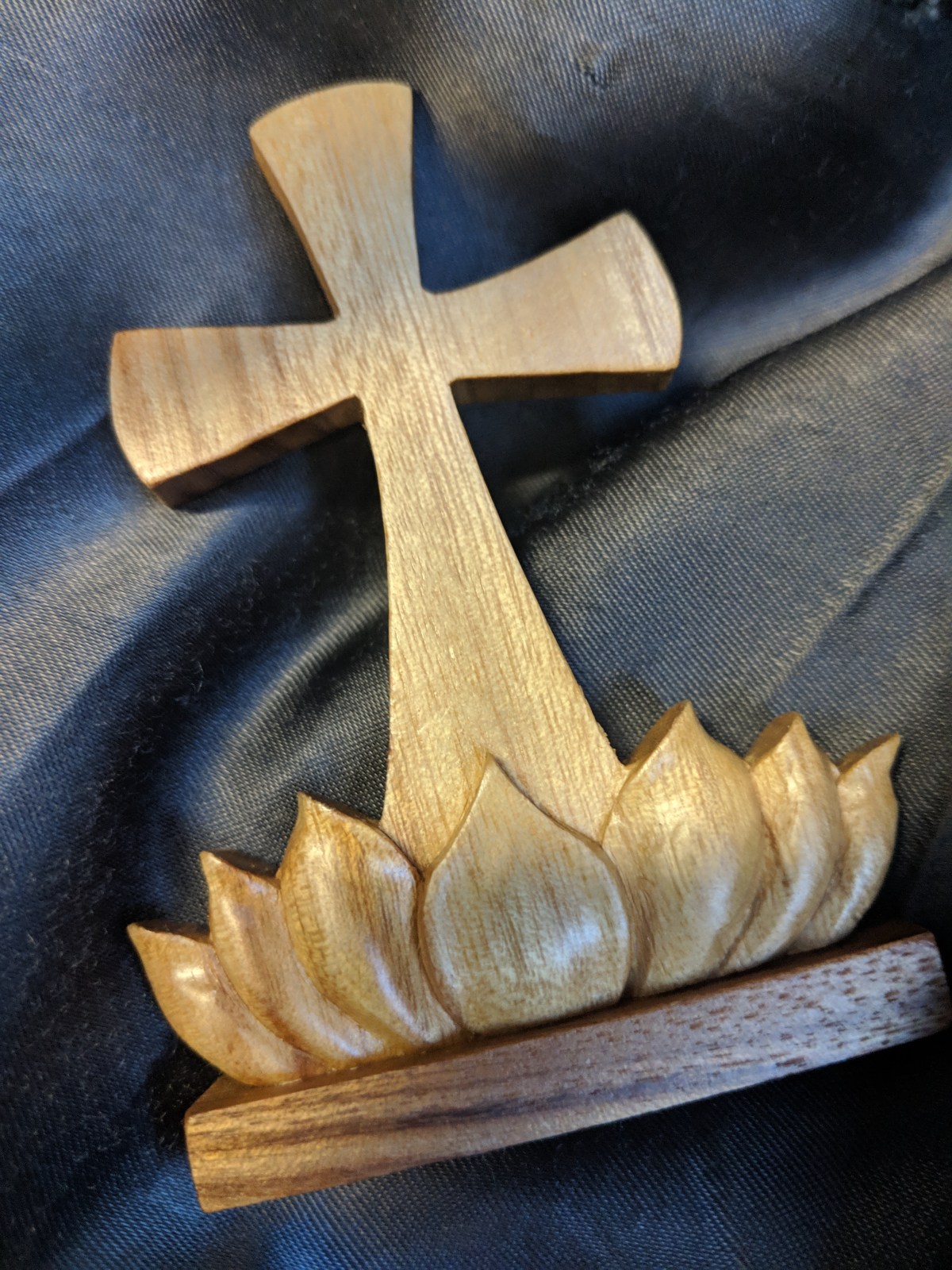
So for now I will just tell you this: the day before I left Hong Kong to come back home, I was looking around the gift shop of the Anglican cathedral for some little souvenir to remind me of my trip. And jammed amid the usual books and postcards I found this: a small wooden carving of a cross, rising up out of a lotus flower.

I thought this was so cool! The lotus is a significant flower in Chinese culture–it shows up in paintings and flags and architecture–so maybe this is a symbol of how the gospel has shown up and taken root in China.

And that’s probably true, but…today’s Gospel reading has cast this little carving in a new light for me, and I want to share with you how so.

In Luke, we encounter Jesus delivering the Sermon on the Plain. He comes down from the mountain and stands on a level place and teaches his disciples. This version in Luke is typically overshadowed by the very similar Sermon on the Mount described in the Gospel of Matthew.

But if we look closely at the words of these two Sermons, they are not the same.

In Matthew, Jesus says “blessed are the poor in spirit…” but here in Luke, Jesus says “blessed are you who are poor.” Just poor. No spiritualization of the concept. The Greek word used, ptochos, more literally means “destitute”—those at the bottom rung of society.

And whereas in Matthew Jesus says blessed are those who “hunger and thirst for righteousness” here he simply says, “blessed are you who are hungry now.” “Blessed are you who weep now.” Those for whom oppression, hunger, and sorrow are immediate, physical realities–these are the people Whom God blesses.

Scholars disagree, of course, on the reason for this discrepancy between the two gospels. Perhaps they were indeed two separate sermons with similar themes. Or perhaps they are different editorial approaches to a well-known collection of Jesus’ teachings. I tend to agree, however, with those who conclude that the Lukan version, the one we heard today, is closer to Jesus’ actual words—because the message is simpler, more prophetic, and thus, frankly, more challenging to the social norms of his time—and ours.

Because to say that the “poor in spirit” are blessed is far more vague and comforting; that phrase is so easily interpreted to suit our own needs. To be “poor in spirit” has been taught at various times in the church’s history to mean a state of dependence on God, or an interior vulnerability of the heart, or detachment from worldly concerns. And those are all meaningful, even valuable pursuits in our personal discipleship.

But to say that it is the poor—the materially poor, the economically and socially poor, the invisible, oppressed, and, as some might think but never say aloud, the “problematic” and “burdensome” poor—to say that it is they, and they alone, who will inhabit God’s kingdom? That is confusing and not altogether good news for anyone who operates on the assumption that the cream rises to the top of society. And it’s fearful news for those among us, in Jesus’ time and now, who enjoy wealth and privilege and know (or suspect) that our abundance comes at the expense of others’ well-being. Because Jesus is saying that to the extent we are those people, the ones who have obtained the good life, the ones who are pursuing comfort while others struggle to live, God is not interested in our cause. In fact, God altogether rejects that cause.

This is hard stuff to face. I know it certainly is for me, as I think about all the ways I have benefitted and continue to benefit from a society that marginalizes and ignores the desperate needs of so many. As I ponder this, I am drawn back to this cross rising out of the lotus.

You see, the lotus is imbued with significance in several faith traditions, especially those in Asia, like Buddhism and Hinduism, where the plant is a native species. The lotus is an aquatic plant, and it has a root system that grows out of muddy, swampy water. At dawn each day, the flowering part of the lotus rises up from the dirty water and blooms, the most spotlessly pure white or soft pink, and at nightfall it closes and disappears again into the swamp. And that blossoming out of the mud is often associated in those faith traditions with wisdom, purity, regeneration, and divine beauty.

But for our purposes, looking at my little carving, to see the Cross of Christ rising out of the lotus petals is a reminder of the very lesson we might want to resist in today’s Gospel:

God’s blessing, God’s tender concern, is found in those places we would rather not tread. In the muddy, messy places. The undesirable places. The places where beauty is least expected. Among the poor and hungry, and sorrowful. That is where the Kingdom of God takes root and blooms and is revealed to the world.

And, this is the difficult part of the message: it is ONLY in those places that the Kingdom is revealed to the world.

The Kingdom of God is not found ensconced in communities of privilege. The kingdom of God is not found where people hoard wealth, eat more than their fill, and laugh while the world cries out in pain.

You know how they used to announce at the end of his concerts, “Elvis has left the building”? Well, wherever privilege is enthroned, God has left the building. God is nowhere to be found in the opulent palaces of this world, because God’s kingdom inhabits that other space, the muddy swamp, where the lotus and the Cross rise up declaring hope and blessing for all who are plunged in its depths.

And this is important: God’s kingdom shows up there, among the miserable, not because God delights in misery, or because poverty is noble, but because the oppressive systems of self-interest and indifference that produce misery are themselves the antithesis of God.  And to the extent that your or I inhabit those systems, the blessing of God is far from us. So we have work to do, to break those systems, to break free from them.

Easier said than done, perhaps, but we take steps every day. I have been heartened and inspired since coming back from my travels to learn how wholeheartedly Christ Church has embraced the warming shelter ministry for our unhoused neighbors in Alameda. I feel, as many of you do, that this program is such a perfect example of the church being and doing what we claim to be about: hospitality, openness, and deep care for others. But with today’s hard lessons from Luke, we are given an important caveat as we embark on that work together in the coming months:

The warming shelter, or any other outreach ministry of the church, should not be understood simply as an act of charity. When we welcome in our homeless brothers and sisters, we miss the point if we think it is simply US giving something to THEM. We start to think things like “oh, WE have all of these resources, and we are going to do a good, Godly thing and welcome in these outsiders, to give them what they need. It will be such a blessing for THEM to be welcomed by US. ”

But remember what Jesus told us today: to the extent that we are the ones with wealth and privilege, WE are the ones in need of blessing!! We are the ones who are in need of those whom we host on cold and rainy nights. Because the kingdom of heaven is THEIRS, it is being revealed in THEIR midst. They are the inheritors of God’s blessing, and we, here, will encounter that blessing when and ONLY when we draw near to them, when we throw open the doors and go out into the streets and fall on our knees and say, “Come in God. Come in Holy Spirit. Come in Lord Jesus. Come in, friends. Liberate US by letting us feed you, and letting us keep you warm, and letting us give you a place to rest. Let us get into the mud and love you and be loved by you and together we will behold salvation blooming like a lotus in the light of dawn.”

This possibility is our joy and our hope, and Christ is revealing it to us, coming up out of the mud.

Blessed are you who are poor. Blessed are you who are hungry, now. Blessed are you who weep, now. And if you, like me, are not those things, then let us go find those who are, and pray that we will be blessed by them. The Kingdom is theirs.