
I preached this sermon on Sunday, January 14, 2024 at St. Anne Episcopal Church, West Chester, OH. The lectionary text cited is John 1:43-51.
This past week, we were in the process of finding a new person to clean our church buildings here at St. Anne, as our previous cleaner has moved on to other endeavors. And Greg, who graciously coordinated our interviews for someone new, joked to me in the midst of all of it that perhaps an exploration of cleaning services would work their way into this week’s sermon.
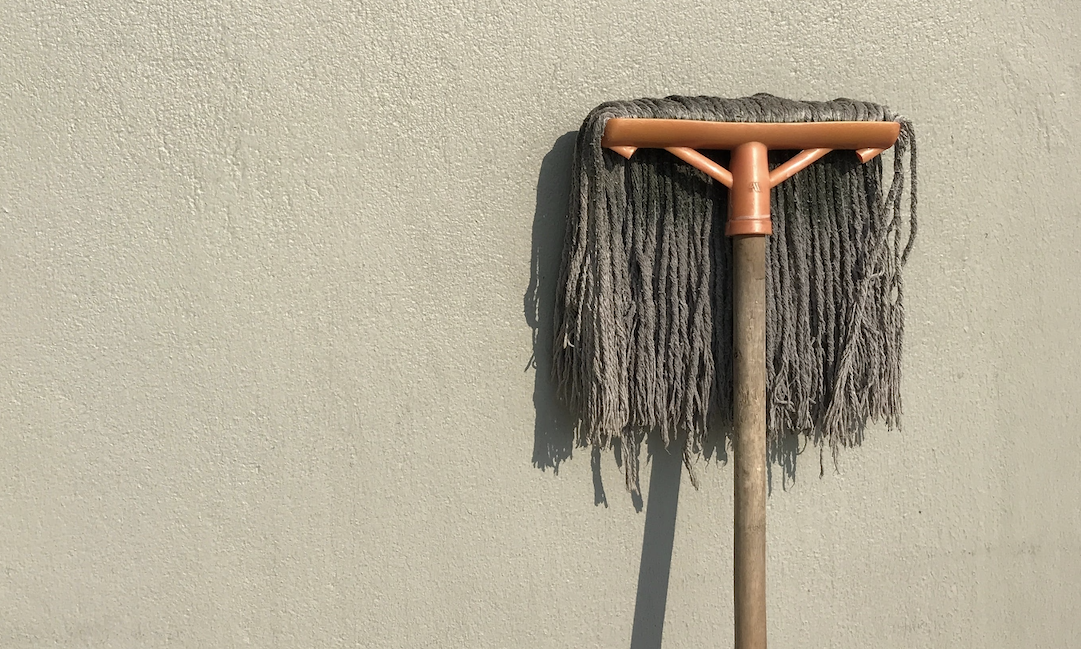
So I was reflecting on this week’s Gospel passage, where Jesus is calling his disciples and then encounters Nathanael (who, by the way, most scholars agree is another name for the apostle Bartholomew)…and I know Greg was kidding… but I got to thinking…and yes, actually, there is a connection to be made. Really, when you come down to it, everything we do, everything that we encounter, for good or ill, the sublime and the mundane, is an opportunity to look for God looking back at us—you can indeed glimpse the Kingdom of heaven hidden among the mops and brooms and cleaning rags.
My grandpa was a janitor for many years up in Michigan—he would clean the school buildings in the nighttime, when the halls were empty and the classrooms silent. He used to tell funny stories about some of his coworkers, and a few scary stories about things that went bump in the night in those old buildings.
And even though, in that role, he was not necessarily seen or lauded by any of the students or teachers or administrators, and even though he never made a ton of money, it was clear that he took pride in his work, and that he knew that what he did was something that mattered—one of those hidden-yet-essential roles that keeps things going day after day, year after year.
The people like my grandpa, and like all those who clean up and repair and fix and tend—like our cleaning staff and like our sexton, Tim, and like many of you who volunteer to keep this place standing—these are the saints behind the scenes, the ones upon whom we all rely.
Creation groans, and empires rise and fall, and the future might feel uncertain, and existential angst might swirl about like winter snow, but somewhere, at every hour of the day, there is someone who is nevertheless salting and shoveling the walks and mopping the floor and sweeping up the shattered pieces and doing all of the other little tasks that seem to say: this is what hope looks like. Because things may break, but it’s worth trying to put them back together again. And things may become a mess, but it’s worth scrubbing them down and starting anew each morning.
My grandpa cleaned those school rooms knowing, of course, that they’d be dirty again the next day, but he also knew that future generations were being educated and formed in those hallways, and so I think he hoped to do his small part. He wanted those floors to gleam with the promise of what they carried.
And it is a beautiful, sacred thing to care with such dogged persistence for some place, for some thing, to keep cleaning up the forgotten corners that gather dust and to mend the things that wear out.
We care for broken pipes and furnaces, just as we care for broken hearts and spirits—even though we know, in both cases, that the breaking is inevitable—because the caring itself is an act of resistance against the forces of decay and despair. It is a sign of our faith in a future time and place and reality where all of those small, loving, unremembered practicalities will have mattered, that they will have amounted to something greater than the sum of their parts, that they will be revealed, in truth, to have been the very foundation of the world.
For our lives have taken shape upon a thousand different floors that were mopped and swept by unseen hands. We have been fed by the labors of people we will never see, liberated by the sacrifices of names we will never speak. Our world is sustained by so many things—so many gestures of care and selflessness and quiet courage—that we tend not to see.
And in that sense, Nathanael in today’s Gospel is a bit like all of us. He is, we presume, a man who is keenly interested in knowing the Messiah, in experiencing for himself the way that God is going to act and manifest his glory in the world.
But Nathanael, like many of us, is looking for the obvious, impressive sorts of signs. And upon hearing about this nobody named Jesus, from a small village in an unremarkable region of the country, Nathanael is decidedly not impressed. “Can anything good come from Nazareth?” he asks. Can the world be saved by a carpenter and his ragtag group of friends? Will oppressive empires fall to the power of the saw and the broom and the fishing net? Nathanael thinks not.
It is only when he thinks Jesus has some superhuman psychic ability—claiming that he saw Nathanael sitting under a fig tree before they ever met—that he starts to get excited. Maybe this Jesus does have some impressive tricks up his sleeve after all. Maybe he is about to reveal himself as a mighty king in hiding, and the whole humble carpenter thing was a just a costume, a front for the real sort power that God’s Son must surely wield.
And then Jesus says to him, knowingly, lovingly, devastatingly—do you believe because I told you that I saw you under the fig tree?
Do you still believe that God is like a magician?
Do you still believe that prayer is like a parlor trick?
Do you still believe it is the impressive, obvious forms of power that will save the world?
Do you still believe that the Messiah will be like any other king, with swords and stratagems?
Do you still believe that wars and the ones who wage them are the backbone of history or the gateway to an everlasting peace?
Do you still believe only in the world you can see in front of you?
You will see greater things than these.
You will see heaven opened you will begin to understand its true simplicity.
You will see the angels of God ascending and descending and the hidden, delicate interdependence of all creation and begin to understand true sustenance.
You will see the tearstained faces of the oppressed and the marching of the peacemakers and the work of humble hands and the bravery of trampled hearts and you will begin to understand true blessedness.
You will see the faith of the sick and the generosity of the widow and the fierce devotion of the parent and you will begin to understand true love.
You will see violence itself laid to waste, the nullification of the cross and the sword and the stone. You will see the dawn on the other side of death, and you will begin to understand true power.
You will see the unsung, unnoticed acts of care that renew the world each day and you will begin to understand true salvation.
Do you believe because I told you that saw you under the fig tree?
Well, brace yourself.
Because you will see that, in the end, the world will indeed be saved by the carpenter, and the fisherman—and the janitor and the cook and the mechanic and the gardener. And empires will indeed yield to the power of the saw and broom and net and plow, because the most enduring thing in the world is the persistence of care, the unyielding dedication of the ones hidden in plain sight who clean up and patch over and refuse to let things fall apart—for they are the signs of the one true God, who is also hidden in plain sight, and who has been cleaning and patching and refusing to given up on us since the beginning of the world.
The God who is, indeed, smiling back at us from amidst the mops and the brooms and the rags, who wants us to do nothing more than to care for what is in front of us, to fix what is broken, to make the world gleam with the promise of what it carries.
Thanks be to God for the ones who already do this. Blessed are they.
And, like Nathanael, blessed are we, when we finally see them.


Dear Phil,This is wonderful. I just sent it to all the sisters. Thank you.Sarah SSM
LikeLike
Sarah, thank you so much! Blessings to you and all of the sisters.
LikeLike
I hope it’s ok Phil that I read this sermon to my parish council tonight.
LikeLike
I am honored that you would do so!
LikeLike
Dear Father Phil,
Just want you to know that your gift is reaching many that you may never know of. Thank you for sharing your weekly sermons, as I read each one. I hope you are well. It is so beautiful to see how far you have come, in and on your spiritual journey! I hope you don’t mind, but I had to share the below poem with you, as I thought of it while reading your sermon today. Wishing you much joy, peace and continued spiritual growth! Blessings and Peace!
Rob Odegaard (Laura’s Dad)
“The Dishwasher”
April 1993 and February 1995
I know of a man who washes dishes, pots and pans
Eight hours a day, five days a week
A person so content with himself
One, who never complains, never sways
From his profound beliefs in simplicity and serenity
The dishwasher I am speaking of
Is like few others I know today
He is not caught up in the ways of the world
Rather, he lives with the values of yesterday
A simple man it would appear to many
I’m not so sure a poet would agree
Or any person spiritually minded
Might look up to the man in the scullery
Scrubbing the dishes, mindful of the present;
The here and now
With no distractions to the soul
Where does the dishwasher fit in?
What is his role?
Perhaps to be a vision to those who are blind
To guide the less fortunate from deep inside
Leading by example, not falsely motivated
By what others think, do or say
Rather internally directed from above and within
Perseverance from faith allows him to trudge
Through the culinary waste
A freedom preventing any scars to the soul
Allowing a deeper vision
To a life that is pure
A message to the lay people of the world
The world may say to this peculiar fellow
Why not use a dishwashing machine,
Or let someone else do this tedious job
Not even realizing or wanting to see
Blind to the message
A message the world has been missing
For such a long time
The hands and soul are connected
The mind in between
Only when the soul is acknowledged
Can there be satisfaction, transformation
The dishwasher I know is intrinsically aware
Of this connection so deep and so rare
I look up to him with respect and awe
Because his soul he will always keep!
Rob Odegaard ©
LikeLike
Rob, I am so grateful for your message and your beautiful poem. Thank you for sharing this! I marvel at the many way God speaks to us and through us when we are open to it. Pray that you are doing well.
LikeLike