I preached this sermon on the Third Sunday of Advent, December 17, 2023 at St. Anne Episcopal Church, West Chester, OH. The lectionary texts cited are Isaiah 61:1-4, 8-11, Psalm 126, and John 1:6-8, 19-28.
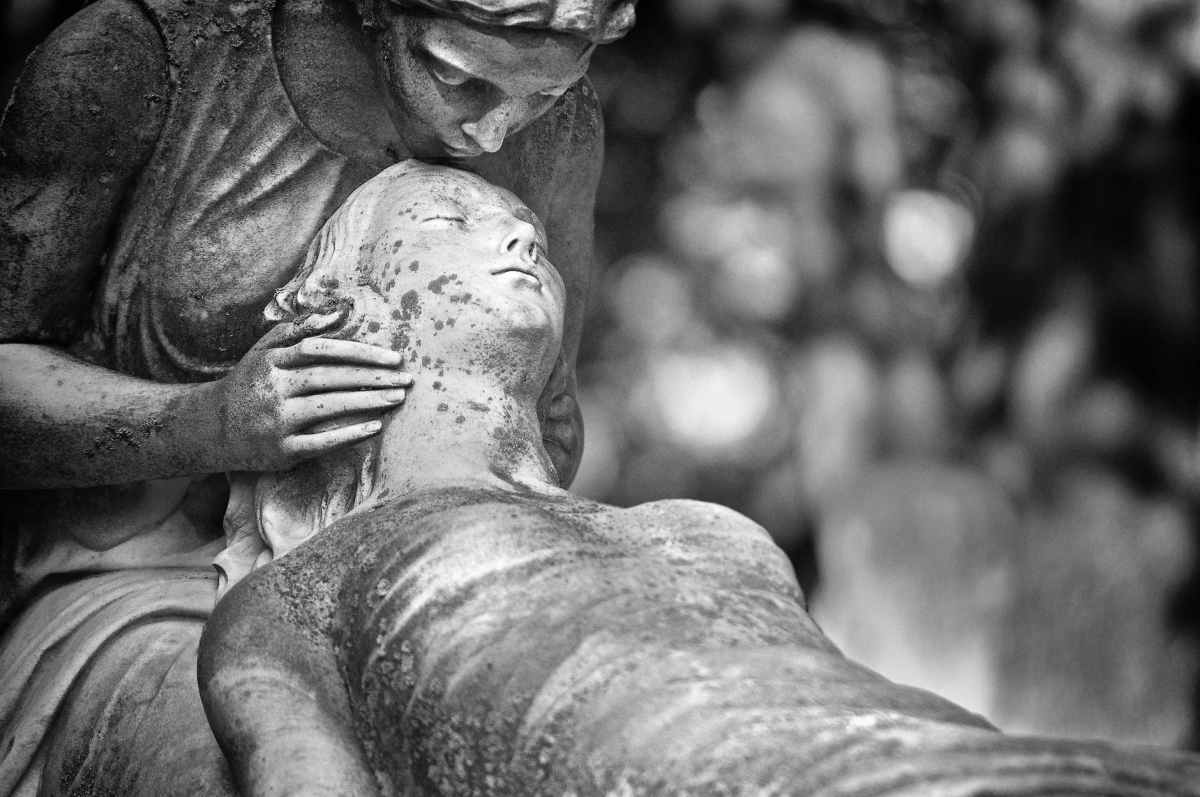
One of the great privileges of my vocation as a priest is when I am invited to spend time with people who are near the end of their life. For reasons that are both self-evident and yet hard to put into words, the dying and those who love them often find deep meaning and comfort in the simple rituals of familiar old prayers offered at the bedside, of oil traced in the shape of the cross on the brow, of meaningful silences and gentle hand-holding.
And every time I am welcomed into such a space, to bear reminders of God’s love and to bear witness to it among families and friends, I think to myself: this is what it’s all about, when everything else is stripped away. This is what it’s all about.
This is the moment when the worries and the wondering and the pretensions and the half-kept promises and the striving and the stumbling that preoccupy so much of our days all give way to the spare essentials, and this is when we finally encounter what has always been true: that we have lived, that we will die, that we are loved in ways that surpass both living and dying.
There is nothing more beautiful to me than the unadorned, earnest intimacy of such moments; few places that feel holier than when people see each other clearly and say what they mean to one other without hesitation or embarrassment.
Would that we experienced such vulnerability and gentleness and openness with each other throughout our lives, and not just near the end of them.
But we tend to lead cluttered, fragmented lives—disappointments jangling in our pockets like loose coins, stacks of should-have-beens and ought-to-dos crowding our peripheral vision, making it difficult to see the path in front of us, difficult to discern how to navigate the shattered landscapes of an equally fragmented world.
The ruined cities of which the prophet Isaiah speaks, and the devastations of many generations—they are still with us and they are within us, and still we go out weeping, carrying the seed, and so it’s no surprise that we are terrified of tenderness, unable to embody it, unsure whether it is safe to do so.
Because the truth is, it is not safe. Love never is. That’s probably why our tenderness towards each other too often shows up at the end, when at last there is nothing left to hide from, when there is no value left in posturing or pretending, when we have nothing to lose but time and when we can finally give voice to the hidden depths within us. When we can say, “I love you,” without a hint or irony or self-preservation, and hold the hand of the one we love and notice the miracle of how our fingers intertwine, like stitches in the fabric of the universe.
What those moments at deathbeds have taught me is that good lives, true lives depend precisely upon a pervasive tenderness, a certain surrender to our need for one another, a relinquishment of the titles and the labels and the boundaries we so often construct in our haste to make sense of things or to protect ourselves.
None of those things will matter much in the end, none of them will console us as we approach the hiddenness of eternity, and none of them will transform our relationships with one another. Only love will do that.
And other than Christ himself, no one in Scripture understands this better than John the Baptist. Nobody, more so than John, understood the liberating necessity of relinquishment, the power of naked vulnerability, the abandonment to the wild and honest tenderness of God.
Given his stature in the tradition of the Church, greatest among the prophets, we might tend to think of John through the lens of strength and influence and force, but if we pay close attention to who he is and how he lives and what he says, what we actually discover is a man who has given away everything—including his own capacity to wield power—in order to be filled with the vast, meaningful emptiness of God’s Spirit. He is one whose whole life is lived in the borderland between heaven and earth, the same borderland we usually only glimpse towards the end.
Who are you? ask the priests and the Levites. I am not the Messiah, he says.
What then? Are you Elijah?
I am not.
Are you the prophet?
No.
Then who are you? What do you say about yourself?
I am the voice of one crying out in the wilderness, ‘Make straight the way of the Lord.’
I am the one who knows that titles do not convey true significance.
I am the one who has stripped away all my defenses, who is brave enough to love foolishly.
I am the one who is not lured by disappointments or distractions.
I am the one who wears my burning heart on my sleeve.
I am the ruined city that is being rebuilt.
I am the other side of devastation.
John is the one who stands on the banks of the river, inviting us to be reborn, inviting the whole earth into that which we will discover on our deathbed: that the only kingdom that will last is the kingdom of love, and that this kingdom is coming and is now here, ready to conquer every human heart willing to be undone by tenderness, willing to be made new by vulnerability.
John is us, if we dare to be him. He is the truest part of us, after everything else is stripped away. He is the reminder that beneath all of the things that scare us, all of the things that tempt us, all of the things that confuse us and confound us, there is something durable, something undaunted, something unafraid and alive within us that will assert itself if we let it, if we release the clutter and the fear and give ourselves over to its fierce and magnanimous possibilities. What is that something? Well, on the Third Sunday of Advent, we call it joy.
But even more fundamentally, it is the image of God, yearning to reveal itself in us, waiting for us to say yes, waiting for us to say, let the light come into the world, and into me, and let me testify to it, let me be baptized in the fire of love and let me reach out to you, my brother, my sister, my sibling, my love, and let me clasp your hand even though we are dying and let that simple embrace be all of the truth that there ever was in this short life, let eternity erupt in the space between our palms, let heaven whisper in the silences that cannot be filled with words.
And although we are afraid, and although yes, we go out weeping, remember that joy is our enduring harvest, and so if we are courageous enough, if we are tender enough, may all of life look like its ending: spare and clear and urgent and gentle, love’s unstoppable advent, a deathbed and a birthing, a promise and a fulfillment, all at once, always.
We do not have to wait til the end of our lives or til the end of time to experience these things. They are available to each of us, here and now, if we, like John, are ready to trust in that Kingdom we already know is coming, to give voice and shape to it wherever we find ourselves. And the cities may continue to smolder, and the devastations will continue to knock upon the door of each generation, but for those who follow in the footsteps of the Baptist, for those who know that a heart broken open is the most powerful thing on earth, for people such as this—for people such as us, we pray—there is another world, there is another way worth seeking, worth speaking, worth dying for, and worth living for, too.
That world, that way, that joy is almost here. Can you feel it?
 By Another Road
Oh what gorgeous, loving and spirit- filled words you give to us this day, Phil. Your words are rich with meaning and invitation, and yearning for everyone to see and feel what you already know so well. Thank you for this gift of yourself. I will read it over and over and dwell on your words.
Blessings & peace to you this Christmas, Phil.
LikeLike
Mary, I am sending love and prayers to you for a truly joyful and blessed Christmas. Thank you so much for your kind words!
LikeLike