
The Fire That Never Came: A Sermon

I preached this sermon on Sunday, January 12, 2025, the Feast of the Baptism of Our Lord, at St. Anne Episcopal Church, West Chester, OH. The lectionary text cited is Luke 3:15-17, 21-22.

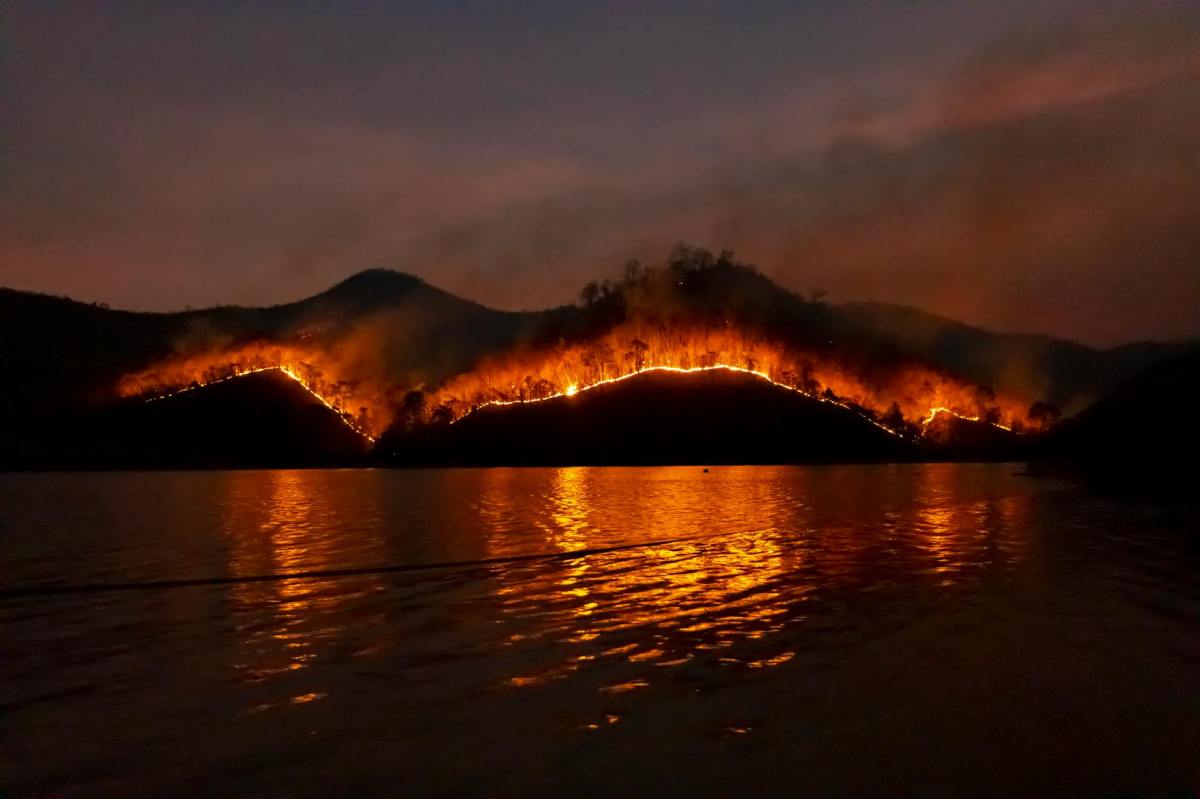
I’ve shared with you in the past how, when you live in California, you become acquainted with the risk of wildfire. You make an uneasy peace with it. Much of the year it’s in the back of your mind and then, when the risk level is high, you look nervously towards the hills, wondering if and when something might spark. 

But because you never really know, most days you go about your business and go to work and do the dishes and pay the bills, carving out a sense of normalcy and telling yourself that, if it does happen, if the fire does come, somehow you will manage. Or maybe, in your less noble moments, you just figure it will happen to somebody else.

But the fires do come, in their own cruel time and manner, and it is hard to be prepared when they do. As we’ve seen this week in Los Angeles—as some of you know intimately well through the impact on friends and family members—the fires come without much warning, and they blaze and they creep up upon the homes and lives of people without much regard for their wealth or background or virtues or vulnerabilities. 

They come, these fires, and they do what fires do—they consume. We know already this week of Episcopal churches and whole communities consumed by this most recent set of wildfires. We also know that we are living in a time when human-impacted climate conditions will only continue to increase the likelihood and intensity of such events. The unquenchable fires have come. 

And maybe it’s just me, maybe when you grow up with this threat of flame and smoke, it has a formative effect..but I have to say that, as evocative as it is, I find little that’s romantic or alluring about most of the fire imagery in Scripture. I’m circumspect about declarations, like the one that John the Baptist makes in this morning’s text, about how God will come and burn and consume things for some divine purpose. There is nothing pretty or transcendent about that. Not when you have seen or known what fire can actually do, what it can take.

And yet that imagery is there for us to contend with. John, admonishing the crowds before Jesus’ appearance, warns of a Messiah who will come bearing unquenchable fire to burn up all that is wicked and unworthy. And I get it, he is angered by injustice and wants the people to look a bit nervously toward the hillsides, wondering when their reckoning will come. As prophets often do, he wants them to experience an uneasy peace with the world as they know it. He assumes that God will save the world through a display of vengeance and power, in billows of smoke and flame. 

He is not alone in that, even today. I found a number of news articles this week in which people described the Los Angeles wildfires as “biblical” and “apocalyptic” and as being like a scene from “the battle of Armageddon.” Still, still, even if we don’t want to, we imagine and speak of God working through destructive forces, raining down judgment upon us like ashes, threatening at any moment to take away all that we know, or, in our less noble moments, to come and take from somebody else. 

I wish we could loosen our grip on that fiery imagery somehow. Because I will tell you that so much of why I am Christian, why I was able to give my life over to the way of Jesus, is because of what actually happens in today’s Gospel after John’s dire predictions. 

And it is this: that Jesus, the Son of God, appears in Galilee, the Incarnate Deity appears at last, coming over the hills…but the fire never comes. Not in the way that anyone expected anyway (and Pentecost is a story for another day). 

No, on this day Jesus appears and it is not as a vengeful blaze cresting the ridge, but as a man ready to get down into the water like everyone else. A man ready to come alongside all of us in the uneasy peace we have negotiated with this life. A man who wants us hope for something more than mere escape and to believe in something more than just survival.

And truly, thank God for that. Because I will tell you, my friends, I am tired of fires, and of people who blithely traffic in the language of fire when talking about God and our common life. I am sick of “burn it down” and “let it burn” and of fire & brimstone theologies that devour human dignity in the name of purgation. I am sick of destruction—of bodies and landscapes and souls—and how they are cast as part of God’s saving mission. 

I don’t want to settle for an uneasy peace anymore. I want the peace that the world cannot give, the peace born of water and Spirit. And today we see where it comes from—from the God who stands in solidarity with us in the River Jordan, whose only fire is the one burning in his heart with love. 

Because John, for all his Spirit-inspired wisdom, got this part wrong, and it’s important that we don’t just read past his mistake. There’s a reason, in other versions of the story, that he is actually somewhat dismayed Jesus wants to be baptized with water. There is a reason, later from prison, John asks, are you the one we have been waiting for

Because John himself is also discovering, as we must, that the true Messiah, the Christ, is not an inferno coming to gobble up everything we’ve tried to build; God is the one strengthening us and helping us to carry those buckets of water– all that blessed baptismal water–to put out all the fires we ourselves have started on this earth. 

And yes, God will help us separate the wheat from the chaff within ourselves and in our world, but God will do so not through devastation but by the devastating power of his mercy and kindness.

And the thing is, we already know this. We already know, if we stop to reflect on it, where and how God shows up in the world. We know that God is not the one burning the hillsides of Los Angeles or blessing the gunfire in war zones. We know that God is instead with the firefighters and the first responders and the widows and the orphans and the volunteers and the communities of people who are sheltering each other and guiding each other into safety. 

We know that Christ asks us to do the same for each other no matter what landscape we live in or what disasters befall us. We know this, because it is what Jesus demonstrated and proved the value of in his life, death, and resurrection. And we can’t let anyone distort this truth.

No matter what we must navigate in our time and in times to come, no matter how many times the fire looms at the edge of the horizon, we are still, and will always be, the people who proclaim the good news of the one fire that never came—that so-called fiery, angry God who instead appeared in the water, like a falling dove, like a gentle Word, stooping down from the misty heavens to scoop up our fears in his hands and bless them and say,

Peace. I am here. You don’t have to be afraid anymore, you who have been uneasy for so long. Step down into the water with me, where the flames cannot reach.

Drench yourself in love, and let us begin again. 

For Such a Time as This: A Sermon

I preached this sermon on Sunday, September 20, 2020 at Trinity Episcopal Church, Fort Wayne, IN. The lectionary texts cited are Philippians 1:21-30 and Matthew 20:1-16.

I know it might feel like a lifetime ago in this ever-frantic news cycle, but just the other week my social media feeds were full of eerie, dark images from friends in the San Francisco Bay Area: a thick mantle of smoke from the voracious, deadly wildfires on the west coast had literally blocked out the sunlight. Office towers were illuminated at midday, and cars crept through the haze with headlights on, like ghosts floating through the thick, amber-tinted gloom that many described as “apocalyptic.”

And while these images were striking in their severity, this rampage of flame and smoke is not a  novelty out west. In fact, as a seminary student in Berkeley a couple years ago, long before the coronavirus pandemic, I was already the owner of several N95 face masks, because the ash from the autumn wildfires would get so thick that our lungs would burn just walking a block or two to class. 

I remember my friend and classmate, Alison, collecting masks and handing them out to the folks living on the streets in our neighborhood, who had to sleep every night under that blanket of toxic air. I remember keeping a bag packed in my dorm room with essential documents and mementos, just in case those sparks of fire began devouring the hills looming outside my window.

As a native Californian, I can tell you that these fires, in recent years, are worse than they ever have been. Their intensity and destrutiveness, exacerbated by climate change and unchecked population growth in fire zones, threatens the life and livelihood of millions of people in our country.

But, as with so many other urgent societal challenges of our time, the debate over what to do about this crisis has been overtaken by the fear and resentment that pervades our public discourse. The need to reckon with complex challenges devolves into false dichtomies and endless posturing. Meanwhile, the land continues to seethe and burn, and our brothers and sisters weep amid ashes both literal and figurative, in a season that indeed feels like an endlessly encroaching twilight.

So when they were talking about apocalyptic skies, my friends might have been engaging in a bit of anxious poeticism, but not by much—becasue we ARE living through an apocalypse, in the strictest sense of that word. Not necessarily the “end times” of popular imagination, but an apokalypsis—which in the Biblical Greek means a revelation, an uncovering of things not previously known. This period of crisis is revealing US, forcing us to face who we are and what we stand for.

Not who we THINK we are. Not who we assume OTHERS to be. But who we actually are, when the rubber meets the road, when times get tough, when we can no longer hide our fears and flaws behind the pleasantly numbing qualities of prosperity and power. When the type of love espoused by Jesus, in all of its raw urgency, is all we have to rely upon and guide us.

If we glean anything from the letter of St. Paul today, who realizes that for him the greater good is to stay and engage in the “fruitful labor” of this troubled world, we must come to understand that sitting this one out, that waiting for the ethereal promise of better days, is not part of our Christian vocation. This is the time for us to stop posturing, to put aside our resentments and regrets about what might have been or should have been, and start getting real about doing God’s work. The needs are great. The hour is coming and is now here.

In today’s gospel, we hear from Jesus that the kingdom of heaven is like a landowner hiring workers for his vineyard. And while we often focus, rightly, on how this parable illustrates God’s almost-scandalous generosity, it also has something important to tell us about simply showing up and laboring in the first place. 

Consider those workers who are lingering in the marketplace near the end of the day. We don’t know why they waited so long without being hired. But to the landowner, it doesn’t really matter. He is willing to take them. Because however late the hour, the laborers did show up. They stepped out in the public square and presented themselves as willing hearts, willing contributors to the harvest, even with only an hour or two of daylight left. Even when it might seem that any chance to make a difference has passed them by.

I think of all the times that I have been late to show up for the truly important people and pursuits in my life. I surely had all kinds of reasons, some better than others. Sometimes because I thought I had better things to do, other times because I was distracted, or scared, or angry, or I just didn’t know where to begin. Maybe you’ve had those experiences too, where you feel like you’ve missed the boat, missed the call, missed the opportunity to do something meaningful.

But what we learn in this parable—something God really, really needs us to learn right now—is that it is NEVER too late to start doing the work we have been called to do. Whether we start in the dawn of our life, or at midday, or at dusk, God will always come find us, will always offer us a place in the vineyard, and most importantly, will always show us that even the smallest thing we do has value in the Divine economy.

So what is the labor that you can contribute, here and now? What is the work of your hands, the work of your heart, that you might offer in this perilous season? There is not one among us who cannot take part, no matter our age, health, or circumstances. 

Daily prayer for the needs of the world is a great place to start. Supporting the life and work of your parish, of course, is of vital importance for so many of us. Extending a hand of friendship and compassion out into the lives of our neighbors, especially those in need. Speaking truth to power in the great prophetic tradition of our faith. Caring for God’s imperiled creation. 

There are so many ways to labor fruitfully, and there is no one solution to all that we face, but neither is there any excuse to exempt ourselves from showing up some way, somehow. As the late Justice Ruth Bader Ginsburg once said, “real change, enduring change, happens one step at a time.” And so each of us has to take that step, whatever it is for us.

God is waiting for us to say yes, like our Blessed Mother Mary, to say yes to something bigger than ourselves, inviting us into the joyful, necessary labor for which we were made.  We cannot let our fear, or frustration, or bewilderment impede us from jumping in and offering what we can. Those who came before us, those who struggled valiantly to make this world a kinder, fairer place, deserve at least that much.

So I pray that the smoke will clear from the skies out west. I pray that the smoke will clear from this pandemic, and from this election season, and from any number of other challenges we are facing. But alongside God’s grace and providence, we have a crucial part to play in the healing of this age.  And we can’t wait til there are clear, sunny skies to jump in and get to work. We do not have the luxury of waiting. Our land continues to burn, and so our hearts must burn in response.

Brothers and sisters, there is no one else on earth that can do the thing you were created to do. There is no one else that can contribute what you were born to contribute.

No matter the hour of life in which you find yourself, this is the hour you are called. I know things feel hard, and scary, and exhausting, but remember: we were born, we were named as God’s beloved, we were baptized into Christ’s death and life for such a time as this. So, take a deep breath; give thanks for those who have labored before us; imagine those who will come after us; and then, here and now, let us go into the vineyard together.