
Coming Out: A Sermon on the Transfiguration

I preached this sermon on Sunday, March 2, 2025 at St. Anne Episcopal Church, West Chester, OH. The lectionary text cited is Luke 9:28-43, an account of Jesus’ transfiguration on the mountaintop.

I came out when I was eighteen. And although I came from a pretty open-minded family, it was still a struggle, as it often is for people. But there came a point about halfway through my first year of college when I was just weary of hiding—hiding from others, hiding from myself, hiding from that fundamental desire to be loved and to love someone back. I was willing to do anything, to give up anything, if it meant that I could stop being half-invisible. To live authentically and experience fullness of life. Or at least have the chance to try, and mess up, and keep trying like anybody else. 

And so, I came out. And it’s been mostly wonderful, and sometimes difficult, but it was never really optional, because it was simply the truth of me. Ultimately life requires us to acknowledge what is true, even if folks don’t get it or don’t want to get it. 

Because what is true is that most of us fundamentally want very similar things: to understand and to be understood; to be able to feel things; to experience life without fear or scarcity; to know and share love; and to leave behind something meaningful when we’re gone. These desires are pretty much universal, whether we are gay or straight; black or white; whether we are in Cincinnati or Kiev; whether we are rich or poor; or any of the other myriad ways people inhabit this world. 

It’s just that for some such people, because of their characteristics or their location or their status, they find themselves having to convince other, more powerful people they actually deserve those fundamental things, too. That they aren’t half-invisible. 

And while the powerful don’t usually like it very much, many such people, in their own ways, eventually have to muster the courage to come out—not specifically as I did, but to come out into the world in the fullness of their own humanity and say, this is who I am, and I dare to be seen. I dare to inhabit the dignity of myself. And I offer myself—all of myself—for I am no longer constrained by the fear of being misunderstood or maligned. Because I would rather perish in the light than wither in the shadows.

Every liberating impulse of the human heart, guided by the Spirit and made manifest in everything from the crossing of the Red Sea to the Stonewall riots to the sit-ins of the Civil Rights movement to the demands of peacemaking of our own time—all of it is a form of coming out. Coming out of Egypt, coming out of Jim Crow, coming out of the closet, coming out from behind the structures of prejudice and fear and choosing to see each other as we are, as the beautifully diverse children of God. 

Churches could learn a lot from all of this coming out, I think. Especially, God love us, those polite, well-meaning churches that have, for too long perhaps, been hiding our own light within our walls, wondering why the world is looking elsewhere. I wonder what such a church might learn from the people who’ve had to come out in their own lives. 

And I wonder, too, what we might learn from today’s Gospel account of the Transfiguration, when Jesus came out as…God. 

Make no mistake, that’s what this story is: a coming out story. Not as any of the categories of identity we usually associate with that term, but a coming out nonetheless. A bold revelation of selfhood to a world not quite ready for it.

On this particular mountaintop, just before his journey to Jerusalem and the suffering that awaits him there, Jesus decides he is tired of being half-invisible, too. He is, perhaps, weary of hiding the truth of himself: that he is the Son of God; the indwelling of the divine light; the Creator aching with love for creation—and he cannot hide it anymore. And for this moment, at least, in the company of his most trusted friends, before he surrenders himself to the culmination of his difficult work, he decides to come out. 

And so he does. And so we behold him.

This is Jesus, in blazing brilliance, in that white light which is formed by every color of the rainbow. This is Jesus, at last inhabiting the dignity of himself. This is Jesus, God, who also fundamentally wants the same things: to understand and be understood by us, to know and share love with us, and to leave us something meaningful of himself when he’s gone. This is Jesus, willing to pay the price for being himself, willing even to be rejected, because he knows that the truth is not optional, because the truth of him is love in its many forms, and it always has been and it always will be. 

This is Jesus, the God who has always called his children to come out from whatever harmed them or held them back from fullness of life, now doing it himself. 

The point of this, my friends, is that if Jesus can come out as God in a world that did not welcome him….and if our vulnerable siblings can come out as human beings seeking dignity  in a world that does not welcome them…then perhaps we as the church should realize that our own future also depends on our willingness to come out of the shadows and into the light. To come out and say, we are Christians, and this is what we stand for. And that we will no longer let others hijack the narrative of our faith or the nature of the Gospel for craven, fear-based, or politically expedient ends. 

We who seek to do good and proclaim love as the Way, perhaps we need to come out and say that we do so not simply because we are well-educated or well-mannered people, but because we are passionate followers of Jesus, and that is what followers of Jesus actually do: they love without exclusion, they surrender their lives to compassion, and they are not cowed by the forces of evil and mistruth. 

Perhaps we who often find it easier to practice a private, respectable faith need to align ourselves more closely with those of our neighbors whose very humanity is a matter of public debate. Our neighbors of other ethnicities and creeds and identities whose very decision to step outside the house and exist each day is an act of courage. Perhaps by seeking them out and knowing them better, we could find some of the courage we need ourselves as Christians. The courage to name Jesus as Lord. The courage to reject, in the name of Jesus, those forces which diminish or demonize any category of people. The courage to not be half-invisible ourselves any longer. To wear God’s heart on our sleeve. 

Because we are living in a time that demands an accounting of our values, of our commitments to one another, and of the depth of our souls. We are not the first to live in such a time, nor will we be the last.

And for those of us who have already had to come out and be ourselves in one way or another…well, some of us are rather accustomed to this sense of high stakes in the basic activities of living. We’ve got some tips to share. There is much that we can learn from one another to navigate the road head. To encourage each other. To stand with each other.

I hope and pray we will continue to do that work here. Whether through the building up of people participating in outreach services, or in the expansion of our advocacy and justice ministries, or in deepening our study of Scripture or in the practice of prayer and contemplation, I hope our parish will find and reveal the fullness of itself in this time. I hope that, right here in West Chester, we will help guide the broader church out into the possibilities of the present moment, despite the perils of stepping into the light. We have too much good news to share here to let it hide behind the doors or wither in the shadows.

If that sounds a little daunting, I get it. But as God likes to say, don’t be afraid. Pretty much anyone who’s had to risk simply being themselves in one way or another can tell you: it’s mostly wonderful. Sometimes difficult, yes: even Jesus, after the transfiguration, still had to keep on casting out demons and dealing with people who couldn’t or didn’t want to understand him.

But mostly, the peace of being wholly oneself with other people, without fear, is a wondrous gift. A gift from God. It is the thing that has saved some of us. Maybe it will help save all of us, together.

All we have to do, beloved church, is hold fast to the love that is the truth of us.

And then…come out.

Screen Door: A Sermon

I preached this sermon on Sunday, February 11, 2024 at St. Anne Episcopal Church, West Chester, OH. The lectionary text cited is Mark 9:2-9, an account of Jesus’ transfiguration.

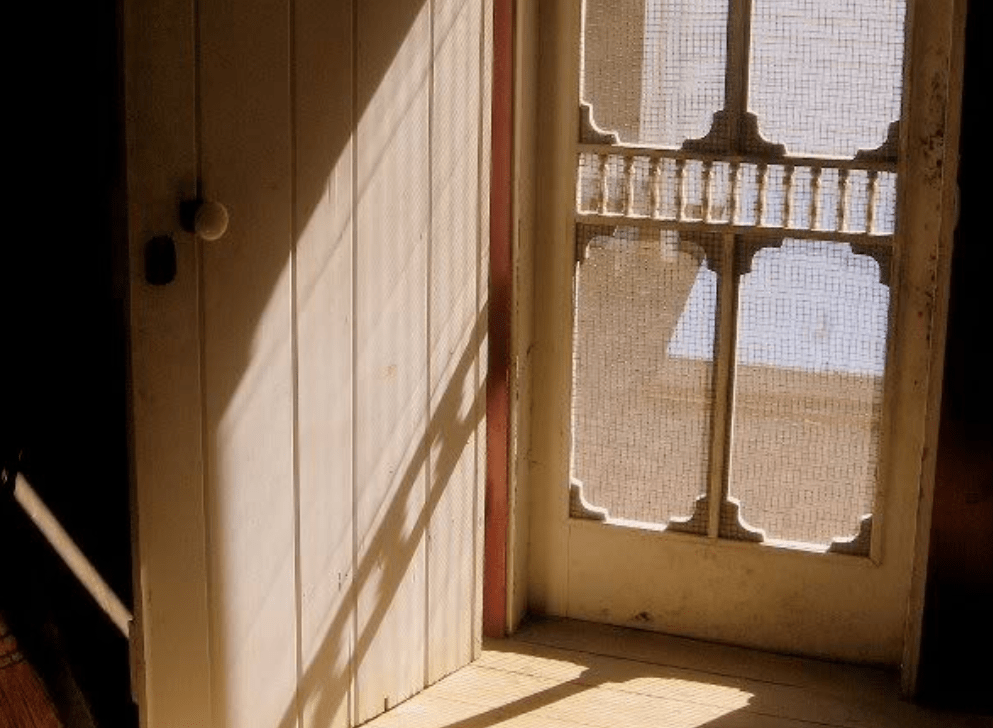
It has been many years, but I can still remember the sound of the screen door opening and slamming shut in the back porch of my grandparent’s house. The door was old and worn and yet amazingly resilient given the infinite number of times that people had passed through it on their way in and out. You see, in that house, nobody ever came in the front door, through the living room—it was always, always through the old screen door out back, and then a few steps through the porch, and on into the kitchen, the room where, as with most Midwestern families, all the truly important stuff took place. 

Maybe you remember a home or a place or a time like this—a season in your own life when the doors were always open. And so it was for us—that loud screen door was never locked, it was always at work, announcing the in-breaking  of the world that lay out beyond the warm cloister of the dim and fragrant kitchen. 

If we happened to glimpse anyone approaching the door from far off, they would emerge first as a glimmer of color and moving light out beyond the wire mesh of the screen and then—creak, rattle, slam!—there they would be, standing in our midst, in the flesh, stomping their boots, commenting on the weather. Friends and family members often showed up like this unannounced, a stream of visitors seeking to share a meal or a moment’s company, bearing news and stories. 

And I am sure someone, at some point, must have knocked, but I don’t remember it. I don’t recall the sound of knocking at all—only the familiar opening and closing of that screen door and how normal it was that people would come right in—how natural it felt for there to be a permeable boundary between what is already known and what comes to make itself known. 

There is an odd sort of paradox in a screen door, when you think about it. It is a barrier, but it’s one that is flimsy by design. It may have the shape of something absolute but it is rather ambiguous in its purpose, used to shield what is within it, but also to receive what is beyond it—the cooling breezes and the beams of light and the birdsong that travel through the screen to mingle with the inside smells of dinner and dish soap. 

It is not much of a safety measure, the screen door, but rather a way for two unique worlds to coexist alongside one another and to reveal themselves to one another. The screen door teaches us that the practice of passing back and forth between privacy and welcome; between domesticity and wildness; between the familiar and the unknown; is a good and necessary thing to do. 

And it seems to me that we have arrived at our own sort of screen door moment today, on the Sunday in the year when we see the Transfiguration, when the familiar and the unknowable commingle on the top of a mountain, when the human and the divine aspects of Jesus reveal themselves in a collision of time and light and cloud, of terror and belovedness. 

We, alongside Peter and James and John, are drawn into the strange paradox of looking at two realities at once—God’s and humanity’s—and realizing that, in Jesus, the boundaries between them are shockingly permeable. 

Today we conclude the seasons of Incarnation and Epiphany, where we have seen how the Son of God has been born and made his way into the world, approaching us, a glimmer of color and light beyond the mesh of our familiar understanding, and yet now—creak, rattle, slam!—here he stands, in his fullness, the eternal God come to pass through our door, to share a meal or a moment’s company, bearing good news and stories. 

And this, I think, is one of the most important things to understand about the Transfiguration—it’s not simply that Jesus revealed himself in a particularly magnificent way in this one moment to a handful of disciples, but that in all of our life with God, in worship and discipleship and service, transfiguration is always ready to reveal itself—the boundaries between our lives and the life of God are as permeable as a screen door through which the breeze of heaven blows.

I have seen and heard and felt him in so many different places. In moments of prayer and song. Beside a deathbed. Last week at the laundromat with the Outreach team. In conversations shared with many of you. Gathered around this table, week by week. And certainly, gathered around a kitchen table.

As we prepare for a long and thoughtful journey through Lent, to the Cross and beyond it, we are reminded today, right before we set out, that there is no aspect of human experience—even the most difficult and despairing ones—where Jesus is not able to come and be with us, to enter through the back door to sit a while, to remind us that he is separated from us by only the thinnest, most pliable boundary, if we are willing to look and listen and receive him.

Which begs the question—if the Kingdom of God is approaching us from the other side of the screen, then what must we do on our side to be ready, to greet this new world when it reveals itself? What does a screen door faith look like for us who desire a glimpse of the transfigured world beyond?

And in that, I think my grandparents were on to something simple, but essential: their door was always open. Part of what we practice here, week after week, in liturgy and in hospitality and in service and in formation, is a permeable, open-door way of life, a blurring of the demarcations between personal and communal, finite and eternal.

First, we engage in the pattern of the Eucharist so that we will go out into the world beyond our red doors and replicate that same pattern elsewhere, giving away our own selves for the sake of love, just as Jesus has done for us.

We practice welcoming visitors and strangers into the doors here at St. Anne because being open to new faces, new stories is how we cultivate openness to the presence of God whenever and however God comes into our lives—which is quite often in the form of visitors and strangers. 

We serve our neighbors, approaching the threshold of their experiences and getting to know them so that we begin to see how little separates us from anyone else; how their well-being is bound up in our own; and how the differences we perceive, while real, are not a barrier to meaningful relationship. 

And we pray and learn and study and challenge our assumptions and expand our perspectives, so that we can be attuned to the infinite number of ways that God passes into our world and abides with us, because Jesus, in that transfigured collision of flesh and light, of time and eternity, has broken down the division between heaven and earth, or at the very least he has made it like a door that will never be locked, a door to eternity that is flimsy by design, a door that is, in fact, like a screen door, where the commingling of two realities finally meet—God’s heart and our heart, God’s life and our life, the beams of light and the birdsong, the dish soap and the dinner, and all of it is God’s and all of it is ours and all of it is sacred.

And so as we approach Lent, and whatever you decide to do or not do in that season, most of all I want you to consider this: how you will stay present to the thin and permeable boundary between you and God? How will you stay open to the life that lies on the other side of the screen? Will you glimpse heaven at the laundromat, in the food pantry? Will you look for the glimmer of color and light that dance behind the words of Scripture? Will you bring good news to your neighbor, share your story with them, proclaim a word of peace to a hurting world? Will you set the table? Will you unlock the door?

Because what we do know is that God will indeed come to see us. We may not know when or how, but in every moment, on every mountain and in every valley, God is always there, ready to be with you , ready to enter in, so eager that he might not even knock, so wondrous that even if you hear his approach—creak, rattle, slam!—you may never be the same once you look up and see him: glorious, stomping his boots and commenting on the weather, seeking to share a meal, a moment; seeking, ultimately, to stay forever in you, in your heart, where, at last, he is transfigured into your flesh, your life.

And then, everything will be both familiar and new; safe and free; and you will be in heaven and you will be at home, all at once. 

Transfixed: A Sermon

I preached this sermon on Sunday, February 27, 2022 at Trinity Episcopal Church, Fort Wayne, IN. The lectionary text cited is Luke 9:28-36, an account of the Transfiguration.

Like many of you, I have been transfixed by the images coming out of Ukraine the past several days. I was transfixed by the video clips of parents kissing their children goodbye. I was transfixed by the story of a young couple who got married one day and signed up to defend their city the next. I was transfixed by the images of people sheltering in subway stations last night, the thought of lives upended and ended, and of the incomprehensibility of yet another needless war blighting the face of God’s beloved creation. I have been transfixed by the question: what now? What next?

I use that word, transfix, intentionally. It means “to make motionless with amazement, awe, or terror,” and in the face of the brutalities that too often characterize life in this world, I do sometimes find myself shocked into motionlessness. I find myself without words or insights or any idea how to meaningfully respond. My prayer this week has been little more than silence and variations of, “Lord have mercy. Christ have mercy. Lord have mercy.” Even the beautiful language of the Prayer Book has felt dry and heavy on my tongue.

It is easy to feel this way when we are inundated with challenging news. Ukraine is the latest iteration of the world’s grief, but in this interconnected planet, I think we are more keenly aware than ever of the collective heartbreak of the human family. We’ve faced our share of it together in the past few years. And it can feel, some days, like too much to process. Like my heart and my mind can’t hold it all. And so I am simply transfixed. 

But our generation is not alone in this experience. As I reflect on all of this, I feel some connection to Peter and John and James in today’s gospel—up on the mountain to pray, they see something incomprehensible—the figures of Moses and Elijah appearing in glory, speaking with Jesus, who is himself visibly changed in some mysterious way. And while we might tend to think of this as an exciting and beautiful vision, in truth it was terrifying and overwhelming for the disciples. It was too big for them, not something they were prepared to process. 

I have an icon in my office of this scene, and in it, the disciples are not gazing placidly, reverently up at Jesus and Moses and Elijah. They are falling back in shock, tumbling down the mountainside, as if they are in the process of being struck dead.

Luke describes their state of being while all of this was going on by saying “Peter and his companions were weighed down with sleep.” They were tired. They were frightened. We might say that they were transfixed. And so I have to wonder whether their prayer as the cloud enveloped them on the mountaintop was also some version of “Lord have mercy. Christ have mercy. Lord have mercy.”

In the face of what is new, and strange, and frightening, it is natural for us to not know what to do, and therefore to end up doing very little. We cannot comprehend the mind of God. We cannot save the world. We cannot explain the persistence of evil. And so we get stuck. We tell ourselves that we are just bystanders, poor pilgrims caught up in the storm on the mountain, waiting for the clouds to break, waiting for things to go back to normal. Waiting, transfixed, until someone else figures out what to do, what the next step should be.

But I fear we might be waiting a long time if that is all we do. Because here’s the thing, both about this gospel passage in particular and about our lives as followers of Jesus more generally: it’s not about being transfixed. It’s a different “t” word.

The word of the day today, the key word in this story, and the key word for our discipleship in moments such as this is not transfixion but transfiguration. That is what is happening up on the mountaintop. Transfiguration—the transformation of one thing into another, better thing. 

Let me say that again: the transformation of one thing into another, better thing. Now you might think, wait a second—Jesus is already fully God and fully human, long before he went up this mountain—he doesn’t need to be transformed into something better. And you would be correct.

Because in truth, although we usually focus on his changed appearance, Jesus is not the one being transfigured in this encounter. It is the disciples. It is the disciples who are changed—it is the disciples who are given eyes to see and ears to hear. It is the disciples who in this moment perceive the fullness of God’s truth, who feel what it is to bear the glorious weight of God’s love. It is the disciples who are being stretched and shaped and re-formed by this experience into who God intends them to become. And that invitation, that challenge, extends to us as well, we who are the disciples of the present, perilous moment.

Jesus, in revealing his eternal inner radiance, is actually inviting the disciples, and us, to let go of that sleep-heavy paralysis, that transfixed state of limited imagination, and to step out into a transfigured life, a life in which we are awake. A life in which we may not have all the answers, a life in which pain and suffering and war still persist, but also a life in which we are ready to face whatever lies ahead because we have seen, we have held, we have tasted–if only for a moment–the fullness of the glory of God.

And if you wonder, how can I live that way? Where will I find the courage? What if I am not  good enough or strong enough or centered enough? Well, yes, I ask myself those things every day, too.

And then I look again at those parents kissing their children goodbye, willing to die to protect them–parents who just a week ago were not very different from you and me. I think of that couple whose marriage is being consecrated as we speak in the laying down of their lives for their friends. And I think of all the saints and the martyrs, the advocates and the prophets, the justice-seekers and the wound-healers, the citizens of God’s kingdom, the famous and the unsung, the ones who gave their lives over to God’s dream of peace even in world that mocks peace, and I don’t know why it must be this way, or how it all works, but I see that it does, indeed, work—that in the mystery of grace, transfiguration is possible. That we can face the moment when it comes. That we won’t be transfixed forever.

So yes, let us pray for peace. In Ukraine, and around the world. And let us also pray for peace to transfigure our hearts, that we might become makers of peace.

And until then,

Lord have mercy. Christ have mercy. Lord have mercy.

After the Light: A Sermon

Today is the last Sunday in the season of the Epiphany—a season that began in January with the Magi encountering the Christ child under the dim light of a secret star, and which now concludes this week as Peter, James, and John encounter the transfigured Christ in searing light atop a wild mountain. 

We actually come upon the Gospels’ transfiguration accounts twice in the Christian year—today, and again in August, on the official Feast of the Transfiguration. It’s worth the double-mention, too, because although we tend to spend a lot more time contemplating Jesus’ birth, death, and resurrection, it is in the Transfiguration that we find something essential about all those intervening years, when Jesus was the God who lived among us—it gives us an image of just what it looks like for fragile human flesh to be melded with heaven, burning with God’s incandescent glory. Through the eyes of the stunned disciples, we are given a momentary glimpse of the end of all things—time circled back upon itself in eternal communion; our reunion with the wise ancestors and beloved dead who have come before us; all of creation radiating the light of a thousand suns. 

But it is only a glimpse, only a taste, and a good thing, too, because it seems that Peter and James and John cannot bear much more than that. They are stupefied, trembling, stammering, and God quickly, mercifully, bathes them in the protective cover of unseeing, unknowing cloud. Truth is a beautiful, powerful thing, but it is also overwhelming. Then, as now, God deigns to give it to us in small bursts—in those rare, jewel-like moments we call epiphanies—and it is our task, in the cool, quiet interims to string them together, to fashion our epiphanies into whatever sense we can make of them. 

Such moments are so sharp and precious and enduring because much of our life can feel a bit confusing, a bit murky. Rather than receiving a series of brilliant insights, knowing exactly what we must do next, most days we’re just muddling our way through, half-guessing, half-hoping, praying to God that we’ve got it right. 

And on those sorts of days, at least for me, my relationship with Jesus is an unseeing one, untransfigured, a series of hesitant steps through the cloud and fog; in such times I am not quite sure who I am, or who he is, or what he wants of me, only that he is there, that he beckons, and that he is present, not because I see him, but because he has promised that he will be. 

As the monk, author and contemplative Thomas Merton once wrote in prayer, 

“My Lord God, I have no idea where I am going. I do not see the road ahead of me. I cannot know for certain where it will end, nor do I really know myself, and the fact that I think I am following your will does not mean that I am actually doing so.”

So it is. For anyone—the monk, the mystic, the everyday seeker of God—epiphanies of God’s unambiguous intentions for us are rare. 

And that is why, if I am perfectly honest, I possess some ambivalence about fixating on dramatic epiphanies in this season, as important as they might be. Because for the most part we cannot spend our days chasing them; we have to construct our lives out of humbler things, everyday things. 

So I am resistant when, in reflecting upon the Transfiguration, commentators sometimes focus primarily on Jesus’ hidden glory, his dazzling brilliance, as the main event, the main point of interest in this passage, as if it is just sort of “sneak peek” into heavenly reality where the “true” Jesus is revealed.

Emphasizing a distinction between this transfigured, shiny Jesus and the “regular” old desert-wandering Jesus doesn’t help us much, because it suggests that this mountaintop version is the “real” one, and that seeing and knowing him fully is the stuff of private revelations and mystical visions, reserved for the few and the chosen, far removed from the dirty, hungry, conflict-ridden valleys where most people live and die. 

An exclusive focus on the Jesus of the transfiguration would have us always scrambling up our own proverbial mountaintops in search of ecstatic epiphanies, leaving behind the prosaic, humdrum prayerfulness of daily bread and messy relationships. This will not do.

Because as fashionable as it is these days to talk about and pursue mystical experiences of one kind or another, to strive for the extraordinary, the fact remains that most of our lives are quite ordinary. They are not spent in the blazing light of epiphany. There are dishes to wash. Bills to pay. Zoom meetings to get onto. Kids to get to school. Bodies that grow older, softer, more vulnerable. More questions to fill our days than answers.

As Merton says, we cannot see the road ahead of us, and we cannot know for certain where it will end.

And that is why there is something else that I choose to focus on in the Transfiguration. Something that does give me hope: that this momentary glimpse of the glorious, transfigured, impossibly radiant Jesus is in fact, in all the ways that matter, the exact same Jesus who remains after the vision is over, after the impressive lights and sounds are gone–after there is nothing left on the mountaintop but cold wind and damp rock. When “suddenly…they looked around, they saw no one with them any more, but only Jesus.” 

Only Jesus. Only the Jesus they already knew, the man, the one in plain, dusty peasant clothes, the one with a face like any other human face, the one who heals and feeds, not with beams of light, but with mud, and breath, and bread and blood and tears…only Jesus, yes, but for all his commoness, not one bit less the eternal Son of God. Not one bit less the Holy Incarnation of light inaccessible.

This is the good news of the transfiguration: that the brilliant, blazing Jesus, and the everyday Jesus—they are one and the same. He is so imbued with Divine love that He carries its power within himself, without spectacle or impressiveness, right back down off that mountaintop, back down into the villages, back down into the landscape of our discontent, back down to you and to me and to every average, confused, hoping, wondering heart. Back to where he is most needed. Back to where he most desires us to follow.

So yes, the Transfiguration is beautiful. Yes, epiphanies are special and ought to be treasured. But let us not obsess too much over hidden brilliance, lest we spend our entire lives chasing after the wrong type of wisdom, missing the obvious, simple beauty right in front of us. Jesus is here, now, consoling us in the middle of our fear and our loneliness and our sickness, and tenderly blessing our best, imperfect attempts to be kind, to be brave, to be true. 

He is satisfied to love you and to teach you here how to build the kingdom of God with the same earthy, everyday tools that he once used to begin it: your hands, your heart, your hope. 

That’s true whether we see clearly or whether we do not. Whether we are impressive or just ourselves. It is only us that Jesus requires. Only you and me, trying our best, in the world we have been given. 

This, in the end, is the only epiphany that we need.