

I preached this sermon on Sunday, November 26, 2023 at St. Anne Episcopal Church, West Chester, OH. The lectionary text cited is Matthew 25:31-46.
I think the holiday season, more so than any time of year, inspires within us the desire to catch a glimpse of a kinder and more compassionate world. There is so much harshness, so much sorrow, and yet right about now we bring out the lights and the wreaths and the inflatable lawn decorations as though to remind ourselves and others—or maybe, to insist to ourselves and others—that suspicion and gloom are not the whole story. That there is still beauty. There is still hope. And there is still a general posture of friendliness that we can assume towards our neighbor, despite everything else.
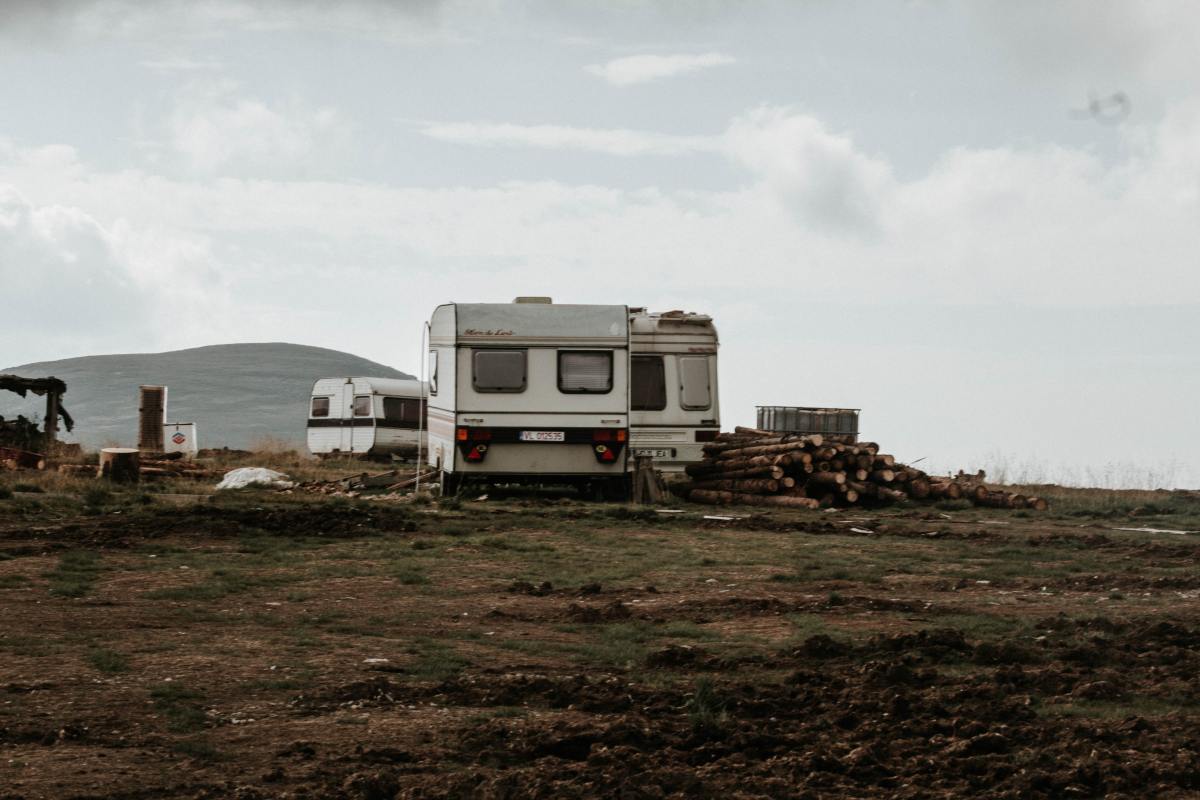
But I have to say, the friendliest neighborhood I ever lived in—both in the holidays and throughout the whole year—was a trailer park in Santa Rosa, California. Yes, for about two or three years, when I was an adolescent, I lived in a small travel trailer on the outskirts of town, due to a complex set of family circumstances that are a whole other story. But the thing that’s on my mind this week is not so much about my reasons for ending up in the trailer park, but instead the extraordinary hospitality and kindness that I witnessed there among people who were, for various reasons, going through seasons of challenge and transition in their lives.
This was not a vacation-destination sort of place, but the kind of community you go to when money is tight and you don’t have any other options. Most of our neighbors were either paycheck-to-paycheck or getting by on even less than a paycheck.
But the remarkable thing—the thing that I have carried with me ever since—was that the people there were friendlier, more approachable, and more open to the stranger in their midst than any other place I’ve lived. These were folks who couldn’t even afford to put up Christmas decorations in their yard, but a mysterious light illuminated the place nonetheless.
People would, without hesitation, invite you over to share some food, or would stop to have a chat while passing by your trailer, or check in on someone when they were sick or hadn’t been seen in a couple of days. The kind of attentiveness and care that feels almost quaint in this day and age.
Our neighbor, an older woman named Pearl, would peer out of her screen window, chain smoking cigarettes and eating Burger King, observing the neighborhood and dispensing her thoughtful insights about life in between puffs of cigarette smoke. Her eyes looked like they had seen more than their fair share of hardship, but they were gentle eyes.
“I’m tiiiiired, man, I’m tiiiiired,” she would say in her Oklahoma drawl, but she was never so tired as to not invite me in for a visit, to ask how I was doing, to really listen to me, which meant a lot to an awkward 13 year old who had a lot of emotional baggage and who felt unseen much of the time.
I can’t say that I loved living in the trailer park, or that everything was easy there. And I don’t want to romanticize the desperate circumstances faced by so many of the folks who were living there. But I can’t deny that overall, my memory is one of kindness, of welcome, and of compassion.
And it’s that final quality, compassion, that I think was the key distinction between that neighborhood and the other, more typical places that I have lived. Whether they thought about it in this way or not, the people in the trailer park lived with an almost instinctive sense of compassion towards their neighbors, because they knew that, no matter the reason someone found themselves there, they probably needed a little understanding, a little care.
And they knew this because they, too, needed the same thing. There was a sense that, though we might be living in cramped quarters, making a home on cracked pavement, we were all in this together. And though yes, we were tiiiired, we were not alone.
You know, it’s funny, this is Christ the King Sunday, and we expend a lot of energy in the Church pondering the mysteries of the Kingdom and what it’s like and who is part of it and how to get in, but I think in the end, it’s not as complicated as some make it out to be.
To put it simply, I think the Kingdom of God is like that trailer park I lived in. Because the Kingdom of God, more than anything else, is a place shaped by compassion. And it glows with a light that is not dependent upon any season.
It has nothing to do with your material resources, this Kingdom of God. It has nothing to do with your nationality or your sexuality or your gender or your political party. It has nothing to do with the mistakes you’ve made or the wrong turns you’ve taken. If we are to take this morning’s gospel passage seriously, truly seriously, then the only criteria of the Kingdom prepared before the foundation of the world is that it is a place of compassion.
Compassion for everyone we meet, including those whom the world tends to forget. Compassion for our enemies. Compassion for creation. Compassion for ourselves.
And the thing about compassion is that it is not the same as benign goodwill or charity. It is not someone sitting in a lofty place dispensing a favor to someone less fortunate. Compassion, the Latin root of which means “to suffer with,” is about experiencing the solidarity of human existence, of realizing that we all need each other, that we are all blessed by one another, and that perhaps those who have struggled, those who have experienced life’s challenges the most, will be the ones to bless us with a particular depth of wisdom. I have often found that to be true.
Compassion, in other words, is not saying “there but for the grace of God go I,” it is saying “by God’s grace, we are in this together. Let’s care for each other.” It is what Jesus embodied in his ministry and in his own passion, and it’s what he asks us to embody as well, if we would know what life is truly about, if we would enter the Kingdom where true life is found.
So when we ponder the Kingship of Christ, and the Kingdom over which he reigns, and how we might seek it here and now so that we might be its inheritors in the age to come, then I will tell you this: it’s right in front of us. It is not reserved for the morally perfect or the privileged. To take part in God’s reign, simply look to cultivate a life of compassion.
And the simplest way to do this? Look for the places in your own story, in your own heart, where there is a wound, a vulnerability, a hard lesson learned, that moment when you were hungry, or sick, or felt imprisoned by circumstance. In other words, recall a time when you needed compassion, and let that memory guide your actions.
Find those who are doing their best to get by, who are tired, or who are struggling in a particular way that you understand, because you’ve been there yourself. And go be with them. Literally, go be with them at least once this holiday season. See how your own life is blessed and illuminated by doing so.
And if you are the one struggling to get by this morning, if you are feeling unseen or lost, then simply imagine the God of the universe looking at you the same way Pearl looked at me all those years ago: with gentle, infinitely compassionate eyes, asking nothing of you other than to do your best, to not give up, to keep that beautiful light burning within you.
The giving and receiving of compassion. That’s it. That’s the Kingdom. Poor or rich, virtuous or broken, sheep or goat, in the end, compassion is the only thing that will show us what heaven looks like, what salvation feels like.
And compassion is the only thing that will endure and live on when our selfishness and indifference and judgment—the stubborn goat that lives inside all of us—has been separated out from our long and complicated history and is burned up in the regenerating fire of God’s justice and love. And even then, yes, even then, on the other side of judgment, I believe that compassion will win out, and that something new will grow from the ashes of our failures, up from the cramped quarters and the cracks in the pavement where we’ve been trying to make a home.
So, I don’t know what it looks like when you close your eyes and imagine the Kingdom of Heaven. Maybe it is a beautiful place, a perfect place, a place of twinkling lights and evergreen and streets gleaming like freshly fallen snow.
But I will confess, for me, it looks a little bit like that trailer park, a place of open doors and broken hearts still beating, a place of no illusions and of deep strength. A place where everyone is welcomed, where every wayward soul has a place to call home.
Like Pearl said, some days I’m tiiiired, man, I’m tiiiiired, and maybe you are too, but I think we’ll get there someday, and when we do, to be part of God’s reign forever, to meet Christ our King, to meet Jesus our friend, compassion will be the crown upon his head, and the whole earth will glow with its radiance. And so will we.
 By Another Road