
Get Up: A Sermon

So, a confession—and one that for some reason always feels a little bit awkward for a priest to make: I am NOT a morning person. Not even in the slightest. I admire and honor the morning people out there among you; I think it’s probably a beautiful thing to have those extra, slightly quieter hours at the outset of the day. I understand this intellectually. But my body does not agree. 

I get up when I must, but I’m not happy about it, and it’s a slow process of reanimation. Eventually, at some point after my morning coffee, I am ready to rejoin the land of the living. 

People sometimes seem surprised by this; maybe they have an idea that priests are up every day with the rising sun chanting the Psalms. And maybe some of my fellow priests do indeed do that, but not me. I am a night owl, and it’s usually late at night that I am especially inclined to talk to God and reflect and pray. The prayer office of Compline, the one said just before bed, is my absolute favorite.

I make this confession to you because, on one hand, it’s always good to remember that we are all simply human beings trying to make it through the day in whatever way we can, whatever clock our bodies are on. 

But also because I realized, pondering the readings for this All Saints Day, that I have a kindred spirit—a new patron saint for those like me who are not always ready to greet the dawn. It is poor Lazarus, who was, by John’s account in the Gospel, not prepared to get up when and how he did. 

Think about it. You have died and, presumably, are resting peacefully in the arms of God. And then all of the sudden someone rolls back that stone and lets all the light in and starts calling, “Lazarus, come out!”

My mom used to do this when I was a kid—she’d come into the bedroom and pull open the blinds and say, Phillip, get up, we’ve got things to do!! And I would grumble and groan.

And yes, I know the raising of Lazarus is a miracle of the highest order, a sign that Jesus is indeed the Son of God, but still, the not-morning people like me might empathize a little with Lazarus stumbling out into the daylight, a bit confused and rough-looking, not quite ready to face whatever this is. This new day. This new, changed life. Maybe he just wanted five more minutes of rest, first, before embarking on existence as a saint raised from the dead. 

Lazarus, in his sleepy disarray, with the smell of the burial shroud and the bandages all askew, is a comfort to me, because he reminds me that sainthood, ultimately, is not about having it all together. It’s not like those senior superlatives that show up in the high school yearbook—most likely to succeed, best dressed, best personality. Lazarus, coming out of the tomb, would not have won any prizes. 

No, sainthood ultimately is about Jesus, about what Jesus does in our very ordinary, imperfect, complicated, exhausting lives, even when we hit the snooze button a few too many times or burn our tongues on the coffee or run a few minutes behind our best intentions. 

Lazarus doesn’t get mentioned much more in the Gospels—as far as we know, he didn’t lead a revolution or work any miracles of his own. He just…got up when Jesus called him and returned to his family and did his best to get on with life. And that was sainthood. That’s a low bar that I feel like I can get over, even on my worst days. 

All Saints’ Day is one of the glorious feasts in our church year, but we should not be overly confused about or intimidated by saints, or feel like they are these remote, pious figures with their hands perpetually clasped in prayer. 

They were and are human beings, with all their idiosyncrasies, living through eras just as complicated and challenging as our own, if not more so. Really, what distinguishes them is simply that God called out to each of them and said, “it’s time to get up. We’ve got things to do. Come on out, wounds and bandages and all, and let’s face the world together.”

And the plot twist is that God is doing the exact same thing to you and to me every day of our lives. Maybe you don’t have actual trouble getting out of bed, like me, but we are all, at times, a little hesitant to open our eyes, to step out into the bright light and the crowd and the fray, with all of the world’s questions and uncertainties and dangers and demands. We might think it would be easier to turn over and go back to sleep, to let someone else handle it, whatever it is. To trust that God will call on someone else. 

And maybe God will, or maybe God won’t. But the question is—what will we never see, what life will we miss out on, what new glory might never be revealed in us, if we just stay curled up in the dark? 

You don’t have to be full of undaunted courage and untroubled certainty. Lazarus was literally still half-dead, couldn’t even speak. But he pulled himself up on those aching bones and even though he didn’t say a word, his heart said yes, Lord, ok, Lord, I am a mess, and I haven’t had my coffee yet, but yes, I’ll come out. I’ll take part in whatever this new thing is that you are doing. 

And with just that, he was a saint. 

My friends, the world needs more saints like Lazarus. We need more imperfect people willing to stand up and step out, just as they are, to bear witness to the all-powerful love that is God’s message for all people. We need more people willing to stand up and say, death and division and enmity and cynicism and hatred and exclusion are NOT the last word of the story, and we will not roll over and we will not pull the covers up over our heads while the world weeps. No. Jesus says come out, we’ve got things to do, and so we’re gonna come out, at every hour of the day, to be the messengers and agents of his undying love. 

And because we are Episcopalians, yes, we will say our prayers and drink our morning coffee to help us along the way. And woe to anyone who stands in the way of a bunch of Episcopalians hyped up on caffeine and God’s love—death and tyranny themselves are going to run in the other direction! 

I know that there is a lot that weighs heavily right now. I know we’re all stressed out, and maybe like Mary and Martha we’re wondering why Jesus isn’t showing up when and how we want him to. Maybe we are afraid of what a new morning will bring.

But listen. Listen closely. Jesus is calling out. He is saying, open your eyes. He is saying, I am here, and I am asking you—yes, you—now, to get up, to come out, to brush off the dust and wipe away the tears and the sleep from your eyes and LIVE. For your own sake, for the sake of the ones who came before us, and for the ones who will follow long after we are gone, LIVE fully, and generously and openly, and lovingly. Live in pursuit of justice. Live in the practice of peace. Live as if God is real and death is a lie, because it is so. Live as though the opportunity to love is the best reason for getting out of bed in the morning, because it is so. And then you will be counted among the saints.

Because that’s all sainthood is, in the end. An accumulation of choices to get up every day and love something or someone fiercely. 

And it is God saying, when all is said and done, at that dawn of a new and eternal day—yes, my child, yes, you understood. Love is all there was to it.

Get up. Open your eyes. Good morning. 

Sleep: A Sermon

I preached this sermon on Sunday, June 11, 2023 at Trinity Episcopal Church, Fort Wayne, IN. The lectionary texts cited are Genesis 12:1-9, Romans 4:13-25, and Matthew 9:9-13, 18-26.

The other night, I couldn’t sleep.

Maybe you’ve had one of those nights, too, where you go to bed and turn off the lights and as you lie there, suddenly all of the questions and the challenges you are facing loom up in the shadows and take on newer, larger dimensions. Maybe you start to think up problems you didn’t even know you had. And you toss and turn and flip and flop and look at the clock and tell yourself “I have to get to sleep,” but then that just makes you more anxious and so now you can’t sleep because you are stressed that you can’t sleep.

I am grateful that this is not a nightly occurrence for me; it happens just once in a while. And I know that for some folks, sleep is persistently hard to come by for a whole host of reasons. But as I was lying there the other night, trying to calm my mind, listening to the fan blowing, I was reminded of other June nights: the ones from my childhood, when I would fall into bed, tired from the day’s activities, and the fan would be blowing in the window…but back then I would just drift off, unfazed by any existential angst or unfinished to-do lists. 

And it occurred to me that, by and large, many of us probably slept a lot better when we were children. Back when our loved ones were just down the hall and we didn’t feel so alone. When it was easier to release the cares of the day, easier to trust that tomorrow would be just fine, and that maybe, when we wake up, it would be even better than we dreamed it to be. 

But somehow, along the way, things change, and by the time we are grown, a great number of questions and worries and memories hold vigil at our bedside, and it becomes hard to fall asleep in their company. What was once an easy rest, a trusting openness to tomorrow, is now a tense, restless waiting, our minds spinning in the darkness as we try to solve all of the problems of the world before the morning comes. And so while I was lying there in bed, I thought, how precious it would be to sleep like a child once again.

As I was recovering from my sleeplessness this week and reflecting on this Sunday’s readings, something else occurred to me that hadn’t before: that sleep is actually a powerful metaphor for faith. Because the sleep for which we long, that wistfully-remembered sleep of the June nights our childhoods—deep, peaceful, trusting—is quite similar in nature to what St. Paul is talking about when he refers to this thing called “faith” in the letter to the Romans. 

When Paul speaks of faith, he is not just talking about an intellectual assent to a set of doctrines, nor is he speaking of a blithe certainty about how and why the world is the way that it is. He is talking about that intimate sort of bond you feel when you know that you are safe, that you are loved, that you are not alone in the dark, and that tomorrow will be ok.

And to this end, Paul uses as an exemplar of such faith the figure of Abraham–someone who had the benefit of neither doctrines nor certainties, but who did (a few passages later in Genesis) fall into a deep sleep and had a dream of what would be–that he would be the “father of many nations.”

Abraham could not have imagined on his own how God was going to do the things God promised to do, but he gave himself over to the promise anyway. And this giving over of the self to something large and mysterious; this surrender to the dream that God unfurls for us in the darkness—this is what we mean when we talk about faith

As best we can tell, Abraham did not lie awake making checklists, trying to figure out exactly what he had to do in order to make this happen on his own; instead, he said, God is with me, and I suppose that will be enough to face whatever tomorrow brings. And so it was.

The faith of Abraham was an abiding trust that the God who called him by name would hold him and carry him and nurture him, like a parent cradling a sleeping child. And so we laud him as the progenitor of our faith not because of his perfect understanding, but because he was the first among us, the first in this long unfolding story, who simply rested in the arms of God. He was the first to trust that tomorrow would be just fine, and that maybe, when he woke up, it would be even better than he dreamed it to be.

A question that remains, though, is how? How do I arrive at such a tranquil faith, such a restful surrender? How do I trust in God so deeply, so fully, that I can drift off in his loving arms, despite the real dangers of this life, despite the despair and the unanswered questions that keep me awake at night? How can any of us, once we are no longer children, once we feel so alone?

Of course the answer, as always, has something to do with Jesus. And our Gospel passage points toward it. 

There’s a lot going on in this Gospel reading, actually. It’s kind of like those dreams you have where one scene suddenly transitions into another, layer upon layer. But after the calling of the reviled tax collector Matthew and the healing of the woman with the hemmhorage (both people, by the way, who have surely suffered their own share of sleepless nights) the story culminates with…what? 

Jesus visiting a child, lying in her bed. A young girl who, he says, is not dead, but sleeping.

Now of course we can interpret this passage several ways, and most of us might assume that he was speaking metaphorically–that the girl was indeed dead and that Jesus brought her back to life, like Lazarus. Or that she was sick or comatose, and he revived her. 

But there is another possibility, too, one that is a bit more evocative and mysterious, one that we might dismiss as easily as the observers in the story itself: the possibility that Jesus meant what he said. 

What if Jesus was right, and the young girl was indeed asleep, in another state of consciousness, resting in the tantalizing, hidden promises of God? She wouldn’t be the first person in the Bible to have done so. As it is said:

your sons and your daughters shall prophesy,

and your young men shall see visions,

and your old men shall dream dreams.

What if she was a mystic deep in a vision, deep in the hidden, luminous darkness of God? What if she was asleep like Jesus was asleep in that boat on the stormy sea; asleep like Joseph when the angels spoke to him; asleep like Abraham dreaming of his children; asleep like one who is held in the arms of the Almighty; asleep in order to remind the clamoring, sleepless world—including us— of what true faith looks like— 

Not like a restless, anxious night, not like a to-do list, but like….rest. Perhaps faith, in the end, is nothing more than rest. Resting in God. 

If so, then this young girl is, for us, another Abraham. Another reminder that faith, more than anything, looks like curling up in the arms of a loving parent and falling asleep. 

And thankfully, we have a God who desires but one thing: to hold us and rock us through the night.

Come to me, all you who are heavy laden, and I will give you rest.

Will we still have some sleepless nights? Probably. Anyone who loves this world and the people in it is bound to worry a bit. But I hope that when I am lying there in the dark, lamenting my inability to figure life out once and for all, to know what’s coming, to know exactly what to do, that I’ll remember dreaming Abraham and the sleeping girl, and I hope I’ll remember how faith feels less like having all the answers and more like slipping into cool sheets on a warm June night and drifting off, knowing that tomorrow will be just fine. That maybe it will be even better than I dreamed it to be. And that no matter what happens, God will still be there, waiting to take my hand when I wake up. 

For he has come through the clamor and the noise, through the vast night of eternity to be at our bedside, to cradle us like a sleeping child, to promise, “you are not alone. I am here.”

And in that promise, I rest.

Dreamer: A Sermon

I preached this sermon on December 18, 2022, Advent IV, at Trinity Episcopal Church, Fort Wayne, IN. The lectionary text cited is Matthew 1:18-25.

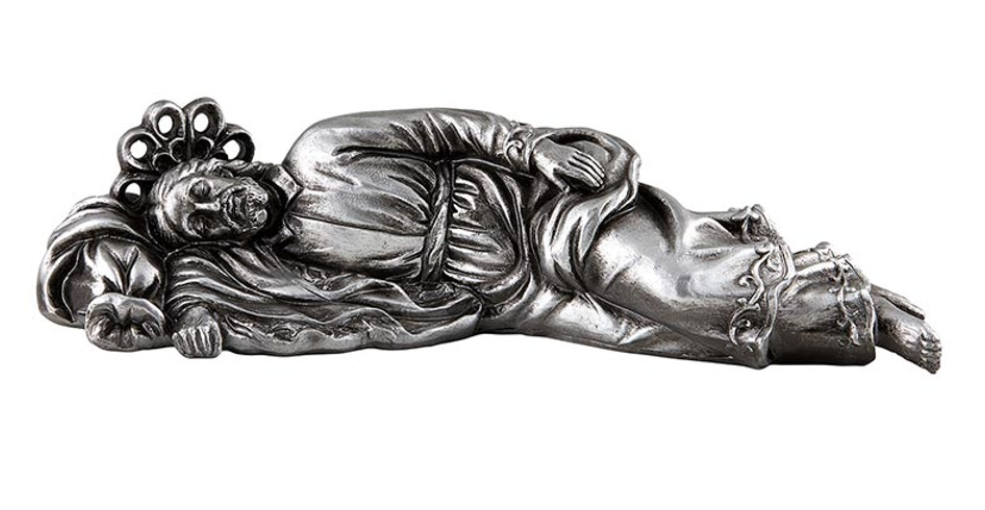
If you ever wander into my office, you’ll see a whole collection of religious art and objects, each with their own special meaning and story. One of the newer additions is a small statue right on my desk—it’s a pewter figure of St. Joseph, who is depicted laying down on his side, eyes closed, deep in sleep. It caught my eye because it’s a bit unusual as far as saint statutes go; they’re usually upright and alert, like toy soldiers: eyes wide, halos glowing, ready to pray for us. 

And maybe I was just feeling extra tired that day, but when I saw sleeping Saint Joseph for the first time, I thought—yes, Lord, at last, here is a saint who really gets me. For I am quite sure that I’m at my holiest and best behaved when I’m sleeping. And I’ll confess that some days the only thing standing between me and a grievous sin is a good long nap! So I was delighted to later receive the statue as a gift, and he continues to remind me, especially in this busy season, to rest. 

The tradition of the sleeping St. Joseph figure is found throughout Christian art, but it’s especially popular in Latin America. It has become more widespread in recent years because Pope Francis is fond of it. He told a crowd once that he has an old figurine of sleeping Joseph, and when the Pope is worried about something, he writes it down on a piece of paper and slips it under the statue so that Joseph can dream about it and in so doing, carry those prayers up to God.

The reason, of course, that Joseph is depicted as sleeping and dreaming in these images is because dreams are a key part of his story in Scripture, as we just heard in today’s Gospel. Matthew tells us that it is in a dream that the Angel of the Lord directs Joseph to do his part in the unfolding story of the Incarnation: to take the pregnant Mary as his wife despite the threat of scandal; to protect her and this mysterious unborn child; and then to name the child Jesus and to adopt him as Joseph’s own. And later, it will also be a dream that warns Joseph to flee with his family to Egypt to escape the murderous plotting of King Herod. 

Like many of his ancestors before him, Joseph was asked to trust in the power of dreams to reveal God’s presence and purpose. And perhaps this is not all that surprising, because even for us dreams are a potent landscape of possibilities. As our body rests and our mind wanders through many chambers at the edge of consciousness, it is in dreams where reality expands, where hope and memory intertwine, where demons lurk and angels whisper. It is in dreams, often, that we can see the things we’re not yet ready to face in the daylight, or perhaps that we hadn’t even begun to imagine. 

And so as Joseph sleeps, he is shown a new possibility: something the social codes and the conventional wisdom of his time would have never allowed. The Angel speaks to him of mercy and courage and fidelity, of trusting in the wild promise of a newborn savior, of journeys long and perilous and good. And then Joseph stirs from sleep, and all of creation waits to see what he will do. The Angel holds its breath. Joseph opens his eyes. And though we never hear him speak, I like to imagine him emulating the response of Mary: 

Here am I, the dreamer of the Lord. Let it be done with me according to your word. 

I think it is no small thing that Joseph decided to trust in his dream. Who among us, in the light of day, doesn’t tend to forget our dreams or brush them off, even when they seem significant? How easy it would have been for Joseph to do the same—and how different things would have been for all of us if he had. And so we honor him not only as a protector and earthly father figure of Jesus, but as a dreamer–as the one who believed in the dream of God. The one who woke up and said yes, that is possible. I can do that.

In some ways, this story–Joseph’s dream, and his waking, and and his choosing to believe–is the story of the whole church. For in Christ we have all been visited by God’s redemptive dream for creation. We have all been asked to wake up and believe, to let the dream change us, to let it shape our choices and our lives, so that God might continue to be made incarnate in the world through us. We, too, are the dreamers of the Lord, and the world is yearning for us to open our eyes, to remember what has been revealed, and to say, yes, that is possible. I can do that.

But how do we know? How do we know that it is indeed God’s dream welling up in us, and not just some random impulse of our own? How did Joseph know that he should trust the dream rather than dismiss it? 

The answer is what the answer always is: love. We will have many of our own fleeting dreams and desires and designs, but the dream of God is love, and the dream of God will always ask of us just one thing: to act out of love. The dream of God speaks of mercy and courage and fidelity, of trusting in love’s wild promises, of journeys long and perilous and good. The dream of God says, just love: love generously, love scandalously, love insistently, and then indeed you will hear the angels sing and you will see the heavens bend down to stand upon the earth and then you will no longer be sleeping. The whole world will at last be awake and the dream will be real. It will be enfleshed. It will be Emmanuel—God with us.

And so I ask you: what is it that you have been dreaming of this Advent? What visions have dazzled you in the darkness? What hopes have stirred within your heart? What new word has God placed upon you in this season?

Whatever it is, hold fast to it. Write it down, and if you happen to find a statue of St. Joseph, slip it beneath him and let him dream with you a bit longer in the cold winter night.

But remember that we are deep into Advent, now, and the light is gathering. The Dayspring approaches. 

Are you ready to wake up? Are you ready, not just to dream, but to believe in the dream God has given you, to make it real? 

All creation waits. The Angel holds its breath. 

And now, dreamer, open your eyes.