
Coming Out: A Sermon on the Transfiguration

I preached this sermon on Sunday, March 2, 2025 at St. Anne Episcopal Church, West Chester, OH. The lectionary text cited is Luke 9:28-43, an account of Jesus’ transfiguration on the mountaintop.

I came out when I was eighteen. And although I came from a pretty open-minded family, it was still a struggle, as it often is for people. But there came a point about halfway through my first year of college when I was just weary of hiding—hiding from others, hiding from myself, hiding from that fundamental desire to be loved and to love someone back. I was willing to do anything, to give up anything, if it meant that I could stop being half-invisible. To live authentically and experience fullness of life. Or at least have the chance to try, and mess up, and keep trying like anybody else. 

And so, I came out. And it’s been mostly wonderful, and sometimes difficult, but it was never really optional, because it was simply the truth of me. Ultimately life requires us to acknowledge what is true, even if folks don’t get it or don’t want to get it. 

Because what is true is that most of us fundamentally want very similar things: to understand and to be understood; to be able to feel things; to experience life without fear or scarcity; to know and share love; and to leave behind something meaningful when we’re gone. These desires are pretty much universal, whether we are gay or straight; black or white; whether we are in Cincinnati or Kiev; whether we are rich or poor; or any of the other myriad ways people inhabit this world. 

It’s just that for some such people, because of their characteristics or their location or their status, they find themselves having to convince other, more powerful people they actually deserve those fundamental things, too. That they aren’t half-invisible. 

And while the powerful don’t usually like it very much, many such people, in their own ways, eventually have to muster the courage to come out—not specifically as I did, but to come out into the world in the fullness of their own humanity and say, this is who I am, and I dare to be seen. I dare to inhabit the dignity of myself. And I offer myself—all of myself—for I am no longer constrained by the fear of being misunderstood or maligned. Because I would rather perish in the light than wither in the shadows.

Every liberating impulse of the human heart, guided by the Spirit and made manifest in everything from the crossing of the Red Sea to the Stonewall riots to the sit-ins of the Civil Rights movement to the demands of peacemaking of our own time—all of it is a form of coming out. Coming out of Egypt, coming out of Jim Crow, coming out of the closet, coming out from behind the structures of prejudice and fear and choosing to see each other as we are, as the beautifully diverse children of God. 

Churches could learn a lot from all of this coming out, I think. Especially, God love us, those polite, well-meaning churches that have, for too long perhaps, been hiding our own light within our walls, wondering why the world is looking elsewhere. I wonder what such a church might learn from the people who’ve had to come out in their own lives. 

And I wonder, too, what we might learn from today’s Gospel account of the Transfiguration, when Jesus came out as…God. 

Make no mistake, that’s what this story is: a coming out story. Not as any of the categories of identity we usually associate with that term, but a coming out nonetheless. A bold revelation of selfhood to a world not quite ready for it.

On this particular mountaintop, just before his journey to Jerusalem and the suffering that awaits him there, Jesus decides he is tired of being half-invisible, too. He is, perhaps, weary of hiding the truth of himself: that he is the Son of God; the indwelling of the divine light; the Creator aching with love for creation—and he cannot hide it anymore. And for this moment, at least, in the company of his most trusted friends, before he surrenders himself to the culmination of his difficult work, he decides to come out. 

And so he does. And so we behold him.

This is Jesus, in blazing brilliance, in that white light which is formed by every color of the rainbow. This is Jesus, at last inhabiting the dignity of himself. This is Jesus, God, who also fundamentally wants the same things: to understand and be understood by us, to know and share love with us, and to leave us something meaningful of himself when he’s gone. This is Jesus, willing to pay the price for being himself, willing even to be rejected, because he knows that the truth is not optional, because the truth of him is love in its many forms, and it always has been and it always will be. 

This is Jesus, the God who has always called his children to come out from whatever harmed them or held them back from fullness of life, now doing it himself. 

The point of this, my friends, is that if Jesus can come out as God in a world that did not welcome him….and if our vulnerable siblings can come out as human beings seeking dignity  in a world that does not welcome them…then perhaps we as the church should realize that our own future also depends on our willingness to come out of the shadows and into the light. To come out and say, we are Christians, and this is what we stand for. And that we will no longer let others hijack the narrative of our faith or the nature of the Gospel for craven, fear-based, or politically expedient ends. 

We who seek to do good and proclaim love as the Way, perhaps we need to come out and say that we do so not simply because we are well-educated or well-mannered people, but because we are passionate followers of Jesus, and that is what followers of Jesus actually do: they love without exclusion, they surrender their lives to compassion, and they are not cowed by the forces of evil and mistruth. 

Perhaps we who often find it easier to practice a private, respectable faith need to align ourselves more closely with those of our neighbors whose very humanity is a matter of public debate. Our neighbors of other ethnicities and creeds and identities whose very decision to step outside the house and exist each day is an act of courage. Perhaps by seeking them out and knowing them better, we could find some of the courage we need ourselves as Christians. The courage to name Jesus as Lord. The courage to reject, in the name of Jesus, those forces which diminish or demonize any category of people. The courage to not be half-invisible ourselves any longer. To wear God’s heart on our sleeve. 

Because we are living in a time that demands an accounting of our values, of our commitments to one another, and of the depth of our souls. We are not the first to live in such a time, nor will we be the last.

And for those of us who have already had to come out and be ourselves in one way or another…well, some of us are rather accustomed to this sense of high stakes in the basic activities of living. We’ve got some tips to share. There is much that we can learn from one another to navigate the road head. To encourage each other. To stand with each other.

I hope and pray we will continue to do that work here. Whether through the building up of people participating in outreach services, or in the expansion of our advocacy and justice ministries, or in deepening our study of Scripture or in the practice of prayer and contemplation, I hope our parish will find and reveal the fullness of itself in this time. I hope that, right here in West Chester, we will help guide the broader church out into the possibilities of the present moment, despite the perils of stepping into the light. We have too much good news to share here to let it hide behind the doors or wither in the shadows.

If that sounds a little daunting, I get it. But as God likes to say, don’t be afraid. Pretty much anyone who’s had to risk simply being themselves in one way or another can tell you: it’s mostly wonderful. Sometimes difficult, yes: even Jesus, after the transfiguration, still had to keep on casting out demons and dealing with people who couldn’t or didn’t want to understand him.

But mostly, the peace of being wholly oneself with other people, without fear, is a wondrous gift. A gift from God. It is the thing that has saved some of us. Maybe it will help save all of us, together.

All we have to do, beloved church, is hold fast to the love that is the truth of us.

And then…come out.

Runaway: A Sermon

I preached this sermon on Sunday, September 15, 2024 at St. Anne Episcopal Church, West Chester, OH. The lectionary texts cited are Mark 8:27-38 and Proverbs 1:20-33.

I want to tell you a story—a true story—about a young man who ran away from home. And, first things first, this is NOT a story about me, though it might ultimately be a story about all of us. 

So there was a young man. At a fairly young age, about 18 or so, his parents died, and he found himself alone in the world, except for a younger sister for whom he was now responsible. But this young man, who was full of idealism, had a struggle within him. He knew that he should settle down and grow up, especially now that tragedy had struck and responsibilities had fallen into his lap. But he was deeply troubled by the world around him. He was not sure he could bear the life he was expected to live.

You see, he lived in a particular time when society was going through a period of decline. There was political intrigue, and widespread poverty, and rumors of war. Conspiracies and coarseness dominated much of public discourse. And this young man did not want to be part of it, of any of it. 

He had been raised a Christian and he had a sense, nurtured from a very early age, that he was destined for a holier sort of life, something purer, something unstained by tears or bloodshed, something uncorrupted by the accepted order of things. He believed that God wanted him to leave it all behind. 

And so he dropped off his sister with some caretakers and he wandered out into the wilderness, convinced that the pristine solitude of an empty space would fill the void in his spirit, that it would mend the cracks in his heart. 

He knew, he just knew, that if he could purge himself of disappointment and attachment, if he could just find a way to make the pain go away, if he could shed the calamity of human flesh, he would finally be worthy of the peace for which he hungered. By leaving the world behind, he would become worthy of seeing God. 

But a funny thing happened on the way to enlightenment. Somehow, people found out about this young man—brave, holy, or simply out of his mind, no one was quite sure—and certain people came to find him. They would not leave him be. 

They camped near the places he had sequestered himself, waiting to catch a glimpse, waiting for a word from his lips, wondering what he had discovered in his solitude. And as they waited, they made for themselves impromptu communities out in the wilderness, communities, ironically, born of the young man’s initial rejection of communal life. Communities that were formed in the desert at the edge of loneliness, at the border of emptiness, made intimate and strangely alive by the search for another way of being.

The young man, by the way, was named Antony, and he lived in Egypt in the 3rd and 4th century CE, and those travelers who followed him into the wilderness were the first monastic communities in the Christian tradition. Antony is now known as St. Antony the Great, the father of all those called into religious life as monks or nuns. 

But I am not telling you his story as a lecture on Church history. I am telling you Antony’s story because there remains, in each of us, I think, a bit of the impulse to run away from home—to look at the disappointments and the pain and the callousness of whatever is around us, our broken relationships or our broken politics and to say, “no thanks.” I am done with all of that. I am seeking something else, I am seeking something better, something unstained. I am walking away from the world as it is. Peace out.

In our own age of fractured social bonds and conspiracy theories and coarseness, this is a daily temptation. A cave in the desert might sound pretty good to some of us right about now. And of course there are circumstances and seasons, in our own lives, when we do need to walk away and free ourselves from unhealthy situations. 

But what Antony discovered, in his accidental creation of monastic communities—when all he thought he needed was to be alone—what he discovered is that the sacred path, the way of Jesus, might be liberating, but it is never an escape. Choosing God is not the same as opting out of the world. Because God’s love will always, in one way or another, lead us DEEPER into the heart of the world, not further from it. 

The plot twist for Antony was that, after many years of battling his demons in the dark and silent chambers of his soul, he emerged, not as a detached saint who had transcended human flesh, but as someone finally comfortable in his skin—and as someone deeply, deeply committed to the flourishing of others. He traveled back into those cities he once hated to debate theologians and take on emperors, challenging their corruption and their rejection of the truth, insisting, always, that the God of Love was more powerful than any partisan agenda, and that this God will hold all of us to account for the ways we form or deform our common life. 

And that is what we must discover, or rediscover, if we are to live faithfully now. We have to remember that a life of faith is not about running away from home, but about realizing that everywhere is home, and that our task is to ensure that everyone experiences a sense of home in this life, no matter how they differ from us or where they have come from. 

In this same vein, much has been debated and preached about Jesus’ invitation for his followers to take up their cross and follow him. What are we taking on? What are we leaving behind? There is one certain perspective, promoted by some, that Jesus wants us to reject our own humanity, to discount our own needs, to leave behind all that is familiar, and brazenly follow him out into some barren place of suffering for its own sake. To grovel  and winnow ourselves down into a thin sort of holiness.

But that would only be the case if Jesus’ story ended with his death on the cross. And, spoiler alert, it does not. The story of Jesus is the story of resurrection—it is the story of what lies on the other side of rejection and despondency. 

It is the story of a man and a God and a people who say, no, I am not running away. I am not running away from myself. I am not running away from what disappoints me or scares me or makes me feel small. I am going to face it, by God, and I am going to live a life shaped by something other than fear. I am going to let love make me courageous and alive in ways nobody dreamed possible. This is the story.

This our story: to charge headlong, with singing and tears and laughter and clarity, into the courageousness of a love that cannot be killed; into the public square where Wisdom still yearns for someone, anyone, to speak a word of truth. It is to venture into the places we once feared to go and the places we feared to return, until we discover, as Antony did, that God makes everywhere home. 

We are at the beginning of a new season in this community—this fall we are resuming and expanding the ways that we connect with one another and with Christ in this place. We are welcoming new friends into our midst as they seek a home in this parish. And we are navigating, as best we can, a fractious and tense time in the life of our country. 

My invitation to you, and to myself, and to all of us, is this: in all that we do this year, let us be a people who are running towards something, not running away. Running towards each other, even in our differences, not retreating into a corner. Running towards the needs of our neighbors. Running towards a joyful and clear and public witness to the Gospel of Love that is Jesus’ true message. Running towards that sense of community that God invites us to build together, we who are still dwelling at the edge of loneliness, at the border of emptiness, and yet who are made intimate and strangely alive in our continued search for another way of being. 

And in all these things, running towards God–who has been running towards us across the wilderness of time since before time began. Running to say, beloved, you don’t have to keep running. You are here. I am here. We are already home. 

Screen Door: A Sermon

I preached this sermon on Sunday, February 11, 2024 at St. Anne Episcopal Church, West Chester, OH. The lectionary text cited is Mark 9:2-9, an account of Jesus’ transfiguration.

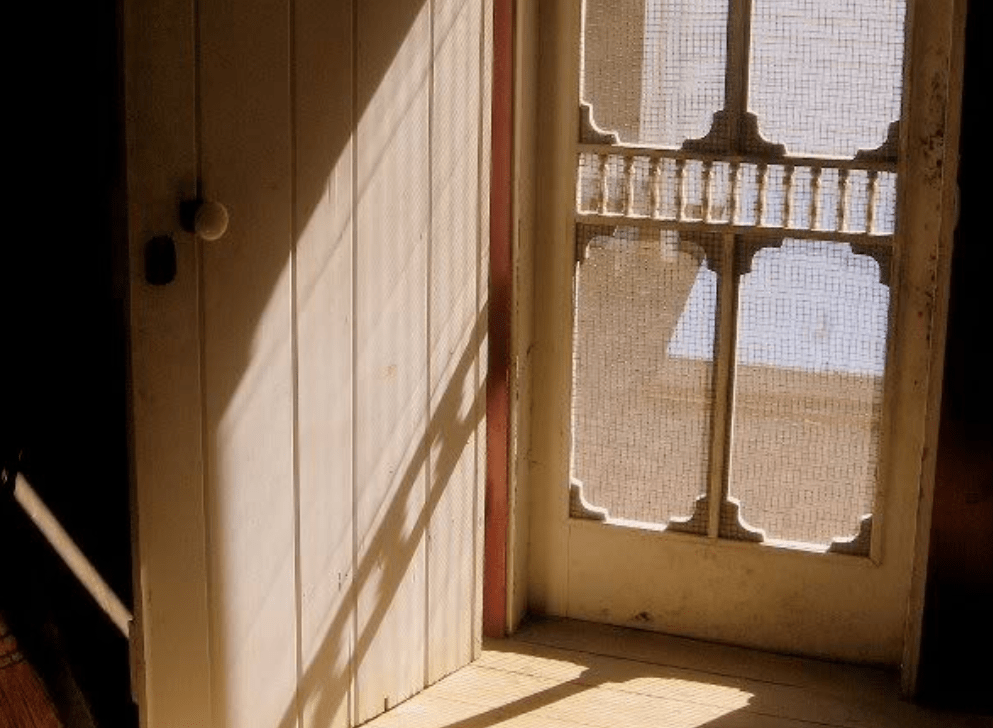
It has been many years, but I can still remember the sound of the screen door opening and slamming shut in the back porch of my grandparent’s house. The door was old and worn and yet amazingly resilient given the infinite number of times that people had passed through it on their way in and out. You see, in that house, nobody ever came in the front door, through the living room—it was always, always through the old screen door out back, and then a few steps through the porch, and on into the kitchen, the room where, as with most Midwestern families, all the truly important stuff took place. 

Maybe you remember a home or a place or a time like this—a season in your own life when the doors were always open. And so it was for us—that loud screen door was never locked, it was always at work, announcing the in-breaking  of the world that lay out beyond the warm cloister of the dim and fragrant kitchen. 

If we happened to glimpse anyone approaching the door from far off, they would emerge first as a glimmer of color and moving light out beyond the wire mesh of the screen and then—creak, rattle, slam!—there they would be, standing in our midst, in the flesh, stomping their boots, commenting on the weather. Friends and family members often showed up like this unannounced, a stream of visitors seeking to share a meal or a moment’s company, bearing news and stories. 

And I am sure someone, at some point, must have knocked, but I don’t remember it. I don’t recall the sound of knocking at all—only the familiar opening and closing of that screen door and how normal it was that people would come right in—how natural it felt for there to be a permeable boundary between what is already known and what comes to make itself known. 

There is an odd sort of paradox in a screen door, when you think about it. It is a barrier, but it’s one that is flimsy by design. It may have the shape of something absolute but it is rather ambiguous in its purpose, used to shield what is within it, but also to receive what is beyond it—the cooling breezes and the beams of light and the birdsong that travel through the screen to mingle with the inside smells of dinner and dish soap. 

It is not much of a safety measure, the screen door, but rather a way for two unique worlds to coexist alongside one another and to reveal themselves to one another. The screen door teaches us that the practice of passing back and forth between privacy and welcome; between domesticity and wildness; between the familiar and the unknown; is a good and necessary thing to do. 

And it seems to me that we have arrived at our own sort of screen door moment today, on the Sunday in the year when we see the Transfiguration, when the familiar and the unknowable commingle on the top of a mountain, when the human and the divine aspects of Jesus reveal themselves in a collision of time and light and cloud, of terror and belovedness. 

We, alongside Peter and James and John, are drawn into the strange paradox of looking at two realities at once—God’s and humanity’s—and realizing that, in Jesus, the boundaries between them are shockingly permeable. 

Today we conclude the seasons of Incarnation and Epiphany, where we have seen how the Son of God has been born and made his way into the world, approaching us, a glimmer of color and light beyond the mesh of our familiar understanding, and yet now—creak, rattle, slam!—here he stands, in his fullness, the eternal God come to pass through our door, to share a meal or a moment’s company, bearing good news and stories. 

And this, I think, is one of the most important things to understand about the Transfiguration—it’s not simply that Jesus revealed himself in a particularly magnificent way in this one moment to a handful of disciples, but that in all of our life with God, in worship and discipleship and service, transfiguration is always ready to reveal itself—the boundaries between our lives and the life of God are as permeable as a screen door through which the breeze of heaven blows.

I have seen and heard and felt him in so many different places. In moments of prayer and song. Beside a deathbed. Last week at the laundromat with the Outreach team. In conversations shared with many of you. Gathered around this table, week by week. And certainly, gathered around a kitchen table.

As we prepare for a long and thoughtful journey through Lent, to the Cross and beyond it, we are reminded today, right before we set out, that there is no aspect of human experience—even the most difficult and despairing ones—where Jesus is not able to come and be with us, to enter through the back door to sit a while, to remind us that he is separated from us by only the thinnest, most pliable boundary, if we are willing to look and listen and receive him.

Which begs the question—if the Kingdom of God is approaching us from the other side of the screen, then what must we do on our side to be ready, to greet this new world when it reveals itself? What does a screen door faith look like for us who desire a glimpse of the transfigured world beyond?

And in that, I think my grandparents were on to something simple, but essential: their door was always open. Part of what we practice here, week after week, in liturgy and in hospitality and in service and in formation, is a permeable, open-door way of life, a blurring of the demarcations between personal and communal, finite and eternal.

First, we engage in the pattern of the Eucharist so that we will go out into the world beyond our red doors and replicate that same pattern elsewhere, giving away our own selves for the sake of love, just as Jesus has done for us.

We practice welcoming visitors and strangers into the doors here at St. Anne because being open to new faces, new stories is how we cultivate openness to the presence of God whenever and however God comes into our lives—which is quite often in the form of visitors and strangers. 

We serve our neighbors, approaching the threshold of their experiences and getting to know them so that we begin to see how little separates us from anyone else; how their well-being is bound up in our own; and how the differences we perceive, while real, are not a barrier to meaningful relationship. 

And we pray and learn and study and challenge our assumptions and expand our perspectives, so that we can be attuned to the infinite number of ways that God passes into our world and abides with us, because Jesus, in that transfigured collision of flesh and light, of time and eternity, has broken down the division between heaven and earth, or at the very least he has made it like a door that will never be locked, a door to eternity that is flimsy by design, a door that is, in fact, like a screen door, where the commingling of two realities finally meet—God’s heart and our heart, God’s life and our life, the beams of light and the birdsong, the dish soap and the dinner, and all of it is God’s and all of it is ours and all of it is sacred.

And so as we approach Lent, and whatever you decide to do or not do in that season, most of all I want you to consider this: how you will stay present to the thin and permeable boundary between you and God? How will you stay open to the life that lies on the other side of the screen? Will you glimpse heaven at the laundromat, in the food pantry? Will you look for the glimmer of color and light that dance behind the words of Scripture? Will you bring good news to your neighbor, share your story with them, proclaim a word of peace to a hurting world? Will you set the table? Will you unlock the door?

Because what we do know is that God will indeed come to see us. We may not know when or how, but in every moment, on every mountain and in every valley, God is always there, ready to be with you , ready to enter in, so eager that he might not even knock, so wondrous that even if you hear his approach—creak, rattle, slam!—you may never be the same once you look up and see him: glorious, stomping his boots and commenting on the weather, seeking to share a meal, a moment; seeking, ultimately, to stay forever in you, in your heart, where, at last, he is transfigured into your flesh, your life.

And then, everything will be both familiar and new; safe and free; and you will be in heaven and you will be at home, all at once. 

Pinky Promise: A Sermon

I preached this sermon on Sunday, January 7, 2024, the Baptism of Our Lord, at St. Anne Episcopal Church, West Chester, OH. The lectionary text cited is Mark 1:4-11.

This may not be a very popular opinion, but I actually love new year’s resolutions. Every December, in that odd lull between Christmas and New Year’s Eve, I find myself pondering what I might want do more or less of in the coming year. And I know for some this is a tiresome custom, but it honestly never gets old for me. When we are able to spend the holidays together, my mom and I have a tradition of writing down our resolutions on a scrap of paper on December 31st, reading them aloud, signing our names at the bottom, and then doing that most sacred gesture of commitment, a pinky promise, and then we tuck the piece of paper away into a wallet or bag for future reference. 

Now, truth be told, I usually find the scrap of paper sometime around June and have a look and a good laugh at my own expense, because undoubtedly my record at that point is mixed at best. I think I’ve been resolving to take up jogging for the past 20 years, and so far I’ve managed a fast walk. But I like to think of this less as a disappointment and more as persistent optimism. And 2024 is a new year—I did jog for about a minute on the treadmill the other day. Anything is possible!

But the thing that helps me—the thing that I have to remind myself, sometimes, in order to stay optimistic—is that while the goals and resolutions we have might indeed be worthwhile, and even drastically improve our lives, they do not impact our fundamental worthiness or value. 

What I have come to realize is that my mom and I are able to relax and enjoy making our lists and our pinky promises together, even if we know we will likely stumble along the way, because we know that even if we have fallen short of every single resolution by next December, it will still be ok, because it is the dreaming together and the trying that matter. 

The pinky promise that we make, I think, is more about saying—we promise we’re in this together, for good or ill, come hell or high water, no matter what happens through the turning of the seasons. It’s the sort of promise that is stronger and more enduring than any failure, because it is rooted in love. 

I think we sometimes have a complicated relationship with resolutions because it can start to feel like they are a checklist that must be accomplished IN ORDER for us to be good enough, to become, somehow, worthy of love, rather than the other way around—knowing that we are already loved, and then figuring out what to do with that knowledge. Love comes first, always.

And what shocks me, sometimes, is that even after two millennia of Christian practice and storytelling and worship and prayer, there are so many people who refuse to recognize that this is also the whole message of the Gospel: that love comes first, always. 

People so easily forget that the entire story of our existence is rooted in an unshakeable love. That, as we heard this morning in Genesis, God ventured into the chaos of primordial darkness and created the world precisely so that he could love it all—and not just the easy stuff, but the light and the darkness together. All of it. Always.

People forget that God’s promise to love us—and everyone, and everything—is itself stronger and more enduring than any failure, and that there is nothing that we can do to alter or diminish this. Some folks like to say hate the sin, love the sinner, forgetting, first, that this statement is not actually in the Bible, and second, that our greatest commandment is to not hate anything, but to love foolishly, indiscriminately, without calculation or agenda or expectation or condition. And to let ourselves be loved in that same way. 

In a world that is so shaped by contracts and conditional promises and careful measurements and demarcations, maybe this unreserved, unabashed, unbounded sort of love is inconceivable. Maybe it is a scandal. And maybe it always has been. 

It would seem so if we consider the Baptism of Jesus, which is itself, when you ponder it, a rather scandalous act, at least for our good friend John the Baptist. We don’t get as many details in Mark’s version that we just heard a few minutes ago, but in other accounts John is actually quite dismayed that Jesus—the one he was waiting for his whole life, the one coming after who is so much more powerful, so much greater—that this Holy One submits himself to a ritual cleansing from sin and failure. Where was the fire and the winnowing fork and the judgment and the display of great strength? 

Whatever John was expecting, this, apparently, was not it. He had proclaimed a Messiah who would shake the foundations of the earth, and yet this promised One comes forward like a simple man, not so different in appearance from the countless others baptized in the River Jordan, with their unmet resolutions and their faltering hopes. Jesus comes forward like one eager to love, eager to be among us, eager to confound us with his humility. 

He comes from within us, content to step down and be submerged in the current of our human frailty, content to love us precisely as we are, not as he is. Jesus’ baptism is God saying to us, we’re in this together, for good or ill, come hell or high water.

And that, essentially, is what Jesus hears, too, when he emerges from the river: this is my Son, whom I love. With him I am well pleased. Since the day the world began, God has desired for us to know and claim our belovedness, and now he has come to show us in the flesh what it looks like.

This belovedness, we begin to see, is not conditional on Jesus’ failure or success. It is woven into the very core of his being. It is this belovedness that will propel  forward into everything that will follow—the temptations and the miracles and the everyday moments.  It is this belovedness that will sustain him even when things get hard, when things fall apart, when he falls apart. And it is this belovedness that he has come to declare as both the birthright and the purpose of all people—of all creation. 

Judgment and punishment are easy to understand. But this is the incomprehensible scandal of the Gospel that no one—maybe not even John—expected: that God is love, and that God loves you and everything and everyone, and that, try as you might, nothing will change this. And once we realize this essential truth—this epiphany–we must begin to live in a new way, with the mercy and tenderness of someone who no longer needs to prove themselves worthy, and who understands the inherent worthiness of everyone else. 

But still we struggle to understand or accept this, even 2,000 years on. Still we think that somehow we must earn our place in the cosmos. But we do not. We need not. We cannot. Because love came first. 

And even if we crawl over the finish line of a particular year, and even if we crawl over the finish line of our lives, God will still say, you are my child, the beloved, with you I am well pleased. And even if we have failed and made a mess of everything, somehow, even then, I think he will be there saying we’re in this together, for good or ill, come hell or high water. 

Because God is not out there somewhere waiting for us to measure up, waiting for us to figure it all out before he loves us fully and comes alongside us. He already does. And he already has.

He has stepped down into the water with us. He has taken note of everything we’ve tried and the things we were afraid to try. The ways we have succeeded and the ways we have fallen short. The resolutions kept and the ones we still keep writing with foolish optimism on a scrap of paper. And through it all, I think he simply delights in our willingness to dream together, to try—our willingness to keep showing up, year after year, to share in a hope that is stronger and more enduring than any failure. The kind that only comes when you know that you are truly, eternally beloved.

Because you are. And that’s a pinky promise. 

Joy: A Sermon

I preached this sermon on the Third Sunday of Advent, December 17, 2023 at St. Anne Episcopal Church, West Chester, OH. The lectionary texts cited are Isaiah 61:1-4, 8-11, Psalm 126, and John 1:6-8, 19-28.

One of the great privileges of my vocation as a priest is when I am invited to spend time with people who are near the end of their life. For reasons that are both self-evident and yet hard to put into words, the dying and those who love them often find deep meaning and comfort in the simple rituals of familiar old prayers offered at the bedside, of oil traced in the shape of the cross on the brow, of meaningful silences and gentle hand-holding. 

And every time I am welcomed into such a space, to bear reminders of God’s love and to bear witness to it among families and friends, I think to myself: this is what it’s all about, when everything else is stripped away. This is what it’s all about.

This is the moment when the worries and the wondering and the pretensions and the half-kept promises and the striving and the stumbling that preoccupy so much of our days all give way to the spare essentials, and this is when we finally encounter what has always been true: that we have lived, that we will die, that we are loved in ways that surpass both living and dying. 

There is nothing more beautiful to me than the unadorned, earnest intimacy of such moments; few places that feel holier than when people see each other clearly and say what they mean to one other without hesitation or embarrassment.

Would that we experienced such vulnerability and gentleness and openness with each other throughout our lives, and not just near the end of them.

But we tend to lead cluttered, fragmented lives—disappointments jangling in our pockets like loose coins, stacks of should-have-beens and ought-to-dos crowding our peripheral vision, making it difficult to see the path in front of us, difficult to discern how to navigate the shattered landscapes of an equally fragmented world. 

The ruined cities of which the prophet Isaiah speaks, and the devastations of many generations—they are still with us and they are within us, and still we go out weeping, carrying the seed, and so it’s no surprise that we are terrified of tenderness, unable to embody it, unsure whether it is safe to do so. 

Because the truth is, it is not safe. Love never is. That’s probably why our tenderness towards each other too often shows up at the end, when at last there is nothing left to hide from, when there is no value left in posturing or pretending, when we have nothing to lose but time and when we can finally give voice to the hidden depths within us. When we can say, “I love you,” without a hint or irony or self-preservation, and hold the hand of the one we love and notice the miracle of how our fingers intertwine, like stitches in the fabric of the universe. 

What those moments at deathbeds have taught me is that good lives, true lives depend precisely upon a pervasive tenderness, a certain surrender to our need for one another, a relinquishment of the titles and the labels and the boundaries we so often construct in our haste to make sense of things or to protect ourselves. 

None of those things will matter much in the end, none of them will console us as we approach the hiddenness of eternity, and none of them will transform our relationships with one another. Only love will do that.

And other than Christ himself, no one in Scripture understands this better than John the Baptist. Nobody, more so than John, understood the liberating necessity of relinquishment, the power of naked vulnerability, the abandonment to the wild and honest tenderness of God. 

Given his stature in the tradition of the Church, greatest among the prophets, we might tend to think of John through the lens of strength and influence and force, but if we pay close attention to who he is and how he lives and what he says, what we actually discover is a man who has given away everything—including his own capacity to wield power—in order to be filled with the vast, meaningful emptiness of God’s Spirit. He is one whose whole life is lived in the borderland between heaven and earth, the same borderland we usually only glimpse towards the end.

Who are you? ask the priests and the Levites.  I am not the Messiah, he says. 

What then? Are you Elijah? 

I am not. 

Are you the prophet?

No.

Then who are you? What do you say about yourself?

I am the voice of one crying out in the wilderness, ‘Make straight the way of the Lord.’

I am the one who knows that titles do not convey true significance. 

I am the one who has stripped away all my defenses, who is brave enough to love foolishly. 

I am the one who is not lured by disappointments or distractions. 

I am the one who wears my burning heart on my sleeve.

I am the ruined city that is being rebuilt.

I am the other side of devastation.

John is the one who stands on the banks of the river, inviting us to be reborn, inviting the whole earth into that which we will discover on our deathbed: that the only kingdom that will last is the kingdom of love, and that this kingdom is coming and is now here, ready to conquer every human heart willing to be undone by tenderness, willing to be made new by vulnerability. 

John is us, if we dare to be him. He is the truest part of us, after everything else is stripped away. He is the reminder that beneath all of the things that scare us, all of the things that tempt us, all of the things that confuse us and confound us, there is something durable, something undaunted, something unafraid and alive within us that will assert itself if we let it, if we release the clutter and the fear and give ourselves over to its fierce and magnanimous possibilities. What is that something? Well, on the Third Sunday of Advent, we call it joy

But even more fundamentally, it is the image of God, yearning to reveal itself in us, waiting for us to say yes, waiting for us to say, let the light come into the world, and into me, and let me testify to it, let me be baptized in the fire of love and let me reach out to you, my brother, my sister, my sibling, my love, and let me clasp your hand even though we are dying and let that simple embrace be all of the truth that there ever was in this short life, let eternity erupt in the space between our palms, let heaven whisper in the silences that cannot be filled with words. 

And although we are afraid, and although yes, we go out weeping, remember that joy is our enduring harvest,  and so if we are courageous enough, if we are tender enough, may all of life look like its ending: spare and clear and urgent and gentle, love’s unstoppable advent, a deathbed and a birthing, a promise and a fulfillment, all at once, always. 

We do not have to wait til the end of our lives or til the end of time to experience these things. They are available to each of us, here and now, if we, like John, are ready to trust in that Kingdom we already know is coming, to give voice and shape to it wherever we find ourselves. And the cities may continue to smolder, and the devastations will continue to knock upon the door of each generation, but for those who follow in the footsteps of the Baptist, for those who know that a heart broken open is the most powerful thing on earth, for people such as this—for people such as us, we pray—there is another world, there is another way worth seeking, worth speaking, worth dying for, and worth living for, too.

That world, that way, that joy is almost here. Can you feel it?

The Church is Crumbling: A Sermon

I preached this sermon on Sunday, April 3rd, 2022 at Trinity Episcopal Church, Fort Wayne. The lectionary text cited is John 12:1-8, when Mary of Bethany anoints Jesus with precious nard.

Now, I don’t want to alarm anyone inordinately on a Sunday morning, but I have to tell you that the church is crumbling.

I’m actually not making a dire prediction about the future of the institutional church (plenty of others are doing that these days). I mean, quite literally, there are bits of Trinity’s building that are crumbling on the outside that will need a little maintenance. Fr. T.J. and I were walking back from lunch the other week when he noted a spot on the exterior of the nave that needs some repair to the mortar work. Such things are to be expected in a building nearly 160 years old, and don’t worry, the members of the Vestry are keenly aware of the ongoing project list to care for these old stone walls. It is part of our collective labor of love as stewards of this community for future generations. 

In every age, as the ones entrusted with the care of the present moment, it is our task to keep an eye out for the cracks in the world around us: the broken bits of buildings and of hearts, the accumulating dust of neglect, the water streaming down in rivulets from leaking roofs and from tear-filled eyes. All of us, both building and people, get a bit tired and careworn eventually. All of us need tending. And so we patch each other up, we put mortar into each others’ broken spots, we carry one another and we carry on. This is our shared responsibility in life, as it always has been.

The tendency towards decay and disorder, whether in church walls or in other human endeavors, has a name derived from science. It is called entropy. The word was coined in the 19th century by the German physicist Rudolf Clausius, who was a leader in the study of thermodynamics. Clausius observed that the energy in heat-powered systems, like steam engines, was not all harnessed; some of it was lost and dispersed, no matter how efficient the system. This unavoidable tendency towards loss and disintegration of energy, he concluded, was the default mode of the material universe.  In other words, entropy suggests that when left to their own devices, things tend to fall apart.

The idea of entropy has since been applied to many aspects of human life, not just physics. And intuitively, I think it makes a lot of sense, even in non-scientific terms. Ideological, cultural, and political movements change and decline over time. Relationships, when we don’t invest in them, drift apart. All the seemingly solid markers of fame, prestige, and strength that we might accumulate in our life eventually diminish. And, eventually, each of us will die and, as we were reminded at the outset of this Lenten season, to dust we shall return, to mix with the crumbling stones and the memories of a thousand generations. 

Holy Scripture is full of the idea of entropy, even if it doesn’t name it as such—think of the Book of Ecclesiastes: “vanity of vanities, all is vanity!” Or the Psalmist, who says “those of high degree are but a fleeting breath, even those of low estate cannot be trusted. On the scales they are lighter than a breath, all of them together.”

The question is, what do we do with this knowledge? If everything in the universe has a tendency towards disintegration, towards chaos, towards loss, then why bother? Why not let the walls come tumbling down?

This is, essentially, the question that this Gospel passage from John asks us. It is the question that Judas and Mary of Bethany are both faced with in those final days leading up to Jesus’ passion and death, and their diverging responses are instructive for us. 

First, there is Judas, who is outraged and offended by Mary’s display of deep devotion—the anointing of Jesus’ feet with precious nard, the intimacy of her hair wound around him in tendrils like branches clinging to the vine. Whether it is out of pure greed or, as I suspect, a whole host of more complicated emotions and motivations, Judas thinks all of this is shameful, wasteful. 

I wonder, though, if this is not so much a matter of Judas misunderstanding what’s going on, but in fact understanding all too well what is about to transpire in Jerusalem. Perhaps Judas has taken Jesus’ prediction of his own death seriously. Perhaps Judas has already given up on him. Perhaps he has seen the cracks in the mortar, if you will, and is ready to walk away from the whole thing.

“Why was this perfume not sold…and the money given to the poor?” he asks, but there is bitterness underneath his words, not generosity. They are the words of a man who has given up on dreams, on love, on friendship, because the entropy of the world and the looming failure of Jesus’s mission has caused Judas to retreat into himself, into his own protective self-righteousness, into his own understanding of how things ought to be.

How hard our hearts become when we try to keep them from breaking. And so Judas decides to break Jesus, instead. He decides to tear down the walls rather than wait for them to fall. 

If we are honest with ourselves, that same tendency is in each of us. Afraid of loss, we run away. Afraid of vulnerability, we slam the door shut. Afraid of being a fool, we become a cynic, with entropy the only news we have to proclaim to the world.

But then there is Mary of Bethany, who is sometimes conflated with Mary Magdalene, but in this moment we will let her be herself. Mary is not naive in her gift-giving. She, too, knows what is coming. She knows that Jesus is approaching an ending. She knows that the nard is costly, and that anointing her Lord will not prevent the pain or loss that is to come. But she does it anyway. She does it because it is what she can do. She does it because she loves him. She does it because she knows, in a way that Judas does not, that in loving someone, nothing is ever wasted. 

Mary, and all of us who would follow in her footsteps, do not deny that death and decay are real. We are not ignoring the fact that things tend to fall apart, that chaos is always at the doorstep. We know that it is. We see the crumbling stones, and we witness the crumbling hopes of too many in every generation. But we show up anyway. We try to mend the cracks anyway, even if we are taken as fools, even if it never seems to amount to very much, because it is what we can do. It is what love requires of us. 

What Mary knew–and what Jesus reveals–is that while entropy might be the most pervasive force in the universe, the most powerful force is love. It is only love that will dare to bind up what is broken. It is only love that can gather in what is lost. It is only love that refuses to give up even when things keep going wrong. And no matter how things disintegrate and scatter, no matter how our own lives fall apart, no matter if these walls do keep crumbling down, no matter if the entire universe breaks apart, God will always be bigger than our brokenness. God holds us. God refuses to give up on us. 

And so we must do the same. What God has said to us, and what Mary says back to God, we must also say:

I will hold what is broken. I will bless it with my deepest tenderness. I will spend all of my love on the things that are doomed to decay, which is, in fact, everything. And though I may weep, though my heart might break at the seeming futility of love, I know in a way beyond knowing that it will all make sense some day. That it will have been worth it.

It is worth it. That’s the good news.

So if you get a chance this week, take a walk around the church building. You might spot the broken bits I mentioned or the places where the garden needs tending after a long winter. You might notice a crack in the plaster here and there. Our work continues, always. But notice, too, the patches, the repairs, and the additions of those who came before us—the small acts of care by generations of people, some of whom we will never know, but who did what they could even as the walls crumbled in their own time. 

And perhaps, like me, you might offer a prayer of thanksgiving for those people–those with the heart of Mary of Bethany–for the sweetness of their offerings, the memory of which still lingers like perfume in the air.  Perhaps, like me, you might marvel at the fact that because of them, and because of us still trying our best, despite the entropy of the world, we are still standing, and these stones are still standing, held together by love as much as by mortar. 

And perhaps, like me, you will find strength in knowing this: that even if everything else turns to dust, this love will remain. It is the one thing that cannot break. It is the one thing that will never go away.

Where are you?: A Sermon

I preached this sermon on June 6, 2021 at Trinity Episcopal Church, Fort Wayne. The primary text cited is Genesis 3:8-15.

I remember once when I was a little boy, I got into an argument with my dad. I don’t really recall what it was about, probably something unimportant. I just remember that in the middle of the argument, I ran out the back door into the yard and hid in some bushes. I guess I just wanted a quiet place to sulk and cry a little bit by myself.

But then my dad came out, looking for me, and the thing that I recall most clearly as I hid under the leaves, a little ball of fury, was the catch in his voice, a note of sadness and worry, as he called out my name, trying to find me. So I got over myself and crawled out, covered in dirt, and said, “here I am,” and he just looked at me, relieved, and said, “come inside.” And I did.

What a blessing it is, in our lives, to experience the kind of love that seeks us out and doesn’t abandon us to ourselves; the kind of love that sees past the fears and the frustrations of our petty, wounded hearts, the kind of love that looks at us unflinchingly and simply says, “it’s been a long day; come back inside.” 

I hope and pray that you have known and continue to know that kind of love in your life, whether from a parent, another family member, a partner, or a friend. I hope and I pray that that’s the sort of persistent, active, reconciling love we are practicing in our common life here at Trinity.

And I also hope that this is the sort of love that informs our understanding of today’s reading from Genesis 3, that pivotal moment when Adam and Eve are, themselves, hiding in the bushes after that fateful, perilous bite of ripened fruit.

“They heard the sound of the Lord God walking in the garden at the time of the evening breeze, and the man and his wife hid themselves from the presence of the Lord God among the trees of the garden. But the Lord God called to the man and said to him, “Where are you?”

Where are you? In those three words, I think we can learn everything we need to know about God’s disposition towards us, from that moment in Eden until this very day, wandering the solitary paths of paradise, searching for his children’s faces. 

Where are you? We have been formed in many different understandings of the nature of God’s love, but I hope, when you hear that question, you can hear, not the threatening yell of a vengeful authority figure, but that of a loving parent, that note of sadness and worry, the voice of one who knows that, yes, something has gone terribly wrong but is nonetheless fervently seeking you out, seeking a way to save you, looking for you in every shadowy corner, under every weeping branch where you might be cowering, seeking you and refusing to abandon you to the despair of your hiding place. 

Where are you? It is the question God has been asking every day since that breezy evening in Eden, since that point in time, for reasons we may never fully understand, when it became possible for us to estrange ourselves from God’s loving embrace. It is the question that underlies the record all of God’s fierce and wild emotions in the Old Testament—

God’s grief and rage over Israel’s waywardness—where are you?

God’s sense of betrayal over humanity’s failure to embody justice, mercy, and peace—where are you?

God’s heartbreak as bow down before the work of our own hands instead of Divine majesty, trembling under the weight of our own fears, all while our One True Love continues to call out—where are you? Where are you? Where are you? 

It is also the question that Jesus came to ask us, face to face: little children, my mother, my sisters, my brothers, I see you now with my own eyes, and you see me, but where are you, in your deepest heart? Do you even know? Do you remember where you belong?

And still, God is asking us that question. Still, God is waiting for us to reveal ourselves, to step forward and to offer the response that Adam and Eve never quite could, the response that a true relationship requires. The word for that response, in Biblical Hebrew is hineini

Hineini. Here I am. 

So much depends on us responding to this love that seeks us out, this love that calls to us in the cool evening breeze even as we keep hiding, even as the evening shadows fall down around us. 

Everything that can be good and true in this fractured world depends upon us saying, as Abraham and Moses and Mary all did: Here I am

Here I am, God.  Covered with dirt and leaves and tears, my best intentions gone awry, my understanding limited, my heart a little bit broken, but here I am, God. I can’t promise to be perfect, but here I am. I am afraid, God, sometimes too afraid to speak, but here I am.

I wonder what it would look like if we could each step out from our hiding places, the ones we’ve run to, the ones we’ve built up around ourselves, and step a little bit closer to one another, a little bit closer to that place where God stretches a hand out to us in the twilight, and I wonder if we might let that question and that answer, that call and response, guide the shape our lives. 

What if we said each day, Where are you? 

Where are you present in my life, God? And where is my neighbor, where is the stranger I forgot to welcome, where is the enemy whom I was taught to fear? Where is the deep, tender heart of the blessed earth, where is the hidden paradise, the love hidden in plain sight? How do I press my soul down into its embrace? Where are you?

And what if we also said each day, Here I am. Here I am, Lord. Here is my face, seeking your face. Here is my voice, speaking your unutterable name on my breath. Here is my body, and here is my mind, and here is my heart; may your Spirit mold them into vessels of your love. You don’t have to search or grieve for me any longer. Hineini. Here I am.

Where are you?

Here I am.

Perhaps this small conversation is the one God has been waiting to have with us for our entire life. Perhaps all God ever wanted was to find us, to bring us home, not back to the beginning, not back to Eden, for we know too much now, we are grown now, but back to our true home, which is within God’s very own heart.

You don’t have to hide from God anymore. We never truly did.

God is calling to you, and there isn’t anything to be afraid of now.

So get up. 

And say, “Here I am.”

And come inside. 

Can’t Go Home Again: A Sermon

I preached this sermon on March 7, 2021 at Trinity Episcopal Church, Fort Wayne, IN. The lectionary text cited is John 2:13-22, an account of Jesus clearing out the Temple in Jerusalem.

Just before I started serving at Trinity, Fort Wayne, nearly two years ago now, I took a drive up north, to the Upper Peninsula of Michigan, where my grandparents and my father lived before they died, where I spent much of my youth. The old family home, a place that had been an anchor throughout my entire life, was no longer occupied, and my aunt and uncles were planning on selling it, so I wanted to see it at least one more time before that happened. 

And you know that old saying, “you can’t go home again”? Well, sometimes you can, technically, but the problem is that either the home has changed so much—or you have—that you feel disoriented, like a stranger wandering into the story that used to be your own, but that doesn’t quite fit anymore. 

The house was quiet, too quiet, cleared of most of its familiar clutter, though some of the furniture remained—the kitchen table right where it had always been, the same curtains in the window, the old parlor organ in its usual spot, the armchair where my grandmother read her books before bed. The outlines of a thousand memories, still rich and resonant, but hollow, too, a monument to an era of our family history that had passed away.

And as strange as it might sound, I kept thinking about that empty house in Michigan as I was sitting with this week’s gospel passage from John, where Jesus clears out the Temple in that dramatic scene.

Because although we often focus on the intensely prophetic nature of his actions—turning over the tables, critiquing the economics of the sacrificial system—I think there is a also a deep poignancy to be found here. This is a personal moment as much as it is a public one, because we must remember that, for Jesus, this is not just a religious power center, a building filled with strangers whom he wants to knock down a peg or two. It is, as he plainly says, his Father’s house. He has, after much time away, come back home.

Remember the story early in Luke’s gospel, when Mary and Joseph lose track of Jesus in Jerusalem when he is a young boy? And they search for him for three days…and then they finally find him…where? In the Temple, yes, still himself but also unfamiliar—a bearer of wisdom, engaging in dialogue with the teachers assembled there. And what does twelve year-old Jesus say to Mary and Joseph?

“Did you not know that I must be in my Father’s house?”

It is a homecoming scene. A memory deeper than memory, a familial instinct has drawn him there, to the dwelling place of his Father, to the place where his own story, just beginning to take shape, finds its larger context. 

And so now, as he arrives again in today’s reading as an adult–a bit older, a bit more knowing–what is Jesus thinking, as he enters the Temple for this very different homecoming? Does he remember how he once sat, just over there, as a young prodigy, amazing the onlookers with his insight? Does he remember, perhaps, that certain slant of light across the stones on that long ago day, or the sound of his mother’s voice calling out to him in relief from across the courtyard, when life was newer, when there was still so much to be discovered? Does he now feel that disconcerting pang of regret when you return to a place after you’ve grown a bit too much to be comfortable there, that swirl of familiarity and estrangement when a Father’s house no longer feels like home? 

You can’t go home again, no. Not even Jesus. Not in the exact same way as before. Too much has changed. But also, there is too much that must still be done. No time to wallow in what is lost. Life persists. And so our histories must be reckoned with, not recaptured. 

In his own way, that is exactly what Jesus is doing, as he braids the whip, as he releases the doves into the sky: he is clearing out the past, because he knows that this story—his family’s story, his nation’s story, creation’s ancient and unfolding story—must now go in a new direction. So out go the sacrificial animals, and the money-changers—out go the old systems, the old patterns, the old and familiar ways of interacting with God, of satisfying our never-ending longing for heaven. 

For a new thing is about to be done: a definitive sacrifice is about to be made, in the confines of a drastically different Temple—the Temple of God’s own body, on the altar of Calvary. Jesus, in clearing out the Jerusalem Temple, is clearing the path towards the new Jerusalem, the heavenly city; he is taking upon himself all the memories, all the hopes, all the sorrows that have been held and offered here through the millennia, in the halls and holy places of his Father’s house, and he is carrying them with him, into the next chapter, into his own life and death–and beyond.

What has been is not always what can continue to be. This is as true for us now as it was then. This is true for you and for me in our own lives, and it is true for us as a community, as a society, as a planet. 

We cannot go back to what was, even if we have loved it more than anything, because things have changed, and we have changed, and the world needs something different from us now. 

And if Jesus fashioning a whip of cords and turning over tables seems drastic, that’s because surrendering to change always is—it requires a certain lack of sentimentality on our parts, a certain fury and fire in the heart, a startled emergence from slumber, to get up, to live, to look forward, to do what must be done now, to say goodbye to what no longer serves us and what no longer serves emerging God’s purpose. 

So the question for us today, here, at the edge of whatever awaits us next, is this: What is it that we need to clear out of our lives? What is it that we need to let go of, in order to make space for what will be? What is holding us back from the next chapter in our story, in Trinity’s story, in America’s story, in the human story–what is holding us back from the chapter of the story where we go out once more and meet the world in its pain and its promise and rediscover the beauty and the healing and the freedom that Jesus can offer? What must be put to rest in order to do that? What are we waiting for?

Nostalgia will not save us. It will not save us in the church, it will not save us in this country; it will not save your life or mine. Try as we might (and God knows I often try) we cannot live on memories or longings for what used to be, for the ways things were, even the way things were a year ago. The pre-pandemic world is gone. The “before” time—the time when we did not know all that we know now—that time is gone. We have seen too much now. We can’t go home again. 

And yes, we can and we should honor the past for all that it has done for us, for its beautiful gifts, for its lessons, and we can preserve the wisdom of our ancestors and the life-giving pieces of the traditions we have been given, and then….we have to let the rest go.

The old mindsets. The old assumptions. The old prejudices. The old fears. The old lies. They don’t serve anymore. We have to be strong enough, together, to figure out how to be the Christians that the world needs now. That’s what we’re here for. That’s what Jesus has driven us out into this present moment to do.

So let’s do it. With some trepdiation, perhaps, maybe even a tear or two, but also with hope, and determination, and curiosity, and above all, a trust in the Lord, our Lord, who knows what he is doing, even when that thing seems dramatic and strange and hard to us.

You know, when I left my family’s house for the last time, I cried as I pulled out of the driveway. And I knew as I drove out of town that the love that I experienced there, in that place, would be lodged deep in my soul for the rest of my life.

But it was time to go, whether I was ready or not. It was time.

And so I did. And I kept going, down through the forests, through the sleepy old towns, down past the shimmering city lights, and across the wide open fields, back down here. Back to you. To this place and time, the one that I had to live into now. 

And I thought: it’s true, you can’t go home again. 

But you can make a new home, wherever it is you have to go. Wherever it is that Jesus leads. You can make a new life there, with gratitude for what came before, and with hope for what is coming next.

Not in your Father’s house, perhaps, but on holy ground, nonetheless. The ground upon which we are standing.

My family’s old home in Iron River, Michigan

The Church that is Willing to Die: A Sermon

I preached this sermon on June 21, 2020 for the online services at Trinity Episcopal Church, Fort Wayne, IN. The lectionary text cited is Matthew 10:24-39

What does it mean to be the church in a time such as this? At this turning point in our national life, when old values, old practices, old ways of being are called into question, when the mythic landscape of American history is being challenged and reordered by pandemics, protests, and political turmoil, when certainties are few and far between, here and now we are urgently led to revisit this question: what does it mean to be the church? Who are we Christians in this fraught moment: this moment of lament, this moment of reckoning with the unjust systems we have built and sustained, this moment of questioning the bedtime stories with which we have comforted ourselves about blessing and destiny and progress? 

What is the church now when the wind comes howling in through the open window, when the doors to the building are locked and the bottom drops out and we are falling, falling down into the gloom of an unknown tomorrow? What are we then? Who are we then?

For so much of our nation’s history, to be part of the church has been a designation of institutional membership, a cultural practice encoded in spiritual language handed down from generation to generation; an elegant packaging of some laudable core values, and a safe, enclosed space in which to work out the meaning of life according to those values. In this understanding of church as institution, which patterns itself according to the societal contexts in which it operates—the world outside the walls—there are usually a number of factions, organized along political, liturgical, or ideological spectrums, and whoever dominates in numbers or funding tends to dictate what we stand for and the ways in which we do so. It’s not that we ignore the gospel in this mode of church; it’s simply that the “good news” we share often sounds like the good news we want to hear, or more specifically, the good news that the powerful want to hear. 

For many, being church in this way feels very navigable—it maps rather neatly onto the rest of our lives, it absorbs the language of the zeitgeist like a sponge, such that the progressive and the conservative, whatever those labels happen to mean in a given moment, have equal opportunity to bedeck themselves in Scripture and silk vestments, to continue their eternal struggle via the proxy wars of theology and church politics. 

This is not a new thing, and perhaps, for much of our history, this mode of being the church felt sufficient for the majority of people. Since the peace of Constantine in the 4th century, when Christianity became legalized in the Roman Empire and later adopted as the religion of that Empire, there has been little distinction between the idealized values of citizenship and the  core teachings of the sacred in dominant Western culture—especially for those of us who enjoyed the privileges and powers that such citizenship affords. The easy mix of civic and ecclesial agendas was simply a given. Church was, in effect, where you learned how to be a good and loyal participant in the realm, to support its structures, to promote the peace of the established order.

But established orders tend to fall apart eventually. Structures give way under their own weight. And what is the church, then? Who are we, then? 

Jesus in Matthew’s Gospel:

Do not think that I have come 

to bring peace to the earth; I have not come to bring peace, 

but a sword. (Matthew 10:34)

Jesus’ words today remind us that there is another choice when it comes to understanding the meaning of the church—a choice that is unsettling, a bit scary even—one that looks nothing like the established order in which we are tempted to become comfortably numb. He describes the cost of following him in the starkest of terms—it is to give up family bonds, it is to give up one’s safety, to give up one’s own life, even, in order to find and participate in whatever strange, magnetic sweetness he seems to carry within himself.  This is not a metaphorical invitation. It is quite serious.

To be church in this way—to relinquish, to descend, to die—has little to do with the striving and the strategies that characterize so much of public life in the West.  It is, instead, an intentional upending, a deconstruction of those values, especially whenver they deny life and dignity to the least among us. For, as Mary proclaims, He has lifted up the lowly and the rich he has sent away empty.

To be the church that responds to Jesus’ invitation is to search for the cracks in the veneer of decadence, to find them and to tear them open,  to name what is rotten underneath and, crucially, inescapably, not simply to name and to criticize, but to cast ourselves, with equal measure of grief and  hope, down into the rottenness, down to the places where we do not want to go, down to where we will finally see what is true, what endures, what refuses to die, even there. Blessed are those who mourn, for they will be comforted.

Here and now, in our present turmoil, some of that work has been done for us. The veneer is already cracked. Some of the rottenness is already exposed. But we still have to choose whether we will get down there and look at it. We still have to choose whether we will do something about it. Nobody will force us to, not even God; and the urge to look away, to go back to the old mode of being, will continue to be powerful. But what we decide will determine what sort of church we are part of. Are we an insitution of the present order, subject to the whims of history, or are we a community of disciples, of learners, of passionate lovers of God, seeking Holy Wisdom into the uncomfortable places she calls us?

Most days, I doubt that I have the strength and the courage to choose this latter vision. Most days, I just want to roll over and go back to sleep. It would be so much nicer to stay on the surface of my Christian identity, to let church function as an ornament, as a daydream where we talk about forgiveness and love in hazy terms without ever submitting to the fierce demands that such things actually require. 

But then, always, there is Jesus, with his unsettling words and his compelling gaze that cuts through me like a sword. I see him looking back at me from the cross, forgiving my weakness, unimaginably patient with my fear. I see him in the faces of my homeless neighbors, my black and brown neighbors, my lgbtq neighbors, my conservative neighbors, my liberal neighbors, my neighbors of every background and belief, and I hear his voice: 

Follow me. Follow me wherever it might take you. Follow me out past the church you thought you knew, out beyond a brittle, compromised peace, follow me out past certainty and cynicism, follow me into the heart of the world’s sorrows and see what lies on the other side of fear and lamentation. I promise you, everything real, everything joyful, everything good, is there. I am there. 

If we listen to Jesus, if we really listen to him, what other choice can we make?

To Bite the Fruit: A Sermon

I preached this sermon on Sunday, March 1, 2020 at Trinity Episcopal Church, Fort Wayne, IN. The lectionary texts cited are Genesis 2:15-17; 3:1-7 (Eve & Adam’s temptation in the garden) and Matthew 4:1-11 (Jesus’ temptation in the desert). 

It is Lent, and Eve is standing in the garden. 

Eve, our primeval mother, the original bearer of our human bodies and our human longing, has paused under the leafy boughs of a tree laden with promises; the tree that offers the one thing she and her companion Adam do not already have: the ability to share fully in the mind of God. The ability to understand, from God’s perspective, the nature of all things. The ability, as the serpent suggests, to not simply be in relationship with God, but to be like God.

And although in the Eden narrative we often focus on themes of wickedness and disobedience, we should not forget that in this crucial moment of decision–as her hand reaches out toward the tantalizing object of her desire–Eve still loves God. She loves God so much, in fact, that she wants something beyond intimacy, something that can never be taken away. As she and Adam bite into the ripe flesh of the fruit, they are hungering for God’s very being to become part of them. They are seeking a perfect, indissoluble union with their Creator. 

There is a problem, though, with trying to consume the things we love: they tend to get destroyed in the process. And in a flash of insight, all too late, Adam and Eve realize a fundamental truth: loving God is not the same as possessing God.

How often we confuse these two things: loving and possessing. If we are to speak of original sin, we might consider it as the seemingly irresolvable void between the two—the former being the dynamic truth of a relational God, and the latter the constricting delusion of the crafty serpent.

I think of the people in my life whom I have loved most deeply and enduringly, and I realize that one common thread in those relationships is a certain sense of freedom—a freedom to be myself, and for the other person to be themselves. No agenda of control imbuing our time together. No manipulation masquerading as affection. Just two people, supporting one another in our mutual growth and inevitable failings.  And, sometimes, parting ways when life makes that necessary.

To love like this is harder because it is far more uncertain. We can’t control its outcome. And I would be lying if I said that I had never seen fruit on the tree and longed to devour it. We are all Eve and Adam on some level; we are all caught in this tension between the need to love and the compulsion to possess.

This is partly what makes Lent so valuable. We enter into this season and we are invited to take a hard look at all the relationships that comprise our lives: our relationships with people, with things, and with habits. And in each instance, we might consider this question: where am I practicing love, true, selfless, life-giving love; and where am I merely trying to possess, to consume, in order to satisfy a deeper, insatiable hunger within myself? 

It is with these questions in mind that we must journey into the desert alongside Jesus in today’s Gospel, out to the place where the devil awaits him. 

When we hear the story of Christ’s temptations: to turn stones into bread; to throw himself from the pinnacle of the temple; to trade his relationship to God for earthly power; I think we would do well to picture him also, standing alongside Eve at the tree in the garden, as the eternal, fundamental questions reverberate between them and down to us through the ages:

Do you love God, or do you want to be God?

Do you love the world, or do you want to possess the world?

And maybe, just maybe, in his hunger and his isolation, Jesus saw the fruit of the tree, and perceived how good it would be to bite it, to possess it, to rule the world on his own terms, to be a king like other kings, to feed people with the bread they already knew.

Perhaps for a moment he, like Eve, thought that loving God and claiming God were the same thing. 

And perhaps, for a moment, every creature in the garden held its breath, waiting for a recapitulation of the original mistake.

But then, he speaks:

       ‘One does not live by bread alone,  but by every word that comes from the mouth of God.’

        ‘Do not put the Lord your God to the test.’

        ‘Worship the Lord your God, 

        and serve only him.’

With these ancient words, drawn from the depths of the Law, Jesus is saying: It is in relinquishing power that I find true strength. I only need to trust, and to serve, for this is what love looks like: mutuality, freedom, vulnerability. A hand outstretched, not to take, but to offer itself. 

He says: I do not need to control the world in order to love the world; in fact, loving it means the exact opposite: it means accepting creation in all its finitude, serving humanity in all its frailty, and giving my life for its healing, and its redemption.

And in that moment the devil departed, for he knew that that this time the fruit would remain on the tree. This time, this Son of Man, this Firstborn of All Creation, had made the proper distinction between love and its counterfeits. 

We are, each of us, through our baptism, both children of Eve and Adam and children of God. That ancient temptation still pulses in our veins every time we feel the longing of desire and reach out to grasp at things not meant for us. And in today’s world, with its many promises and perils, giving into this impulse can feel quite natural, acceptable, even noble.

But in Lent, at the edge of Eden and deep in the desert, we are invited, instead, to let go. To leave the fruit untouched. To let the stones remain stones. To turn and face the world in all its terror and promise trusting in God alone. And trusting that somehow, at the end of our long journey, we will be ushered into someplace altogether new.  Another garden, perhaps, but one with an open gate, and an empty tomb. The garden where Eve stands once more, singing a song of redemption, basking in a love that feels, finally, like freedom.