
I preached this sermon on Sunday, February 11, 2024 at St. Anne Episcopal Church, West Chester, OH. The lectionary text cited is Mark 9:2-9, an account of Jesus’ transfiguration.
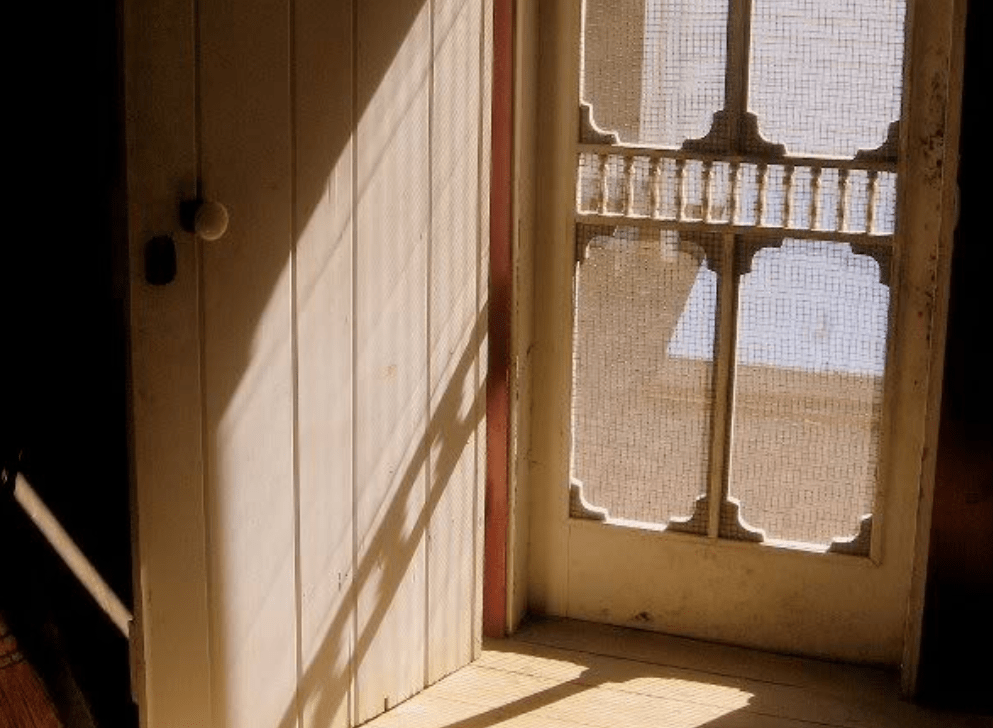
It has been many years, but I can still remember the sound of the screen door opening and slamming shut in the back porch of my grandparent’s house. The door was old and worn and yet amazingly resilient given the infinite number of times that people had passed through it on their way in and out. You see, in that house, nobody ever came in the front door, through the living room—it was always, always through the old screen door out back, and then a few steps through the porch, and on into the kitchen, the room where, as with most Midwestern families, all the truly important stuff took place.
Maybe you remember a home or a place or a time like this—a season in your own life when the doors were always open. And so it was for us—that loud screen door was never locked, it was always at work, announcing the in-breaking of the world that lay out beyond the warm cloister of the dim and fragrant kitchen.
If we happened to glimpse anyone approaching the door from far off, they would emerge first as a glimmer of color and moving light out beyond the wire mesh of the screen and then—creak, rattle, slam!—there they would be, standing in our midst, in the flesh, stomping their boots, commenting on the weather. Friends and family members often showed up like this unannounced, a stream of visitors seeking to share a meal or a moment’s company, bearing news and stories.
And I am sure someone, at some point, must have knocked, but I don’t remember it. I don’t recall the sound of knocking at all—only the familiar opening and closing of that screen door and how normal it was that people would come right in—how natural it felt for there to be a permeable boundary between what is already known and what comes to make itself known.
There is an odd sort of paradox in a screen door, when you think about it. It is a barrier, but it’s one that is flimsy by design. It may have the shape of something absolute but it is rather ambiguous in its purpose, used to shield what is within it, but also to receive what is beyond it—the cooling breezes and the beams of light and the birdsong that travel through the screen to mingle with the inside smells of dinner and dish soap.
It is not much of a safety measure, the screen door, but rather a way for two unique worlds to coexist alongside one another and to reveal themselves to one another. The screen door teaches us that the practice of passing back and forth between privacy and welcome; between domesticity and wildness; between the familiar and the unknown; is a good and necessary thing to do.
And it seems to me that we have arrived at our own sort of screen door moment today, on the Sunday in the year when we see the Transfiguration, when the familiar and the unknowable commingle on the top of a mountain, when the human and the divine aspects of Jesus reveal themselves in a collision of time and light and cloud, of terror and belovedness.
We, alongside Peter and James and John, are drawn into the strange paradox of looking at two realities at once—God’s and humanity’s—and realizing that, in Jesus, the boundaries between them are shockingly permeable.
Today we conclude the seasons of Incarnation and Epiphany, where we have seen how the Son of God has been born and made his way into the world, approaching us, a glimmer of color and light beyond the mesh of our familiar understanding, and yet now—creak, rattle, slam!—here he stands, in his fullness, the eternal God come to pass through our door, to share a meal or a moment’s company, bearing good news and stories.
And this, I think, is one of the most important things to understand about the Transfiguration—it’s not simply that Jesus revealed himself in a particularly magnificent way in this one moment to a handful of disciples, but that in all of our life with God, in worship and discipleship and service, transfiguration is always ready to reveal itself—the boundaries between our lives and the life of God are as permeable as a screen door through which the breeze of heaven blows.
I have seen and heard and felt him in so many different places. In moments of prayer and song. Beside a deathbed. Last week at the laundromat with the Outreach team. In conversations shared with many of you. Gathered around this table, week by week. And certainly, gathered around a kitchen table.
As we prepare for a long and thoughtful journey through Lent, to the Cross and beyond it, we are reminded today, right before we set out, that there is no aspect of human experience—even the most difficult and despairing ones—where Jesus is not able to come and be with us, to enter through the back door to sit a while, to remind us that he is separated from us by only the thinnest, most pliable boundary, if we are willing to look and listen and receive him.
Which begs the question—if the Kingdom of God is approaching us from the other side of the screen, then what must we do on our side to be ready, to greet this new world when it reveals itself? What does a screen door faith look like for us who desire a glimpse of the transfigured world beyond?
And in that, I think my grandparents were on to something simple, but essential: their door was always open. Part of what we practice here, week after week, in liturgy and in hospitality and in service and in formation, is a permeable, open-door way of life, a blurring of the demarcations between personal and communal, finite and eternal.
First, we engage in the pattern of the Eucharist so that we will go out into the world beyond our red doors and replicate that same pattern elsewhere, giving away our own selves for the sake of love, just as Jesus has done for us.
We practice welcoming visitors and strangers into the doors here at St. Anne because being open to new faces, new stories is how we cultivate openness to the presence of God whenever and however God comes into our lives—which is quite often in the form of visitors and strangers.
We serve our neighbors, approaching the threshold of their experiences and getting to know them so that we begin to see how little separates us from anyone else; how their well-being is bound up in our own; and how the differences we perceive, while real, are not a barrier to meaningful relationship.
And we pray and learn and study and challenge our assumptions and expand our perspectives, so that we can be attuned to the infinite number of ways that God passes into our world and abides with us, because Jesus, in that transfigured collision of flesh and light, of time and eternity, has broken down the division between heaven and earth, or at the very least he has made it like a door that will never be locked, a door to eternity that is flimsy by design, a door that is, in fact, like a screen door, where the commingling of two realities finally meet—God’s heart and our heart, God’s life and our life, the beams of light and the birdsong, the dish soap and the dinner, and all of it is God’s and all of it is ours and all of it is sacred.
And so as we approach Lent, and whatever you decide to do or not do in that season, most of all I want you to consider this: how you will stay present to the thin and permeable boundary between you and God? How will you stay open to the life that lies on the other side of the screen? Will you glimpse heaven at the laundromat, in the food pantry? Will you look for the glimmer of color and light that dance behind the words of Scripture? Will you bring good news to your neighbor, share your story with them, proclaim a word of peace to a hurting world? Will you set the table? Will you unlock the door?
Because what we do know is that God will indeed come to see us. We may not know when or how, but in every moment, on every mountain and in every valley, God is always there, ready to be with you , ready to enter in, so eager that he might not even knock, so wondrous that even if you hear his approach—creak, rattle, slam!—you may never be the same once you look up and see him: glorious, stomping his boots and commenting on the weather, seeking to share a meal, a moment; seeking, ultimately, to stay forever in you, in your heart, where, at last, he is transfigured into your flesh, your life.
And then, everything will be both familiar and new; safe and free; and you will be in heaven and you will be at home, all at once.
 By Another Road