River Towns: A Sermon

I preached this sermon on Sunday, January 28, 2024, the date of the annual parish meeting at St. Anne Episcopal Church, West Chester, OH. The lectionary text cited is Mark 1:21-28.

It’s somewhat customary, when preaching on the Sunday of a parish’s annual meeting, to focus on the state of things in our faith community and to explore what it looks like to follow Jesus in this place. And I will get to that, but first, of course: a little story. 

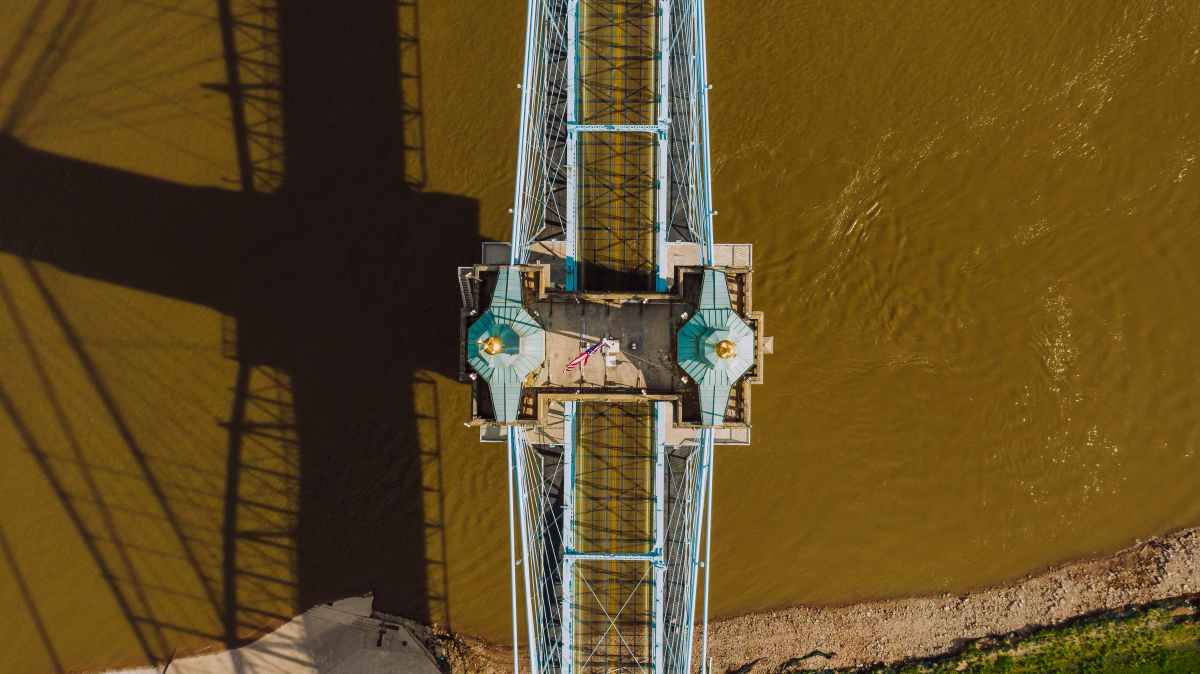
Last September, on my 40th birthday, Matt and I took a drive out from Cincinnati and along the Ohio River, first down the Kentucky side and then crossing the river by boat on one of the region’s last remaining car ferries, and then down the Ohio side of the river and eventually back up again. Surely many of you have made this trip. And if you have, you know it’s a meandering journey through a number of river towns, some of decent size, some no more than a cluster of quietly deteriorating houses. 

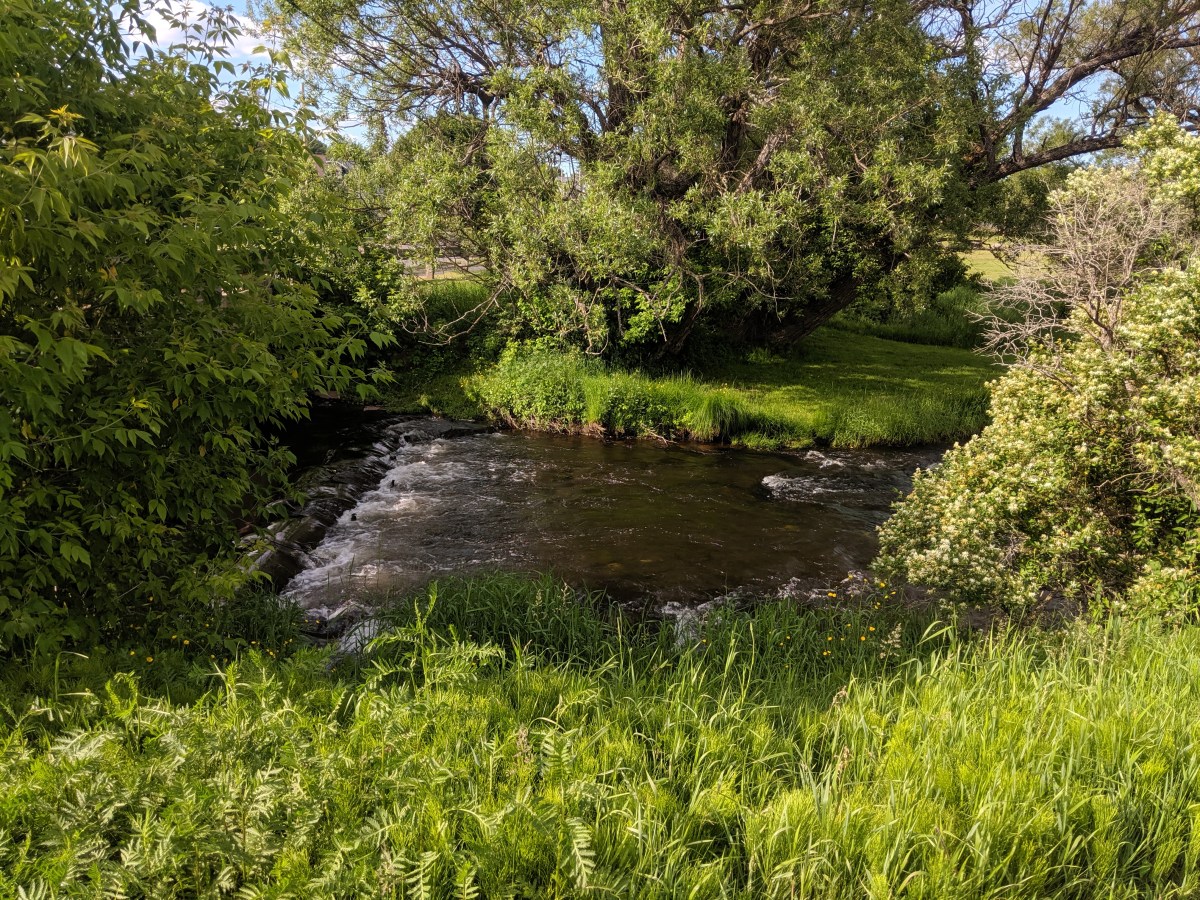
But what you notice in all of these places, no matter their size or condition, is that the river always looms large, just at the edge of vision and consciousness. Even if the broad water is hidden by trees or the swell of a hill, you know it is there, flowing swiftly, quietly, with determination, and the towns along its edge have conformed to the river’s temperament; they have been indelibly formed by its moods and its movement. 

I later read a book by a local author reflecting on the history of these river towns, the ones large and small, and he noted that, because there is both great opportunity and great risk in choosing to dwell at the river’s edge, people must learn to coexist with its power rather than trying to control it. 

Because when you live alongside a mighty force like the Ohio, it provides both sustenance and danger; it offers both a point of connection with the rest of the world and an ever-present possibility of inundating you. To build alongside the river, and to stay there, season after season, requires a particular blend of pragmatism, irrational hope, and surrender.

And in that sense, those river towns are a perfect metaphor for a life of faith, for a community of faith like the one that has been built here at St. Anne. To build up a church is an act of vision and of great trust in something much larger and more powerful than ourselves. We do not sit at the edge of a literal river here, of course, but we have planted ourselves alongside the living waters that comprise God’s movement through our individual lives and through the course of human history, and here at our particular bend in the stream, we must continuously live in that same precarious, energizing balance between preparedness and vulnerability, never knowing exactly what God will do next.

And while this sense of unpredictability might feel especially disorienting because of contemporary politics or technology or culture, in truth it is not a new thing—it is as old as the church itself, older even than that. It is, in fact, bound up in the very reality of God in our midst, who is always both sustaining us and overwhelming us all at once. We cannot domesticate this God any more than we can tame the power of the river, even as we are drawn to build our community upon his holy banks. 

Did you know, St. Anne, that simply by building this place, and by tending to it, and welcoming others into it, you have bravely staked a claim in close proximity to the infinite, outpouring majesty of heaven? And the whole purpose of what we do here is to learn how to live faithfully in the presence of such a force, to arrive at a knowledge of God that is born of a direct encounter with his immense and dynamic vitality. How incredible that you have done this. How wondrous that we get to continue doing this together!

And this wondrous proximity is exactly what our Gospel passage today speaks of. Consider this: Jesus, when he goes to the synagogue in Capernaum and begins to teach, impresses those present because he has what is termed “authority,” somehow unlike the wisdom of the scribes. The scribes, remember, were very learned interpreters of the law—they knew a lot of stuff—but Jesus spoke and acted as one with direct, unmediated understanding of the living force that pulsed beneath the letter of the law. 

Whatever he offered in that synagogue, however he conveyed God’s activity in the now-imminent Kingdom of Heaven, it was not just a lecture or a study guide; it was like a familiar riverbed of understanding suddenly swelling up with a previously unseen fullness—recognizable in its shape, but newly enthralling in its force, and perhaps a bit scary, too. If you have ever stood near a river that threatens to crest its banks, you might imagine what it felt like to be in the presence of Jesus. And that image might be a useful one for us to think about how God shows up to transform us and the world around us.

If you have ever witnessed a piece of art or oratory that made you well up with tears because it is so urgently true, God was there. And if you have ever stood amidst an undulating sea of protestors crying out for justice, God was there. And if you have been overcome by the beauty of a song or a thunderstorm or the silence between two kindred hearts, you might know what this looks and feels like, this torrent of God’s presence. Let justice roll down like waters and righteousness like an ever-flowing stream, says the prophet, and so we come down to the river and pray for it to roll and flow through us. 

And so it does in the synagogue at Capernaum, because Jesus does not simply teach via dry explanation or interpretation. He is the lesson. He washes away the clinging roots of demonic forces, he floods the space with holiness, he saturates the crowd with divine possibility and this is a new teaching indeed, this is authority indeed, for like a river that will not be contained, the Son of God is on a course not fixed by human machinations or timelines but is One who flows freely, with a wild, unruly peacefulness, towards the vast and hidden depths of the Father’s will. 

And the invitation—and the challenge—both for those in Capernaum back then and those of us sitting here today—is to dive in after him. To decide how we will bear witness and bear within ourselves this unmediated current of divine love and justice. How we will let our lives become the riverbeds that hold God’s life, how we will coexist, in humility and hope, with the Kingdom of God that rolls down through our cities and through our lives like those mighty waters, sustaining us and sweeping us away all at once. How will we, as the church, be like those who dwell alongside the river, building our common life with that same blend of pragmatism, irrational hope, and surrender?

Practically speaking, those are questions we will have to answer together in this new season of life at St. Anne, but they are questions we are well equipped to answer because this community knows how to build wisely and well, and this community knows how to love courageously in the face of challenge, and this community knows how to welcome the surprising in-breaking of the Spirit. 

And I am so grateful that God’s providence has led us all to be here, on the proverbial riverbank, at the outset of a new year, in that precarious, energizing balance between preparedness and vulnerability, figuring it out together. 

And so we will, this year and in the years to come, continue to construct a community that looks outward, that understands how deeply our well-being and our liberation is bound up in the well-being and the liberation of our neighbor. We are going to go deep into the riches of our spiritual life, in prayer and worship and study. We are going to welcome, with intentionality and care, every single person brought to our doors by the currents of the Spirit, so that no one here ever feels like a stranger. We are going to proclaim to all who will listen that God’s love is the most unstoppable force in the world, and that the way of love, though it can make life challenging, is the only way to truly be alive. 

On some level, we cannot know exactly how this will play out or what the future will bring. But what I do know is that all of this—what we do here, how we adapt, how we flourish, how we navigate the rise and fall of the years—is the most beautiful and courageous and necessary thing we will ever do. 

I am so excited to walk with you as we do so, because this way of life draws us into the presence and the power and the authority of the living God, whose sole purpose is to inundate the world with grace and mercy and truth. May we build faithfully at the water’s edge; may we be swept away; and may we, like all who dwell beside the mighty river, choose each day–with determination and love–to do it all over again. 
Where Waters Meet: A Sermon

I preached this sermon on Sunday, October 17th at Trinity Episcopal Church, Fort Wayne, IN. The lectionary text cited is Mark 10:35-45.

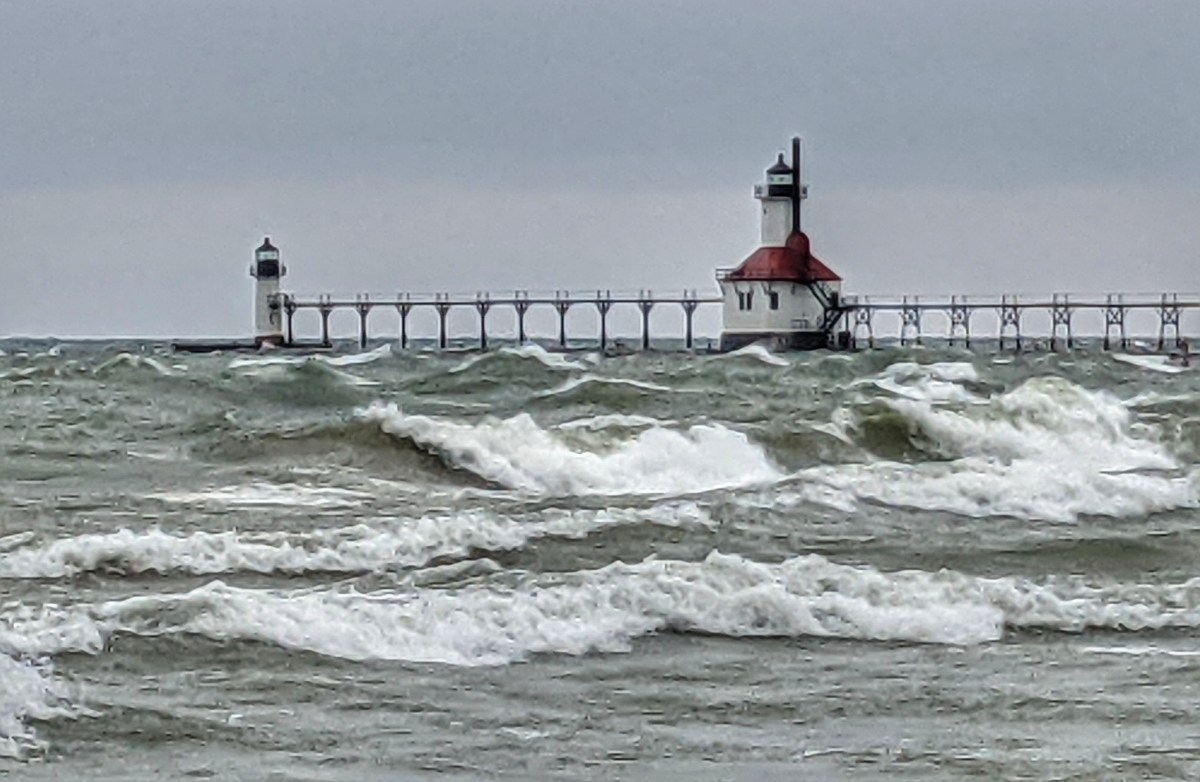
This past week, during a few days of retreat and quiet time, I visited the place where the St. Joseph River merges with Lake Michigan. In case you haven’t been up that way, I’ll describe it to you. The river ends in a broad channel, deep enough for large ships to enter, and the chop and swell on a blustery day, as it was when I visited, makes it hard to distinguish where the river water ends and the great expanse of lake begins. There is a pair of lighthouses marking the spot, though, the St. Joseph North Pier Lights.

Though the weather wasn’t great, I somewhat foolishly decided to walk out along the breakwall to get as close as I could to the lighthouses. The swells were so high that day that they crashed against the wall as I walked along it, the water rushing under my feet on the slick, wet stone, the wind howling. I was the only person out there. And it was clear, the farther I ventured out, that I had crossed a sort of threshold, and this was no gentle river now, but the wild, wide open waves, the swirling, undulating freedom of the great, grey lake.

As I stood out on the breakwall and looked back toward the place where the river gave itself to the expanse beyond, I thought of how far that water had traveled to get there, across hundreds of miles of watershed, accumulating strength and depth as it traveled, along with some broken branches and the fallen petals of summer flowers and autumn leaves, all of it pulled towards this moment, its broad unfolding destiny, no longer a brook or a stream swelling against its own banks, but released, transformed, encountering the greatness of something bigger than itself, shedding its old, narrow boundaries, becoming what it must become, contributing itself into a greater whole: perfect freedom, perfect consummation. 

And I wondered, can a river ever quite comprehend the mystery of the open waters that wait for it? When it is eagerly bursting forth from its headwaters, can it grasp how deep, how wide is the measure of its destiny? Probably not. None of us, when we first set out on a journey, can truly predict what it will be like when we finish, or who we will have become in the meantime.

And in all of this I was reminded of James and John in today’s Gospel, a coupe of exuberant upstarts, babbling like a brook to Jesus, asking for a share of his glory when they don’t fully understand yet what God’s glory even is. They say that they want to sit at his right hand and his left in the coming Kingdom, not realizing that the ones to Jesus’ right and left will be the criminals crucified alongside him on Calvary—for it is there, in the place of the skull, the place where ambition dies, that the coronation of their King will take place, not in a throne room or a temple court. Hence Jesus’ reply to them, perhaps with equal measures of love, incredulity, and pity: “you do not know what you are asking.” Young, eager, thundering river, you are not yet ready for the depths of which I speak. 

Do any of us really know what we are asking for when we set out to follow Jesus? Can we, confined to the landscape of our present understanding, envision both the cost and the promise of where he leads a willing heart? Probably not. The river knows its own banks quite well, but it cannot picture the sea. 

So as easy as it is to laugh a bit at James and John for completely missing the point, for focusing on their own glory rather than God’s, we can’t be too harsh on them lest we condemn ourselves at the same time. For each of us, following Christ, are on a similar course that we don’t fully understand, angling for something better, when what we are actually promised is something deeper—striving for something higher when what we are actually given is something broader, a love as expansive as the open waves, a love that cannot be harnessed to suit our cravings for power or control. 

This all might sound a bit vague and overwhelming, but that’s sort of the point. James and John, too, are overwhelmed, because Jesus has been leading them towards Jerusalem, repeatedly predicting his own torture and death and resurrection, and they are probably feeling scared, disappointed, maybe even a little frustrated. 

Give us something we can rely upon, they seem to be demanding in this moment—give us something to hope for, something to hold onto, something material and reassuring, something that will make all of this make sense. That’s what we all want when things feel uncertain—we want the obvious solution. A cure, a windfall, a sudden change of heart, a surprise advantage. 

We cannot see beyond the next bend, and we are afraid. We cry out, in desperation, “Teacher, we want you to do for us whatever we ask of you.” And of course, we ask for the solutions we are capable of imagining—vanquishing our enemies, winning the struggle, securing our position. For James and John, like us, these are the things that seem within the boundaries of possibility. A river dreams of becoming mightier; it doesn’t know how to dream of becoming an entirely new body. 

And Jesus knows this. And like the rich young man from last week’s Gospel, he sees us in this condition, and he loves us. And yet…

Jesus is not limited by our fear-induced dreams; he is the incarnation of God’s dream. And so even when we are certain that we know what we want, what we need, he often tends to say, as he does to his disciples here:

No, my dear ones, you are missing the bigger picture. I have other purposes for you, things beyond your frantic visions of human glory, things wilder and unpredictable and yet even more true, things more beautiful, more satisfying, than you ever dreamt of along the grassy banks of younger days. Take courage, and follow, follow where the river flows, past where you can see, and yes, drink the cup that I drink, and be baptized with the baptism that I am baptized with: a baptism that began, yes, right here, in the river and yet does not end here, for it is moving, moving, surging inexorably towards true glory, God’s glory, towards the cresting wave of heaven, a chorus of wind and light, thundering on a distant shore. 

That’s what James and John are part of. That is what we are part of. Something big. Big and wondrous and all-encompassing.

This is good news, my friends. For James and John and for you and me. Because it means that no matter how many times we get it wrong, no matter how many times we misunderstand Jesus or ourselves, no matter how many times we let our fear and our striving get the best of us, as long as we keeping following our Lord faithfully, we are borne on a current towards that encounter with wonder, a place we cannot yet even imagine in full. 

And so even on the days when the water is muddy and brackish, when the branches close in and the horizon is lost, when it feels like we’re stuck, or going backwards, if we follow Jesus’ call, then we aren’t really, because we are living in his wake, and it is guiding us, sometimes imperceptibly, sometimes quickly, toward the boundless expanse of that holy dream, towards the place where the river and the waves tumble into one another’s embrace, where, as the Psalmist says, “steadfast love and faithfulness will meet, where righteousness and peace will kiss”——the place where our sometimes lonely sojourns merge into the currents of the one single story—the one that has been unfolding since the beginning of time, guiding us on, guiding us home, beyond the uttermost parts of the sea.

Needless to say, I didn’t get washed off of the breakwall that afternoon and I made it back to the shore, back up the river, back into the enclosure of my days, with all of their twists and turns and unresolved questions, where the horizon is a bit harder to spot.

But that image of the colliding waters remains as a gift in my minds’ eye—an image to draw upon, perhaps, when life feels stifling or disappointing—a reminder that even when I don’t realize it, I am being carried forward by God through this endless stream of days, and that there will come a moment, brave and wonderful and strange, when each of us will finally encounter the fulness of truth, and we will feel the breath of God making waves across the deep, and we will see the Lord standing astride the place where the waters meet, like a lighthouse, arms sweeping wide across the horizon, welcoming us to himself, welcoming us home. 

And on that day, what was once narrowly conceived as the lonely journey, the journey that felt like it was mine and mine alone to bear, will suddenly tumble, with joy and trembling and release, into the breadth and length and height and depth of what was never only mine, never only yours, but ours–always ours, with God, in the limitless love of Christ, forever. 

In the Water: A Sermon

I preached this sermon on January 12, 2020, the Baptism of Our Lord, at Trinity Episcopal Church, Fort Wayne, IN. The lectionary texts cited are Isaiah 42:1-9 and Matthew 3:13-17.

Jesus came from Galilee to John at the Jordan, to be baptized by him. John would have prevented him, saying, “I need to be baptized by you, and do you come to me?” But Jesus answered him, “Let it be so now; for it is proper for us in this way to fulfill all righteousness.” Then he consented. And when Jesus had been baptized, just as he came up from the water, suddenly the heavens were opened to him and he saw the Spirit of God descending like a dove and alighting on him. And a voice from heaven said, “This is my Son, the Beloved, with whom I am well pleased.” (Matthew 3:13-17)


So there is John, fueled by God and by his diet of locusts and wild honey, baptizing in the River Jordan, calling people into repentance, into preparation, for the coming Messiah. Prepare the way, Make straight the paths! Repent, for the kingdom of heaven is ever nearer to to you!

We might imagine a group of his followers gathered there on the banks at dawn, sharing a simple meal as they wipe the sleep from their eyes, praying fervently, glancing over at the river, moody and turgid, the water both beckoning and menacing to them, just like John himself. To climb down into to those chilly depths, to be submerged in them by this eccentric prophet: will it change them? Are they ready to repent, to receive a new vision? Can someone ever be ready for a thing that is beyond comprehension?

And yet the river is flowing, and a raspy voice is crying out in the wilderness, and the bruised reeds at the waters edge are trembling, whispering amongst themselves, and they know that today, yes, surely today, is the day their lives will change forever.  Today they will slip into the water and be cleansed of their sin. Today they will prepare the way of the Lord, whatever that might mean. 

But there is one man in their midst, a stranger from Galilee, who isn’t so tentative. He keeps to himself, mostly, but he seems to know what he is doing there. He looks at the water with a sense of determination and acceptance, like the face of one who suddenly understands what must be done, and it is clear that whatever has drawn him here, he will not be deterred.

The group approaches the riverbank, and one by one they wade out alone into its chilly embrace where John awaits them, hurling enticements and warnings. Words thundering across the water, and then a submersion, and a gasp of breath and sunlight, and the reeds in the water are whispering, still whispering—he is coming.

He is almost here. 

Prepare the way.

Prepare the way. 

The man from Galilee steps forward.

Did Jesus know what was about to happen as he approached the river? Did he fully understand what it meant to be plunged deep down into the water, that same water that he, the Eternal Word, breathed over at the beginning of time? Did he realize, as he crested the surface, that his life was now what it was always meant to be? That the time of preparation was over?

We have some idea that he did. “Let it be so now,” he tells the Baptizer. “For it is proper for us in this way to fulfill all righteousness.” 

In other words, this is God’s will, John: 

You and I, the one before, and the one after, and the one who encircles all things. Let us go down into the deep together, baptize me with your cleansing water and I will baptize you with the fire of God’s  descending Spirit, and you will see—we will see together—how the two are inextricable from each other. 

Washed and illuminated and transformed and yet fundamentally ourselves. This is what will fulfill the emergence of God’s righteous purpose.

For this is precisely what the Baptism of Our Lord signifies: emergence. Rising up from the water, we behold the emergence of Jesus, the humble man of Nazareth, into his public revelation as the Son of God; the one who arrives like the Servant heralded in Isaiah:

My chosen, in whom my soul delights

I have put my spirit upon him

He will bring forth justice to the nations. (42:1)

In his baptism, Jesus is revealed as an embodiment of this servant, the one who will be in total obedience to the will of his heavenly Father, and who, through his self-giving service, will inaugurate a kingdom characterized by peace, redemption, and healing. A new world is revealed that morning in the River Jordan—a world with the Triune God at its center, and with Christ as its servant king.

And so when the voice from above says, “this is my Son, whom I love” and when the Spirit descends like a dove upon him, it is not that Jesus becomes something he wasn’t already. It’s that now he is seen more fully for who he always was. He is God,  who has come to us in our frailty, to live as we live, and who calls us into a path of service, so that we might live as God lives.

 What a thing to have witnessed on that day beside the river. 

And what a thing we are witnessing today, in this place, as we baptize two people into the very same experience of God’s enveloping love and concern. 

Because we must remember: our baptism draws us into the reality that Jesus experienced at his own baptism. Just as he emerged from the water to hear himself named as the Beloved, the Servant, the One called to embody his Father’s will, so do we. 

Whether in the river or at the font, the water and the Spirit do their work on us—they name us as God’s children, they incorporate us into God’s household, and they propel us forward into lives that are patterned after Jesus’ own life. Lives of service, and justice, and peace, and self-giving.

For those who will be baptized today, as for each of us who have been marked by the sacrament of baptism, this is the moment when the wait is over. The way has been prepared. A new life in Christ begins now. And they are ready; as ready as anyone can be for something that is beyond comprehension.

So rejoice, this day, my friends, for the Savior has come to the river. He has waded down into the water with us; he is standing in solidarity with us as we cry out for healing, for cleansing, for consolation. He is treading gently amidst the bruised reeds and he is guiding them back upright. 

And when we plunge into the depths and feel what it’s like to die, he will be there; 

and when we emerge into the morning light and breathe in the fulness of life, he will be there; 

there, in the water, calling us Beloved,

calling us onward,

calling us home.