
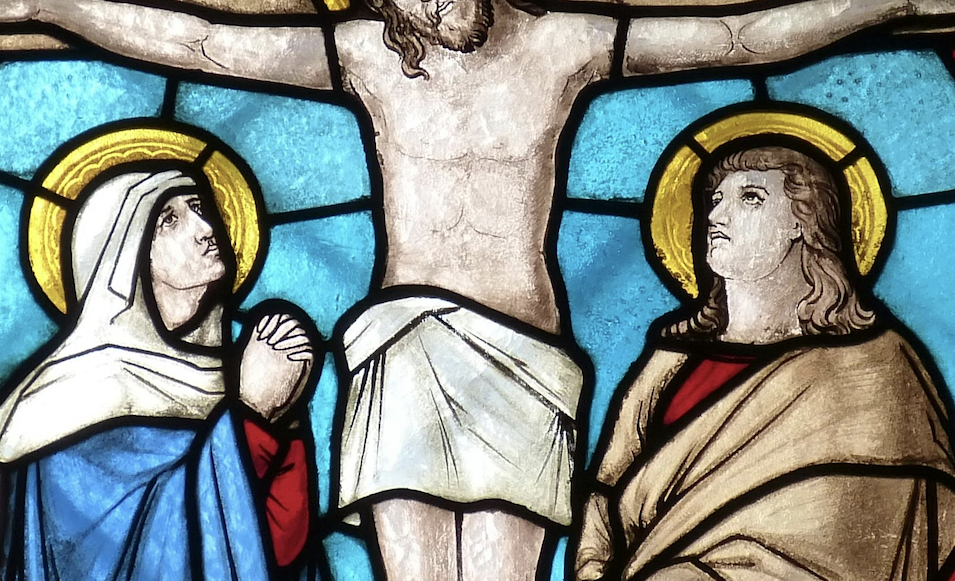
Eyes on Him: A Sermon

I preached this sermon on Sunday, July 20, 2025 at St. Anne Episcopal Church, West Chester, OH. The lectionary text cited is Luke 10:38-42.

Not too long before I began my training to be a priest, I had a meeting with my rector and mentor, Fr. Shannon. I was, as you might imagine, a bundle of nerves and excitement and anticipation, wondering what on earth I’d gotten myself into, even though I also knew it was the only thing I could imagine doing with my life. 

Fr. Shannon was and is a prayerful and wise man; he is the sort of person who cuts right to the heart of the matter when you speak with him. Even so, when I asked him for any last-minute advice as I headed off to seminary, I wasn’t quite prepared for the simplicity of his words. 

Just keep your eyes on Jesus, he said. Just keep your eyes on Jesus and you’ll be fine. 

That was it. 

Now, I can be an over-thinker. With good PR one might call my personality type “introspective,” but if we’re honest, sometimes I just get in my head about stuff.

So when I’m all worked up inside about the future and Fr. Shannon just says to me, keep your eyes on Jesus, I will admit to you that internally, I was kind of like, uh huh….and??? Throw me a bone here, Father. There’s gotta be something more to it than that. How am I going to crack the code and become the ideal priest? How am I going to help fix all the problems of the church and the world? How am I going to shoulder the impossibility of the task ahead?

But that was all he said that day. Keep your eyes on Jesus. 

So I packed my Uhaul truck with a lot of unanswered questions and went on my way. 

And wouldn’t you know, that he was exactly right? Because I would learn in all sorts of ways throughout my years of training and formation—and I continue to learn—that keeping your eyes on Jesus is a deceptively simple invitation. It is actually really, really hard, especially once we realize how many other things we’re accustomed to focusing on. 

The truth is our complicated lives and the complicated world around us and our egos and sometimes even the ups and downs of Church itself seem to conspire to keep our eyes on anything other than Jesus. Anything other than the simple, devastating truth of him and all that he offers, teaches, and dismantles. 

I got to seminary and, as with anything, it was so easy to get caught up in the externalities of it—the grades and the institutional anxieties and the questions about the future. So easy to forget, if I wasn’t careful, that none of that stuff mattered if I wasn’t first focused on the deep, healing love that I had found in Jesus.

And as with any great love, some years on, I’m still only beginning to discover its fullness—only beginning to see what it means to keep my eyes on Jesus and to let that seeing change me. 

I tell you this story, though, because in this light, I hope we can reassess today’s gospel passage. Here’s another confession: if I hear one more take on this story that divides us all into “Martha” types and “Mary” types, or that pits action against contemplation, I will pull out the nonexistent hairs on my head. With all due respect to those interpretations, this is not a passage about any of that. You are not just a Martha or a Mary. This is a meaningless distinction.

If you need some convincing on this point, consider: was Jesus a Martha or a Mary? Was he an active or a contemplative? The answer of, course, is that he was all of these things together and none of them alone. He was and is the unity of love and action, of prayer and prophetic witness, of service and surrender. Which is why, of course, we are supposed to keep our eyes on him—so that we might become like him. 

Consider, too, that in Scripture Martha and Mary are both more than this isolated passage would suggest. Martha, in John’s Gospel, is not a hapless busybody, but a person of deep faith and insight: she is the first person in that book to proclaim Jesus as the Messiah. And Mary, in that same Gospel, is no retiring navel gazer, but a person of decisive word and action. She pours out her expensive ointment and anoints Jesus’ feet with her hair, defying criticism and convention. 

Imagine that, women in scripture actually being more complex and powerful than church interpretive tradition has allowed them to be? What a concept! So let’s lay down that tired old binary these women supposedly represent. It is not real. 

The point here, instead—the distinction that Jesus is making when he talks about Mary “choosing the better part”—is a question of where our focus lies. It is his gentle, direct reminder to Martha to keep her eyes on him in all that she does. In the things that she can set into order and in the things that remain a mess—in all of it, he wants her to not forget what it’s all for, what it’s all about, what it’s all moving towards: union with him, life in him, the eternal love affair between God and creation consummated in him. 

Because Martha, worried and distracted by the many things she genuinely cares about, can only truly learn how to love them if she keeps her eyes on Jesus and receives him not just into her home but into the very depths of her soul. 

And the same is true for us, friends. 

All that we do in the church—our programs and our fellowship and our formation and our service projects—all of it is meaningless unless we first keep our eyes on Jesus and receive him into the deepest parts of ourselves. You’d think this would be obvious, but just like that advice Fr. Shannon gave me, it is deceptive in its simplicity.

Because it is so, so easy to become distracted, worried, and tempted by many other things—the ups and downs of economics and politics, the personal hurts and hungers that plague us, the unresolved conflicts and the institutional inertia. They are all important in their own way; they all need some faithful tending. But without keeping our eyes on Jesus—without making him the main thing that we are actually about—we will never go beyond a sort of well-meaning crisis mode. And I think we find ourselves in well-meaning crisis mode a lot of the time.

But God wants something more for you than that, St. Anne. God wants your liberation. God wants your peace. God wants you to be able to breathe again. And to help others do the same.

And the journey towards that liberation and peace and room to breathe begins, and becomes, and ends, for us, in focusing on Jesus. Listening to him, praying as he prayed, confessing to and confiding in him, studying his teachings, modeling our social ethics and our relationships upon his generous and gentle love. And then receiving him—reaching out our hands and receiving him into the deepest parts of ourselves.

This is what we must be about here at St. Anne, first and foremost: keeping our eyes on Jesus. And when I say Jesus, I mean the real Jesus, by the way, in case you’d forgotten or never been told what he’s actually like: living and present, responsive to reality, no enemy of science or truth or human experience, sacramentally available, still-being-revealed to us, Spirit-driven, justice-seeking, reconciliation-making, mercy-rendering. That is Jesus. Keep your eyes on him. 

The stranger-caring, everyone-welcoming, difference-respecting, listening, peacemaking, table-turning, mountain praying, active, contemplative, holy Jesus. The Martha and the Mary and the Peter and the Paul and even the Judas-loving Jesus. Keep your eyes on him, because he is there waiting to love you, too.

Not Christian nationalist Jesus; not conservative or liberal Jesus; not idol of patriarchy Jesus; not disembodied, benign, relative-truth Jesus; not war-monger Jesus; not mere symbol Jesus; but the real, risen, living, loving, bleeding, blessing, breaking, laughing, dancing, fire and firmament Jesus who demands nothing less than all of you and nothing more than this: to see him, and to fall in love with him, and to fall in love with your neighbor and the world again because of him, and to die and to live again, all at once in him. 

That’s who I am going to keep my eyes on, no matter what else comes along. 

Just like Martha, and just like Mary, and just like everyone else who has ever dared to look up from the worries and distractions that surround them and instead chooses the better part that is, quite simply, Jesus. That is, quite simply, love. 

Whatever else we do, lets start there. Just keep our eyes on Jesus.

As a wise friend told me once, do that, and we’ll be just fine. 

This is How it Ends: An Easter Sermon

I preached this sermon on Easter Day, April 20, 2025 at St. Anne Episcopal Church, West Chester, OH. The lectionary text cited is John 20:1-18, Mary’s encounter with the risen Jesus in a garden.

This is how it ends. THIS is how it ends. 

Take a look around you—at the morning light, at the flowers, and the flame that burns, refusing to be overtaken by darkness. Bathe in these rolling waves of alleluias, all of us here, together, finally, on the edge of a new day, standing in the risen light. If you take nothing else away from this moment, from this season, from this life, just hold on to the revelation all around you now: this is how it ends. 

Whatever else has ended, or is ending for you, or in this world, this is how it ultimately ends. Whatever you are afraid of, or angered by, or regretful of, take heart, because this is how it ends. Whatever grief you carry, whatever wrongs you can’t take back, whatever words you never got to say, this is how it ends. Whoever you have lost, whatever parts of yourself you have betrayed, whatever you are still trying to find, this is how it ends. Whatever seems to be falling down around us or fraying apart at the seams: remember, and believe, and taste and see, that this is how it actually ends. 

In this line of work, every day I hear and I feel, underneath all the words spoken and headlines blaring and the anxieties that pervade our church and our country and our time on this fragile earth, every day I hear the fear of endings. I hear that we are “in decline”, that we are losing ground, that we are coming apart, that everything we’ve loved and worked for is leaving us. 

I hear this across all spectrums of identity and ideology and outlook and circumstance. We have all been seized by this sense of an ending, a bad ending, and like Mary Magdalene we are, many days, stooped over by the weight of our tears.  Like her, we are wailing at the angels to give us back the things we love most, the things we cannot bear the ending of. 

But why are you weeping? Look around you, and see, and know again, or for the first time, the truth of Easter: this is how it ends

Whatever breaks, whatever dies, whatever unravels in us and around us—that is not the actual ending that God has in store for us. This is. Because our God is the God of Love and Life, our God is an Easter God, and we are Easter people, and on this clear and fragrant morning our Living, Loving Risen God emerges from the darkness, up among the flowers like a gardener, asking us to look, to look, and to see how the first green shoots of this new and deathless creation are rising right up all around us, right out of the wreckage of all those dreaded endings we fear.

So look! Stop your weeping and look!

Now, I love this moment of reunion between Mary Magdalene and Jesus; I find it one of the most poignant in all of Scripture. But I have also wondered sometimes if Mary felt like she got the brush off from Jesus. He’s in an awful hurry. 

Here she is, the only one who stuck around after the men left and went back home, here she is crying her heart out, suddenly reunited with her Lord and teacher and friend, and then through her blur of tears and joy and relief, Jesus is just like, “Girl, bye! I’ve got places to be. It’s Easter; I’ve got brunch plans. I love you, Mary, but kindly extricate yourself from my person.” 

Well, maybe he was a little more pastoral than that. But he doesn’t stick around long enough to explain or even to instruct. Because how can you really explain all of this. He simply needs her to look, to see, for that briefest, most crucial moment in human history: to see that, whatever has us bowed down in grief, this is how it ends. With you and I, and him, and everything alive, redeemed, renewed—and united with the One who made us. And on that day, oh what an Easter brunch it will be.

And this is important, especially now: that this glimpse, this Easter day that shows us how it all will end: this is meant for something far more than consolation. It is meant to EMBOLDEN us. It is meant to make us a little brave, a little feisty, because this ending means that we are free. We are free from despair. We are free from shame. We are free from death. We are free!

And Mary, well, she gets it. She understood the assignment. Because out of that garden she goes—she goes and she announces—she PROCLAIMS what she has seen. Oh yes, if you hadn’t noticed, the first APOSTOLIC PROCLAMATION of the risen Lord…the first human heralding of the new creation…is borne on a woman’s lips to the men hanging out at home. 

Because what has been cast down is being raised up and blessed are those who mourn for they shall be comforted; and blessed are the pure in heart for they, THEY shall see God; and blessed is she who has believed that the Lord would fulfill his promises to her!

And as Mary goes along proclaiming, mind you, the world still looks the way it always did. Caesar is still on his throne, and Pilate is in his judgment seat wondering what truth is, and the crowds who called for crucifixion still know not what they have done. And all around are all of those usual endings, endings, endings, and falling temples and crumbling nations. Oh yes, we’ve been here before. 

But Mary? Mary is emboldened now, because she stands at the center of a new world, she has seen, before anyone else, that this is how it ends. And when you know that this is how it ends, you can do anything that love requires, because there is nothing left to fear. 

Friends, Easter is the feast of fearlessness. It is the feast that invites us to not just cling to the hope of some good news someday, somehow, but to see it here, now, alive, in front of us and around us. It is the feast that asks us to stop wailing at angels, and to dry our tears and hike up our garments and chase after that good news. Proclaiming as we go this thing, this Person, this Risen One, this new world that we have glimpsed. 

And as we go, if we run into those petty tyrants of every age and the structures that prop them up, we will laugh, and we will stand in the streets and tell them: NO. You have no ultimate power. Because this is how it ends!

And if we see our beloved church changing through the years, we will cry out joyfully: it will be ok, because we are not limited by institutional realities, we are proclaimers of the Gospel of the Risen Lord, and this is how it ends!

And if we must say goodbye to each other along the way, as we certainly will in time, then we will say goodbye with tears and with tenderness but also with hope, because we know that this is how it ends. 

And frankly, even if society were to fracture all around us and we had to stand on the rubble of what has been built, even then, even then, like the generations before us, even then we will look for that green shoot rising up at the mouth of the empty tomb and we will point and say, LOOK. This is how it ends!  I have seen the Lord and this is how it ends!

Just like this. With love and truth and possibility, and resurrection, and a day that is not actually an ending at all, but a beginning. Look around you. This is the first glimpse of a new heaven and a new earth, with flowers, and a flame that will not be overtaken by darkness, and a torrent of unstoppable alleluias, and all of us together, finally, fully, always. 

So why are you weeping? This is how it ends. 

Get Up: A Sermon

So, a confession—and one that for some reason always feels a little bit awkward for a priest to make: I am NOT a morning person. Not even in the slightest. I admire and honor the morning people out there among you; I think it’s probably a beautiful thing to have those extra, slightly quieter hours at the outset of the day. I understand this intellectually. But my body does not agree. 

I get up when I must, but I’m not happy about it, and it’s a slow process of reanimation. Eventually, at some point after my morning coffee, I am ready to rejoin the land of the living. 

People sometimes seem surprised by this; maybe they have an idea that priests are up every day with the rising sun chanting the Psalms. And maybe some of my fellow priests do indeed do that, but not me. I am a night owl, and it’s usually late at night that I am especially inclined to talk to God and reflect and pray. The prayer office of Compline, the one said just before bed, is my absolute favorite.

I make this confession to you because, on one hand, it’s always good to remember that we are all simply human beings trying to make it through the day in whatever way we can, whatever clock our bodies are on. 

But also because I realized, pondering the readings for this All Saints Day, that I have a kindred spirit—a new patron saint for those like me who are not always ready to greet the dawn. It is poor Lazarus, who was, by John’s account in the Gospel, not prepared to get up when and how he did. 

Think about it. You have died and, presumably, are resting peacefully in the arms of God. And then all of the sudden someone rolls back that stone and lets all the light in and starts calling, “Lazarus, come out!”

My mom used to do this when I was a kid—she’d come into the bedroom and pull open the blinds and say, Phillip, get up, we’ve got things to do!! And I would grumble and groan.

And yes, I know the raising of Lazarus is a miracle of the highest order, a sign that Jesus is indeed the Son of God, but still, the not-morning people like me might empathize a little with Lazarus stumbling out into the daylight, a bit confused and rough-looking, not quite ready to face whatever this is. This new day. This new, changed life. Maybe he just wanted five more minutes of rest, first, before embarking on existence as a saint raised from the dead. 

Lazarus, in his sleepy disarray, with the smell of the burial shroud and the bandages all askew, is a comfort to me, because he reminds me that sainthood, ultimately, is not about having it all together. It’s not like those senior superlatives that show up in the high school yearbook—most likely to succeed, best dressed, best personality. Lazarus, coming out of the tomb, would not have won any prizes. 

No, sainthood ultimately is about Jesus, about what Jesus does in our very ordinary, imperfect, complicated, exhausting lives, even when we hit the snooze button a few too many times or burn our tongues on the coffee or run a few minutes behind our best intentions. 

Lazarus doesn’t get mentioned much more in the Gospels—as far as we know, he didn’t lead a revolution or work any miracles of his own. He just…got up when Jesus called him and returned to his family and did his best to get on with life. And that was sainthood. That’s a low bar that I feel like I can get over, even on my worst days. 

All Saints’ Day is one of the glorious feasts in our church year, but we should not be overly confused about or intimidated by saints, or feel like they are these remote, pious figures with their hands perpetually clasped in prayer. 

They were and are human beings, with all their idiosyncrasies, living through eras just as complicated and challenging as our own, if not more so. Really, what distinguishes them is simply that God called out to each of them and said, “it’s time to get up. We’ve got things to do. Come on out, wounds and bandages and all, and let’s face the world together.”

And the plot twist is that God is doing the exact same thing to you and to me every day of our lives. Maybe you don’t have actual trouble getting out of bed, like me, but we are all, at times, a little hesitant to open our eyes, to step out into the bright light and the crowd and the fray, with all of the world’s questions and uncertainties and dangers and demands. We might think it would be easier to turn over and go back to sleep, to let someone else handle it, whatever it is. To trust that God will call on someone else. 

And maybe God will, or maybe God won’t. But the question is—what will we never see, what life will we miss out on, what new glory might never be revealed in us, if we just stay curled up in the dark? 

You don’t have to be full of undaunted courage and untroubled certainty. Lazarus was literally still half-dead, couldn’t even speak. But he pulled himself up on those aching bones and even though he didn’t say a word, his heart said yes, Lord, ok, Lord, I am a mess, and I haven’t had my coffee yet, but yes, I’ll come out. I’ll take part in whatever this new thing is that you are doing. 

And with just that, he was a saint. 

My friends, the world needs more saints like Lazarus. We need more imperfect people willing to stand up and step out, just as they are, to bear witness to the all-powerful love that is God’s message for all people. We need more people willing to stand up and say, death and division and enmity and cynicism and hatred and exclusion are NOT the last word of the story, and we will not roll over and we will not pull the covers up over our heads while the world weeps. No. Jesus says come out, we’ve got things to do, and so we’re gonna come out, at every hour of the day, to be the messengers and agents of his undying love. 

And because we are Episcopalians, yes, we will say our prayers and drink our morning coffee to help us along the way. And woe to anyone who stands in the way of a bunch of Episcopalians hyped up on caffeine and God’s love—death and tyranny themselves are going to run in the other direction! 

I know that there is a lot that weighs heavily right now. I know we’re all stressed out, and maybe like Mary and Martha we’re wondering why Jesus isn’t showing up when and how we want him to. Maybe we are afraid of what a new morning will bring.

But listen. Listen closely. Jesus is calling out. He is saying, open your eyes. He is saying, I am here, and I am asking you—yes, you—now, to get up, to come out, to brush off the dust and wipe away the tears and the sleep from your eyes and LIVE. For your own sake, for the sake of the ones who came before us, and for the ones who will follow long after we are gone, LIVE fully, and generously and openly, and lovingly. Live in pursuit of justice. Live in the practice of peace. Live as if God is real and death is a lie, because it is so. Live as though the opportunity to love is the best reason for getting out of bed in the morning, because it is so. And then you will be counted among the saints.

Because that’s all sainthood is, in the end. An accumulation of choices to get up every day and love something or someone fiercely. 

And it is God saying, when all is said and done, at that dawn of a new and eternal day—yes, my child, yes, you understood. Love is all there was to it.

Get up. Open your eyes. Good morning. 

What Is Loved, Is Resurrected

I preached this sermon on Easter Day, March 31, 2024, at St. Anne Episcopal Church, West Chester, OH. A version was also featured this day as part of The Episcopal Church’s Sermons that Work.

“While it was still dark, Mary Magdalene came to the tomb and saw that the stone had been removed.”

What is loved, is resurrected. 

This is the proclamation of this singular, eternally true day. This is what we discover on this morning, as the dawn caresses the darkness and wipes away its tears. Just as sunlight reveals itself in the morning sky, so has the Son of God revealed his fullness, so that in the light of this impossible, wondrous moment, we, like Mary Magdalene, might finally behold God’s answer to our broken hearts:

That what is loved, is resurrected.

Because Jesus, who was so deeply loved, who is Love, has been resurrected. Or, more accurately, he IS the resurrection, just as he once told Martha as she grieved over Lazarus. He is Love and he is Resurrection, and now, at last, we see what had previously been hidden: that these two, love and resurrection, are the same thing. We see that love is not a temporary condition, not something that we must live in fear of losing; it is the fundamental premise of existence, it is the Alpha and the Omega. When we love, when we are loved, we are given a taste of eternity. 

And so Jesus, this Love enfleshed, stands before us, bathed in the dew of the garden, his voice as soft as flower petals, his heart as radiant as fire, and he has arrived, not at the end of his journey, but at the new beginning of our journey. At the new beginning of the world—again, as before, in a garden. A beginning that is again, as before, signified by the tenderness of a God who walks among the trees and seeks his children and calls out to them by name. 

But on this day, on the other side of night and on the other side of death, God has a new message to add: not simply that we are loved, for that has always been true…but that what is loved is resurrected. That love is resurrection, and that death is no longer a closed door. It is an empty tomb. 

It was not always evident that this would be so. 

Humanity has traveled a long way to get to this morning. Outward from the original, creative tension between chaos and genesis; outward from the garden of Eden; outward across a thousand wildernesses of yearning and temptation; traveling through the turbulent seas and across the river to the precarious, uncertain peace of our earthly promised lands.

And as we have traveled, humanity, in good times and hard, has always sought the one thing it could never have: a solution to the conflict between our affections and our mortality. In other words, that what we love, dies.

This has been the curse, this has been the bitten, bitter fruit of an inescapable insight: that even if our deep love—for God, for family, for spouse, for neighbor, for earth—somehow manages to endure over time, our bodies and the work of our hands do not. We are burdened with the degeneration of even our noblest efforts, the severing of our most precious bonds. The inescapable presence of death has driven the world mad with grief, desperate with the longing for something other than goodbye.

But today, in the strange dim light of Easter morning, a wondrous thing takes place. And not just the one you are thinking of. 

No, in fact, the first thing is this: that a disciple, Mary Magdalene, who has watched Jesus suffer and die, and who now carries the vast pain and loneliness of all creation in her heart, on a morning in which God is dead and Love is dead…she comes to the tomb. She comes to the grave of all human hope, knowing what has been lost, and she looks into the void where Love used to be…and yet she refuses to yield her love to that void.

Mary refuses, there, despite the literal death of Love itself, to give up the love she carries in her. She keeps that love alive in her broken heart. And so, on behalf of all of us, she comes to bear witness and to tend to God’s body when no one else is able or willing to do so, because she knows that bearing witness and tending to what is broken is what love looks like, both in life and in death. 

And in this moment of miraculous tenderness and strength, she, the stubborn bearer of a Love that was supposed to have been killed, is given to behold a new miracle:

That what is loved, is resurrected. 

Mary Magdalene did not resurrect Jesus, of course—the upwelling, earth-sustaining, heaven-rending power of the living God did that—but it is also true that, even as Jesus lay dead, this very same divine, undying love coursed through her veins and animated her soul and carried her to the tomb that day. 

It was God’s love, it was God’s own heart, in and with and through the heart of Mary Magdalene, who also wept beside the empty tomb, God weeping in her and with her and with us for the senselessness of separation, weeping for that long journey out of Eden, across the wilderness, through the seas, searching for something other than goodbye—a journey that God made, too, right beside us, step by weary step.

And so while Mary did not resurrect Jesus, we can say that she carried that same resurrecting love within herself, that she was an agent of and a participant in its surprising, vivifying force, and that she partook, in that moment, of the very same powerful, stubborn love that will ultimately restore all life back to life. 

And if she does, then so can we. 

What you need to know is this: the Resurrection of Jesus is not just a remote story of a bygone moment when something amazing happened; it is a statement about what is still true for you and for me and for everyone who is still navigating that long and often wearisome journey in search of something other than goodbye. For everyone who struggles to love; for everyone who has loved and lost; for everyone who feels confused about what love even is: Easter Day is the answer. 

What is loved, however imperfectly, for however long, is resurrected. 

This is what the risen body of Christ signifies and enacts: that what is loved is not lost to you, and it will live forever, not only as a memory, but in its fullness, in the flesh, on that day when God becomes all in all, and the whole earth is loved back to life. 

And, as Mary discovered, what you choose to love in this world is imbued with the promise of resurrection simply by the act of loving it. Every time you have gently kissed a soft cheek or held a calloused hand. Every time you have refused to break a bruised reed or trample a fragile spirit. Every time you have preserved the hope of the poor, or sought beauty, or made peace. Every time you have stopped to love something, you have taken part in the ultimate resurrection of the world, for what is loved—by you, by God, and by God working through you—is resurrected. 

Why and how is this so? How can Easter be what it is? 

We cannot explain it. We need not explain it. Because neither can we really explain our compulsion to love, even in the face of loss and uncertainty, and yet we simply do. Love is its own answer to the questions we ask. And resurrection is the same. 

Jesus emerges from the fading night, calling Mary by name, calling you by name, to confirm what you already knew in your bones but dared not trust: that love is worth the cost, it is worth having to say goodbye, because there is indeed, something other than goodbye at the end of the story, there is a place where beginnings and endings meet, where, forever, the dawn will caress the darkness and wipe away its tears and all that has been loved will be alive, and we will call each other by name. 

And in this strange new Easter light, perhaps we will realize that there was, in fact, always something deeper than mere human longing that propelled us across the wilderness and through the sea—that our long history of choosing to seek, to hope, to endure, to dream of something other than goodbye, was never a futile endeavor—it was a fertile one. It was the resurrecting love of God already at work in our mortal bodies, now completed in God’s body.

And like Mary in the garden, beholding the Risen Lord of flesh and flower and flame, perhaps we will discover that we, too, are bearers of that force which is stronger than death; that our choice to love is to take part in the very same mysterious, power that compels life to rise up from the earth.

For what is loved, is resurrected. 

Just like Jesus. 

And, one day, just like us. 

Names: A Sermon

I preached this sermon on Sunday, May 8 2022 at Trinity Episcopal Church, Fort Wayne. The lectionary text cited is Acts 9:36-43, in which Peter raises a woman from death.

How many names do you have?

The immediate answer to that question might seem obvious—many of us have a first, a middle, and a last, with maybe one or two more thrown in for good measure by our parents. But it’s not always that straightforward—some of us also have old nicknames, the recollection of which might make us squirm with delight or embarrassment; affectionate names given by friends and romantic partners; and names that we have claimed for ourselves later in life as we have better understood who we are and how we wish to be known to the world. There might be other names, too, that we’d rather not hear—the hurtful, insulting ones that were hurled at us at one point or another, the ones that still rattle around in our memory like heavy stones. 

There is great power in the names we carry; power to heal and to harm; to remember who we are and to be reborn. It should not be surprising, then, that much of Scripture is taken up with the giving and the changing and the remembering of names, including the ones we have applied, with the limitations of human language, to the unspeakable name of God. 

We might say that, in some way, the entire story of God’s people thoroughout the Bible is the search for a name—a name by which to know ourselves, a name by which to address the ineffability of divine truth, a name to call out into the silent infinitude of the stars—a name that is sufficient to say what life is, a name that can capture in full something that is ultimately beyond words.

I got to thinking about names because of today’s passage from Acts, where Peter restores to life a woman in the city of Joppa, a woman who bears two names, Tabitha and Dorcas. As the writer of Acts informs us, Dorcas is the Greek translation of the Aramaic name Tabitha, which means “gazelle.” Now, it would be easy to pass right over this detail as we read about her miraculous resurrection, but I think we would miss something important if we did so. 

Commentators note that Tabitha/Dorcas, in addition to being a woman of some financial means who was able to support the widows in her community, was also a woman that straddled two worlds. Joppa is a port city, and given her two names, it is likely that this disciple of Jesus was a Greek-speaking Jewish woman who occupied a liminal space between her Israelite identity and her ties to the Hellenized world of the Roman empire. Her two names suggest that she had learned to traverse the ambiguous territory between colonized and colonizer, between membership in an oppressed nation and the society of the imperial oppressor.

We do not know how she managed this interplay of names and identities, but we do know that in the midst of them, this woman who was both Tabitha and Dorcas dedicated her life to service in the name of Jesus. And perhaps, for her, the name of disciple–follower of the Way, sheep in the flock of the Good Shepherd–was the thread that bound her disparate roles in a fractured world. 

But then note what happens in the passage. Peter (himself another bearer of two names) comes to see the body of the woman, and in raising her back to life, he says, “Tabitha, get up.” Not Dorcas, but Tabitha. Her first name, the name that was with her from the beginning, the name spoken in her people’s original language: this is the name by which she is called back to herself, this is the name that inaugurates her resurrected existence. It is Tabitha, tzvia in ancient Hebrew, the same word that names the gazelle leaping on the mountainside in the Song of Solomon, that is the name of life for her. That is the name by which God, through Peter, breathes life back into her body. And while the Scriptures do not tell us anything about her life after this miracle, I can’t help but imagine that, for the rest of her days, she remembered the sacred power of being brought back to life by the sound of her original name. Tabitha, get up. 

What is the name by which God would call you? What is the name that encapsulates your deepest self, the name that is life to you? And, conversely, what names have been put upon you that no longer work, that no longer tell the whole story of who you are called to be?

I speak not only of given names and surnames, but also of the roles and identities by which we are known and named, which, while important, are too often over-simplified, objectified, and used to label and limit our complexity—old, young, healthy, sick, parent, child. Priest, layperson, spiritual wanderer. Gay, straight, trans*, Black, Brown. American. Foreigner. Pro-Life. Pro-choice. Democrat. Republican. Do these names actually tell you who you are, or who your neighbor is?

Or is there a deeper name, an original name, by which you must identify yourself and those whom you encounter if we will ever hope to actually know one another? Is there a name for ourselves that will bring the dying parts of this world back to life?

There is, in fact.

And it turns out that the woman known as Dorcas heard that it day as she awoke from the sleep of death. Because a funny thing about the name Tabitha—tzvia. That word, in its original language, doesn’t only mean gazelle, but also, simply this: beautiful. Her name was beauty. 

Beautiful one, get up. 

This is the name by which God knows each of us. This is the name that God has called us from the moment the world began. And this is the name by which God, in Christ, desires us to know one another—the name underneath our names, the name beyond every label and slur and stereotype. The name that will bring anyone back to life. 

Beautiful one, get up.

And this is the only name that can heal us, that can see us through the divisions and the suspicions that have plagued not only our recent history but the entirety of the human story. It is only when we know ourselves as beautiful, as beloved, and when we see that same thing in the face of our neighbors, in the face of our enemies, as Jesus taught us to, that we will begin to move back from the brink.

It is only when we see and name the inherent beauty and dignity of all creation and develop a reverence for what God has made and called good that we will move closer toward the kingdom wherein we were meant to dwell. It is only when we stop name-calling and start naming each other as beautiful, when we start noticing the beauty we see, even in the places and people where it’s not first apparent—it is only then that we will finally speak our own true names, and it is only then our mortal tongues will begin to utter something that approaches the one true name of God. 

The God who woke Tabitha from the dead.

The God who woke Jesus from the dead.

The God who will wake each of us, on the last day, saying, quite simply:

Beautiful one, get up. 

The Island: A Sermon

I preached this sermon on Sunday, February 13, 2022 at St. Paul’s Episcopal Church in Mishawaka, IN. The lectionary text cited is 1 Corinthians 15:12-20.

I spent most of the summers of my childhood in the Upper Peninsula of Michigan, where my dad’s side of the family lived for generations. Now here in Mishawaka, you all live relatively close to Lake Michigan, so you have a good sense of the beauty of the Great Lakes, and if you have ever gone way up north, you know how rugged and beautiful it is on the shoreline of Lake Superior—rock formations and dense forests colliding with the open expanse of the water in its many shades and moods. 

And although there are any number of places along the shore of Lake Superior where one might be struck by its wild beauty, there is one particular spot we would visit as a kid that always stayed with me—the type of place that impresses itself upon your psyche, such that you might recall it out of nowhere while absentmindedly washing the dishes or just before drifting off to sleep at night—a pleasurably haunting memory, a dream, a landscape pregnant with unspoken meaning. 

It is a rocky, forested point of land, stretching out into the lake, with a small sandy beach at its tip and then, across a churning channel of  water, an island—so close that you can see it clearly, and, when the waters are calm, even dare to wade across to its shore. I have a distinct memory of doing so, by myself, as a child—scrambling through the water and ending up on the other side, giddy with freedom—just a couple hundred feet from the mainland but a world apart.

The point of land, the channel of water, the island—the image of that place stayed with me through many long and parched seasons of my life—chronic illness, the uncertainties of young adulthood, the sudden death of my father and, then, later, my grandparents. And although I had not been back to visit Michigan for nearly a decade and hadn’t been back to the lake for even longer than that, when I moved to Indiana nearly three years ago to serve at Trinity Fort Wayne, one of the first things I did was make the long drive north through the landscape of my past, through the mining towns and the forests. Eventually I ended up at Lake Superior, and I found the point of land again, and I walked out to the edge of it.

What struck me, though, was how deep the waters were this time—choppy waves and wind blowing in off the lake, no rocks visible to scramble on, no chance of crossing over. All I could do was stand and stare at the island, that childhood dreamscape, so close, but just beyond my reach. 

As we grow up and grow older, we tend to experience life as a sort of expanding distance from the solidities of the past. Sometimes we are grateful for that increased distance, and other times we mourn it, but either way, I think that there comes a time in each of our lives when we stand at the edge of what we know and glimpse the islands of youth and memory as beloved, yet inaccessible kingdoms. And we might despair how death consumes what was once so present to us—the places, the faces and the voices of another time.  And perhaps we start to believe that this is simply our portion in a fragile and fleeting world.

But there is another choice. There is another way to see this. 

“How can some of you say there is no resurrection of the dead?” Paul asks the church at Corinth. “If there is no resurrection of the dead, then Christ has not been raised; and if Christ has not been raised, then our proclamation has been in vain and your faith has been in vain.”

Apparently there were some among the Corinthians who accepted that Christ indeed had risen from the dead, and that this was a miraculous act of God, but they could not accept the idea that all of the rest of us were destined for the same undying life. In a world where it is self-evident that everything and everyone dies and decays, perhaps it felt foolish to them, naive, even, to claim such a possibility.  They were content, it seems, for Jesus to be the inaccessible island, beautiful to behold but not part of their actual lived reality—not a place they themselves could ever dare to venture. 

But Paul will have none of this. For he understands that we are not just people who have beheld the resurrection of someone else, of Jesus, but we are, ourselves, resurrection people. Where Jesus goes, we go too. And if the chasm between where we stand and where he has risen seems impassable, that is because we have still bought into the lie that death wins. It does not. Not any more. With Jesus, death is not the last word of any story. “If for this life only we have hoped in Christ, we are of all people most to be pitied,” because then we have missed the actual endpoint, the actual telos of following Jesus. Follow me, he says, not just through this world but onward, onward, “further up and further in” as C.S. Lewis wrote, to the undying life of God that makes everything possible.

I think sometimes as good, reasonable Episcopalians, we are hesitant to really lean into this paradigm of resurrection, of life eternal. We don’t want to think so much about heaven that we discount the beauty and the urgent need of this world. But the danger is that we go too far the other way—that we become so focused on our present reality that we forget that we are inheritors of the resurrection—that another world is not only possible, it is promised, and it is already making itself known in our midst. 

And when we see that, it changes EVERYTHING, because death is no longer the precipice over which our love inevitably vanishes. Death is no longer an impassable, stormy channel separating us from God’s life. For God’s Son has calmed the waters, he has made it passable. And so the island beckons once more; its golden shores are a place we were meant to stand; the kingdom beyond death where Jesus stands, welcoming us back into life.

What does this mean for us, here and now, to be Resurrection people? It means that we can be people of joyful courage. We don’t have to stand wistfully on the shore, mourning what once was. Because to believe in Resurrection is to believe that nothing is truly lost; that every good thing is still possible. Even when we are poor, hungry, grieving, or lonely, even when the world is changing, even when the church is changing—every good thing is possible. This is our proclamation and our practice.

And here at St. Paul’s, and down at Trinity Fort Wayne, and in every parish and faith community that comes together in the name of Jesus, we have an opportunity to practice at this together—to practice being Resurrection people. Everything we do in our faith communities—serving, donating, tending to one another, worshipping, studying, feeding, mending, advocating—all of it is a way of saying yes to God’s aliveness, it is a step out into the water, confident that we can reach the other side, that that Divine life awaits us, as long as we hold onto each other and keep our eyes on Jesus.

I know it has been a long hard couple of years, but don’t turn back. Don’t give up. We can get there.

I haven’t been back up to to Lake Superior since that day, and I don’t know if or when I will make it there again. But I think that the island will remain in my mind’s eye forever—a reminder that I have a choice—that life can be viewed either as a wistfully inaccessible, passing dream or it can be viewed as a promise that lies on the other side of death. Every day, with God’s help, I mean to choose the latter. I mean to choose the promise. 

And perhaps, one distant day, when the waters have been stilled forever, I will cross that channel and stand on the other side once more, and life will feel new, and nothing will be lost, ever again. Perhaps that’s where we’re all headed in time. I pray that we are.

And on that day, Resurrection will be not just a promise glimpsed far off, but the ground upon which we stand. 

This Peaceful Body: A Sermon

I preached this sermon on April 18, 2021 at Trinity Episcopal Church, Fort Wayne, IN. The lectionary text cited is Luke 24:36-48.

Jesus himself stood among the disciples and said to them, “Peace be with you.” They were startled and terrified, and thought that they were seeing a ghost. He said to them, “Why are you frightened, and why do doubts arise in your hearts? Look at my hands and my feet; see that it is I myself.

I’ve been thinking a lot about bodies this week—about how inseparable our bodies are from our own particular identity and story. I’ve been thinking about bodies that grow and move through the world, gathering experience and wisdom, and other bodies that are broken, bruised and scarred. Bodies that connect, and bodies that retreat from companionship. Bodies that stand tall and hopeful, and bodies that lie low upon the earth, down where the blood cries out from the ground. Bodies that live. And bodies that die and are laid to rest.

And I’ve been thinking about one body in particular, the body of Jesus, who, in today’s Gospel passage, appears in his body and stands in our midst in the strange light of Eastertide saying, “peace be with you.” 

A risen body. An offering of peace. Somehow, it seems, these are connected—two notes of the same song. 

The disciples’ bodies trembled, though, when he appeared to them and gave them this greeting; they were “startled and terrified” and “disbelieving.” I can’t say I blame them, for how can our limited imaginations possibly begin to picture deathless life? And what do we know of true, embodied peace? How could we begin to recognize it or comprehend it if it appeared in front of us?

Because the peace of God is a beautiful thought, yes, but I will admit that this week, like too many before it, I’ve been distracted and dismayed and far from peaceful, thinking about those bodies that know no peace, bodies to whom no peace is offered—black and brown bodies beaten and gunned down in the streets. Bodies ravaged and silenced by COVID, by cancer, by injury or addiction. The bodies that sleep under bridges and the ones that go to bed hungry.

And all of them are so present, their suffering so urgent and persistent, that I sometimes do not know what to do with this invitation to peacefulness, which can ring a bit hollow when I hear it, as if ‘peace’ is just a polite way of saying that those broken bodies are someone else’s problem, that the world’s violence ought not disturb the tranquility of our spiritual endeavors. 

But no, this can’t be what Jesus means when he says “peace be with you,” although, if we are honest, it is what we are used to—a world that seems to foment only our capacity for rage or apathy.

And so perhaps it is not so shocking that the disciples, in encountering the risen, peace-bearing Christ, are confused, even in their joy. Because they, like us, could not quite understand what it is that he proclaims or represents. Because they, like us, were accustomed to the expendability of fragile bodies caught up in imperial systems; they, like us, were intimately acquainted with the prevalence of death, whether from disease, disaster, or violence. They, like us, were conditioned to accept the machinations of a society that favors the powerful, that privileges forcefulness, and that mischaracterizes “peace” as acquiescence, passivity or disengagement. 

And so against all of that, what could this moment–this resurrection encounter–possibly mean, strange not only because their Lord has reclaimed life after a cruel and senseless death, but also because he does so as one proclaiming peace, rather than retribution? 

What is the significance of this resurrected body of his, which has conquered death and yet still bears the marks of torture? This body challenges us, for how can any of us look upon the violence and the degradation imprinted upon his flesh—upon all flesh—and yet proclaim, with hope and without irony, “peace be with you?”

I think we still struggle to resolve these questions. And yet it is fundamentally important that we try to do so, because without joining the disciples and facing the uncomfortable paradox of Jesus’ wounded, resurrected body, we will not ever truly know him, nor the type of peace that he offers; a peace that is unlike anything the world can give us.

“Look at my hands and my feet; see that it is I myself,” Jesus tells the group, and much like Thomas in last week’s Gospel passage, we observe that it is in examining the marks upon his body, in touching the scars and the bruised places, that the Lord invites the disciples to recognize him, to know him for who he is. And it is only once they have done so that they can even begin to imagine the possibility of what he represents—not just their Lord and teacher returned to them, but a new life, a new type of peacefulness, the kind that does not come about by vanquishing enemies but by loving so fiercely, so fully, that the idea of enmity itself is nullified. A peace that is deep enough, and true enough, to stand in solidarity with the woundedness of the world, rather than evade it.

Because that is what Jesus is doing in this wounded, resurrected body of his—he is standing in solidarity with the disciples, and with you and me and everyone who has ever been wounded or broken or beaten down, and he is saying: 

I see you, I understand you, and whatever it is that you have faced, and whatever new horror the world tries to inflict upon the vulnerable among you, it will not prevail, not truly. Because I have taken these wounds and grafted them onto my own, undying, Spirit-infused, eternal body. And it is THIS frail and magnificent body, so much like your own, still bearing the marks of human sorrow, it is THIS body which is ascending to the Father—wounds and scars and bruises and all. I am taking this pain—your pain and my own and all the pain of the world—and I am going up, up to glory, up to the right hand of God—and I am binding the world to myself, I am binding you to myself, so that nothing can separate us ever again. 

This is good news, to say the least, because it means that our sanctity and our salvation have nothing to do with pretending we are whole or perfect or pure. We do not have to be unblemished, unwounded to be beloved, to enter the Kingdom of God, because the Wounded Holy One has already gone there to prepare a place for us. 

Jesus shows us that the Christian life–the life of true and lasting peace–is not about glossing over or refusing to acknowledge the painful parts of life, or bravely pretending for one another that everything is fine. It is about truth. It is about facing and naming the things that are hard and ugly even as we celebrate the things that are beautiful.

It is about cultivating reverence for the wounded, resurrected body of our Lord upon this altar so that we might carry that same reverence into our encounters with our neighbors, that we might tend to their bodies and their wounds with the same care that we offer his.

His risen body shows us that the life he offers is about entering into the fray, into the heaving heart of the world and saying: Peace be with you.

True and courageous peace be with you.

The peace of the wounded, resurrected Jesus be with you.

The peace of love’s tender and deathless power be with you.

The peace that is the inheritance and the destiny of every beloved, broken body be with you. 

God’s peace be with you. 

Alleluia.