Jackrabbit: A Sermon

I preached this sermon on Sunday, February 9, 2025 at St. Anne Episcopal Church, West Chester, OH. The lectionary texts cited are Isaiah 6:1-13 and Luke 5:1-11.

Fun fact about me: at least three or four times, I’ve traveled the remnants of Route 66, that famous old highway which once stretched from Chicago to Los Angeles. A lot of the roadside attractions and cafes and motels from its heyday in the 40s and 50s have been lost to time, but even now it’s a beautiful and worthwhile trip, a sort of pilgrimage road across America, where odd wonders abound.

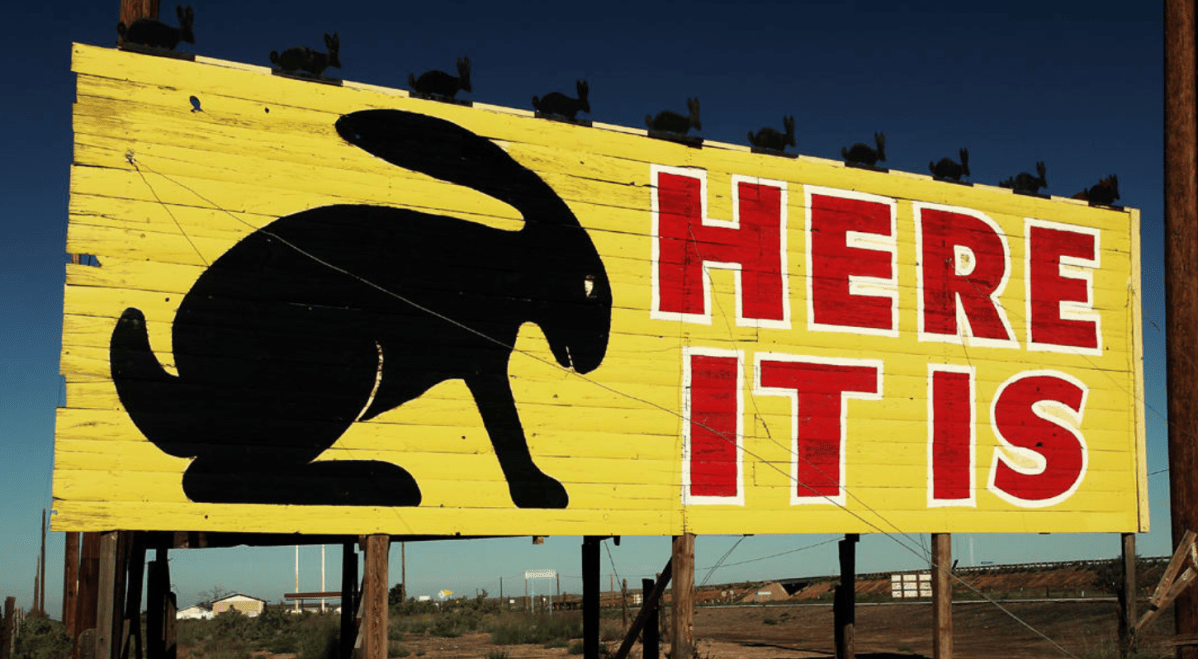
For example, as you drive across northeastern Arizona, just a bit south of Navajoland, you might notice these signs along the desert highway. They’re ambiguous, just old wooden billboards painted bright yellow, no words, just the silhouette of a big black rabbit and a number of miles counting down. 

150 miles, one sign says…and then 100….and 50….and 10…and as you drive across the empty landscape with not much else to look at, you find yourself overly invested in these mysterious signs, wondering, what exactly are we counting down to? What is that big rabbit all about? What or who is waiting out there across the desert, across the hours and the miles and long, winding road?

So you can imagine that, by the time you get to the end of the countdown, you have to pull off the highway to see whatever this thing is that has been tantalizing, taunting, beckoning you. And as you arrive at the exit, there’s one last sign, bigger than all the rest, still bright yellow like the noonday sun with that big black rabbit and big red letters that spell out, at last, three words: HERE. IT. IS.

That’s all the sign says. Here it is.

And you better believe, like countless travelers before us, we turned off the highway to see what IT is. Nothing would have stopped me. 

And do you know what’s there, shimmering in the desert sun, under the gaze of the big black rabbit?

A gift shop. 

Yes, it’s just a gift shop. Mildly disappointing, perhaps. It’s the Jackrabbit Trading Post and it’s been there since 1949 offering t-shirts and cold drinks and restrooms for all those wide-eyed pilgrims.

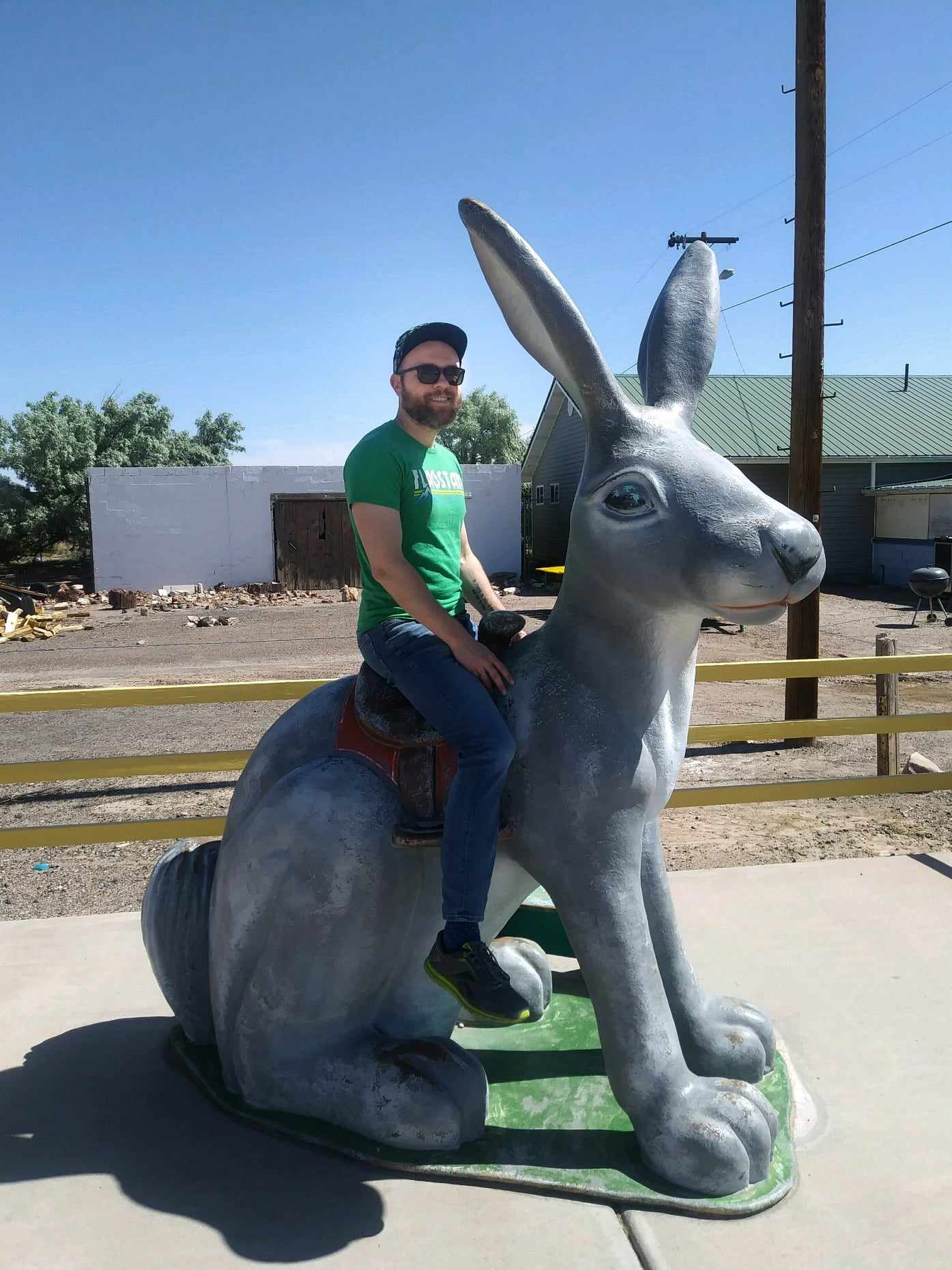
But if that sounds underwhelming, fear not. Because there’s also a big statue of a jackrabbit in the parking lot, with a saddle attached to it, that you can mount for a completely absurd photo of yourself. And did I get up on that jackrabbit every single time I’ve stopped there, including when I was 35 years old? You bet your life I did!

Because, well, why not? Maybe the sign is right after all. Here it is, five miles outside of Joseph City, Arizona…as good a place as any to find whatever it is we’ve been looking for in this life. 

As the years go by, I’ve found a sort of contemplative wisdom in that phrase, here it is. Especially when things don’t go quite the way I thought they would.

Bad diagnosis? Bad breakup? Tough election outcome? Before I can act purposefully, I have to start by saying, well, here it is. And, since it has always been true before, I also have to trust that God is not done with me just yet. In the meantime, the best I can do is to just get up on the jackrabbit so to speak, and accept the invitation of the present moment. 

Because here it is, this moment we’ve been given. And there’s still abundant life to be found here. Besides, what I notice so often in Scripture is that that the mildly disappointing and the foolish and the transcendent often converge in surprising ways.

As it happens, we have two such stories in our readings this morning—two call stories where somebody gets less than what they bargained for. Here’s what I mean.

First there’s Isaiah. Forget the billboards, he’s just had a vision of the throne of God, a glimpse of the heavenly court singing the same song we do during the Eucharist, Holy, Holy, Holy Lord. And he’s been touched by the burning coal of truth and he feels ready. HERE I AM he cries out. HERE IT IS! Here is my time to shine, my opportunity to tell the world exactly how powerful God is!

But God says, no. That’s not quite how this works. In fact, the people will not hear you. They will not understand. No, as they tend to do, the people will look for other, smaller, more alluring salvations, the ones promised by the forces of this world with better marketing. No, God says, you, my prophet, you will be left alone in the dry desert, sitting up there on your jackrabbit, the cars whizzing past you. But even though you won’t understand it, I am asking you to get up on there anyway. Here it is.

And then there’s Simon Peter, who sees Jesus perform the miraculous sign of abundant fish at Lake Gennesaret. Peter, like Isaiah, is both impressed and overwhelmed by this show of power, and he tells Jesus, “go away from me Lord, for I am a sinful man,” but we can also imagine he’s pretty excited to be in proximity to the One who can do such things. He may feel unworthy, but he wants to be among the inner circle of such a Lord. 

But as we will come to see, Jesus does not end up saving the world through abundant displays of power. The fish thing is a bit of a head fake. Not because God can’t do impressive things, but because Jesus chooses not to, and it’s in the self-limiting, foolish weakness of God that true salvation becomes possible for us all. A Messiah who rides on the back of a donkey, which is not a jackrabbit, but pretty close.

And those, like Peter, who have been counting down the miles til their glimpse of the Messiah, are destined to be mildly disappointed, at least for a little while. But here it is.

God says to all of us still clamoring for an impressive sort of divinity who is nothing more than the satisfaction of our desires—God says, no. That’s not quite how this works. 

I am the God of forgotten things…of forgotten trading posts and forgotten people on the side of the road. I am not in the halls of power and privilege and plenty. I am waiting for you out on the wilderness road, waiting to share a drink and a meal with you, out under the ramshackle sign that says, HERE IT IS. Here is what salvation is, at the intersection of the sublime and the absurd. Waiting for those brave, holy fools who understand that sometimes in this life, you just have to get up on the jackrabbit and go with it. 

And really, we do.

In such a time as we are living through now, friends—a time of political crisis and climate crisis and cultural crisis, when Neo-Nazis are trying to set up their own signs above our highways and when it can feel like we are many miles from home—in such a time as this, we run a great risk as disciples of Jesus.

We run the risk of being so burdened by fear that we lose our ability to respond to the present moment with what it requires: defiant, purposeful joy. We run the risk of letting despair make us small and hard and cynical and incurious, terrified of the future and longing for the past, unable to get on with the somewhat absurd work of hope and love here, now, where it is needed. We cannot let that happen. We will not let that happen here.

At the risk of exhausting the metaphor, we need to get up on the jackrabbit—to clamber up onto the unapologetic foolishness of our proclamation, which is that Christ’s mercy and peace and kindness are more substantive than the evil we see. And even if it’s not as impressive or mighty as some of the other narratives out there, we have to go with it. Because that proclamation is the only thing that will save us.

And as for the ones who try to put up the billboards of hate and fear and petty grievance to lure people in—to them we point to our own unambiguous signs—to the Cross of Christ crucified for love’s sake and to the Risen Christ who defeated hatred for love’s sake, and we say, HERE IT IS. Here is the truth about about this world: foolish and transcendent and sometimes mildly disappointing, yes, but also lovely and good and worth not giving up on. Worth following. Worth looking a bit foolish for.

So, like those who have been called before us, here we are, too, Lord. Here we are, only beginning to understand what You are all about. Here we are, praying and serving and speaking truth and caring for our weary neighbors. Here we are, counting down the miles, trusting your promise, the one that waits for us at the end of the many lonely roads we have traveled.

Here we are, ready to just go with it, ready to speak your name and get up on that jackrabbit and tell the world, tell anyone who will listen—

Here it is. You who have been longing for whatever is on the other side of fear and disappointment. 

Here it is. 
Two Fires: A Sermon

I preached this sermon on Sunday, September 3, 2023 at Saint Anne Episcopal Church, West Chester, OH. The lectionary texts cited are Exodus 3:1-15 and Matthew 16:21-28.

Throughout the wider church, this month begins what is called the Season of Creation. It’s a time when we consider our interrelatedness with all created things and how our connection to the natural elements might shape the elements of our faith. So today, in that spirit, I want to tell you two stories about fire. 

The first will probably sound familiar: when I was a kid, I spent summers up in the north woods of Michigan, and one of my favorite memories is of the campfires that my dad and my grandpa would build out by the lake. There were s’mores, of course, and ghost stories, and as the evening wore on, a companionable silence settled in as the wood snapped and the flames danced in the darkness. And what I love about that memory of fire is not that it was something unique to me or my family, but that it felt like something that people have been doing forever. I suspect most of us have, at some point, experienced a similar quiet pleasure around a fire pit, where, as the night enfolds us, busyness gives way to simply being, and the amber glow creates a sense of closeness and belonging for all those who are bathed in its light. 

The second story is less comforting. When I was in seminary in northern California, having returned to the state after many years away, one of the things that was hard to ignore was the pervasive and intense threat of wildfire, far more so than when I grew up there as a child. Due to the corrosive effects of climate change, the fires across our continent are bigger and more widespread than ever before, and each year one must live under their shadow, both literally and figuratively. 

There was one fall where the smoke from nearby fires poured into Berkeley and the sky was gray like fog and the sun was red and we had to wear N95 masks to go outside long before COVID made them necessary for other reasons. And I remember how my friends and I discussed whether we should pack a bag with essentials ready to grab should the wildfire jump to the nearby hillsides. We wondered where we would escape to if they did. I thought of that again, recently, when smoke enveloped the midwest from Canadian wildfires and while watching videos of people flee the town of Lahaina as Maui burned. 

This is the duality of fire: it warms and sustains, but it also consumes and destroys. We need it, and we fear it. We rejoice in its beauty, but we ignore its power at our peril. 

And so perhaps it is no surprise that fire often appears in key moments of Scripture where God is revealed to humanity, for that same duality characterizes our relationship with the Holy. God is the source of our life and yet also of our trembling. God is the light of belonging and is also the burning heat that lays bare our pretenses of safety. And, as Scripture attests, the challenge of life with God is to learn how to hold both of these understandings at the same time. 

When Moses sees the burning bush, he is not immediately afraid, but attracted. This fire in the wilderness that burns but does not consume is not exactly a campfire, but it is a sign of God’s desire to gather in the people of Israel and tell them a new story. Moses and the burning bush form an image of humanity drawing together in communion with its Creator; and Moses’ experience suggests that when we gather in close to listen to God, we too will hear a promise of deliverance; we too, in the companionable silence, might hear the name of the One who abides with us. 

This story reminds us that part of our calling is to form communities where everyone and anyone can come hear the story of how God will liberate and heal all of creation. And even if we, like Moses, feel unworthy or unprepared to take part in that story, we are part of it, because the place we are standing is already holy ground. 

But gentle warmth is only half the story. Because this morning we also hear Jesus telling his disciples—in fiery, unsparing language—about the true nature of discipleship: the necessity of death and relinquishment and the searing pain of the cross that he will soon experience. We do not need to indulge in theologies that glorify suffering nor should we promote the idea that people’s pain is itself holy. But we do have to acknowledge that God’s activity in the world is not always cozy; it’s not limited to upholding that which comforts us. 

Through the Cross of Christ, God is like a wildfire, laying waste to the structures and the systems and the sins that confine and subjugate and placate; God’s intention is to incinerate them with justice; God means to engulf them in peace, so that something new might spring up. And this type of divine fire is dangerous—dangerous to the powerful, dangerous to the complacent, dangerous to anything within us our around us that stands in the way of the Kingdom’s coming. Get behind me, Satan, Jesus says to Peter, not because he hates Peter but because he rejects Peter’s assumptions of comfortable messiahship, of self-satisfied discipleship, and he intends to burn away those parts of ourselves that resist God’s mission in the world. As John the Baptist once said, “the one who is coming after me …will baptize you with the Holy Spirit and fire.” Now we begin to see what he meant.

So, two stories about fire, and two stories about God’s presence in the world. Two stories that are part of our own story, which must be held in tension and told and lived into, again and again, in every generation. 

How are we, at Saint Anne, gathering others in toward the burning bush? How are we creating a community with space enough for everyone to share their story, to delight in fellowship, to sing and study and pray and learn together? And how are we making sure others know that this fire burns as a sign for all people? Because it’s important to remember that Moses’s encounter with God in the desert was not a private revelation. It was the initiation of a public mission, one that radiated outward with light and heat and hope. There is a story about the world that does not end in division or oppression or fear. Are we telling that story beyond these walls? Are we inviting people to gather ‘round, to come and rest in its light? This is the call of the burning bush. 

At the same time, how are we, at Saint Anne, taking up the Cross as the sign of God’s categorical rejection of all that would harm and oppress and stifle the flourishing of life on this planet? Because it’s not enough for us to gather around the campfire while the world burns. Jesus could have stayed in Galilee telling stories with his friends if that’s all that was needed to save creation. 

But he didn’t. He took on the Cross—the ultimate symbol of degradation and cruelty—in order to consume it with the power of his love. And we who would follow him, we, too, have to look for the crosses of our own time—the failings, the fault lines, the dehumanizing tendencies of our hearts and our culture—and we have to take them up and take them on, speaking the word of love that is like fire, so that the crucifying forces of this world will be revealed for what they are: a lie. A delusion. A pile of ashes.  This is the call of the Cross. 

The good news that I have already witnessed at Saint Anne is that we are engaged in both of these things—the gathering in around the fire, and the setting the world aflame with love. But as we prepare for another program year, as we prepare for a new season of ministry together, I encourage you to consider how you are taking part in these two stories yourself, whether through education, through prayer, through advocacy and justice-seeking, through service, through pastoral care, or through the many ways that we build up and enrich life in this community. I hope you will make that commitment, knowing that you will never be walking alone as you do so. 

Because here’s the thing: God is already doing what God will do in the world: beckoning and illuminating, dismantling and renewing. Our choice, our vocation, our glorious gift and responsibility is whether we will join in, whether we will rest in the light, and whether we will become like holy fire ourselves, fierce, fluid, and free. 

In the end, it’s not two stories about fire, but one. Just one story, reconciled in the burning heart of Christ, one story that holds all of life, that holds all of creation, and it is God’s story and, if we so choose, of we so dare, it is also ours. 

Seen: A Sermon

I preached this sermon on August 27, 2023 at Saint Anne Episcopal Church, West Chester, OH. The lectionary texts cited are Exodus 1:8-2:10, Romans 12:1-8, and Matthew 16:13-20.

Some years ago, there was an essay published in the New York Times and it was tantalizingly titled, “To Fall in Love with Anyone, Do This.” Now, I admit that I was rather skeptical when I saw that title; it sounded like one of those ads you see on the internet, offering “one weird trick” to make you look ten years younger or to regain your lost hair. As you can see, I have not generally taken advantage of those ads.

But being single at the time, I was intrigued by the idea of a surefire method for finding love, so I read on. The author, Mandy Len Catron, described a study done in the 90s by psychologist Dr. Arthur Aron, which suggested that significant levels of connection between two people could be achieved very quickly by asking one another a series of 36 vulnerable questions over a 90 minute period. After asking all of the questions, according to the Times essay, you were then supposed to gaze into the eyes of the other person for *exactly* four minutes and…voila. Love.

If this sounds a bit far-fetched to you, I get it, though for the record, in both the original study and in the essay, some marriages did emerge from this initial moment of connection. So, hey, you never know. Dating is tough, you have to get creative. 

But romance aside, it does make sense to me that there would be a unique sort of potency in the combination of knowing and seeing someone with great intentionality. So often, we only casually consider the people in proximity to us, even the ones we are around a great deal. We know their names, maybe some of their hobbies or associations, and their general appearance, but how often do we look, really look at them? How often do we seek to know, really know, something substantive about their inner life or their memories or their dreams? For that matter, how often do we strive to see and to know ourselves in that way? 

It can be a little scary, if we’re honest, to know and to be known on that level. Maybe we fear that if someone actually sees us as we are, all of us, every mistake, every quirk, every wrinkle, we will become less lovable in their eyes. And maybe we fear if we see others in their fullness, we won’t know what to do with it, we won’t be up to the task of loving them in the way they need. 

I’ve been on both sides of that equation. I think of the times when I have been hesitant to share my story and my identity with others for fear of rejection. And I think of the times, whether in my hurry or my hard-heartedness, that I haven’t looked into the eyes of that person seeking assistance on the street, my gaze downcast, hiding from them, hiding from our shared humanity. Maybe you’ve experienced these things as well: opportunities missed to be seen, to see, to experience the connection that only comes from open eyes and open hearts.

But we learn in Scripture time and time again that the flourishing, the healing, and the salvation that we seek can only be found when we dare to look and to be looked upon, in that space of mutual recognition, both with our neighbor and with God. 

In our Exodus story, it is the willingness of the midwives to see the beauty and the humanity of the Hebrew children that gives them the courage to defy Pharaoh’s edict. 

And St. Paul is encouraging a certain type of self-disclosure in the letter to the Romans when he invites the faithful to ‘present [their] bodies as a living sacrifice, holy and acceptable to God” offering up not just the parts of themselves that seem impressive or strong or unmarred, but the totality of themselves, their creaking bones and their broken hearts and their unanswered questions, to let all of it be placed upon the altar of life, where God in Christ will see it all, and hold it all, and render it all into something beautiful. 

But part of the strange and lovely mystery of the gospel is that the work of seeing and being seen is not humanity’s alone. Because in Jesus, God’s own life is laid out for us to see, it is placed on the altar, too, that we might know him and render something beautiful from divine self-disclosure. 

And so God stands before us with his own list of vulnerable questions, his own desire to look us in the eye for four minutes, or maybe forever, to give us a glimpse of his eternal longing for us. 

This is what we encounter in today’s Gospel passage, in that all important question on Jesus’ lips, perhaps the most vulnerable question that God has ever asked of humanity: Who do you say that I am? 

Who do you say that I am, my friends, my children, my infuriating and precious creation? Who do you say that I am, now that we are face to face? Am I another prophet? Am I another king? Am I a projection of your own desires? Am I an instrument of your political agendas? A benefactor to meet your needs? Or do you see, do you know, do you feel the way that it is much more than that, do you sense how heaven erupts in the space between us, the way that an undying love weaves in and out of every question I ask you and every story I share? Do you understand who I am and how far I have come in order that you might understand? 

And if you understand, can you love me? Can you love me back, as I love you? 

Who do you say that I am?

And Peter, on behalf of the other disciples, on behalf of all of us who would follow, says, 

You are the Messiah. You are the Son of the Living God. 

You are the One we’ve waited for. You are the Love of our Lives, you are the Love of Life itself. Yes, we understand.

And I like to think that Jesus smiles in that moment because at last God knows what it feels like to be seen. 

If we want to know what heaven on earth can look like, how we might participate in it day by day, this moment is instructive. For if the God of the Universe came to be with us in the flesh, that we might see and know and name him as our own truest love, then perhaps our interactions with one another should reflect this. 

Perhaps, on the most basic level, our discipleship begins simply by looking, really looking, into the eyes of the people we encounter—the familiar ones and the strangers, the friends and yes, even the enemies—especially the enemies—and saying, yes, I see you. I see you. At the very least I want to see you. And while I’m at it, let me show you something of myself, too, and maybe in that brief moment of vulnerability, when we behold each other, something new will begin to take root in each of us, something that feels a little bit like falling in love, even if only for a moment. It’s like one weird trick to change the world. 

You might be wondering if I ever tried the experiment in that essay. Sort of. Matt and I have asked each other some of the questions, and they’re really good. The four minutes of eye contact still feels a little daunting to me. 

But it has reminded me that one of the most fundamentally important things we can do, and one of the bravest, is simply to see what is, and to love what is, and to believe that we, too, are worthy of being seen and loved. Because if you look closely enough, no matter whom you meet, you will always be looking into the face of the Holy One, if you choose to recognize him.

Just like the essay said, to fall in love with anyone—or really, to fall in love with everyone—do this. 

Names: A Sermon

I preached this sermon on Sunday, May 8 2022 at Trinity Episcopal Church, Fort Wayne. The lectionary text cited is Acts 9:36-43, in which Peter raises a woman from death.

How many names do you have?

The immediate answer to that question might seem obvious—many of us have a first, a middle, and a last, with maybe one or two more thrown in for good measure by our parents. But it’s not always that straightforward—some of us also have old nicknames, the recollection of which might make us squirm with delight or embarrassment; affectionate names given by friends and romantic partners; and names that we have claimed for ourselves later in life as we have better understood who we are and how we wish to be known to the world. There might be other names, too, that we’d rather not hear—the hurtful, insulting ones that were hurled at us at one point or another, the ones that still rattle around in our memory like heavy stones. 

There is great power in the names we carry; power to heal and to harm; to remember who we are and to be reborn. It should not be surprising, then, that much of Scripture is taken up with the giving and the changing and the remembering of names, including the ones we have applied, with the limitations of human language, to the unspeakable name of God. 

We might say that, in some way, the entire story of God’s people thoroughout the Bible is the search for a name—a name by which to know ourselves, a name by which to address the ineffability of divine truth, a name to call out into the silent infinitude of the stars—a name that is sufficient to say what life is, a name that can capture in full something that is ultimately beyond words.

I got to thinking about names because of today’s passage from Acts, where Peter restores to life a woman in the city of Joppa, a woman who bears two names, Tabitha and Dorcas. As the writer of Acts informs us, Dorcas is the Greek translation of the Aramaic name Tabitha, which means “gazelle.” Now, it would be easy to pass right over this detail as we read about her miraculous resurrection, but I think we would miss something important if we did so. 

Commentators note that Tabitha/Dorcas, in addition to being a woman of some financial means who was able to support the widows in her community, was also a woman that straddled two worlds. Joppa is a port city, and given her two names, it is likely that this disciple of Jesus was a Greek-speaking Jewish woman who occupied a liminal space between her Israelite identity and her ties to the Hellenized world of the Roman empire. Her two names suggest that she had learned to traverse the ambiguous territory between colonized and colonizer, between membership in an oppressed nation and the society of the imperial oppressor.

We do not know how she managed this interplay of names and identities, but we do know that in the midst of them, this woman who was both Tabitha and Dorcas dedicated her life to service in the name of Jesus. And perhaps, for her, the name of disciple–follower of the Way, sheep in the flock of the Good Shepherd–was the thread that bound her disparate roles in a fractured world. 

But then note what happens in the passage. Peter (himself another bearer of two names) comes to see the body of the woman, and in raising her back to life, he says, “Tabitha, get up.” Not Dorcas, but Tabitha. Her first name, the name that was with her from the beginning, the name spoken in her people’s original language: this is the name by which she is called back to herself, this is the name that inaugurates her resurrected existence. It is Tabitha, tzvia in ancient Hebrew, the same word that names the gazelle leaping on the mountainside in the Song of Solomon, that is the name of life for her. That is the name by which God, through Peter, breathes life back into her body. And while the Scriptures do not tell us anything about her life after this miracle, I can’t help but imagine that, for the rest of her days, she remembered the sacred power of being brought back to life by the sound of her original name. Tabitha, get up. 

What is the name by which God would call you? What is the name that encapsulates your deepest self, the name that is life to you? And, conversely, what names have been put upon you that no longer work, that no longer tell the whole story of who you are called to be?

I speak not only of given names and surnames, but also of the roles and identities by which we are known and named, which, while important, are too often over-simplified, objectified, and used to label and limit our complexity—old, young, healthy, sick, parent, child. Priest, layperson, spiritual wanderer. Gay, straight, trans*, Black, Brown. American. Foreigner. Pro-Life. Pro-choice. Democrat. Republican. Do these names actually tell you who you are, or who your neighbor is?

Or is there a deeper name, an original name, by which you must identify yourself and those whom you encounter if we will ever hope to actually know one another? Is there a name for ourselves that will bring the dying parts of this world back to life?

There is, in fact.

And it turns out that the woman known as Dorcas heard that it day as she awoke from the sleep of death. Because a funny thing about the name Tabitha—tzvia. That word, in its original language, doesn’t only mean gazelle, but also, simply this: beautiful. Her name was beauty. 

Beautiful one, get up. 

This is the name by which God knows each of us. This is the name that God has called us from the moment the world began. And this is the name by which God, in Christ, desires us to know one another—the name underneath our names, the name beyond every label and slur and stereotype. The name that will bring anyone back to life. 

Beautiful one, get up.

And this is the only name that can heal us, that can see us through the divisions and the suspicions that have plagued not only our recent history but the entirety of the human story. It is only when we know ourselves as beautiful, as beloved, and when we see that same thing in the face of our neighbors, in the face of our enemies, as Jesus taught us to, that we will begin to move back from the brink.

It is only when we see and name the inherent beauty and dignity of all creation and develop a reverence for what God has made and called good that we will move closer toward the kingdom wherein we were meant to dwell. It is only when we stop name-calling and start naming each other as beautiful, when we start noticing the beauty we see, even in the places and people where it’s not first apparent—it is only then that we will finally speak our own true names, and it is only then our mortal tongues will begin to utter something that approaches the one true name of God. 

The God who woke Tabitha from the dead.

The God who woke Jesus from the dead.

The God who will wake each of us, on the last day, saying, quite simply:

Beautiful one, get up.