
The Lord’s Own Prayer: A Palm Sunday Sermon

I preached this sermon on Palm Sunday, April 13, 2025 at St. Anne Episcopal Church, West Chester, OH. The lectionary text cited is Luke’s narrative of the Last Supper, Passion and Crucifixion of Jesus.

When you encounter hard things, sometimes it can be difficult to know exactly what to say. In such moments, our eloquence can crumble, leaving us wide eyed and silent like children. 

Palm Sunday is always sort of like that for me. It’s hard to vocalize what it all means, this jumble of praise and fury. I imagine it was even more so for the disciples who watched from afar as their Lord, the Lord, succumbed to the senselessness of his death. I wonder what they said. I wonder what prayer was on their lips as they stood there watching, as he gave himself away, as the sun covered its face and the earth was darkened, its Creator flickering and faltering like a dying star. 

I wonder if, in such an impossible moment, those disciples simply grasped at whatever prayer they knew best, as most of us do in desperate times. And for the majority of us, I would suspect the prayer that we know best and turn to is the Lord’s Prayer.

How many times have we prayed it? Impossible to number, like those flickering stars. I couldn’t even tell you exactly when I first learned the Lord’s Prayer. It’s just always sort of been there, rattling around in between my breath and my bones. 

I’d suspect though, as reliable as it can be, for many of us, the Lord’s Prayer is almost too familiar We remember the words but forget the meaning. We become dulled to the boldness and intimacy of  what it says about God and about being alive to God in this world that births and crucifies us. It is only in moments like this, like today, when all other words fail us, that the Lord’s Prayer returns to mind, like a life raft.

I’ve been thinking about the Lord’s Prayer lately for two reasons. The first is because, with the ups and downs of the world as it is, I sometimes need a life raft as I struggle to express whatever tempest of feelings fills my heart. In such instances, sometimes the old, familiar words are all I have to offer up. Thy kingdom come. Thy will be done.

The second reason, though, is because, as I was spending time this week with Luke’s narrative of the Last Supper and the Passion and the Crucifixion that we just heard, I realized something that I hadn’t before: woven into this narrative, like a hidden scaffolding that holds together Jesus’ final days, are all the elements of the Lord’s Prayer. In fact, if you look closely, you realize that Jesus quotes or enacts the prayer directly throughout the Passion narrative.

So let’s refresh our memory. Earlier in Luke, Jesus has taught his disciples to pray in this way:

Father, hallowed be your name. Your kingdom come, your will be done on earth as in heaven. Give us each day our daily bread. And forgive us our sins, for we ourselves forgive everyone indebted to us. And do not bring us to the time of trial.

And then, in today’s story, as we just heard, he does and says again all the things in this prayer. He gathers with his disciples and gives them bread. And he prays near the Mount of Olives, crying out to his Father who is in heaven and says, your will be done. And he asks his disciples, multiple times, to pray that they would not come into the time of trial. And then, finally, with his dying breath, he seeks forgiveness, for everyone. It is the Lord’s Prayer, every single piece of it. 

In this Palm Sunday story—in the culmination of his earthly ministry—we see Jesus living the very same prayer he has been teaching. He is walking the walk. When he is experiencing his own pain, and fear, and doubts about why it all has be like this, and why people do what they do, and whether the ones he loves can carry on when he is gone, when in effect he has run out of anything else to say or know, he, too, falls back into the familiar words:

Thy kingdom come. Thy will be done.

And although it is a painful story; and although we are living through painful times, I find a sort of hopeful symmetry in the realization that God is praying the same prayer that God wants us to pray. 

I find it rich with possibility and power, even, that when we call to mind those familiar old words, we are not just reciting something memorized as a child, but that we are somehow part of God’s own eternal prayer.

And that God, from the time before all our senseless crucifixions, from the very beginning, God has been offering himself to Creation in prayer, calling us by our names, seeking for earth and heaven to be one, desiring to give us bread and love and forgiveness.

I believe that God is still praying that prayer, today and every day, because God’s heart breaks not just for the Passion of Jesus, but for the passion and pain of every one of us who have trod the path of crumpled palms and broken dreams, hosannas caught in our throats, unsure of the words to speak. 

Yes, with us and for us, Jesus is praying this prayer in Holy Week, and in the many hard, holy weeks that comprise our lives. The Lord’s Prayer is the Lord’s own prayer, you see. God is alongside us in the praying this week, and has been forever. And when we call to mind those familiar words, God is reflecting them back to us, saying,

My Child, who art of the dust,

Blessed is your name to which I call.

My kingdom is coming, so that our wills can be one

On earth as it is in heaven.

So eat the bread I give. It is more than enough for all your days.

And forgiveness is already yours if you receive it

And share it freely.

We have been through many trials and temptations together,

You and I,

But I have never left you.

And those things that are past will never define you,

because your deliverance is already at hand. 

So take my hand.

In the same way that the Lord’s Prayer shapes and guides Jesus’ path to the Cross, I pray that this Holy Week will shape and guide your path through whatever you are facing in life. This week will reveal everything that Christianity is actually about, beyond the noise and the politics and the culture wars. It is the week when we learn what walking the walk really looks like.

Come and wade deep into these waters as much as you possibly can. We will watch, and listen, and grieve, and celebrate and yes, we will pray the Lord’s Prayer many times over, and all of this—all that Jesus is and all that he gives and all that he loses and all that he transforms—will become the hidden scaffolding of our souls, strengthening us for whatever might flicker or falter.

Because beneath and beyond the clamor and the confusion and the crumpled palms and the wide-eyed silences, only one thing abides, only one thing really can, in the end, be true:

The Kingdom, and the Power, and the Glory are God’s. Now and for ever.

And to that I can only say, Amen.

What If?: A Sermon for Palm Sunday

I preached this sermon on Palm Sunday, 2024, at St. Anne Episcopal Church, West Chester, OH. The text cited is the Passion narrative in the Gospel according to Mark.

One thing that strikes me, every year, as Holy Week envelops us in the stark power of its narrative, is how inevitable it all feels, this story about Jesus’ betrayal and death. How fixed the trajectory, after lifetimes, after centuries, after millennia of retracing it. It is easy to forget that the story we tell today began so differently.

Just a few months ago, we beheld a baby born in Bethlehem under the chill of starlight, and we heard angel choirs singing of peace, and then we watched that child grow and mature through the soft gloom of the season, and in the slow lengthening of our days through Epiphany, we beheld his light and his life and his love gathering their own brightness, and we have looked for signs of the unfurling promise of his Kingdom, like springtime emerging from the muddy, fertile ground of Lent. 

And yet, once more, here we stand on Palm Sunday, only to witness this particular story of God’s goodness cut short again, this particular promise deferred again, the tender green growing palms trampled, again, under the force of misguided adulation; the gently stirring earth soaked, again, not with gentle spring rain, but with blood.

And yet, despite the grave horrors, the enduring shock of what we see and experience in this Passion story, still, I think, we tend to see it as inevitable. As if this brutal end to Jesus’ earthly ministry was somehow the necessary price of his message, as if it were normal for for mothers to mourn their children, as if it were normal for springtime to give way to winter instead of summer. As if this sacrifice was as natural as the turning of the seasons. As if there was no other way the story could have ended. 

What if there was?

It’s odd, we rarely seem to ask that question about Holy Week. And it’s especially odd because, for most of us, in our own lives, we spend a lot of time and energy asking “what if?” 

What if I had made a different choice? What if I had chosen a different path? What if I had learned from my mistakes sooner? What if we, as a nation or as a community or as a church had chosen another course of action? 

Asking these sorts of questions is, most of the time, as natural as breathing. 

We are accustomed to “what ifs” because we are faced with a dizzying number of choices every day, and so of course we wonder how else things might have turned out if we had gone a different way. 

And yet, when it comes to Holy Week, when it comes to Jesus stumbling on the rocky road to Golgotha, we surrender him to his fate. We surrender our “what ifs”  to the violence we know and expect, and we behold the drama as if it were fixed and preordained, the way that it had to be for Jesus to be who he was and accomplish what he did. 

Without the suffering of Christ, without the brutality of the Cross (we have often been taught) there would be no salvation, no redemption, no liberation from the brokenness and sin that formed and fashioned the Cross in the first place. And so we have accepted, on some level, that all of this was necessary.

It’s a strange sort of logic that a God of Love would require torture to prove that love. At best, it leaves us to simply shake our heads and shrug at God’s inscrutable will. But at worst, it gives rise to the idea of redemptive violence—a God who inflicts harm upon himself and creation to achieve the ends of peace. Which sounds suspiciously like the tyrants we know, not like the God for whom we long. 

And so I wonder if, perhaps, as we move through Holy Week together, we are meant not to accept the inevitability of the Passion as passive observers of Jesus’ pain, but to trouble the narrative, just as our spirits are troubled by it. I wonder if we are meant to ask “what if?”

What if Jesus did not have to die in the way that he did? What if his own predictions of the Passion reflected his deep, grief-stricken understanding of our brokenness rather than some necessary violence inflicted by his Father? 

What if none of this had to happen?

What if the crowd chose to listen to his actual teachings? What if they understood, as he entered the city, the subversive symbolism of his ride on the colt for what it was—a challenge to the pageantry of imperial power—rather than projecting their own political agendas onto his actions?

What if his disciples had not forsaken him? What if the temple authorities had kept an open mind, had been humble in the face of things they did not understand? What if Pilate had chosen to be something more than a functionary of the deadly inertia of empire? 

What if there had, in fact, been another way for the story to end, another way for Jesus’ undying love to be made manifest and to bless the earth? 

We cannot know the answer to these questions, anymore than we ever know the answer to the “what ifs” of our own lives. The story is the story. And we must tell it. 

But that is not the point. The point is that we still need to ask the question. We need to ask “what if” during Holy Week, just as we must ask “what if” every time we are faced with violence and pain and prejudice, so that we do not accept these things as somehow normative, somehow determinative, because without “what if,” we will have made an uneasy peace with the crucifying impulses of the world. We will have surrendered our imaginations to the sense of their inevitability.

But what if we didn’t? 

What if the God who has repeatedly said “I desire mercy, not sacrifice,” actually meant it, and meant us to expect this from ourselves and our world? What if the brutality of this Passion story is no more part of God’s plan than any of the rest of the suffering we inflict upon one another? 

Because when you start asking “what if,” you realize that everything in the Passion narrative is the result of choices, choices made made by people not so different from you and me, choices made, too often, in service to the prevailing order, choices made by people who were as agitated and lost and polarized as we are, people caught up in faltering hopes and flourishing suspicions, people distracted and weighed down by a history of loss, people who also forgot to ask, “what if this was not the way it has to be?”

I tried it this week, asking “what if” as I was reading and wrestling with the story. And there are signs of possibility, thank God, if we look closely. Especially if we look closely at the women.

There’s the unnamed woman with the alabaster jar, who pours out her rare, costly, sweet ointment with the same mixture of wild abandon and care by which God pours his love upon creation. They say it is wasteful, this love and care, and yet she seems to be asking, “what if it’s not?”

And there’s the servant girl who, like a prophet, calls Peter to account for abandoning his true identity, all of his no, no, no, I do not know him. And she seems to be asking, “what if you said yes? What if you did finally, fully, know him and claim him as your own?”

And the women who gather near the Cross to hold vigil with Jesus as he dies, refusing to abandon him to his shame and loneliness. The crowds call it a lost cause, a failed revolution, a big disappointment, but the women seem to be asking, “what if none of that was the point?”

All of these women are the ones who refuse to accept the unfolding trajectory of the story—the ones who see another way, the true Way. They are the ones brave enough to name presence and fidelity, not violence and power, as the strongest force at work in this narrative. They are the ones who are asking, what if this story is not about the myth of redemptive violence that forms its center, but about the quiet, determined insistence of love that flourishes on the margins?

What if the point of Holy Week is not to valorize the story of Jesus’ suffering, but to build a world in which it is the last such story that ever need be told? 

What if we realized that the Cross is not the necessary means to an end, that God would have saved us in a thousand different ways if we would have let him, and that he still will?

What if we realized that the only inevitable narrative is not the Passion, but this: that Jesus—and all of us— are loved passionately from the day of our birth, all of us adored by angels under the chill of starlight, loved through the soft gloom of the turning seasons, loved through the lengthening of our days, and loved when we rejoice and loved when we despair and loved even when we die—however we die—and loved, ultimately, back to life.

What if that was the one, true, enduring, necessary story we needed to hear? What if all the rest was up to us? 

What if?

Palm Sunday People: A Sermon

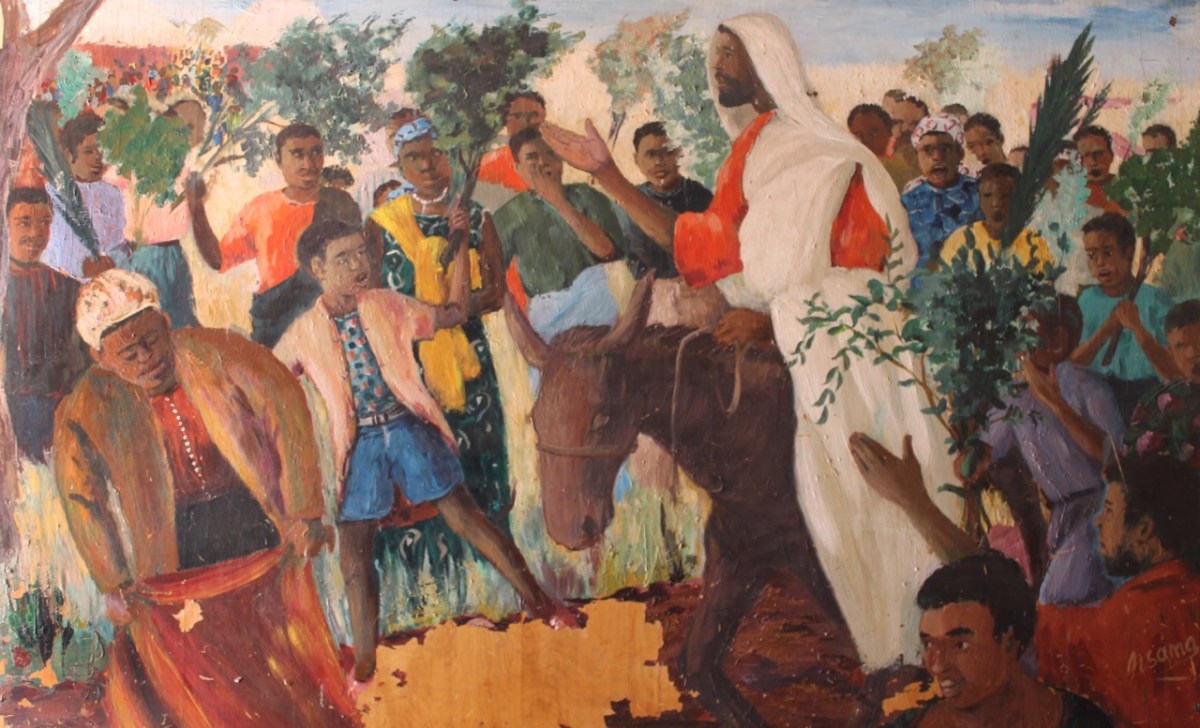
I preached this sermon on Palm Sunday, March 28, 2021 at Trinity Episcopal Church, Fort Wayne, IN. The lectionary text cited is the Passion narrative in Mark 14:1-15:47. The image at the top of this post is Triumphal Entry (1969), by Zambian artist Emmanuel Nsama.

We have just heard a story that is, for most of us, deeply familiar. We gather, year after year, during this holiest of weeks to hear it again, to immerse ourselves in the narrative—one that begins today clutching our palm fronds with an exultant crowd at the city’s edge and has just ended at the lonely tomb where only a few brave women dare to visit. 

But rather than pick apart this story, rather than analyze and intellectualize its themes and symbols from a comfortable emotional distance, I wonder whether we ought to simply let it speak for itself. I wonder whether it is a story best received and held with humble, pregnant silence, as all truly important stories ought to be received. 

For the one thing that we do know about this story, this passion narrative, is that it is of deep importance—that it reaches out to speak into the most hidden parts of ourselves. It is a story that observes us, that comments upon us, rather than the other way around. This story knows us and names us in ways we might not want to be known—our hopes, our fears, our terrifying capacity for callousness— and reminds us why we so desperately need God’s saving love in the first place.

So at the outset of this Holy Week, as we summon up the courage to sit with this narrative that is both familiar and shocking, I simply ask you to ponder this question: what if this passage, this passion narrative that we just heard today, was the end of the story? What if that was it?

What if Jesus, the Son of God, the miracle worker and prophet and teacher of peace and radical inclusiveness, who rode into Jerusalem as a new sort of king, was simply put to death and laid to rest and then…nothing. What if the story ended here—as it does for most of us in this life—with the stone sealing the tomb?

I ask this for two reasons. First, because in order to let Holy Week do its work upon our hearts, we must try take it as it comes and not skip ahead. We have to suspend, for a bit, our knowledge of what will come next Sunday and simply be present to what is happening in the moment of each liturgy. 

So today, hear what Palm Sunday has to say to you. Don’t move on too quickly. We need to stand awhile in this crowd that cheers one moment and calls for blood the next, if only to recognize that we are not so very different from them. And in each of the days to come, as we take part in the Masses and read our daily reflections, let the story unfold, living it as the disciples did, as they followed Jesus into the city. Like the disciples, allow the events to disarray your certainties and upend your expectations of what success and significance mean. We will learn so much more from this week if we can somehow live it.

The second reason I ask what it would mean if the story ended here, at the tomb—is because for many people, Palm Sunday IS the whole, representative story of human life. 

Without the eyes of faith, without the Divine inbreaking, Palm Sunday IS how the world tends to work—a place where the strong dominate the vulnerable, and the pursuit of peace is viewed as a farce, and mercy is called weakness and battle lines must aways be drawn and redrawn, age after age. 

We live in a world that has been, for too many people and for too many generations, one long and unending Palm Sunday—and so it is easy to believe that this indeed is where the story ends, and that our longing for something else, something kinder, is a delusion. 

That is the story that the world continues to try to proclaim to us and form within us. And if we’re not careful, we might buy into it, talking pleasantly enough about resurrection but living fearfully, meagerly, as if Jesus is still dead and buried in that tomb.

So on this Palm Sunday, and perhaps every day for the rest of our lives, we have a choice to make: is this the story that we are actually telling and living by our actions and words; are these the values that we are embodying? Are we, in fact, a “Palm Sunday” people?

Or do we dare to live as another type of people, people who have their hearts fixed on God’s promises, on God’s version of triumph–people who persist beyond today’s heartbreak?

Are we willing to tell a different story, a story that says there is something more to this life than trampled palm fronds and jeering crowds and the desolate silence of the grave? 

That is the choice given to us, and this is the week when we must decide anew how deep into this story we are willing to journey.

Because yes, for today, we end here at the tomb. But come back tomorrow, and the next day, and on throughout all of Holy Week, and see what God can do with this broken body. See what God can do with your broken heart. Let this journey reveal its mysteries to you one day at a time, until the real ending comes—the ending that will be for us, in truth, only the beginning.

Holy Week at Home #1: Palm Sunday

With liturgies suspended for this (most unusual) Holy Week, I wrote some brief daily meditations/reflections/poems on social media as a way to navigate the passage from Palm Sunday to Easter without the usual guideposts of communal worship. 

The process of daily writing and posting was a reminder for me that our praise of God is just as much about what we offer–the oblation of our hearts–as it is what we receive. So even now, when we are separated by circumstance and the usual blessings of the liturgy feel distant, we can still present our humble gifts with gratitude. With this in mind, here are the posts I shared last week.

PALM SUNDAY: 

You know that anxious feeling of entry into something unfamiliar and inevitable, like the first day of school or that difficult conversation you simply can’t put off? The dry mouth and the churning gut? The sweat on the back of your neck?

Such is Palm Sunday. Bright, dizzying, crystallized, expectant, palm leaves that scratch your own palms, cries of praise that leave you hoarse. The big event that doesn’t quite satisfy.

Palm Sunday has a feverish quality, like infatuation that has convinced itself that it’s love. It is desire without generosity. Longing without trust.

As we stand at the roadside, or peer from our windows, at the man who enters our midst on a donkey, let us be mindful of all that we still project onto him, all the ways we demand him to solve the heartbreaks and hatreds of our own creation. He comes to illuminate suffering, but not to erase it. He comes to show us life, but we must still traverse through the narrow gate that leads there. When we cry Hosanna, when we wave the branch, we are greeting a very different sort of salvation than the one we privately hoped for. If we truly understood it, its magnitude and its cost, we would likely fall silent as he passed by.

Palm Sunday is                                                                                                                                   the irony of ripping branches                                                                                              zealously;                                                                                                                                                to kill the tender green                                                                                                    prematurely–                                                                                                                                         a misguided homage to the One
Who would not break a bruised reed.
In our plundering jubilation we are convicted–
but soon
he will gather the trampled fronds and
mend the broken branches back
onto the Tree of Life.