
Screen Door: A Sermon

I preached this sermon on Sunday, February 11, 2024 at St. Anne Episcopal Church, West Chester, OH. The lectionary text cited is Mark 9:2-9, an account of Jesus’ transfiguration.

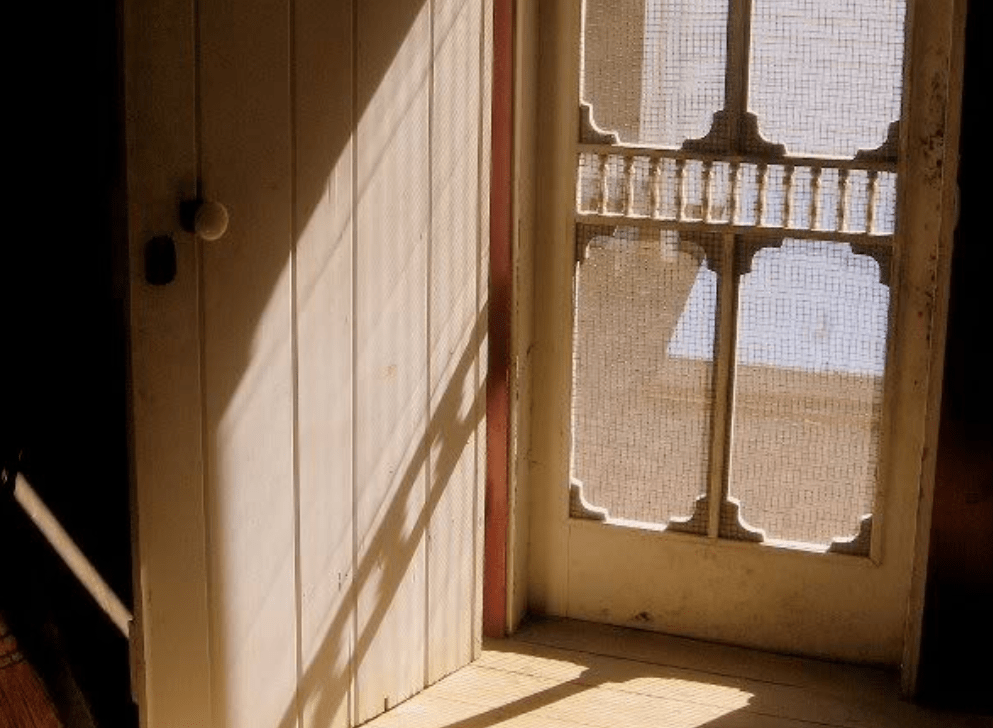
It has been many years, but I can still remember the sound of the screen door opening and slamming shut in the back porch of my grandparent’s house. The door was old and worn and yet amazingly resilient given the infinite number of times that people had passed through it on their way in and out. You see, in that house, nobody ever came in the front door, through the living room—it was always, always through the old screen door out back, and then a few steps through the porch, and on into the kitchen, the room where, as with most Midwestern families, all the truly important stuff took place. 

Maybe you remember a home or a place or a time like this—a season in your own life when the doors were always open. And so it was for us—that loud screen door was never locked, it was always at work, announcing the in-breaking  of the world that lay out beyond the warm cloister of the dim and fragrant kitchen. 

If we happened to glimpse anyone approaching the door from far off, they would emerge first as a glimmer of color and moving light out beyond the wire mesh of the screen and then—creak, rattle, slam!—there they would be, standing in our midst, in the flesh, stomping their boots, commenting on the weather. Friends and family members often showed up like this unannounced, a stream of visitors seeking to share a meal or a moment’s company, bearing news and stories. 

And I am sure someone, at some point, must have knocked, but I don’t remember it. I don’t recall the sound of knocking at all—only the familiar opening and closing of that screen door and how normal it was that people would come right in—how natural it felt for there to be a permeable boundary between what is already known and what comes to make itself known. 

There is an odd sort of paradox in a screen door, when you think about it. It is a barrier, but it’s one that is flimsy by design. It may have the shape of something absolute but it is rather ambiguous in its purpose, used to shield what is within it, but also to receive what is beyond it—the cooling breezes and the beams of light and the birdsong that travel through the screen to mingle with the inside smells of dinner and dish soap. 

It is not much of a safety measure, the screen door, but rather a way for two unique worlds to coexist alongside one another and to reveal themselves to one another. The screen door teaches us that the practice of passing back and forth between privacy and welcome; between domesticity and wildness; between the familiar and the unknown; is a good and necessary thing to do. 

And it seems to me that we have arrived at our own sort of screen door moment today, on the Sunday in the year when we see the Transfiguration, when the familiar and the unknowable commingle on the top of a mountain, when the human and the divine aspects of Jesus reveal themselves in a collision of time and light and cloud, of terror and belovedness. 

We, alongside Peter and James and John, are drawn into the strange paradox of looking at two realities at once—God’s and humanity’s—and realizing that, in Jesus, the boundaries between them are shockingly permeable. 

Today we conclude the seasons of Incarnation and Epiphany, where we have seen how the Son of God has been born and made his way into the world, approaching us, a glimmer of color and light beyond the mesh of our familiar understanding, and yet now—creak, rattle, slam!—here he stands, in his fullness, the eternal God come to pass through our door, to share a meal or a moment’s company, bearing good news and stories. 

And this, I think, is one of the most important things to understand about the Transfiguration—it’s not simply that Jesus revealed himself in a particularly magnificent way in this one moment to a handful of disciples, but that in all of our life with God, in worship and discipleship and service, transfiguration is always ready to reveal itself—the boundaries between our lives and the life of God are as permeable as a screen door through which the breeze of heaven blows.

I have seen and heard and felt him in so many different places. In moments of prayer and song. Beside a deathbed. Last week at the laundromat with the Outreach team. In conversations shared with many of you. Gathered around this table, week by week. And certainly, gathered around a kitchen table.

As we prepare for a long and thoughtful journey through Lent, to the Cross and beyond it, we are reminded today, right before we set out, that there is no aspect of human experience—even the most difficult and despairing ones—where Jesus is not able to come and be with us, to enter through the back door to sit a while, to remind us that he is separated from us by only the thinnest, most pliable boundary, if we are willing to look and listen and receive him.

Which begs the question—if the Kingdom of God is approaching us from the other side of the screen, then what must we do on our side to be ready, to greet this new world when it reveals itself? What does a screen door faith look like for us who desire a glimpse of the transfigured world beyond?

And in that, I think my grandparents were on to something simple, but essential: their door was always open. Part of what we practice here, week after week, in liturgy and in hospitality and in service and in formation, is a permeable, open-door way of life, a blurring of the demarcations between personal and communal, finite and eternal.

First, we engage in the pattern of the Eucharist so that we will go out into the world beyond our red doors and replicate that same pattern elsewhere, giving away our own selves for the sake of love, just as Jesus has done for us.

We practice welcoming visitors and strangers into the doors here at St. Anne because being open to new faces, new stories is how we cultivate openness to the presence of God whenever and however God comes into our lives—which is quite often in the form of visitors and strangers. 

We serve our neighbors, approaching the threshold of their experiences and getting to know them so that we begin to see how little separates us from anyone else; how their well-being is bound up in our own; and how the differences we perceive, while real, are not a barrier to meaningful relationship. 

And we pray and learn and study and challenge our assumptions and expand our perspectives, so that we can be attuned to the infinite number of ways that God passes into our world and abides with us, because Jesus, in that transfigured collision of flesh and light, of time and eternity, has broken down the division between heaven and earth, or at the very least he has made it like a door that will never be locked, a door to eternity that is flimsy by design, a door that is, in fact, like a screen door, where the commingling of two realities finally meet—God’s heart and our heart, God’s life and our life, the beams of light and the birdsong, the dish soap and the dinner, and all of it is God’s and all of it is ours and all of it is sacred.

And so as we approach Lent, and whatever you decide to do or not do in that season, most of all I want you to consider this: how you will stay present to the thin and permeable boundary between you and God? How will you stay open to the life that lies on the other side of the screen? Will you glimpse heaven at the laundromat, in the food pantry? Will you look for the glimmer of color and light that dance behind the words of Scripture? Will you bring good news to your neighbor, share your story with them, proclaim a word of peace to a hurting world? Will you set the table? Will you unlock the door?

Because what we do know is that God will indeed come to see us. We may not know when or how, but in every moment, on every mountain and in every valley, God is always there, ready to be with you , ready to enter in, so eager that he might not even knock, so wondrous that even if you hear his approach—creak, rattle, slam!—you may never be the same once you look up and see him: glorious, stomping his boots and commenting on the weather, seeking to share a meal, a moment; seeking, ultimately, to stay forever in you, in your heart, where, at last, he is transfigured into your flesh, your life.

And then, everything will be both familiar and new; safe and free; and you will be in heaven and you will be at home, all at once. 
The Master: Sermon

I preached this sermon on Sunday, November 19, 2023 at St. Anne Episcopal Church, West Chester, OH. The lectionary text cited is Matthew 25:14-30, Jesus’ parable of the talents.

The other day a very exciting thing happened to me: I received in the mail a copy of the Vermont Country Store Christmas catalog. Now, if you are not familiar with this company or its catalog, it is a family-owned business in Vermont that primarily sells home goods and clothing and other items for anyone who is enticed by things like flannel sheets and wool sweaters and maple syrup. 

And the Christmas catalog, especially, is something I look forward to all year, even though I rarely buy anything from it. Just to flip through it is a treasure trove of nostalgia—vintage holiday decorations and cakes made from “old world” recipes and cozy slippers like the ones my dad used to wear on cold nights in northern Michigan. To read the Vermont Country Store catalog is, for me at least, to be drawn into that landscape of memory that feels especially potent as the holidays approach, as the past reaches out to embrace us.

And although our memories of the past can be both pleasant and painful, there is something about this time of year that seemingly compels us not just to remember it but to re-engage it, to make it live again through recipes and traditions and songs. 

For me it might be the Vermont Country Store catalog, for you it might be something else, but I am willing to bet that there will be something in the next several weeks—a scent, a taste, a melody—that will suddenly collapse the boundaries between past and present such that your life will suddenly feel both very spacious and very small all at once—spacious enough to hold so many memories, small enough to still feel like they were only yesterday. Time is strange like that. 

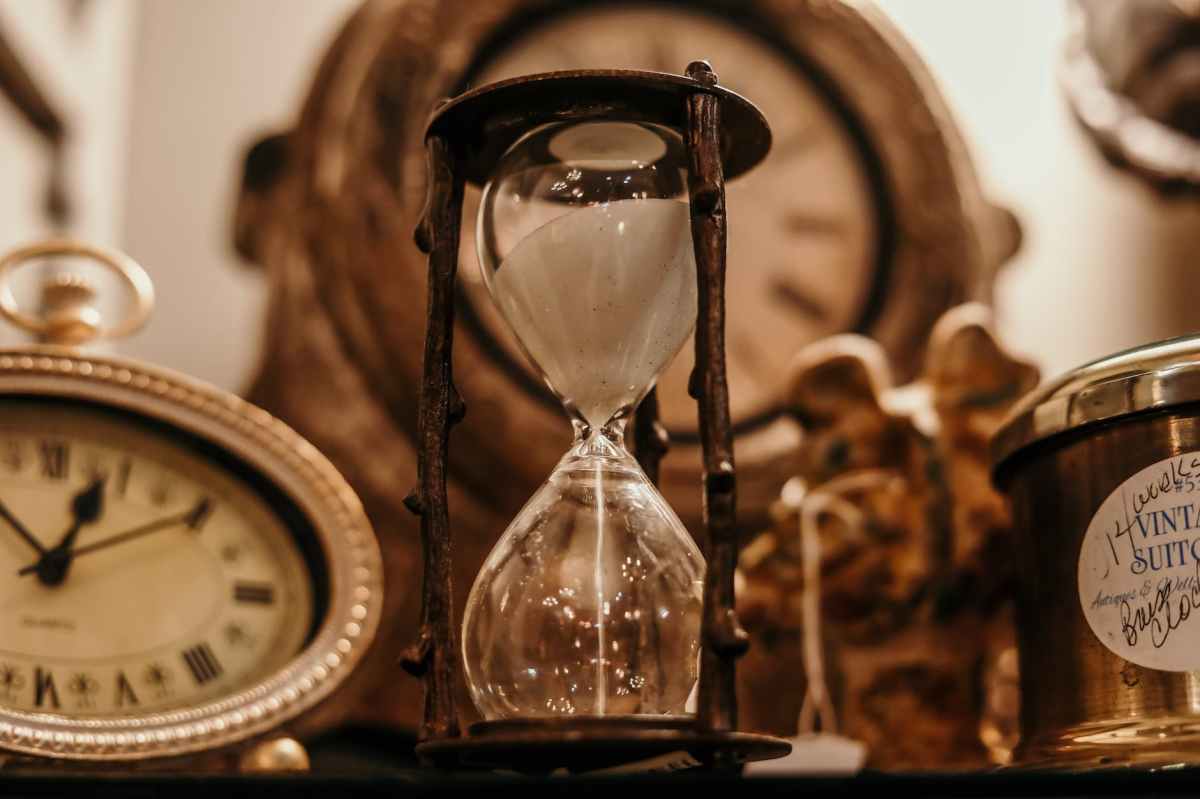
I’ve been thinking about time this week. It is precious, isn’t it? Perhaps the most precious thing we are given. It seems so abundant when we start out. It can feel interminable when we are waiting for something to happen. 

And then, suddenly, it slips away, and we think, oh, wait, not quite yet. I thought I had a bit more, I need a little bit more. There were still things I wanted to do, there were still words I needed to say. I don’t know why I didn’t. Maybe I was distracted. Maybe I was afraid. Please, just a bit more time. 

But the dying light and the winnowing down of the year reminds us that time is a relentless master; we are given what we are given, and it is up to us to make the most of it. It is up to us to imbue it with light and love and care while we can. I think we try to remind ourselves of this during the holidays.

If you wonder why on earth I’m going on about Christmas catalogs and time and memory, it’s not just because Thanksgiving is coming up in a few days, although I am excited about that. I have my Cool Whip ready!

No, it’s because I have been wrestling all week with the parable we have been given this morning, seeking a life-giving word from what can feel like an impenetrable text. Jesus, yet again, gives us an image of the Kingdom that seems, on its face, short on mercy and full of dire threats from a cruel master demanding a return on his investments. Is this supposed to be God? I cannot believe it. And so, yet again, I found myself seeking good news in an unexpected place.

And as I was flipping through that Christmas catalog and reflecting on the past, I found it. Not in the catalog itself, but in that tender sense of longing for times past that it evoked in me. It made me realize, in a new way, that the thing in this life that is of greatest value—the closest thing we might equate with both  the “talents” given in this parable and the Master who dispenses them—is not God. It is time. 

Time is our greatest resource. Time is our most precious gift. Time is the thing we must decide how to use while it is entrusted to us. And time, in the end, is the unyielding master of our mortal bodies, for it will run out, and it will call us to account. Time will ask us, in the dying light, in the winnowing down of our own years: what did you do while you could? What dividends of love and justice and peace do you have to show for it all?

And yes, I know that for generations, the Church has interpreted the Master in this parable as Christ and the talents as our material or spiritual resources that we should not bury out of idleness or fear. But I will be honest, I don’t believe that God punishes us simply because we are afraid, because we didn’t know quite what to do, because we didn’t yield a certain rate of return. I think such notions of God have been used to exploit people or at the very least, to make them feel like they are never enough, that they had better produce results or else, usually for the cruel masters of this world. 

Because here’s the thing about God—here’s the good news for those of us wearied and tearstained by the passage of the years—God is bigger than time. God is not bound by time. God is not sitting out there somewhere, watching the clock, waiting to see what you and I will accomplish. God is not making a list and checking it twice. 

God already knows. God has always known all that you would be, and all that you wouldn’t, or couldn’t be. And God has loved you anyway. Whether time has been kind or cruel to you, God has been with you every moment of your life, and will continue to be there, even when time runs out. And on that day, God will guide you out beyond time itself, beyond longing and regret and fear to that place where nothing is wasted, where nothing is lost, where everything is given. 

And if this is so, then perhaps the true invitation of this parable, the way into a Kingdom that arises in the midst of the cruelty and finitude of time, is simply this: cherish what you have been given. Savor the collection of fleeting moments that are your life. Use your days to make a world that is more peaceful, more beautiful and gentle and loving. 

Not to try and impress that master, Time, who will take all we have back for himself, but to get in touch with something even more powerful—to awaken to the reality that no matter what is taken from us by time, the love that we experience and share in this life is timeless, it is eternal, for it belongs to God. And one day Christ will come and give back everything and everyone that time has taken, and it will be a gift more precious than anything you can order in a catalog. 

It will be the life that is beyond time, which we cannot yet even imagine, and yet which is deeper, even, than our most cherished memories. Because even more so than our own lives, God is both very spacious and very small, all at once—spacious enough to hold forever, small enough to hold you. 

Take Me Back: A Sermon for Christ the King

I preached this sermon on Sunday, November 20, 2022, the Feast of Christ the King. The lectionary texts cited are Jeremiah 23:1-6 and Luke 23:33-43.

Maybe it’s the holidays, or the winter setting in, or maybe it’s the fact that we have arrived at the final Sunday of the Church’s liturgical year, but around this time each November I get a little bit nostalgic. The smell of familiar foods and the melody of old songs and the sight of candles glowing in the darkness behind icy windows—it takes me back. 

Maybe it takes you back, too. Back to memories of childhood, or to when you were first in love, or maybe even just a few years ago; nostalgia connects us to those periods of our lives that contained some measure of simplicity, a special sweetness. And while we know that “the good old days” were never actually as simple or perfect as we might recall them to be, it remains true that the pull of the past is powerful, and the longing we experience for it is real: longing for the faces and the places we once knew and even the versions of our selves that we used to be. 

Every so often a certain memory wells up in us and we feel the gap between then and now and we cry out “Take me back!” Though we always say with a bit of irony, for we know that it’s not possible: we can’t go back, because time unfolds in only one direction, and our memories are windows into a land we can’t reenter. 

If I ever get a bit self-conscious, though, about my tendency towards this November nostalgia, I remind myself that it’s simply part of the human condition. People have been haunted by their memories in every age. In Scripture we encounter generations of people caught between the past and the future, strugglng to make sense of both. Think of Israel in exile, longing for Jerusalem. Think of Jesus’ contemporaries, agitating to overthow the Empire and restore the political glory of their nation. Think of how such impulses both console and plague us, even now.

Going back in time—or at least wanting to—has been written upon the human heart since Adam and Eve stumbled out of Eden and the gates were closed to them. From that day, it seems, we have been looking over our shoulders, longing for the time “before”, longing for the people we were back then. You might even say that nostalgia is one of the most prevalent themes throughout the Bible, and while it doesn’t always serve people especially well in those stories (I am reminded of Lot’s wife), I find some reassurance in the fact that it is not just our generation that feels like it’s a long way from where it started.

But what struck me for the very first time, as I was reflecting on the passages for this Christ the King Sunday, is that we humans aren’t the only ones who feel nostalgia, why cry out “take me back.” God, too, seems to long for the time before. The time before kings and conquests. The time before we and God lost sight of one another on the long road through the centuries.  

Now it’s true that the words of the Lord spoken through the prophet Jeremiah, which we heard this morning, like most prophetic writings, are all future tense—I will do this, and this will happen, and the days are surely coming, but implicit in them is God’s desire that things should return back to the way they were supposed to be—namely, to when God was the shepherd, the provider, the one who would not abandon his people or exploit them or lead them astray. God wants to go back to when there were no mortal kings of Israel, back to when God was their only sovereign, when God’s heart spoke directly to theirs. 

God longs for unmediated intimacy with his people. He remembers how he walked alongside them, leading them in a pillar of flame through the deep night of the desert wilderness. God remembers how he made his dwelling place in their midst, how they sang hymns of liberation to him on the other side of the Red sea, how he fed them from his own hands with manna. And God remembers even farther back still, back to Paradise, when he walked among the trees in the cool of the evening and his creation knew the sound of his voice and the fruit still trembled, unpicked, upon the branch. Yes, God remembers it all: the smell of the familiar foods and the old songs and the fire glowing in the darkness. And he longs for it as much as we do. 

Take me back, he says, without any irony. Take me back. Take me back. 

How humbling that the King of Glory, the Creator of the Cosmos, would ask such a thing. That he would ask us such a thing. 

Of course, we could not go back—neither back in time, nor back to him, for it seems that we are made only to tumble forward into the future. Gone, the food and song and fire. We could not recover it. We could not undo what had been done. We could not pry open the gates to Paradise. At least, not by ourselves. Not without help.

But we are here this morning, on Christ the King Sunday, because help did arrive. God determined, in the end, how to move beyond nostalgia, his own and ours, how to finally reclaim the past. He did the only thing, perhaps, that was left to do: he brought all that we had lost directly to us, in the flesh. In Jesus.

He showed up with the food in his own hands and the song on his own lips and the fire in his own eyes. He came as a different sort of king—a king who would not engage any power except the powers of love and mercy and justice. A king who would die rather than compromise his commitment to those things. One who would rise again to show us that these are the only things that are truly powerful.

And so he was born into the margins and stood at the margins, and he broke down the thin margin between heaven and earth with the force of his love, and he died, this image of the Invisible God, with a name affixed above him: The King of the Jews. 

And whatever the authorities intended for him, there was no irony in that title. 

For this is what he was and is: the one true King—the last king of his people, and the first king of all people. The Alpha and the Omega. The one who, from his throne on the cross, forgives us for all that has been lost, and who promises that nothing, and no one, ever need be lost. The king reopening the gates into Paradise, which is really just the gate into his heart.

Take me back, says Christ, our King. 

Take me back, we reply. 

And for once, maybe for the first time, it is possible.

Can’t Go Home Again: A Sermon

I preached this sermon on March 7, 2021 at Trinity Episcopal Church, Fort Wayne, IN. The lectionary text cited is John 2:13-22, an account of Jesus clearing out the Temple in Jerusalem.

Just before I started serving at Trinity, Fort Wayne, nearly two years ago now, I took a drive up north, to the Upper Peninsula of Michigan, where my grandparents and my father lived before they died, where I spent much of my youth. The old family home, a place that had been an anchor throughout my entire life, was no longer occupied, and my aunt and uncles were planning on selling it, so I wanted to see it at least one more time before that happened. 

And you know that old saying, “you can’t go home again”? Well, sometimes you can, technically, but the problem is that either the home has changed so much—or you have—that you feel disoriented, like a stranger wandering into the story that used to be your own, but that doesn’t quite fit anymore. 

The house was quiet, too quiet, cleared of most of its familiar clutter, though some of the furniture remained—the kitchen table right where it had always been, the same curtains in the window, the old parlor organ in its usual spot, the armchair where my grandmother read her books before bed. The outlines of a thousand memories, still rich and resonant, but hollow, too, a monument to an era of our family history that had passed away.

And as strange as it might sound, I kept thinking about that empty house in Michigan as I was sitting with this week’s gospel passage from John, where Jesus clears out the Temple in that dramatic scene.

Because although we often focus on the intensely prophetic nature of his actions—turning over the tables, critiquing the economics of the sacrificial system—I think there is a also a deep poignancy to be found here. This is a personal moment as much as it is a public one, because we must remember that, for Jesus, this is not just a religious power center, a building filled with strangers whom he wants to knock down a peg or two. It is, as he plainly says, his Father’s house. He has, after much time away, come back home.

Remember the story early in Luke’s gospel, when Mary and Joseph lose track of Jesus in Jerusalem when he is a young boy? And they search for him for three days…and then they finally find him…where? In the Temple, yes, still himself but also unfamiliar—a bearer of wisdom, engaging in dialogue with the teachers assembled there. And what does twelve year-old Jesus say to Mary and Joseph?

“Did you not know that I must be in my Father’s house?”

It is a homecoming scene. A memory deeper than memory, a familial instinct has drawn him there, to the dwelling place of his Father, to the place where his own story, just beginning to take shape, finds its larger context. 

And so now, as he arrives again in today’s reading as an adult–a bit older, a bit more knowing–what is Jesus thinking, as he enters the Temple for this very different homecoming? Does he remember how he once sat, just over there, as a young prodigy, amazing the onlookers with his insight? Does he remember, perhaps, that certain slant of light across the stones on that long ago day, or the sound of his mother’s voice calling out to him in relief from across the courtyard, when life was newer, when there was still so much to be discovered? Does he now feel that disconcerting pang of regret when you return to a place after you’ve grown a bit too much to be comfortable there, that swirl of familiarity and estrangement when a Father’s house no longer feels like home? 

You can’t go home again, no. Not even Jesus. Not in the exact same way as before. Too much has changed. But also, there is too much that must still be done. No time to wallow in what is lost. Life persists. And so our histories must be reckoned with, not recaptured. 

In his own way, that is exactly what Jesus is doing, as he braids the whip, as he releases the doves into the sky: he is clearing out the past, because he knows that this story—his family’s story, his nation’s story, creation’s ancient and unfolding story—must now go in a new direction. So out go the sacrificial animals, and the money-changers—out go the old systems, the old patterns, the old and familiar ways of interacting with God, of satisfying our never-ending longing for heaven. 

For a new thing is about to be done: a definitive sacrifice is about to be made, in the confines of a drastically different Temple—the Temple of God’s own body, on the altar of Calvary. Jesus, in clearing out the Jerusalem Temple, is clearing the path towards the new Jerusalem, the heavenly city; he is taking upon himself all the memories, all the hopes, all the sorrows that have been held and offered here through the millennia, in the halls and holy places of his Father’s house, and he is carrying them with him, into the next chapter, into his own life and death–and beyond.

What has been is not always what can continue to be. This is as true for us now as it was then. This is true for you and for me in our own lives, and it is true for us as a community, as a society, as a planet. 

We cannot go back to what was, even if we have loved it more than anything, because things have changed, and we have changed, and the world needs something different from us now. 

And if Jesus fashioning a whip of cords and turning over tables seems drastic, that’s because surrendering to change always is—it requires a certain lack of sentimentality on our parts, a certain fury and fire in the heart, a startled emergence from slumber, to get up, to live, to look forward, to do what must be done now, to say goodbye to what no longer serves us and what no longer serves emerging God’s purpose. 

So the question for us today, here, at the edge of whatever awaits us next, is this: What is it that we need to clear out of our lives? What is it that we need to let go of, in order to make space for what will be? What is holding us back from the next chapter in our story, in Trinity’s story, in America’s story, in the human story–what is holding us back from the chapter of the story where we go out once more and meet the world in its pain and its promise and rediscover the beauty and the healing and the freedom that Jesus can offer? What must be put to rest in order to do that? What are we waiting for?

Nostalgia will not save us. It will not save us in the church, it will not save us in this country; it will not save your life or mine. Try as we might (and God knows I often try) we cannot live on memories or longings for what used to be, for the ways things were, even the way things were a year ago. The pre-pandemic world is gone. The “before” time—the time when we did not know all that we know now—that time is gone. We have seen too much now. We can’t go home again. 

And yes, we can and we should honor the past for all that it has done for us, for its beautiful gifts, for its lessons, and we can preserve the wisdom of our ancestors and the life-giving pieces of the traditions we have been given, and then….we have to let the rest go.

The old mindsets. The old assumptions. The old prejudices. The old fears. The old lies. They don’t serve anymore. We have to be strong enough, together, to figure out how to be the Christians that the world needs now. That’s what we’re here for. That’s what Jesus has driven us out into this present moment to do.

So let’s do it. With some trepdiation, perhaps, maybe even a tear or two, but also with hope, and determination, and curiosity, and above all, a trust in the Lord, our Lord, who knows what he is doing, even when that thing seems dramatic and strange and hard to us.

You know, when I left my family’s house for the last time, I cried as I pulled out of the driveway. And I knew as I drove out of town that the love that I experienced there, in that place, would be lodged deep in my soul for the rest of my life.

But it was time to go, whether I was ready or not. It was time.

And so I did. And I kept going, down through the forests, through the sleepy old towns, down past the shimmering city lights, and across the wide open fields, back down here. Back to you. To this place and time, the one that I had to live into now. 

And I thought: it’s true, you can’t go home again. 

But you can make a new home, wherever it is you have to go. Wherever it is that Jesus leads. You can make a new life there, with gratitude for what came before, and with hope for what is coming next.

Not in your Father’s house, perhaps, but on holy ground, nonetheless. The ground upon which we are standing.

My family’s old home in Iron River, Michigan