Promised Land: A Sermon

I preached this sermon on October 29, 2023 at St. Anne Episcopal Church, West Chester, OH. The lectionary texts cited are Deuteronomy 34:1-12 and Matthew 22:34-46.

When you live in Las Vegas, as I did for many years, the temperatures in the summertime, reaching 115 degrees or more, can become unbearable after a while. Air conditioning makes it survivable of course, but some days you get sick of that frigid, metallic breeze and you start to long for something cool and gentle and real, a soft wind filtered through trees and birdsong, perhaps, the kind that dances across your brow rather than blasting it with an artificial chill. 

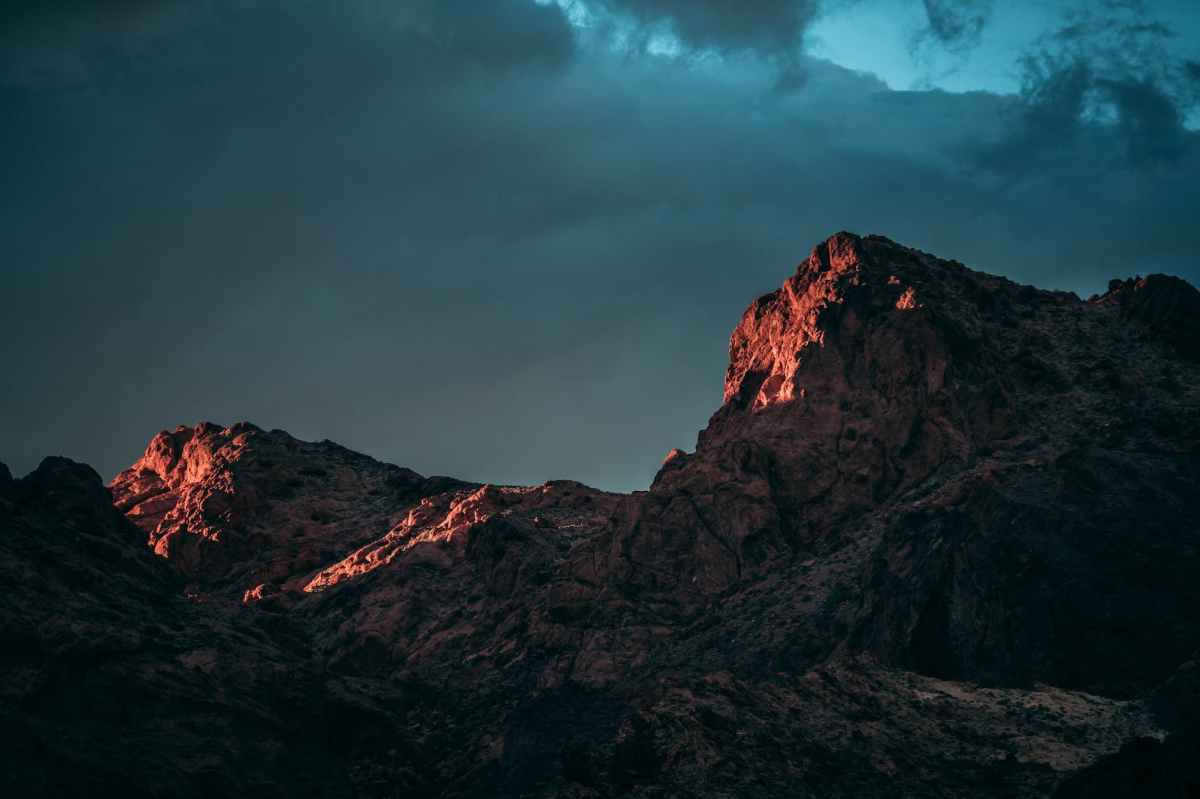
And luckily, even in the midst of the Mojave Desert where Las Vegas sits, there is a solution to this dilemma, a place known as Mt. Charleston. Drive north from the city, surrounded by endless jagged rock formations and scrub brush and shaggy Joshua trees, and then turn left, and go down a long two lane road through a desert expanse, and suddenly, the highway begins to climb, up, up, up, and the landscape changes before your eyes, and as the elevation increases, suddenly, miraculously, there are mountainsides covered in green pine trees and wildflowers grow along the ditches, and the thermometer on your car drops 5, 10, 15, 20 degrees in a matter of minutes. 

You arrive at one of the many trailheads or parking lots and breathe in the cool, verdant air and it seems absolutely impossible that you were roasting amid the harsh glare of the Las Vegas Strip just 40 minutes ago. Up on Mt. Charleston, the world is suddenly new and fragrant and full of different possibilities and the stifling desert is a distant memory. 

There was one time up there, though, when I decided to hike a particular trail that led even higher, up through the alpine forest, to an outcropping called Cathedral Rock. I had read that the views from the top were spectacular in every direction. It was a long, moderately strenuous hike, but it was indeed breathtaking at the summit. In one direction, you could look further into the expanse of green mountainside and imagine that you were in Colorado or northern California. 

But what struck me the most was that in the other direction you could see all the way back down the mountainside, back down the road that led there, all the way back to the brown valley and the hot desert and the unsparing sunlight of another climate, another reality. 

It was jarring and fascinating, from that vantage point, to comprehend the totality of the landscape, how I had not really “escaped” the desert but had simply been lifted up a bit to see how its edges gave way to something else, how the brown and the green, the fiery sun and the cool breeze, were all part of one another. From Cathedral Rock, one could see in a sweeping glance the coherence of things that felt so different, the interplay of opposites, and the ways that the place from which we came and the place where we now stand are always lapping up against one another, borderless. 

Now, I make no claim to have reenacted Moses’ journey up to the top of Pisgah, as we heard described in today’s reading from Deuteronomy, but in thinking about that view from Mt. Charleston, I do find myself wondering about his own mountaintop moment, looking into the Promised Land.

I think we usually hear this story and figure that Moses must have been awfully disappointed, never getting to go to the place he’d been working so hard to arrive in. But I wonder if, befitting one who has somehow seen God face to face, perhaps he was given something even better than arrival, something more profound than a simple journey’s end. 

We spend a great deal of energy in our own lives, and in the communities and societies we have constructed, assuming that there will be, one magic day, the point when we arrive. Arrive at stability, arrive at safety, arrive at certainty, arrive at the untroubled future long sought but always just around the next bend. Arrive, so to speak, in our own sort of Promised Land. 

And when we do, we tell ourselves, then life will really begin, then it will be the way it is supposed to be, and we can forget about all this hardship and heartache that has accompanied us. We will leave the stifling desert wilderness behind, we can forget it ever existed, and the world will be new and fragrant and full of different possibilities. 

But the thing is, we never quite escape what has come before. We make strides, we see the possibility of progress and peace, and then—another war erupts and drags innocent victims back into a maelstrom of violence and ancient enmity. Or another pandemic comes along and disrupts our patterns of life and work and worship. Or we lose someone dear to us, or we just make the same old tiresome mistake yet again, or the bottom drops out of our best laid plans, and the hot despair of the desert threatens to engulf us once more. 

And maybe we wonder—what’s the point of all this if we can’t ever seem to get where we’re going? What the use of seeing the Promised Land if it keeps evading our grasp?

But as I imagine Moses standing there with tears in his eyes on the top of Pisgah, weeping for a land he will never quite reach, I also imagine him looking back in the other direction, back down into the long road toward the desert, back into the wilderness from whence they had come, back into the memory of Egypt, of heat and sweat and tears. 

And I wonder if, from that high vantage point, Moses realized that there was less distinction than one might assume between where they’d been and where they were going. For, despite all the great expectations of the Promised Land, we can’t forget that the desert was also a place where God spoke to them and fed them and guided them day and night and refused to forsake them, even in their faithlessness and desolation and despair. 

And so perhaps the wisdom Moses was given, one final gift in the dying light on the mountain, as he cast his eyes back and forth between the road traveled and the road ahead, was to see that, in the end, the desert and the land beyond the Jordan might look different, but they are actually the same landscape. They are just the past and the present lapping up against one another, and while only one might be called the Promised Land, they are both lands that revealed a promise kept—a promise by God to never abandon his people, to never to let them walk alone. 

The deserts of our lives and the lands of plenty—they are both places where God abides and where God provides, and the truth is that to cross the proverbial river; to escape; to forget what came before–none of this is the ultimate prize or even the point of the journey. The point is to know that God stands with us wherever we are. It is to know that God loves us wherever we are and, as Jesus says, God commands us to love one another wherever we are. It is to discover that when we do this, then the Kingdom of Heaven, which is dependent on no particular landscape, can spring up anywhere—in the desert heat, in a green and fragrant valley, and the spaces in between. 

So no, we cannot spend our lives waiting for arrival at some perfect place in order to begin the work of love. Like Moses, like Jesus, we can only love the rock upon which we stand. We can only love here, love now, love the people that God has placed in front of us, love the world we know, despite its seemingly endless propensity to break our hearts and to backslide into the barren wilderness. 

And so we must hold onto the view from Pisgah; we must hold onto the greatest commandment to love, in which all of our perceived divisions are revealed to be an illusion, and in which we discover that there is just one land, there is just one body, one story, one home where all deserve to live in peace and safety. 

We must begin to see in a way that comprehends the totality of the landscape, realizing that God’s love is borderless—and that wherever we cast our gaze, and wherever we go from here, and wherever we end up, God will be there. Even on the near side of the Jordan. Because where we ultimately arrive someday is less important than the fact that God has already arrived here, today.

If we are able to see this, and if we choose to live as if this is so, then the Promised Land is no elusive dream of a summer breeze in another place; it’s the ground right under our feet. 

Mountaintop: A Sermon

I preached this sermon on Sunday, September 24, 2023 at Saint Anne Episcopal Church, West Chester, OH. The lectionary text cited is Philippians 1:21-30.

Sometimes it feels like you have to possess superhuman capacities to face the enormity of the world’s challenges. In times of social strife or of personal distress, we might look at inspirational figures from the past, looking for some guidance about how to live bravely and well through times such as these.

But it can also feel, for me at least, like those inspiring saints of ages past must have possessed some otherworldly insight or giftedness to do what they did, to face what they faced. And I find myself wondering how on earth they found the strength, what secret wisdom must have guided them. 

On April 3, 1968, one day before he was assassinated, Martin Luther King, Jr. gave his final public address in Memphis, Tennessee in support of a sanitation workers’ strike. It’s referred to as his “Mountaintop” speech, and in case you’ve never heard it, or if it’s been a while, here is the final, unforgettable piece of it, where King said,

Well, I don’t know what will happen now. We’ve got some difficult days ahead. But it doesn’t matter with me now. Because I’ve been to the mountaintop. And I don’t mind. Like anybody, I would like to live a long life. Longevity has its place. But I’m not concerned about that now. I just want to do God’s will. And He’s allowed me to go up to the mountain. And I’ve looked over. And I’ve seen the promised land. I may not get there with you. But I want you to know tonight, that we, as a people, will get to the promised land. And I’m happy, tonight. I’m not worried about anything. I’m not fearing any man. Mine eyes have seen the glory of the coming of the Lord. 

What is striking for many people about King’s final message, of course, is the sense that he knew, on some level, what was about to happen, that he somehow foresaw the end of his own journey.

But it’s not King’s seeming anticipation of his own death that I find the most compelling thing about this speech. It’s that he seemed to be at peace with it. It’s the way he stood in that perilous moment speaking something that sounds a lot like joy, a lot like hope. And not a naive sort of hopefulness that assumes everything will turn out fine. No, it sounds like the deep sort of hope, deeper than fear, the hope that knows how, even if everything goes wrong, even if the worst possible thing happens, that even then, there is a well of goodness underlying everything that will never run dry. The kind of hope that says even though my life may end, and my eyes may close, the vision endures, for

Mine eyes have seen the glory of the coming Lord. And I’m happy.

But then I think about the small anxieties that sometimes clutter my own life, and I look around at the big anxieties of our age, and I hear that opening prayer we offered, the one that says not to be anxious about earthly things, and I think—I’d sure like to know what that feels like. I’d sure like to know how Dr. King got to where he was on that April night. And although, God willing, none of us will ever face the danger he faced, I wonder what it would take for the rest of us to experience that deep kind of hope, that peace, that tenacious belief in the well of goodness, even in the face of our own hardships.

Is such a thing only for the saints and the heroes? Or is there some way that we, too, might travel up to the Mountaintop? 

I think there is, and St. Paul helped me see it this week in his letter to the Philippians. 

It’s interesting, in this passage we heard today, Paul sounds a lot like Dr. King; he, too, seems to possess a peace and a hope even as he is suspended between the possibility of life or death. He says,

I do not know which I prefer. I am hard pressed between the two: my desire is to depart and be with Christ, for that is far better; but to remain in the flesh is more necessary for you.

Whatever else we might say about Paul, we know that he was a passionate person, deeply engaged in the life of the world. But death was on his mind, because he likely wrote this letter from prison in the final years of his life. He was put there by the Roman authorities, and while it was his ardent desire to be reunited with the various faith communities he had founded, there was surely a part of him that knew his chances of doing so were slim. 

Like Dr. King, he was a man hunted. But also like Dr. King, he was a man haunted by possibility, who had glimpsed something on the proverbial mountaintop. He had glimpsed something and he insisted that what he had seen, what drove his entire mission, was not for a select group of wise or superhuman people, but for everyone, everywhere. It was the key to his hope, his peace, and his courage.

What was it? 

Well, it was Jesus, of course, but more specifically, it was the revelation that in Jesus and through Jesus, God’s wants us to know that we are in this together. You and me and God and everyone else, we are in this together. We don’t have to face this alone. We are one people. We are one creation, redeemed by the one Living God. We are part of one story, and it is a good story, a story that begins in love and ends in love. 

And though we are diverse, and though we each face our own choices and challenges and fears in each generation, it is this essential unity that holds us, that sustains us, and that places upon us the responsibility of caring for one another, loving our neighbor as ourselves, because fundamentally they are.

And although they don’t state it explicitly, what you will notice beneath the words of Dr. King and beneath the words of St. Paul is that they are able to face those big, frightening things, those questions of life and death and loss and hope, simply because they knew, deep down, that whatever happened, God would not abandon them nor would God abandon the story that has begun. 

And when you know you aren’t alone, then you can face anything. That’s why we come here week after week. That’s why we keep challenging ourselves to build more fully the Beloved Community. That’s why we pray for each other and lean on each other through good times and bad, all the way to the end.

You, and me, and everyone we’ve ever loved, and everyone we’ve ever hated, and everyone we’ve ever lost, and everything that has ever been and the God who made it all—we’re in this together. And that’s it. That’s the Mountaintop. That’s the simple, world-changing, heart-transforming truth that sustains the saints but is also available to every single one of us, even in our anxieties. And even when we face death.

Catching a glimpse of the promised land is not a private revelation for the few—it’s everywhere. It’s as close as looking in your neighbors face and realizing: we belong to one another. It’s as close as looking down at the earth and realizing: we belong to one another. It’s as close as listening to God in the still moments and in the frightening moments and hearing God say to you: we belong to one another. In life, and in death, and beyond, we belong to one another. 

Let’s keep building up a community here at Saint Anne where that is what it means to be the church. Let’s keep discovering what it means to belong to one another, and then to go out into the world and discover that ultimately we belong to everything. Maybe, if we do, we too will say, even at the end of our days:

Mine eyes have seen the glory of the coming of the Lord. And I’m happy.

Spectacle: A Sermon on The Transfiguration

I preached this sermon on Sunday, February 19, 2023 at Trinity Episcopal Church, Fort Wayne, Indiana. The lectionary texts cited are Exodus 24:12-18 and Matthew 17:1-9, an account of the Transfiguration of Jesus.

I wonder if this has ever happened to you: you come to church on a Sunday for Mass, and the service moves you deeply—the music is transcendent, and the prayers are full of meaning, and maybe (we pray!) the sermon is even inspiring or thought provoking. And then you receive communion and you emerge out into the world, basking in the radiance of love and light and liturgy… 

…and then someone cuts you off in traffic. Or you get home and your dog has eaten your favorite pillow. Or you have an email waiting from that frustrating coworker. Or you see the news and some dire, troubling thing has taken place somewhere. And suddenly all those warm feelings, those lingering memories of song and silence and candlelight collide with the less-than lovely-realities of life as it is. 

If you know what I’m talking about, rest assured that you are not alone. It is, I think, a challenge shared by all worshipping Christians to experience the disjuncture between the glimpse of heaven at the altar—that ordered vision of life and eternity grasped in our prayers and rituals and hymns—and the decidedly messier truth of days spent navigating a fractured world.

This has been true for members of the Church for a very long time. The elaborate beauty and deep feeling we cultivate in worship is intentional. It reminds us of the beauty of God for which we long and the beauty of one another, too, which is often harder to sense amid the traffic and the emails and the gloomy headlines. 

But the contrast between liturgy and life, between the transcendent and the prosaic, is not entirely by accident. It also has its roots in a rather pragmatic need identified by the early leaders of the Church. 

A brief liturgical history lesson: In the 4th century, when the decidedly countercultural followers of Jesus suddenly found their traditions absorbed by the ruling elites into the power structures of the Roman Empire, a curious thing happened. What had been a grassroots, underground movement, subject to persecution and shaped by fervent commitment to an alternative way of being in the world, gradually became an institution for the powerful and the fashionable. 

Whereas once baptism was more akin to the Mark of Cain—a seal of divine promise in the face of peril—it now became more like a badge of honor and access and status. People showed up to be baptized not because they necessarily understood how Christ had transformed their existence, but simply because it was the thing to do.

And as a result, the bishops and other church leaders decided that they needed a new way to make an impression upon these slightly passive, comfortable new members of the body of Christ. If they couldn’t compel them with the bracing possibilities of martyrdom or a new, radical communitarian ethic, then they would dazzle them into awe and reverence with liturgy. Spectacle would stand in where, perhaps, substantive conversion of life fell short. And so liturgy, over the years, become ever more elaborate, ever more majestic, to remind people that Church was not just a social club, but a sign of eternity. 

Now I admit this all sounds a bit cynical, as if liturgy were a tool to play with people’s emotions. I don’t think that’s quite it. It’s just that we, as human beings, especially when we are enmeshed in myriad concerns, need potent reminders that another world, another way of being in this world is possible. 

And the more our daily lives are entrenched in the predictable patterns of consumption and competition and zero-sum thinking, the harder it is to perceive the alternative. We, like those Roman converts, are deep in the valley of Empire, stooped over, scrabbling for our daily bread, and it takes the power of something bold and wondrous, a mountaintop experience, to draw our gazes heavenward, to remind us to dream again. And so we come here.

God knows this about us. God knows we need to be dazzled sometimes in order to believe. Perhaps that’s why mountaintops figure so prominently in the two theophanies—Godly manifestations—in our readings this morning. 

Moses is called up the cloud-draped mountain where the glory of the Lord has come to meet him, “like a devouring fire…in the sight of the people of Israel.” It’s that last phrase that matters here—in the sight of the people of Israel. Remember, Moses himself had been in communication with God ever since the burning bush; he did not need to go up a mountain in dramatic fashion to trust in the word given to him. 

But the people, newly released from the land of their bondage, uncertain about what was true and what was possible for them—it was for their benefit that God gathered like a cloud and burned like a fire. The spectacle reassured them that whatever Moses found there at the top of Mt. Sinai was Real with a capital R. It was God. It was the answer to their deepest fears and longings. 

And then we have Jesus with James and Peter and John, on another mountain sojourn. Immediately before this, Peter has already confessed Jesus to be the Messiah, the Son of the Living God—and so his head already knows what is true, but Jesus, in his wisdom, knows that seeing is believing, and that the road ahead will be hard, and so now the disciples’ own eyes behold the Transfiguration of Christ’s body into the glory of the Lord, another spectacle, his face blazing like fire, like sunlight, like certainty.

Two mountaintops, two dazzling visions to imprint themselves on the memory and on the heart. Maybe we need these transcendent visions, just like we need our transcendent liturgies. We are creatures of sensation and feeling contending with a world that sometimes drains us of both, and so perhaps it is part of the strange mercy of God to to slay us with beauty so that we might survive for another day. 

But here’s the thing we cannot forget, whether in our own experience of liturgy or in our reflections on these two texts: spectacle alone cannot save us. To be moved by beauty is not, by itself, to be transformed. Those church leaders of the 4th century knew this—they just hoped to make a big enough impression in worship to keep people engaged in deeper formation the rest of the time. 

And Moses knew this, too, for he came down from the fiery mountain not with more bedazzlements for the people but with Commandments and instructions for how to build a real life, a real society worthy of the glorious vision. 

And Jesus knew this, too, he knew that his transfiguration would soon be followed by his crucifixion, and that his disciples would need to build a living community based on an ethic of sacrificial, self-giving love, not just a pretty piece of performance art and some pious recollections. Because whether on the mountaintop or in the sanctuary, we were not made children of God and we were not given the glimpse of heaven’s perfect beauty simply for the enjoyment of a private holiness, but for the exercise of a public wholeness.

And these two things—beauty and responsibility, spectacle and sacrifice— must work together if we actually want to BE a transfigured people rather than people who simply admire the Transfiguration. We can love our worship, as all Christians in all traditions should, and we can give our hearts over to it on Sunday and give the best of ourselves to its enactment, but we will not be changed into bearers of the beatific vision until that day when our liturgy spills out into the streets and its fire and its light are no longer reserved for the mountaintop but instead become the flame we carry within us in the hard, dim, disordered, necessary work of everyday life, the work of loving the world into the newness life that God has ordained for it. Yes, even when we get cut off in traffic or get a troubling email. Even when the news is dire. Especially then. 

Because although God can indeed be glimpsed in the mountaintop moments, and God is in the bread and the wine and is dancing in the flame upon the altar, and although God will continue to show us how wondrous, how beautiful, how spectacular is the glory of his presence in this place, it is in the unspectacular moments, the ones after the formal liturgy ends, the moments that make up most our lives, when we will see not just who God is, but who God has formed us into and what, we pray, his glory has wrought in us. 

Are we radiating with his light? Are we helping build his just and peaceful Kingdom? Can all who see us feel both the power and the gentleness of our love, like a devouring fire, like a cool mantle of cloud?

When we do these things, and when the world can see these things, then on that day the true spectacle will not be the beauty of God alone, but of God alive in us. On that day, God’s glory will no longer be reserved for the liturgy, for the mountaintop, but will be everywhere. And on that day, the Transfiguration will be complete.

After the Light: A Sermon

Today is the last Sunday in the season of the Epiphany—a season that began in January with the Magi encountering the Christ child under the dim light of a secret star, and which now concludes this week as Peter, James, and John encounter the transfigured Christ in searing light atop a wild mountain. 

We actually come upon the Gospels’ transfiguration accounts twice in the Christian year—today, and again in August, on the official Feast of the Transfiguration. It’s worth the double-mention, too, because although we tend to spend a lot more time contemplating Jesus’ birth, death, and resurrection, it is in the Transfiguration that we find something essential about all those intervening years, when Jesus was the God who lived among us—it gives us an image of just what it looks like for fragile human flesh to be melded with heaven, burning with God’s incandescent glory. Through the eyes of the stunned disciples, we are given a momentary glimpse of the end of all things—time circled back upon itself in eternal communion; our reunion with the wise ancestors and beloved dead who have come before us; all of creation radiating the light of a thousand suns. 

But it is only a glimpse, only a taste, and a good thing, too, because it seems that Peter and James and John cannot bear much more than that. They are stupefied, trembling, stammering, and God quickly, mercifully, bathes them in the protective cover of unseeing, unknowing cloud. Truth is a beautiful, powerful thing, but it is also overwhelming. Then, as now, God deigns to give it to us in small bursts—in those rare, jewel-like moments we call epiphanies—and it is our task, in the cool, quiet interims to string them together, to fashion our epiphanies into whatever sense we can make of them. 

Such moments are so sharp and precious and enduring because much of our life can feel a bit confusing, a bit murky. Rather than receiving a series of brilliant insights, knowing exactly what we must do next, most days we’re just muddling our way through, half-guessing, half-hoping, praying to God that we’ve got it right. 

And on those sorts of days, at least for me, my relationship with Jesus is an unseeing one, untransfigured, a series of hesitant steps through the cloud and fog; in such times I am not quite sure who I am, or who he is, or what he wants of me, only that he is there, that he beckons, and that he is present, not because I see him, but because he has promised that he will be. 

As the monk, author and contemplative Thomas Merton once wrote in prayer, 

“My Lord God, I have no idea where I am going. I do not see the road ahead of me. I cannot know for certain where it will end, nor do I really know myself, and the fact that I think I am following your will does not mean that I am actually doing so.”

So it is. For anyone—the monk, the mystic, the everyday seeker of God—epiphanies of God’s unambiguous intentions for us are rare. 

And that is why, if I am perfectly honest, I possess some ambivalence about fixating on dramatic epiphanies in this season, as important as they might be. Because for the most part we cannot spend our days chasing them; we have to construct our lives out of humbler things, everyday things. 

So I am resistant when, in reflecting upon the Transfiguration, commentators sometimes focus primarily on Jesus’ hidden glory, his dazzling brilliance, as the main event, the main point of interest in this passage, as if it is just sort of “sneak peek” into heavenly reality where the “true” Jesus is revealed.

Emphasizing a distinction between this transfigured, shiny Jesus and the “regular” old desert-wandering Jesus doesn’t help us much, because it suggests that this mountaintop version is the “real” one, and that seeing and knowing him fully is the stuff of private revelations and mystical visions, reserved for the few and the chosen, far removed from the dirty, hungry, conflict-ridden valleys where most people live and die. 

An exclusive focus on the Jesus of the transfiguration would have us always scrambling up our own proverbial mountaintops in search of ecstatic epiphanies, leaving behind the prosaic, humdrum prayerfulness of daily bread and messy relationships. This will not do.

Because as fashionable as it is these days to talk about and pursue mystical experiences of one kind or another, to strive for the extraordinary, the fact remains that most of our lives are quite ordinary. They are not spent in the blazing light of epiphany. There are dishes to wash. Bills to pay. Zoom meetings to get onto. Kids to get to school. Bodies that grow older, softer, more vulnerable. More questions to fill our days than answers.

As Merton says, we cannot see the road ahead of us, and we cannot know for certain where it will end.

And that is why there is something else that I choose to focus on in the Transfiguration. Something that does give me hope: that this momentary glimpse of the glorious, transfigured, impossibly radiant Jesus is in fact, in all the ways that matter, the exact same Jesus who remains after the vision is over, after the impressive lights and sounds are gone–after there is nothing left on the mountaintop but cold wind and damp rock. When “suddenly…they looked around, they saw no one with them any more, but only Jesus.” 

Only Jesus. Only the Jesus they already knew, the man, the one in plain, dusty peasant clothes, the one with a face like any other human face, the one who heals and feeds, not with beams of light, but with mud, and breath, and bread and blood and tears…only Jesus, yes, but for all his commoness, not one bit less the eternal Son of God. Not one bit less the Holy Incarnation of light inaccessible.

This is the good news of the transfiguration: that the brilliant, blazing Jesus, and the everyday Jesus—they are one and the same. He is so imbued with Divine love that He carries its power within himself, without spectacle or impressiveness, right back down off that mountaintop, back down into the villages, back down into the landscape of our discontent, back down to you and to me and to every average, confused, hoping, wondering heart. Back to where he is most needed. Back to where he most desires us to follow.

So yes, the Transfiguration is beautiful. Yes, epiphanies are special and ought to be treasured. But let us not obsess too much over hidden brilliance, lest we spend our entire lives chasing after the wrong type of wisdom, missing the obvious, simple beauty right in front of us. Jesus is here, now, consoling us in the middle of our fear and our loneliness and our sickness, and tenderly blessing our best, imperfect attempts to be kind, to be brave, to be true. 

He is satisfied to love you and to teach you here how to build the kingdom of God with the same earthy, everyday tools that he once used to begin it: your hands, your heart, your hope. 

That’s true whether we see clearly or whether we do not. Whether we are impressive or just ourselves. It is only us that Jesus requires. Only you and me, trying our best, in the world we have been given. 

This, in the end, is the only epiphany that we need.