
Lo, He Comes Anyway: A Christmas Sermon

I preached this sermon at St. Anne Episcopal Church, West Chester, OH on Christmas Eve, 2025.

Here’s the thing about the circumstances of that first Christmas: it was the best they could do. 

We’ve heard the story so many times, and maybe we’ve imagined it as something quaint and simple, but it was not. Consider: there’s a young woman soon to give birth, and man who is not quite yet her husband, both suddenly compelled into a long, challenging journey to Bethlehem. It’s place that is not their home and where no familiar faces wait to welcome them. 

And so they did the best they could do, these two, but by the time they got to their destination, there was no space left. And no time left, either. No choice for Mary and Joseph but to do their best—to make way for the baby now, to prepare the way of the Lord now, in this wilderness of happenstance, for he is coming, here, right now, this mysterious, urgent, holy child. He will not wait for the peaceful or convenient moment to appear; God rarely does. 

No, the birth pangs of a new creation have come, as they so often do, in the midst of displacement and discomfort, and Jesus emerges, ready or not, into the messiness of life, just as it is.

As that old Anglican hymn tries to put it politely, with classic British understatement: lo, he comes

Replace “lo” with whatever word slips out of your mouth when things go wrong, and you probably have a more accurate sense of the scene. 

Lo, he comes, as all babies do, with tears and cries. Lo, he comes into a world not quite ready to greet him. Lo, he comes, from up beyond the drifting clouds and the blazing stars, to see how our tense and divided world might yet learn to love again. 

No space? No time? So be it, for lo, he comes anyway—God emerging from outside of space, outside of time itself to make a home with us, just as we are.

And yet, we might think, surely, surely, despite all the challenges in their journey leading up to this, surely when this moment comes, Mary and Joseph will at least be able to welcome him properly. Surely this birth-of-God moment, despite our long and imperfect history, will itself be perfect

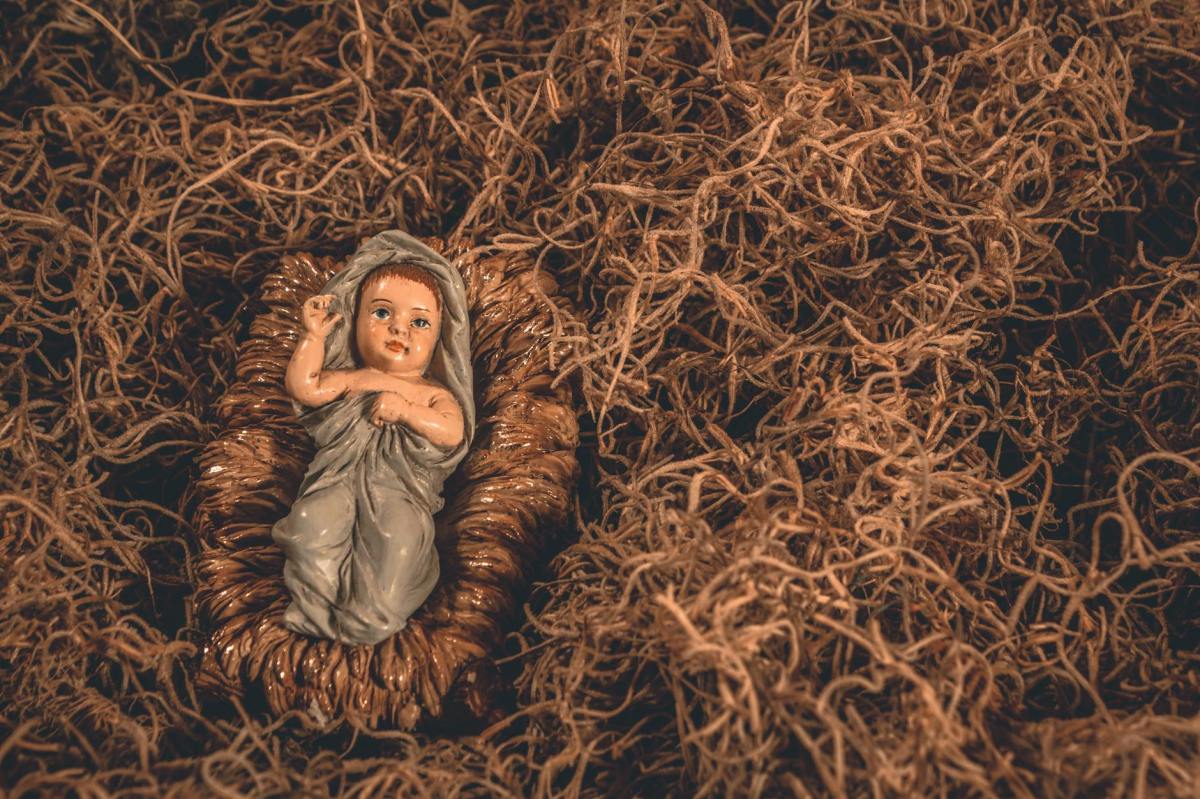
But, lo, there is just that one little problem: no space. No time. And no cradle, either. And so poor Mary and Joseph have to plop the precious little Creator of the universe into a manger, which is, let’s not sugar coat it, a feeding trough for livestock, and, we can imagine, not a very clean one. 

Given the circumstances, it was the best they could do. 

Blessedly for us, though, I think Mary and Joseph set a precedent for Christmases to come, because saying “just put the baby in the trough” is somehow representative of all those moments when our plans fall apart. Those moments when, due to circumstance or desperation, we have to make a hard pivot towards “good enough.”

Maybe I wanted to wrap all my presents perfectly, but end up stuffing them into gift bags sometime late on Christmas Eve. Or I planned the perfect dish, and it burned (and I definitely said some word other than “lo”), so my potluck contribution will just have to be some extra napkins and my winning personality. 

Or, more significantly, perhaps I thought this would be the year that I finally mended a few fences, patched up a few broken relationships, helped to make a more just and compassionate society take shape, but it didn’t quite go that way. So I come and sing Silent Night one more time hoping it’ll stick this year, that such peace will exist someday for me, for my neighbor, for this world. 

It’s the best I can do. 

And the baby in the feeding trough gets it. He has understood from the very beginning. 

If you take some time with the story of Jesus’ nativity, and if we can look past, for a moment, all of the beautiful art and poetry and pageantry that accompanies our observance of this night, you will find that it’s actually the story of a big old mess. I think that’s what helps it feel so true. 

We have the manger, yes, and the rushed journey to Bethlehem, and there are also the shepherds—not considered respectable company in those days—and then there’s just the fact that there are all these people running around in the dark of night, shouting strange news at each other by starlight. Dirt and sweat and stumbling and confusion. There is absolutely nothing perfectly composed about this moment. Nothing clear or easy about the arrival of the answer to our deepest questions. Just a bunch of imperfect people doing the best they could do and finding themselves bathed in grace anyway. 

Lo, he comes, just as we are. 

And that is the most hopeful thing I can imagine. Because I don’t know about you, but I am more intimately acquainted with messiness than I am with perfection. I know quite well what it feels like to have no space, no time. I am less familiar with transcendent and abiding peacefulness. 

I look around, most days, and that is what I see: people doing the best they can do. Trying to understand themselves, trying to endure. Trying to love their neighbors. Trying to provide for their families. Trying to know who God is. Trying to cultivate some small moments of joy and contentment and right relationship in cultural, economic, and political landscapes that are not always hospitable to those things. 

I see people, against all odds, still looking up at the drifting clouds and blazing stars, seeking a reassurance that it will all be ok—that we might sing Silent Night this yearand actually feel it. That it is not all just a pipe dream, this Kingdom of heaven bending down to kiss us and dry our tears.

And so how wondrous and how wonderful that, on this night, God is precisely what he is: a baby born of displaced, stressed parents, resting in a resting in feeding trough, making his home amidst our foibles and fears and tremblings. How glorious that God looks at all of our various “best that they could dos” and says to all of them: Yes. 

Yes, I am here for that. Yes, I am here to love you in the middle of that. 

You may think that this is the God of perfectly wrapped gifts and finely seasoned dishes, but I am here to tell you this is also the God of unmade beds and messed up schedules and burnt tongues. You may fear that this is the God who demands fine garments and unstained reputations, but in truth this is the God of shepherds; of dark places; of those who sorrow and those who survive. 

And this God has come to you this night. Yes, you—you who may be questioning yourself or questioning all of this or wondering how we can sing any song at all while the world is heaving with grief and this God is here to tell you: you have to sing and you have to pray and you have to just “put the baby in the trough,” because we have to start with the best we know how to do, and then we just keep going. 

And that will somehow be enough.

So says the God who has been working, working, working since the world began to help us see that we are enough, that perfection was never his purpose for us, but connection. Connection with each other and connection with the infinite divine Love by which we were made. Connection with the beauty of the earth and the beauty hidden within our hearts, broken and burdened though they might be. 

And though our long history with God has been full of ups and downs, of misunderstandings and missed opportunities, tonight God is trying something new.

Perhaps he realized, in the end, that this was the only way to truly connect with us: to be with us completely, to experience the same failures that we do, to gather them into himself and guide us toward another type of world, one where there is plenty of space and all the time in the world. 

And if it all has to begin in a manger, so be it. 

For lo, he comes anyway, ready to give his whole life to us. 

Ready to risk everything to see us, at last, face to face. 

When you think about it, I think it was, perhaps, the best that he could do. 

Uncountable: A Christmas Sermon

I preached this sermon on Christmas Eve, 2024 at St. Anne Episcopal Church, West Chester, OH. A version of this sermon was also featured as the 2024 Christmas offering in The Episcopal Church’s Sermons that Work project.

They came to be counted. 

This is where our story begins tonight: Joseph and Mary, just two of many in the teeming, trembling, transcendent history of their people, just two, traveling the well-worn roads of their ancestors and coming, at last, to Bethlehem, the city of that singular king, David. 

They came, these two, to be registered in a census decreed by distant ruler on a foreign throne—one who knew few of their number and cared even less; a ruler who had likely never stood where they stood or stopped to consider the centuries of sacrifice and prayer and supplication that cried out from the stones of this particular wilderness.

But nonetheless they obeyed, Joseph and Mary, and they came to be counted. Counted among the multitude of faces, both familiar and strange, in a place that barely felt like home. Counted as two, though a third was on the way. Counted as fixed commodities of an empire that did not suspect and could not comprehend the infinite possibility carried in this flesh of theirs—a child, yes, but even before that new miracle, an older one: a long history of survival, an ancient promise of human dignity yet to be delivered in its fullness. A fullness that will not and cannot be commodified or controlled. A fullness that is a story, not a sum. 

And although that story has shaped us and brought us here today, it is safe to say that most of us are still caught up in the process of counting. We are a people encircled by an empire of metrics and measures, whether for economies or households or faith communities or even our own bodies. This is understandable to a certain extent. We pursue the stability and the clarity that numbers offer. We want an objective proclamation of what is real, even if we can’t decide what to do about it. 

But it is also true, especially evident in recent times, that numbers alone cannot save or solve our most urgent and fundamental questions. We can count, and count, and count some more, and order census after census and survey after survey to track our shared challenges, but in the face of deep spiritual hunger and anger and grief and change, the power of these numbers is limited. They can be idolized or distorted or ignored. At their worst, they become weapons rather than tools, used to shape arguments rather than reveal truth. Like the empires that wield them, numbers can be useful in the project of uniformity, they are insufficient for the pursuit of salvation.

No, as we travel the well-worn roads of our own ancestors, bearing our own miracles of survival, something else must be revealed to us, something else must arrive. Something—or someone—else must come, not just to be counted, but to make our lives count.

And today, that something does arrive. He arrives. The surprise addition to the census; the child whom no one was counting on.

If we wish to begin to understand the significance of Jesus’ birth and how this Christmas gospel begins to counter our empires of counting, we should pay close attention to how his arrival is heralded. Not by an agent of the orderly government, but by an angel of light, by one who emanates from the expanse of a heavenly host more numerous than the stars. “A multitude,” Luke’s narrative tells us, and the Greek word is plethos, which connotes a number so large it is impossible to quantify. 

And then we are told that this divine plethora delivers its message, not to the statisticians or the bureaucrats of Caesar, but to the shepherds in the fields. And they are figures who are themselves barely considered countable, roaming elusively among fields and pastures at the edge of respectability or safety. These nameless, numberless shepherds are given a message that would likely have been ignored by larger, more august bodies: that the long sought answer, the long awaited promise kept, is to be found in the most unlikely of places—in a manger, in a child, in the smallest fraction of possibility, nearly obscured by the margin of our errors. 

The angels no one can count and the shepherds nobody bothers to count—these are God’s chosen messengers. These are the means of revelation. No census could ever account for it. 

And yet this baby, this Jesus—he is perhaps the greatest surprise of all. For he is not just one of many, he is the One with a capital O—the One who made many. He is the One who, as the Psalmist says, determines the number of the stars and gives to all of them their names. He is the Uncountable One who has, for the sake of love, come himself to be counted, to submit himself to the census of our despair, to the sum of our fears, to stare all our empires in the eye and forgive them, knowing that they know not what they do. 

And on this night of his birth the ways in which this baby in the manger will do all of this have not yet revealed to us, but the story is set into motion, and the countdown to our transformation has begun anew in his newborn flesh. 

This transformation is still at work in us, never more visible than in this season. Because the joy of Christmas is and always has been this: that despite all our attempts to categorize and commodify ourselves and the world around us, God always manages to introduce an element of the immeasurable into our midst. 

Just like the child whom we celebrate, Christmas itself refuses to yield itself entirely to our lists and our ledgers. Just when we become overburdened by the weight of expectations or regrets or the other ways we fear we don’t quite measure up—the number on the scale or the number in our bank account or the number of empty seats at the table this year—suddenly there is a song in the night, and a burning star, and the old story retold, and although we, too, may feel like just one of many in the teeming, trembling, transcendent history of the world, we remember that there is a fullness meant for us, too, and it is still seeking us, even now. It has a name and a face that we can call upon even when nothing else makes sense. 

It is Jesus, and he, too, has come to be counted. Counted as one of us. And even more importantly, he has come to be counted upon by you and by me and by all who seek a life that is more than the sum of its parts. 

And like the shepherds who first received this good news, Christmas is also an invitation for us to stand up, to go forth, and to be counted upon as well. To be counted upon as those who keep telling the story, who keep seeking the signs of a new Kingdom being born, and who will keep working to make this new Kingdom something more than a fleeting dream in the night. 

Because the paradox of the Uncountable One becoming one of the counted actually suggests the opposite for us: that even in the finite number of moments that make up our individual lives, there is an element of numberless eternity that abides and yearns to be born through our prayers and our actions. 

We are called not only to behold a birth but to give birth ourselves, through the labor of our hearts, to the tangible realities of glory and peace and justice and hope for the entirety of the plethos, the multitudes, who live on the face of the earth and who are still searching the heavens for something more than that which can be quantified.

Christmas is the enduring moment when that search was—and continues to be—answered. And the answer, for all creation, is the same as it was for Mary and Joseph:

You, who have traveled so very far, who have perhaps arrived in a place that barely feels like home, and who fear that you will be counted among the lost and the forgotten and the used up of this world—on this day, eternity has been born unto you; infinite love has condensed itself down to be as one for you, to be one with you, and to show you the way into a life that cannot be commodified or conquered. All we must do is seek him, and hold him, and stand with him. 

And when we do, the story will reach its fullness all over again in our lives, just as it did on that night in Bethlehem: the ancient promise fulfilled, and the innumerable host of heaven singing its song, and something measureless welling up within us to be revealed.

And what is that something?

It is love. It is the love we were born to bear into the world. The One True Love that holds all things together. 

And tonight, and forever, it is yours.