Bricks: A Sermon

I preached this sermon on Sunday, November 16, 2025 at St. Anne Episcopal Church, West Chester, OH. The lectionary text cited is Luke 21:5-19.

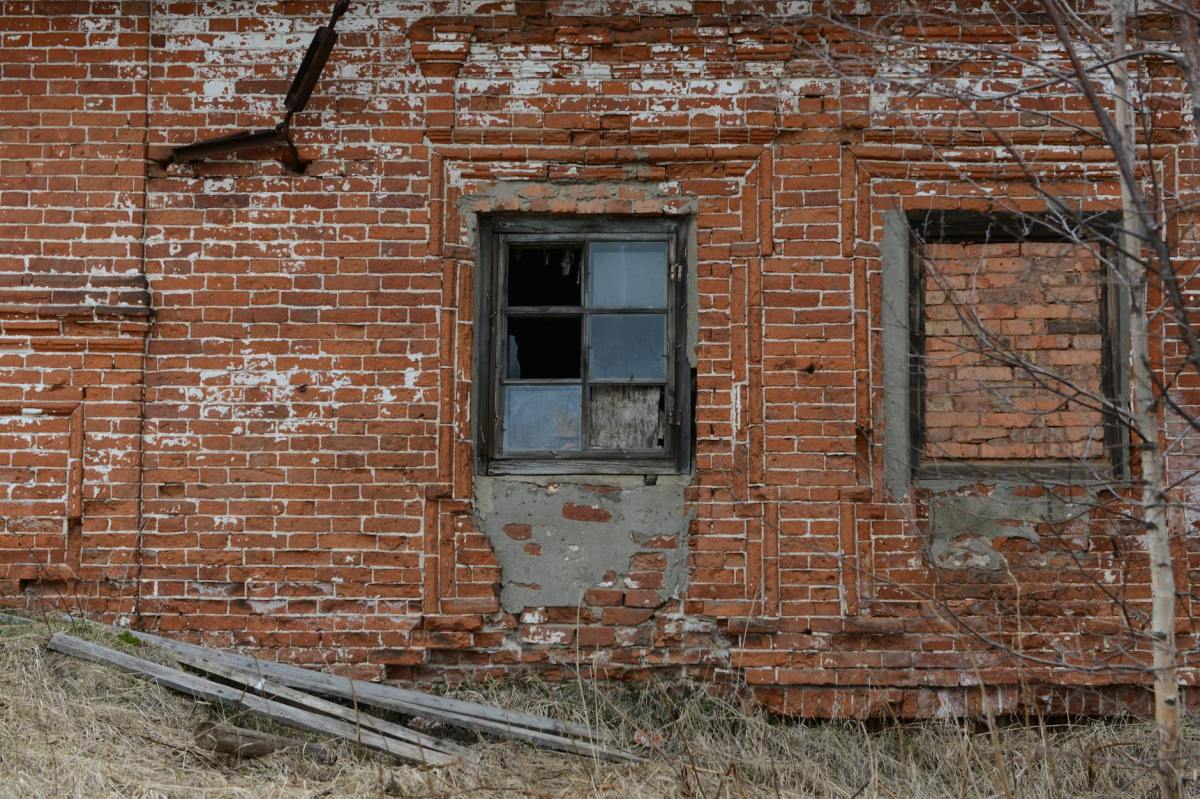
Early in our relationship, as Matt and I got to know each other, we discovered an odd coincidence. Among our respective collections of personal mementos, we each have a single brick. Not a brick of gold, mind you, just an old, slightly crumbly, dusty brick. Kind of a strange thing for each of us to be carrying around through life, but so it is. 

What’s more, these bricks we each have are both from old school buildings. Matt’s is from his elementary school, north of Dayton, which was torn down some years back. And mine is from a dilapidated portion of this massive old Victorian school building that was just out behind my grandparents’ house in Michigan—the Central School. I wasn’t a student there, but generations of Hoopers were. 

Now the Central School was not a one-room schoolhouse, but more like a palace, or at least that’s how it looked to me when I was young. It occupied a whole city block and was made up of a bunch of wings and turrets and gables. I know Cincinnati still has some schools like that. 

But eventually, in this increasingly small Michigan town, they closed it up for lack of money and students. By the time I was skulking around its perimeter as a kid, it was already boarded up and coming apart gently at the seams. And for whatever reason, this made me very sad. 

I remember as an 8 or 9 year old going to sit up against the old brick walls of the Central School in summer, feeling the heat of those brick walls radiate into my back, and I remember wishing, praying, even, that somehow it could all be saved, that it could be brought back to life. And I suppose, in that moment, that I was being given an inkling of mortality—how things and people can crumble, how certainties falter, and how not even brick walls can always withstand the onslaught of the years. 

Years later, when a portion of the building was pulled down, a family member saved me a single brick, and though I am no longer a child, and I have seen many things fall apart in life, I confess I still can’t quite let that brick go. For me, it’s a holy relic. 

You might have already guessed why I am talking about old buildings today, because in our Gospel passage, Jesus and those with him are also considering a building, though one that is far grander, even, than the Central School. They are walking near the Temple in Jerusalem, a structure whose importance would be hard to overstate for the Israelites in Jesus’ time. 

The Temple was not just a place of worship or a focal point of national identity; it was, for those who worshipped there, the beating heart at the center of the world. It was the place which held God’s very presence, where they could lean their backs against the stone walls and sense that divine warmth radiating into their souls. It was one true and reliable thing to count on in a world that often takes so much away. 

So if we want to understand and relate to the pathos of what Jesus says in this text, his dire prediction of falling stones and uncertain times and great sacrifices, you don’t have to be a 1st century Israelite. 

You can simply imagine whatever or whomever or wherever is most precious to you—and how quickly, how shockingly the impermanence of what we love can be revealed to us. We know it is so, we know that nothing is permanent, and yet we cannot bear the thought of it any more than Jesus’ companions could. So we press our backs up against the proverbial bricks of whatever we love and feel their warmth and we pray for these things to never go away. We pray for something good to last forever, just this once. 

Now, I know that this particular passage is usually interpreted in apocalyptic terms—a sort of “bad times are coming, so you better get right with God” type of message. And that’s ok, I guess.

But I can’t help but think that there is also a deeply human and pastoral dimension to Jesus’ observation here. I hear grief and empathy in his words.

Because remember two things: first, Jesus loved the Temple. He had his own childhood memories there in his Father’s house. And second, everything he is predicting about the Temple and the hardship of the disciples is about to happen in his own life first—accusation and punishment, defenselessness and destruction. Jesus’ own life, his body, is also the temple of God that will fall down and fall apart, long before this Temple of stone does. 

And so I think that his observation is not so much a threat of divine wrath or apocalyptic comeuppance as it is an acknowledgment of our struggle in every age: we who have been laboring forever to hold up and hold onto everything we love, everything we have built, everything we fear to lose. 

Jesus is telling us that he gets it, that he is right here with us as we press our backs against the crumbling bricks—of our homes, our health, our relationships, our country, our world. He sees us begging them not to fall down. He hears us praying for something good to last forever, just this once. 

But here’s the thing, my friends—and this is perhaps the most important thing that Jesus can teach us in hard times: even if it does fall apart—whatever it is you love the most—even you fall apart—and even if we find ourselves, in shock, standing amidst the rubble of our own personal promised lands, even then, Jesus says, do not be terrified. Endure. I am with you. For I am not a God who requires a pristine temple to meet you. I am not a God who demands perfect composure in order to love you. I never was that. For I will be with you in the wreckage, too. 

Even if all you have left is a single brick to remind you of what is good and loving and true in this life, that will be enough. Hold onto it. Hold onto me. 

Some days, friends, some days I look around at the state of things, or I feel the pain of certain challenges in my own life, and indeed it feels like just a brick’s worth of hopefulness is all I’ve got to hold onto.

But here’s the real miracle of us doing this life of faith together: if I just show up holding my single brick, and if you show up holding yours, and if all of us show up with our own small fragments of love and truth and mercy, maybe we can put them together and build something altogether new. Maybe that’s exactly what Jesus was praying for his disciples to understand and to do.

Because that’s what I see you doing here at St. Anne, week by week and year by year. Things in life do change. Things in our world do fall apart. But that’s never the end of the story. 

Because every prayer, every ministry idea, every leaky faucet fixed, every bit of food or friendship offered to a neighbor, every pledge made and every heart opened in unconditional welcome is one of us holding up a brick that still remains—a small, stubborn piece of hope we refuse to let go of, and it’s us saying, it’s not much by itself, but by God if we add them all up together, all these fragments, we could build something beautiful. Brick by brick by brick.

So let’s keep building.

As it happens, much of the Central School did not get torn down; by some miracle, part of it was converted into affordable rental housing and it has a whole new purpose now. I guess my childhood prayer was answered. 

But I still hold onto that brick anyway—partially as a memento of the odd and sentimental kid I used to be, but also as a reminder that even among the ruins, there is still something good that remains. Something worth preserving. Something that can be rebuilt.

And if I could go back and find my 8 or 9 year old self, his back pressed up against the bricks, fearful of all the things that can fall apart, I think I’d tell him, don’t be terrified. You will learn how to endure, even if the walls come tumbling down all around you. Because that’s not the end of the story. It never is.

And it’s funny, but…I think God might want us, now, to hear the exact same thing. 

On Anger, & What To Do With It: A Sermon

I preached this sermon on Sunday, April 6 at St. Anne Episcopal Church, West Chester, OH. The text cited is John 12:1-8, Jesus’ anointing for burial by Mary of Bethany.

There’s an aspect of life—of faith, even—that we don’t talk much about on Sundays. Maybe it’s because we’ve been raised to be polite. Maybe it’s because, for very good reason, we hold fast to the proclamation of a loving and gracious God. But nonetheless, there’s something that we all contend with in our lives that’s probably worth talking about, and that’s anger

Are you feeling angry these days?

If not, at some point you surely have felt it, whether about the state of the world; the decisions of others; or the frustrations that tend to show up each day. Maybe you’ve felt anger at yourself for the things you wish you’d done differently but can’t take back. I know I have felt all this and more, though as a person who tries to remain centered and peaceful, I may not like to admit it. 

But anger is hard to avoid when our hopes are dashed or our deep fears encountered or our wounds touched. And some days we might wonder, if anger is so bad for us, why, Lord, do people keep giving me so many good opportunities to practice it??

It’s tough, though, because sometimes a bit of righteous anger feels appropriate. I get angry, for example, when folks demonize vulnerable groups of people who aren’t hurting them, people who are just trying to live their lives as best they can.

And I get angry, too, when I see how working-class communities like the one my family came from in rural Michigan have been dismissed and left behind by 21st century economics and culture.

And this is sillier, but I was even a bit angry last week when Cincinnati got passed over for the Sundance Film Festival because, essentially, some folks out west still consider the entire middle of the country a big blank space. I’m from California, but I consider myself a proud midwesterner now, so that riled me up a bit!

I cite these because anger, it seems, cuts across ideologies, politics, cultures, and identities. It is an equal-opportunity companion in this life. And there are plenty of late nights when I reflect on my own personal failures and I’m just angry at my own foolish self.

The question is, what do we do about it? 

In a cultural moment that seems so saturated by anger and its consorts—fear, anxiety, uncertainty, cynicism—the question of what to do with our anger, individual and collective, is both an ethical and an existential one. Ethical, because somehow we have to figure out how to live meaningfully in this world despite its frustrations. Existential, because Jesus calls us to be something more than the sum of our many angers. 

Lent is almost over, and we are in the foothills of Holy Week. Soon, through the Passion of Christ, we will bear witness to the the cost of humanity’s capacity for self-defeating anger. So it’s a good time to figure out what to do about the rage within us and amongst us, lest we keep on murdering the promise of the kingdom that still stands in our midst. 

In today’s Gospel reading, I think we are given two insights–two pathways–in our response to anger, though I don’t think that this story is usually viewed that way. 

Consider first Mary of Bethany—she who previously sat at Jesus’ feet while her sister Martha cooked and cleaned. Mary is not usually viewed as an angry person, but for the first time this week I found myself wondering if here, in this moment in the narrative, she actually is. 

Because I remember how angry I was when my father was dying—not angry at him, but angry that it had to happen at all. Angry that I had to watch his vitality slowly ebb away. And I know, too, how somethings the things we love the most also wound us the deepest. And so I wondered, maybe, if Mary’s anointing, her shattering of the precious jar, her wasteful smearing of fragrant oils, was not, as I have often assumed, some sort of calm, smiling ritual. 

Maybe there were angry tears streaming down her face as she did so. Maybe she was furious with grief that Jesus–her teacher, her Lord, the one who raised her brother from the dead, the one who could potentially make this mess of a world beautiful again—maybe she was furious that he was giving himself over, that he was surrendering himself to death at the hands of those same old persecutors who kill everything good. Maybe Mary was anointing him with holy anger as much as holy love. Because I find those two are often strange companions in the tangle of this life, where good things break and sure things falter and we must both rage and bless at the same time.

However (and this is essential) anoint him she does, even through her angry tears, because despite how disappointed Mary must be that Jesus will die, and that life does not conform to our expectations, she realizes in the way that only Wisdom can reveal that we must anoint our fierce anger at the world with an even fiercer love, rather than try to manipulate or abandon or destroy what disappoints us. 

Because to give into that temptation is to choose the other path in the story today—that of Judas, the betrayer, who is likely also disappointed that Jesus is not the sort of savior he imagined. But for Judas, it seems, the world is just a series of disputes to be bargained and negotiated and won, rather than a network of relationships to honor.

It may be tempting to navigate the world that way, with our understandable anger at the way things are (even Judas surely raged against the empire) but it is not the way of Jesus. It is not the way that will lead to the flourishing or health or peace that Jesus offers. Only the pouring out of our hearts, only the giving away of our costly love will ever lead us to the kingdom of Christ. 

So what do we do, friends, with the angers of our own life and times? How do we acknowledge all that we carry within ourselves but then, like Mary of Bethany, surrender it to our Lord? 

First, we have to name it—really name it. Maybe part of the problem in all our conditioning to be polite is that we tend to remain strangers with our anger. Maybe it would help to begin by writing down for ourselves the things that anger us. Not on social media, please, but just for ourselves. An accounting of our frustrations, our sorrows, our disappointments, and our fears. And then, as this Lent winds down, give them over to Jesus in prayer. 

Maybe it would help, like Mary, to undo your hair, and bend low, and smear the bittersweet fragrance of your rage and blessing on his feet. If you are disappointed that nothing seems like an easy fix, tell him. If you had hope for so much more from this life and from your fellow humans, tell him. If you don’t understand why crucifixion must be the path, and why we can’t have nice things, and why so many people suffer for no good reason at all, tell him. 

But I pray we will tell him, too, that in our anger, we will refuse to be apathetic or craven or cynical. That we’ll tell him we’re willing to love with our shattered jar and our shattered hearts. I promise you, he will understand.

And then, together, we will continue to go about the work of building a community and a world in which, even as we acknowledge our anger, we become a people who are not ultimately formed by it. A people who will not sell our hope for thirty pieces of silver or justify our anger on the backs of the poor, but who will anoint the present moment with our furious compassion. Even with tears in our eyes. 

Because every week, as we come to the table to feast on the shattered pieces of Christ’s body, we glimpse the truth: anger is persistent, yes, but love is eternal. And he will transform it all: our anger, our grief, our disappointment, our fear. He will transform it. 

Just ask Mary. Because in a couple of weeks’ time, we will see her again, but it will be in a garden, in the cool morning light, with the perfume of burial washed away by the scent of living, resurrected things. And she will cry very different tears. And maybe so will we.

And for once in the history of broken jars and broken hearts and all the things we do not understand, our anger, at last, will be forgotten.

Breakwater: A Sermon

I preached this sermon on Sunday, March 17, 2024 at St. Anne Episcopal Church, West Chester, OH. The lectionary text cited is John 12:20-33.

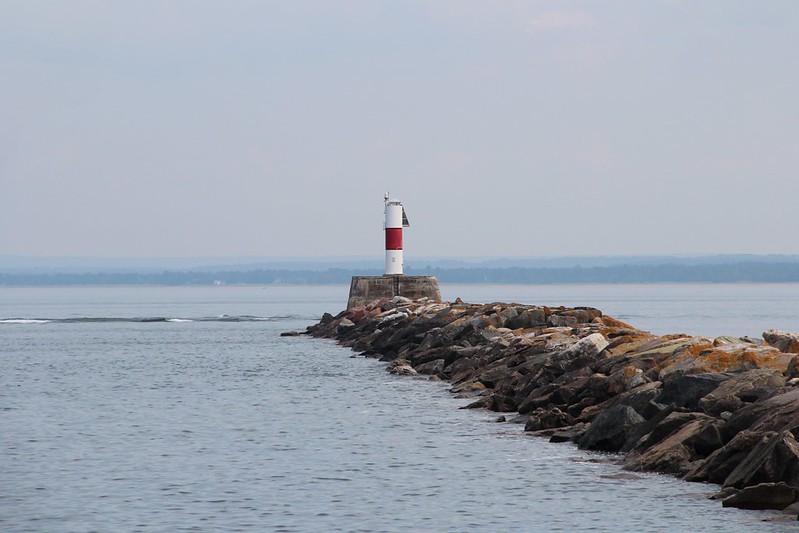
If you have spent any time traveling up around the Great Lakes, you might have observed the structures called breakwaters, which are a feature of many cities with harbors and bays along the lakeshore. Their construction varies, but essentially they are a thin wall or barrier that juts out into the lake in order to do exactly what the name implies—to break the waves that move in toward the shore, creating calm, navigable water on the inner side of the wall for ships and other small craft, while the swells and breakers roll and rage in the great expanse beyond. 

Growing up, every summer we would spend time in Marquette, Michigan, which sits right at the edge of Lake Superior, the largest and wildest of the Great Lakes. There is a breakwater that extends out from the shore there, and when I was young, my family and I would walk out onto it, taking in the views of the water and the city. 

The breakwater in Marquette has been there since the 1800s, reconstructed a few times due to storms, and the first half of it is a sturdy concrete structure, flat easy to walk on in good weather. You can stroll out in this narrow path, the calm harbor to your right, the endless waves to your left, and as a kid it was a thrill to be there on the breakwater, bathed in summer breezes, dancing and skipping out, out, out along the thin line between home and the world beyond, between familiarity and the eternity of blue water stretching toward an unseen shore.

But then there was a point on our walk where we would always stop. About halfway, the breakwater turns at an angle and keeps going farther out into the lake, but this second portion is only comprised of large boulders; the concrete wall ends and from there the going gets slick and treacherous as the waves collide with the bare stone. The only way forward is to scramble and leap and crawl along the rocks. 

My cousins and I always wanted to go onto the rocks all the way out to the end, the very end, where a light tower marked the edge of the breakwater. But the adults wisely said no, it wasn’t safe. So we would turn back. 

And what I could not have perceived then, but that I do now—more and more so with every passing year—is that life is much like that walk along breakwater. When we are younger, setting out into the wide expanse of the world is deliriously exciting, and, if we are blessed with a kind and caring childhood, we take for granted, perhaps, the solid structures beneath our feet. Stay on the straight and solid path, we are told, and all shall be well, and if you are careful, the waves will not break over you, and you will go as far as you need to go. 

But then, somewhere along the way, we get to the place in our lives where the solid footing ends, and we realize, with some surprise and trepidation, that we are no longer children, and that now we are expected to keep going. 

We discover that growing up and growing wise means that the journey does not, in fact, end at the bend in the path, but that life keeps going, going out where there are only rocks to traverse, where the water licks at our heels and sometimes threatens to sweep us away, out where we must indeed scramble and leap and crawl on our knees, and the walls we relied upon for safety suddenly seem much more permeable than they once did. 

One of the times I realized this was when my father had his first major heart attack in late spring, several months before he died. As it happens, I flew into Marquette, where he was in the ICU, and I remember seeing the lake as we drove through town in between hospital visits, and I remember seeing the breakwater, too, curling like a question mark out into the blue expanse, a reminder of simpler springs. 

And I remember feeling, in that moment, like my own solid path had ended, but that I was now required to keep moving forward out where there were only rocks ahead, with no one there to call me back.  I suspect most of us have had experiences like that.

And, in our passage from John’s Gospel today, this is also such a moment for Jesus, where the solid path he has been traveling since the day he was born comes to a precarious place , and when he, too, accepts that he must still keep going, out, out, onward, to where the footing is uncertain and where there is no guarantee of safety. 

“Now my soul is troubled,” he says. “And what should I say—‘Father, save me from this hour’? No, it is for this reason that I have come to this hour.”

Just as the other Gospel authors record his struggle in the Garden of Gethsemane, here John depicts Jesus at the edge of his own understanding, wrestling to reconcile the deep love he shares with his Father with the dawning sense that this love is no guarantee of preservation. Quite the opposite, in fact—this love for the Father is now clearly an invitation, a call, out onto the rocks where certainties end and faith alone must guide him. 

This love that has been growing in Jesus, that has been manifesting in his deeds and his teachings, this love that has bathed him in clear, calm living water, is now rolling in like a wave, rolling in from the unseen shore, and he knows, now, that to be all that he must be, to do all that he must do—for himself, for us—the wave must break over him, come what may, and the rock must be the place where he plants his feet and carries his cross and builds his church, the rocks where the walls of safety, the walls between heaven and earth, the walls between familiarity and eternity, seem much more permeable than they once did. 

It’s interesting, too, that this moment occurs alongside Andrew and Philip, who have been asked by some Greek believers to come and “see” Jesus, echoing Andrew and Philip’s own encounter with Jesus at the beginning of John’s text. Because inasmuch as this passage is Jesus reckoning with the nature of his own journey, it is also a moment for his disciples—including us—to reckon with ours. For “where I am, there will my servant be also.” If we are to follow Christ, then the rocks and the waves beckon us all. 

And our reaction to this realization might depend on where we stand. If we have become too comfortable in our faith, if we have become accustomed to solid ground beneath our feet, if we have not dared to venture out to the places where love requires us to risk something, then we, too, might feel our souls troubled by Jesus’ call. 

If so, then today we are being asked to take one small step outward onto the rocks—one small step towards admitting that we don’t have all the answers, ones step towards being vulnerable, towards embracing new ideas, new relationships, new ways of opening our hearts, new ways of standing with the poor and the forgotten and the storm-tossed—so that we might follow the path that Jesus has already traversed.

But if you are already out there on the rocks, somewhere between scrambling and leaping and crawling on your knees; if you already know all to well what it feels like to have left your certainties and safety behind, then perhaps Jesus’ call will be a consolation, because you will come to understand that even when the path crumbles under your feet, you are not lost. For this, too, is part of the path. 

And this is, in fact, the part of the path that we must travel if we ever want to grow up, if we ever want to grow, to reach that place where familiarity and eternity meet, where home and heaven lap up against one another: out, out at the outermost edge where Jesus abides, where he burns like a light at the end of the breakwater, at the end of every journey, drawing all people to himself, blessing every rocky path you have walked, every crashing wave that has washed over you, and every weary heart, including yours.

I have not been out on that breakwater in Marquette for many years, now, but I hope to go back someday. I still have a little bit of my father’s ashes, and if I can, I’d like to sprinkle a few into the lake there. But I am no longer a child, now, so I think that when I go, I’ll venture out a bit farther out onto the rocks to do so, to let his ashes mix with the water and the wind. It feels right, somehow, that this is how it must be, and where it must be, on that thinnest of lines between home and the world beyond. 

And though my feet might be a little unsteady, and my eyes might sting, I think my heart will still dance and skip like it once did.

It will not be entirely safe. Life never is. Love never is.

But it is still part of the path. And God will be there. 

The Church is Crumbling: A Sermon

I preached this sermon on Sunday, April 3rd, 2022 at Trinity Episcopal Church, Fort Wayne. The lectionary text cited is John 12:1-8, when Mary of Bethany anoints Jesus with precious nard.

Now, I don’t want to alarm anyone inordinately on a Sunday morning, but I have to tell you that the church is crumbling.

I’m actually not making a dire prediction about the future of the institutional church (plenty of others are doing that these days). I mean, quite literally, there are bits of Trinity’s building that are crumbling on the outside that will need a little maintenance. Fr. T.J. and I were walking back from lunch the other week when he noted a spot on the exterior of the nave that needs some repair to the mortar work. Such things are to be expected in a building nearly 160 years old, and don’t worry, the members of the Vestry are keenly aware of the ongoing project list to care for these old stone walls. It is part of our collective labor of love as stewards of this community for future generations. 

In every age, as the ones entrusted with the care of the present moment, it is our task to keep an eye out for the cracks in the world around us: the broken bits of buildings and of hearts, the accumulating dust of neglect, the water streaming down in rivulets from leaking roofs and from tear-filled eyes. All of us, both building and people, get a bit tired and careworn eventually. All of us need tending. And so we patch each other up, we put mortar into each others’ broken spots, we carry one another and we carry on. This is our shared responsibility in life, as it always has been.

The tendency towards decay and disorder, whether in church walls or in other human endeavors, has a name derived from science. It is called entropy. The word was coined in the 19th century by the German physicist Rudolf Clausius, who was a leader in the study of thermodynamics. Clausius observed that the energy in heat-powered systems, like steam engines, was not all harnessed; some of it was lost and dispersed, no matter how efficient the system. This unavoidable tendency towards loss and disintegration of energy, he concluded, was the default mode of the material universe.  In other words, entropy suggests that when left to their own devices, things tend to fall apart.

The idea of entropy has since been applied to many aspects of human life, not just physics. And intuitively, I think it makes a lot of sense, even in non-scientific terms. Ideological, cultural, and political movements change and decline over time. Relationships, when we don’t invest in them, drift apart. All the seemingly solid markers of fame, prestige, and strength that we might accumulate in our life eventually diminish. And, eventually, each of us will die and, as we were reminded at the outset of this Lenten season, to dust we shall return, to mix with the crumbling stones and the memories of a thousand generations. 

Holy Scripture is full of the idea of entropy, even if it doesn’t name it as such—think of the Book of Ecclesiastes: “vanity of vanities, all is vanity!” Or the Psalmist, who says “those of high degree are but a fleeting breath, even those of low estate cannot be trusted. On the scales they are lighter than a breath, all of them together.”

The question is, what do we do with this knowledge? If everything in the universe has a tendency towards disintegration, towards chaos, towards loss, then why bother? Why not let the walls come tumbling down?

This is, essentially, the question that this Gospel passage from John asks us. It is the question that Judas and Mary of Bethany are both faced with in those final days leading up to Jesus’ passion and death, and their diverging responses are instructive for us. 

First, there is Judas, who is outraged and offended by Mary’s display of deep devotion—the anointing of Jesus’ feet with precious nard, the intimacy of her hair wound around him in tendrils like branches clinging to the vine. Whether it is out of pure greed or, as I suspect, a whole host of more complicated emotions and motivations, Judas thinks all of this is shameful, wasteful. 

I wonder, though, if this is not so much a matter of Judas misunderstanding what’s going on, but in fact understanding all too well what is about to transpire in Jerusalem. Perhaps Judas has taken Jesus’ prediction of his own death seriously. Perhaps Judas has already given up on him. Perhaps he has seen the cracks in the mortar, if you will, and is ready to walk away from the whole thing.

“Why was this perfume not sold…and the money given to the poor?” he asks, but there is bitterness underneath his words, not generosity. They are the words of a man who has given up on dreams, on love, on friendship, because the entropy of the world and the looming failure of Jesus’s mission has caused Judas to retreat into himself, into his own protective self-righteousness, into his own understanding of how things ought to be.

How hard our hearts become when we try to keep them from breaking. And so Judas decides to break Jesus, instead. He decides to tear down the walls rather than wait for them to fall. 

If we are honest with ourselves, that same tendency is in each of us. Afraid of loss, we run away. Afraid of vulnerability, we slam the door shut. Afraid of being a fool, we become a cynic, with entropy the only news we have to proclaim to the world.

But then there is Mary of Bethany, who is sometimes conflated with Mary Magdalene, but in this moment we will let her be herself. Mary is not naive in her gift-giving. She, too, knows what is coming. She knows that Jesus is approaching an ending. She knows that the nard is costly, and that anointing her Lord will not prevent the pain or loss that is to come. But she does it anyway. She does it because it is what she can do. She does it because she loves him. She does it because she knows, in a way that Judas does not, that in loving someone, nothing is ever wasted. 

Mary, and all of us who would follow in her footsteps, do not deny that death and decay are real. We are not ignoring the fact that things tend to fall apart, that chaos is always at the doorstep. We know that it is. We see the crumbling stones, and we witness the crumbling hopes of too many in every generation. But we show up anyway. We try to mend the cracks anyway, even if we are taken as fools, even if it never seems to amount to very much, because it is what we can do. It is what love requires of us. 

What Mary knew–and what Jesus reveals–is that while entropy might be the most pervasive force in the universe, the most powerful force is love. It is only love that will dare to bind up what is broken. It is only love that can gather in what is lost. It is only love that refuses to give up even when things keep going wrong. And no matter how things disintegrate and scatter, no matter how our own lives fall apart, no matter if these walls do keep crumbling down, no matter if the entire universe breaks apart, God will always be bigger than our brokenness. God holds us. God refuses to give up on us. 

And so we must do the same. What God has said to us, and what Mary says back to God, we must also say:

I will hold what is broken. I will bless it with my deepest tenderness. I will spend all of my love on the things that are doomed to decay, which is, in fact, everything. And though I may weep, though my heart might break at the seeming futility of love, I know in a way beyond knowing that it will all make sense some day. That it will have been worth it.

It is worth it. That’s the good news.

So if you get a chance this week, take a walk around the church building. You might spot the broken bits I mentioned or the places where the garden needs tending after a long winter. You might notice a crack in the plaster here and there. Our work continues, always. But notice, too, the patches, the repairs, and the additions of those who came before us—the small acts of care by generations of people, some of whom we will never know, but who did what they could even as the walls crumbled in their own time. 

And perhaps, like me, you might offer a prayer of thanksgiving for those people–those with the heart of Mary of Bethany–for the sweetness of their offerings, the memory of which still lingers like perfume in the air.  Perhaps, like me, you might marvel at the fact that because of them, and because of us still trying our best, despite the entropy of the world, we are still standing, and these stones are still standing, held together by love as much as by mortar. 

And perhaps, like me, you will find strength in knowing this: that even if everything else turns to dust, this love will remain. It is the one thing that cannot break. It is the one thing that will never go away.