I preached this sermon on Sunday, March 17, 2024 at St. Anne Episcopal Church, West Chester, OH. The lectionary text cited is John 12:20-33.
If you have spent any time traveling up around the Great Lakes, you might have observed the structures called breakwaters, which are a feature of many cities with harbors and bays along the lakeshore. Their construction varies, but essentially they are a thin wall or barrier that juts out into the lake in order to do exactly what the name implies—to break the waves that move in toward the shore, creating calm, navigable water on the inner side of the wall for ships and other small craft, while the swells and breakers roll and rage in the great expanse beyond.
Growing up, every summer we would spend time in Marquette, Michigan, which sits right at the edge of Lake Superior, the largest and wildest of the Great Lakes. There is a breakwater that extends out from the shore there, and when I was young, my family and I would walk out onto it, taking in the views of the water and the city.
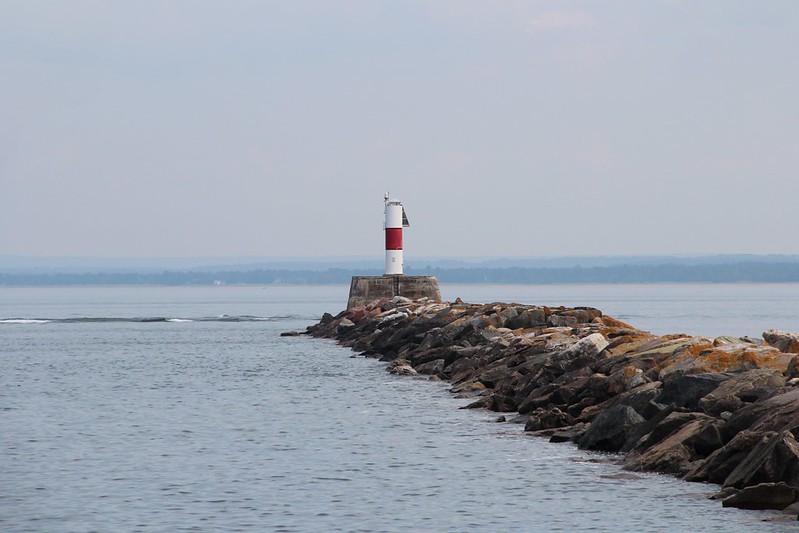
The breakwater in Marquette has been there since the 1800s, reconstructed a few times due to storms, and the first half of it is a sturdy concrete structure, flat easy to walk on in good weather. You can stroll out in this narrow path, the calm harbor to your right, the endless waves to your left, and as a kid it was a thrill to be there on the breakwater, bathed in summer breezes, dancing and skipping out, out, out along the thin line between home and the world beyond, between familiarity and the eternity of blue water stretching toward an unseen shore.
But then there was a point on our walk where we would always stop. About halfway, the breakwater turns at an angle and keeps going farther out into the lake, but this second portion is only comprised of large boulders; the concrete wall ends and from there the going gets slick and treacherous as the waves collide with the bare stone. The only way forward is to scramble and leap and crawl along the rocks.
My cousins and I always wanted to go onto the rocks all the way out to the end, the very end, where a light tower marked the edge of the breakwater. But the adults wisely said no, it wasn’t safe. So we would turn back.
And what I could not have perceived then, but that I do now—more and more so with every passing year—is that life is much like that walk along breakwater. When we are younger, setting out into the wide expanse of the world is deliriously exciting, and, if we are blessed with a kind and caring childhood, we take for granted, perhaps, the solid structures beneath our feet. Stay on the straight and solid path, we are told, and all shall be well, and if you are careful, the waves will not break over you, and you will go as far as you need to go.
But then, somewhere along the way, we get to the place in our lives where the solid footing ends, and we realize, with some surprise and trepidation, that we are no longer children, and that now we are expected to keep going.
We discover that growing up and growing wise means that the journey does not, in fact, end at the bend in the path, but that life keeps going, going out where there are only rocks to traverse, where the water licks at our heels and sometimes threatens to sweep us away, out where we must indeed scramble and leap and crawl on our knees, and the walls we relied upon for safety suddenly seem much more permeable than they once did.
One of the times I realized this was when my father had his first major heart attack in late spring, several months before he died. As it happens, I flew into Marquette, where he was in the ICU, and I remember seeing the lake as we drove through town in between hospital visits, and I remember seeing the breakwater, too, curling like a question mark out into the blue expanse, a reminder of simpler springs.
And I remember feeling, in that moment, like my own solid path had ended, but that I was now required to keep moving forward out where there were only rocks ahead, with no one there to call me back. I suspect most of us have had experiences like that.
And, in our passage from John’s Gospel today, this is also such a moment for Jesus, where the solid path he has been traveling since the day he was born comes to a precarious place , and when he, too, accepts that he must still keep going, out, out, onward, to where the footing is uncertain and where there is no guarantee of safety.
“Now my soul is troubled,” he says. “And what should I say—‘Father, save me from this hour’? No, it is for this reason that I have come to this hour.”
Just as the other Gospel authors record his struggle in the Garden of Gethsemane, here John depicts Jesus at the edge of his own understanding, wrestling to reconcile the deep love he shares with his Father with the dawning sense that this love is no guarantee of preservation. Quite the opposite, in fact—this love for the Father is now clearly an invitation, a call, out onto the rocks where certainties end and faith alone must guide him.
This love that has been growing in Jesus, that has been manifesting in his deeds and his teachings, this love that has bathed him in clear, calm living water, is now rolling in like a wave, rolling in from the unseen shore, and he knows, now, that to be all that he must be, to do all that he must do—for himself, for us—the wave must break over him, come what may, and the rock must be the place where he plants his feet and carries his cross and builds his church, the rocks where the walls of safety, the walls between heaven and earth, the walls between familiarity and eternity, seem much more permeable than they once did.
It’s interesting, too, that this moment occurs alongside Andrew and Philip, who have been asked by some Greek believers to come and “see” Jesus, echoing Andrew and Philip’s own encounter with Jesus at the beginning of John’s text. Because inasmuch as this passage is Jesus reckoning with the nature of his own journey, it is also a moment for his disciples—including us—to reckon with ours. For “where I am, there will my servant be also.” If we are to follow Christ, then the rocks and the waves beckon us all.
And our reaction to this realization might depend on where we stand. If we have become too comfortable in our faith, if we have become accustomed to solid ground beneath our feet, if we have not dared to venture out to the places where love requires us to risk something, then we, too, might feel our souls troubled by Jesus’ call.
If so, then today we are being asked to take one small step outward onto the rocks—one small step towards admitting that we don’t have all the answers, ones step towards being vulnerable, towards embracing new ideas, new relationships, new ways of opening our hearts, new ways of standing with the poor and the forgotten and the storm-tossed—so that we might follow the path that Jesus has already traversed.
But if you are already out there on the rocks, somewhere between scrambling and leaping and crawling on your knees; if you already know all to well what it feels like to have left your certainties and safety behind, then perhaps Jesus’ call will be a consolation, because you will come to understand that even when the path crumbles under your feet, you are not lost. For this, too, is part of the path.
And this is, in fact, the part of the path that we must travel if we ever want to grow up, if we ever want to grow, to reach that place where familiarity and eternity meet, where home and heaven lap up against one another: out, out at the outermost edge where Jesus abides, where he burns like a light at the end of the breakwater, at the end of every journey, drawing all people to himself, blessing every rocky path you have walked, every crashing wave that has washed over you, and every weary heart, including yours.
I have not been out on that breakwater in Marquette for many years, now, but I hope to go back someday. I still have a little bit of my father’s ashes, and if I can, I’d like to sprinkle a few into the lake there. But I am no longer a child, now, so I think that when I go, I’ll venture out a bit farther out onto the rocks to do so, to let his ashes mix with the water and the wind. It feels right, somehow, that this is how it must be, and where it must be, on that thinnest of lines between home and the world beyond.
And though my feet might be a little unsteady, and my eyes might sting, I think my heart will still dance and skip like it once did.
It will not be entirely safe. Life never is. Love never is.
But it is still part of the path. And God will be there.
 By Another Road