

Lock: A Sermon

I preached this sermon on Sunday, June 9 at St. Anne Episcopal Church, West Chester, OH. The lectionary texts cited are 1 Samuel 8:4-20 and Mark 3:20-35.

Last week, while Matt and I were on vacation in Boston, we did a lot of walking. And of course we visited all of the famous sites in the city: the Old North Church, and Paul Revere’s house, and Bunker Hill, and all the rest. But we also ended up in some lesser known corners. I won’t say we were lost, but at the end of one day, we were trying to find our way back across the Charles River to the central part of the city. We came across a narrow little walking path that cut through a park and then over a series of concrete structures in the river. 

As we crossed over, I saw that it was a dam used to control the inflow of saltwater from the ocean and that it had a series of locks built into it to make the water navigable for boats traveling up and down the river. So we stopped for a moment to look. 

I’ve always found locks interesting—the kind for boats, not for doors—maybe because I grew up in proximity to the famous Soo Locks up in Sault Ste. Marie, Michigan, where large cargo ships must pass through to get from Lake Superior to the rest of the Great Lakes. 

The basic concept of a lock, if you have never seen one, is that a boat, when it is passing from one elevation of water to another, enters into an enclosed chamber, and then water either flows in or out of the chamber so that the boat can rise or fall and then emerge safely on the other side at the proper elevation. They are elegant and ingenious in their simplicity, and you can find them all over the world, in all sorts of settings.

But as we looked down into these locks in Boston, I was surprised to see one little boat, just floating there in the chamber, in the still water, with nobody on board. Now, I am sure there was a perfectly mundane reason for this boat to be left there, but it struck me as a rather forlorn sight, almost as if the boat had been abandoned, mid-journey, trapped between the river and the sea, left to sit alone in this chamber of somber, motionless water, surrounded by gray cement walls, waiting for someone to claim it and release it. 

And, as it happens, that image of the boat trapped in the lock came to my mind this week as I was reflecting on our Scripture lessons—probably because I was thinking about the price we are sometimes asked to pay for safety and for belonging.

Just as that boat was suspended in motion, confined to a safe place that it was not meant to stay in forever, so, too, I think, we can find ourselves trapped in proverbial locks—ones that we have constructed for ourselves or that we’ve drifted into unwittingly—and in those moments we need to be reminded that we were meant for something more.

Consider: in our first passage from the Book of Samuel, Israel wants a king. They want a king because they are a bedraggled and storm-tossed people; they are weary of being vulnerable, weary of having to trust in the guidance of a God whom they cannot see. They want to be like other nations, they want to be ruled by the sort of king they can comprehend, the kind who will put them on the same level as their adversaries. And so they enter the lock. 

But Samuel warns them—and warns us still: beware of hiding yourselves within the stone walls of an earthly king’s protection, because you might get stuck there, stifled and crushed by the very safety you once craved. That’s why Samuel says, in that day you will cry out because of your king, whom you have chosen for yourselves; but the Lord will not answer you in that day. Personally and politically,God will let us build up all the walls we think we need, but it will also be up to us to dismantle them when we realize we’re trapped inside. All of history seems to be us learning this lesson over and over again. 

Because now, as then, God wants us to remember that the human heart and our common destiny was not meant for small spaces, intellectually, socially, or spiritually—we were created for for expansiveness, for mutuality, for the practice of a love that is broad and deep, the kind that ultimately cannot be contained by fear. 

If our life is something like that little boat in the lock, then God is not found in the walls around us, hemming us in. God is instead the living water rising up beneath us, the bracing current flowing from the depths of time, the One saying, come out, be brave, sail upon the ocean of light, see where the wind of the Spirit carries you, and fear not, for I am with you in every cresting wave.

And, speaking of the Spirit, we must also deal with this morning’s Gospel, which can, again, read as one of those passages that locks us in, with all of this talk about blasphemy and unforgivable sins, and Jesus rejecting his mother and siblings. What does all this have to do with the good news of God’s broad and deep love?

Quite a lot, actually. And here, again, the image of the boat and the lock helped me think about this. 

I think the Church has too often read Scripture as if Jesus himself was the keeper of the lock rather than what he actually is: the ocean that lies beyond it. We have too often imagined Jesus as if he was the heir of King Saul rather than the Son of God. We have entrapped him within the limited nature of our cultural and political imagination, as if he wants to rule over us like any other king. But he does not.

He is, as God was with Israel, as God has always been, the One who warned us against the seductive promises of tyrants. He is the God who wants us to leave behind the locks we have built up, who wants us to open the gates and break down the walls and break open our hearts and unfurl our spirits and cross the sea with him toward a farther, more promising shore.

And that is why, in today’s reading, he rebukes the religious authorities who condemn his healing and his casting out demons all because such things challenge their narrow understandings and harden them against the infinite compassion that is the true power of God. And this is why Jesus rebukes his family’s efforts to restrain his ministry, too. They want to keep his mission quiet and still and respectable like the water pent up in a cement chamber, rather than let it be the raging torrent of mighty waters that it actually is!

Jesus wants them—and us, now—to see: all of the systems and structures and institutions in the world, even the most cherished and fundamental ones, can turn into stifling dead ends if we hide within them, if we resist the outpouring of love and justice and mercy that is the true purpose of being alive.

And until we realize this, until we claim this as God’s true purpose for us—to leave the lock, to brave the waters, to give our lives over to the blowing wind of the Spirit—then we are indeed at risk of blasphemy against that Spirit, which has nothing to do with taking the Lord’s name in vain, but is the serious risk of living our lives in vain—of never letting God transform our hearts and our world. That’s why Jesus came among us. That is why we must set out; that is why our hearts must be set free.

Can you accept that you are loved so deeply and unconditionally that you are indeed free? Are we out there telling others in our community that they are loved that deeply and unconditionally, too?

They need to hear it. Because a lot of people are hurting, and they need to know that the Gospel is, in fact, good news for everyone and everything, without condition or exception. No cement walls. No tyrant kings. Just a river flowing toward the open water, and a wind that will carry us home. 

If we do nothing else in The Episcopal Church and here at St. Anne, I hope that we will realize this and help others do the same. I hope, in this moment in our world when there are so many big questions and deep hurts, that we will understand: the time for waiting behind the walls is over. It’s time to get out there, and show the world who Jesus actually is, and see where his love takes us.

The gates of the lock are open. 

Let’s go. 
Feast: A Sermon

I preached this sermon on Sunday, November 21, 2021, Christ the King Sunday, at Trinity Episcopal Church, Fort Wayne, IN. The lectionary text cited is John 18:33-37.

One of my happiest holiday memories is when I would wake up on Thanksgiving day to the smells of an already-busy kitchen: sage and onion and baking pies and brewing coffee. It was almost as delicious as the meal itself, that long moment of awakening, warm and half-dreaming in the morning light, knowing that there was a feast being prepared, that everyone I love would be gathered in one place, and that, even though the world outside was complicated and so were we, for this one day, at least, there was no need for anything else. There was enough, and we were enough, here, now, together. 

And while for some of us, perhaps, Thanksgiving was never quite so happy an occasion, I do think each of us understands the potency of the idea itself: a time of rest and reunion, a world in which no one goes hungry, where everyone is welcome at the table, where being known and seen and loved is a gift available to all.

As we grapple with some of the entrenched realities and the challenges facing our country and our world—racism, violence, economic inequality, and ecological crisis, to name but a few—I acknowledge that for many the observance of America’s Thanksgiving holiday is fraught with complexity, and I also acknowledge that its celebration can bring up feelings of ambivalence for those among us whose families are fractured or scattered or simply gone. 

But the principle of gratitude that underlies the day is something that must be reclaimed and reinvigorated anew by each generation, so that this is not just the passive reception of an unexamined history or a private lament over a broken family system, but a courageous choice to believe in what is still possible—to believe that there might yet remain much for which we can give thanks. Because even as we face what is ugly and messy about the human condition, we must also hold fast to what is beautiful and hopeful—those simple, good gifts that make life not just bitter, but sweet, that make the struggle worth it, the things that tell a story of hope, not just disillusionment. The things glimpsed around the bountiful table of the present moment—a feast of memory, but also of determination and of expectation of a better tomorrow. 

That’s why I love that after this service we will go upstairs and pack bags with food supplies and encouraging notes for our neighbors so that they, too, might enjoy a Thanksgiving meal. It’s our congregation’s own small gesture of gratitude for the blessings in our own lives, and a demonstration of our belief that the world can still be a hopeful place, a generous place, and that we can help make it so, even when fear and scarcity seem to dominate the narratives around us. 

Choosing to believe in the redemptive possibility of this world—in its goodness, in its capacity fpr renewal—this is part of what we mean when we speak of the Kingdom of God—not just a place up in the heavens that we escape to when we die, but the emergent, lived reality of God’s love here and now—the power of that love, the triumph of that love, the sovereignty of that love. The ultimate gift for which we give thanks.

And so while it is somewhat a fluke of the calendar, it is fitting, perhaps, that Thanksgiving and Christ the King Sunday fall in proximity to one another, because each observance, at its best, calls us toward a vision of beloved community. Thanksgiving  calls us back to what is essentially good and true in our own lives, and as we conclude the calendar of the church year and prepare for the cycle to start anew with Advent next week, we pause to ask ourselves: who is this Christ, this King whom we worship and follow? What is the essential goodness and truth that he brings? And how do we take part in it?

I will admit that answering these questions and then living into the answers can be harder than we care to admit. We want to believe that love wins, that hope endures, but sometimes we look at the world around us and we look up at Jesus above the altar, on the cross, and we can feel as incredulous and bitter as Pontius Pilate, and we ask: Are you the King? Are you? Because you are nothing like any king I have ever seen. You are not the sort of king who fixes all of the problems around us. And even if you are, what is truth when no one is honest anymore? And what is love when everyone is just out for themselves? And what is justice when blood flows in the streets and children go hungry, just as it has always been? And what is hope when it’s just the same bitter pill to swallow, time after time?

Are you the King? 

And Jesus simply looks back at us, infinitely tender, and says: “You say that I am a king. For this I was born, and for this I came into the world: to testify to the truth.” 

 Because the truth is that Jesus’ power, Jesus’ kingdom, is still not the type we expect it to be. And he comes into our midst, still, not to rule like other kings. Not to control. Not to gather power and wealth at the expense of others, and not to tell us to do so in his name. Jesus comes to testify to a truth that is deeper and more powerful than kingship, even if it is less obvious. A truth that God has been trying to convey from the very beginning, although we continue to ignore it, time and again. 

A truth that rises up, growing like a seed sown in a field A truth that rises up like yeast in bread. A truth that rises up like a spring of living water. A truth that rises up and refuses to be killed or silenced, even in our most desolate, hungry moments: the truth that love persists through death. The truth that mercy persists through brokenness. That there is, indeed, enough for everyone, if we will let it be so. That we are, indeed enough. That we belong to this earth and to one another. That we are known and seen by God in our weakness, in our hunger, and we are forgiven. 

The truth that we have to stop being afraid, stop hiding from God and one another, and step out towards each other with hope and gratitude and say, yes, here I am. And yes, I believe in your goodness, Lord. And yes, I believe that it is love—not fear, not the power of kings—that is the strongest force in the universe. And so I will take a chance on this Kingdom, I  will reach out my hands to the world, to my neighbor, to give and to receive, to bless and to be blessed, to join in the feast, to gather round the table where there are always enough seats, always enough to satisfy even the hungriest of hearts.

Because that’s the thing to remember about Christ as a king, as a ruler. What did he actually rule over? In his earthly life, Jesus never led an army into a battlefield, nor did he oversee a court of law, nor did he celebrate a Temple rite. 

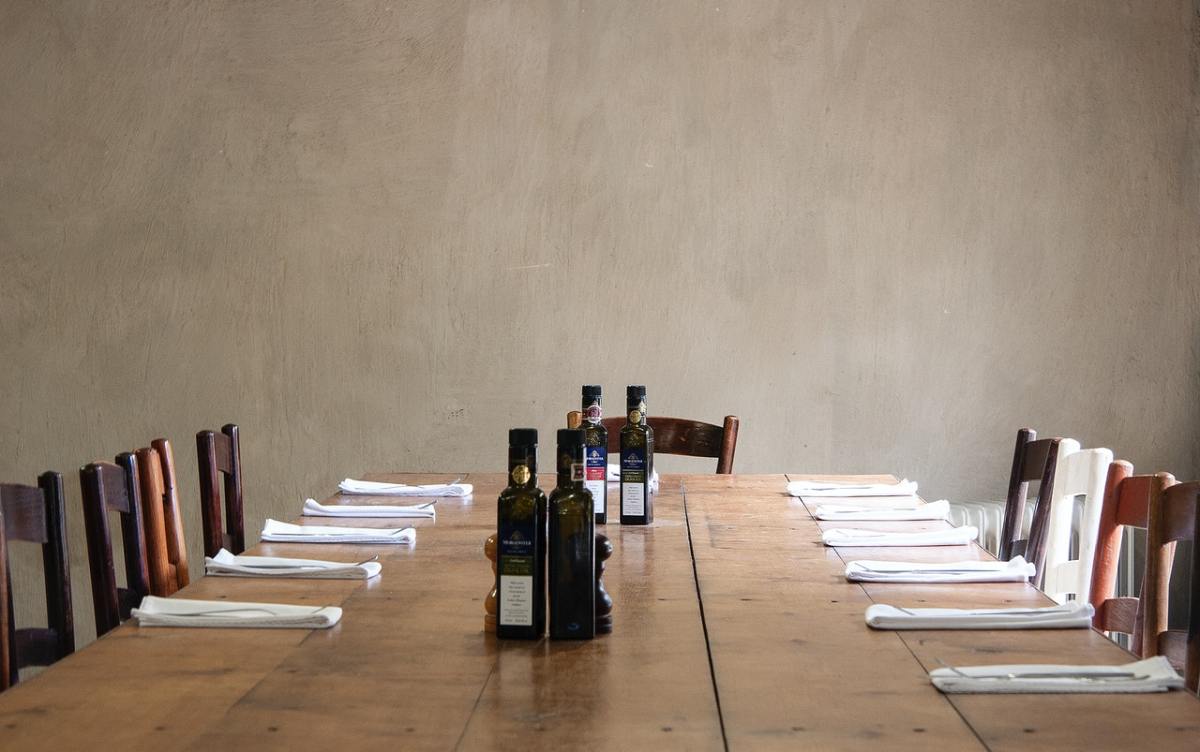
Instead, he presided over…a meal. Many meals, in fact, culminating in the Eucharistic banquet in which we still take part. A meal to nourish the world. A meal in which his own life, his own love is the substance. He is the Lord of the feast, the King of the abundant table, and more than anything we are his grateful guests, called to celebrate with him, called to invite others to take their place alongside us. 

That is the Kingdom of God, my friends. That is what will transform the world. That is what will transform us. Bigger hearts and bigger tables. More time spent breaking bread, listening to one another’s stories and creating a new story together. A story that tells of peace, of justice, of the deep joy that is the birthright of all people. A story that can yet be true. 

May we live like this, on Christ the King Sunday, on Thanksgiving Day, and on every other day, for the rest of our lives. And then, by God’s grace, may we one day, after a long and deep and restful sleep, wake up in the morning light of a new life, a new earth, warm and half-dreaming, to the smell of brewing coffee and baking pies, and may we know that we are home, that we are all home together at last, and that there will always be enough, and that we will alway be welcome, in that beautiful Kingdom, at that glorious table, forever.