Jackrabbit: A Sermon

I preached this sermon on Sunday, February 9, 2025 at St. Anne Episcopal Church, West Chester, OH. The lectionary texts cited are Isaiah 6:1-13 and Luke 5:1-11.

Fun fact about me: at least three or four times, I’ve traveled the remnants of Route 66, that famous old highway which once stretched from Chicago to Los Angeles. A lot of the roadside attractions and cafes and motels from its heyday in the 40s and 50s have been lost to time, but even now it’s a beautiful and worthwhile trip, a sort of pilgrimage road across America, where odd wonders abound.

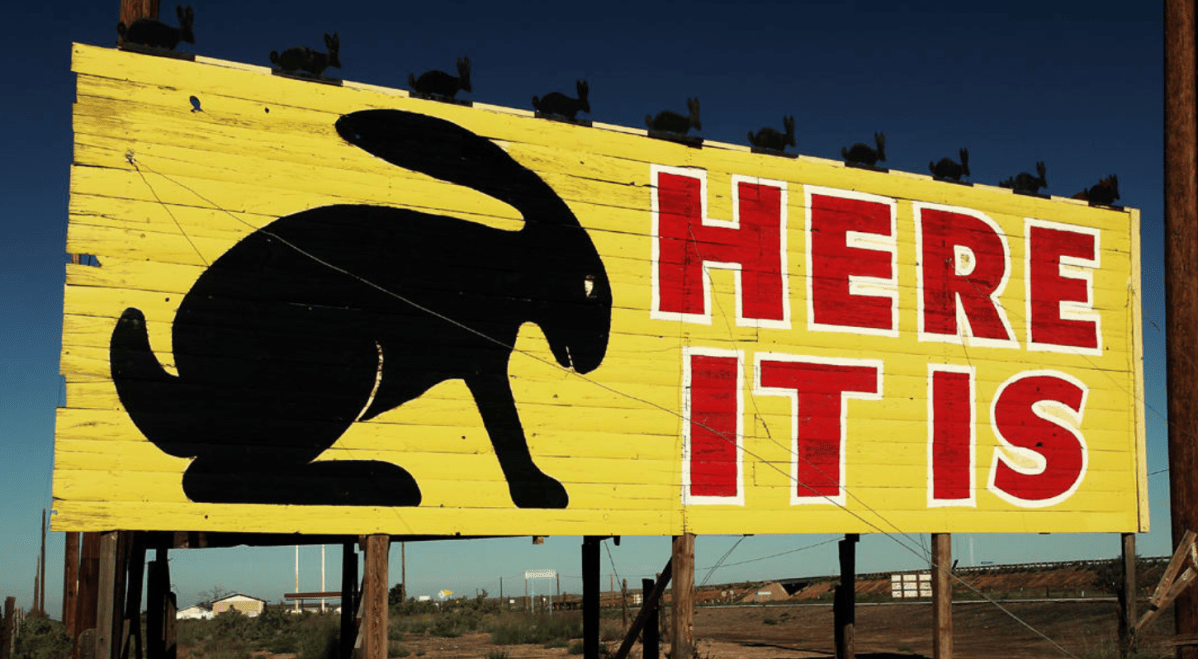
For example, as you drive across northeastern Arizona, just a bit south of Navajoland, you might notice these signs along the desert highway. They’re ambiguous, just old wooden billboards painted bright yellow, no words, just the silhouette of a big black rabbit and a number of miles counting down. 

150 miles, one sign says…and then 100….and 50….and 10…and as you drive across the empty landscape with not much else to look at, you find yourself overly invested in these mysterious signs, wondering, what exactly are we counting down to? What is that big rabbit all about? What or who is waiting out there across the desert, across the hours and the miles and long, winding road?

So you can imagine that, by the time you get to the end of the countdown, you have to pull off the highway to see whatever this thing is that has been tantalizing, taunting, beckoning you. And as you arrive at the exit, there’s one last sign, bigger than all the rest, still bright yellow like the noonday sun with that big black rabbit and big red letters that spell out, at last, three words: HERE. IT. IS.

That’s all the sign says. Here it is.

And you better believe, like countless travelers before us, we turned off the highway to see what IT is. Nothing would have stopped me. 

And do you know what’s there, shimmering in the desert sun, under the gaze of the big black rabbit?

A gift shop. 

Yes, it’s just a gift shop. Mildly disappointing, perhaps. It’s the Jackrabbit Trading Post and it’s been there since 1949 offering t-shirts and cold drinks and restrooms for all those wide-eyed pilgrims.

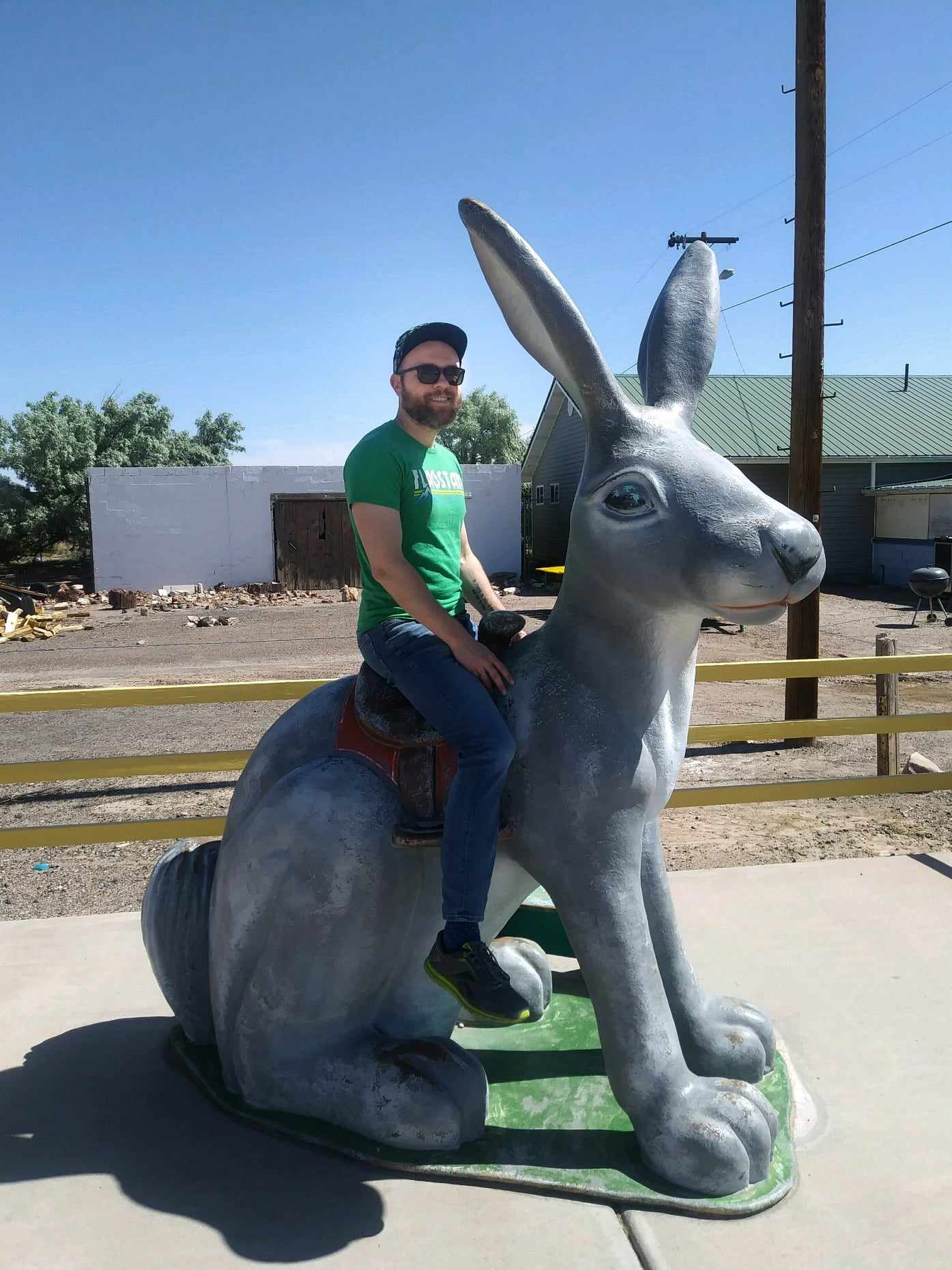
But if that sounds underwhelming, fear not. Because there’s also a big statue of a jackrabbit in the parking lot, with a saddle attached to it, that you can mount for a completely absurd photo of yourself. And did I get up on that jackrabbit every single time I’ve stopped there, including when I was 35 years old? You bet your life I did!

Because, well, why not? Maybe the sign is right after all. Here it is, five miles outside of Joseph City, Arizona…as good a place as any to find whatever it is we’ve been looking for in this life. 

As the years go by, I’ve found a sort of contemplative wisdom in that phrase, here it is. Especially when things don’t go quite the way I thought they would.

Bad diagnosis? Bad breakup? Tough election outcome? Before I can act purposefully, I have to start by saying, well, here it is. And, since it has always been true before, I also have to trust that God is not done with me just yet. In the meantime, the best I can do is to just get up on the jackrabbit so to speak, and accept the invitation of the present moment. 

Because here it is, this moment we’ve been given. And there’s still abundant life to be found here. Besides, what I notice so often in Scripture is that that the mildly disappointing and the foolish and the transcendent often converge in surprising ways.

As it happens, we have two such stories in our readings this morning—two call stories where somebody gets less than what they bargained for. Here’s what I mean.

First there’s Isaiah. Forget the billboards, he’s just had a vision of the throne of God, a glimpse of the heavenly court singing the same song we do during the Eucharist, Holy, Holy, Holy Lord. And he’s been touched by the burning coal of truth and he feels ready. HERE I AM he cries out. HERE IT IS! Here is my time to shine, my opportunity to tell the world exactly how powerful God is!

But God says, no. That’s not quite how this works. In fact, the people will not hear you. They will not understand. No, as they tend to do, the people will look for other, smaller, more alluring salvations, the ones promised by the forces of this world with better marketing. No, God says, you, my prophet, you will be left alone in the dry desert, sitting up there on your jackrabbit, the cars whizzing past you. But even though you won’t understand it, I am asking you to get up on there anyway. Here it is.

And then there’s Simon Peter, who sees Jesus perform the miraculous sign of abundant fish at Lake Gennesaret. Peter, like Isaiah, is both impressed and overwhelmed by this show of power, and he tells Jesus, “go away from me Lord, for I am a sinful man,” but we can also imagine he’s pretty excited to be in proximity to the One who can do such things. He may feel unworthy, but he wants to be among the inner circle of such a Lord. 

But as we will come to see, Jesus does not end up saving the world through abundant displays of power. The fish thing is a bit of a head fake. Not because God can’t do impressive things, but because Jesus chooses not to, and it’s in the self-limiting, foolish weakness of God that true salvation becomes possible for us all. A Messiah who rides on the back of a donkey, which is not a jackrabbit, but pretty close.

And those, like Peter, who have been counting down the miles til their glimpse of the Messiah, are destined to be mildly disappointed, at least for a little while. But here it is.

God says to all of us still clamoring for an impressive sort of divinity who is nothing more than the satisfaction of our desires—God says, no. That’s not quite how this works. 

I am the God of forgotten things…of forgotten trading posts and forgotten people on the side of the road. I am not in the halls of power and privilege and plenty. I am waiting for you out on the wilderness road, waiting to share a drink and a meal with you, out under the ramshackle sign that says, HERE IT IS. Here is what salvation is, at the intersection of the sublime and the absurd. Waiting for those brave, holy fools who understand that sometimes in this life, you just have to get up on the jackrabbit and go with it. 

And really, we do.

In such a time as we are living through now, friends—a time of political crisis and climate crisis and cultural crisis, when Neo-Nazis are trying to set up their own signs above our highways and when it can feel like we are many miles from home—in such a time as this, we run a great risk as disciples of Jesus.

We run the risk of being so burdened by fear that we lose our ability to respond to the present moment with what it requires: defiant, purposeful joy. We run the risk of letting despair make us small and hard and cynical and incurious, terrified of the future and longing for the past, unable to get on with the somewhat absurd work of hope and love here, now, where it is needed. We cannot let that happen. We will not let that happen here.

At the risk of exhausting the metaphor, we need to get up on the jackrabbit—to clamber up onto the unapologetic foolishness of our proclamation, which is that Christ’s mercy and peace and kindness are more substantive than the evil we see. And even if it’s not as impressive or mighty as some of the other narratives out there, we have to go with it. Because that proclamation is the only thing that will save us.

And as for the ones who try to put up the billboards of hate and fear and petty grievance to lure people in—to them we point to our own unambiguous signs—to the Cross of Christ crucified for love’s sake and to the Risen Christ who defeated hatred for love’s sake, and we say, HERE IT IS. Here is the truth about about this world: foolish and transcendent and sometimes mildly disappointing, yes, but also lovely and good and worth not giving up on. Worth following. Worth looking a bit foolish for.

So, like those who have been called before us, here we are, too, Lord. Here we are, only beginning to understand what You are all about. Here we are, praying and serving and speaking truth and caring for our weary neighbors. Here we are, counting down the miles, trusting your promise, the one that waits for us at the end of the many lonely roads we have traveled.

Here we are, ready to just go with it, ready to speak your name and get up on that jackrabbit and tell the world, tell anyone who will listen—

Here it is. You who have been longing for whatever is on the other side of fear and disappointment. 

Here it is. 
On Facebook: A Sermon

I preached this sermon on Sunday, February 4, 2024 at St. Anne Episcopal Church, West Chester, OH. The lectionary texts cited are Isaiah 40:21-31 and Mark 1:29-39.

Today, February 4, 2024, is a somewhat significant anniversary. Do you know what it is?

It’s the 20th anniversary of Facebook. 

On February 4, 2004, Facebook, or “The Facebook” as it was originally known, was launched by a team of students at Harvard as a sort of high-tech student directory and then began its long, seemingly unstoppable march towards changing the way we interact with one another and the world around us. Two months after launching, in 2004, it had 70,000 active monthly users. Now it has over 3 billion, or 37% of the world’s population. As with many types of anniversary dates, reflecting on who we were then, before Facebook, and who we are now might bring up some mixed feelings. 

I was a senior in college when Facebook started, and I still remember hearing about it from some friends and signing up for the website in my dorm room in early 2005, uploading a grainy picture of myself and hunting for my real-life friends on there, when there were no links to news articles, no “like” buttons, no videos or vindictive comment sections. 

It was, back then, a novel and gently thrilling thing to be able to connect (or reconnect) with so many people at once, almost as if everyone you had ever known had moved back into your neighborhood, their lives and their stories no longer obscured by time and distance. Maybe you, too, if you ever signed up for Facebook, felt that same sense of promise, of an infinite horizon somehow drawn close enough to touch. 

But 20 years on, even if we continue to be active users of Facebook or other social media platforms, I think it’s safe to say that we have come to experience the shadow side of such a vast network of connections. And I am not just referring to the casual vitriol that seems to infect so much online discourse or the amount of time we spend staring at screens, though those are major challenges of their own. 

But even more fundamental than these, I think, and something that we might overlook, is that the vastness of information and awareness that is available via digital social networks is more than any one person is equipped to process and integrate. It might be wonderful to reconnect with lost friends, but it is also true that we only have so much bandwidth to invest in deeply meaningful, mutual relationships. 

And it is indeed valuable to have access to information about other people’s experiences, especially those whose lives are very different from our own, but the unceasing avalanche of content of all kinds, means that we also run the risk of becoming numb from overexposure, or that we end up spend a great deal of energy arguing and posturing around areas of social concern without actually engaging them in our off-screen realities.

But it makes sense that this would happen. It is not simply a failure of the will, but the reality of our limited capacity as mortal beings who, despite our deep hunger for knowledge and our inherent sense of empathy, cannot know everything, cannot respond to everything in the world with the depth and nuance it requires.

And running up against our limitations in the face of the seemingly infinite need and infinite possibility of the world–transmitted to us online–can lead us to rage, or despair, or cynicism, or some strange mixture of the three. Thinking of this through a scriptural lens, every day we bite the bitter fruit of the tree of knowledge of good and evil, and the truth is as it always has been: it was not meant for us; we cannot digest it. 

And here we are, 20 years on. 

But lest we get too down on ourselves and the ills of a digital age, we must acknowledge that this wrestling with our capacity for knowledge and compassion is as ancient as existence itself. It is a tension that is woven into all of Scripture, including our readings this morning. 

The prophet Isaiah, in a passage of both comfort and gentle reproach for Israel, asks the people whether they have forgotten the incomparable scale of God–not only that God is acting on their behalf, to care for and deliver them, but that God alone has the capacity to do so. They, by themselves, cannot conceive of or effect their own salvation. Only God can do that. God alone is able to hear and understand the many cries of the people, to bear the pain and the longing of all creation and discern a path toward healing and reconciliation. God alone can do that, because God alone has a heart large enough to break open and hold all things, and to beat and to burn with determination for the rescue and restoration of all things. 

Have you not known? Have you not heard? Has it not been told you from the beginning? It is he who sits above the circle of the earth…his understanding is unsearchable…he does not grow faint or weary. 

In other words, only God can digest the fruit of the tree of knowledge. Only he can bear the fullness of knowing and loving all of us and each of us. And God does not give in to rage or despair or cynicism in the face of our infinite need. Our hope is found in the One who can do what we ourselves cannot: to be the agent of infinite compassion, of unyielding justice, of uncompromising charity. This is who God is for us. 

And yet this truth about God sets up a deep and striking irony in the Gospel passage from Mark, where Jesus, picking up from last week, continues his ministry of healing and exorcism and in so doing, draws out the desperation and the hope and the curiosity of everyone in his vicinity, such that “the whole city was gathered around the door.” The whole city was gathered around the door. Much like reading the news online, when it can feel like the whole world is at our door, it was surely more than any one person could keep up with or even comprehend. Even Jesus.

Because unlike the infinitely expansive capacities of God spoken of in Isaiah, Jesus is–like us–just one man. Despite his eternal power, he is as finite as we are, and he can only take in so much need, so much information. And this is perhaps why, whether out of exhaustion or frustration, or both, he decides to evade the clamoring crowds, trying to stay focused on his mission to proclaim the Kingdom. 

It is as though God, in the flesh, had his own epiphany: the needs of the world are too numerous for any of us to comprehend, much less to solve on our own. We children of the dust cannot bear the fullness of what it means to be alive, to suffer, to dream. And we need something more than help. We need some measure of God’s mind, God’s heart, God’s body to mingle with our own if we ever hope to digest the bitter fruit of the tree and know what to do with it. 

And that, of course, is what Jesus ultimately gives us—not just help, but transformation into his likeness. This is my body, given for you. My peace I give to you.

So I think of Jesus, sometimes, when I struggle on Facebook and elsewhere with the enormity of the world’s grief and anxiety and the endless profusion of the world’s ideas. I think about how he, too, struggled to take it all in, and had to figure out what to do. I think about how his decision, in that moment, was not to try and understand everything or solve everything, nor to reject everything, but to love everything.

I think about how he showed up as one of us and how he blessed our finitude; how he demonstrated that true wisdom is less about an infinite capacity for knowledge or strength and more about getting in touch with the deep well of compassion that forms and sustains the cosmos. 

And I think about how we are invited—when we are overwhelmed by waves of information and endlessly expanding networks of connectivity—to neither ignore them nor to be subsumed by them, but, like Jesus, to find the still, small center of love that abides at the core of our immensely complex world and to hold fast to it no matter what. To observe and bless the ground beneath our feet; to pray; to heal whom we can heal; to love whom we can love; to proclaim what we have been sent to proclaim–the Kingdom of incarnate love; to trust that this will be sufficient. 

And to realize that, as we do so, even in our limited capacity, we are taking part in the infinite; that we are part of the broken, beating, burning heart of the One who will gather us all in and hold us; the One does not grow faint or weary, the One who will someday carry us up on eagle’s wings into the vast interconnectedness of heaven and creation, of time and eternity. Into something far better than a social network–into the very fabric of life itself, where we will be truly known and understood, where our infinite stories and endless longings will finally make sense, and where the fruit of the tree of knowledge, at long last, will be for us, and we will eat of it, and it will be sweet.

Courage: A Sermon

I preached this sermon on December 22, 2019, the fourth Sunday of Advent, at Trinity Episcopal Church, Fort Wayne, IN. The lectionary texts cited are Isaiah 7:10-16 and Matthew 1:18-25.

I have discovered in recent months that one of the great privileges of a life in ordained ministry is the invitation to be present with people in those deep, delicate moments when life’s urgent mysteries present themselves:

In the act of placing our Lord’s body, hidden in bread, into an outstretched hand;

In the silence between a question asked and an answer given during a vulnerable conversation;

In the prayers offered beside hospital beds or when gathered around tables for meetings and meals;

In the tears and the jokes, the handshakes and the hugs.

There is, for me, no greater joy than to see the infinite iterations of love that flow in and through this parish—in and through each of us who gather here. 

And throughout this Advent, as I reflect on the many ways that love shows up here at Trinity, the word that keeps coming up in my mind is courage.  

Now, courage is perhaps not a word that we might typically associate with the quiet, expectant season of Advent, but courage is something that I see demonstrated in the lives of every person seated here today. As we learn one another’s stories and better understand each others lives, we often find out how much courage is contained in the people around us, in ways we couldn’t have begun to imagine beforehand. 

Courage is something of a misunderstood word. We tend to equate it with showy displays of bravery or strength, as if it is a quality reserved for the fearless and the bold. But the ancient root of the word courage, “cor” simply means “heart”—and so to be courageous is to be full of heart; to let whatever resides in our heart to overflow into our lives and into the world around us. 

And that is what you and I do in our lives as disciples of Jesus—we seek the heart of Christ and cultivate our own hearts to mirror his. We engage in a thousand small, daily acts of courage—of heart-centered action. Most of these acts the world will never notice, but they are, in fact, the very things upon which the flourishing of the world depends. The quiet gestures of attentiveness that sustain our common life.

So if you do not tend to think of yourself as courageous, I have news for you: you are. By getting up each morning and doing the thing that you must do—to offer the care that you must offer, to send up the prayer that you must send, to grieve what you must grieve—you are full of heart. You are full of courage. And, as our texts this morning reveal, God is with you in all of it. 

God with us. Emmanuel. This is the name we hear in Isaiah and in Matthew; and it is not just a name, it is a promise.

It is, in fact, the definitive promise of the entire Biblical narrative: that God is with God’s people, through everything. Through creation, through estrangement, through exile and restoration, through waiting, through weeping, through victory and vanquishment, through the thrill of love and the void of loneliness—God is with us. God is the one who gives us the courage—the hopeful, faithful heart— to face all of it, and God is the one who makes meaning out of all of it. 

For King Ahaz, who was ruling over the kingdom of Judah in a time of political instability, the name and the promise of Emmanuel was the sign he didn’t ask for. For whatever reason, he refused the prophet Isaiah’s offer of an assurance from God.  But God offered the sign anyway, in the form of a baby about to be born whose name-Emmanuel–literally bore the promise of God’s presence. And for the time being, anyway, the people of Judah were safe. God was with them.

Centuries later, as Matthew recorded the story of Christ’s birth, the moment that God appeared to us in human flesh, he drew on this ancient narrative of a baby carrying God’s eternal promise—God’s eternal “en-couragement,” if you will—and connected the name Emmanuel with the name of Jesus.  So it is a name we sing out to this day, especially at this time of year, with fervent hope and gratitude, offering it as the answer to every question that this troubled word might offer.

O come, O Come, Emmanuel. O, Come, O Come, God, to be with us.

This is the heart of our faith: that even when it seems otherwise, we believe that God is with us. That God will always be with us. The prophecy of Isaiah has been and continues to be fulfilled, especially and ultimately through Christ.

God’s name and God’s promise of presence is written on our hearts, and that name and that promise gives us the strength to do what we must do, those everyday acts of courage. Those small, unglamorous, but vital offerings:

the feeding of a hungry mouth,

the wiping of a tear,

the holding of a trembling hand,

the speaking of truth to power. 

In each of these, we find the presence of God.  In their accumulation, we find the significance of our entire lives. 

So yes, in Advent, we are reminded of the big, beautiful things: of God’s promises to us, and how the coming of Jesus Christ fulfills those promises for all time; how the birth of a child who we call Emmanuel will make the mountains sing and the stars dance in the night sky.

But we are also reminded, in Advent, of the humble things, the earthy things, the tender, powerful things that comprise our lives, that fill our periods of longing and waiting, and we are assured that these things are courageous enough, beautiful enough, just as they are. As the offerings of our hearts to God, as the demonstration of our courage, they tell the same story, they bear the same name: Emmanuel.

Because the God who will be with us as an infant in a bed of straw is also the God who is with us as we wait beside the hospital bed; 

the God who is with us as a thundering voice from on high is also the God who is with us when we cry silent tears into our pillow at night; 

the God who is with us as the sovereign of all creation is also with us as we stand in the lamplight of a familiar doorway, being welcomed home. 

So no matter where you find yourself in this season, and in the seasons to come, take courage. God is with you, and within you, working through you. In your waiting, in your wondering. In your pain and in your joy. In every act of love that you give or receive. 

In each of your names, I hear a whisper of his name, Emmanuel. In each of your faces, I see the face of Christ. What a gift we are given, to find God in one another. To be courageous for one another. To love one another. 

This–simply this–is enough.

This–simply this–is everything there is.