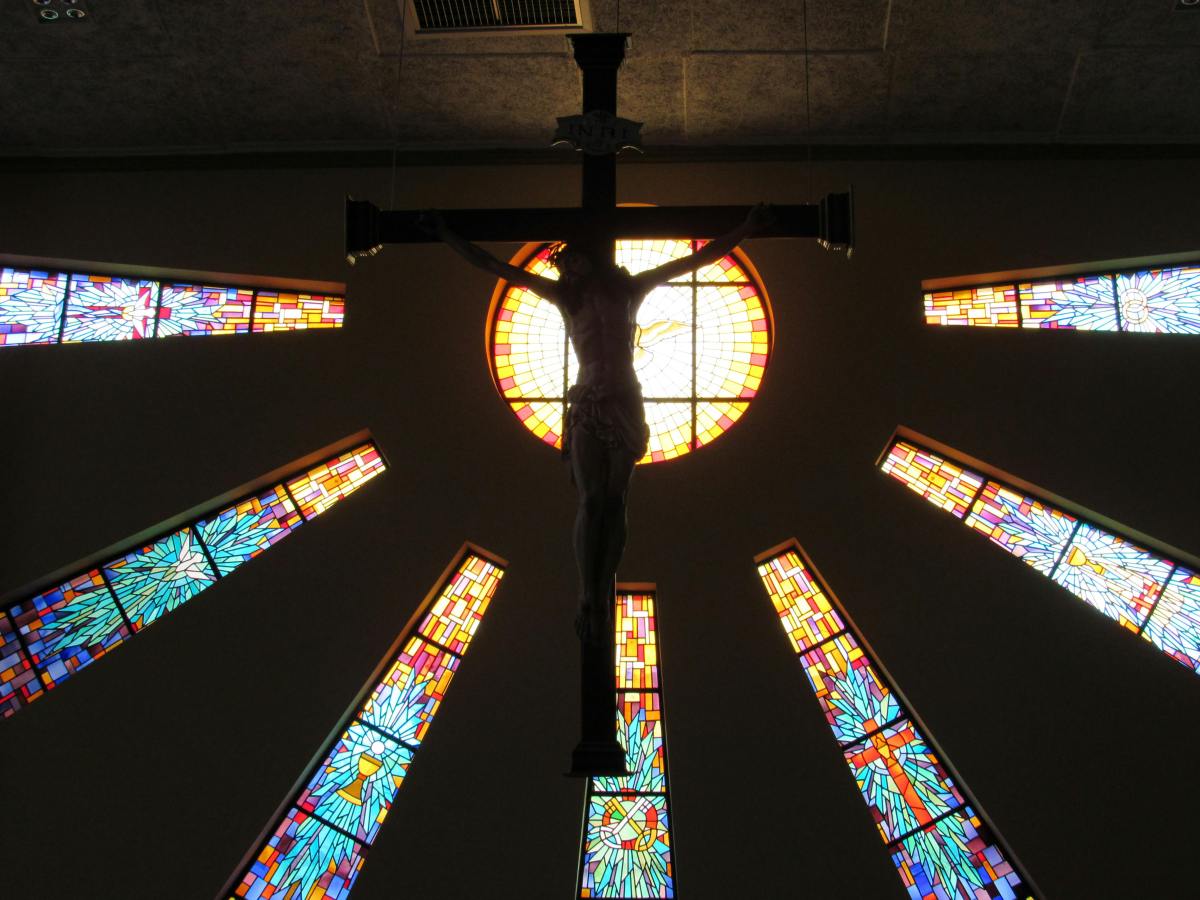

Failed: A Good Friday Sermon

Preached on Good Friday, April 18, 2025 at St. Anne Episcopal Church, West Chester, OH.

It is important that we speak plainly and honestly today. We owe that much to ourselves, and to him. There is no hiding, here. No pretty turns of phrase to evade the truth. 

No, the truth of Good Friday is simply this: We failed, God.

We failed today, fully and completely. We failed to see you. We failed to understand who you are and why you created us and why you came among us and what you asked of us. 

It was so simple, what you asked, but so impossible for us to accept: to love one another and to love you. 

But for so many reasons, and sometimes for no reason at all, we can’t do it. We don’t do it. And instead we crucify. And instead we are crucified. We fail. 

And oh, how we hate to admit it. We are so afraid of failure and shame. But somehow that fear of our own failure, that recoiling at our own limitations, is precisely what we lay upon others. We make them bleed the blood we are terrified of spilling. We make them die the death we are terrified of dying.

And so we have ended up here again, like clockwork, on another Golgotha, on that dusty hill which arises in every age, soaked with sorrow and strewn with cynicism. And we are bathed, today, in a grim, unflattering light, the sort of light that doesn’t illuminate so much as it lays bare. In the deathly light of Good Friday, every blemish and crack and wound in the body of creation is made plain in your body, Lord; your precious body, as it, too, fails. 

And we see here, in Jesus, upon this hill of sorrows, that, despite all our best efforts and biggest dreams, we don’t know how avoid failure in the end, not in the world as it is, because here death consumes even our greatest successes and highest ideals. It even consumes our God. 

So even if we give everything we have, like Jesus did, even if we practice peace and stay patient and never speak a hateful word, even if we do everything asked of us, still, it seems, the crucifier comes. The crucifier who is time and death and fear and fury.

Still he comes, with crosses freshly assembled to dole out. Still he comes, in his heavy boots, stomping on the harvest of our years. 

And still he comes, too, this crucifier, as a strange unwelcome traveler within us, welling up as the apathy and anger and resentment of our own hearts. We are the crucifier, too, somedays, even if we wish we weren’t. We must say that plainly, too.

Because so often, on any given Friday, good or otherwise, we choose to shrug or gawk or look away as the crucified ones continue to struggle through the streets of our own Jerusalems: draped in the flags of other nations or other identities, crowned with the thorns of prejudice, bearers of the burdens we’ve been taught to sneer at or dismiss. 

And if we are honest, really honest with ourselves, we’re often just relieved that it isn’t us.

And so on it goes, this passion play.

So yes, we have failed, God, and we can’t fully explain it. 

But it is necessary to say it, now, because really, what else can be said at the foot of your cross? There is no worldly victory here. No positive spin. There is no sly wink or nudge you give us that this is all just for show. This is simply what it appears to be. It is the opposite of love. And you, the One who is Love, you are gone. 

And that is that. 

But here’s the thing about today, God (and I am afraid, almost, to say it out loud, but I must, if we are speaking plainly.) Today is your encounter with failure, too, Lord. Your acceptance of your own failure. 

I’ve struggled to understand this or even put it into words, since you are eternal and unfailingly good, but I am realizing that Good Friday is nonetheless your own surrender to failure. 

Because you chose not just any death, but a shameful, embarrassing, degrading death. On the Cross, we see the fullness of your failure on the world’s terms. We see how creation could not bear the weight of you, how even your blessed flesh could not bear the weight of us. How you could not draw us back from our worst impulses.

You who–ever since your hungry children stumbled out of Eden with tearful eyes–you who have been trying to teach us how to undo the curse, how to find our way home. You who have parted seas and toppled tyrants and rained bread from heaven and crossed deserts and appeared in smoke and fire, all in the hopes of helping us find you again and find ourselves again…today is the shocking day when you say, my children, I have failed, too

Because you have come to us in every way possible. You have come as light and as fire and as word and now as a man. You have come as bread and as silence and as liberation, to show us, to show us, to show us, and still, still, still we are here again, on this dusty hill, unable to truly find each other. 

No matter what you have done til now, still, the crucifer comes.

And I am sorry, Jesus seems to say with his own parched lips, out of his own deep wounds. I am sorry that this has never quite worked. I am sorry that we always seem to end up here, on these many Golgothas. Because I promise you, you were created for so much more than a world full of crosses. I have wanted to give you so much more than this.

But now, it is finished. It is finished. 

On Good Friday, the saga of our long journey out of Eden is finished. It ends here, with us casting God from our garden, sending him away, weeping and hungry. It ends here.

And I realize that saying this might make us uncomfortable. Surely this is not the end of the story? We know there is more.

But it is very important, actually, that we let Good Friday be Good Friday, and nothing else. That we let it be the ending that it is. 

It is necessary, I think, after our long history of death and despair, to say that this particular story, this particular mode of endless disappointment—ours and Gods—ends today. 

Because perhaps we need to say goodbye here, us and God, here upon the dusty hill, upon the rubble of our failed dreams. Perhaps Jesus’ words are the most honest thing that we can say to one another today: it is finished. We tried, and it failed, but whatever this is, this world that crucifies truth, it must be finished. 

Because somewhere, out beyond time and terror and the Cross, somewhere within the mysterious alchemy of love and death and failure, only there and only then is something else possible, some truly good news that is not just a new chapter in this same, sad old story, but that’s a new story altogether. A new creation altogether. 

A different garden that is neither Eden nor our own, but a new world, a new life in which no one will ever be cast out. 

But whatever that looks like, whatever that new thing is that might yet be revealed from the depths of the tomb, we have to come here, first. We have to look into the face of our broken Lord, who tried so hard, who came so far, who loved so deeply. And we have to let him look at us, too: we who try so hard, who have come so far, who love so deeply, and yet are as broken as we’ve always been.

And today, for now, we have to let each other go.

I am sorry, Lord. I am sorry for all that we could not be to each other in the world as it is. I am sorry this is the ending of your time with us. 

But please, please let it not be the end

Let there be some new word spoken, some gentler, more kindly light revealed. Let there be something on the other side of all this failure. Let there be something plain and honest and good that does not always get crucified.

For whatever it is, we wait. 

For you, we wait. 

The Lord’s Own Prayer: A Palm Sunday Sermon

I preached this sermon on Palm Sunday, April 13, 2025 at St. Anne Episcopal Church, West Chester, OH. The lectionary text cited is Luke’s narrative of the Last Supper, Passion and Crucifixion of Jesus.

When you encounter hard things, sometimes it can be difficult to know exactly what to say. In such moments, our eloquence can crumble, leaving us wide eyed and silent like children. 

Palm Sunday is always sort of like that for me. It’s hard to vocalize what it all means, this jumble of praise and fury. I imagine it was even more so for the disciples who watched from afar as their Lord, the Lord, succumbed to the senselessness of his death. I wonder what they said. I wonder what prayer was on their lips as they stood there watching, as he gave himself away, as the sun covered its face and the earth was darkened, its Creator flickering and faltering like a dying star. 

I wonder if, in such an impossible moment, those disciples simply grasped at whatever prayer they knew best, as most of us do in desperate times. And for the majority of us, I would suspect the prayer that we know best and turn to is the Lord’s Prayer.

How many times have we prayed it? Impossible to number, like those flickering stars. I couldn’t even tell you exactly when I first learned the Lord’s Prayer. It’s just always sort of been there, rattling around in between my breath and my bones. 

I’d suspect though, as reliable as it can be, for many of us, the Lord’s Prayer is almost too familiar We remember the words but forget the meaning. We become dulled to the boldness and intimacy of  what it says about God and about being alive to God in this world that births and crucifies us. It is only in moments like this, like today, when all other words fail us, that the Lord’s Prayer returns to mind, like a life raft.

I’ve been thinking about the Lord’s Prayer lately for two reasons. The first is because, with the ups and downs of the world as it is, I sometimes need a life raft as I struggle to express whatever tempest of feelings fills my heart. In such instances, sometimes the old, familiar words are all I have to offer up. Thy kingdom come. Thy will be done.

The second reason, though, is because, as I was spending time this week with Luke’s narrative of the Last Supper and the Passion and the Crucifixion that we just heard, I realized something that I hadn’t before: woven into this narrative, like a hidden scaffolding that holds together Jesus’ final days, are all the elements of the Lord’s Prayer. In fact, if you look closely, you realize that Jesus quotes or enacts the prayer directly throughout the Passion narrative.

So let’s refresh our memory. Earlier in Luke, Jesus has taught his disciples to pray in this way:

Father, hallowed be your name. Your kingdom come, your will be done on earth as in heaven. Give us each day our daily bread. And forgive us our sins, for we ourselves forgive everyone indebted to us. And do not bring us to the time of trial.

And then, in today’s story, as we just heard, he does and says again all the things in this prayer. He gathers with his disciples and gives them bread. And he prays near the Mount of Olives, crying out to his Father who is in heaven and says, your will be done. And he asks his disciples, multiple times, to pray that they would not come into the time of trial. And then, finally, with his dying breath, he seeks forgiveness, for everyone. It is the Lord’s Prayer, every single piece of it. 

In this Palm Sunday story—in the culmination of his earthly ministry—we see Jesus living the very same prayer he has been teaching. He is walking the walk. When he is experiencing his own pain, and fear, and doubts about why it all has be like this, and why people do what they do, and whether the ones he loves can carry on when he is gone, when in effect he has run out of anything else to say or know, he, too, falls back into the familiar words:

Thy kingdom come. Thy will be done.

And although it is a painful story; and although we are living through painful times, I find a sort of hopeful symmetry in the realization that God is praying the same prayer that God wants us to pray. 

I find it rich with possibility and power, even, that when we call to mind those familiar old words, we are not just reciting something memorized as a child, but that we are somehow part of God’s own eternal prayer.

And that God, from the time before all our senseless crucifixions, from the very beginning, God has been offering himself to Creation in prayer, calling us by our names, seeking for earth and heaven to be one, desiring to give us bread and love and forgiveness.

I believe that God is still praying that prayer, today and every day, because God’s heart breaks not just for the Passion of Jesus, but for the passion and pain of every one of us who have trod the path of crumpled palms and broken dreams, hosannas caught in our throats, unsure of the words to speak. 

Yes, with us and for us, Jesus is praying this prayer in Holy Week, and in the many hard, holy weeks that comprise our lives. The Lord’s Prayer is the Lord’s own prayer, you see. God is alongside us in the praying this week, and has been forever. And when we call to mind those familiar words, God is reflecting them back to us, saying,

My Child, who art of the dust,

Blessed is your name to which I call.

My kingdom is coming, so that our wills can be one

On earth as it is in heaven.

So eat the bread I give. It is more than enough for all your days.

And forgiveness is already yours if you receive it

And share it freely.

We have been through many trials and temptations together,

You and I,

But I have never left you.

And those things that are past will never define you,

because your deliverance is already at hand. 

So take my hand.

In the same way that the Lord’s Prayer shapes and guides Jesus’ path to the Cross, I pray that this Holy Week will shape and guide your path through whatever you are facing in life. This week will reveal everything that Christianity is actually about, beyond the noise and the politics and the culture wars. It is the week when we learn what walking the walk really looks like.

Come and wade deep into these waters as much as you possibly can. We will watch, and listen, and grieve, and celebrate and yes, we will pray the Lord’s Prayer many times over, and all of this—all that Jesus is and all that he gives and all that he loses and all that he transforms—will become the hidden scaffolding of our souls, strengthening us for whatever might flicker or falter.

Because beneath and beyond the clamor and the confusion and the crumpled palms and the wide-eyed silences, only one thing abides, only one thing really can, in the end, be true:

The Kingdom, and the Power, and the Glory are God’s. Now and for ever.

And to that I can only say, Amen.

What If?: A Sermon for Palm Sunday

I preached this sermon on Palm Sunday, 2024, at St. Anne Episcopal Church, West Chester, OH. The text cited is the Passion narrative in the Gospel according to Mark.

One thing that strikes me, every year, as Holy Week envelops us in the stark power of its narrative, is how inevitable it all feels, this story about Jesus’ betrayal and death. How fixed the trajectory, after lifetimes, after centuries, after millennia of retracing it. It is easy to forget that the story we tell today began so differently.

Just a few months ago, we beheld a baby born in Bethlehem under the chill of starlight, and we heard angel choirs singing of peace, and then we watched that child grow and mature through the soft gloom of the season, and in the slow lengthening of our days through Epiphany, we beheld his light and his life and his love gathering their own brightness, and we have looked for signs of the unfurling promise of his Kingdom, like springtime emerging from the muddy, fertile ground of Lent. 

And yet, once more, here we stand on Palm Sunday, only to witness this particular story of God’s goodness cut short again, this particular promise deferred again, the tender green growing palms trampled, again, under the force of misguided adulation; the gently stirring earth soaked, again, not with gentle spring rain, but with blood.

And yet, despite the grave horrors, the enduring shock of what we see and experience in this Passion story, still, I think, we tend to see it as inevitable. As if this brutal end to Jesus’ earthly ministry was somehow the necessary price of his message, as if it were normal for for mothers to mourn their children, as if it were normal for springtime to give way to winter instead of summer. As if this sacrifice was as natural as the turning of the seasons. As if there was no other way the story could have ended. 

What if there was?

It’s odd, we rarely seem to ask that question about Holy Week. And it’s especially odd because, for most of us, in our own lives, we spend a lot of time and energy asking “what if?” 

What if I had made a different choice? What if I had chosen a different path? What if I had learned from my mistakes sooner? What if we, as a nation or as a community or as a church had chosen another course of action? 

Asking these sorts of questions is, most of the time, as natural as breathing. 

We are accustomed to “what ifs” because we are faced with a dizzying number of choices every day, and so of course we wonder how else things might have turned out if we had gone a different way. 

And yet, when it comes to Holy Week, when it comes to Jesus stumbling on the rocky road to Golgotha, we surrender him to his fate. We surrender our “what ifs”  to the violence we know and expect, and we behold the drama as if it were fixed and preordained, the way that it had to be for Jesus to be who he was and accomplish what he did. 

Without the suffering of Christ, without the brutality of the Cross (we have often been taught) there would be no salvation, no redemption, no liberation from the brokenness and sin that formed and fashioned the Cross in the first place. And so we have accepted, on some level, that all of this was necessary.

It’s a strange sort of logic that a God of Love would require torture to prove that love. At best, it leaves us to simply shake our heads and shrug at God’s inscrutable will. But at worst, it gives rise to the idea of redemptive violence—a God who inflicts harm upon himself and creation to achieve the ends of peace. Which sounds suspiciously like the tyrants we know, not like the God for whom we long. 

And so I wonder if, perhaps, as we move through Holy Week together, we are meant not to accept the inevitability of the Passion as passive observers of Jesus’ pain, but to trouble the narrative, just as our spirits are troubled by it. I wonder if we are meant to ask “what if?”

What if Jesus did not have to die in the way that he did? What if his own predictions of the Passion reflected his deep, grief-stricken understanding of our brokenness rather than some necessary violence inflicted by his Father? 

What if none of this had to happen?

What if the crowd chose to listen to his actual teachings? What if they understood, as he entered the city, the subversive symbolism of his ride on the colt for what it was—a challenge to the pageantry of imperial power—rather than projecting their own political agendas onto his actions?

What if his disciples had not forsaken him? What if the temple authorities had kept an open mind, had been humble in the face of things they did not understand? What if Pilate had chosen to be something more than a functionary of the deadly inertia of empire? 

What if there had, in fact, been another way for the story to end, another way for Jesus’ undying love to be made manifest and to bless the earth? 

We cannot know the answer to these questions, anymore than we ever know the answer to the “what ifs” of our own lives. The story is the story. And we must tell it. 

But that is not the point. The point is that we still need to ask the question. We need to ask “what if” during Holy Week, just as we must ask “what if” every time we are faced with violence and pain and prejudice, so that we do not accept these things as somehow normative, somehow determinative, because without “what if,” we will have made an uneasy peace with the crucifying impulses of the world. We will have surrendered our imaginations to the sense of their inevitability.

But what if we didn’t? 

What if the God who has repeatedly said “I desire mercy, not sacrifice,” actually meant it, and meant us to expect this from ourselves and our world? What if the brutality of this Passion story is no more part of God’s plan than any of the rest of the suffering we inflict upon one another? 

Because when you start asking “what if,” you realize that everything in the Passion narrative is the result of choices, choices made made by people not so different from you and me, choices made, too often, in service to the prevailing order, choices made by people who were as agitated and lost and polarized as we are, people caught up in faltering hopes and flourishing suspicions, people distracted and weighed down by a history of loss, people who also forgot to ask, “what if this was not the way it has to be?”

I tried it this week, asking “what if” as I was reading and wrestling with the story. And there are signs of possibility, thank God, if we look closely. Especially if we look closely at the women.

There’s the unnamed woman with the alabaster jar, who pours out her rare, costly, sweet ointment with the same mixture of wild abandon and care by which God pours his love upon creation. They say it is wasteful, this love and care, and yet she seems to be asking, “what if it’s not?”

And there’s the servant girl who, like a prophet, calls Peter to account for abandoning his true identity, all of his no, no, no, I do not know him. And she seems to be asking, “what if you said yes? What if you did finally, fully, know him and claim him as your own?”

And the women who gather near the Cross to hold vigil with Jesus as he dies, refusing to abandon him to his shame and loneliness. The crowds call it a lost cause, a failed revolution, a big disappointment, but the women seem to be asking, “what if none of that was the point?”

All of these women are the ones who refuse to accept the unfolding trajectory of the story—the ones who see another way, the true Way. They are the ones brave enough to name presence and fidelity, not violence and power, as the strongest force at work in this narrative. They are the ones who are asking, what if this story is not about the myth of redemptive violence that forms its center, but about the quiet, determined insistence of love that flourishes on the margins?

What if the point of Holy Week is not to valorize the story of Jesus’ suffering, but to build a world in which it is the last such story that ever need be told? 

What if we realized that the Cross is not the necessary means to an end, that God would have saved us in a thousand different ways if we would have let him, and that he still will?

What if we realized that the only inevitable narrative is not the Passion, but this: that Jesus—and all of us— are loved passionately from the day of our birth, all of us adored by angels under the chill of starlight, loved through the soft gloom of the turning seasons, loved through the lengthening of our days, and loved when we rejoice and loved when we despair and loved even when we die—however we die—and loved, ultimately, back to life.

What if that was the one, true, enduring, necessary story we needed to hear? What if all the rest was up to us? 

What if?

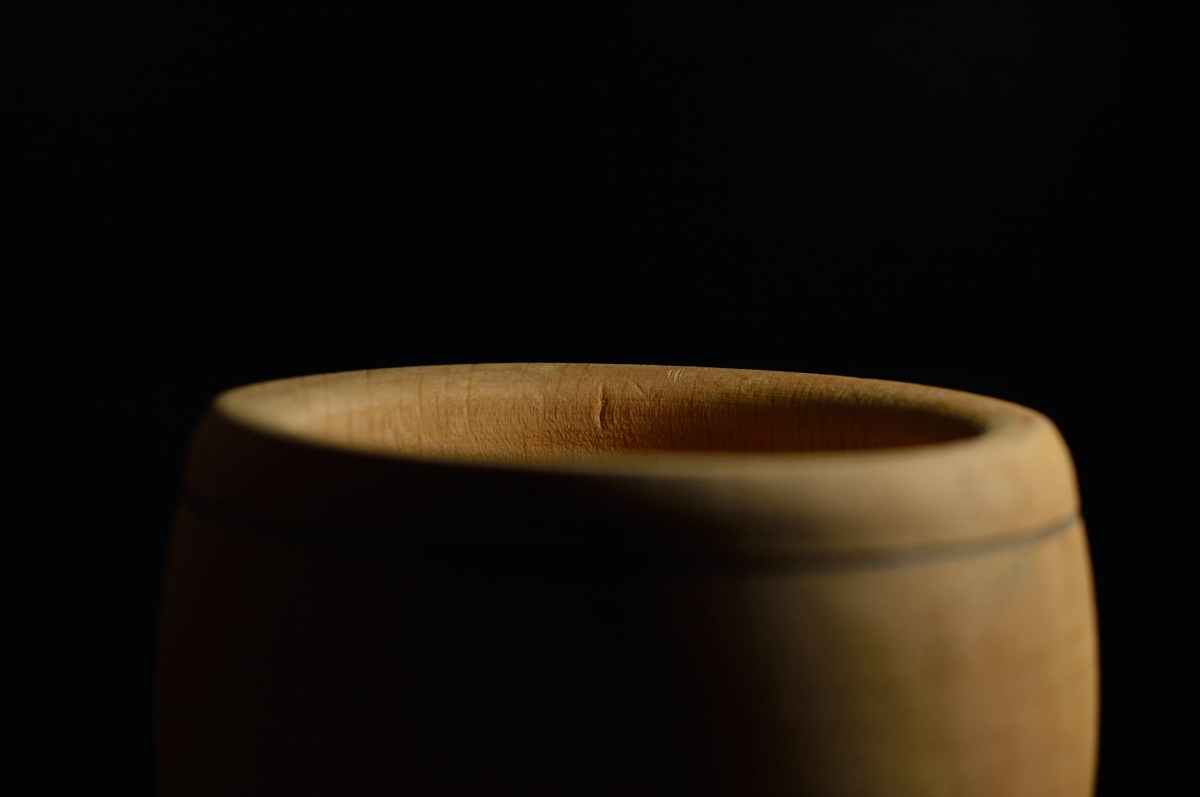
The Cup: A Sermon

I preached this sermon on Maundy Thursday, April 14, 2022 at Trinity Episcopal Church, Fort Wayne. The communion cup, which had been suspended in our parish during the COVID-19 pandemic, was restored at this service.

There isn’t a general confession in tonight’s liturgy, so allow me a bit of time for a very minor confession of my own. While I generally try to embrace material simplicity, there is one area in which I have grievously failed, and it is this: I have an embarrassingly large collection of cups and mugs in my kitchen at home. Far more than any one person should have. Perhaps you can relate to this. When I open up my cupboard, there they are, stacked on top of one another, balanced precariously, mismatched, the designs a bit faded in spots, but comforting—a jumble of memories. 

There is the juice glass I used to use every morning as kid visiting my grandma’s house. There is the coffee mug from a monastery I visited when discerning the priesthood. There is a cup that my mom and I picked up while driving Route 66. There is the 175th anniversary coffee mug from Trinity Fort Wayne. There is a wine glass I bought in Europe. There is yet ANOTHER coffee mug that I don’t especially love but that was given to me by someone whom I do love. You get the idea. 

In terms of problems to have, it’s a very silly one. But it reminds me that there is something very evocative about cups. For some strange reason we are drawn to them; they mean more to us, somehow, than just a receptacle to hold a beverage.They hold memories, too, they tell a story about where we come from, the things we have seen, and what our life has been about. When we bring them to our lips, we kiss the past and we hold a part of ourselves. The cups reveal, in some small way, who we are. 

Maybe that’s why it has been so disorienting, these past two pandemic-shaped years, to have no cup offered during the Eucharist. The Church decided, out of an abundance of caution, to suspend this aspect of Holy Communion, and while we’ve certainly been on solid theological ground receiving only the bread during this time, I admit I have still felt a bit lost at sea without that other component of the Eucharistic feast: the common cup shared among us, the sweetness on the lips, and those words that satisfy our deepest thirst: the blood of Christ, the cup of salvation.

It is fitting, deeply fitting, then, on this Maundy Thursday when we remember and celebrate Jesus’ institution of the Eucharist, that the common cup is returning to our communion offering. This evening when you come forward to be nourished by Christ’s body in the form of bread, the chalice of his blood will be offered to you as well, and if you feel comfortable doing so, you are invited to drink, and remember what this particular cup reveals about where we come from, the things we have seen, and what our life together is about. 

But this cup that we drink from is special, it is singular, because unlike the mugs and the glasses stacked on our shelves, each holding our own private histories, this Eucharistic vessel also reveals something essential about about God’s history, about who God is and what God has done. In truth, the Eucharistic cup is God’s cup first and foremost, not our own. It bears the story of God’s journey alongside and among humankind.

In the Hebrew Scriptures the prophets and the Psalmist speak often of the cup: the cup of consolation, the cup of wrath, the cup of trembling, the cup of astonishment—a cup that holds the strange mix of grace and fury that is God’s complex and unfolding relationship with the world. And tonight we come to realize that it is this same cup that Jesus must reckon with in Gethsemane—Father, if it be possible, let this cup pass from me. Ultimately he does what God has always done: he accepts the cup as the price of loving his wayward creation, drinking in the sweetness and the bitterness of his solidarity with the children of the earth.

And so I imagine that if we were to go to heaven and rummage through the cupboards, we’d open them up and find, in quiet repose, this one cup, ancient, gleaming, heavy with significance, hallowed by its use, held aloft at a thousand feasts, emptied out upon a thousand battlefields, stained with the blood and the salt-tears of our Creator. The same cup that, in the mystery of Eucharistic grace, is handed to us on this night, that we might take hold of its heavy glory. No longer God’s cup alone, but also ours.

“I received from the Lord what I also handed on to you,” Paul tells the church at Corinth, recounting the words of Jesus at the Last Supper—a meal, of course, at which he himself was not present, but which, we must conclude, he must have come to know as part of the all-encompassing, all-consuming revelation of Christ he experienced on the Damascus road. 

Paul understood, somehow, in the lifelong aftermath of his conversion, that this particular meal, this particular bread and cup, reveal the truth about God’s deepest self—and that as often as we eat this bread and drink this cup, we are taking part in God’s own feast—the banquet prepared from the foundation of the world. In so doing, God’s story, God’s sustaining life becomes ours as well. 

And so, tonight, like the disciples who gathered in the lamplight of the Upper Room, we glimpse salvation upon this table, and we drink from this cup—the cup of memory, the cup of sorrow, the cup of laughter, the cup that holds the fermentation of finitude and eternity, the cup that holds ALL THINGS in the costly covenant of love—we drink from this cup tonight for Jesus’ sake because he drank from it for our sake. He drank it to the dregs, knowing what it meant to do so, knowing that living also means one must die, knowing that it was worth dying for us in order to live for us. 

All of that significance, all of that history, all of that costliness, all of that promise, all held in a single sip. A sip he now asks us to take as well, so that at last, we might know him for who he is. 

I know all of this is true, I know it is real, but I cannot really comprehend it. And yet, like you, I will hold that cup in my hands, I will receive it with wonder and gratitude, trusting that even if I never really understand the mystery of death and life, even if I never understand the depth and breadth of God’s love, at least I will know what it tastes like. 

And that will be enough.

For as we will discover repeatedly throughout these holy days, words can only take us so far. Ultimately we must do a thing for it it be real. The feet must be washed. The bread must be broken. The cup must be poured out. 

These actions are both a question and their own sort of answer, because they are the pieces of God’s story that speak best for themselves, like a cupboard full of jumbled vessels, passed down, love-worn, inexplicably precious, infinitely capable of holding our own stories—the old stories, the ones we are living through today, and the story that God, with us, is only now beginning to tell.

Tonight is the night that story begins, again. 

Drink it in, beloved children of God. Drink it all in. 

Parting Words: A Sermon for Good Friday

I preached this sermon on Good Friday, April 2, 2021 at Trinity Episcopal Church, Fort Wayne, IN. The lectionary text cited is the Passion Narrative from John’s Gospel. A recording of the service can be found here.

What can we say, now that we have arrived here?

This is the moment in the Christian year when words fail us, when our platitudes turn to dust. What meager phrase is adequate to express what we see, what we feel, what we fear in this place: the first and only time in the history of creation when we face the prospect of being truly, utterly alone in the cosmos? What could we say that would ever be a sufficient offering, a word of consolation to our God as he hangs on the cross?

For that is what we are doing today, on Good Friday: we are keeping vigil at the side of our Lord as he dies for us. We plant ourselves here, amid the skulls, at the foot of his cross, and we wait, and we watch, not because we can change anything or solve anything, but because somehow we know that to love him is to be present in this moment. Nobody should have to die alone. 

But in our waiting and watching, still, perhaps, we wonder how to express to him what we feel—all the things that we always wanted to say, but never quite could.

My Lord and my God, how quickly the time went; how much more I wish I had told you while we were together. But now we are here in this valley of shadows, and you are slipping away, and there is so little time left. Please don’t leave us. But if you must leave us, what would you have me say?

If you have ever lost someone close to you, you know that this is not just a Good Friday conundrum; when death is imminent, when it is time for that last conversation, we often struggle with what to say. We are often not very good with endings. 

And in those moments, beside the hospital bed, in the moment before we must finally turn away, memory and regret and fear can leave us as inarticulate as Mary and the Beloved Disciple, gazing upon the face of the one who is leaving us, but saying not a word, our tongues parched by grief. 

For what can we say, now that we have arrived here? 

I recently read, though, that, in the end, there are, in truth, just four things that are most important to say to someone you care about before they die. Four statements that we can offer: Forgive me. I forgive you. Thank you. I love you.

So perhaps that is what we can offer today; perhaps that is the best we can do, to give our dying God the same, humble tenderness we might offer each other. To say to him: Forgive me. I forgive you. Thank you. I love you.

Lord Jesus, forgive me. Forgive me for all the times I forgot you, while you patiently waited for me to remember. Forgive my stubbornness and my smallness, and all the times that I got in the way of the joy that you yearned to nurture within me. Forgive me for all the ways that I have passively accepted a world that still crucifies the vulnerable and disregards the poor and the meek and the hungry, whom you have blessed. Forgive me for my silence when I ought to have spoken; and for my careless words when I ought to have been still. Forgive me for holding you at a distance, for trying to preserve myself from the transformational intensity of your love. Lord Jesus, forgive me.

Lord Jesus, it may sound strange to say it, but I forgive you, too. I forgive you for not being present in the ways that I needed you to be when I felt so alone. I forgive you for inaugurating a church that at times, in your name, has harmed so many people. I forgive you for creating a world that allows for sin to break people apart, for this mortal life where we seem to lose everyone we love. I forgive you for being so hard to understand at times, and so hard to follow. I forgive you for not being the type of strong and mighty savior that I expected, the kind that would keep me safe. I forgive you for all these things, mostly because I need to let them go, in order to see you properly, in your fullness, and not the incomplete version of you that has been distorted by my own pain and confusion and resentment. I forgive you because I want to know you as you are, not as I wish you were. Lord Jesus, I forgive you.

Lord Jesus, thank you. Thank you for loving me beyond comprehension. I know that your love is why you hang upon the cross, why you choose to lay down your life for your friends, and although I cannot fully understand it, I feel it—its saving, healing power—deep in my soul. Thank you for showing us what it means to live as a human being fully alive, fully in communion with our Father in heaven, fully in partnership with our neighbors and with the web of all creation. Thank you for the outpouring gift of your grace in water and bread and wine and oil; for giving your flesh and your Spirit to us, unworthy as we may be. Thank you for your church, which, at its best, has saved my life and taught me the meaning of community. Thank you for the invitation to live a life caught up in the joy your life, and to love with a heart enraptured by your undying love. Lord Jesus, thank you.

Lord Jesus, I love you. Not perfectly. Not as consistently as I might hope to. But I love you. I love you for challenging me to be better; for believing in us, in our potential, these wayward children that you have fashioned out of the dust of the earth. I love you for your tenacity and your gentleness; your courage and your peace. I love you because you have taught me how to be myself, the way you created and intended for me to be. I love you because you were yourself, purely and utterly yourself. And as your life slips away on this day, know that I will carry you with me now, for all the days to come, until death is but a memory, until I see your face again. But for now, Lord Jesus, just know that I love you. And it’s ok to go, if you must. I know you must. 

What can we say, now that we have arrived here? 

Forgive me. I forgive you. Thank you. I love you. 

And then, it is finished.

But is enough. It is, perhaps, all he ever wanted us to say.

Palm Sunday People: A Sermon

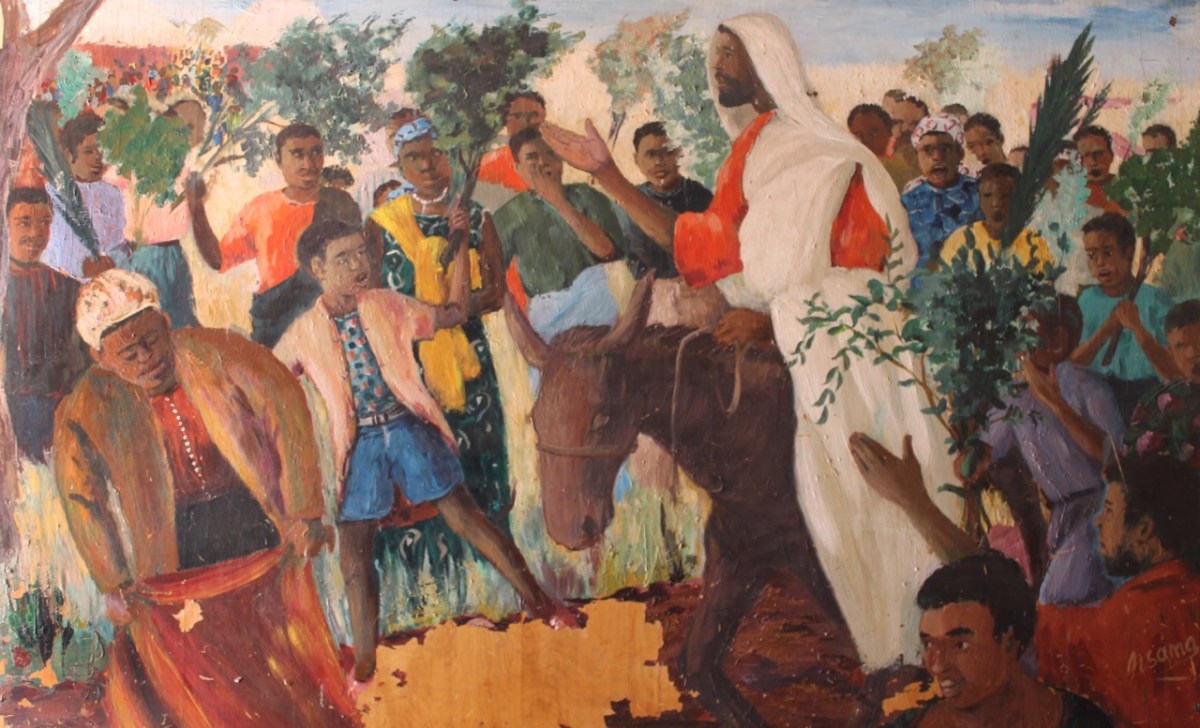
I preached this sermon on Palm Sunday, March 28, 2021 at Trinity Episcopal Church, Fort Wayne, IN. The lectionary text cited is the Passion narrative in Mark 14:1-15:47. The image at the top of this post is Triumphal Entry (1969), by Zambian artist Emmanuel Nsama.

We have just heard a story that is, for most of us, deeply familiar. We gather, year after year, during this holiest of weeks to hear it again, to immerse ourselves in the narrative—one that begins today clutching our palm fronds with an exultant crowd at the city’s edge and has just ended at the lonely tomb where only a few brave women dare to visit. 

But rather than pick apart this story, rather than analyze and intellectualize its themes and symbols from a comfortable emotional distance, I wonder whether we ought to simply let it speak for itself. I wonder whether it is a story best received and held with humble, pregnant silence, as all truly important stories ought to be received. 

For the one thing that we do know about this story, this passion narrative, is that it is of deep importance—that it reaches out to speak into the most hidden parts of ourselves. It is a story that observes us, that comments upon us, rather than the other way around. This story knows us and names us in ways we might not want to be known—our hopes, our fears, our terrifying capacity for callousness— and reminds us why we so desperately need God’s saving love in the first place.

So at the outset of this Holy Week, as we summon up the courage to sit with this narrative that is both familiar and shocking, I simply ask you to ponder this question: what if this passage, this passion narrative that we just heard today, was the end of the story? What if that was it?

What if Jesus, the Son of God, the miracle worker and prophet and teacher of peace and radical inclusiveness, who rode into Jerusalem as a new sort of king, was simply put to death and laid to rest and then…nothing. What if the story ended here—as it does for most of us in this life—with the stone sealing the tomb?

I ask this for two reasons. First, because in order to let Holy Week do its work upon our hearts, we must try take it as it comes and not skip ahead. We have to suspend, for a bit, our knowledge of what will come next Sunday and simply be present to what is happening in the moment of each liturgy. 

So today, hear what Palm Sunday has to say to you. Don’t move on too quickly. We need to stand awhile in this crowd that cheers one moment and calls for blood the next, if only to recognize that we are not so very different from them. And in each of the days to come, as we take part in the Masses and read our daily reflections, let the story unfold, living it as the disciples did, as they followed Jesus into the city. Like the disciples, allow the events to disarray your certainties and upend your expectations of what success and significance mean. We will learn so much more from this week if we can somehow live it.

The second reason I ask what it would mean if the story ended here, at the tomb—is because for many people, Palm Sunday IS the whole, representative story of human life. 

Without the eyes of faith, without the Divine inbreaking, Palm Sunday IS how the world tends to work—a place where the strong dominate the vulnerable, and the pursuit of peace is viewed as a farce, and mercy is called weakness and battle lines must aways be drawn and redrawn, age after age. 

We live in a world that has been, for too many people and for too many generations, one long and unending Palm Sunday—and so it is easy to believe that this indeed is where the story ends, and that our longing for something else, something kinder, is a delusion. 

That is the story that the world continues to try to proclaim to us and form within us. And if we’re not careful, we might buy into it, talking pleasantly enough about resurrection but living fearfully, meagerly, as if Jesus is still dead and buried in that tomb.

So on this Palm Sunday, and perhaps every day for the rest of our lives, we have a choice to make: is this the story that we are actually telling and living by our actions and words; are these the values that we are embodying? Are we, in fact, a “Palm Sunday” people?

Or do we dare to live as another type of people, people who have their hearts fixed on God’s promises, on God’s version of triumph–people who persist beyond today’s heartbreak?

Are we willing to tell a different story, a story that says there is something more to this life than trampled palm fronds and jeering crowds and the desolate silence of the grave? 

That is the choice given to us, and this is the week when we must decide anew how deep into this story we are willing to journey.

Because yes, for today, we end here at the tomb. But come back tomorrow, and the next day, and on throughout all of Holy Week, and see what God can do with this broken body. See what God can do with your broken heart. Let this journey reveal its mysteries to you one day at a time, until the real ending comes—the ending that will be for us, in truth, only the beginning.

Holy Week at Home #8: Easter Day

The final installment of my “Holy Week at Home” posts; a meditation on happiness and joy in a season when both feel harder to inhabit. Yet still we say: Christ is Risen! Alleluia!

Something I am continuing to discover is how joy and happiness are not the same thing. And on this particular Easter, when the usual signs of celebration are absent or muted by grief, understanding that distinction feels more important than ever.

Happiness is precious and usually comes, in its purest form, unbidden, from humble things. A flower blooming, a familiar voice, a gentle hand outstretched. But happiness also vanishes as quickly as it comes, and cannot be pursued. We must learn to hold it gently, and then let it go.

Thus I think of Mary Magdalene encountering Jesus in the garden on Easter morning. There is a flower and a voice and an outstretched hand, yes, but also this: “Do not hold onto me, because I have not yet ascended to the Father, to my God and your God.” This happiness is only momentary. Resurrection is not just reunion. It’s also letting go.

So, we must consider what we mean by joy, and Easter joy in particular. Not mere happiness, but perhaps, instead, a fullness. Fullness of life. Fullness of presence, both God’s presence and our own. A fullness that contains happiness, yes, but also grief, and confusion, and wonder, and mercy, and everything else that emanates from the deep heart of Life. A fullness that sustains us even when our pleasures feel meagre, as they sometimes do.

As we live into the reality of this unusual Eastertide, I find myself kneeling in the garden with Mary Magdalene, having experienced such a collision of grief and happiness that my soul feels stretched beyond its capacity. But I am choosing to trust that in the stretching, there is the shape of joy. In the stretching, Christ is forming me into something new. Something that can contain a bit more of the vastness of God’s dream, wherein Resurrection finds its source and endpoint.

Blessed Easter, dear friends. I wish you happiness to soothe your spirit. And I wish you joy, that each of us might become who God made us to be.

Holy Week at Home #7: Holy Saturday

A continuation of my “Holy Week at Home” posts; on Holy Saturday we are caught in that space between grief and hope. I have a particular love for the Virgin Mary on this day, who is known on Holy Saturday as Our Lady of Solitude. She has been with me through many seasons of waiting and wondering, including this one. I dedicate this poem to her.

In between beginnings, I must learn to live in interims.

And today I am here, in that shadow-place at the intersection of memory and hope,
The dove-grey moment
when the past ebbs, unreachable
and the cloud bears no hint of light.

Where have you gone, my beloved?

I wait, and yes, I grieve
the yet-unsatisfied promise
But I also find that

shadows cast their own illumination over those who pause to consider–
who ponder in their heart–
the saintliness of not knowing;
The beatitude of contingency.

And as the night enfolds understanding
As your absence drapes over me like a mantle of fog
I perceive how needed it is
To say goodbye, and to mean it

To let this waiting be its own solace
Its own teacher
Its own revelation of the
unchanging liminality
at the heart of my restless heart.

After the going and before the coming
There is simply this,
The sufficient poverty of now,
And that must always be enough
Or nothing ever will.

Son, behold your mother
in repose
in recollection
in the resilience you required of her
wild as the sea-grass
Bending
in solitude
But rising
in strength.

Holy Week at Home #6: Good Friday

A continuation of my “Holy Week at Home” posts; on Good Friday we stand at the foot if the Cross as Jesus is crucified. 

Look up.

He is unfurled
aloft,

Like a flag of surrender,
So that you might see, and know
It is finished.

Like a scroll,
So that you might read the lines on his skin and find the place
where it is written in rivulets of tears:
The Spirit of the Lord is upon me.
I have been anointed to proclaim release.
And I am releasing—
I am giving up
my spirit.

A broken body
Arched like a question
inquiring into your frailty;
testing whether it is tolerable
For love to cost this much.

But if you will stay
In this place without answers
Then you will learn that the
rending and the mending of the world
are two notes of the same song.

You will learn that there is no such thing
as dispassionate salvation
or tentative redemption.

And how in the Divine economy
everything is given
And returned
Eternally.

You will learn that nothing is ever wasted
even when waste is the only credible conclusion.
Even when all the evidence suggests defeat.

You will learn that victory is not the same as winning;
that truth is not the same as certainty;
And that peace is not the same as pleasure.

But all of this is offered now, only now,
On this desiccated and necessary hill,
The final bequeathment of a dying God
Who cannot teach you the secrets of eternity
Without entering finitude.

Look up, into his face.

Look up, and see how he is grieving all of your endings.

Look up, and see how he is dying all of your deaths.

Look up, and see the world pass into something new.

Look up. 

Holy Week at Home #5: Maundy Thursday

A continuation of my “Holy Week at Home” posts; on Maundy Thursday we commemorate Jesus’ institution of the Eucharist at the Last Supper, as well as Jesus’ anguish and arrest in the garden of Gethsemane. 

Before I must die, he says, let me show you what cannot be killed.

Always, your tyrants will stumble. Your temples will fall. Time and plague lay will lay waste. Enmity will wound.

But there is something else, something underneath and beyond the brittle, crumbling certainties of this (and every) age. Something eternal.

Let us gather together at this table so you might glimpse it, dancing in the shadows as your faces shine in the lamplight. Let me feed you here, let me cleanse you. Let me be with you forever in this moment, even when I must go.

Begin to understand, beloved ones, that there are things more precious than that which you can hold onto. You must begin to see the strange inversion of Truth: how service is power; how love is relinquishment; how death opens us to life.

I admit that I could never explain this to you adequately in words alone. So now I can only demonstrate. I can only *be* for you what is commanded for us all. My tools are bread and wine and water basin. And tomorrow there will be other instruments, but let us not speak of them yet.

Oh, beloveds, how I have loved you, ever since my breath first swept across the waters, ever since I molded you from dust. How I have longed to be known by you.

And so, as you have said to me so often through the cascading generations, I now say to you:

Here Am I.
I Am Here.

I have come from across eternity to kneel before you. To breathe across this water. To wash the earth from your feet of dust.

I am the unkillable offering. I give you myself so that you will know how, even if you do not know why.

Do the same, always, in remembrance of me.