Breakwater: A Sermon

I preached this sermon on Sunday, March 17, 2024 at St. Anne Episcopal Church, West Chester, OH. The lectionary text cited is John 12:20-33.

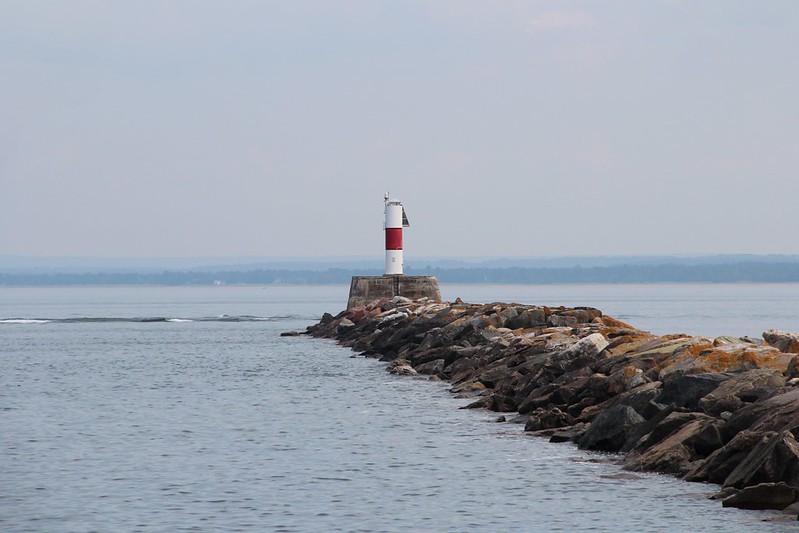
If you have spent any time traveling up around the Great Lakes, you might have observed the structures called breakwaters, which are a feature of many cities with harbors and bays along the lakeshore. Their construction varies, but essentially they are a thin wall or barrier that juts out into the lake in order to do exactly what the name implies—to break the waves that move in toward the shore, creating calm, navigable water on the inner side of the wall for ships and other small craft, while the swells and breakers roll and rage in the great expanse beyond. 

Growing up, every summer we would spend time in Marquette, Michigan, which sits right at the edge of Lake Superior, the largest and wildest of the Great Lakes. There is a breakwater that extends out from the shore there, and when I was young, my family and I would walk out onto it, taking in the views of the water and the city. 

The breakwater in Marquette has been there since the 1800s, reconstructed a few times due to storms, and the first half of it is a sturdy concrete structure, flat easy to walk on in good weather. You can stroll out in this narrow path, the calm harbor to your right, the endless waves to your left, and as a kid it was a thrill to be there on the breakwater, bathed in summer breezes, dancing and skipping out, out, out along the thin line between home and the world beyond, between familiarity and the eternity of blue water stretching toward an unseen shore.

But then there was a point on our walk where we would always stop. About halfway, the breakwater turns at an angle and keeps going farther out into the lake, but this second portion is only comprised of large boulders; the concrete wall ends and from there the going gets slick and treacherous as the waves collide with the bare stone. The only way forward is to scramble and leap and crawl along the rocks. 

My cousins and I always wanted to go onto the rocks all the way out to the end, the very end, where a light tower marked the edge of the breakwater. But the adults wisely said no, it wasn’t safe. So we would turn back. 

And what I could not have perceived then, but that I do now—more and more so with every passing year—is that life is much like that walk along breakwater. When we are younger, setting out into the wide expanse of the world is deliriously exciting, and, if we are blessed with a kind and caring childhood, we take for granted, perhaps, the solid structures beneath our feet. Stay on the straight and solid path, we are told, and all shall be well, and if you are careful, the waves will not break over you, and you will go as far as you need to go. 

But then, somewhere along the way, we get to the place in our lives where the solid footing ends, and we realize, with some surprise and trepidation, that we are no longer children, and that now we are expected to keep going. 

We discover that growing up and growing wise means that the journey does not, in fact, end at the bend in the path, but that life keeps going, going out where there are only rocks to traverse, where the water licks at our heels and sometimes threatens to sweep us away, out where we must indeed scramble and leap and crawl on our knees, and the walls we relied upon for safety suddenly seem much more permeable than they once did. 

One of the times I realized this was when my father had his first major heart attack in late spring, several months before he died. As it happens, I flew into Marquette, where he was in the ICU, and I remember seeing the lake as we drove through town in between hospital visits, and I remember seeing the breakwater, too, curling like a question mark out into the blue expanse, a reminder of simpler springs. 

And I remember feeling, in that moment, like my own solid path had ended, but that I was now required to keep moving forward out where there were only rocks ahead, with no one there to call me back.  I suspect most of us have had experiences like that.

And, in our passage from John’s Gospel today, this is also such a moment for Jesus, where the solid path he has been traveling since the day he was born comes to a precarious place , and when he, too, accepts that he must still keep going, out, out, onward, to where the footing is uncertain and where there is no guarantee of safety. 

“Now my soul is troubled,” he says. “And what should I say—‘Father, save me from this hour’? No, it is for this reason that I have come to this hour.”

Just as the other Gospel authors record his struggle in the Garden of Gethsemane, here John depicts Jesus at the edge of his own understanding, wrestling to reconcile the deep love he shares with his Father with the dawning sense that this love is no guarantee of preservation. Quite the opposite, in fact—this love for the Father is now clearly an invitation, a call, out onto the rocks where certainties end and faith alone must guide him. 

This love that has been growing in Jesus, that has been manifesting in his deeds and his teachings, this love that has bathed him in clear, calm living water, is now rolling in like a wave, rolling in from the unseen shore, and he knows, now, that to be all that he must be, to do all that he must do—for himself, for us—the wave must break over him, come what may, and the rock must be the place where he plants his feet and carries his cross and builds his church, the rocks where the walls of safety, the walls between heaven and earth, the walls between familiarity and eternity, seem much more permeable than they once did. 

It’s interesting, too, that this moment occurs alongside Andrew and Philip, who have been asked by some Greek believers to come and “see” Jesus, echoing Andrew and Philip’s own encounter with Jesus at the beginning of John’s text. Because inasmuch as this passage is Jesus reckoning with the nature of his own journey, it is also a moment for his disciples—including us—to reckon with ours. For “where I am, there will my servant be also.” If we are to follow Christ, then the rocks and the waves beckon us all. 

And our reaction to this realization might depend on where we stand. If we have become too comfortable in our faith, if we have become accustomed to solid ground beneath our feet, if we have not dared to venture out to the places where love requires us to risk something, then we, too, might feel our souls troubled by Jesus’ call. 

If so, then today we are being asked to take one small step outward onto the rocks—one small step towards admitting that we don’t have all the answers, ones step towards being vulnerable, towards embracing new ideas, new relationships, new ways of opening our hearts, new ways of standing with the poor and the forgotten and the storm-tossed—so that we might follow the path that Jesus has already traversed.

But if you are already out there on the rocks, somewhere between scrambling and leaping and crawling on your knees; if you already know all to well what it feels like to have left your certainties and safety behind, then perhaps Jesus’ call will be a consolation, because you will come to understand that even when the path crumbles under your feet, you are not lost. For this, too, is part of the path. 

And this is, in fact, the part of the path that we must travel if we ever want to grow up, if we ever want to grow, to reach that place where familiarity and eternity meet, where home and heaven lap up against one another: out, out at the outermost edge where Jesus abides, where he burns like a light at the end of the breakwater, at the end of every journey, drawing all people to himself, blessing every rocky path you have walked, every crashing wave that has washed over you, and every weary heart, including yours.

I have not been out on that breakwater in Marquette for many years, now, but I hope to go back someday. I still have a little bit of my father’s ashes, and if I can, I’d like to sprinkle a few into the lake there. But I am no longer a child, now, so I think that when I go, I’ll venture out a bit farther out onto the rocks to do so, to let his ashes mix with the water and the wind. It feels right, somehow, that this is how it must be, and where it must be, on that thinnest of lines between home and the world beyond. 

And though my feet might be a little unsteady, and my eyes might sting, I think my heart will still dance and skip like it once did.

It will not be entirely safe. Life never is. Love never is.

But it is still part of the path. And God will be there. 

One: A Sermon

I preached this sermon on Sunday, September 4th, 2022, at Trinity Episcopal Church, Fort Wayne. The lectionary text cited is Philemon 1-21.

A few months ago I had one of those paradigm shifting moments that make you question something that had, before, always seemed so obvious. I was reading a book called The Death and Life of the Great Lakes, by Dan Egan, which chronicles both the history of the lakes and the challenges that they have faced through the years due to agricultural runoff and pollution and the threat of invasive species. As someone who has grown up with a deep love for the Great Lakes, it was both fascinating and sobering to take a deeper dive, if you will, into the singular natural wonder that is practically in our backyard. 

But back to the paradigm shift. Many of us can easily picture the Great Lakes on a map, and we know that there are five of them—Superior, Michigan, Huron, Erie, Ontario. But early in the book, Egan writes, “they might be called the Great Lakes, but the five inland seas are essentially one giant slow-motion river flowing west to east, with each lake dumping like a bucket into the next until all the water is gathered in the St. Lawrence River and tumbles seaward.”

One giant river. 

That just blew my mind, even though when you actually look at a map, it makes perfect sense—all of the lakes are connected to one another by smaller rivers and straits and waterways, the most final and dramatic of which is Niagara falls, as the system that began in Lake Superior tumbles down into lake Ontario and on towards the ocean. One giant river. 

Egan’s point was that what happens in one lake, for better or worse, ultimately happens in all of the lakes, given enough time—and that even though we see them as massive and immovable entities, they are in fact a broad and delicate network of relationships, larger and more complex than the human eye can perceive, a single flow of interdependent life. 

It makes sense, though, that we would tend to see the lakes as separate bodies, ascribing to each its own personality and landscape. Separating everything out, giving things a name and a discernible boundary, is how we make sense of the vastness of the landscape around us. This is as true for people as it is for lakes. We make distinctions, we give each other names and we assess one another’s basic qualities because it helps us navigate a world that would otherwise feel overwhelming. And just as we can easily picture a map of the Great Lakes in our mind’s eye, each of us, somewhere within ourselves, carries a sort of emotional map upon which we locate the people and places we know—those that feel like home, and those that, perhaps, we’d rather not revisit. 

But here’s the thing—once the paradigm shifts, it’s hard to go backwards. Now, no matter how many times I see a map of the Great Lakes, I will know that they are actually just one giant river. And while I will always have a particular affection for this piece of the shoreline of Lake Superior or that little town along the shore of Lake Michigan, I cannot unsee their essential unity now that I have seen it. 

And as for all of the people located on that inner map I carry, especially the ones whose company I’d rather avoid, well, it’s the same thing. I cannot, as a follower of Jesus, forget the fact that we are, essentially, one body. 

This fundamental unity is something that is absolutely essential for understanding what St. Paul is up to in today’s epistle, the letter to Philemon. To summarize the letter: Paul is sending this letter to Philemon, a wealthy householder and church leader, asking him to receive back into his home a man named Onesimus, an enslaved person who at some point fled Philemon’s house and came to stay with Paul while he was under house arrest. Onesimus has come to faith in Christ, and so Paul requests that Philemon now receive Onesimus back no longer as a slave but as a beloved brother. It is a very pragmatic and human letter in many ways, one of the most personal that we have of Paul’s writings. It’s also a complex letter, given its ambiguity on the insitution of 1st century Roman slavery and whether Paul is condoning it or not. 

But the essential takeaway for us is not just that Paul was a nice guy trying to do a nice thing in an imperfect world. It is not just that Philemon, we hope, received Onesimus back with a more socially enlightened perspective. No, it is far more radical than that. 

The essential takeaway, the underlying argument that Paul is making about the nature of Christian life–the argument that is in fact woven throughout most of his writings–is that in Christ, we are fundamentally ONE. And that the categories that we use to distinguish ourselves from one another, to create order, to map out the world that we can see, are ultimately knit together in the Kingdom of God. And so when Paul says of Onesimus, “I am sending him, that is, my own heart, back to you,” he is not speaking poetically, like a slogan on a Hallmark card. He is speaking quite literally, because in Christ we are one body. And when he says “welcome him as you would welcome me” he is not speaking metaphorically, but literally, because in Christ we are one body.

One giant body. All connected to each other. 

And so Paul doesn’t need Philemon to just “do the right thing” legally or ethically by choosing to welcome Onesimus as a brother. He needs him to understand the stakes of his choice. It is not just whether Philemon, too, will choose to be a nice guy doing a charitable thing. The question is whether Philemon actually believes that the Body of Christ is a real and living thing, and whether he actually plans to live as though it is—whether he plans to reorder his understanding of other people, whether he is willing to dissolve the boundaries between his interests and theirs, to live as though they are indeed the limbs and the organs of his own body. Is he willing? 

Are we willing?

When you look into the face of a person, especially one whom you struggle to love, struggle to live alongside, can you look into their face and see a glimpse of your own looking back? Can you choose, in that moment—even in the hurt and in the confusion and resentment—to remember that the same blood and breath and water flows through each of us—that we are not separate bodies encased within rocky shorelines, but one flowing stream, one giant river, tumbling forward together?

Paul hopes that we do. He hopes that we remember Jesus’ prayer that we may all be one—that we open our eyes and see that we already are one, that we always were. 

Nobody knows for sure what Philemon decided to do—whether he welcomed Onesimus as a beloved brother. Though I like to think that the fact that the letter survived through the centuries suggests that he did—that the letter was, perhaps, the precursor to a moment of sheer grace.

I imagine a treasured family story lovingly passed down in the household of Philemon about the day when two men, so very different, separated by time and station and circumstance, saw one another as if for the first time, and fell into one another’s arms and wept tears of joy and regret and forgiveness. Tears welling up from some hidden place their souls. Tears that mingled and fell onto the earth, pooling together, indistinguishable from one another, as if they flowed from the same body. 

Flowed, like one giant river. 

The Island: A Sermon

I preached this sermon on Sunday, February 13, 2022 at St. Paul’s Episcopal Church in Mishawaka, IN. The lectionary text cited is 1 Corinthians 15:12-20.

I spent most of the summers of my childhood in the Upper Peninsula of Michigan, where my dad’s side of the family lived for generations. Now here in Mishawaka, you all live relatively close to Lake Michigan, so you have a good sense of the beauty of the Great Lakes, and if you have ever gone way up north, you know how rugged and beautiful it is on the shoreline of Lake Superior—rock formations and dense forests colliding with the open expanse of the water in its many shades and moods. 

And although there are any number of places along the shore of Lake Superior where one might be struck by its wild beauty, there is one particular spot we would visit as a kid that always stayed with me—the type of place that impresses itself upon your psyche, such that you might recall it out of nowhere while absentmindedly washing the dishes or just before drifting off to sleep at night—a pleasurably haunting memory, a dream, a landscape pregnant with unspoken meaning. 

It is a rocky, forested point of land, stretching out into the lake, with a small sandy beach at its tip and then, across a churning channel of  water, an island—so close that you can see it clearly, and, when the waters are calm, even dare to wade across to its shore. I have a distinct memory of doing so, by myself, as a child—scrambling through the water and ending up on the other side, giddy with freedom—just a couple hundred feet from the mainland but a world apart.

The point of land, the channel of water, the island—the image of that place stayed with me through many long and parched seasons of my life—chronic illness, the uncertainties of young adulthood, the sudden death of my father and, then, later, my grandparents. And although I had not been back to visit Michigan for nearly a decade and hadn’t been back to the lake for even longer than that, when I moved to Indiana nearly three years ago to serve at Trinity Fort Wayne, one of the first things I did was make the long drive north through the landscape of my past, through the mining towns and the forests. Eventually I ended up at Lake Superior, and I found the point of land again, and I walked out to the edge of it.

What struck me, though, was how deep the waters were this time—choppy waves and wind blowing in off the lake, no rocks visible to scramble on, no chance of crossing over. All I could do was stand and stare at the island, that childhood dreamscape, so close, but just beyond my reach. 

As we grow up and grow older, we tend to experience life as a sort of expanding distance from the solidities of the past. Sometimes we are grateful for that increased distance, and other times we mourn it, but either way, I think that there comes a time in each of our lives when we stand at the edge of what we know and glimpse the islands of youth and memory as beloved, yet inaccessible kingdoms. And we might despair how death consumes what was once so present to us—the places, the faces and the voices of another time.  And perhaps we start to believe that this is simply our portion in a fragile and fleeting world.

But there is another choice. There is another way to see this. 

“How can some of you say there is no resurrection of the dead?” Paul asks the church at Corinth. “If there is no resurrection of the dead, then Christ has not been raised; and if Christ has not been raised, then our proclamation has been in vain and your faith has been in vain.”

Apparently there were some among the Corinthians who accepted that Christ indeed had risen from the dead, and that this was a miraculous act of God, but they could not accept the idea that all of the rest of us were destined for the same undying life. In a world where it is self-evident that everything and everyone dies and decays, perhaps it felt foolish to them, naive, even, to claim such a possibility.  They were content, it seems, for Jesus to be the inaccessible island, beautiful to behold but not part of their actual lived reality—not a place they themselves could ever dare to venture. 

But Paul will have none of this. For he understands that we are not just people who have beheld the resurrection of someone else, of Jesus, but we are, ourselves, resurrection people. Where Jesus goes, we go too. And if the chasm between where we stand and where he has risen seems impassable, that is because we have still bought into the lie that death wins. It does not. Not any more. With Jesus, death is not the last word of any story. “If for this life only we have hoped in Christ, we are of all people most to be pitied,” because then we have missed the actual endpoint, the actual telos of following Jesus. Follow me, he says, not just through this world but onward, onward, “further up and further in” as C.S. Lewis wrote, to the undying life of God that makes everything possible.

I think sometimes as good, reasonable Episcopalians, we are hesitant to really lean into this paradigm of resurrection, of life eternal. We don’t want to think so much about heaven that we discount the beauty and the urgent need of this world. But the danger is that we go too far the other way—that we become so focused on our present reality that we forget that we are inheritors of the resurrection—that another world is not only possible, it is promised, and it is already making itself known in our midst. 

And when we see that, it changes EVERYTHING, because death is no longer the precipice over which our love inevitably vanishes. Death is no longer an impassable, stormy channel separating us from God’s life. For God’s Son has calmed the waters, he has made it passable. And so the island beckons once more; its golden shores are a place we were meant to stand; the kingdom beyond death where Jesus stands, welcoming us back into life.

What does this mean for us, here and now, to be Resurrection people? It means that we can be people of joyful courage. We don’t have to stand wistfully on the shore, mourning what once was. Because to believe in Resurrection is to believe that nothing is truly lost; that every good thing is still possible. Even when we are poor, hungry, grieving, or lonely, even when the world is changing, even when the church is changing—every good thing is possible. This is our proclamation and our practice.

And here at St. Paul’s, and down at Trinity Fort Wayne, and in every parish and faith community that comes together in the name of Jesus, we have an opportunity to practice at this together—to practice being Resurrection people. Everything we do in our faith communities—serving, donating, tending to one another, worshipping, studying, feeding, mending, advocating—all of it is a way of saying yes to God’s aliveness, it is a step out into the water, confident that we can reach the other side, that that Divine life awaits us, as long as we hold onto each other and keep our eyes on Jesus.

I know it has been a long hard couple of years, but don’t turn back. Don’t give up. We can get there.

I haven’t been back up to to Lake Superior since that day, and I don’t know if or when I will make it there again. But I think that the island will remain in my mind’s eye forever—a reminder that I have a choice—that life can be viewed either as a wistfully inaccessible, passing dream or it can be viewed as a promise that lies on the other side of death. Every day, with God’s help, I mean to choose the latter. I mean to choose the promise. 

And perhaps, one distant day, when the waters have been stilled forever, I will cross that channel and stand on the other side once more, and life will feel new, and nothing will be lost, ever again. Perhaps that’s where we’re all headed in time. I pray that we are.

And on that day, Resurrection will be not just a promise glimpsed far off, but the ground upon which we stand.