
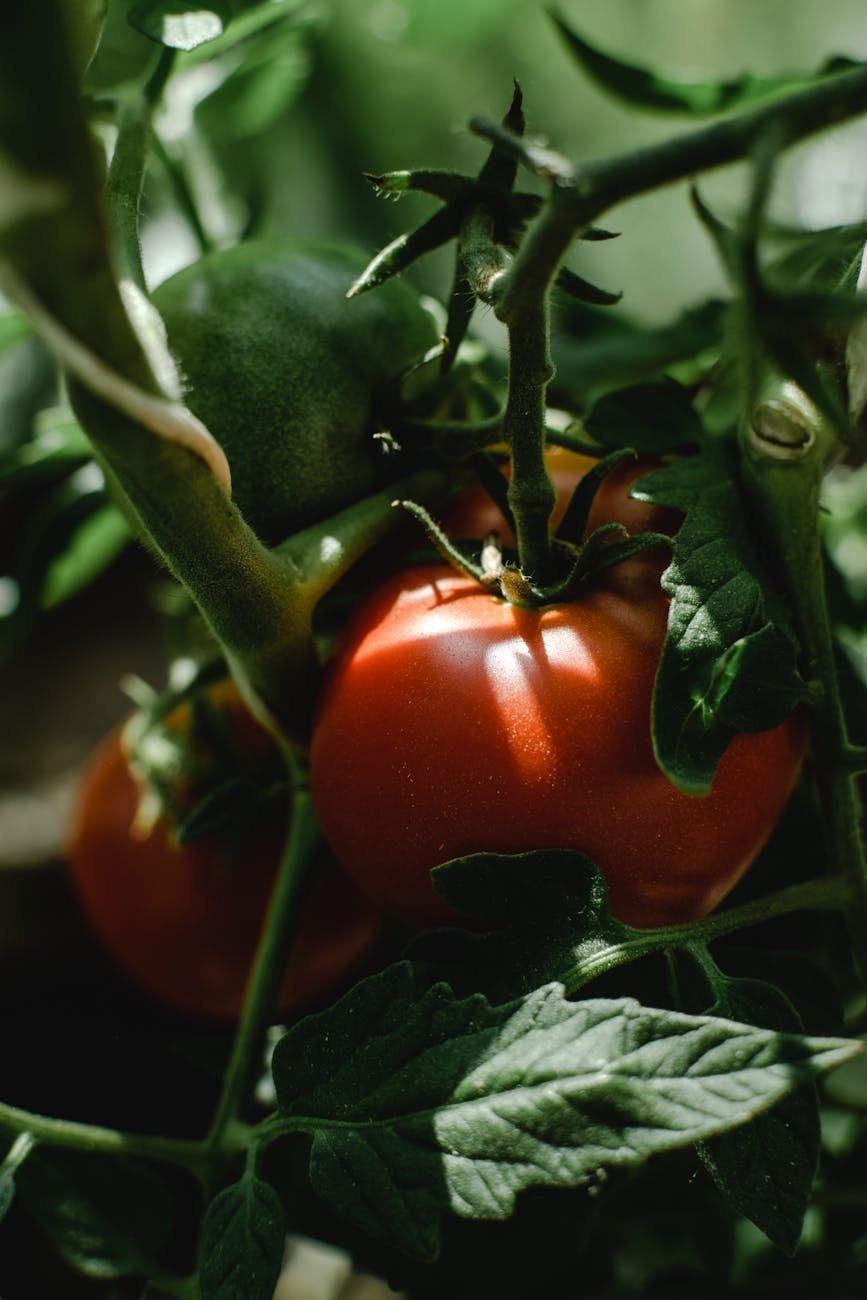
Tomato: A Sermon

I preached this sermon on Sunday, September 1, 2024, the first Sunday in the ecumenical Season of Creation, at St. Anne Episcopal Church, West Chester, OH. The lectionary texts cited are Song of Solomon 2:8-13; James 1:17-27; and Mark 7:1-8, 14-15, 21-23.

When I moved back to the midwest several years ago and started serving in parishes in this part of the world, I got to experience all over again the distinct pleasures of the turning of the seasons.

Living out in California, where summer and fall are pretty much the same, you have to rely on manmade, manufactured reminders—back to school sales and ads for pumpkin spice lattes. But here, in the midwest, we get real, tangible, earthy signs of the changing year as we make our way through it. 

For example, right now is not just Labor Day weekend or the precipice of football season, as wonderful as those things are. It is also…tomato season. Oh dear God, is it ever tomato season. Ask me how I know this.

You see, every year right about this time, a curious thing happens in the life of a midwestern priest. Tomatoes start appearing in odd places. They show up on your desk when you come back from lunch….and they appear randomly on Bible study tables and at breakfast meetings. They manifest, almost miraculously, in little bags pushed into your hands by unseen gift-givers as you make your way through a Sunday crowd. 

Indeed, had Jesus wanted to perform a feeding miracle in our own time, he would have done well to pick August in the midwest, and the crowds would have feasted on bread and tomatoes, and there would have been far more than twelve baskets left over!

I am grateful for the generosity of the gardeners among us, truly, especially since I don’t have much of a green thumb. For those who enjoy them, as I do, there are few things that approach pure, balanced perfection more than a late summer tomato, barely able to contain within its fragile skin the deep, bittersweet, vegetal tang of green stem and sunlight. Tomatoes are, if you will forgive my tendency towards poetics, almost saintly in their abundant, delirious, self-giving, delicious brightness. 

Oh yes, you can look for reminders of God even in a tomato.

And I was thinking about tomatoes this week not just because Matt and I have a stack of them on our counter and because we’ve been eating salads and BLTs and tomato sandwiches for dinner, but because these tomatoes revealed something to me about our Scripture passages this week. 

Yes, really.

What all of our passages this morning are all talking about, to some extent, is what I would describe as an ancient struggle experienced by humanity in its search for meaning and healing and hope: the perceived struggle between our inner life and our outer life. 

Think about it. Almost without realizing, we constantly talk in our faith lives about the tension between inner reality, inner spirituality, inner knowing, and what happens on the so-called outside: our actions in the world or those of others. This dichotomy is always with us. And usually we understand this interplay between inner and outer as one of conflict. 

Maybe our inner thoughts and feelings strive to be kind and loving, but then our outward actions betray us. This is what James is warning against in his letter, when he encourages the church to be doers of the word and not just hearers of it—to put their money where their mouth is and match their actions with their interior commitments. 

But then at other times, we might actually be doing good things, helpful and righteous things in public view, yet there is war and bitterness in our hearts. We are consumed with pettiness or jealousy or some other self-defeating emotion. This is what Jesus is warning against in the Gospel as he reproaches the scribes and Pharisees for committing grand public acts of virtue while their inner life and their theological imagination are shriveled and small and hard. To Jesus, the Pharisees are like the most beautiful tomato you have ever seen, only to bite into it and realize it is made of wax. 

But God wants neither of these outcomes for us—God doesn’t want us to be houses divided against ourselves, or to live divided lives. God wants our insides and our outsides to match.

That’s the invitation that Jesus is making to his disciples. It’s really quite simple. And really quite hard!

If we want to know what this looks like in practice, of course, we can look at Jesus who was, in a way no one else ever could be, someone who cultivated within himself and lived visibly with an undivided love for God, self, and neighbor. 

When he tells the Pharisees that what comes out of a person is what defiles them, he is not saying that the interior life matters more; he is upending their assumptions about how the world works so that they might finally perceive that their judgment is not just harmful, it is irrelevant, because everyone and everything is part of a whole.

One of the most distinctive and important aspects of Jesus is that in him, the ancient dichotomy of struggle between the inner and outer life does not exist. There is simply—life. Life flowing through, life taking shape, life abundant, rising up as urgently as a summer garden. Nothing to hide, everything to offer.

And I don’t know about you, but my God, as I look around our world, full of real crises and manufactured divisions and illusory promises…my God how I long for something with integrity, for something true, for something that is what it says it is, someone who is what they appear to be. And how I long to be the version of myself that is also all of these things, even when things get tough.

Like the voice crying out in the Song of Solomon, looking for her lover through the latticework, we are all desperately seeking something true, something whole, something that won’t betray us or turn on us or trick us, and it can often seem rather impossible to find…

…until you meet Jesus and realize that he is–my Lord and my God–the real deal. That he is the ripe summer fruit that is just as delicious as it looks. He is the fruit that bears no curse. The simple, abundant gift of life rising up from the earth and coming down from heaven. Stem and sunlight.

And if we, as the church, as the followers of this simple, bittersweet, abundant God, if we hope to show the world who he is, then by God we’d better get out there and act like it, whether in the pews or in the laundromat or in the office or in the public square. And we’d better get in here, too, into our hearts, and nourish ourselves with the prayer and silence and study that seed and nourish our work. 

Because the Gospel, ultimately, is about leaving behind the notion of inner and outer lives. We don’t get to choose between them. The world needs us to do love and to be love at the same time. The world needs us to be disciples who are as uncontrived, as self evident, as whole as Jesus. And yes….as uncontrived and self evident and whole as those tomatoes that keep appearing everywhere I look. 

So I guess that’s what the tomatoes showed me this week—those saintly summer tomatoes. They aren’t the most impressive or exotic thing. But, they are, blessedly, exactly what they appear to be. They are a promise kept, for once in this world. And they offer themselves, without reservation, without calculation, and with completeness, for the sustenance of all.

And just when you think there’s nothing left….they keep showing up, in unexpected places, to remind you what sunlight tastes like. Sort of like Jesus. And, at our best, like us, too.

So yes, if anyone asks you this week, you can say, well…he preached about tomatoes

But if I have learned anything thus far, it is that you can look for reminders of God everywhere, even in a tomato.

And imagine—if God can be revealed in a tomato, then, maybe, just maybe, he can be revealed in us, too.

Weeds: A Sermon

I preached this sermon on Sunday, July 30, 2024 at St. Anne Episcopal Church, West Chester, OH. The lectionary text cited is Mark 5:21-43.

I am not an adept gardener, but I can always tell when we have reached peak growing season—it’s when those pesky weeds spring up through the cracks in the sidewalk. I plucked out several this morning on the walkway into church, likely nourished by this weekend’s rain. It’s the eternal struggle—we weed, God laughs. But I also admire the tenacity of those weeds! They seem to defy our best efforts to subdue them. Their impulse to grow is strong. 

Maybe they have something to teach us. Have you ever noticed that, throughout human history, our impulse towards growth and freedom also emerges most often in the summer? 

There’s the Fourth of July, of course, when we Americans were the proverbial weeds in the garden of King George III, but there was also the singing of the Magna Carta (which happened in June); and the storming of the Bastille in France (in July); and the March on Washington (in August); and the summer Freedom Rides of the civil rights movement; and the Stonewall riots and the Pride marches inspired by them; and the racial justice protests of 2020; and many, many other such moments when people had finally had enough and demanded something new… and they all unfolded in the long, hot, hopeful days of summer. 

I’ve been wondering this week why that is. It’s almost as though the human spirit comes alive, too, in this warm growing season with our own renewed, fierce determination to flourish, almost as if our souls were like stalks of summer corn, reaching up towards the infinite blue sky, determined to reach the clouds, to brush against the hem of eternity, to thrive unencumbered.

And you might notice that, in the seasons of the Church, we acknowledge this impulse too, adorning the altars and the ministers with green, the color of an insistent, stubborn vitality. After Easter and Pentecost, in the long green season of Ordinary Time, we are reminded that the Church, at is best, is indeed like a weed growing up through the cracks of empire, or like wildflowers growing in a forgotten ditch—it is the embodiment of the beautiful, humble, pesky aliveness of Christ that challenges anything and everything that would try to pave it over. 

And so, we, too, in the church, have our own summer revolutions. One of them is coming up in just a few weeks, on July 29th. Do you know what it is?

It’s the 50th anniversary of the Philadelphia Eleven, the first eleven women ordained to the priesthood in the Episcopal Church on July 29, 1974. These women were indeed possessed of a fierce determination to flourish. They were not willing to wait for the church hierarchy of the time to drag its feet any longer, and so they found a few retired bishops willing to ordain them and they simply…did it. They went up to the altar and put on those green vestments, for they knew that they, too, were called to brush against the hem of eternity, and they said, now is our time to thrive, unencumbered. Call us a weed in the garden if you want, but we know what we are: fully alive.

And thank God for them. I would not be able to be the out and proud priest I am today if it were not for their courage to be the priests God made them to be. And thank God for all those saints and heroes of summers past who decided to grab hold of their chance to flourish. We need their witness now more than ever. 

In an age where it is especially easy to be cynical, or even despairing about our politics and our culture and our collective future, the examples of the Philadelphia Eleven and all the summer revolutionaries remind me that true change, true justice, true peace, are gifts of God, but gifts that must be claimed and grown and harvested if we want them in our own time.

And more often than not, these revolutions are initiated by those at the bottom of the power structure, those at the margins, those weeds in the garden who finally say: we have languished for too long. Now is our time to thrive. All of Scripture and much of human history is a testament to this.

A perfect example is our Gospel reading today. Jesus has been traveling around the countryside, criss-crossing the Sea of Galilee, calming storms and casting out demons and offering all sorts of signs of his power. And there is a particular woman who hears about all of this—a woman who, because of illness and poverty has been consigned to a meager, desperate existence. She is a woman who is tired of waiting for relief, tired of grieving, tired of bleeding and calling out for help while people look the other way. She is not dead, like Jairus’ daughter, but she is a ghost among her people.

But when she hears about Jesus, something shifts within her. Who knows, maybe it was summertime, maybe she was hot and tired and fed up with the way things were. 

But whatever it was, something deeper than despair, something stronger than cynicism or despondency arises within her and she says, “if I but touch is clothes, I will be made well.” If I reach out and brush against the hem of eternity and say, I too, deserve to thrive unencumbered, then it will be so.

And so she did. And so it was.

And I imagine her standing there, this unnamed woman, this patron saint of nothing left to lose, and what I realize is that, when Jesus says, “daughter, your faith has made you well,” he is not just talking about a cure to her illness—he is saying, you, my child, have tapped into the stubborn vitality that is at the heart of God. 

And by claiming the blessing long denied you, by asserting your inherent dignity, you have discovered the one thing that cannot be taken away, the one thing that rises up again and again like a weed, or like a stalk of summer corn—God’s life, God’s love, God’s wholeness, God’s humble, pesky aliveness, which is now my gift to you and all who have been told for too long that they do not deserve it. Receive it today, this love and this life freely given to you and for you, for this is the revolutionary truth at the center of creation. 

So I wonder, are we willing to be revolutionaries, too, St. Anne? Revolutionaries for the sake of love? It’s a good question to ask on the 4th of July or in any season, really. 

God knows we need to be, for our own sakes and for the sake of our neighbors. Like the woman with the hemorrhage, we may be bleeding and tired, but we do not have the luxury of languishing in despondency, no matter how gloomy it looks out there. Just like all those generations before us, we are called to be people with summer hearts, with souls on fire for justice, with bodies and spirits ready for the necessary work of liberation that arises in every age. And how we will engage that work is a conversation we must continue to have. 

We’ve made some strides already in our parish. But there is more we can do together, more we must do given the challenges of our time and the demands of our faith. 

Conversations are rising up among us about social justice ministries and creation care work and more proactive outreach to people who have been hurt by other churches, and more formation to equip us for ministry, and I am thrilled by all of this, and I encourage you to seek out these conversations and take part in them and then take part in making them a reality. Let’s brush up against the hem of eternity, and let’s pursue the vitality that is God’s gift to us, and let’s see what happens. 

Because we and the whole Church, when we’re at our bravest and our best, we are still that weed, growing up through the cracks; we are still that wildflower in the ditch, reminding people of what’s beautiful about this world, what is not easily killed, what it looks like to reach up towards the infinite blue sky, and to be fully, truly, stubbornly, miraculously alive.

And wouldn’t you know, it’s summertime. Signs of life are all around us. Sounds like a good time to grow.

Garden at the End of the World: A Reflection

I offered this reflection during a parish Lenten retreat at Trinity Episcopal Church, Fort Wayne, which explored the various gardens of Scripture, including Eden, Gethsemane, and, here, the garden of the New Creation in the Book of Revelation.

I want to tell you a story about a garden at the end of the world.

Last summer, I was on a trip to the United Kingdom, and after a very long set of flights from Fort Wayne to London, and a train from London to the northern city of Newcastle, and a car from Newcastle to the Northumbrian coast near the border of England and Scotland, I found myself standing on the seashore, looking out towards my final destination: an island just off the mainland, separated by a tidal causeway that is only passable at certain times of day when the seawater does not inundate it. It was the Holy Island of Lindisfarne, an ancient seat of Christian monasticism and a pilgrimage site for centuries. 

I was still wearing the same clothes I’d put on, many, many hours ago in Indiana, and it was a surreal experience to stand there, bleary eyed, carrying the dust and the baggage of all I’d left behind, and yet to be in the midst of something so luminously, shockingly new. 

We crossed the causeway as the sun sank into the North Sea and the skies were every pastel shade imaginable, like ice cream flavors melting together. Rasberry, peach, grape, blueberry, cream. And once we’d arrive to the other side, my companion and I made our way up a grassy embankment, to the top of a ridge overlooking the sea. We had arrived, and we were bathed in color and salt air, and I confess that it felt like the landscapes of heaven one dreams of as a child, before heaven seems a bit harder to imagine. 

As we stood among the waving grasses of Lindisfarne, we looked out towards the far side of the island, straining our eyes in the falling dusk. Isn’t it interesting how, whenever we get to the edge of something we still want to see what is even further out? Curiousity, or longing, keeps our eyes on the horizon. 

And as we looked, we noticed something that was hard to make out, a low structure of some kind, dark and earthen, out beyond any other buildings or roads. It wasn’t on our map. It was a mystery, and we decided to go out the next day to see what it was, sitting in solitude at the far end of an island at the far end of the earth. 

So we set out the next morning, making our way along a path that followed the sea, curving out around the old castle that sits like a sentinel atop a rocky hill on the otherwise gentle landscape of Lindisfarne. And that low, dark thing, whatever it was, was still hard to make out, until we curved around the eastern edge of the island and followed a narrow road that led us closer. 

It was not a building at all, in fact, but a set of low stone walls, made of rocks piled on top of one another, moss growing in the cracks between them, delicate sea grasses growing out of the top. And in the center of one wall was a gate. And when we opened the gate…we stepped into a garden.

A garden, sitting in silent, abundant repose, at the end of the earth. And in that garden, on this July afternoon, every color flower imaginable was blooming—red poppies and white daisies and flowers I did not recognize—fuschia and pink and gold and amethyst. And there were bees buzzing around, gathering their pollen, and the sea breeze stirred the plants gently and the air smelled like earth and salt and sweetness and greenness. Like viriditas. 

And we just stood there, in awe, marveling that such a beautiful thing could actually exist anywhere, but especially here, out at the end of the world. 

In the Revelation to John, we are given a vision of another garden, in another place and time, or perhaps it is more accurate to say that it is a vision of a garden that is in every place and beyond time. For it is the garden of the New Creation, the garden that is the fulfillment of God’s promise to redeem creation and to make it whole. To make it holy.

John writes: Then the angel showed me the river of the water of life, bright as crystal, flowing from the throne of God and of the Lamb through the middle of the street of the city. On either side of the river is the tree of life with its twelve kinds of fruit, producing its fruit each month; and the leaves of the tree are for the healing of the nations. 

This vision, the very last one given in the Book of Revelation, and thus the final one in Holy Scripture, is the consummation of God’s promises: that in the end, beyond death, beyond time itself, there will be a garden, there will be life, there will be food and healing and abundance in every season. There will be a garden at the end of the world, and there will be a place for everyone and everything.

It is worth noting that this new garden, this new and eternal revelation of Divine viriditas, is not just a reentry into Eden. We don’t simply end up where our forebears started, as if nothing had happened, as if the millennia of life and death and growth and decay we’ve survived all just folded back on itself into some sort of primordial, unknowing, unremembering dream. Because God cherishes the beauty of all the seasons we have endured. God knows the seeds we have planted, the dreams and the tears and the blood spilled into the soil. God sees all of it, God sees all of you, all of us, and God does not desire to erase but to redeem it, to heal it, to imbue it with an everlasting radiance. To imbue it with viriditas.

So no, we are never going back to Eden. But neither are we stuck forever in Gethsemane, where life and death struggle in their tortured dance. No, in the Garden of the New Creation, we enter into something far better than a new and improved version of the world we know. We enter into the very life of God. We enter into God’s own heart, God’s own home, God’s own viriditas, a place that is not simply a lost paradise reclaimed, but is the very love and life that underlies every notion of paradise. 

In the new heave and new earth, we enter into God, who is waiting for us at the end of the world. And according to Scripture, it seems that God looks very much like a garden. 

I confess that as we look around the world today, it is hard to hold onto this vision. Our planet is in crisis, and all of us—humanity and plants and animals, rocks, rivers, and seas—all of us are bound together in uncertainty and in pain. So some days it’s hard to imagine a place where there is ever-ripening fruit and balm for every ailment. A place where all creation exists in harmony with itself and its Creator. It is a lovely thought, beyond lovely, but it can feel like a fanciful wish rather than a grounded hope, because we have known so much of hardship for so long.

Loss and death and finitude are so intimately part of our lives; they are big and burdensome yet also familiar, and if I am honest with myself, I can’t imagine life without death, as much as I want to. Sometimes the idea of eternity, even in a beautiful garden, scares me a little. I can’t really understand its unending joy. It’s hard to imagine a world that is not Eden or Gethsemane, a world where the serpent won’t show up again with his temptations, it’s hard to imagine a world where the Cup that we receive will be full of life, with not even a trace of bitterness or loss.

But the Revelation, of course, doesn’t really explain how it all will work. We are given a dream, a promise to trust in. We are given a garden, and the rest is left to our sense of wonder. This vision of the New Creation is not a precise roadmap to eternity, but more of a song, or a poem, or an intuition. A reminder that as we wait, if we seek a foretaste of heaven, we might tend to the earth and help in flourish.

All we can do, here and now, is love the gardens in which we find ourselves, the gardens of the earth as it is: broken yet insistently hopeful; the gardens of our lives as they are: broken yet insistently hopeful. The gardens that remind us of what has been given, what has been lost, what has been promised. All I can do is walk through this earth and notice it, and care for it, and I can walk alongside my neighbor (my human neighbor and all the rest of creation too) and notice them and care for them, and I can trust that my Lord, the unseen gardener and caretaker of us all, is just on the other side of the dense greenery, smiling through the leaves, and that whatever he is planting for that future day, that final harvest, that eternal garden, it will be more beautiful, more whole, more full of connection and love than anything I’ve yet known or imagined. 

More so, even, than the gift I found hidden behind those stone walls on the Holy Island, where for one brief summer afternoon, heaven whispered among the poppies and the seagrass, and God was in the green and in the wind and said,

I want to tell you a story about a garden at the end of the world.