The Fire That Never Came: A Sermon

I preached this sermon on Sunday, January 12, 2025, the Feast of the Baptism of Our Lord, at St. Anne Episcopal Church, West Chester, OH. The lectionary text cited is Luke 3:15-17, 21-22.

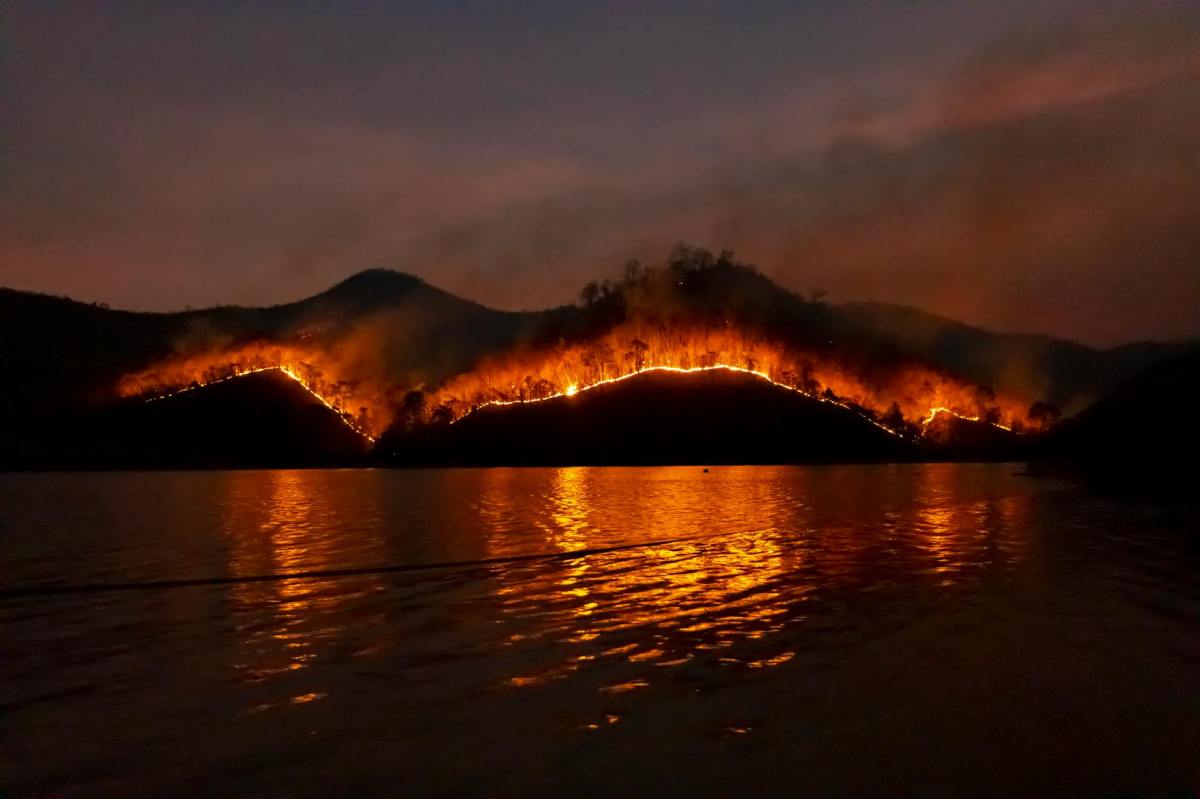
I’ve shared with you in the past how, when you live in California, you become acquainted with the risk of wildfire. You make an uneasy peace with it. Much of the year it’s in the back of your mind and then, when the risk level is high, you look nervously towards the hills, wondering if and when something might spark. 

But because you never really know, most days you go about your business and go to work and do the dishes and pay the bills, carving out a sense of normalcy and telling yourself that, if it does happen, if the fire does come, somehow you will manage. Or maybe, in your less noble moments, you just figure it will happen to somebody else.

But the fires do come, in their own cruel time and manner, and it is hard to be prepared when they do. As we’ve seen this week in Los Angeles—as some of you know intimately well through the impact on friends and family members—the fires come without much warning, and they blaze and they creep up upon the homes and lives of people without much regard for their wealth or background or virtues or vulnerabilities. 

They come, these fires, and they do what fires do—they consume. We know already this week of Episcopal churches and whole communities consumed by this most recent set of wildfires. We also know that we are living in a time when human-impacted climate conditions will only continue to increase the likelihood and intensity of such events. The unquenchable fires have come. 

And maybe it’s just me, maybe when you grow up with this threat of flame and smoke, it has a formative effect..but I have to say that, as evocative as it is, I find little that’s romantic or alluring about most of the fire imagery in Scripture. I’m circumspect about declarations, like the one that John the Baptist makes in this morning’s text, about how God will come and burn and consume things for some divine purpose. There is nothing pretty or transcendent about that. Not when you have seen or known what fire can actually do, what it can take.

And yet that imagery is there for us to contend with. John, admonishing the crowds before Jesus’ appearance, warns of a Messiah who will come bearing unquenchable fire to burn up all that is wicked and unworthy. And I get it, he is angered by injustice and wants the people to look a bit nervously toward the hillsides, wondering when their reckoning will come. As prophets often do, he wants them to experience an uneasy peace with the world as they know it. He assumes that God will save the world through a display of vengeance and power, in billows of smoke and flame. 

He is not alone in that, even today. I found a number of news articles this week in which people described the Los Angeles wildfires as “biblical” and “apocalyptic” and as being like a scene from “the battle of Armageddon.” Still, still, even if we don’t want to, we imagine and speak of God working through destructive forces, raining down judgment upon us like ashes, threatening at any moment to take away all that we know, or, in our less noble moments, to come and take from somebody else. 

I wish we could loosen our grip on that fiery imagery somehow. Because I will tell you that so much of why I am Christian, why I was able to give my life over to the way of Jesus, is because of what actually happens in today’s Gospel after John’s dire predictions. 

And it is this: that Jesus, the Son of God, appears in Galilee, the Incarnate Deity appears at last, coming over the hills…but the fire never comes. Not in the way that anyone expected anyway (and Pentecost is a story for another day). 

No, on this day Jesus appears and it is not as a vengeful blaze cresting the ridge, but as a man ready to get down into the water like everyone else. A man ready to come alongside all of us in the uneasy peace we have negotiated with this life. A man who wants us hope for something more than mere escape and to believe in something more than just survival.

And truly, thank God for that. Because I will tell you, my friends, I am tired of fires, and of people who blithely traffic in the language of fire when talking about God and our common life. I am sick of “burn it down” and “let it burn” and of fire & brimstone theologies that devour human dignity in the name of purgation. I am sick of destruction—of bodies and landscapes and souls—and how they are cast as part of God’s saving mission. 

I don’t want to settle for an uneasy peace anymore. I want the peace that the world cannot give, the peace born of water and Spirit. And today we see where it comes from—from the God who stands in solidarity with us in the River Jordan, whose only fire is the one burning in his heart with love. 

Because John, for all his Spirit-inspired wisdom, got this part wrong, and it’s important that we don’t just read past his mistake. There’s a reason, in other versions of the story, that he is actually somewhat dismayed Jesus wants to be baptized with water. There is a reason, later from prison, John asks, are you the one we have been waiting for

Because John himself is also discovering, as we must, that the true Messiah, the Christ, is not an inferno coming to gobble up everything we’ve tried to build; God is the one strengthening us and helping us to carry those buckets of water– all that blessed baptismal water–to put out all the fires we ourselves have started on this earth. 

And yes, God will help us separate the wheat from the chaff within ourselves and in our world, but God will do so not through devastation but by the devastating power of his mercy and kindness.

And the thing is, we already know this. We already know, if we stop to reflect on it, where and how God shows up in the world. We know that God is not the one burning the hillsides of Los Angeles or blessing the gunfire in war zones. We know that God is instead with the firefighters and the first responders and the widows and the orphans and the volunteers and the communities of people who are sheltering each other and guiding each other into safety. 

We know that Christ asks us to do the same for each other no matter what landscape we live in or what disasters befall us. We know this, because it is what Jesus demonstrated and proved the value of in his life, death, and resurrection. And we can’t let anyone distort this truth.

No matter what we must navigate in our time and in times to come, no matter how many times the fire looms at the edge of the horizon, we are still, and will always be, the people who proclaim the good news of the one fire that never came—that so-called fiery, angry God who instead appeared in the water, like a falling dove, like a gentle Word, stooping down from the misty heavens to scoop up our fears in his hands and bless them and say,

Peace. I am here. You don’t have to be afraid anymore, you who have been uneasy for so long. Step down into the water with me, where the flames cannot reach.

Drench yourself in love, and let us begin again. 
Two Fires: A Sermon

I preached this sermon on Sunday, September 3, 2023 at Saint Anne Episcopal Church, West Chester, OH. The lectionary texts cited are Exodus 3:1-15 and Matthew 16:21-28.

Throughout the wider church, this month begins what is called the Season of Creation. It’s a time when we consider our interrelatedness with all created things and how our connection to the natural elements might shape the elements of our faith. So today, in that spirit, I want to tell you two stories about fire. 

The first will probably sound familiar: when I was a kid, I spent summers up in the north woods of Michigan, and one of my favorite memories is of the campfires that my dad and my grandpa would build out by the lake. There were s’mores, of course, and ghost stories, and as the evening wore on, a companionable silence settled in as the wood snapped and the flames danced in the darkness. And what I love about that memory of fire is not that it was something unique to me or my family, but that it felt like something that people have been doing forever. I suspect most of us have, at some point, experienced a similar quiet pleasure around a fire pit, where, as the night enfolds us, busyness gives way to simply being, and the amber glow creates a sense of closeness and belonging for all those who are bathed in its light. 

The second story is less comforting. When I was in seminary in northern California, having returned to the state after many years away, one of the things that was hard to ignore was the pervasive and intense threat of wildfire, far more so than when I grew up there as a child. Due to the corrosive effects of climate change, the fires across our continent are bigger and more widespread than ever before, and each year one must live under their shadow, both literally and figuratively. 

There was one fall where the smoke from nearby fires poured into Berkeley and the sky was gray like fog and the sun was red and we had to wear N95 masks to go outside long before COVID made them necessary for other reasons. And I remember how my friends and I discussed whether we should pack a bag with essentials ready to grab should the wildfire jump to the nearby hillsides. We wondered where we would escape to if they did. I thought of that again, recently, when smoke enveloped the midwest from Canadian wildfires and while watching videos of people flee the town of Lahaina as Maui burned. 

This is the duality of fire: it warms and sustains, but it also consumes and destroys. We need it, and we fear it. We rejoice in its beauty, but we ignore its power at our peril. 

And so perhaps it is no surprise that fire often appears in key moments of Scripture where God is revealed to humanity, for that same duality characterizes our relationship with the Holy. God is the source of our life and yet also of our trembling. God is the light of belonging and is also the burning heat that lays bare our pretenses of safety. And, as Scripture attests, the challenge of life with God is to learn how to hold both of these understandings at the same time. 

When Moses sees the burning bush, he is not immediately afraid, but attracted. This fire in the wilderness that burns but does not consume is not exactly a campfire, but it is a sign of God’s desire to gather in the people of Israel and tell them a new story. Moses and the burning bush form an image of humanity drawing together in communion with its Creator; and Moses’ experience suggests that when we gather in close to listen to God, we too will hear a promise of deliverance; we too, in the companionable silence, might hear the name of the One who abides with us. 

This story reminds us that part of our calling is to form communities where everyone and anyone can come hear the story of how God will liberate and heal all of creation. And even if we, like Moses, feel unworthy or unprepared to take part in that story, we are part of it, because the place we are standing is already holy ground. 

But gentle warmth is only half the story. Because this morning we also hear Jesus telling his disciples—in fiery, unsparing language—about the true nature of discipleship: the necessity of death and relinquishment and the searing pain of the cross that he will soon experience. We do not need to indulge in theologies that glorify suffering nor should we promote the idea that people’s pain is itself holy. But we do have to acknowledge that God’s activity in the world is not always cozy; it’s not limited to upholding that which comforts us. 

Through the Cross of Christ, God is like a wildfire, laying waste to the structures and the systems and the sins that confine and subjugate and placate; God’s intention is to incinerate them with justice; God means to engulf them in peace, so that something new might spring up. And this type of divine fire is dangerous—dangerous to the powerful, dangerous to the complacent, dangerous to anything within us our around us that stands in the way of the Kingdom’s coming. Get behind me, Satan, Jesus says to Peter, not because he hates Peter but because he rejects Peter’s assumptions of comfortable messiahship, of self-satisfied discipleship, and he intends to burn away those parts of ourselves that resist God’s mission in the world. As John the Baptist once said, “the one who is coming after me …will baptize you with the Holy Spirit and fire.” Now we begin to see what he meant.

So, two stories about fire, and two stories about God’s presence in the world. Two stories that are part of our own story, which must be held in tension and told and lived into, again and again, in every generation. 

How are we, at Saint Anne, gathering others in toward the burning bush? How are we creating a community with space enough for everyone to share their story, to delight in fellowship, to sing and study and pray and learn together? And how are we making sure others know that this fire burns as a sign for all people? Because it’s important to remember that Moses’s encounter with God in the desert was not a private revelation. It was the initiation of a public mission, one that radiated outward with light and heat and hope. There is a story about the world that does not end in division or oppression or fear. Are we telling that story beyond these walls? Are we inviting people to gather ‘round, to come and rest in its light? This is the call of the burning bush. 

At the same time, how are we, at Saint Anne, taking up the Cross as the sign of God’s categorical rejection of all that would harm and oppress and stifle the flourishing of life on this planet? Because it’s not enough for us to gather around the campfire while the world burns. Jesus could have stayed in Galilee telling stories with his friends if that’s all that was needed to save creation. 

But he didn’t. He took on the Cross—the ultimate symbol of degradation and cruelty—in order to consume it with the power of his love. And we who would follow him, we, too, have to look for the crosses of our own time—the failings, the fault lines, the dehumanizing tendencies of our hearts and our culture—and we have to take them up and take them on, speaking the word of love that is like fire, so that the crucifying forces of this world will be revealed for what they are: a lie. A delusion. A pile of ashes.  This is the call of the Cross. 

The good news that I have already witnessed at Saint Anne is that we are engaged in both of these things—the gathering in around the fire, and the setting the world aflame with love. But as we prepare for another program year, as we prepare for a new season of ministry together, I encourage you to consider how you are taking part in these two stories yourself, whether through education, through prayer, through advocacy and justice-seeking, through service, through pastoral care, or through the many ways that we build up and enrich life in this community. I hope you will make that commitment, knowing that you will never be walking alone as you do so. 

Because here’s the thing: God is already doing what God will do in the world: beckoning and illuminating, dismantling and renewing. Our choice, our vocation, our glorious gift and responsibility is whether we will join in, whether we will rest in the light, and whether we will become like holy fire ourselves, fierce, fluid, and free. 

In the end, it’s not two stories about fire, but one. Just one story, reconciled in the burning heart of Christ, one story that holds all of life, that holds all of creation, and it is God’s story and, if we so choose, of we so dare, it is also ours.