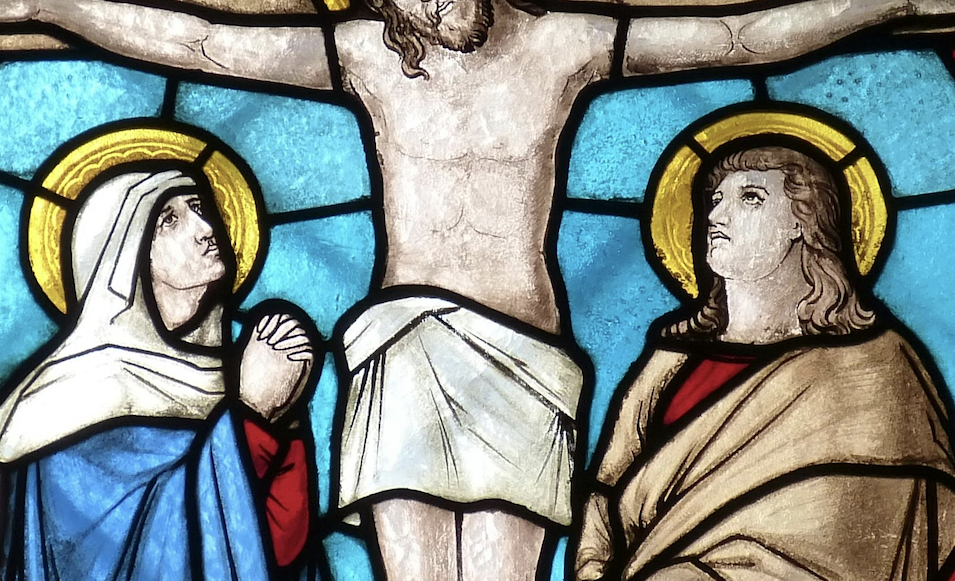

Eyes on Him: A Sermon

I preached this sermon on Sunday, July 20, 2025 at St. Anne Episcopal Church, West Chester, OH. The lectionary text cited is Luke 10:38-42.

Not too long before I began my training to be a priest, I had a meeting with my rector and mentor, Fr. Shannon. I was, as you might imagine, a bundle of nerves and excitement and anticipation, wondering what on earth I’d gotten myself into, even though I also knew it was the only thing I could imagine doing with my life. 

Fr. Shannon was and is a prayerful and wise man; he is the sort of person who cuts right to the heart of the matter when you speak with him. Even so, when I asked him for any last-minute advice as I headed off to seminary, I wasn’t quite prepared for the simplicity of his words. 

Just keep your eyes on Jesus, he said. Just keep your eyes on Jesus and you’ll be fine. 

That was it. 

Now, I can be an over-thinker. With good PR one might call my personality type “introspective,” but if we’re honest, sometimes I just get in my head about stuff.

So when I’m all worked up inside about the future and Fr. Shannon just says to me, keep your eyes on Jesus, I will admit to you that internally, I was kind of like, uh huh….and??? Throw me a bone here, Father. There’s gotta be something more to it than that. How am I going to crack the code and become the ideal priest? How am I going to help fix all the problems of the church and the world? How am I going to shoulder the impossibility of the task ahead?

But that was all he said that day. Keep your eyes on Jesus. 

So I packed my Uhaul truck with a lot of unanswered questions and went on my way. 

And wouldn’t you know, that he was exactly right? Because I would learn in all sorts of ways throughout my years of training and formation—and I continue to learn—that keeping your eyes on Jesus is a deceptively simple invitation. It is actually really, really hard, especially once we realize how many other things we’re accustomed to focusing on. 

The truth is our complicated lives and the complicated world around us and our egos and sometimes even the ups and downs of Church itself seem to conspire to keep our eyes on anything other than Jesus. Anything other than the simple, devastating truth of him and all that he offers, teaches, and dismantles. 

I got to seminary and, as with anything, it was so easy to get caught up in the externalities of it—the grades and the institutional anxieties and the questions about the future. So easy to forget, if I wasn’t careful, that none of that stuff mattered if I wasn’t first focused on the deep, healing love that I had found in Jesus.

And as with any great love, some years on, I’m still only beginning to discover its fullness—only beginning to see what it means to keep my eyes on Jesus and to let that seeing change me. 

I tell you this story, though, because in this light, I hope we can reassess today’s gospel passage. Here’s another confession: if I hear one more take on this story that divides us all into “Martha” types and “Mary” types, or that pits action against contemplation, I will pull out the nonexistent hairs on my head. With all due respect to those interpretations, this is not a passage about any of that. You are not just a Martha or a Mary. This is a meaningless distinction.

If you need some convincing on this point, consider: was Jesus a Martha or a Mary? Was he an active or a contemplative? The answer of, course, is that he was all of these things together and none of them alone. He was and is the unity of love and action, of prayer and prophetic witness, of service and surrender. Which is why, of course, we are supposed to keep our eyes on him—so that we might become like him. 

Consider, too, that in Scripture Martha and Mary are both more than this isolated passage would suggest. Martha, in John’s Gospel, is not a hapless busybody, but a person of deep faith and insight: she is the first person in that book to proclaim Jesus as the Messiah. And Mary, in that same Gospel, is no retiring navel gazer, but a person of decisive word and action. She pours out her expensive ointment and anoints Jesus’ feet with her hair, defying criticism and convention. 

Imagine that, women in scripture actually being more complex and powerful than church interpretive tradition has allowed them to be? What a concept! So let’s lay down that tired old binary these women supposedly represent. It is not real. 

The point here, instead—the distinction that Jesus is making when he talks about Mary “choosing the better part”—is a question of where our focus lies. It is his gentle, direct reminder to Martha to keep her eyes on him in all that she does. In the things that she can set into order and in the things that remain a mess—in all of it, he wants her to not forget what it’s all for, what it’s all about, what it’s all moving towards: union with him, life in him, the eternal love affair between God and creation consummated in him. 

Because Martha, worried and distracted by the many things she genuinely cares about, can only truly learn how to love them if she keeps her eyes on Jesus and receives him not just into her home but into the very depths of her soul. 

And the same is true for us, friends. 

All that we do in the church—our programs and our fellowship and our formation and our service projects—all of it is meaningless unless we first keep our eyes on Jesus and receive him into the deepest parts of ourselves. You’d think this would be obvious, but just like that advice Fr. Shannon gave me, it is deceptive in its simplicity.

Because it is so, so easy to become distracted, worried, and tempted by many other things—the ups and downs of economics and politics, the personal hurts and hungers that plague us, the unresolved conflicts and the institutional inertia. They are all important in their own way; they all need some faithful tending. But without keeping our eyes on Jesus—without making him the main thing that we are actually about—we will never go beyond a sort of well-meaning crisis mode. And I think we find ourselves in well-meaning crisis mode a lot of the time.

But God wants something more for you than that, St. Anne. God wants your liberation. God wants your peace. God wants you to be able to breathe again. And to help others do the same.

And the journey towards that liberation and peace and room to breathe begins, and becomes, and ends, for us, in focusing on Jesus. Listening to him, praying as he prayed, confessing to and confiding in him, studying his teachings, modeling our social ethics and our relationships upon his generous and gentle love. And then receiving him—reaching out our hands and receiving him into the deepest parts of ourselves.

This is what we must be about here at St. Anne, first and foremost: keeping our eyes on Jesus. And when I say Jesus, I mean the real Jesus, by the way, in case you’d forgotten or never been told what he’s actually like: living and present, responsive to reality, no enemy of science or truth or human experience, sacramentally available, still-being-revealed to us, Spirit-driven, justice-seeking, reconciliation-making, mercy-rendering. That is Jesus. Keep your eyes on him. 

The stranger-caring, everyone-welcoming, difference-respecting, listening, peacemaking, table-turning, mountain praying, active, contemplative, holy Jesus. The Martha and the Mary and the Peter and the Paul and even the Judas-loving Jesus. Keep your eyes on him, because he is there waiting to love you, too.

Not Christian nationalist Jesus; not conservative or liberal Jesus; not idol of patriarchy Jesus; not disembodied, benign, relative-truth Jesus; not war-monger Jesus; not mere symbol Jesus; but the real, risen, living, loving, bleeding, blessing, breaking, laughing, dancing, fire and firmament Jesus who demands nothing less than all of you and nothing more than this: to see him, and to fall in love with him, and to fall in love with your neighbor and the world again because of him, and to die and to live again, all at once in him. 

That’s who I am going to keep my eyes on, no matter what else comes along. 

Just like Martha, and just like Mary, and just like everyone else who has ever dared to look up from the worries and distractions that surround them and instead chooses the better part that is, quite simply, Jesus. That is, quite simply, love. 

Whatever else we do, lets start there. Just keep our eyes on Jesus.

As a wise friend told me once, do that, and we’ll be just fine. 

Urgency: A Sermon

I preached this sermon on May 11, 2025 at St. Anne Episcopal Church, West Chester, OH. The lectionary text cited is John 10:22-30.

I have been told many times throughout my life (as I am sure you have been, too) that patience is a virtue. My track record with that is mixed at best. 

Especially in springtime. Most years when I was growing up, right about this time, when the May afternoons become warm and breezy and filled with the scent of mown grass and flowers, I felt anything but patient—because the promise of summer felt so close, so tantalizing! Everything felt possible. Patience? Who needs it? That was something for boring old grown ups—I wanted freedom and sunshine and ice cream cones that dripped on the sidewalk and those long, campfire-scented nights when we listened to the old stories and sang the old songs. I was impatient, impatient for all of it. 

And then a bit later, like some of our graduating teens whom we are celebrating today, you start to feel a new form of impatience for “real life” in the world beyond childhood, when you get to make your own decisions and mistakes and discoveries. The May of senior year of high school is sort of an icon of impatience, though usually a joyful one.

But frankly, as I have become more and more like those boring old grown ups, I’ve discovered that the whole patience thing never magically materialized with age. There are still so many things that I want–eagerly and anxiously–things I do not want to wait around for forever. Because as you go along through life, you realize the preciousness of time, the preciousness of experiencing everything you can, while you can. 

And you also notice the deep needs and challenges and pain of the world around you, too, and you start wonder whether “patience is a virtue” might’ve been something coined by those who simply want the rest of us to be quiet and give up our dreams and our collective agency. In our own lives and in our common life in this world, more often than not what I really find myself wondering is not how to be more patient, but what, on earth, we are waiting for? Let’s go!

I love life too much, I love the world and the people in it too much to wait on truly being alive in it. So I think today, I think now, I think in all truth I am interested in the virtue of urgency. The virtue of loving, compassionate urgency. 

Some of the personal circumstances of my life are surely shaping that feeling, but to be honest, I think I am still and always have been that kid who is eager for freedom and sunshine and sweetness, and I think most all of us are, deep down, in our own ways. The problem, the fundamental problem, is not that we are impatient—it is that we are too willing to wait. We are too willing to forestall what is truly important. We put off waking up and seeing the beauty and the goodness that we were created to be and called to build in the name of God. 

So yes, I want to seek the virtue of urgency. Urgency to do something real that contributes to God’s kingdom. Urgency to love without discrimination. Urgency to listen and respond to the people around me, like Jesus did. Urgency to stand up to what is wrong and dishonest and harmful. Urgency to be the sort of person who is unashamed of the Cross of Christ and who is unabashedly confident in the promise of his Resurrected Life. 

And I think that is what Jesus wants from all of us, really. Now, I know that patience is named as a fruit of the Holy Spirit in Scripture, and there are indeed times when we must slow down and seek the capacity to endure, to persist, to trust in God when we can’t see the road ahead. 

But more often than not, I think Jesus wants us to get a little more urgent in our discipleship: in our living and our loving. A little wilder, a little bit more free. A little bit less like a boring old grown up and more like what we once were and still are—an open heart, running down summer sidewalks, licking ice cream cones and chasing stars. 

Note this morning’s Gospel passage. Jesus is walking in the temple, a very serious grown up sort of place. He is approached by some Jewish leaders, and they have an urgent, rather insolent question for him. “How long will you keep us in suspense,” they ask. A better translation of the Greek is, how long will you keep wasting our time? If you are the Messiah, tell us plainly.

And you can’t really blame them. They have good reason to be impatient. They are not just longing for summer freedom, they are longing for true freedom—from oppression and suffering and exploitation. They are impatient for hope. And I think we all know what that feels like, we who have had too much of disappointment. 

But as is so often the case,  it’s Jesus’ reply that I find so compelling. You might think he’d say, now, now, my brothers, wait and see. Patience is a virtue. You’re just gonna have to be quiet and hold tight and buckle down til your salvation comes. 

But that’s not what Jesus says. He is, instead, equally insolent, equally blunt. I have told you. You want a Messiah? You want salvation and liberation? I have told you all about it, and you do not believe. I’m waiting on you, my brothers and sisters!

I am standing here, I am standing here, Jesus says.  I am God, standing here asking you to do something, anything other than sit around waiting for God’s Kingdom.  I am asking you to live the Kingdom with me now, to build it with me now! I am God standing here, just as impatient as you are for the healing of the world. That’s why I came and why I am willing to die and to rise again.  I am God standing here with my love and my life and my Spirit poured out for you like an ice cream cone melting in the summer heat, asking you to taste of its sweetness. Asking you to urgently live a life shaped by love and justice rather than patiently waiting for someone else to do it for you. 

Thanks be to our urgently loving God.

And with all due respect to patience is a virtue, I do not want to be patient for the things of Jesus—the things of truth and beauty and goodness in this world—and I don’t think you should be either. If someone comes through our red doors, let them come away saying, wow, those people are not waiting around on the Good News. They’re running with it! They’re doing it! They are living with compassionate urgency and my God, what if all of us did that? How different things could look. 

And if we are going to be the sheep of the Good Shepherd, then let us be the wild unruly sort, the kind who are utterly impatient to run through summer fields and to bless the earth as we stumble along through the flowers. Let us cause a stir for love’s sake. Let us make a bit of a mess for righteousness’ sake. And when people tell us to be quiet and shut up about love and to just be patient for the Kingdom, let’s do what all good sheep do—let’s not listen. Let’s chase it, right now. Let’s help it spring up, right now. Let’s never stop.

And sure, maybe we all start to look like boring old grown ups after a while. And I definitely can’t eat ice cream like I once did. But oh, oh, in here, in my heart, I am still trembling at the promise of springtime. I am still wanting to huddle in close to the firelight and hear the old stories and sing the old songs. I am still wanting to chase the stars and make my own discoveries and for all of us to be free. All of us, together, with Jesus, our Shepherd, leading the way.

So if patience is a virtue, I am still looking for it. Maybe I’ll find it some day.

But in the meantime, you’ll find me out there somewhere, running towards summertime. Running towards love. Running towards the God who is always, always running back towards us. 

It is May. Everything is possible. And we’ve all had enough of waiting. So let’s go. 

Failed: A Good Friday Sermon

Preached on Good Friday, April 18, 2025 at St. Anne Episcopal Church, West Chester, OH.

It is important that we speak plainly and honestly today. We owe that much to ourselves, and to him. There is no hiding, here. No pretty turns of phrase to evade the truth. 

No, the truth of Good Friday is simply this: We failed, God.

We failed today, fully and completely. We failed to see you. We failed to understand who you are and why you created us and why you came among us and what you asked of us. 

It was so simple, what you asked, but so impossible for us to accept: to love one another and to love you. 

But for so many reasons, and sometimes for no reason at all, we can’t do it. We don’t do it. And instead we crucify. And instead we are crucified. We fail. 

And oh, how we hate to admit it. We are so afraid of failure and shame. But somehow that fear of our own failure, that recoiling at our own limitations, is precisely what we lay upon others. We make them bleed the blood we are terrified of spilling. We make them die the death we are terrified of dying.

And so we have ended up here again, like clockwork, on another Golgotha, on that dusty hill which arises in every age, soaked with sorrow and strewn with cynicism. And we are bathed, today, in a grim, unflattering light, the sort of light that doesn’t illuminate so much as it lays bare. In the deathly light of Good Friday, every blemish and crack and wound in the body of creation is made plain in your body, Lord; your precious body, as it, too, fails. 

And we see here, in Jesus, upon this hill of sorrows, that, despite all our best efforts and biggest dreams, we don’t know how avoid failure in the end, not in the world as it is, because here death consumes even our greatest successes and highest ideals. It even consumes our God. 

So even if we give everything we have, like Jesus did, even if we practice peace and stay patient and never speak a hateful word, even if we do everything asked of us, still, it seems, the crucifier comes. The crucifier who is time and death and fear and fury.

Still he comes, with crosses freshly assembled to dole out. Still he comes, in his heavy boots, stomping on the harvest of our years. 

And still he comes, too, this crucifier, as a strange unwelcome traveler within us, welling up as the apathy and anger and resentment of our own hearts. We are the crucifier, too, somedays, even if we wish we weren’t. We must say that plainly, too.

Because so often, on any given Friday, good or otherwise, we choose to shrug or gawk or look away as the crucified ones continue to struggle through the streets of our own Jerusalems: draped in the flags of other nations or other identities, crowned with the thorns of prejudice, bearers of the burdens we’ve been taught to sneer at or dismiss. 

And if we are honest, really honest with ourselves, we’re often just relieved that it isn’t us.

And so on it goes, this passion play.

So yes, we have failed, God, and we can’t fully explain it. 

But it is necessary to say it, now, because really, what else can be said at the foot of your cross? There is no worldly victory here. No positive spin. There is no sly wink or nudge you give us that this is all just for show. This is simply what it appears to be. It is the opposite of love. And you, the One who is Love, you are gone. 

And that is that. 

But here’s the thing about today, God (and I am afraid, almost, to say it out loud, but I must, if we are speaking plainly.) Today is your encounter with failure, too, Lord. Your acceptance of your own failure. 

I’ve struggled to understand this or even put it into words, since you are eternal and unfailingly good, but I am realizing that Good Friday is nonetheless your own surrender to failure. 

Because you chose not just any death, but a shameful, embarrassing, degrading death. On the Cross, we see the fullness of your failure on the world’s terms. We see how creation could not bear the weight of you, how even your blessed flesh could not bear the weight of us. How you could not draw us back from our worst impulses.

You who–ever since your hungry children stumbled out of Eden with tearful eyes–you who have been trying to teach us how to undo the curse, how to find our way home. You who have parted seas and toppled tyrants and rained bread from heaven and crossed deserts and appeared in smoke and fire, all in the hopes of helping us find you again and find ourselves again…today is the shocking day when you say, my children, I have failed, too

Because you have come to us in every way possible. You have come as light and as fire and as word and now as a man. You have come as bread and as silence and as liberation, to show us, to show us, to show us, and still, still, still we are here again, on this dusty hill, unable to truly find each other. 

No matter what you have done til now, still, the crucifer comes.

And I am sorry, Jesus seems to say with his own parched lips, out of his own deep wounds. I am sorry that this has never quite worked. I am sorry that we always seem to end up here, on these many Golgothas. Because I promise you, you were created for so much more than a world full of crosses. I have wanted to give you so much more than this.

But now, it is finished. It is finished. 

On Good Friday, the saga of our long journey out of Eden is finished. It ends here, with us casting God from our garden, sending him away, weeping and hungry. It ends here.

And I realize that saying this might make us uncomfortable. Surely this is not the end of the story? We know there is more.

But it is very important, actually, that we let Good Friday be Good Friday, and nothing else. That we let it be the ending that it is. 

It is necessary, I think, after our long history of death and despair, to say that this particular story, this particular mode of endless disappointment—ours and Gods—ends today. 

Because perhaps we need to say goodbye here, us and God, here upon the dusty hill, upon the rubble of our failed dreams. Perhaps Jesus’ words are the most honest thing that we can say to one another today: it is finished. We tried, and it failed, but whatever this is, this world that crucifies truth, it must be finished. 

Because somewhere, out beyond time and terror and the Cross, somewhere within the mysterious alchemy of love and death and failure, only there and only then is something else possible, some truly good news that is not just a new chapter in this same, sad old story, but that’s a new story altogether. A new creation altogether. 

A different garden that is neither Eden nor our own, but a new world, a new life in which no one will ever be cast out. 

But whatever that looks like, whatever that new thing is that might yet be revealed from the depths of the tomb, we have to come here, first. We have to look into the face of our broken Lord, who tried so hard, who came so far, who loved so deeply. And we have to let him look at us, too: we who try so hard, who have come so far, who love so deeply, and yet are as broken as we’ve always been.

And today, for now, we have to let each other go.

I am sorry, Lord. I am sorry for all that we could not be to each other in the world as it is. I am sorry this is the ending of your time with us. 

But please, please let it not be the end

Let there be some new word spoken, some gentler, more kindly light revealed. Let there be something on the other side of all this failure. Let there be something plain and honest and good that does not always get crucified.

For whatever it is, we wait. 

For you, we wait. 

The Lord’s Own Prayer: A Palm Sunday Sermon

I preached this sermon on Palm Sunday, April 13, 2025 at St. Anne Episcopal Church, West Chester, OH. The lectionary text cited is Luke’s narrative of the Last Supper, Passion and Crucifixion of Jesus.

When you encounter hard things, sometimes it can be difficult to know exactly what to say. In such moments, our eloquence can crumble, leaving us wide eyed and silent like children. 

Palm Sunday is always sort of like that for me. It’s hard to vocalize what it all means, this jumble of praise and fury. I imagine it was even more so for the disciples who watched from afar as their Lord, the Lord, succumbed to the senselessness of his death. I wonder what they said. I wonder what prayer was on their lips as they stood there watching, as he gave himself away, as the sun covered its face and the earth was darkened, its Creator flickering and faltering like a dying star. 

I wonder if, in such an impossible moment, those disciples simply grasped at whatever prayer they knew best, as most of us do in desperate times. And for the majority of us, I would suspect the prayer that we know best and turn to is the Lord’s Prayer.

How many times have we prayed it? Impossible to number, like those flickering stars. I couldn’t even tell you exactly when I first learned the Lord’s Prayer. It’s just always sort of been there, rattling around in between my breath and my bones. 

I’d suspect though, as reliable as it can be, for many of us, the Lord’s Prayer is almost too familiar We remember the words but forget the meaning. We become dulled to the boldness and intimacy of  what it says about God and about being alive to God in this world that births and crucifies us. It is only in moments like this, like today, when all other words fail us, that the Lord’s Prayer returns to mind, like a life raft.

I’ve been thinking about the Lord’s Prayer lately for two reasons. The first is because, with the ups and downs of the world as it is, I sometimes need a life raft as I struggle to express whatever tempest of feelings fills my heart. In such instances, sometimes the old, familiar words are all I have to offer up. Thy kingdom come. Thy will be done.

The second reason, though, is because, as I was spending time this week with Luke’s narrative of the Last Supper and the Passion and the Crucifixion that we just heard, I realized something that I hadn’t before: woven into this narrative, like a hidden scaffolding that holds together Jesus’ final days, are all the elements of the Lord’s Prayer. In fact, if you look closely, you realize that Jesus quotes or enacts the prayer directly throughout the Passion narrative.

So let’s refresh our memory. Earlier in Luke, Jesus has taught his disciples to pray in this way:

Father, hallowed be your name. Your kingdom come, your will be done on earth as in heaven. Give us each day our daily bread. And forgive us our sins, for we ourselves forgive everyone indebted to us. And do not bring us to the time of trial.

And then, in today’s story, as we just heard, he does and says again all the things in this prayer. He gathers with his disciples and gives them bread. And he prays near the Mount of Olives, crying out to his Father who is in heaven and says, your will be done. And he asks his disciples, multiple times, to pray that they would not come into the time of trial. And then, finally, with his dying breath, he seeks forgiveness, for everyone. It is the Lord’s Prayer, every single piece of it. 

In this Palm Sunday story—in the culmination of his earthly ministry—we see Jesus living the very same prayer he has been teaching. He is walking the walk. When he is experiencing his own pain, and fear, and doubts about why it all has be like this, and why people do what they do, and whether the ones he loves can carry on when he is gone, when in effect he has run out of anything else to say or know, he, too, falls back into the familiar words:

Thy kingdom come. Thy will be done.

And although it is a painful story; and although we are living through painful times, I find a sort of hopeful symmetry in the realization that God is praying the same prayer that God wants us to pray. 

I find it rich with possibility and power, even, that when we call to mind those familiar old words, we are not just reciting something memorized as a child, but that we are somehow part of God’s own eternal prayer.

And that God, from the time before all our senseless crucifixions, from the very beginning, God has been offering himself to Creation in prayer, calling us by our names, seeking for earth and heaven to be one, desiring to give us bread and love and forgiveness.

I believe that God is still praying that prayer, today and every day, because God’s heart breaks not just for the Passion of Jesus, but for the passion and pain of every one of us who have trod the path of crumpled palms and broken dreams, hosannas caught in our throats, unsure of the words to speak. 

Yes, with us and for us, Jesus is praying this prayer in Holy Week, and in the many hard, holy weeks that comprise our lives. The Lord’s Prayer is the Lord’s own prayer, you see. God is alongside us in the praying this week, and has been forever. And when we call to mind those familiar words, God is reflecting them back to us, saying,

My Child, who art of the dust,

Blessed is your name to which I call.

My kingdom is coming, so that our wills can be one

On earth as it is in heaven.

So eat the bread I give. It is more than enough for all your days.

And forgiveness is already yours if you receive it

And share it freely.

We have been through many trials and temptations together,

You and I,

But I have never left you.

And those things that are past will never define you,

because your deliverance is already at hand. 

So take my hand.

In the same way that the Lord’s Prayer shapes and guides Jesus’ path to the Cross, I pray that this Holy Week will shape and guide your path through whatever you are facing in life. This week will reveal everything that Christianity is actually about, beyond the noise and the politics and the culture wars. It is the week when we learn what walking the walk really looks like.

Come and wade deep into these waters as much as you possibly can. We will watch, and listen, and grieve, and celebrate and yes, we will pray the Lord’s Prayer many times over, and all of this—all that Jesus is and all that he gives and all that he loses and all that he transforms—will become the hidden scaffolding of our souls, strengthening us for whatever might flicker or falter.

Because beneath and beyond the clamor and the confusion and the crumpled palms and the wide-eyed silences, only one thing abides, only one thing really can, in the end, be true:

The Kingdom, and the Power, and the Glory are God’s. Now and for ever.

And to that I can only say, Amen.

On Anger, & What To Do With It: A Sermon

I preached this sermon on Sunday, April 6 at St. Anne Episcopal Church, West Chester, OH. The text cited is John 12:1-8, Jesus’ anointing for burial by Mary of Bethany.

There’s an aspect of life—of faith, even—that we don’t talk much about on Sundays. Maybe it’s because we’ve been raised to be polite. Maybe it’s because, for very good reason, we hold fast to the proclamation of a loving and gracious God. But nonetheless, there’s something that we all contend with in our lives that’s probably worth talking about, and that’s anger

Are you feeling angry these days?

If not, at some point you surely have felt it, whether about the state of the world; the decisions of others; or the frustrations that tend to show up each day. Maybe you’ve felt anger at yourself for the things you wish you’d done differently but can’t take back. I know I have felt all this and more, though as a person who tries to remain centered and peaceful, I may not like to admit it. 

But anger is hard to avoid when our hopes are dashed or our deep fears encountered or our wounds touched. And some days we might wonder, if anger is so bad for us, why, Lord, do people keep giving me so many good opportunities to practice it??

It’s tough, though, because sometimes a bit of righteous anger feels appropriate. I get angry, for example, when folks demonize vulnerable groups of people who aren’t hurting them, people who are just trying to live their lives as best they can.

And I get angry, too, when I see how working-class communities like the one my family came from in rural Michigan have been dismissed and left behind by 21st century economics and culture.

And this is sillier, but I was even a bit angry last week when Cincinnati got passed over for the Sundance Film Festival because, essentially, some folks out west still consider the entire middle of the country a big blank space. I’m from California, but I consider myself a proud midwesterner now, so that riled me up a bit!

I cite these because anger, it seems, cuts across ideologies, politics, cultures, and identities. It is an equal-opportunity companion in this life. And there are plenty of late nights when I reflect on my own personal failures and I’m just angry at my own foolish self.

The question is, what do we do about it? 

In a cultural moment that seems so saturated by anger and its consorts—fear, anxiety, uncertainty, cynicism—the question of what to do with our anger, individual and collective, is both an ethical and an existential one. Ethical, because somehow we have to figure out how to live meaningfully in this world despite its frustrations. Existential, because Jesus calls us to be something more than the sum of our many angers. 

Lent is almost over, and we are in the foothills of Holy Week. Soon, through the Passion of Christ, we will bear witness to the the cost of humanity’s capacity for self-defeating anger. So it’s a good time to figure out what to do about the rage within us and amongst us, lest we keep on murdering the promise of the kingdom that still stands in our midst. 

In today’s Gospel reading, I think we are given two insights–two pathways–in our response to anger, though I don’t think that this story is usually viewed that way. 

Consider first Mary of Bethany—she who previously sat at Jesus’ feet while her sister Martha cooked and cleaned. Mary is not usually viewed as an angry person, but for the first time this week I found myself wondering if here, in this moment in the narrative, she actually is. 

Because I remember how angry I was when my father was dying—not angry at him, but angry that it had to happen at all. Angry that I had to watch his vitality slowly ebb away. And I know, too, how somethings the things we love the most also wound us the deepest. And so I wondered, maybe, if Mary’s anointing, her shattering of the precious jar, her wasteful smearing of fragrant oils, was not, as I have often assumed, some sort of calm, smiling ritual. 

Maybe there were angry tears streaming down her face as she did so. Maybe she was furious with grief that Jesus–her teacher, her Lord, the one who raised her brother from the dead, the one who could potentially make this mess of a world beautiful again—maybe she was furious that he was giving himself over, that he was surrendering himself to death at the hands of those same old persecutors who kill everything good. Maybe Mary was anointing him with holy anger as much as holy love. Because I find those two are often strange companions in the tangle of this life, where good things break and sure things falter and we must both rage and bless at the same time.

However (and this is essential) anoint him she does, even through her angry tears, because despite how disappointed Mary must be that Jesus will die, and that life does not conform to our expectations, she realizes in the way that only Wisdom can reveal that we must anoint our fierce anger at the world with an even fiercer love, rather than try to manipulate or abandon or destroy what disappoints us. 

Because to give into that temptation is to choose the other path in the story today—that of Judas, the betrayer, who is likely also disappointed that Jesus is not the sort of savior he imagined. But for Judas, it seems, the world is just a series of disputes to be bargained and negotiated and won, rather than a network of relationships to honor.

It may be tempting to navigate the world that way, with our understandable anger at the way things are (even Judas surely raged against the empire) but it is not the way of Jesus. It is not the way that will lead to the flourishing or health or peace that Jesus offers. Only the pouring out of our hearts, only the giving away of our costly love will ever lead us to the kingdom of Christ. 

So what do we do, friends, with the angers of our own life and times? How do we acknowledge all that we carry within ourselves but then, like Mary of Bethany, surrender it to our Lord? 

First, we have to name it—really name it. Maybe part of the problem in all our conditioning to be polite is that we tend to remain strangers with our anger. Maybe it would help to begin by writing down for ourselves the things that anger us. Not on social media, please, but just for ourselves. An accounting of our frustrations, our sorrows, our disappointments, and our fears. And then, as this Lent winds down, give them over to Jesus in prayer. 

Maybe it would help, like Mary, to undo your hair, and bend low, and smear the bittersweet fragrance of your rage and blessing on his feet. If you are disappointed that nothing seems like an easy fix, tell him. If you had hope for so much more from this life and from your fellow humans, tell him. If you don’t understand why crucifixion must be the path, and why we can’t have nice things, and why so many people suffer for no good reason at all, tell him. 

But I pray we will tell him, too, that in our anger, we will refuse to be apathetic or craven or cynical. That we’ll tell him we’re willing to love with our shattered jar and our shattered hearts. I promise you, he will understand.

And then, together, we will continue to go about the work of building a community and a world in which, even as we acknowledge our anger, we become a people who are not ultimately formed by it. A people who will not sell our hope for thirty pieces of silver or justify our anger on the backs of the poor, but who will anoint the present moment with our furious compassion. Even with tears in our eyes. 

Because every week, as we come to the table to feast on the shattered pieces of Christ’s body, we glimpse the truth: anger is persistent, yes, but love is eternal. And he will transform it all: our anger, our grief, our disappointment, our fear. He will transform it. 

Just ask Mary. Because in a couple of weeks’ time, we will see her again, but it will be in a garden, in the cool morning light, with the perfume of burial washed away by the scent of living, resurrected things. And she will cry very different tears. And maybe so will we.

And for once in the history of broken jars and broken hearts and all the things we do not understand, our anger, at last, will be forgotten.

More than Welcome: A Sermon

I offered this sermon at the Diocese of Southern Ohio’s inaugural LGBTQ+ Ministry Summit on Saturday, March 29, 2025 at the Procter Camp & Conference Center . The text cited is John 4:5-26, Jesus’ encounter with the Samaritan woman at the well.

One of the indelible images of The Episcopal Church is that little sign posted here and there outside some of our church buildings: “The Episcopal Church welcomes you.” Maybe you’ve noticed them before. Maybe it even encouraged you to go inside an Episcopal Church. They are pleasant signs; I have no particular issue with them, other than that they are often so small that the welcome reads like a whisper. Pssst, yeah, you, come in here. Let’s all be quietly welcoming together. Very demure. Very mindful. We’ll be mindfully, quietly welcoming together.

I’m an introvert, so on some level, I can get into that. I love a sweet, reverent silence. 

But then I look up and I look around at the world today…and I look back at the history of violence and rejection inflicted upon LGBTQ+ people, and upon so many other groups, all supposedly in the name of Christ. And I look at how cheap, how rescindable are some of the promises of equity and inclusion in political and corporate spaces, and I begin to wonder: maybe we as the Church need to make those signs a little bit bigger. Maybe we need to speak a little louder. A little prouder. 

And maybe, too—and I realize I am going to verge on some Episcopal heresy here—maybe, after all this time, we also need to talk about something more than just welcome

Because here’s the thing, Church. Here’s the thing many of us in this room already know: welcome is lovely, welcome is important, but welcome is only step one towards building up the kingdom of God in our midst. A community can graciously, warmly welcome all sorts of people. It can slide over and create some space for them in the pews and show them how the liturgy works, and that’s good. 

But after a while, a person does not live on welcome alone. Eventually, we all want something more, something deeper than welcome—we want belonging. We want to feel like we belong among others, and that others want to belong with us. We want to feel that belonging in our bones. We want to know that all of us together belong to each other and to God. 

The hunger for belonging is deeper than a greeting and a handshake at the door. It is the acknowledgement that you need me, you need my gifts and my story and my insights, just as much as I need yours. The acknowledgement that loving our neighbor as ourself means something other than casual friendliness—that it means the risk of vulnerability, the risk of permeability, the risk of being changed. That is what I am seeking when I walk into a church. And to the extent that any of us have been settling for less than that, or giving less than that, well—we still have work to do, with God’s help. We need a church that doesn’t simply welcome quietly, but actively, vibrantly, fearlessly creates communities of belonging

The Samaritan woman in our Gospel passage experiences her own insight into welcome and belonging, too. This is a familiar scene for many of us, but let’s reimagine it together. This woman has come to draw water from the well in her own city. She is not the stranger here. Jesus is. And we can imagine that they are not necessarily hanging out the welcome sign for him and his followers. Despite their shared ancestry, the Samaritans and the Jews understand themselves as being at a religious and cultural impasse. Maybe they’ve used a few clobber passages against each other, who knows. 

But nonetheless there is Jesus, sitting by himself at the well, asking for water. Asking this woman, in effect, am I welcome here? Will you welcome me? Will you give me something from the deep well? 

And the woman is astounded by this. So astounded, you might notice, that we never hear whether she gives Jesus any actual water. 

But what she does give him is something even better than welcome, something that is indeed from the deepest well of all—she gives him back her own deep thirst for connection and truth. Because she, too, knows what it is to feel like a stranger. To be labeled as an enemy, a villain, a lonely figure making her way through the world. And she, too, like Jesus, wants to know what that thing beyond mere welcome feels like, what belonging feels like. She, too, wants to be more than the labels applied to her, more than the constraints of her history and identity. And she senses, perhaps, that this man sitting with her understands this better than anyone. 

Because God does. That’s the big reveal: that God, too, wants something more than just welcome and a little bit of space in our pews on Sunday morning. God wants to belong with us, God wants to belong within us, in the deepest well of our hearts. God wants to be the living water that is absorbed into our souls—not just a guest, but a part of the whole. That is why God came in the flesh, to satisfy the Divine thirst for communion with us. 

And some of us here who, like the Samaritan woman, know something of feeling like a stranger, an enemy, a villain, or who have felt like a lonely figure making our way through the world—we who are queer, we who have thirsted and wept, well, we have something to teach the Church about the necessity of true communion. 

Because we already know the insufficiency of a simple welcome when it doesn’t lead to something deeper. We know what it means to long for human kindness, and to risk our safety, even our lives, for the possibility of connection. And we have been drawing from the deep wells of inner knowing and vulnerability for our whole lives. To the extent that the rest of the church can see this and hear this and internalize this for itself, it will bless all of us together. Maybe it will help us all become something more than demurely welcoming. Maybe it will help us be brave. Brave for love’s sake. Brave in the way people can only be when they know they truly belong. 

This is what it means to worship God in Spirit and in Truth—to experience an intimacy and a trust that cannot be taken away by anyone or anything. No law, no leader, no single passage of Scripture. And that deep connection to God and each other is (if we will embrace it) the unfolding mission that Christ offers to the church. The Episcopal Church, and the whole church. And it begins by getting to the other side of welcome and beginning the good, scary, holy work of actually belonging to each other. 

That’s what we’ve been doing here this weekend. And that, I pray, is what all of us will bring back to our churches, and to our communities, and to the whole lonely, thirsty world. To unapologetically, joyfully, truthfully show them not just what it means to be LGBTQ+, but what it means to drink from the deep well of Spirit and Truth, where everyone—EVERYONE—Jew or Greek, enslaved or free, male or female or nonbinary, gay or straight or questioning, trans or Two-Spirit, of any color or heritage, of any orientation or ability, the one who knows God on the Mountain or in the city or only in the silence of their heart and the tears on their pillow—EVERYONE is part of the whole. For God says my house shall be called a house of prayer for ALL peoples. All peoples. All peoples who are are not just welcomed tentatively but BELONG in the household of the Living Word. It was already our home, because in God everyone is home. Thanks be to God, if we would only hear it and live it! Let’s hear it. And live it.

Ironically enough, outside my own current parish, I don’t think we ever actually had a sign that says, “The Episcopal Church welcomes you.” In our setting, nobody would have seen it driving by. But last year, instead, we put up a big banner by the side of the road. And it simply says, You Belong Here. I confess that I personally wanted to put it there because for so long in my past I needed that to be true. And so we pray–through the work of our hands and the openness of our hearts–that it may truly be so, for us and for all who come to the well seeking something deeper than mere welcome.

You are not just welcome here in the church, beloved, you belong here. You always did. And you always will. No matter who you are or who you are becoming. So drink deeply from the well of God’s love. It belongs to you. It belong to all of us.

And then let’s all of us show the world–not quietly–how beautiful belonging can be.

Everything Happens: A Sermon

I preached this sermon on Sunday, March 23, 2025 at St. Anne Episcopal Church, West Chester, OH. The lectionary texts cited are Exodus 3:1-15 and Luke 13:1-9.

So there’s a particular phrase that gets used a lot, one that most of us have heard or maybe used at one point or another. I’m sure that I have used it in the past. But it’s a phrase that, as I live longer and especially as I do ministry longer, I have become more and more troubled by. It’s this one: “everything happens for a reason.”

I’ll be honest, I really don’t like this phrase very much anymore. And if you use it in your own discussions of the big questions of life, I hope you’ll at least hear me out. Because as I have spent these years as a priest and have been invited into the vulnerable, sometimes painful and complex stories of people’s lives, the more I see how empty this phrase can be. 

Imagine if you will: a person comes to you and says they have been harmed in every imaginable way by their family, and now they deal with mental illness and addiction, and they struggle to keep a roof above their heads, and lately they’ve been sleeping in a tent in the park. But they come to you and want to know more about what God’s love could possibly mean for them. 

Or imagine this: you are visiting with someone who has lost their spouse of over 60 years, gone in the blink of an eye, and they tell you the stories of how they met, and show you old, beautiful photos of when they were both young and laughing and strong and unafraid of love’s deep costliness. And today, this person gazes at the photos with an unanswerable longing and wonders what the rest of life will look like. 

Would you, could you ever bring yourself to say to such a person, “well, everything happens for a reason”? Having sat with them, many times over, I can assure you with every fiber of my being: I could not. I would not. I will never.

Because even if we rightly acknowledge that we do not understand why things happen the way they do, this phrase, everything happens for a reason, is still just a flimsy band-aid over the deep wounds of life. It is attempt at naming something when a gentle silence would suffice. Better, I’ve learned, to just be present with that which we cannot understand. Better to offer quiet love than easy answers. Like that unspeakable name of the Living God who speaks to Moses from the burning bush, sometimes it is good for words to fail us. 

I was thinking about this because wrestling with “everything happens for a reason” is also, I think, a helpful way of wrestling with our Gospel reading this morning. It’s a reading which at first hearing sounds very severe. Someone at Bible study this week said this is a very “Lenten” reading, full of suffering and judgment. And that’s true, but I would offer that suffering and judgment are not the deeper message that Jesus is trying to convey to us here. His call to repentance is a call to a new understanding of God and the world we live in.

When these unnamed individuals come and let Jesus know about some Galileans—in other words, people who could have been Jesus’ neighbors—who have been killed by the imperial authorities and had their bodies desecrated, we can imagine that they want some answer from Jesus about why such a thing could happen. And although we don’t actually hear them say it out loud, we can imagine them wondering: did these Galileans do something to deserve this fate? Or is there some greater plan God has in mind by making these people suffer? Did all of this happen for a reason?

But Jesus’ answer to them is bracing and provocative, especially for those of us who need everything to fit together neatly. No, he says. Do not ascribe the suffering of the Galileans to God. And do not console yourself by secretly assuming it couldn’t happen to you. “Do you think that because these Galileans suffered in this way they were worse sinners?” In other words, are you, when confronted with the horrors of cruelty and injustice in this world, trying to convince yourself that everything happens according to God’s plan? That God instrumentalizes our suffering? If so, you are not yet understanding the nature of God. 

And, he goes on, those eighteen killed with the tower of Siloam fell…and those who were in the Twin Towers when they collapsed…and the generation of people lost to AIDS…and the children who are dying in Gaza and the hostages who haven’t come home…and our neighbors in West Chester who go to bed hungry at night…and the ones next to us in the pews who have suffered illness or deep loss—are they somehow “worse offenders than all the others living in Jerusalem?” If anyone says yes, they, too, are not yet understanding the nature of God. 

Because the awakened and transfigured heart can’t look at such things and hold onto “everything happens for a reason” or “they had it coming” or “at least it wasn’t me and mine.” The awakened and transfigured heart, the one that is grafted onto the heart of God, does not put band-aids on deep wounds; it does not offer platitudes that primarily serve to comfort the one who speaks them. No, the awakened and transfigured heart—the heart of Christ, the heart that beats in our own chest, too, if we will let it–chooses to offer love rather than easy answers. 

Jesus wants his disciples to understand, both in that age of Roman oppression and now in our own time of social and political disarray, that the Christian path is not paved with empty words and good intentions—that road leads…elsewhere. The Christian path is not characterized by shrugging our shoulders at the universe and saying “everything happens for a reason” and then going back to whatever it was we were doing.

No, the Christian path is the one gentle and courageous enough to look into the face of suffering and to simply say, yes, everything happens. Everything happens. Families hurt us sometimes, and loved ones leave us, and towers fall, and democracies struggle and times get tough, and it’s hard to know what to say. But what we can do is choose compassionate action. What we can do is plant the seeds of love and mercy and hope, defiant in the face of death and despair. And in fact we must do that if we hope to experience true salvation, to live as God lives, both in this life and beyond it. 

That’s why, after his challenging teaching and his call to a new way of life, Jesus gives us, today, a parting image—one that clarifies the alternative to empty words and flimsy band-aids. He shows us a gardener who refuses to give up on a fig tree. A gardener who refuses to shrug his shoulders at the fruitless branch, who refuses to say “everything happens for a reason,” and leave the quaking tree to its lonely fate. He shows us a gardener who bends down close, who chooses to stay, who chooses to care, who chooses to try, no matter what the next year brings. 

Because that turning around and leaning down into love, that’s repentance. And that’s the beginning of understanding the true nature of God. 

And to the extent we are doing that here at St. Anne—in our ministries, in our hearts, in our community—thank God, because that is the journey along the true Christian path, which indeed always leads back to a garden, back to what might yet grow—so that this hungry world might be fed something more than platitudes. 

After all, we ourselves are fed, week by week, by the God who does not often speak out loud with easy answers, but who prefers to simply show up in bread and wine and song and silence. Quiet, eternal, impossibly near. Thi is the God who asks us to do anything but give up on each other, and who refuses to give up on us, no matter how little we understand.

The God in Christ who, even when everything happens, as it too often does, prefers to give us the one thing better than a reason: himself. 

Sandwich: A Sermon

Preached on the First Sunday in Lent, March 9, 2025 at St. Anne Episcopal Church, West Chester, OH.

Matt and I started new diet and fitness routines this past week. Our wedding is coming up in just a few months, and we decided we’d both like to be looking and feeling our best as the big day approaches. So we’ve committed to a plan and we’ve mostly got our groceries stocked up for it and our exercises mapped out. And it’s Lent, no less, so the perfect time for a little healthy self-discipline, right?

Yes, it’s all lovely in theory. That is, until I have to measure out my little bowl of oats for breakfast and then put together my grim little sandwich for lunch—no cheese, no mayo, no meaning in life. And let me tell you, by about 3PM I start to get a wild look in my eyes. Right about now I’d give just about anything for a big sandwich with all the fixings. 

Maybe you can relate; self-discipline of any sort is hard work. My only consolation in this instance is that it’s something we are doing together and we’re encouraging each other as we go. And maybe we won’t be perfect in our efforts, but we’ll give it our best. And at the end of the process, it will be a beautiful wedding day no matter what. 

But in the meantime, in the spirit of what I preached on Ash Wednesday, I am hungry. And so, maybe unsurprisingly, I was particularly struck this week by the story of Jesus and his fasting and testing in the wilderness, a version of which shows up every year on the first Sunday in Lent. There were absolutely a few rocks I spied here and there this week that I was wishing would turn into bread. And maybe because I was feeling rather “hangry,” as they say, I will confess to you that this time around with the text I found myself a little bit annoyed by Jesus’ stoic forbearance.

One does not live by bread alone. Oh really, Jesus? Sure. I love that for you.

But, my own selfish appetite issues aside, I did also wonder: what of all the people who literally don’t have enough bread to eat each day? And the people who could use a little more human comfort and safety? Aside from the sense that Jesus is really good at fasting, what sort of good news is this story supposed to convey to the rest of us?

Because what occurred to me in my caloric deficit, maybe for the first time, really, is that on their most basic level the things that Jesus is tempted by—food, authority, and safety—are not inherently evil things. They are the things that all of us need to survive and operate in this world. We need our daily bread. We need some ability to exercise agency and authority in order to keep things working and to pursue necessary change. And every single one of us, when we’re in danger, want to be protected and preserved. These are not intrinsically bad things. They are just human things.

So what, then, is the purpose of Jesus being tested by the devil in this way? Is it a reminder that our basic human desires are easily corruptible? Or is it simply that we are supposed to be impressed by Jesus’ holy restraint and realize that we ourselves are not as strong as he is? That we need to pray for superhuman levels of detachment and determination in order to follow him to the Cross?

Maybe. There are probably good lessons to be found in some of that.

But I have seen and heard some of the fruit of that kind of theology, the kind that denigrates human needs and bodily realities, and too often it ends up diminishing people or telling them to deny their basic worthiness. And maybe it’s because I am tired of heavy-handed, hypocritical moralizing in the world…or maybe it’s because I haven’t had a carb in seven days…but I am really not up for any theologies of shame this Lent. 

So I was thinking there must be something more tangible and human and humane for us here, right? Love must have been at work in the wilderness, right? 

I think so, yes, and again it comes back to a sandwich—though not the sandwiches of my recent obsession. 

You see, this story of Jesus’ time in the wilderness—which, if you only read today’s lectionary, comes across like the solitary, noble quest in the archetypal hero’s journey—is actually part of a broader whole. It is sandwiched—get it?—between two really important pieces of the gospel narrative. We miss this when all we hear is today’s reading. As is often true in Scripture, we have to step back and look at the bigger picture. 

On one side of this story sandwich in Luke, there’s the account of Jesus’ baptism and then his family tree. Then, on the other side of the temptation story, we see Jesus preaching in his hometown of Nazareth and calling his first disciples. And this sandwich structure is nearly identical in the other Synoptic gospels. It’s a literary structure that’s actually used many times, especially in Mark, called the Markan Sandwich (really), lest you think this whole sermon is just some hunger-induced rabbit hole.

So in today’s case, on both sides of Jesus’ experience in the wilderness, we find him embedded in stories of community—the community of the baptized; the community of Jesus’ ancestors; the faith community he grew up in; and this new Kingdom-oriented community he sets about to build with his disciples. 

This pattern is not accidental. The gospel writers are trying to tell us something with this sandwich, something that our individualistic culture could easily miss: Jesus’ time in the wilderness only makes sense in the context of community. It is not about going it alone and conquering ourselves through force of will in order to be perfect and pure. It’s about remembering who we are and where we come from and the vision of community that sustains us when we come up against the inevitable deprivations and challenges and urgent questions of life. 

The true test of the devil here is not actually about food or authority or safety—it is whether Jesus will succumb to the temptation to pursue these things by himself or for himself alone.

And Jesus could resist this temptation because he already carried within himself the one thing that the devil doesn’t understand and cannot defeat—that deepest and most communitarian sort of love which is the love of God. Jesus was full of the Spirit of the communal, Three-in-One God, which means he knew he never truly alone in the wilderness, but knit into everyone and everything else, and responsible to everyone and everything else, always.

Community is what strengthened him. Community is what kept him focused. Because Jesus knew:

Bread is good; but it is meant to be shared in community so that none go hungry. Power and authority can be good to get things done; but they are meant be balanced and guided by the wisdom of diverse voices in community. Safety and protection are good; but everyone should be included in the circle of care that is community, because everyone deserves to live without fear. That’s what the Kingdom of God looks like.

And by the way, don’t talk to me about the notion of a “Christian nation” unless that’s the sort of thing you have in mind. I’m a man who *hasn’t had creamer in his coffee for a week* and my patience for nonsense is stretched thin.

Now, we are not Jesus, of course. So how do we stay true to all of this, especially when things get scarce or scary like they might feel right now? Well, as it happens, that’s what church is for. It is this community that both reminds us we are not alone, and that we cannot and should not trust only in ourselves. It is this place where we are sandwiched in by grace, communing with our ancestors in faith through the liturgy, and building the future together with God’s help. And how deeply nourishing it all is. 

So if we would renounce anything this Lent, let us renounce the lie of a rugged individualist Jesus. And let us renounce the lie of a go-it-alone salvation. God came to be in community with us. And God came to help us build a new community of hope with bread for all who need it.

And yes, God knows and loves and calls to us each, intimately and closely, and God walks with us through our own private wildernesses, but the Christian story is not a “me, myself, and I” story, and it is not an “us vs. them” story. It is an “all of us” story.

And right now, what all of us are being called to do in perilous, exhausting times is to build this community and make it stronger and more vibrant than ever. To baptize and confirm and study and pray. To show up and speak out and make calls and advocate and supply basic needs. To dream and wonder and connect and listen. To receive Sacrament and to become sacramental people, together. For each other. For the world that God so loves. 

And if we do that? Well, then even in our present wilderness, it might just be enough to send the devil packing. 

And for those of us who are feeling a bit hungry for hope and purpose and possibility—well, I suspect it will be…like a big, glorious sandwich. With all the fixings. 

The Feast of All Hungers: An Ash Wednesday Sermon

Offered on Ash Wednesday, March 5, 2025, at St. Anne Episcopal Church, West Chester, OH.

Ash Wednesday has an unusual quality to it. It’s a bit hard to describe. It’s not exactly mournful like Good Friday, but it’s not joyful, either. It’s quiet and sharp and dim and bright all at once. But to me, more than anything else, Ash Wednesday is a hungry day. 

I remember back in seminary, when I studied and lived for a bit of time at a theological college in England next to a community of monks, they took their Lenten observances quite seriously. On the morning of Ash Wednesday I went into the dining hall and discovered that we were being given the sparest of meals to last us for most of the day. Talk about wailing and gnashing of teeth; I felt the fear of God deep in my stomach that day!

So yes, sometimes Ash Wednesday is literally a hungry day if you participate in the tradition of fasting, but that’s not all I mean. It’s about other types of hunger, too.

You know how we celebrate a Feast of All Angels in September and a feast of All Saints in November? 

I have come to the conclusion that Ash Wednesday is the feast of all hungers. It is the day when we acknowledge that, simply by virtue of being alive, we are hungry people—hungry for many things. There is a rumble in our stomachs and a yearning in our souls, and we are driven by the pursuit of them across the long, lean years of life. 

In Psalm 51, a version of which we will recite in a little while, the Psalmist declares, “I have been wicked from my birth, a sinner from my mother’s womb.” And while that sounds a little dire, we might relate to the Psalmist, who is frustrated by the many gnawing hungers, bodily and spiritual, that never seem to go away—the hungers that assert themselves afresh each day. The Psalmist senses, as we do, the desperate sense that enough is an elusive concept, and that we will be starving for something for all our days. Call it wickedness, call it sin, but whatever it is that plagues us, its origin is that we are so very hungry. 

And so Ash Wednesday is when we name, without too much fanfare, that this is where we begin in Lent. This is the human condition. That we come into the world this way: from our first gasp and cry outside of the womb, we are hungry for air and for food, and also for love, for protection, for shelter, for community.

And as we grow, these basic hungers endure; they are our companions for as long as we live, joined in time by other, subtler pangs—a hunger for purpose, for meaning, for wholeness, for righteousness, for beauty. And every once in a while, by some grace or tribulation, we tap into the deepest hunger of all—the hunger for the One we call God. 

Despite its reputation as a very pious sort of observance, I would argue that Ash Wednesday is actually a visceral feast day, not an ethereal, spiritual one. You feel Ash Wednesday in the gut, sort of like I did sitting at that monastic breakfast table. And, as odd as it might sound, that means it is an ideal time to come to church even if you don’t know what you believe about God, because no matter what we believe, what we all know is this: that we are hungry. That we are very hungry.

And we also know that we are tired—tired of seeing the world go hungry, whether for bread or justice or love or simple human kindness. We are tired, ourselves, of going to bed with an emptiness in our stomachs and in our souls. We long for that which satisfies, wherever or whatever (or Whoever) it is.

And today all of these hungers and longings collide, both the temporal and the transcendent. We stand at the raw edge of springtime, the earth hungry for sunlight and our mouths watering for a fulfillment we can’t quite name. A fulfillment that, our readings and our worship suggest, might be found in the places we don’t tend to look. 

And if Lent is the journey toward an answer to that fulfillment–an answer that will come, in time, with the scent of lilies and the song of resurrection–then today, Ash Wednesday, is simply when we dare to make the admission that yes, despite our desire to seem satiated and wise and successful and strong….we are really just hungry. So truly, honestly hungry that we are willing, even, to follow this Lenten road all the way to the Last Supper and the Passion and the Cross, because something that groans deep within us suggests that we will be fed, here, in a way that nothing and no one else can offer. 

In that spirit of hunger, then ,the mark that we are about to receive on our foreheads—the mark of dust and ashes—takes on a slightly different meaning. 

If you heard Jesus’ words about not being ostentatious in our piety and if you are wondering how that squares with wearing a cross on your forehead the rest of the day, I would simply offer this: the ashes on your brow are not a sign of membership in a club. They are not a status symbol. They are not proof of our collective and elevated holiness. Those are the self-important, self-deluding impulses Jesus advises against. 

Instead, consider this: that the mark that you are about to receive simply indicates: I am hungry. I am hungry for God. I am hungry for a glimpse of my truest, most beloved self. And like all who have come before me, like all the children of the dust that ever lived and died, I came into this world hungry, and I walk through my days hungry, and I admit it openly here and now on this feast of all hungers. Because I trust, somehow, that if I can name my hunger, then God will fill the depth of it with himself. 

And that on the other side of this hungry season, this hungry life, there will be something waiting for us. There will be an answer. There will be a feast. And there will be One who welcomes us, and who bids us rest, and who says, again, and at last, and always,

Blessed are you who are hungry, for you shall be satisfied. 

Coming Out: A Sermon on the Transfiguration

I preached this sermon on Sunday, March 2, 2025 at St. Anne Episcopal Church, West Chester, OH. The lectionary text cited is Luke 9:28-43, an account of Jesus’ transfiguration on the mountaintop.

I came out when I was eighteen. And although I came from a pretty open-minded family, it was still a struggle, as it often is for people. But there came a point about halfway through my first year of college when I was just weary of hiding—hiding from others, hiding from myself, hiding from that fundamental desire to be loved and to love someone back. I was willing to do anything, to give up anything, if it meant that I could stop being half-invisible. To live authentically and experience fullness of life. Or at least have the chance to try, and mess up, and keep trying like anybody else. 

And so, I came out. And it’s been mostly wonderful, and sometimes difficult, but it was never really optional, because it was simply the truth of me. Ultimately life requires us to acknowledge what is true, even if folks don’t get it or don’t want to get it. 

Because what is true is that most of us fundamentally want very similar things: to understand and to be understood; to be able to feel things; to experience life without fear or scarcity; to know and share love; and to leave behind something meaningful when we’re gone. These desires are pretty much universal, whether we are gay or straight; black or white; whether we are in Cincinnati or Kiev; whether we are rich or poor; or any of the other myriad ways people inhabit this world. 

It’s just that for some such people, because of their characteristics or their location or their status, they find themselves having to convince other, more powerful people they actually deserve those fundamental things, too. That they aren’t half-invisible. 

And while the powerful don’t usually like it very much, many such people, in their own ways, eventually have to muster the courage to come out—not specifically as I did, but to come out into the world in the fullness of their own humanity and say, this is who I am, and I dare to be seen. I dare to inhabit the dignity of myself. And I offer myself—all of myself—for I am no longer constrained by the fear of being misunderstood or maligned. Because I would rather perish in the light than wither in the shadows.

Every liberating impulse of the human heart, guided by the Spirit and made manifest in everything from the crossing of the Red Sea to the Stonewall riots to the sit-ins of the Civil Rights movement to the demands of peacemaking of our own time—all of it is a form of coming out. Coming out of Egypt, coming out of Jim Crow, coming out of the closet, coming out from behind the structures of prejudice and fear and choosing to see each other as we are, as the beautifully diverse children of God. 

Churches could learn a lot from all of this coming out, I think. Especially, God love us, those polite, well-meaning churches that have, for too long perhaps, been hiding our own light within our walls, wondering why the world is looking elsewhere. I wonder what such a church might learn from the people who’ve had to come out in their own lives. 

And I wonder, too, what we might learn from today’s Gospel account of the Transfiguration, when Jesus came out as…God. 

Make no mistake, that’s what this story is: a coming out story. Not as any of the categories of identity we usually associate with that term, but a coming out nonetheless. A bold revelation of selfhood to a world not quite ready for it.

On this particular mountaintop, just before his journey to Jerusalem and the suffering that awaits him there, Jesus decides he is tired of being half-invisible, too. He is, perhaps, weary of hiding the truth of himself: that he is the Son of God; the indwelling of the divine light; the Creator aching with love for creation—and he cannot hide it anymore. And for this moment, at least, in the company of his most trusted friends, before he surrenders himself to the culmination of his difficult work, he decides to come out. 

And so he does. And so we behold him.

This is Jesus, in blazing brilliance, in that white light which is formed by every color of the rainbow. This is Jesus, at last inhabiting the dignity of himself. This is Jesus, God, who also fundamentally wants the same things: to understand and be understood by us, to know and share love with us, and to leave us something meaningful of himself when he’s gone. This is Jesus, willing to pay the price for being himself, willing even to be rejected, because he knows that the truth is not optional, because the truth of him is love in its many forms, and it always has been and it always will be. 

This is Jesus, the God who has always called his children to come out from whatever harmed them or held them back from fullness of life, now doing it himself. 

The point of this, my friends, is that if Jesus can come out as God in a world that did not welcome him….and if our vulnerable siblings can come out as human beings seeking dignity  in a world that does not welcome them…then perhaps we as the church should realize that our own future also depends on our willingness to come out of the shadows and into the light. To come out and say, we are Christians, and this is what we stand for. And that we will no longer let others hijack the narrative of our faith or the nature of the Gospel for craven, fear-based, or politically expedient ends. 

We who seek to do good and proclaim love as the Way, perhaps we need to come out and say that we do so not simply because we are well-educated or well-mannered people, but because we are passionate followers of Jesus, and that is what followers of Jesus actually do: they love without exclusion, they surrender their lives to compassion, and they are not cowed by the forces of evil and mistruth. 

Perhaps we who often find it easier to practice a private, respectable faith need to align ourselves more closely with those of our neighbors whose very humanity is a matter of public debate. Our neighbors of other ethnicities and creeds and identities whose very decision to step outside the house and exist each day is an act of courage. Perhaps by seeking them out and knowing them better, we could find some of the courage we need ourselves as Christians. The courage to name Jesus as Lord. The courage to reject, in the name of Jesus, those forces which diminish or demonize any category of people. The courage to not be half-invisible ourselves any longer. To wear God’s heart on our sleeve. 

Because we are living in a time that demands an accounting of our values, of our commitments to one another, and of the depth of our souls. We are not the first to live in such a time, nor will we be the last.

And for those of us who have already had to come out and be ourselves in one way or another…well, some of us are rather accustomed to this sense of high stakes in the basic activities of living. We’ve got some tips to share. There is much that we can learn from one another to navigate the road head. To encourage each other. To stand with each other.

I hope and pray we will continue to do that work here. Whether through the building up of people participating in outreach services, or in the expansion of our advocacy and justice ministries, or in deepening our study of Scripture or in the practice of prayer and contemplation, I hope our parish will find and reveal the fullness of itself in this time. I hope that, right here in West Chester, we will help guide the broader church out into the possibilities of the present moment, despite the perils of stepping into the light. We have too much good news to share here to let it hide behind the doors or wither in the shadows.

If that sounds a little daunting, I get it. But as God likes to say, don’t be afraid. Pretty much anyone who’s had to risk simply being themselves in one way or another can tell you: it’s mostly wonderful. Sometimes difficult, yes: even Jesus, after the transfiguration, still had to keep on casting out demons and dealing with people who couldn’t or didn’t want to understand him.

But mostly, the peace of being wholly oneself with other people, without fear, is a wondrous gift. A gift from God. It is the thing that has saved some of us. Maybe it will help save all of us, together.

All we have to do, beloved church, is hold fast to the love that is the truth of us.

And then…come out.