Failed: A Good Friday Sermon

Preached on Good Friday, April 18, 2025 at St. Anne Episcopal Church, West Chester, OH.

It is important that we speak plainly and honestly today. We owe that much to ourselves, and to him. There is no hiding, here. No pretty turns of phrase to evade the truth. 

No, the truth of Good Friday is simply this: We failed, God.

We failed today, fully and completely. We failed to see you. We failed to understand who you are and why you created us and why you came among us and what you asked of us. 

It was so simple, what you asked, but so impossible for us to accept: to love one another and to love you. 

But for so many reasons, and sometimes for no reason at all, we can’t do it. We don’t do it. And instead we crucify. And instead we are crucified. We fail. 

And oh, how we hate to admit it. We are so afraid of failure and shame. But somehow that fear of our own failure, that recoiling at our own limitations, is precisely what we lay upon others. We make them bleed the blood we are terrified of spilling. We make them die the death we are terrified of dying.

And so we have ended up here again, like clockwork, on another Golgotha, on that dusty hill which arises in every age, soaked with sorrow and strewn with cynicism. And we are bathed, today, in a grim, unflattering light, the sort of light that doesn’t illuminate so much as it lays bare. In the deathly light of Good Friday, every blemish and crack and wound in the body of creation is made plain in your body, Lord; your precious body, as it, too, fails. 

And we see here, in Jesus, upon this hill of sorrows, that, despite all our best efforts and biggest dreams, we don’t know how avoid failure in the end, not in the world as it is, because here death consumes even our greatest successes and highest ideals. It even consumes our God. 

So even if we give everything we have, like Jesus did, even if we practice peace and stay patient and never speak a hateful word, even if we do everything asked of us, still, it seems, the crucifier comes. The crucifier who is time and death and fear and fury.

Still he comes, with crosses freshly assembled to dole out. Still he comes, in his heavy boots, stomping on the harvest of our years. 

And still he comes, too, this crucifier, as a strange unwelcome traveler within us, welling up as the apathy and anger and resentment of our own hearts. We are the crucifier, too, somedays, even if we wish we weren’t. We must say that plainly, too.

Because so often, on any given Friday, good or otherwise, we choose to shrug or gawk or look away as the crucified ones continue to struggle through the streets of our own Jerusalems: draped in the flags of other nations or other identities, crowned with the thorns of prejudice, bearers of the burdens we’ve been taught to sneer at or dismiss. 

And if we are honest, really honest with ourselves, we’re often just relieved that it isn’t us.

And so on it goes, this passion play.

So yes, we have failed, God, and we can’t fully explain it. 

But it is necessary to say it, now, because really, what else can be said at the foot of your cross? There is no worldly victory here. No positive spin. There is no sly wink or nudge you give us that this is all just for show. This is simply what it appears to be. It is the opposite of love. And you, the One who is Love, you are gone. 

And that is that. 

But here’s the thing about today, God (and I am afraid, almost, to say it out loud, but I must, if we are speaking plainly.) Today is your encounter with failure, too, Lord. Your acceptance of your own failure. 

I’ve struggled to understand this or even put it into words, since you are eternal and unfailingly good, but I am realizing that Good Friday is nonetheless your own surrender to failure. 

Because you chose not just any death, but a shameful, embarrassing, degrading death. On the Cross, we see the fullness of your failure on the world’s terms. We see how creation could not bear the weight of you, how even your blessed flesh could not bear the weight of us. How you could not draw us back from our worst impulses.

You who–ever since your hungry children stumbled out of Eden with tearful eyes–you who have been trying to teach us how to undo the curse, how to find our way home. You who have parted seas and toppled tyrants and rained bread from heaven and crossed deserts and appeared in smoke and fire, all in the hopes of helping us find you again and find ourselves again…today is the shocking day when you say, my children, I have failed, too

Because you have come to us in every way possible. You have come as light and as fire and as word and now as a man. You have come as bread and as silence and as liberation, to show us, to show us, to show us, and still, still, still we are here again, on this dusty hill, unable to truly find each other. 

No matter what you have done til now, still, the crucifer comes.

And I am sorry, Jesus seems to say with his own parched lips, out of his own deep wounds. I am sorry that this has never quite worked. I am sorry that we always seem to end up here, on these many Golgothas. Because I promise you, you were created for so much more than a world full of crosses. I have wanted to give you so much more than this.

But now, it is finished. It is finished. 

On Good Friday, the saga of our long journey out of Eden is finished. It ends here, with us casting God from our garden, sending him away, weeping and hungry. It ends here.

And I realize that saying this might make us uncomfortable. Surely this is not the end of the story? We know there is more.

But it is very important, actually, that we let Good Friday be Good Friday, and nothing else. That we let it be the ending that it is. 

It is necessary, I think, after our long history of death and despair, to say that this particular story, this particular mode of endless disappointment—ours and Gods—ends today. 

Because perhaps we need to say goodbye here, us and God, here upon the dusty hill, upon the rubble of our failed dreams. Perhaps Jesus’ words are the most honest thing that we can say to one another today: it is finished. We tried, and it failed, but whatever this is, this world that crucifies truth, it must be finished. 

Because somewhere, out beyond time and terror and the Cross, somewhere within the mysterious alchemy of love and death and failure, only there and only then is something else possible, some truly good news that is not just a new chapter in this same, sad old story, but that’s a new story altogether. A new creation altogether. 

A different garden that is neither Eden nor our own, but a new world, a new life in which no one will ever be cast out. 

But whatever that looks like, whatever that new thing is that might yet be revealed from the depths of the tomb, we have to come here, first. We have to look into the face of our broken Lord, who tried so hard, who came so far, who loved so deeply. And we have to let him look at us, too: we who try so hard, who have come so far, who love so deeply, and yet are as broken as we’ve always been.

And today, for now, we have to let each other go.

I am sorry, Lord. I am sorry for all that we could not be to each other in the world as it is. I am sorry this is the ending of your time with us. 

But please, please let it not be the end

Let there be some new word spoken, some gentler, more kindly light revealed. Let there be something on the other side of all this failure. Let there be something plain and honest and good that does not always get crucified.

For whatever it is, we wait. 

For you, we wait. 

On Failure and Faithfulness: A Sermon

I preached this sermon March 13, 2019, the commemoration of Bishop James Theodore Holly, at All Saints Chapel, Church Divinity School of the Pacific, Berkeley, CA. The lectionary text cited is John 4:31-38.

As we settle into the reflective season of Lent, and as I look beyond graduation to whatever lies ahead, there is one thing that I am acutely aware of: despite all of my personal formation at seminary, I am still deeply afraid of failure.

And that can show up in a lot of ways: failing to do well in classes, failing to find the right church position, failing to maintain my integrity in difficult conversations, failing to find a life partner, failing to deliver an effective sermon…and the list goes on. Despite the wisdom that our tradition offers about the value of humility and the holy foolishness of the Cross and the preeminence of love over success, I still find myself operating in a system that categorizes life and its activities in terms of success, failure, and the spectrum of perceived merit that lies in between those two poles.

This is certainly true in seminary, where we are constantly graded and assessed, and I suspect most of us will continue to encounter something similar in the institutional church or wherever we do our work. My fear of failure, in its many permutations, will likely be a demon I wrestle with for a very long time. Maybe I am not the only one who struggles with this.

Hold onto that thought for a minute. I’d like to offer you a story:

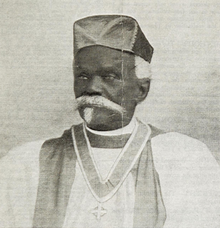
On March 13th, 1911, James Theodore Holly died in his sleep at a church rectory in Port au Prince, Haiti. He was the founding missionary of the Episcopal Church in that country, and had been ordained as the missionary bishop of the church in Haiti in 1874, the first African American in the Episcopal Church to enter into that order of ministry. If you read the official commemorative materials about Holly, that’s mostly what you’re going to learn about him. But, as with every life, the story is far more complex.

At the time of his death, Holly’s ministry was, in the eyes of many, a story of continuous disappointment and unrealized dreams:

  • The main church in Port au Prince had burned down a couple of years prior, in 1908, and there was essentially no support from the American church to help rebuild it. His attempts to raise money for a church endowment through speaking tours across the U.S. were similarly unfruitful.
  • A combination of ongoing political unrest and natural disasters in Haiti had proved immensely detrimental to the growth of the mission, beginning almost immediately upon its initiation in 1861.
  • The Bishops and other church leaders in the United States, because of the Civil War; because of their own personal preoccupations; and, let’s be honest, because of deep seated cultural and institutional racism, had been lukewarm at best in providing any resources to an autonomous black church in an autonomous black nation state.
  • Furthermore, Holly’s initial dream—the dream that launched the whole mission in the first place—to inspire a mass emigration of black Americans to Haiti through the building up of a strong, national church, was largely rejected by black persons who, in the years before and after the Civil War, preferred to stay in the US, their homeland, and fight for equality there.

Holly arrived in Haiti 1861 with 101 people as part of his church mission; 80% of them died or left within a year; his own wife and young children were among the dead. 50 years later, when he died, the church severely lacked resources and had not yet reached 2,000 communicants. One publication, in announcing his death, assessed his life and ministry curtly by observing that the church in Haiti “has not prospered so greatly as was at one time hoped.”

Some eulogy.

In the US, at the time of his death, he was largely dismissed or forgotten. The only officially recorded acknowledgment of his death by The Episcopal Church was a note in the board minutes to strike his salary from the budget for the remainder of 1911.

And so I ask you: was James Theodore Holly’s ministry a failure?

I would say, firmly, no, but we could debate that question for a long time. And if we did, we’d have to account for many things:

  • The racism and oppression that impeded his work from the very start.
  • The political and historical and theological contexts that shaped his decisions and those of the people he encountered.
  • The relative meanings of failure and success as measured over time and the criteria used to do so.
  • The fact that the Episcopal Diocese of Haiti is, today, both the largest diocese in our Church in terms of membership and yet is one still beset with a number of challenges.

Yes, I am sure we could ponder the question of whether Bishop Holly failed or not for a very long time indeed.

But it’s the wrong question to ask.

It is the wrong question that we keep askingabout our spiritual forebears and about ourselves. Failure and success are the wrong modes of assessment. They are, through the metaphor of today’s Gospel passage, the wrong type of food with which we keep filling our plates, over and over again.

 “’He said to them, I have food to eat that you do not know about.’ So the disciples said to one another, surely no one has brought him something to eat? Jesus said to them, ‘My food is to do the will of him who sent me and to complete his work.'”

The demand of Christ on our lives is not a demand to be successful.

I am coming to see, more and more, that the demand of Christ on my life is to forget the language of success and failure, and to let myself instead be governed and judged by faithfulness. Faithfulness to the will of the One Who has called me; faithfulness to the vision of the kingdom that God is revealing in our midst.

This simple, daily faithfulness, made up of the longing in our hearts for God and the steadfast trust and devotion which we lay at the feet of Jesus in all that we do: this is the sole criteria of our discipleship.

Not the degrees we earn or the income we gather.

Not the churches we help grow.

Not the titles we acquire or the vestments we are allowed to put on.

Because if we use those things as the ultimate measure, as ends in themselves, then we get mired in the landscape of success and failure, and we might start to believe the toxic lie that our shifting fortunes serve as indicators of God’s favor upon us.

“Do you not say, four months more, then comes the harvest?” Jesus chides his disciples. But what if the crop fails? What if life is not what you expected it to be? What if the church burns down and the money stops coming in and you die, disregarded and poor, in your bed? How can the language of success and failure ever get to the heart of what you have faced, what you have learned, whom and what you have loved?

It can’t. We have to toss that language out. Our lives are sown and reaped not in power and influence and success, but in faithfulness—in fidelity and love, which gives us new vision, a new mode of assessment. It is by our faithfulness which we reveal the extent to which we have embedded our lives in God.

“But I tell you, look around you, and see how the fields are ripe for harvesting.”

Whatever else can be said of James Theodore Holly, whatever the ups and downs of his life and ministry, he saw the ripe fields of God’s kingdom, and he was faithful to that vision. His fervent advocacy for the liberty and self-determination of black Americans; his unflagging belief in the potential of the nation of Haiti and in the church’s role there; and fundamentally, his unfailing trust in the liberating, life-giving God he found in Jesus Christ—these are the marks of a faithful disciple. These are the reasons we commemorate him today. He inspires me to let go of my fear of failure and my hunger for success, and challenges me to dwell in faithfulness, no matter what happens next.

Because if his life is a failure, then may God grant each of us the grace so to live, and so to fail.

220px-James_theodore_holly