Jesus & Johnny Appleseed: A Sermon

I preached this sermon on the First Sunday in Lent, February 18, 2024, at St. Anne Episcopal Church, West Chester, OH. The lectionary text cited is Mark 1:9-15.

I love quirky historical sites and stories and figures. So you won’t be too surprised to learn that back in 2019, when I was getting ready to move to Fort Wayne, Indiana to serve at my former parish, I was deeply excited to learn that the city is the final resting place of John Chapman, better known to the world as Johnny Appleseed. 

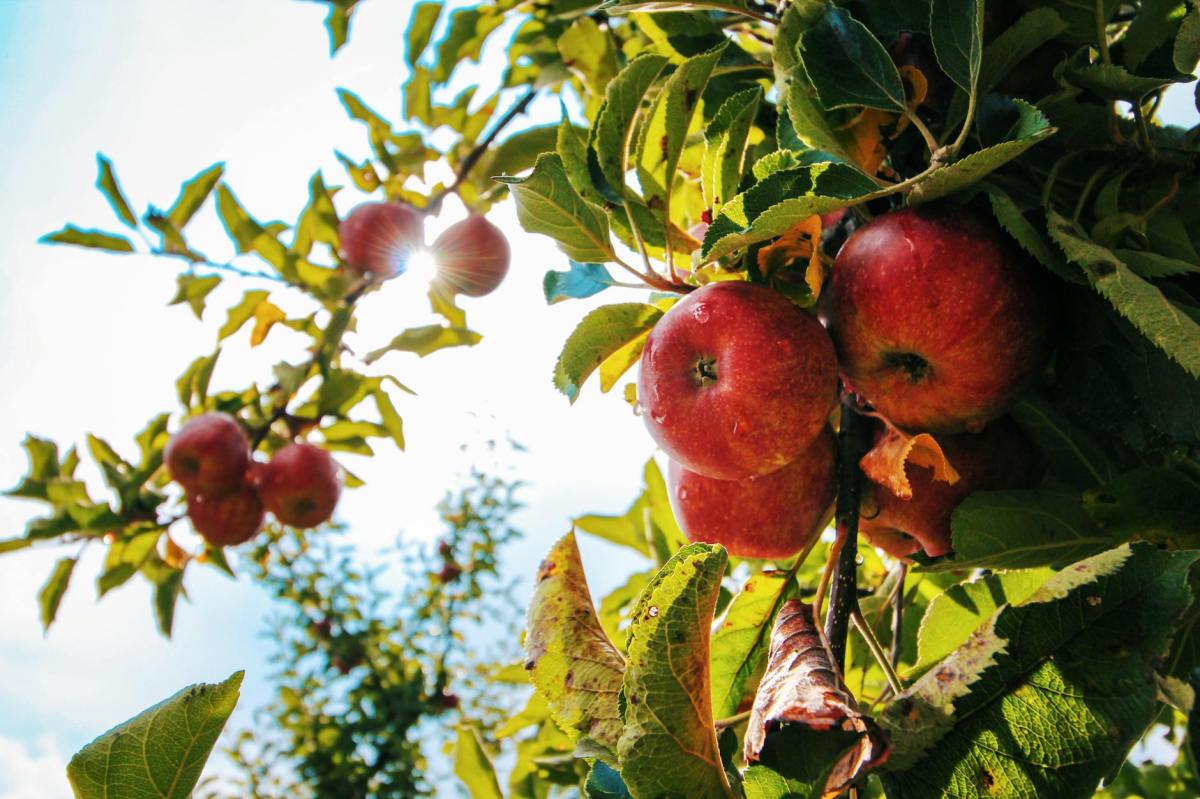
Many of you know probably know who Johnny Appleseed is, but just in case you don’t recall, he was a real person in American history who has taken on a somewhat legendary status. He roamed the countryside in the early 1800s, starting in his native New England and moving westward, introducing and cultivating apple orchards in regions where apples were previously unknown, including much of the Midwest.

And after a lifetime spent wandering about with his bag of seeds, in 1845, while visiting Fort Wayne, he died unexpectedly. So you can visit his gravesite there, and there is also a Johnny Appleseed Park & campground and a Johnny Appleseed Festival and the local baseball team is the Tincaps, in honor of the tin pot that Johnny supposedly wore as a hat.

And I recently discovered that there are a number of towns in Ohio, too, associated with Johnny: the Johnny Appleseed Museum is up in Urbana, and the last surviving tree planted by him still grows on a farm in northern Ohio. So there are a couple more road trips my partner, Matt, doesn’t know he’s signed up for yet! 

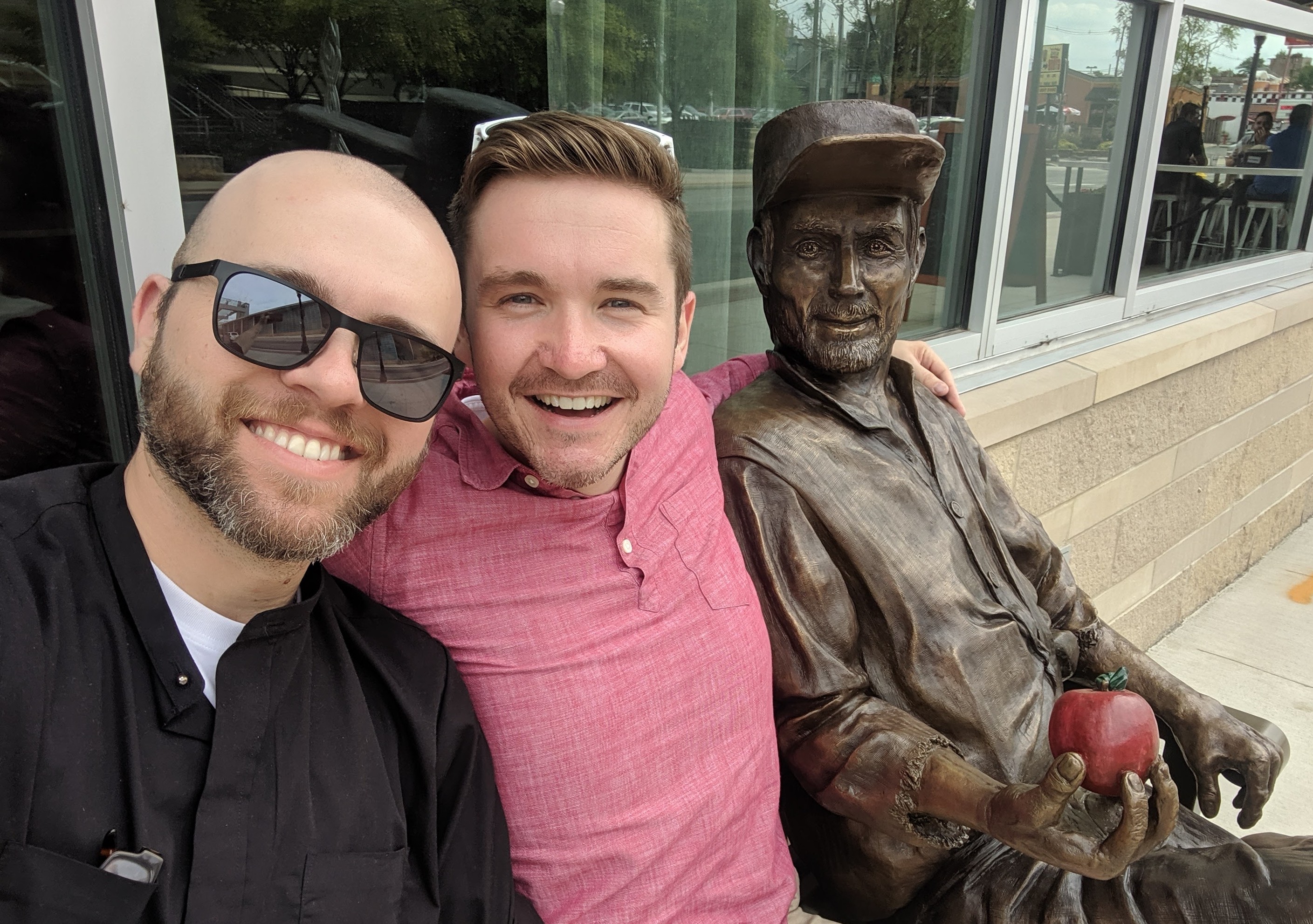
But hopefully he’ll be fine with it, because the very first picture that Matt and I ever took together, the first documentation of our relationship, right after we met, is a selfie of us sitting on a bench with a statue of Johnny Appleseed. So he has a very special place in our personal history, too!

And if you’re wondering why on earth I am going on about Johnny Appleseed on the First Sunday in Lent, well, one of the reasons I find him such fascinating figure–one worthy of our consideration here today–is that John Chapman, while unusual, was not just an eccentric driven purely by some strange obsession with apples. 

No, it so happens that he was a missionary, too, and by most accounts a kind and gentle one. He was a member of the Swedenborgian Church, a small Christian denomination that still exists, and as he traveled, planting and raising up small nurseries of apple seedlings, Johnny also distributed information about his Church, which was, especially for his time, a remarkably progressive and inclusive expression of Christianity. 

And these two things—his love of the land, his desire to carpet it with fruitful plantings; and his love of humanity, his desire to offer people a fruitful and life-giving message: these were all bound up together in his years of roaming the hills and valleys we now call home, and the sweet fragrance of his mission lingers even today.

But you know, long, long before John Chapman ever set out with his pamphlets and his seed bag, there was another man who set out on a similar sort of mission, out beyond his familiar homeland, out into the world, out into the wilderness, for purposes deemed strange by some at the time and yet which have left their own lingering sweetness. 

Of course, I am talking about Jesus of Nazareth, whom we encounter in today’s Gospel, driven by the Spirit, driven by the mysterious designs of God, out from the river’s edge an into an unknown, untamed place. He did not wear a tin cap, but we can be assured that people still didn’t know what to make of this man on a mission, propelled by his unconventional, radical form of love, his vision of a harvest that nobody else could quite imagine.

But we might wonder—if Jesus was the Son of God, if he was already God in the flesh, why did he first go on this journey into temptation we hear about today? What was the point of these 40 days in the wild? 

We could interpret it a number of ways, but it has not been lost on some observers that, especially in Mark’s version of Jesus’ trip into the wilderness, where he is tempted by Satan and is in the company of both wild beasts and ministering angels, that Jesus is, in some sense, not going somewhere new but going back somewhere that God knows very well. He is returning back to the Garden of Eden, where humanity first met the beasts and the angels and Satan, the one who tempts us away from our God-given place in creation. 

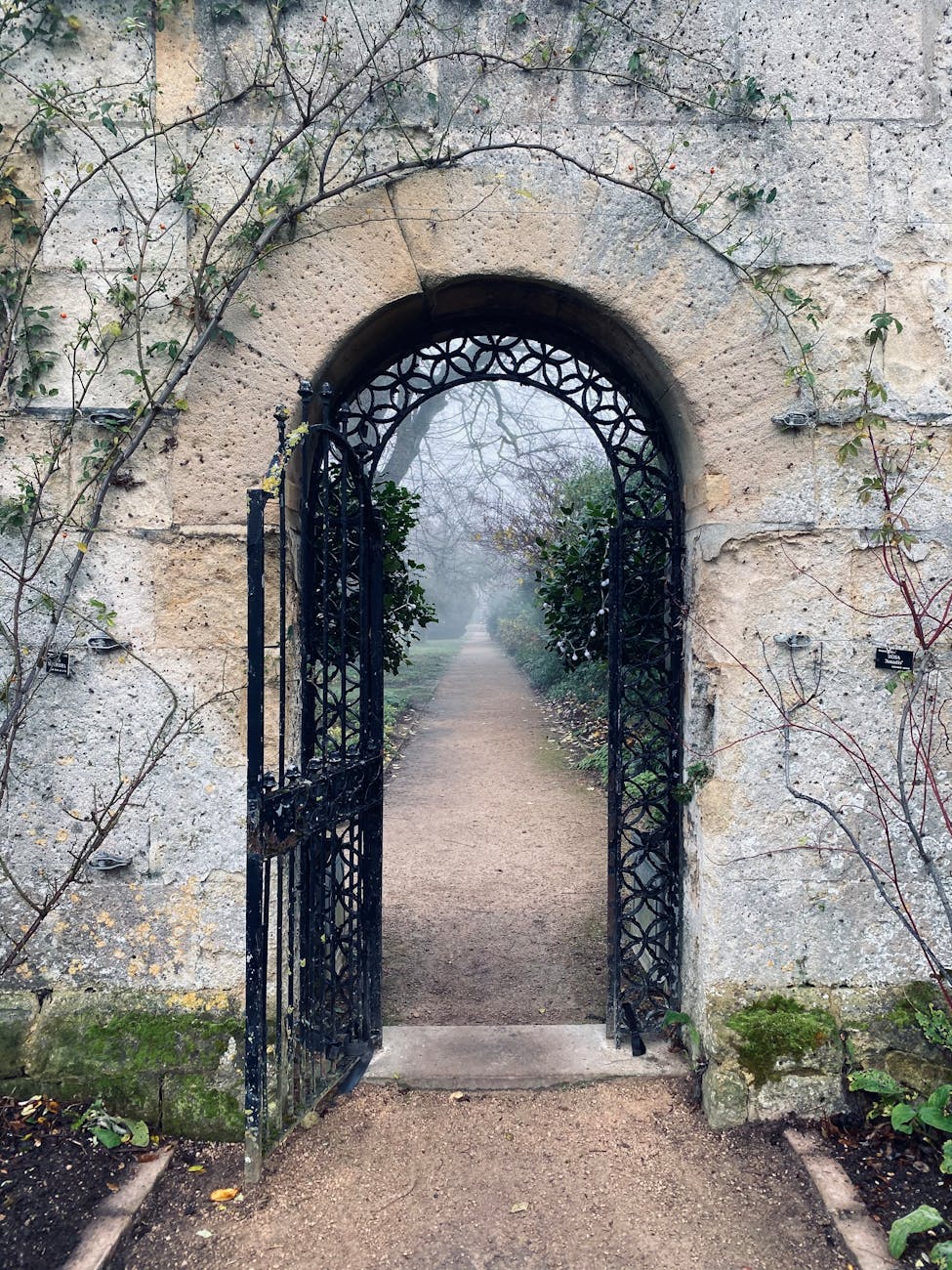
Let’s do a little imagining together. In this unnamed wilderness we hear about today, a tangle of wild plants and harsh sunlight, we might imagine Jesus stepping back through the rusted, broken gate of that original garden, now long abandoned. We might imagine the cherubim guarding the lost portals of Eden, lowering their flaming swords in deference to the Son of God passing through. 

We might imagine him walking amongst the derelict seed beds and the withered trees, meeting the wild beasts who no longer remember the names once given them by Adam. 

And perhaps we might imagine, too, Jesus encountering that ripe fruit of the tree of knowledge on an old gnarled branch—the fruit once bitten by the children of God, when they did not know the price of their hunger. 

And if this is so, if Jesus is, somehow, in the wilderness, also standing in the ruins of Eden and holding the fruit, bright and beguiling as a ripe apple, considering what to do with temptation, 

perhaps this is the purpose of his journey: to discover what Adam and Eve did not—that the fruit of the sacred tree, the fruit of the mind of God, wasn’t meant to be consumed for ourselves—it was meant to be shared. It was meant to be broken open and given away. It was meant to be spread throughout the world. Its seeds were meant to be planted far and wide. 

And so:

Jesus came to Galilee, proclaiming (we might say sowing) the good news of God… “The time is fulfilled, and the kingdom of God has come near; repent, and believe in the good news.”

Jesus is what John Chapman would become and what we are invited to be as well: planters of the seeds of God’s Kingdom. Our journey through Lent, our journey through life, isn’t meant to be one where we stay indoors and gorge ourselves on private spiritual insights, as if heaven were an apple pie baked for us to eat all by ourselves. 

No, we, too, are participants in the planting of a future harvest. Following in Jesus’ footsteps, we are the propagators of the seeds of Eden, the seeds of a paradise that is no longer lost to us. We, too, are a people called to carpet the land with the fruitful plantings of love and truth and mercy and knowledge and care—day by day, step by step, seed by seed. 

Now, I don’t imagine that most of us will take this Lent as an opportunity to put a tin cap on our heads and head out to roam the world as missionaries and seed-planters—though maybe the world would look a whole lot different if more of us did so in our own community. 

But what Jesus and Johnny Appleseed can teach us today is that small, faithful choices have transformative impacts. So maybe this Lent you will volunteer at our burgeoning neighborhood Laundry Ministry. Or maybe you will attend a Thursday Eucharist or a Bible study. 

Maybe you will write to your representatives and tell them to advocate for the poor, the hungry, the war-torn, the forgotten. Maybe you will call someone who is lonely or invite someone to church with you. Maybe you will simply tell someone that you love them, that you forgive them, that you see how hard they are trying, how far they have come. Maybe you will tell yourself these things. 

Maybe you will prune the overgrown bushes of paradise.

Maybe you will teach the wild beasts their long-forgotten names.

Maybe you will remember your own long-forgotten name: beloved Child, disciple, seed-bearer of the Kingdom of God.

And maybe, come Easter, we will already see the green shoots of something new growing up from the earth, from our hearts and our souls. If so, it will have been a good and holy Lent. 

You know, there is one more memorial to Johnny Appleseed, just down the road in Spring Grove Cemetery in Cincinnati. There is a statue of him, holding an apple sprig up to the sky, as if seeking a blessing upon it from heaven. And carved into the stone, there is a fitting summary of all that he was. It says:

SAINTLY IN HIS DAILY LIFE. HE LOVED LIFE IN ALL ITS FORMS AND HAD A JOYOUS WILL TO HELP THE EARTH YIELD ITS FRUITS.

The same could be said about the seed-planter from Nazareth. 

And someday, we pray, it might be said of us, too.

Where are you?: A Sermon

I preached this sermon on June 6, 2021 at Trinity Episcopal Church, Fort Wayne. The primary text cited is Genesis 3:8-15.

I remember once when I was a little boy, I got into an argument with my dad. I don’t really recall what it was about, probably something unimportant. I just remember that in the middle of the argument, I ran out the back door into the yard and hid in some bushes. I guess I just wanted a quiet place to sulk and cry a little bit by myself.

But then my dad came out, looking for me, and the thing that I recall most clearly as I hid under the leaves, a little ball of fury, was the catch in his voice, a note of sadness and worry, as he called out my name, trying to find me. So I got over myself and crawled out, covered in dirt, and said, “here I am,” and he just looked at me, relieved, and said, “come inside.” And I did.

What a blessing it is, in our lives, to experience the kind of love that seeks us out and doesn’t abandon us to ourselves; the kind of love that sees past the fears and the frustrations of our petty, wounded hearts, the kind of love that looks at us unflinchingly and simply says, “it’s been a long day; come back inside.” 

I hope and pray that you have known and continue to know that kind of love in your life, whether from a parent, another family member, a partner, or a friend. I hope and I pray that that’s the sort of persistent, active, reconciling love we are practicing in our common life here at Trinity.

And I also hope that this is the sort of love that informs our understanding of today’s reading from Genesis 3, that pivotal moment when Adam and Eve are, themselves, hiding in the bushes after that fateful, perilous bite of ripened fruit.

“They heard the sound of the Lord God walking in the garden at the time of the evening breeze, and the man and his wife hid themselves from the presence of the Lord God among the trees of the garden. But the Lord God called to the man and said to him, “Where are you?”

Where are you? In those three words, I think we can learn everything we need to know about God’s disposition towards us, from that moment in Eden until this very day, wandering the solitary paths of paradise, searching for his children’s faces. 

Where are you? We have been formed in many different understandings of the nature of God’s love, but I hope, when you hear that question, you can hear, not the threatening yell of a vengeful authority figure, but that of a loving parent, that note of sadness and worry, the voice of one who knows that, yes, something has gone terribly wrong but is nonetheless fervently seeking you out, seeking a way to save you, looking for you in every shadowy corner, under every weeping branch where you might be cowering, seeking you and refusing to abandon you to the despair of your hiding place. 

Where are you? It is the question God has been asking every day since that breezy evening in Eden, since that point in time, for reasons we may never fully understand, when it became possible for us to estrange ourselves from God’s loving embrace. It is the question that underlies the record all of God’s fierce and wild emotions in the Old Testament—

God’s grief and rage over Israel’s waywardness—where are you?

God’s sense of betrayal over humanity’s failure to embody justice, mercy, and peace—where are you?

God’s heartbreak as bow down before the work of our own hands instead of Divine majesty, trembling under the weight of our own fears, all while our One True Love continues to call out—where are you? Where are you? Where are you? 

It is also the question that Jesus came to ask us, face to face: little children, my mother, my sisters, my brothers, I see you now with my own eyes, and you see me, but where are you, in your deepest heart? Do you even know? Do you remember where you belong?

And still, God is asking us that question. Still, God is waiting for us to reveal ourselves, to step forward and to offer the response that Adam and Eve never quite could, the response that a true relationship requires. The word for that response, in Biblical Hebrew is hineini

Hineini. Here I am. 

So much depends on us responding to this love that seeks us out, this love that calls to us in the cool evening breeze even as we keep hiding, even as the evening shadows fall down around us. 

Everything that can be good and true in this fractured world depends upon us saying, as Abraham and Moses and Mary all did: Here I am

Here I am, God.  Covered with dirt and leaves and tears, my best intentions gone awry, my understanding limited, my heart a little bit broken, but here I am, God. I can’t promise to be perfect, but here I am. I am afraid, God, sometimes too afraid to speak, but here I am.

I wonder what it would look like if we could each step out from our hiding places, the ones we’ve run to, the ones we’ve built up around ourselves, and step a little bit closer to one another, a little bit closer to that place where God stretches a hand out to us in the twilight, and I wonder if we might let that question and that answer, that call and response, guide the shape our lives. 

What if we said each day, Where are you? 

Where are you present in my life, God? And where is my neighbor, where is the stranger I forgot to welcome, where is the enemy whom I was taught to fear? Where is the deep, tender heart of the blessed earth, where is the hidden paradise, the love hidden in plain sight? How do I press my soul down into its embrace? Where are you?

And what if we also said each day, Here I am. Here I am, Lord. Here is my face, seeking your face. Here is my voice, speaking your unutterable name on my breath. Here is my body, and here is my mind, and here is my heart; may your Spirit mold them into vessels of your love. You don’t have to search or grieve for me any longer. Hineini. Here I am.

Where are you?

Here I am.

Perhaps this small conversation is the one God has been waiting to have with us for our entire life. Perhaps all God ever wanted was to find us, to bring us home, not back to the beginning, not back to Eden, for we know too much now, we are grown now, but back to our true home, which is within God’s very own heart.

You don’t have to hide from God anymore. We never truly did.

God is calling to you, and there isn’t anything to be afraid of now.

So get up. 

And say, “Here I am.”

And come inside. 

To Bite the Fruit: A Sermon

I preached this sermon on Sunday, March 1, 2020 at Trinity Episcopal Church, Fort Wayne, IN. The lectionary texts cited are Genesis 2:15-17; 3:1-7 (Eve & Adam’s temptation in the garden) and Matthew 4:1-11 (Jesus’ temptation in the desert). 

It is Lent, and Eve is standing in the garden. 

Eve, our primeval mother, the original bearer of our human bodies and our human longing, has paused under the leafy boughs of a tree laden with promises; the tree that offers the one thing she and her companion Adam do not already have: the ability to share fully in the mind of God. The ability to understand, from God’s perspective, the nature of all things. The ability, as the serpent suggests, to not simply be in relationship with God, but to be like God.

And although in the Eden narrative we often focus on themes of wickedness and disobedience, we should not forget that in this crucial moment of decision–as her hand reaches out toward the tantalizing object of her desire–Eve still loves God. She loves God so much, in fact, that she wants something beyond intimacy, something that can never be taken away. As she and Adam bite into the ripe flesh of the fruit, they are hungering for God’s very being to become part of them. They are seeking a perfect, indissoluble union with their Creator. 

There is a problem, though, with trying to consume the things we love: they tend to get destroyed in the process. And in a flash of insight, all too late, Adam and Eve realize a fundamental truth: loving God is not the same as possessing God.

How often we confuse these two things: loving and possessing. If we are to speak of original sin, we might consider it as the seemingly irresolvable void between the two—the former being the dynamic truth of a relational God, and the latter the constricting delusion of the crafty serpent.

I think of the people in my life whom I have loved most deeply and enduringly, and I realize that one common thread in those relationships is a certain sense of freedom—a freedom to be myself, and for the other person to be themselves. No agenda of control imbuing our time together. No manipulation masquerading as affection. Just two people, supporting one another in our mutual growth and inevitable failings.  And, sometimes, parting ways when life makes that necessary.

To love like this is harder because it is far more uncertain. We can’t control its outcome. And I would be lying if I said that I had never seen fruit on the tree and longed to devour it. We are all Eve and Adam on some level; we are all caught in this tension between the need to love and the compulsion to possess.

This is partly what makes Lent so valuable. We enter into this season and we are invited to take a hard look at all the relationships that comprise our lives: our relationships with people, with things, and with habits. And in each instance, we might consider this question: where am I practicing love, true, selfless, life-giving love; and where am I merely trying to possess, to consume, in order to satisfy a deeper, insatiable hunger within myself? 

It is with these questions in mind that we must journey into the desert alongside Jesus in today’s Gospel, out to the place where the devil awaits him. 

When we hear the story of Christ’s temptations: to turn stones into bread; to throw himself from the pinnacle of the temple; to trade his relationship to God for earthly power; I think we would do well to picture him also, standing alongside Eve at the tree in the garden, as the eternal, fundamental questions reverberate between them and down to us through the ages:

Do you love God, or do you want to be God?

Do you love the world, or do you want to possess the world?

And maybe, just maybe, in his hunger and his isolation, Jesus saw the fruit of the tree, and perceived how good it would be to bite it, to possess it, to rule the world on his own terms, to be a king like other kings, to feed people with the bread they already knew.

Perhaps for a moment he, like Eve, thought that loving God and claiming God were the same thing. 

And perhaps, for a moment, every creature in the garden held its breath, waiting for a recapitulation of the original mistake.

But then, he speaks:

       ‘One does not live by bread alone,  but by every word that comes from the mouth of God.’

        ‘Do not put the Lord your God to the test.’

        ‘Worship the Lord your God, 

        and serve only him.’

With these ancient words, drawn from the depths of the Law, Jesus is saying: It is in relinquishing power that I find true strength. I only need to trust, and to serve, for this is what love looks like: mutuality, freedom, vulnerability. A hand outstretched, not to take, but to offer itself. 

He says: I do not need to control the world in order to love the world; in fact, loving it means the exact opposite: it means accepting creation in all its finitude, serving humanity in all its frailty, and giving my life for its healing, and its redemption.

And in that moment the devil departed, for he knew that that this time the fruit would remain on the tree. This time, this Son of Man, this Firstborn of All Creation, had made the proper distinction between love and its counterfeits. 

We are, each of us, through our baptism, both children of Eve and Adam and children of God. That ancient temptation still pulses in our veins every time we feel the longing of desire and reach out to grasp at things not meant for us. And in today’s world, with its many promises and perils, giving into this impulse can feel quite natural, acceptable, even noble.

But in Lent, at the edge of Eden and deep in the desert, we are invited, instead, to let go. To leave the fruit untouched. To let the stones remain stones. To turn and face the world in all its terror and promise trusting in God alone. And trusting that somehow, at the end of our long journey, we will be ushered into someplace altogether new.  Another garden, perhaps, but one with an open gate, and an empty tomb. The garden where Eve stands once more, singing a song of redemption, basking in a love that feels, finally, like freedom.