I preached this sermon on Ash Wednesday, 2024, at St. Anne Episcopal Church, West Chester, OH.
God loves dust.
God has always loved the dust: the particles of stars; the tiny fragments of creation borne aloft on a dark wind from heaven. He has loved the dust since the moment he brought it into being, each mote like the note of a song still being written, carried on the light of a thousand suns.
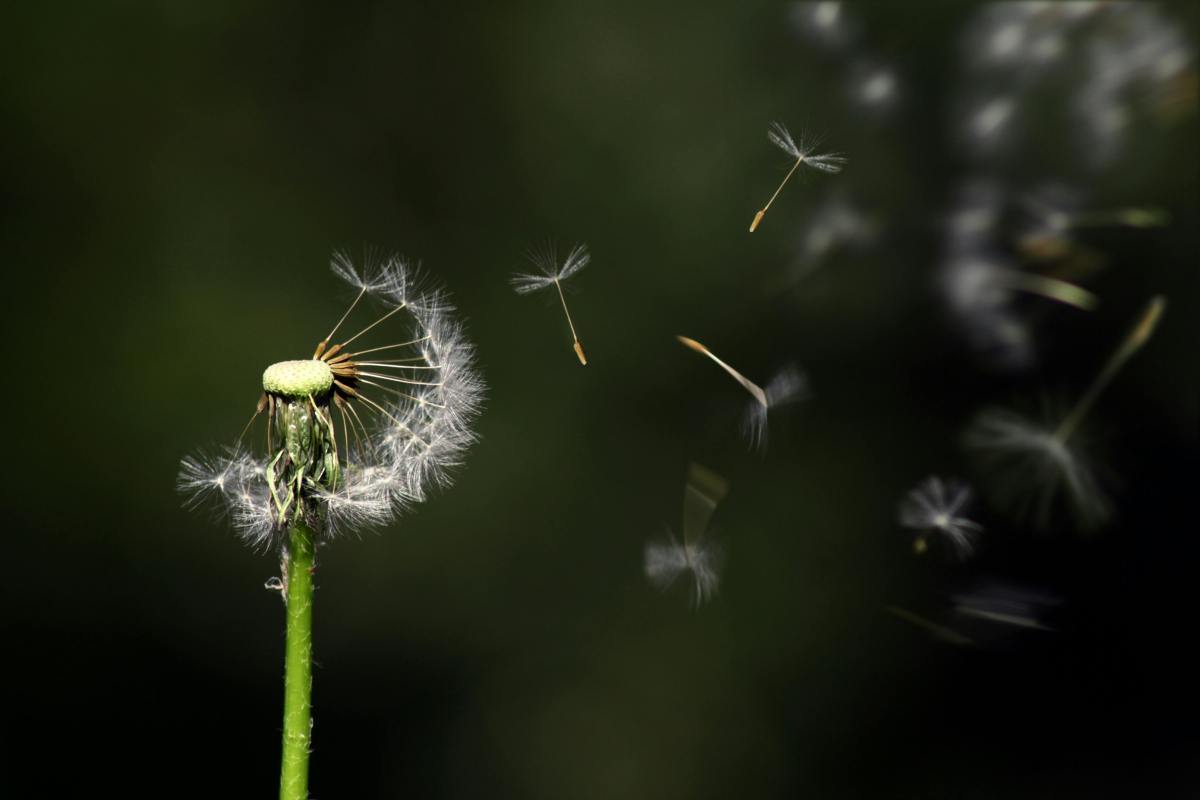
And when the dust had at last gathered and settled upon our small corner of creation, then–like one who makes a wish on a delicate head of dandelion seeds, closes their eyes, and blows–God blew upon the dust of earth to make it dance; to mix within every speck of it his own particular hopes and dreams; to animate it with love and life; to name it and trace his own image in it.
God made a companion out of the dust and called it you and me and us, and that same wish-making, dream-shaping breath first blown, that same impulse to love what has been made and called good…is what still holds us together. It is what drives our bodies of dust onward through time and space, guiding our feet across the dusty trails of the earth, looking up to the shimmering, dusty stars and feeling, somehow, like they are looking back us–all of us children of the dust, bearers of an ancient light, long lost siblings from the same source.
And so, if all is dust, and all is loved, then Ash Wednesday is less about bemoaning our mortality and more about marveling at the fact that we were made in the first place, that everything was made in the first place. Made of tiny pieces of one divine dream, knit together in an infinite number of shapes and places and faces, changing in form, this holy dust, but never in its belovedness.
For God loves dust, and God’s love does not change or die, even when we do.
And we come here today to inspect this dust and this love up close, to remember the times we have made a mess of it, and to be reminded that God has not given up on us regardless.
It is often said that our Gospel passage on this day, where Jesus cautions against showy acts of piety, is an awkward one for this occasion when we come to receive a smudge on our brow and go out & about wearing it for all to see.
But it is worth noting that Jesus is not opposed to public piety in and of itself—he was himself a man of deep and serious prayer, one who grew up formed by the piety of his own time and place and who embodied openly his own awareness of divine truth.
And the reading from Isaiah, too, while raging against empty, self-serving piety, still speaks of a very public devotion, a communal spirituality of care and justice–the type that is formed and sustained by knowing how sacred, how precious, is everything and everyone that God has made…from dust.
The reminder, here, then, is that piety is worthless and empty if and when we use it to try and prove—to ourselves or to others—that God loves us. And it is dangerous when we use it to try and prove that God loves only us, and not “them.”
Piety should not, cannot, need not prove any such thing, because love is already a given for all things. It is freely offered; it is the mandate that underlies creation; it is the rationale for everyone and everything that was ever made. God’s love is as inevitable, as pervasive as the dust that gathers on still surfaces; the dust that clings to our skin; that dances on beams of light; the dust that swirls in the wind. It is a love that is seeking, always seeking, like dust, to rest upon us, to be where we are, to remind us who and what we are—that we are dust, and that God loves dust. And so should we.
So to pray in secret and to fast in secret, as Jesus instructs us to do, is about resting quietly in that love, resting in the knowledge that you do not have to prove your worthiness. You do not have to win the affections of God as if he were a fickle Valentine waiting to be romanced by your words and your grand gestures. You are worthy of love already. And so is everyone else.
God loves our life even when we have little to show for it in the end. God loves the times we tried and failed and tried again. God loves you even with a streak of dirt across your brow and tears on your cheek. God loves you even when you have no good words left to offer, when you have stumbled and fallen and are covered in dust, and maybe, just maybe, God loves you most of all in those moments when you are fully yourself, without pretense, without affectation or pride.
And maybe that’s the point of our practices of simplicity and prayer and relinquishment in this season. Maybe when we are down close to the earth, when we are down close to the simplest form of ourselves, we might begin to feel that original love for the dust of which we are made, the force that orchestrated the stars, the breath that still stirs the primordial soil in our flesh—maybe we will feel that love reverberating up through us, and out through us, out to wherever the Spirit is leading.
And maybe, as we will discover in this season of Lent, that is also why Jesus came to live among the dust and move upon the dust and cry tears over the dust and trace his finger in the dust and stumble and fall and bleed into the dust and to die as dust and to live again in a body made of dust–and eternity. Because God loves dust, and he could not rest until he became that which he had loved.
In a moment you will receive a mark on your forehead, and you will hear those ancient words—remember that you are dust—and perhaps, as we often do, you will feel the challenges that this reality poses: the brevity of our composition and the inevitability of its being carried away on the wind. And that’s ok. It’s human to wonder, to weep, to carry with us the anticipation of all that comes to an end.
But remember this: wherever it goes, the dust that you are, the dust that we all are—whenever and however it finds its repose: every particle of it is still imbued with the undying love by which it was formed.
And so this smudge on your brow is not a mark of shame or lament, it is a promise—a promise that even when we return to the dust, we will not be forgotten nor forsaken, and that one day God will use it to reconstitute a new creation. One in which all of us, at long last, will feel that belovedness coursing through every particle of our being; and at long last we will see that same belovedness in the face of our neighbor and in the face and shape of everything; and at long last there will nothing left to prove, nothing left to fear, and our piety will simply be looking at the stars and the soil and seeing that they are indeed our siblings, that they always were, and that the whole cosmos is but one beautiful dance of dust. Carried on the breath of the Spirit. Swirling in the eternal light.
And when we see this, and live this, then the wish that was made when God closed his eyes and blew his breath at the dawn of time…that wish will have, at last, come true:
To know that you are dust. And to dust all things shall return.
And God loves dust.

 By Another Road