
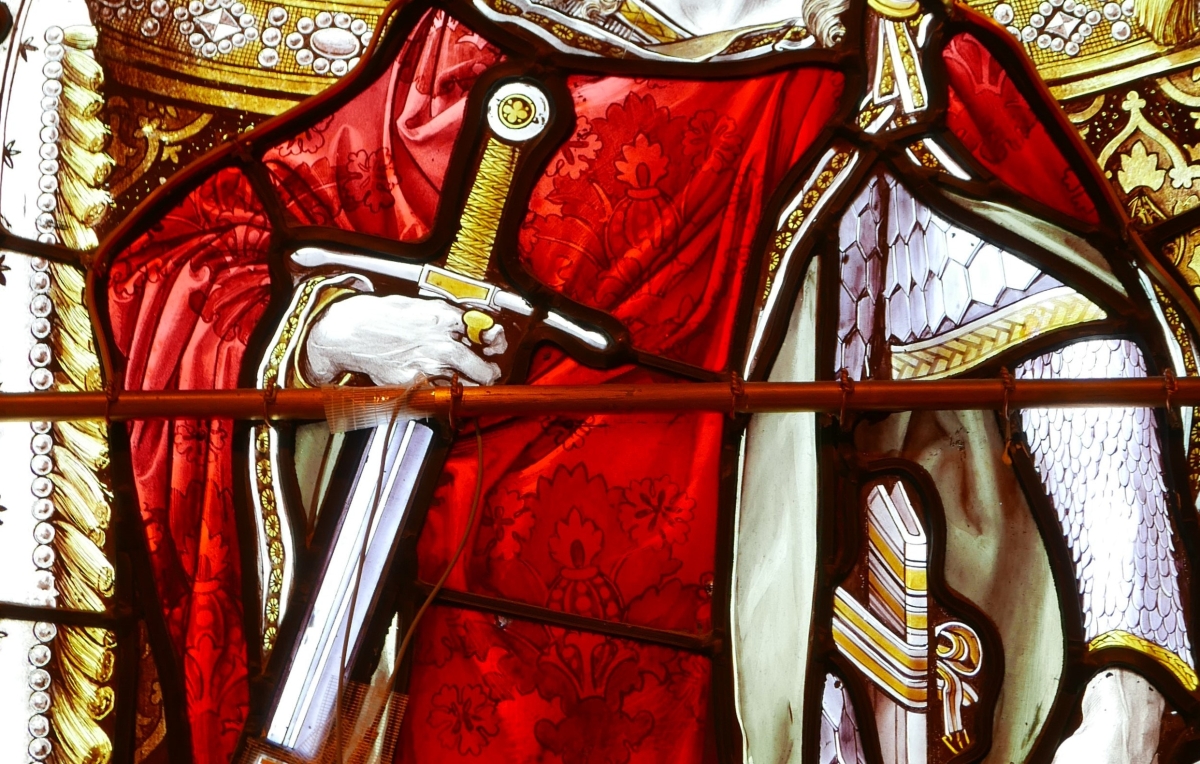
Emperor: A Sermon

I preached this sermon on Sunday, October 22, 2023 at St. Anne Episcopal Church in West Chester, OH. The lectionary text cited is Matthew 22:15-22. This sermon was offered as part of the parish’s annual pledge/fundraising campaign.

Over the past couple of months, I’ve gotten together with many of you at a series of meet-and-greet events. I’ve loved the opportunity for us to learn more about one another and to hear from you about your hopes and dreams for St. Anne. There are still a couple more of these on the calendar, so I hope to see you soon if you haven’t made it to one yet. 

At a few of these, I have been able to share a bit of my own story—how I came to be in The Episcopal Church and how that eventually led me into the priesthood. I am not going to retell that whole story this morning, but a piece of it has been on my mind this week as I’ve been reflecting on both our Gospel for today and our annual pledge campaign to fund St. Anne’s mission and ministry in the coming year, because one common thread in all of these things—my own story, the Gospel story, and in St. Anne’s ongoing story—is that sometimes we discover that God is not at all who we thought God was, or that God does not in any way resemble our longstanding assumptions…and that this can be very good news. 

When I was in college, I drifted away from church; or it might be more accurate to say I ran away. My reasons were personal, but not entirely unique; I think many of us, at one juncture or another, begin to question our foundational understandings of who we are and how the world works and what is ultimately true. And that is exactly what happened to me. 

And so, in my mid-twenties, I found myself in an awkward position: I had spent a number of years feeling very unsure about everything I had been taught about faith and religion, and yet the hunger for meaning, for purpose, for belonging to something greater than myself, would not leave me alone. I longed to be part of a community that was committed to something deeper than just a hobby or a political opinion or a worldview; I wanted to engage the big questions of life and death and love and eternity, but I didn’t want to be given an ultimatum as to how best to answer those questions, and I had always understood religion as a place of ultimatums—believe this, think this, be like this, or else you are not part of this. 

And yet, despite my trepidation, God still haunted me, like the lingering memory of a lost love, and so one day I found myself slipping into the back pew of an Episcopal church near my house, tentative, uncertain, hopeful. I followed along as best I could; I stood and sat and kneeled like Episcopalians do. When it came time to recite the Creed, I only said parts of it, because I didn’t know what I believed anymore, and I didn’t want to lie. 

And yet, when the time came, I nonetheless went up to the rail for communion, praying that if there was a God who still loved me, that he would forgive my confusion and my reticence and still meet me there in the bread and the cup. I prayed that I would not be punished for having so many doubts, for being wayward and unsure of my commitments. And I reached out my hands, almost breathless, waiting to see what would happen.

I think that the stakes of that moment, at least as I perceived them, were similar to the stakes of the question posed by the Pharisees and the Herodians to Jesus in this morning’s gospel passage. They have ulterior motives, of course, but they are asking, fundamentally, where Jesus’ loyalties lie, and whether he is all in for God or for Caesar, as if the two are comparable forces competing for the same spiritual and material resources. 

Although they don’t say so explicitly, there is, woven into their question, the idea that God, like Caesar, is an emperor of sorts—a figure or a force demanding fealty and submission. And to be fair to them, this is an image of God that is embedded in much of our Scripture, since these are texts that were shaped and recorded by a society accustomed to rulers with absolute authority. 

This is the same understanding of God that I had when I approached the communion rail: a God who literally sat on a throne, ready to suss out whether I had been loyal, whether I was willing to pay the price of my authenticity in order to receive his beneficence. 

But what Jesus knew, and what he came to proclaim to the world, is that God is not comparable to Caesar. God is not like an emperor at all; God’s power is from the ground up, not from the top down. And though we still try to put a crown on God’s head and though there are still those who try to fashion God’s Word into a sword rather than a healing balm, Jesus continues to dismiss such posturing. And he continues to console those among us who fear that we are too doubtful, too wayward, too lost to be part of this. 

He says, render unto Caesar your questions of punishment and debt and power.

But render unto God what is God’s—the deepest longing of your heart to be welcomed unconditionally, to be loved without reservation, to be invited into building and sustaining something kind, something beautiful, something true. 

And so you know what happened when I reached out my hands to receive communion on that Sunday so many years ago? Nothing. In the best possible way, nothing. God did not send down a thunderbolt and smite me for having run away. God did not send an angry Episcopalian to berate me for not reciting the whole Creed. God did not punish me for having doubts and questions.

God simply fed me, and that was its own sort of answer. 

Because, as I realized, perhaps for the first time that day, God is not Caesar, demanding conformity and unthinking allegiance, asking “are you worthy, are you certain, are you pure?” No, the God revealed in Christ is more like a person standing on the front porch to welcome you home, saying, “I’ve missed you. Come on in; you look like you need something to eat.”

And I did eat, and I am still eating, responding to that hunger that could not be satisfied anywhere else. And from that first Sunday onward, I knew that if this was what church could be, then it was worth everything I had to give. 

I know, from hearing so many of your stories already, that some of what I am talking about overlaps with your experience of the Episcopal Church and of St. Anne in particular. I know that in this place, many of you have come to the realization that God is not that which we were once taught to fear, and that the point of all this is not to arrive at some untroubled belief in God, but to discover that God believes in us, and that God always will, no matter how far we run or how long we wander.

And I want you to consider what a rare and precious treasure this is—that there is a place in this world, as polarized and fractured as it is, where people are welcomed to come as they are, to be held in community, to be invited to grow in faith while still leaving space for tough questions, for doubt, for mystery, and for a certain acceptance that we don’t have all the answers. 

I know that, because of what I discovered about God that first Sunday in an Episcopal church, I decided to pledge my life to this vision and embodiment of Christianity. And because of the ways that St. Anne so joyfully and passionately pursues that same vision, both within our walls and beyond them, I will be pledging a substantial amount to help fund the mission of this parish in the coming year. 

I want to do that not just because of all the good things already taking place here, but because I know that somewhere out there, maybe just down the road, there are people just like I was on that Sunday so long ago—no longer able to endure the notion of the God of empire, yet still longing to find a place of welcome, longing to belong to and to help build something kind and beautiful and true. Longing to hear a voice saying, I’ve missed you. Come on in. You look like you need something to eat.

This is that place. Let’s make sure they find it. Let’s be ready for them when they do.

Tunnel: A Sermon

I preached this sermon on Sunday, April 16, 2023 at Trinity Episcopal Church, Fort Wayne. The lectionary text cited is John 20:19-31, when the risen Jesus appears to the disciples, including Thomas.

Many of you know that I was born in Northern California, and for the most part we lived just north of San Francisco. Now, a curious quirk in that part of the world: when you grow up in any proximity to the Bay Area, you don’t refer to San Francisco by name, you just call it the city, and everyone else knows implicitly what you mean. Within a several hour radius, you can simply say “we’re going to the city,” and they will assume that you don’t mean Oakland or Berkeley, or San Jose, or Sacramento.

For northern Californians, for better or worse, there is only one city that is the city, and it’s the one you leave your heart in, as the old song goes—the one that glows like a beacon at the end of the world; the one that is draped in fog and flowers; the one that is complex, and layered, and broken, and is yet still beautiful; the one that looms large in the imagination of everyone who has been there and many who have not—it is only this one that needs no other name but is simply the city

And if you have never been to San Francisco before, let me tell you the absolute best way to see the city for the first time. You have to come by car, from the north, down through the towns and the vertiginous hillsides of Marin County, your view obscured by the terrain: steep, cypress-clad hills and winding roads. 

And as you go along, any notion of what lies ahead is completely hidden from sight, until suddenly you come upon an arched tunnel in the rock, long known as the Rainbow Tunnel. Drive through the dim passage, ever so briefly, and as you emerge on the other side, suddenly, all at once, everything is there before you: the blue of the bay; the shadowy mountains rising up from the sea, reaching toward heaven; the Golden Gate; and beyond it, the city—the luminous city, indeed glowing like a beacon at the end of the world. You’re never quite prepared for it. Every time as a kid that we drove through the tunnel, the shocking beauty of that view took my breath away. 

Now there are all sorts of unexpected views revealed to us as we journey through the world—both the literal ones waiting just over the next hillside, and the more figurative ones, too—those new insights and understandings that come upon us at certain points in our life and change us in profound ways. 

Sometimes we can go looking for such revelations, but just as often they come to us when we do not expect them, when we are deep in a tunnel of one sort or another, rushing ahead, our vision narrowed, and then suddenly, the world opens up and the the landscape is entirely new to us. It can be wonderful, and it can be terrifying; sometimes it can be both.

The season of Easter is just such a moment, when a new and astounding vision unfolds before us. Easter is when everything that seemed impossible, everything that seemed dead and gone, sealed away behind our certainties and our sorrow, is suddenly standing before us, more vivid and alive than we ever imagined, inviting us to reconsider how the world actually works.

Easter is when our tunnel vision falls away and suddenly we see things previously undreamt of: that death is not definitive, that love is more enduring than we ever dared to hope, and that God’s purpose is not simply to make our burdens bearable but to bear our burdens himself; not simply to preserve our lives but to give us his own life. It’s enough to take your breath away.

And it is understandable that, emerging from the long tunnel of our painful histories, we might not know what to do with such a vision. It is only natural that we would feel unprepared for its implications, its possibilities, its endless horizons. As Fr. T.J. said in  last week’s homily, resurrection is messy, because we are messy, and resurrection has come to find us here and now, just as we are: fearful, unsure, full of questions.

But don’t worry, we’re in good company, because you know who else was fearful and unsure, and full of questions? All of the first disciples! All of them—not just Thomas—needed some help in processing what it meant to see the risen Jesus standing in their midst. All of them had their breath taken away by the shock of it. 

And it was only in Jesus ministering to them—giving them his own Spirit-infused breath, showing them his wounds, offering them peace and blessing, commissioning them to go forth in his name—that they were able to begin to comprehend the landscape that awaited them on the other side of the dark, narrow tunnel of grief and fear in which they had found themselves. 

And Thomas, our dear friend Thomas, should actually be called “Believing Thomas,” not “Doubting Thomas,” for it is he who truly emerges first onto the other side of understanding; it is he who comprehends the fullness of the vision before him; it is he who realizes the significance of the risen body of Jesus that, though wounded, persists in life and love; it is Thomas who names what he sees, and who thereby gives voice to the Church’s dawning understanding of what the Resurrection is meant to show all of us: My Lord and my God

My Lord and my God, it is you! It is you, wounded like me! Wounded for me! It is you, complex, and layered and broken and yet still beautiful, and loving me, loving all of us, loving this whole earth for being the same! It is you, glowing like a beacon at the end of the world! It was always you. It will always be you, forgiving, peace-bearing, redeeming, blessing, waiting to reveal yourself, through the dark tunnel, just around the bend, a vision to take my breath away. Now I see. 

And it is this movement from not seeing to seeing that is, in truth, the heart of the message of this Gospel passage, rather than any dichotomy of doubt versus belief. Because the good news of the Resurrection is not about whether we can conquer doubt through the power of our faith; it is about the God who conquers death through the power of his love. It is about the God who comes to show us what that love looks like in this world and in the world to come. It is about the gift, the incomprehensible gift, of seeing something beautiful, hopeful, and true, even when we least expected it. Especially when we least expected it.

You might wonder, though, with all this talk of seeing, what to make of Jesus’ final statement here:

Blessed are the ones who have not seen and yet have come to believe,

It is tempting to read this as a sort of challenge, either to Thomas or to ourselves—as if we might be deemed more faithful, more favored, somehow, by God if we believe in the Resurrection without hard evidence. But I think this misses the point. 

Because this statement, like those in the Sermon on the Mount, is structured as a beatitude (blessed are the poor in spirit, blessed are those who mourn, and so on…) And beatitudes are not challenges, but are God’s promises of comfort and sustenance to those who are struggling in the world as it is. The ones who have forgotten to hope for any glorious new visions.

Thus, blessed are the ones who have not seen is not a gold star for the especially committed believers, the ones who are blithely certain of their faith…

No, it is a word of comfort for the rest of us. It is a word of blessing to those who have not yet seen the fulfillment of God’s Kingdom and yet long for it. It is a word of promise to those who look at the world around them and see only death and injustice and callousness but refuse to give up on the practice of love and the search for truth. It is a word of encouragement to those who are deep in the tunnel, who are deep in the tomb, who are in the dark, but are searching for the light, who are persisting on the path, who are pursuing the vision, who are trusting that somewhere, someday, the City, the heavenly City, the City of God, the City of a Redeemed and Resurrection Creation, the City long promised and long sought, will be just around the bend, glowing like a beacon at the end of the world, and all of us, complex and layered and broken and beautiful will get there, and the gates will be open and the risen, wounded Christ will greet us and say Peace be with you and we will cry out in one voice:

My Lord and My God!

…and it’ll be enough to take your breath away.