Notes on a Dance: A Sermon

I preached this sermon on Sunday, March 3, 2024 at St. Anne Episcopal Church, West Chester, OH. The lectionary texts cited are Exodus 20:1-17 and John 2:13-22.

I am a big fan of the ballet—some of you know that I worked for the Nevada Ballet for a number of years before seminary. Behind the scenes, though—I was never a graceful dancer!

Working there, I saw a lot of ballets over the years. And one of those, in 2013, was a touring centennial performance of The Rite of Spring, an infamous ballet first performed in Paris in 1913. 

Now if the thought of ballet makes you feel bored or sleepy, stay with me—because The Rite of Spring was not (and still is not) what anyone thinks of when they think of ballet. There is no dancing on pointe, no tutus. The music is not pretty. The whole work—the score by Stravinsky and the choreography by Vaslav Nijinsky, is harsh and unsettling. The ballet portrays a fictional ritual dance done by pre-Christian Russian peasants, where a Spring Maiden is selected and ultimately dances herself to death as a sort of sacrificial offering. Cinderella it is not. 

When I saw in on tour, I felt a little overwhelmed and disturbed by the whole thing. But back in 1913, when it premiered, the audience lost it. It touched some strange nerve deep within them. People started screaming at the stage and throwing things at the orchestra, and then they started shouting at one another and starting fights, and the police had to be called in, even as the dancers and the music kept going. 

Critics called the performance “barbaric” and “in complete opposition to the traditions of classical ballet,” without realizing that this was, in fact, the entire point. The Rite of Spring was meant to be challenging, to point to something wild and uncontrollable that lay pulsating beneath the benignly oppressive surface of our social and political structures. It was an artistic premonition of sorts for a society that was, in 1913, already on the precipice of its own tumble into war-torn barbarity. 

The Rite of Spring was only performed a few times, and after World War I, the music survived but the ballet was considered lost. The choreographer had suffered a mental breakdown, and nobody else seemed to have preserved the dance notations. Perhaps some felt it was best left forgotten anyway. Too raw, this dance, too zealous, too much a reminder of things that people would rather forget.

It wasn’t until the 1980s, when a copy of the those dance notes was found tucked away in the cupboard, that the ballet was brought back to life, to shock and unsettle and invigorate new audiences, including me. 

We rely so much on the notes we take down. Notes of information, notes of music, notes on a dance—they are what help us perpetuate ephemeral, fleeting encounters with truth, including the unsettling truth, so that future generations can know what it felt like to see what we have seen, to feel what we have felt, and in so doing, to rediscover something about themselves.

It’s the same reason, here, that we sing the old hymns, pray the old prayers, and, above all, hear the old readings, year after year, even the ones that challenge us—for they, too, are something like notes on a dance—a very old dance, indeed, one even more elemental and uncontrolled than The Rite of Spring. A dance that, in today’s readings, begins like this: 

Then God spoke all these words: I am the Lord your God, who brought you out of the land of Egypt, out of the house of slavery. You shall have no other gods before me. 

I know, we don’t tend to think of the Ten Commandments as a series of dance steps. Maybe that sounds a bit absurd. The Ten Commandments are weighty things in our cultural imagination—words carved into stone tablets, all the “thou shalt nots,” words of stony solemnity, words thrown like stones at the unworthy: immovable, fixed, and cold. 

But what if the Ten Commandments were not meant to be rigid and heavy at all? What if these notes, given to Moses from amidst the wild, dancing, fire-lit darkness atop Mt. Sinai, are in fact something quite different, quite dynamic?

Because we must remember that God gives the Ten Commandments to Israel while they are in the middle of their wilderness journey—out where there are no courts or palaces or temples. They are notes given to a group of lean, hungry dreamers, the salt of the Red Sea still clinging to their skin, the impassive judgments of Pharaoh weighing on their memories. 

But God speaks to them and says, I am the Lord your God, who brought you out of the land of Egypt. I am not Pharaoh. I have brought you out not so that you might be crushed under the heaviness of another oppressive system, but so that you might LIVE with me. So that you might DANCE with me.

I, the Lord your God, I am the artist and you are my beloved work! Understand: I have guided you through the raging, dancing waters of the sea, under the pirouetting pillars of cloud and fire and now, my children, I am giving you notes on this dance. I am teaching you, in ten steps, how to keep dancing. 

These commandments I give you are not a stone around your neck, they are the choreography of your liberation, so that you and your descendants might never again be bound by the forces that oppress and constrain. I give you these commandments, these notes, so that the dance will never be lost, so that it will keep going, so that you will teach it to the rest of the world. 

It’s funny, though. Even with the best notes, the interpretation can get a bit muddled after a while. And maybe the the power of those ten commandments, the wilderness intimacy upon which they were founded, became dulled by the passage of the years, such that people began to forget it was ever a dance at all.

Which makes Jesus’ entry into the Temple, his big show of flipping of tables and driving out the livestock so very interesting. What was his purpose in doing this? Was he staging a protest against the system? Was he simply angry in the moment? 

We could interpret it in many ways, and people do, of course, but to me there has always been something of the artist about Jesus in this moment—something visionary and deliberate and creative in his action, his all-consuming zeal. It is performative, not in the hollow sense, but in the sense that he is showing those around him how to perform—how move in a way that is expressive of a deep and fundamental truth. Sort of like…a dance.

And I imagine that some of Jesus’ critics said that he was being barbaric, that he was in complete opposition to the traditions of classical temple procedure—and they were right. But that was, perhaps, the point. Perhaps it was was meant to be challenging, meant to point to something wild and uncontrollable that lay pulsating beneath the benign surface of the Temple’s social and political structures. Perhaps it was the rite of a new spring about to blossom, and a new sacrifice, too. 

The Son has returned to his Father’s house, and in the turning of the tables and the whip of cords he is saying: I, the Lord your God, I am the artist and you are my beloved work! Have you forgotten the steps? Have you forgotten that I long to be close to you, close as two partners dancing under the stars, close like we were in the wilderness, when I first taught you the choreography of liberation? 

And now I am here, in the flesh, for a revival, to turn these tables over like I once made chariots somersault into the sea, and I do this to save you from forgetfulness, because ultimately this is what you were made for: Not to be the bearers of oppressive regulations as cold and heavy as stone, but to be dancers of a dance as alive and free as the God who made you.

What would our faith look like, what would our church look like, what would our world look like, if we realized that this is what God desired of us? That all of the Commandments and the codes and the practices and the liturgies we follow were designed to help us respond to the deep, elemental music of the earth, and to move in harmony with it? What does it look like for us to respond to that music here at St. Anne? 

What steps would we make together? What small gods would we relinquish? What tables might we overturn? 

Because here’s the thing: just as it was on Sinai, just as it was in the Temple, just as it was when the audience came undone during The Rite of Spring: there is something deep and fierce and strange and beautiful pulsating just under the surface of things, and it is true, and it is alive, and it is God, and he will never be content to let us forget. He is always emerging, the artist with his notes, to remind us who he is, and who we are, and what we are supposed to do.

Our decision is simply this:

Shall we dance?
Dancing Alone: A Sermon

I preached this sermon on Sunday, February 16, 2020 at Trinity Episcopal Church, Fort Wayne, IN. The lectionary text cited is Matthew 5:21-37, wherein Jesus speaks about the radical demands of the Law upon the heart.

In the California desert, along a lonely highway that cuts through the merciless expanse of Death Valley, there is a town. It’s hard to call it a town, really; it’s more of an outpost—a cluster of low buildings huddling together in the searing, shimmering vastness of the Mojave, the only sign of human habitation for miles and miles in any direction.

Death Valley Junction, it is called—built in the 1920s by a mining company that has long since disappeared. There is an abandoned gas station, and a cafe that never seems to be open, and an old hotel with an empty parking lot. Driving past, you would be forgiven for thinking that it is just a ghost town, a dessicated relic, like so many other ruins that dot the western landscape of the United States.

And in some ways it is. On most days in Death Valley Junction, the only sound you will hear is wind raking over the scrub brush, whistling through the empty buildings. But I urge you: if for some odd reason you are ever passing through this place, stop the car and get out. In fact, if you are ever near Death Valley at all, make your way to this forgotten corner of the desert. Because hidden among those decaying buildings is a miracle.  A strange, wonderful miracle.

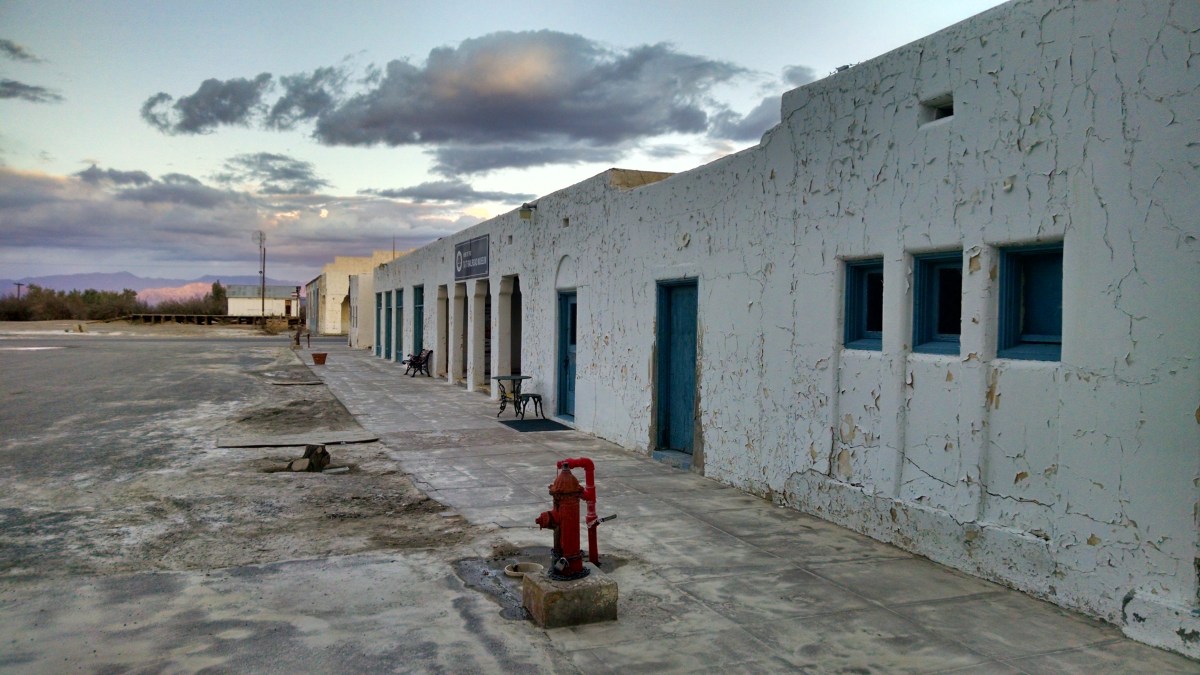
It’s called the Amargosa Opera House. From the outside it is unremarkable, just a white stucco structure in a dusty lot with a simple wooden sign above the doors. You won’t find any big headliners performing here, nor throngs of eager patrons lining up outside. But the Amargosa Opera House contains something better, something far more precious, inside its walls. Because when you step into it, as your eyes adjust to the dim light, you will encounter a vision: a vision of truth, a vision of authenticity, a vision of what I think love really looks like. 

You see, in the early 1960’s, a successful ballet dancer and artist from New York City by the name of Marta Becket was traveling through Death Valley with her husband on a camping trip. They got a flat tire and had to stop in Death Valley Junction. Even then it was a largely empty place, and as she waited for the car to get fixed, Marta wandered among the decrepit buildings, pondering their history.  And then something happened.

As she peered into the windows of an abandoned community hall, with its peeled paint and its battered old stage, she had a revelation.  Marta knew, in a flash of insight, that somehow she belonged there. 

“My life split in two at this junction,” she later told a newspaper reporter. “I looked at the stage and knew it was my future. I knew I’d perform here the rest of my life.”

And that’s exactly what she did. Marta left New York and moved to Death Valley Junction with her husband and fixed up the old performance hall. She rechristened it the Amargosa Opera House. She started performing one-woman ballets of her own creation. As you can imagine, given the location, the audiences were not large.  A local rancher or two; some workers from a nearby brothel; the occasional traveler. Sometimes, quite often in fact, no one would show up for the performance, but Marta would dance anyway–for an empty house, in the empty desert. 

Later, Marta and her husband divorced. And despite the protestations of her friends back east, she remained there alone in the Opera House, in the middle of Death Valley, now the sole inhabitant of the town, restoring buildings, welcoming the occasional visitor, and dancing, always dancing, through the decades, for anyone or no one at all. 

At some point, she had another inspiration: if no audience would come to her, she would create her own. And so she painted the interior of the Opera House with murals filled with people—huge, vivid murals that make you feel like you are standing inside a grand European theater, with gilded balconies and elegantly dressed figures and a big blue sky overhead with billowy clouds and laughing cherubs. 

And so, with her painted audience cheering her on, Marta danced, night after night, on her desert stage, dedicated fully to that vision, to the calling she felt when she first peered through the dusty window: unashamed, unafraid, utterly devoted to her singular vision of creative expression.  Utterly in love with her unusual life. Utterly authentic. 

I met Marta just a couple years before she died at the age of 92. She had continued dancing until she was 87. And ever since I stumbled upon the Amargosa Opera House, and saw her murals and learned about her story, it has been something of a beacon for me in moments when I feel lost. Each of us, in our own way, comes face to face with the question: who am I? What am I supposed to do with this life I have been given? How can I live purposefully, courageously, authentically?

I tell you this because I am convinced that’s what God desires from each of us, my friends: to be authentic. That doesn’t mean moving to Death Valley, necessarily. That was Marta’s story, her particular calling.

But God does ask us to show up in the world as fully and deeply ourselves as possible; to share our gifts for the betterment of the world; and to trust that this alone is enough, that we are enough, even if nobody else understands us, even if we end up dancing onstage alone.

That is what it means to be the bearers of God’s image: to discover what is true, what is sacred—in ourselves and in each other—and to love it, tenaciously. 

And so when we hear Jesus teaching in today’s Gospel about the intense, seemingly impossible demands that the Law places on our hearts—when we learn from him that the kingdom of heaven looks something like those rare moments when our inner motives are in perfect alignment with our outward actions—I believe we are hearing his invitation to a brave, self-giving, authenticity. 

It is not enough, Jesus tells us, to go through the motions of virtue if you are harboring fear and anger and covetousness deep within you. It is not enough to proclaim peace with your lips if there is war in your heart.  It is not enough to fulfill the legal and ceremonial obligations of your culture if you are not also attentive to the injustices that your culture perpetuates.

Because in that gap between the person God intends for us to be and the person we might have allowed ourselves to become—that is the void where sin and despair creep in. The Law, which Christ fulfills, beckons us beyond despair, into the glory of God, and, as St. Irenaeus writes, “the glory of God is the human person, fully alive.” Fully oneself.

True life, true blessedness, Jesus tells us, will only come when there is an integration between humanity’s heart and its hands; when we need not swear by any power beyond ourselves–by heaven or by earth— because we are so fully, authentically present to each other and to the world that Yes truly does mean Yes, and No truly does mean No.   To know ourselves, and to be ourselves, unvarnished, unapologetic, humble, rooted—this is what it means to know peace, and this is what it means to be a peacemaker.  This is what we are offered when we follow Christ.

But make no mistake; this much easier said than done. The embrace of authenticity always has a price in this broken world of ours. Sometimes a very steep one. The world is not always kind to the vulnerable, the meek, the open-hearted.

And each of us, looking back at our lives, can probably recognize a juncture when embracing the true and necessary thing might have cost us a great deal. Our sense of security. Or our livelihood. Or maybe friends and loved ones who have rejected us.

The road that leads deep into the heart of life can be lonely.

Like Jesus, and like Marta, it might lead us far out into the desert, where the evil one whispers in the Valley of Death that we are lost, that we are living with ghosts, forgotten, and that our fragile dreams are not worth tending, that nobody cares enough to come join us in the dance that we were born to do. 

But I have stood in the Amargosa Opera House, my friends. I have seen its vivid colors swirling and laughing defiantly in the heart of emptiness, and I can tell you that God shows up when we inhabit the places we fear the most. There is abundant life, abundant truth, when we allow God’s grace to form us into ourselves.

Because somewhere out there, in the vastness, in the kingdom of heaven, at the center of our deepest longings, Marta is still dancing, shrouded in lamplight and smiling mysteriously, knowingly, like a saint who has glimpsed the secret.

She is silent; silent as the desert. But her art, her life, her story speaks for itself. 

May the same be said for each of us, whoever we are called to be.