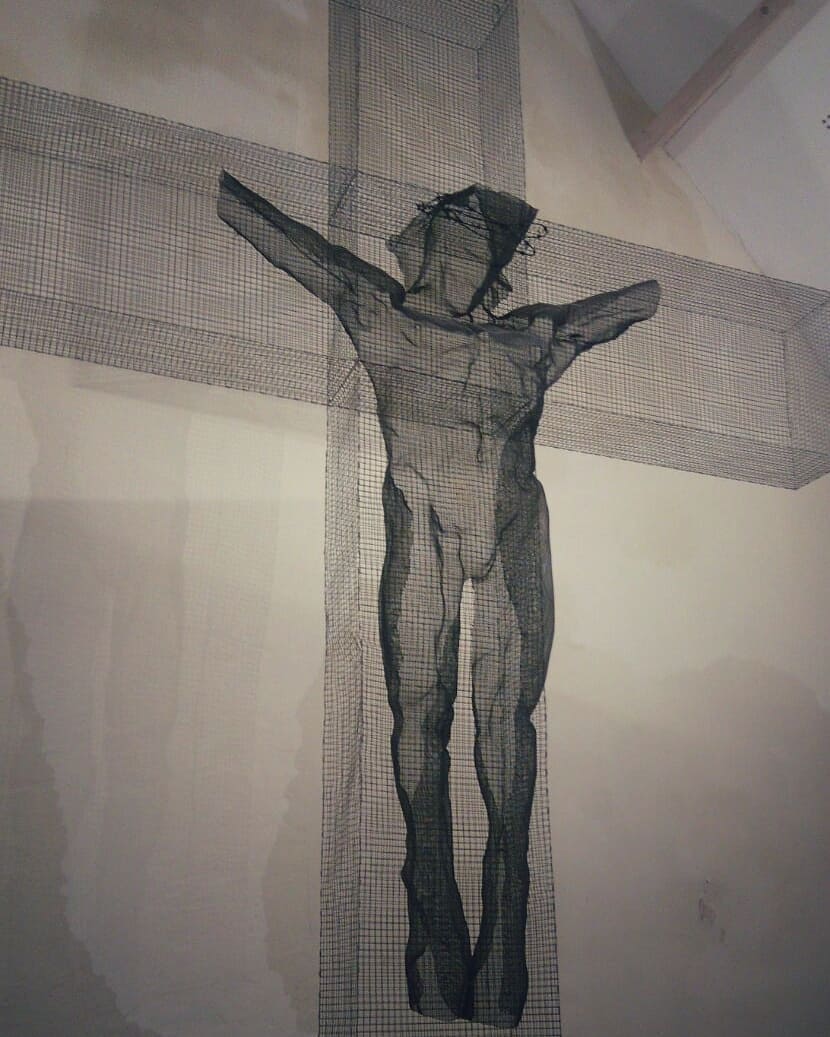
Failed: A Good Friday Sermon

Preached on Good Friday, April 18, 2025 at St. Anne Episcopal Church, West Chester, OH.

It is important that we speak plainly and honestly today. We owe that much to ourselves, and to him. There is no hiding, here. No pretty turns of phrase to evade the truth. 

No, the truth of Good Friday is simply this: We failed, God.

We failed today, fully and completely. We failed to see you. We failed to understand who you are and why you created us and why you came among us and what you asked of us. 

It was so simple, what you asked, but so impossible for us to accept: to love one another and to love you. 

But for so many reasons, and sometimes for no reason at all, we can’t do it. We don’t do it. And instead we crucify. And instead we are crucified. We fail. 

And oh, how we hate to admit it. We are so afraid of failure and shame. But somehow that fear of our own failure, that recoiling at our own limitations, is precisely what we lay upon others. We make them bleed the blood we are terrified of spilling. We make them die the death we are terrified of dying.

And so we have ended up here again, like clockwork, on another Golgotha, on that dusty hill which arises in every age, soaked with sorrow and strewn with cynicism. And we are bathed, today, in a grim, unflattering light, the sort of light that doesn’t illuminate so much as it lays bare. In the deathly light of Good Friday, every blemish and crack and wound in the body of creation is made plain in your body, Lord; your precious body, as it, too, fails. 

And we see here, in Jesus, upon this hill of sorrows, that, despite all our best efforts and biggest dreams, we don’t know how avoid failure in the end, not in the world as it is, because here death consumes even our greatest successes and highest ideals. It even consumes our God. 

So even if we give everything we have, like Jesus did, even if we practice peace and stay patient and never speak a hateful word, even if we do everything asked of us, still, it seems, the crucifier comes. The crucifier who is time and death and fear and fury.

Still he comes, with crosses freshly assembled to dole out. Still he comes, in his heavy boots, stomping on the harvest of our years. 

And still he comes, too, this crucifier, as a strange unwelcome traveler within us, welling up as the apathy and anger and resentment of our own hearts. We are the crucifier, too, somedays, even if we wish we weren’t. We must say that plainly, too.

Because so often, on any given Friday, good or otherwise, we choose to shrug or gawk or look away as the crucified ones continue to struggle through the streets of our own Jerusalems: draped in the flags of other nations or other identities, crowned with the thorns of prejudice, bearers of the burdens we’ve been taught to sneer at or dismiss. 

And if we are honest, really honest with ourselves, we’re often just relieved that it isn’t us.

And so on it goes, this passion play.

So yes, we have failed, God, and we can’t fully explain it. 

But it is necessary to say it, now, because really, what else can be said at the foot of your cross? There is no worldly victory here. No positive spin. There is no sly wink or nudge you give us that this is all just for show. This is simply what it appears to be. It is the opposite of love. And you, the One who is Love, you are gone. 

And that is that. 

But here’s the thing about today, God (and I am afraid, almost, to say it out loud, but I must, if we are speaking plainly.) Today is your encounter with failure, too, Lord. Your acceptance of your own failure. 

I’ve struggled to understand this or even put it into words, since you are eternal and unfailingly good, but I am realizing that Good Friday is nonetheless your own surrender to failure. 

Because you chose not just any death, but a shameful, embarrassing, degrading death. On the Cross, we see the fullness of your failure on the world’s terms. We see how creation could not bear the weight of you, how even your blessed flesh could not bear the weight of us. How you could not draw us back from our worst impulses.

You who–ever since your hungry children stumbled out of Eden with tearful eyes–you who have been trying to teach us how to undo the curse, how to find our way home. You who have parted seas and toppled tyrants and rained bread from heaven and crossed deserts and appeared in smoke and fire, all in the hopes of helping us find you again and find ourselves again…today is the shocking day when you say, my children, I have failed, too

Because you have come to us in every way possible. You have come as light and as fire and as word and now as a man. You have come as bread and as silence and as liberation, to show us, to show us, to show us, and still, still, still we are here again, on this dusty hill, unable to truly find each other. 

No matter what you have done til now, still, the crucifer comes.

And I am sorry, Jesus seems to say with his own parched lips, out of his own deep wounds. I am sorry that this has never quite worked. I am sorry that we always seem to end up here, on these many Golgothas. Because I promise you, you were created for so much more than a world full of crosses. I have wanted to give you so much more than this.

But now, it is finished. It is finished. 

On Good Friday, the saga of our long journey out of Eden is finished. It ends here, with us casting God from our garden, sending him away, weeping and hungry. It ends here.

And I realize that saying this might make us uncomfortable. Surely this is not the end of the story? We know there is more.

But it is very important, actually, that we let Good Friday be Good Friday, and nothing else. That we let it be the ending that it is. 

It is necessary, I think, after our long history of death and despair, to say that this particular story, this particular mode of endless disappointment—ours and Gods—ends today. 

Because perhaps we need to say goodbye here, us and God, here upon the dusty hill, upon the rubble of our failed dreams. Perhaps Jesus’ words are the most honest thing that we can say to one another today: it is finished. We tried, and it failed, but whatever this is, this world that crucifies truth, it must be finished. 

Because somewhere, out beyond time and terror and the Cross, somewhere within the mysterious alchemy of love and death and failure, only there and only then is something else possible, some truly good news that is not just a new chapter in this same, sad old story, but that’s a new story altogether. A new creation altogether. 

A different garden that is neither Eden nor our own, but a new world, a new life in which no one will ever be cast out. 

But whatever that looks like, whatever that new thing is that might yet be revealed from the depths of the tomb, we have to come here, first. We have to look into the face of our broken Lord, who tried so hard, who came so far, who loved so deeply. And we have to let him look at us, too: we who try so hard, who have come so far, who love so deeply, and yet are as broken as we’ve always been.

And today, for now, we have to let each other go.

I am sorry, Lord. I am sorry for all that we could not be to each other in the world as it is. I am sorry this is the ending of your time with us. 

But please, please let it not be the end

Let there be some new word spoken, some gentler, more kindly light revealed. Let there be something on the other side of all this failure. Let there be something plain and honest and good that does not always get crucified.

For whatever it is, we wait. 

For you, we wait. 

Parting Words: A Sermon for Good Friday

I preached this sermon on Good Friday, April 2, 2021 at Trinity Episcopal Church, Fort Wayne, IN. The lectionary text cited is the Passion Narrative from John’s Gospel. A recording of the service can be found here.

What can we say, now that we have arrived here?

This is the moment in the Christian year when words fail us, when our platitudes turn to dust. What meager phrase is adequate to express what we see, what we feel, what we fear in this place: the first and only time in the history of creation when we face the prospect of being truly, utterly alone in the cosmos? What could we say that would ever be a sufficient offering, a word of consolation to our God as he hangs on the cross?

For that is what we are doing today, on Good Friday: we are keeping vigil at the side of our Lord as he dies for us. We plant ourselves here, amid the skulls, at the foot of his cross, and we wait, and we watch, not because we can change anything or solve anything, but because somehow we know that to love him is to be present in this moment. Nobody should have to die alone. 

But in our waiting and watching, still, perhaps, we wonder how to express to him what we feel—all the things that we always wanted to say, but never quite could.

My Lord and my God, how quickly the time went; how much more I wish I had told you while we were together. But now we are here in this valley of shadows, and you are slipping away, and there is so little time left. Please don’t leave us. But if you must leave us, what would you have me say?

If you have ever lost someone close to you, you know that this is not just a Good Friday conundrum; when death is imminent, when it is time for that last conversation, we often struggle with what to say. We are often not very good with endings. 

And in those moments, beside the hospital bed, in the moment before we must finally turn away, memory and regret and fear can leave us as inarticulate as Mary and the Beloved Disciple, gazing upon the face of the one who is leaving us, but saying not a word, our tongues parched by grief. 

For what can we say, now that we have arrived here? 

I recently read, though, that, in the end, there are, in truth, just four things that are most important to say to someone you care about before they die. Four statements that we can offer: Forgive me. I forgive you. Thank you. I love you.

So perhaps that is what we can offer today; perhaps that is the best we can do, to give our dying God the same, humble tenderness we might offer each other. To say to him: Forgive me. I forgive you. Thank you. I love you.

Lord Jesus, forgive me. Forgive me for all the times I forgot you, while you patiently waited for me to remember. Forgive my stubbornness and my smallness, and all the times that I got in the way of the joy that you yearned to nurture within me. Forgive me for all the ways that I have passively accepted a world that still crucifies the vulnerable and disregards the poor and the meek and the hungry, whom you have blessed. Forgive me for my silence when I ought to have spoken; and for my careless words when I ought to have been still. Forgive me for holding you at a distance, for trying to preserve myself from the transformational intensity of your love. Lord Jesus, forgive me.

Lord Jesus, it may sound strange to say it, but I forgive you, too. I forgive you for not being present in the ways that I needed you to be when I felt so alone. I forgive you for inaugurating a church that at times, in your name, has harmed so many people. I forgive you for creating a world that allows for sin to break people apart, for this mortal life where we seem to lose everyone we love. I forgive you for being so hard to understand at times, and so hard to follow. I forgive you for not being the type of strong and mighty savior that I expected, the kind that would keep me safe. I forgive you for all these things, mostly because I need to let them go, in order to see you properly, in your fullness, and not the incomplete version of you that has been distorted by my own pain and confusion and resentment. I forgive you because I want to know you as you are, not as I wish you were. Lord Jesus, I forgive you.

Lord Jesus, thank you. Thank you for loving me beyond comprehension. I know that your love is why you hang upon the cross, why you choose to lay down your life for your friends, and although I cannot fully understand it, I feel it—its saving, healing power—deep in my soul. Thank you for showing us what it means to live as a human being fully alive, fully in communion with our Father in heaven, fully in partnership with our neighbors and with the web of all creation. Thank you for the outpouring gift of your grace in water and bread and wine and oil; for giving your flesh and your Spirit to us, unworthy as we may be. Thank you for your church, which, at its best, has saved my life and taught me the meaning of community. Thank you for the invitation to live a life caught up in the joy your life, and to love with a heart enraptured by your undying love. Lord Jesus, thank you.

Lord Jesus, I love you. Not perfectly. Not as consistently as I might hope to. But I love you. I love you for challenging me to be better; for believing in us, in our potential, these wayward children that you have fashioned out of the dust of the earth. I love you for your tenacity and your gentleness; your courage and your peace. I love you because you have taught me how to be myself, the way you created and intended for me to be. I love you because you were yourself, purely and utterly yourself. And as your life slips away on this day, know that I will carry you with me now, for all the days to come, until death is but a memory, until I see your face again. But for now, Lord Jesus, just know that I love you. And it’s ok to go, if you must. I know you must. 

What can we say, now that we have arrived here? 

Forgive me. I forgive you. Thank you. I love you. 

And then, it is finished.

But is enough. It is, perhaps, all he ever wanted us to say.

Holy Week at Home #6: Good Friday

A continuation of my “Holy Week at Home” posts; on Good Friday we stand at the foot if the Cross as Jesus is crucified. 

Look up.

He is unfurled
aloft,

Like a flag of surrender,
So that you might see, and know
It is finished.

Like a scroll,
So that you might read the lines on his skin and find the place
where it is written in rivulets of tears:
The Spirit of the Lord is upon me.
I have been anointed to proclaim release.
And I am releasing—
I am giving up
my spirit.

A broken body
Arched like a question
inquiring into your frailty;
testing whether it is tolerable
For love to cost this much.

But if you will stay
In this place without answers
Then you will learn that the
rending and the mending of the world
are two notes of the same song.

You will learn that there is no such thing
as dispassionate salvation
or tentative redemption.

And how in the Divine economy
everything is given
And returned
Eternally.

You will learn that nothing is ever wasted
even when waste is the only credible conclusion.
Even when all the evidence suggests defeat.

You will learn that victory is not the same as winning;
that truth is not the same as certainty;
And that peace is not the same as pleasure.

But all of this is offered now, only now,
On this desiccated and necessary hill,
The final bequeathment of a dying God
Who cannot teach you the secrets of eternity
Without entering finitude.

Look up, into his face.

Look up, and see how he is grieving all of your endings.

Look up, and see how he is dying all of your deaths.

Look up, and see the world pass into something new.

Look up.