What If?: A Sermon for Palm Sunday

I preached this sermon on Palm Sunday, 2024, at St. Anne Episcopal Church, West Chester, OH. The text cited is the Passion narrative in the Gospel according to Mark.

One thing that strikes me, every year, as Holy Week envelops us in the stark power of its narrative, is how inevitable it all feels, this story about Jesus’ betrayal and death. How fixed the trajectory, after lifetimes, after centuries, after millennia of retracing it. It is easy to forget that the story we tell today began so differently.

Just a few months ago, we beheld a baby born in Bethlehem under the chill of starlight, and we heard angel choirs singing of peace, and then we watched that child grow and mature through the soft gloom of the season, and in the slow lengthening of our days through Epiphany, we beheld his light and his life and his love gathering their own brightness, and we have looked for signs of the unfurling promise of his Kingdom, like springtime emerging from the muddy, fertile ground of Lent. 

And yet, once more, here we stand on Palm Sunday, only to witness this particular story of God’s goodness cut short again, this particular promise deferred again, the tender green growing palms trampled, again, under the force of misguided adulation; the gently stirring earth soaked, again, not with gentle spring rain, but with blood.

And yet, despite the grave horrors, the enduring shock of what we see and experience in this Passion story, still, I think, we tend to see it as inevitable. As if this brutal end to Jesus’ earthly ministry was somehow the necessary price of his message, as if it were normal for for mothers to mourn their children, as if it were normal for springtime to give way to winter instead of summer. As if this sacrifice was as natural as the turning of the seasons. As if there was no other way the story could have ended. 

What if there was?

It’s odd, we rarely seem to ask that question about Holy Week. And it’s especially odd because, for most of us, in our own lives, we spend a lot of time and energy asking “what if?” 

What if I had made a different choice? What if I had chosen a different path? What if I had learned from my mistakes sooner? What if we, as a nation or as a community or as a church had chosen another course of action? 

Asking these sorts of questions is, most of the time, as natural as breathing. 

We are accustomed to “what ifs” because we are faced with a dizzying number of choices every day, and so of course we wonder how else things might have turned out if we had gone a different way. 

And yet, when it comes to Holy Week, when it comes to Jesus stumbling on the rocky road to Golgotha, we surrender him to his fate. We surrender our “what ifs”  to the violence we know and expect, and we behold the drama as if it were fixed and preordained, the way that it had to be for Jesus to be who he was and accomplish what he did. 

Without the suffering of Christ, without the brutality of the Cross (we have often been taught) there would be no salvation, no redemption, no liberation from the brokenness and sin that formed and fashioned the Cross in the first place. And so we have accepted, on some level, that all of this was necessary.

It’s a strange sort of logic that a God of Love would require torture to prove that love. At best, it leaves us to simply shake our heads and shrug at God’s inscrutable will. But at worst, it gives rise to the idea of redemptive violence—a God who inflicts harm upon himself and creation to achieve the ends of peace. Which sounds suspiciously like the tyrants we know, not like the God for whom we long. 

And so I wonder if, perhaps, as we move through Holy Week together, we are meant not to accept the inevitability of the Passion as passive observers of Jesus’ pain, but to trouble the narrative, just as our spirits are troubled by it. I wonder if we are meant to ask “what if?”

What if Jesus did not have to die in the way that he did? What if his own predictions of the Passion reflected his deep, grief-stricken understanding of our brokenness rather than some necessary violence inflicted by his Father? 

What if none of this had to happen?

What if the crowd chose to listen to his actual teachings? What if they understood, as he entered the city, the subversive symbolism of his ride on the colt for what it was—a challenge to the pageantry of imperial power—rather than projecting their own political agendas onto his actions?

What if his disciples had not forsaken him? What if the temple authorities had kept an open mind, had been humble in the face of things they did not understand? What if Pilate had chosen to be something more than a functionary of the deadly inertia of empire? 

What if there had, in fact, been another way for the story to end, another way for Jesus’ undying love to be made manifest and to bless the earth? 

We cannot know the answer to these questions, anymore than we ever know the answer to the “what ifs” of our own lives. The story is the story. And we must tell it. 

But that is not the point. The point is that we still need to ask the question. We need to ask “what if” during Holy Week, just as we must ask “what if” every time we are faced with violence and pain and prejudice, so that we do not accept these things as somehow normative, somehow determinative, because without “what if,” we will have made an uneasy peace with the crucifying impulses of the world. We will have surrendered our imaginations to the sense of their inevitability.

But what if we didn’t? 

What if the God who has repeatedly said “I desire mercy, not sacrifice,” actually meant it, and meant us to expect this from ourselves and our world? What if the brutality of this Passion story is no more part of God’s plan than any of the rest of the suffering we inflict upon one another? 

Because when you start asking “what if,” you realize that everything in the Passion narrative is the result of choices, choices made made by people not so different from you and me, choices made, too often, in service to the prevailing order, choices made by people who were as agitated and lost and polarized as we are, people caught up in faltering hopes and flourishing suspicions, people distracted and weighed down by a history of loss, people who also forgot to ask, “what if this was not the way it has to be?”

I tried it this week, asking “what if” as I was reading and wrestling with the story. And there are signs of possibility, thank God, if we look closely. Especially if we look closely at the women.

There’s the unnamed woman with the alabaster jar, who pours out her rare, costly, sweet ointment with the same mixture of wild abandon and care by which God pours his love upon creation. They say it is wasteful, this love and care, and yet she seems to be asking, “what if it’s not?”

And there’s the servant girl who, like a prophet, calls Peter to account for abandoning his true identity, all of his no, no, no, I do not know him. And she seems to be asking, “what if you said yes? What if you did finally, fully, know him and claim him as your own?”

And the women who gather near the Cross to hold vigil with Jesus as he dies, refusing to abandon him to his shame and loneliness. The crowds call it a lost cause, a failed revolution, a big disappointment, but the women seem to be asking, “what if none of that was the point?”

All of these women are the ones who refuse to accept the unfolding trajectory of the story—the ones who see another way, the true Way. They are the ones brave enough to name presence and fidelity, not violence and power, as the strongest force at work in this narrative. They are the ones who are asking, what if this story is not about the myth of redemptive violence that forms its center, but about the quiet, determined insistence of love that flourishes on the margins?

What if the point of Holy Week is not to valorize the story of Jesus’ suffering, but to build a world in which it is the last such story that ever need be told? 

What if we realized that the Cross is not the necessary means to an end, that God would have saved us in a thousand different ways if we would have let him, and that he still will?

What if we realized that the only inevitable narrative is not the Passion, but this: that Jesus—and all of us— are loved passionately from the day of our birth, all of us adored by angels under the chill of starlight, loved through the soft gloom of the turning seasons, loved through the lengthening of our days, and loved when we rejoice and loved when we despair and loved even when we die—however we die—and loved, ultimately, back to life.

What if that was the one, true, enduring, necessary story we needed to hear? What if all the rest was up to us? 

What if?

Parting Words: A Sermon for Good Friday

I preached this sermon on Good Friday, April 2, 2021 at Trinity Episcopal Church, Fort Wayne, IN. The lectionary text cited is the Passion Narrative from John’s Gospel. A recording of the service can be found here.

What can we say, now that we have arrived here?

This is the moment in the Christian year when words fail us, when our platitudes turn to dust. What meager phrase is adequate to express what we see, what we feel, what we fear in this place: the first and only time in the history of creation when we face the prospect of being truly, utterly alone in the cosmos? What could we say that would ever be a sufficient offering, a word of consolation to our God as he hangs on the cross?

For that is what we are doing today, on Good Friday: we are keeping vigil at the side of our Lord as he dies for us. We plant ourselves here, amid the skulls, at the foot of his cross, and we wait, and we watch, not because we can change anything or solve anything, but because somehow we know that to love him is to be present in this moment. Nobody should have to die alone. 

But in our waiting and watching, still, perhaps, we wonder how to express to him what we feel—all the things that we always wanted to say, but never quite could.

My Lord and my God, how quickly the time went; how much more I wish I had told you while we were together. But now we are here in this valley of shadows, and you are slipping away, and there is so little time left. Please don’t leave us. But if you must leave us, what would you have me say?

If you have ever lost someone close to you, you know that this is not just a Good Friday conundrum; when death is imminent, when it is time for that last conversation, we often struggle with what to say. We are often not very good with endings. 

And in those moments, beside the hospital bed, in the moment before we must finally turn away, memory and regret and fear can leave us as inarticulate as Mary and the Beloved Disciple, gazing upon the face of the one who is leaving us, but saying not a word, our tongues parched by grief. 

For what can we say, now that we have arrived here? 

I recently read, though, that, in the end, there are, in truth, just four things that are most important to say to someone you care about before they die. Four statements that we can offer: Forgive me. I forgive you. Thank you. I love you.

So perhaps that is what we can offer today; perhaps that is the best we can do, to give our dying God the same, humble tenderness we might offer each other. To say to him: Forgive me. I forgive you. Thank you. I love you.

Lord Jesus, forgive me. Forgive me for all the times I forgot you, while you patiently waited for me to remember. Forgive my stubbornness and my smallness, and all the times that I got in the way of the joy that you yearned to nurture within me. Forgive me for all the ways that I have passively accepted a world that still crucifies the vulnerable and disregards the poor and the meek and the hungry, whom you have blessed. Forgive me for my silence when I ought to have spoken; and for my careless words when I ought to have been still. Forgive me for holding you at a distance, for trying to preserve myself from the transformational intensity of your love. Lord Jesus, forgive me.

Lord Jesus, it may sound strange to say it, but I forgive you, too. I forgive you for not being present in the ways that I needed you to be when I felt so alone. I forgive you for inaugurating a church that at times, in your name, has harmed so many people. I forgive you for creating a world that allows for sin to break people apart, for this mortal life where we seem to lose everyone we love. I forgive you for being so hard to understand at times, and so hard to follow. I forgive you for not being the type of strong and mighty savior that I expected, the kind that would keep me safe. I forgive you for all these things, mostly because I need to let them go, in order to see you properly, in your fullness, and not the incomplete version of you that has been distorted by my own pain and confusion and resentment. I forgive you because I want to know you as you are, not as I wish you were. Lord Jesus, I forgive you.

Lord Jesus, thank you. Thank you for loving me beyond comprehension. I know that your love is why you hang upon the cross, why you choose to lay down your life for your friends, and although I cannot fully understand it, I feel it—its saving, healing power—deep in my soul. Thank you for showing us what it means to live as a human being fully alive, fully in communion with our Father in heaven, fully in partnership with our neighbors and with the web of all creation. Thank you for the outpouring gift of your grace in water and bread and wine and oil; for giving your flesh and your Spirit to us, unworthy as we may be. Thank you for your church, which, at its best, has saved my life and taught me the meaning of community. Thank you for the invitation to live a life caught up in the joy your life, and to love with a heart enraptured by your undying love. Lord Jesus, thank you.

Lord Jesus, I love you. Not perfectly. Not as consistently as I might hope to. But I love you. I love you for challenging me to be better; for believing in us, in our potential, these wayward children that you have fashioned out of the dust of the earth. I love you for your tenacity and your gentleness; your courage and your peace. I love you because you have taught me how to be myself, the way you created and intended for me to be. I love you because you were yourself, purely and utterly yourself. And as your life slips away on this day, know that I will carry you with me now, for all the days to come, until death is but a memory, until I see your face again. But for now, Lord Jesus, just know that I love you. And it’s ok to go, if you must. I know you must. 

What can we say, now that we have arrived here? 

Forgive me. I forgive you. Thank you. I love you. 

And then, it is finished.

But is enough. It is, perhaps, all he ever wanted us to say.

Holy Week at Home #6: Good Friday

A continuation of my “Holy Week at Home” posts; on Good Friday we stand at the foot if the Cross as Jesus is crucified. 

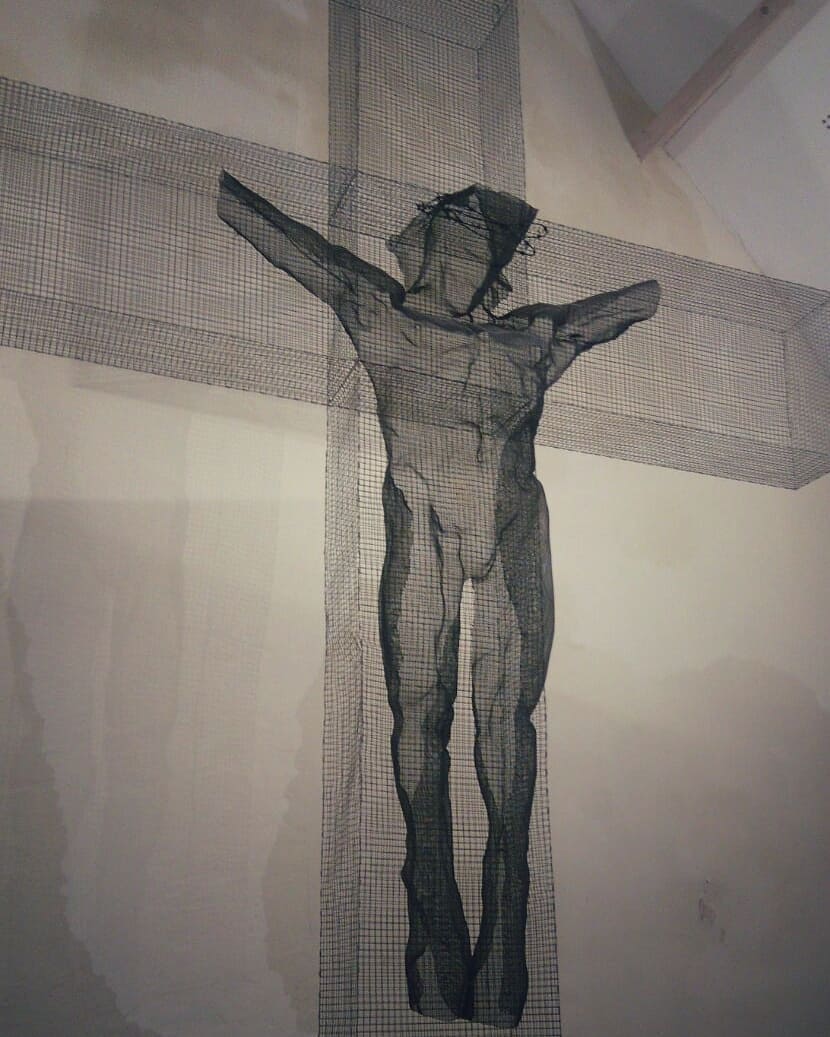
Look up.

He is unfurled
aloft,

Like a flag of surrender,
So that you might see, and know
It is finished.

Like a scroll,
So that you might read the lines on his skin and find the place
where it is written in rivulets of tears:
The Spirit of the Lord is upon me.
I have been anointed to proclaim release.
And I am releasing—
I am giving up
my spirit.

A broken body
Arched like a question
inquiring into your frailty;
testing whether it is tolerable
For love to cost this much.

But if you will stay
In this place without answers
Then you will learn that the
rending and the mending of the world
are two notes of the same song.

You will learn that there is no such thing
as dispassionate salvation
or tentative redemption.

And how in the Divine economy
everything is given
And returned
Eternally.

You will learn that nothing is ever wasted
even when waste is the only credible conclusion.
Even when all the evidence suggests defeat.

You will learn that victory is not the same as winning;
that truth is not the same as certainty;
And that peace is not the same as pleasure.

But all of this is offered now, only now,
On this desiccated and necessary hill,
The final bequeathment of a dying God
Who cannot teach you the secrets of eternity
Without entering finitude.

Look up, into his face.

Look up, and see how he is grieving all of your endings.

Look up, and see how he is dying all of your deaths.

Look up, and see the world pass into something new.

Look up. 

“Who Is This King of Glory?”: A Sermon

I preached this sermon on November 24, 2019, Christ the King Sunday, at Trinity Episcopal Church, Fort Wayne, IN. The lectionary texts cited are Luke 23:33-43 and Colossians 1:11-20

Recently, I enrolled in a weeklong evening workshop to learn how to paint an icon—those beautiful religious images that are especially associated with the Eastern Orthodox Christian tradition. We were tasked with creating an icon of Christ on the cross, and after nearly 20 hours of sketching, painting, applying gold leaf, and layering colors, the last step was to add Jesus’ name, in Greek, and a title above the cross: The King of Glory. This final act of inscribing the name and title, our instructor told us, gave the image its sacred quality. It defined who the icon was, and how it should be viewed by those who gaze upon it.

And it is this title which I carefully added to the icon, “The King of Glory,” that has been on my mind all week.

It is a designation found in only place in the entire Bible, in the 24th Psalm:

Lift up your heads, O gates!

and be lifted up, O ancient doors!

    that the King of glory may come in.

Who is this King of glory?

    The Lord of hosts,

    he is the King of glory.

And the question keeps presenting itself to me, like an insistent whisper: who is this King of Glory? Who is he indeed? Where is he to be found? What sort of king is he?

On this day, Christ the King Sunday, at the conclusion of the church year–at the threshold of Advent–we, too, are asked to open the gates and doors of our hearts and ask ourselves this question: who is this King to whom we have pledged our lives, our resources, and our trust? Who is this King whom we worship and wait for?

There is, perhaps, no more important question we will ever ask ourselves, because the nature of our King—the one in whom we place our identity and our destiny— tells us, fundamentally, who we are and how we are to live. To understand Him is to glimpse our ultimate significance as God’s people.

But truth be told, there is a strangeness in naming Jesus as king and ourselves as his subjects. Not just because you and I happen to live in a country where the concept of monarchy is foreign. But because humanity’s usual ideas about the nature of a king and of royal prestige are wrapped up in power dynamics that Jesus seems to undermine at every turn. 

Far from being a mighty ruler in the gilded halls of influence, our King is the one who walks dusty roads alongside the marginalized, the one who hangs pitifully on a cross, scorned and abandoned, and who, at the end, offers no satisfying retribution against his enemies; only forgiveness and a whisper of paradise. 

This is a far cry from the King whom the Psalmist describes; in the Psalm, the King of Glory is the Lord of Hosts, the Lord of mighty armies, charging into battle to defend his people with impressive strength. He is the one who subdues the nations and ensures his justice by the power of the sword. 

And frankly we know a lot about kings like that—too much, in fact; they haunt our violent history, and their successors are still rattling around among us, weaponizing power and treating the world like a playing field for their own deluded ambitions.

But this is not what we are given in Jesus, and I think it is a mistake when we attempt to fashion him in those terms. As revealed in today’s gospel, it is a Crucified King who reigns over us: a man of sorrows, whose earthly palace is the Place of the Skull; whose coronation is an execution; and whose royal title, “The King of the Jews,” is a cruel bit of imperial irony. There is no pomp and splendor here, no adoring crowd, no royal feast.

Christ is, in fact, revealed to us on the cross as the anti-king, the one who upends our entire notion of dignity and honor and power, who reveals himself to the world not in the heights of glory but in the depths of vulnerability and weakness. And this tender pathos is part of him always; even the risen Christ still bears the wounds of his humiliation.

So when we sing of thrones, we also sing of thorns, because in Jesus the two realities—the glory and the sacrifice—are bound up in one another. For our King, true power is revealed in the moment when power is given away for the good of others. For our King, it is a surrender to God’s will, not triumphalism, that leads to eternal glory. 

And all of this makes *Christ the King Sunday* a rather subversive occasion. 

Because just as the earliest members of the Church proclaimed that it was Jesus, crucified, risen, and ascended, who revealed the true nature of kingly authority, and not the passing tyrants of a declining Roman empire, so we, as Christians, must proclaim the same thing today to all the would-be leaders of our own time: that their power is contingent. That they are answerable to something greater than themselves, greater than all of us. That justice without mercy, and strength without humility, is an abomination.

This is an uncomfortable position, no matter where one falls on the political spectrum, because it requires each of us to relinquish the illusion that any one person or party or movement will save us, or any one earthly ruler, even those whom we admire. It requires us to challenge both those with whom we tend to disagree and those whom we desperately want to follow.

These leaders will not save us. They cannot save us.  Because the ultimate questions of power and destiny have already been resolved by another—by Jesus Christ, the King—the firstborn King of all creation and the Last King, who will return to us in a blaze of mercy. This is our King of Glory, the only authority who has ever mattered, and who reveals himself in a most unexpected way: born in a shed, living in obscurity, dying in shame, rising again in quiet, piercing light. 

In the end, our only duty is to seek him in the shadow of his cross and in the radiance of his love, and to live as he would have us live.  Our true identity is found only here—in Christ’s kingdom, where we are not merely passive subjects, but active citizens, patterning our lives after his own, proclaiming his mission of justice and reconciliation, and trusting that his eternal glory will belong to us as well.

This requires much of us—everything, in fact, that we have to offer. And as the cross reveals, it is not a life that guarantees comfort. But there is nothing more true, nothing more real, nothing more for which we were made. And so, as St. Paul prays in his letter to the Colossians, “may you be made strong with all the strength that comes from his glorious power, and may you be prepared to endure everything with patience.”

Who is this King of Glory?

For us it is Jesus, broken and yet eternal; wounded and yet wondrous; rejected and yet reigning supreme. It has always been Jesus, the Christ, Our King. And it always will be. 

Only Questions: A Good Friday Sermon

This sermon was preached on Good Friday, April 19, 2019, at Christ Episcopal Church in Alameda, CA. 

Shortly before condemning Jesus to death, Pilate asks him–and thus unknowingly asks God–a bitter, heartbreaking , fundamental question, one that humanity has likely been asking from the very beginning: “what is truth?”

He receives no answer.

There is no answer to give that could be encapsulated into words. Truth, the very embodiment of Truth, is a bruised and battered face staring back into his own face, and it is beyond articulation.

Like Pilate and everyone else who participates in the crucifixion of God Incarnate, we are deep in a mystery now, a place where words are largely inadequate, where answers are few, where only questions prevail. We must tread carefully, for this is terrifying holy ground we stand upon today, Good Friday, and we should not profane it with endless speculation.

We are at the foot of the Cross, gazing up at Jesus, who in turn gazes back at us, blood and tears streaming down his face—and in this place, tidy, insightful observations about the nature of God and clever turns of phrase about sin and forgiveness and sacrifice all dry up like chaff and blow away in the wind.

The Cross rejects every attempt to understand it fully. It is not a place for self-assured theologizing or domesticated spiritualizing. It is a raw, awful, unspeakable place in which we find ourselves.

Last night, on Maundy Thursday, Jesus told us to love one another, and we did so. We washed one another’s feet and broke bread together with the best of intentions. We perceived that this was the proper way to live, to care, to be present in God’s kingdom. And on Easter we will no doubt come back together as a people renewed and forgiven for all the times we have failed to love, returning to our senses after this day of desperation and horror, and we will recommit ourselves to the fullness of life that God offers freely in the light of resurrection.

But today we are no-place. Today we have murdered the very best of our intentions to love. We have traveled to the Place of the Skull, the place where confidence is shattered like bone. Today we stand at the farthest point from comfort, the place where Jesus, God-With-Us, He who was the smiling babe in the manger, the youth in the temple, the wise teacher on the mountain, the Holy One, cries out to the Father for some sign of presence and receives…nothing. No answer. No words.

And in that silence we know what it is to forsake and to be forsaken.

Yes, we are deep in a mystery, one so strange and terrible that any attempt to sort it out, to prod at its depths, to explain it, results in cheap, brittle platitudes.

Think about of all the things that you should never, ever say when someone has experienced a great loss in their life: things like

“It’s all part of God’s plan.”

“Everythinghappens for a reason.”

“When one door closes, another one opens.”

These are things we say to each other that are usually more about soothing our own sense of confusion and fear rather than simply being present, deeply present, to the pain of another.

And yet these trite, hollow, inadvertently callous attempts at comfort are exactly what we so often apply to our encounter with Jesus on the Cross. We want to justify this awful thing, to make sense of it, to assure ourselves that God knew what God was doing the whole time. We approach Golgotha and see the crucified Christ writhing in agony and fear, and we say, to Him, as we do to others: “everything happens for a reason! Your suffering is part of God’s plan!”

And these words are like yet more nails, hammered and stammered into the endless void of His suffering.

The Church has done this since the beginning, in various ways. It’s only human, perhaps. We don’t like sitting with questions, and we rely too much on explanations.

Some of us want to reason the Cross away as God’s clever, elegant, brutal plan to atone for our sins, to make proper restitution for our brokenness, as if the cosmos were constructed like an accounting system or a court of law.

Or, equally tempting for some of us and yet equally limiting: we confine the Cross to the realm of  human political drama, as if Jesus was nothing more than an enlightened social justice prophet murdered by “conservative” religious authorities and imperial forces—those bad, unenlightened others that of course look nothing like us. As if the Cross was merely an unfortunate byproduct of a backwards political system rather than what it actually is: the fundamental, unanswerable question at the core of all the pain which we experience and inflict upon each other.

Every time we try to reconstruct the Cross in a way that suits us, in a way that provides easy answers, in a way that excuses us from the narrative, we are simply building another instrument of torture to re-crucify that which we cannot understand.

No more of this, I ask you. No more. Lay down your easy theories of atonement that taste of sour wine; stop casting lots for your competing theologies of the Cross. For one day, let us stop trying to figure it out. Look into the face of Christ crucified and let Him be all that He is, uncertain and frightening and heart-rending, the face of Truth.

And let that wordless recognition of Truth, terrible as it may be, let it be enough today, because it is all we are given. Just as with Pilate, Jesus has no further answers for us.

It is called Good Friday because it is God’s Friday—the day in which God presents us with a mystery, a deep mystery, a Man who is on a cross for reasons so strange and intimate that they are as distant as an all-consuming black hole, and yet as close as our own breath.

And yes, we know in our hearts that there is more to the story, and that perhaps soon, very soon, we will fumble our way toward the answer of the empty tomb and the radiant joy of something entirely new. But not now. Not yet.

What is truth, we ask? Look at the Cross. It is staring us in the face, wordless and unutterable. Approach it cautiously, without certainty. Touch it if you dare; look into the void and see God staring back at you. Today, this is all we have.