By Another Road: A Sermon

I preached this sermon on Sunday, January 5 at St. Anne Episcopal Church, West Chester, OH. The lectionary text cited is Matthew 2:1-12, the journey of the Magi to see the baby Jesus.

Some of you know that I post the text of my sermons each week on a little blog site I created several years ago. I’ve always loved writing, and it started out as a helpful way for me to share some of my early sermons and reflections with a few family members and friends. It has transitioned into, I hope, a convenient way for anyone to go back, if they want to, to see what exactly I was attempting to say on any given Sunday—whether because you found it interesting, or perhaps because it made no sense at all. I make no promises! 

It is the humbling labor of a preacher each week to launch out our words as an offering to the community we serve and out into the universe as an offering to God. We hope, at best, to leave behind a small impression—which can feel like trying to skip a stone on the surface of the sea.

But I digress. The blog where I post my sermons and skip my stones is titled By Another Road, and folks have asked me on occasion why it’s called that. Well, in this morning’s Gospel reading, you have your answer. I took it from Matthew’s account of the Magi (or Wise Men) who, after visiting the baby Jesus and having been warned of King Herod’s nefarious intentions, decide to travel home “by another road.” 

On its face, this little phrase is just part of the plot—the Magi literally have to go home a different way in order to avoid an awkward or dangerous conversation with Herod. They’ve accomplished what they came to do, paying homage to this newborn king, and now they slip down a back road to their own homelands.  

But for me, at least, this phrase, by another road, always meant something more. Maybe it’s because, for various reasons, I have known what it feels like to be “other” myself. When a person feels different somehow from those around them, you come to know what it means and what it costs to walk a road through life that some people cannot—or choose not—to understand.

This can be many things. For some, this “other road” is tied to an identity we carry with us; for others perhaps it is shaped by our personal or family history, or our physical limitations, or the unexpected responsibilities and challenges that life has visited upon us. The more I live and serve as a priest and hear people’s stories, the better I understand that we are all traveling “by another road” of one sort or another.

And what I became convinced of at a particular point in my walk with God, and which I fervently believe is the basis of our faith, is that the story of following Jesus is less about conforming ourselves to one straight and narrow, conventionally acceptable path, and instead is about opening our hearts and our eyes and our minds to recognize how God is present on every road we must travel. And that God is present, too, on the roads we do not recognize—the ones walked by people very different from us. 

The point of being Christian is found not so much in which road we take, but how we travel. Are we going gently and justly? Are we helping others along the way? Are we stopping to notice the beauty of the world around us and giving thanks for it? Are we treating those whom we meet as adversaries, or as fellow pilgrims? 

To travel by another road, ultimately, means seeing the world as the Wise Men did after their encounter with the Christ child—once they decided to opt out of whatever political intrigue they’d been drawn into. It is to see the world no longer as place of transactional relationships and personal ambitions, but as a network of winding paths—all our pasts and futures and sorrows and dreams, all converging, ultimately, beneath the star of Bethlehem, in the flesh of God, and in the humble gifts we offer to one another…all of us skipping our stones on the surface of the sea. 

And to be a follower of Jesus is to commit to walking whatever road we’re on as if all of this is true and worthwhile. Because in every worship service and in every act of service to our neighbor we affirm that it is—that God was born into this world to bless every pathway we have stumbled upon, and even to journey by another road of his own, to the Cross and beyond. 

Now, I’ll admit that the idea that there isn’t just one road, one perfect way to “do” this Christian life, and that—heaven help us—there might even be holy pathways for people who look or love or live differently than us— might be a bit disorienting, even offensive to some. So be it.

But I’ll tell you—it’s this realization–that God was with me on my own road, that Jesus wanted to walk with me just as I am–that saved me, and continues to save me every day of my life. And I suspect, because you have found a sense of home at St. Anne, that might be true for you, too.

Because the other thing I love about the story of the Magi is that they, themselves, discovered in their encounter with Jesus that it was ok to be different. They were not Israelites. They weren’t part of the in-crowd in this story. And yet God, as a child, welcomed them as any child would—full of love and trust and wonder. These Magi were enough, just as they are; they were loved and blessed not because of the particular road they have traveled, but simply because they have come. And so it is for you.

I hope we learn something from all of this. And so, if I could ask you to do two things, my dear friends, at the outset of this new calendar year, it would be this:

First—take some time to look at the road you’re on, whether in this past year or maybe for your whole life. Maybe it’s not perfect. Maybe it’s been hard. But I want you to kneel down and bless that road, and bless the body and soul that has carried you on it. 

I want you to trace a cross in the dust of this road you’ve been walking, trace a cross over the story you’ve been carrying in your heart, over the questions you’ve been asking, over the fears you’ve been fearing, and I want you to say to yourself, God is on this road with me. Jesus is on this road with me. And so I will travel it with my head held high, with a sense of love and purpose and care, because like any other road, it is made sacred by the journey.

And second—take some time to learn about the road someone else is walking. Maybe someone close to you whose life just doesn’t make a lot of sense to you. Or maybe someone you’ve lost touch with. Or maybe a community of people whose life experiences differ greatly from yours. 

In whatever way you can, whether through conversation or study, try to understand the road that they are walking. Maybe you can ask them those questions I suggested last November:  What do you love? What do you fear? What do you hope for? And another important question one of you added to that list: What can I do to help? 

Because the Epiphany that we speak of this time of year—the Epiphany of God’s revelation in our midst—is not just about the news of Jesus born in Bethlehem all those years ago, visited by wise men and feared by kings. 

No, the Epiphany is also that God is still here with every one of us, no matter which road we’re on—the winding roads and the dangerous ones; the placid pathways and the ones cut short; the long hauls and the dead ends. 

And we are now the ones who must be Wise Men and Wise Women and Wise People, putting one foot in front of the other, following that star, bearing our own particular gifts, so that kings and tyrants might yet tremble in the face of love and peace and mercy, both in the form of a child and in the ones who seek him—the ones, like us, who dare to travel by another road. 

A road which, no matter where it goes, always leads us home.

Uncountable: A Christmas Sermon

I preached this sermon on Christmas Eve, 2024 at St. Anne Episcopal Church, West Chester, OH. A version of this sermon was also featured as the 2024 Christmas offering in The Episcopal Church’s Sermons that Work project.

They came to be counted. 

This is where our story begins tonight: Joseph and Mary, just two of many in the teeming, trembling, transcendent history of their people, just two, traveling the well-worn roads of their ancestors and coming, at last, to Bethlehem, the city of that singular king, David. 

They came, these two, to be registered in a census decreed by distant ruler on a foreign throne—one who knew few of their number and cared even less; a ruler who had likely never stood where they stood or stopped to consider the centuries of sacrifice and prayer and supplication that cried out from the stones of this particular wilderness.

But nonetheless they obeyed, Joseph and Mary, and they came to be counted. Counted among the multitude of faces, both familiar and strange, in a place that barely felt like home. Counted as two, though a third was on the way. Counted as fixed commodities of an empire that did not suspect and could not comprehend the infinite possibility carried in this flesh of theirs—a child, yes, but even before that new miracle, an older one: a long history of survival, an ancient promise of human dignity yet to be delivered in its fullness. A fullness that will not and cannot be commodified or controlled. A fullness that is a story, not a sum. 

And although that story has shaped us and brought us here today, it is safe to say that most of us are still caught up in the process of counting. We are a people encircled by an empire of metrics and measures, whether for economies or households or faith communities or even our own bodies. This is understandable to a certain extent. We pursue the stability and the clarity that numbers offer. We want an objective proclamation of what is real, even if we can’t decide what to do about it. 

But it is also true, especially evident in recent times, that numbers alone cannot save or solve our most urgent and fundamental questions. We can count, and count, and count some more, and order census after census and survey after survey to track our shared challenges, but in the face of deep spiritual hunger and anger and grief and change, the power of these numbers is limited. They can be idolized or distorted or ignored. At their worst, they become weapons rather than tools, used to shape arguments rather than reveal truth. Like the empires that wield them, numbers can be useful in the project of uniformity, they are insufficient for the pursuit of salvation.

No, as we travel the well-worn roads of our own ancestors, bearing our own miracles of survival, something else must be revealed to us, something else must arrive. Something—or someone—else must come, not just to be counted, but to make our lives count.

And today, that something does arrive. He arrives. The surprise addition to the census; the child whom no one was counting on.

If we wish to begin to understand the significance of Jesus’ birth and how this Christmas gospel begins to counter our empires of counting, we should pay close attention to how his arrival is heralded. Not by an agent of the orderly government, but by an angel of light, by one who emanates from the expanse of a heavenly host more numerous than the stars. “A multitude,” Luke’s narrative tells us, and the Greek word is plethos, which connotes a number so large it is impossible to quantify. 

And then we are told that this divine plethora delivers its message, not to the statisticians or the bureaucrats of Caesar, but to the shepherds in the fields. And they are figures who are themselves barely considered countable, roaming elusively among fields and pastures at the edge of respectability or safety. These nameless, numberless shepherds are given a message that would likely have been ignored by larger, more august bodies: that the long sought answer, the long awaited promise kept, is to be found in the most unlikely of places—in a manger, in a child, in the smallest fraction of possibility, nearly obscured by the margin of our errors. 

The angels no one can count and the shepherds nobody bothers to count—these are God’s chosen messengers. These are the means of revelation. No census could ever account for it. 

And yet this baby, this Jesus—he is perhaps the greatest surprise of all. For he is not just one of many, he is the One with a capital O—the One who made many. He is the One who, as the Psalmist says, determines the number of the stars and gives to all of them their names. He is the Uncountable One who has, for the sake of love, come himself to be counted, to submit himself to the census of our despair, to the sum of our fears, to stare all our empires in the eye and forgive them, knowing that they know not what they do. 

And on this night of his birth the ways in which this baby in the manger will do all of this have not yet revealed to us, but the story is set into motion, and the countdown to our transformation has begun anew in his newborn flesh. 

This transformation is still at work in us, never more visible than in this season. Because the joy of Christmas is and always has been this: that despite all our attempts to categorize and commodify ourselves and the world around us, God always manages to introduce an element of the immeasurable into our midst. 

Just like the child whom we celebrate, Christmas itself refuses to yield itself entirely to our lists and our ledgers. Just when we become overburdened by the weight of expectations or regrets or the other ways we fear we don’t quite measure up—the number on the scale or the number in our bank account or the number of empty seats at the table this year—suddenly there is a song in the night, and a burning star, and the old story retold, and although we, too, may feel like just one of many in the teeming, trembling, transcendent history of the world, we remember that there is a fullness meant for us, too, and it is still seeking us, even now. It has a name and a face that we can call upon even when nothing else makes sense. 

It is Jesus, and he, too, has come to be counted. Counted as one of us. And even more importantly, he has come to be counted upon by you and by me and by all who seek a life that is more than the sum of its parts. 

And like the shepherds who first received this good news, Christmas is also an invitation for us to stand up, to go forth, and to be counted upon as well. To be counted upon as those who keep telling the story, who keep seeking the signs of a new Kingdom being born, and who will keep working to make this new Kingdom something more than a fleeting dream in the night. 

Because the paradox of the Uncountable One becoming one of the counted actually suggests the opposite for us: that even in the finite number of moments that make up our individual lives, there is an element of numberless eternity that abides and yearns to be born through our prayers and our actions. 

We are called not only to behold a birth but to give birth ourselves, through the labor of our hearts, to the tangible realities of glory and peace and justice and hope for the entirety of the plethos, the multitudes, who live on the face of the earth and who are still searching the heavens for something more than that which can be quantified.

Christmas is the enduring moment when that search was—and continues to be—answered. And the answer, for all creation, is the same as it was for Mary and Joseph:

You, who have traveled so very far, who have perhaps arrived in a place that barely feels like home, and who fear that you will be counted among the lost and the forgotten and the used up of this world—on this day, eternity has been born unto you; infinite love has condensed itself down to be as one for you, to be one with you, and to show you the way into a life that cannot be commodified or conquered. All we must do is seek him, and hold him, and stand with him. 

And when we do, the story will reach its fullness all over again in our lives, just as it did on that night in Bethlehem: the ancient promise fulfilled, and the innumerable host of heaven singing its song, and something measureless welling up within us to be revealed.

And what is that something?

It is love. It is the love we were born to bear into the world. The One True Love that holds all things together. 

And tonight, and forever, it is yours.

Poetry: A Sermon

I preached this sermon on Sunday, December 22, 2024, the Fourth Sunday of Advent, at St. Anne Episcopal Church, West Chester, OH. The lectionary text cited is Luke 1:39-55, the Visitation of Mary to Elizabeth.

Holy Sacred Spirit/Vanishes noiselessly/Shining Rivers, Dying Trees/Quietly Grass Whispers

This little verse is in a magnetic frame on our refrigerator, and I’m somewhat self-conscious to admit that it’s a poem I wrote in 3rd grade, while sitting with my class in a field in rural northern California. I think the class assignment was to write a haiku, and I didn’t meet the sentence structure or standards of that venerable art form at all, but hey, I was 8. 

I share those few lines with you not because they’re anything remarkable, but because they remind me, whenever I see them, that from a very early age, as kids we are already aware of the sacredness of the world, no matter what words we might attach to this awareness. 

When we are young, wonder and love and fidelity and that vivid, almost-tangible presence we call God are all as natural as breathing. I was not raised going to church, but I could write a poem about the Spirit whispering to me in the brown field grass because, well, I was young, and the whole world felt alive. That’s childhood. We find it easier to accept that God is at work wherever we look.

And then we grow up a bit, and our capacity for poetry falters. The grass is just the grass. It wasn’t until much, much later, after many faith-uncertain years, that I began to wonder what had ever happened to that holy, sacred Spirit who used to whisper and hover and suggest herself to me on the wind.

She hadn’t gone anywhere. One day, years later, I was back again in rural northern California, driving down a winding road with some friends and I looked up into the forested hillside and I saw a mantle of fog unfurling down among the green boughs of the trees and those words came back to me again….holy sacred spirit…and I thought, oh, there you are, old friend. I had almost forgotten. I need to remember to name you when I see you.

Calling God by name, and naming God’s presence. That is, in many ways, the primary vocation and the mission of the Church. We have inherited the story of how God named things—how God made the world and named it good, named it beloved, named us as the bearers of God’s image. 

And in a way, all of Scripture is one long record of us trying to give a name back to to God—to  pronounce that unspeakable holy word disclosed to Moses, I AM THAT I AM—a word in Hebrew, sometimes translated as Yahweh, which isn’t really a word at all, but the sound of breath, of dynamic silence. The sound of the wind stirring the grass. 

And the names we have given this nameless One are many—Elohim. Adonai. Shaddai. And later, in our own language, God. Lord. Creator. Holy, Sacred Spirit

But here’s the thing: we aren’t called or tasked with simply coming up with new names to address God.

No, more importantly we as the people of God are asked to name those moments and movements and things in our world that are revelations of God. We are asked to look for God at work and to point him out when we see him, so that others might understand what God is all about—

We are to say, look! There! Yes! That is what God is like. That is the One we speak of! There he is, filling the hungry with good things. And there is God, leaning against the bus stop in a shabby coat, smiling in the rain. And there she is, doing her children’s laundry with just a few dollars left in her purse. And there, too, there is God, in the grasp of my beloved’s hand when I am frightened, and in the laughter between old friends, and in the candlelight, and in the taste of bread and wine. There is God, and there, and there, and there…This naming is one of our primary jobs as disciples. 

But we forget about it as we grow up. We forget how self-evident is the sacred dimension of all things. We don’t hear God in the grass anymore. The world is a bit more matter of fact, a bit less poetic. Growing up, growing older, can do that.

Elizabeth, who we meet in todays Gospel, would have known something about that. 

Now, we don’t know much about Elizabeth, other than that she is Mary’s much older relative and Zechariah’s wife and that she has been, til now, unable to have a child. In her time and place and culture, this would have been an especially great source of sorrow and shame. 

And we might imagine that Elizabeth had long given up on trying to figure out where to look for God at work in her life, or how to name his presence. She has not lived a life with much poetry in it. 

But then, a miracle. Despite being advanced in age, Elizabeth has been blessed by that holy, sacred Spirit, and in the great Biblical tradition of barrenness transformed into promise, she, like Mary, now carries a child in her womb, a child who will be named John, who will grow up to be sort of wilderness poet himself.

But before John, and before Jesus, and even before Mary sings her own Magnificat, that powerful song of hope and redemption we heard today, Elizabeth does something quite remarkable. It’s easy to overlook. Let’s revisit the text, so that we don’t miss it:

Elizabeth was filled with the Holy Spirit and exclaimed with a loud cry, “Blessed are you among women, and blessed is the fruit of your womb. And why has this happened to me, that the mother of my Lord comes to me?

Do you see what Elizabeth does there? She names the baby in Mary’s womb as Lord. She is the first one—the very first person—to call Jesus Lord

She, Elizabeth, she the forsaken, she the unfruitful, she who had capitulated to an unpoetic life, she is now speaking the first verse of a new creation—the first human person in the Gospel narrative to speak of God and flesh as one—the first person to say that this child is God and that God could be a child and that a new poetry is emerging, being birthed from the deep mystery of life. 

Elizabeth names what thus far only angels have dared to say—that the shining rivers and the dying trees and the whispering grass and the whole laboring creation are about to become ONE with the substance of heaven. 

And in seeing this, and saying this, Elizabeth is, we might say, the very first Christian disciple. The very first to name God where she sees God at work in the world, in the most unexpected of places.

So what does that mean for us, we who are doing our best to make Christ known, here, in another time and place?

It’s means we must do what Elizabeth did. Look for God at work in the world, and take part in God’s labor in the world—the work of peacemaking, of compassion, of justice, of service, of loving our neighbors, of loving the earth—and—this is very important—call it what it is. Call it the work of God. 

Not just a nice deed or an act of human kindness. No, not just that. Give God back his name. Give the world back its divine poetry. Name the work of love as the true work of God, the true nature of God—the God who is love—the God who saves and sings and comes to us in frailty and gentleness. 

Because the problem of our own time is that the Christian message has been de-poeticized. It has been stripped of its creativity and robbed of its lush beauty. It has been turned into a cultural weapon or a social club or a benign pastime we fit in between brunch and grocery shopping when what the Kingdom of Heaven really is, is the insistent, upwelling, powerful transcendence of the living God that saturates and spills out of every cell of creation and asserts its advent into every moment of our day. If only we would look for it and name it and take part in it. 

The world needs us to take part in it. The world needs to hear the true name of God, which is love, which is undying, reconciling, proactive, poetic love, which is what we are waiting for in Advent, which is what we are naming when we speak the name of Christ, and when we speak the name of that holy, sacred Spirit who still sings, in wind and grass and in the Magnificats that well up in our hearts. Let them well up, my friends. Let yourself see the world as poetry again. 

And when we do, then we, much like Elizabeth, will be able to say,

Blessed are we, and blessed is the fruit we bear. And blessed are those who know that God has a name we are finally able to speak, and that it is Jesus, and that it is love. 

And blessed are those who speak it. 

Visitor: An Advent Sermon

I preached this sermon on Sunday, December 1, 2024, the First Sunday of Advent. The lectionary text cited is Luke 21:25-36.

If you are relatively new to the Episcopal Church, one thing you will learn very quickly at this time of year is that Episcopalians really want you to know that Advent is not the same as Christmas. And once you begin to profess, in hushed, knowing tones, your particular love for Advent…I guarantee you are well on your way to becoming a bonafide Episcopalian!

The world around us might be playing Christmas carols at full volume and decking the halls with boughs of holly, but we, by God, we are the select few who know that Advent is not all fun and games. It’s serious business. It has apocalyptic Scripture readings for us to enjoy(!) and hymns about the Second Coming of Christ(!) and a decided lack of frivolity.

And for all that, I do love it. Advent is the slow, thoughtful descent into winter darkness, as candle flames tremble in the night and our souls reach out towards the cold, silent stars, looking for a sign of hope.

But let’s be honest with ourselves—a lot of us sort of do Advent and Christmas at the same time. We alternate between cozy cheer and prayerful pondering depending on when and where we find ourselves. Matt and I put up our Christmas tree this past weekend and we did some Black Friday shopping with the best of them.

And yet he is engaged to an Episcopal priest, the poor guy. As we were driving, Matt put on some cheerful Christmas tunes and then it was my turn to pick a song and I put on that absolute Advent banger, “Lo! He Comes with Clouds Descending.” I wildly waved my arms around in the car, conducting the unseen choir of King’s College, Cambridge while Matt patiently drove and listened. And…that really sums up our relationship, now that I think about it.

But I do find it restful and gratifying that here, in church, we embrace a bit of reflective, anticipatory energy in these weeks. We let Advent be what it is- we let it be its intense, quiet self. We allow it to make us squirm a bit with wonder and and longing and even a little fearfulness, if only so that when Christmas does arrive, we are fully prepared to be undone by the simple, gentle loveliness of a baby in a manger.

I think the pairing of these two seasons right alongside each other is helpful in developing our spiritual palates, because, to be honest, life is an acquired taste…most often bitter and sweet on the tongue at the same time. And we are learning, as we grow in faith, to appreciate the more complex flavors. 

As I was thinking the other day about the bitter and the sweet, and the peculiar blessings of Advent, all of the sudden I thought of my great uncle Dick—my grandma’s brother. Now, Dick was a unique character. I think I would describe him as Advent in the flesh—pale and slim and serious; a man of very few, yet very deliberate words. And when Dick came to visit, it always made me a little nervous because, although a kind man, he was not like other people. You would come into my grandma’s kitchen and suddenly there he’d be, sitting in the lamplight at the kitchen table with a cup of weak coffee, surveying the room, saying nothing. If I’m honest, Uncle Dick was a complete mystery and as a kid he scared me a little— I just didn’t know what to make of him. 

Then one day, without any explanation, when I was about 8 or 9, he told me to come with him, and we walked down the street to a little restaurant and he bought me a strawberry shortcake and we ate it in silence. And on the way home, we stopped at the dime store and he bought me a package of those old fashioned Ticonderoga pencils, the kind you have to sharpen. The whole time he said almost nothing at all.

I can’t tell you why, but of the many gifts I’ve received in my life, for some reason that outing with the shortcake and the pencils sticks with me. It haunts me with its quiet sweetness to this very day. 

I think Advent is sort of like that—kind, stern, a bit hidden from view, and very precious as the years go by, especially once you realize that life is more than just bright lights and loud noise. Because it is the quiet moments and the quiet people and the quiet revelations of love that often make everything else make sense.

We need those Advent people, the Uncle Dicks of this world, to tether us to the value of that which is unadorned and profound. For it is their arrival which prepares our hearts for the winter seasons of life, when we cannot see clearly and when we need to rely on that something which is deep and dim and cool, long buried in our souls beneath the striving and the haste.

And this is exactly what Jesus is trying to convey to his disciples in this morning’s Gospel and what he wants us to realize, too. We might hear all of the imagery he speaks of—the roaring sea and the shaken heavens—and think that the apocalypse is the part of the story that matters most to Jesus. We might think that war and ruin are his chosen manner of appearing. But that is a misreading of his words. 

Jesus is not apocalyptic noise; he is the quiet revelation who comes afterwards. That’s why Jesus tells his disciples over and over again to stay alert, aware, attentive, suggesting that, just like when he came the first time as a baby in a manger, perhaps his second coming will also be easy to miss. Like a thief in the night or a light in the darkness or…like a quiet visitor who slips in unannounced, gazing at you across the kitchen table over a cup of weak coffee. We must be ready to recognize him when he comes.

Because here’s the thing—apocalypse and noise are always around us. They’re nothing special. No, it is the cool, clear, quiet of grace and peace and the advent of those who bear these things which is transformative. It is ones such as these who reveal to us something worth knowing: that God will conquer the world and will conquer our hearts not through sword and terror but through strawberry shortcakes. And Ticonderoga pencils. 

Jesus is many things, and he asks us to be many things, but above all he wishes for us to be unprovoked by fear and satisfied by the simplicity of love. Heaven and earth will pass away, but my words will not pass away, he says to us. My authority will not crumble like a temple, my hope will not decay like a body in the tomb, because true authority and true hope is here, in the advent of another sort of kingdom. The kind we are baptized into. The kind that indeed comes descending upon the clouds and lo, it is quiet, and it is gracious, and it is love.

Which is exactly what I hope each of us will seek, in our own way, during the next few weeks. It’s ok—do Advent and Christmas all at once if you need to. Go ahead and listen to all the songs and trim your trees and attend your parties and engage in whatever deeds of goodwill you can.

But also stop, every once in a while, and be quiet, and tend to that hidden corner of yourself where festiveness gives way to something deeper, something more substantive and kind than anything that can be written on a greeting card. Learn to savor that bittersweetness at the bottom of your heart, that mixture of weak coffee and shortcake, where God abides in us. 

My Uncle Dick died years ago, but every time I happen to a sharpen a pencil, I am reminded of him, and I feel a twinge of gratitude for his grave, lonely gentleness. Thanks to him, I know what Advent looks and feels like. And thanks to him and his visits, I think that, should God come again in my own life, my heart will be attentive and ready and a little less afraid of an unexpected visitor. 

And we’ll stare at one another across the table, God and I, as the winter shadows lengthen, and the lamplight burns and the world at last comes home to itself. And we’ll pour another cup of coffee. And no words will be necessary. 

Unimpressive: A Christmas Eve Sermon

I preached this sermon at the 2023 Christmas Eve services at St. Anne Episcopal Church in West Chester, OH. The lectionary text cited is Luke 2:1-20.

All of us probably have a story or two about a Christmas gift that we received that wasn’t quite what we were hoping for. Something in the wrong size or style, maybe, or some odd item that we don’t know quite what to do with. It’s bound to happen at some point, of course, because we are all just people doing our best to know and to provide for one another, and sometimes we miss the mark a bit. That’s life. It’s ok.

But 4-year old me did not understand this quite as well. 4 year old me, I must confess, had a very particular expectation of what a Christmas present should look like. And so it came to pass that, when I was in pre-school, I had to learn a tough lesson during our classroom gift exchange.

I was only 4, but I remember it vividly. Every student brought in one gift to give, and they were all placed in a circle around the Christmas tree. And then, sort of like musical chairs, we all got in a circle around the tree, too, and when the music started, we started marching around it, and when the music stopped, whichever present was in front of us was ours to open.

Well, the music started, and off we went, and I was eyeing all the various packages and boxes under the tree, getting more excited by the moment. And then the music stopped, and there in front of me was a big box, beautifully wrapped, big enough to be a board game or a whole set of toys. I thought, this is looking good for me! 

And then, all of the sudden—immediately to my left, the kid next to me swooped forward and grabbed that big present and ran off with it. I can still feel the indignity of it! And all the other kids grabbed their presents and ran off, too, and before I knew what to say or do, there I was, alone at the tree with the gift that the little thief next to me didn’t want. 

It was a very small little box, wrapped in some crumpled paper. 

And I stood there and opened it up and it was a tiny little plastic bear, the kind you could stick onto the end of a pencil. 

I was FURIOUS. I will admit to you now that I stood there in my Christmas sweater and I cried sad, angry tears, and I refused to be consoled. Whatever had been in that big box was supposed to be MINE and now all I had was this stupid little plastic bear.  My parents tried to tell me something about gratitude, but I wasn’t having any of that! I didn’t get it. Not then. Not yet. All I knew is that I thought I was going to get something big and shiny and instead I had this tiny, unimpressive little thing in my hands.

I think a lot of life is like that little plastic bear. We carry with us so many big hopes and expectations of what will be, what ought to be, what WE ought to be, and then the music stops and we look in front of us and instead we are only given what is, and we are who we are, and things might look a little dimmer and dingier and smaller than we imagined. Even Christmas, bright and lovely though it is, can feel like that, sometimes, depending on what we’re going through, what the year has brought (or taken) from us. 

And when that happens—when plans fall apart, when we lose what is precious, when the world turns out to be a messy and complicated place where joy is sometimes snatched out from under us—well, maybe we all shed a few sad, angry tears in those moments, too. And that’s life. It’s ok.

But here’s the thing about Christmas, about the Christmas story, in particular—the one that we just heard retold a few minutes ago about the birth of a baby in Bethlehem, and the frightened shepherds in the field and the new mother pondering this strange, small gift she now cradles in her arms—here’s the thing about all of it: 

It is good news for us precisely because it is unimpressive. Surprising, unexpected, even miraculous, yes, but on the surface, by all outward appearances, the nativity of Jesus is entirely unimpressive. 

We forget this, too easily perhaps, because our traditions and our music and our associations with the holiday are all so beautiful and rich with meaning, as they should be, given that we know who Jesus turned out to be. But if we pay close attention to what is actually told in the narrative itself, the bare facts underneath the wrapping paper and ribbons,  it’s a rather simple little story, that can be summed up like this:

A young, unwed mother gives birth in a tiny town of no great wealth or prominence. She is in crowded quarters because her fiance’s family is of modest means and so she has to place her newborn into a makeshift crib. A few ragtag men show up in the night telling a story about a strange vision they just had out in the fields. The family members, or whoever happens to be around, are surprised by this odd visit. Maybe they believe them; maybe they think the shepherds are off their rocker. We don’t really know. Then the shepherds leave. And that’s it.

The night is quiet, and the baby slumbers, and the world spins on. 

No palaces, no proclamations from the king, no processions or parades or parties in the street, no big board games wrapped under the tree. From the perspective of any passerby in Bethlehem, the birth of Jesus is completely unimpressive. God is born and heaven unites itself with mortal flesh and the One who is mightier than any emperor is in our midst…and yet still the animals must be brought in from the cold and hungry mouths must be fed and everyone still goes to bed with backaches and unfinished to-do lists.

The coming of the Messiah is small: small like a child sleeping in the night, small like a little gift wrapped in crumpled paper, small like real life can be, all the average moments that are too easily overlooked in the quest for bigger brighter, more impressive things. And although the years go by with their ups and downs, and although sometimes we cry sad, angry tears and it’s hard to feel grateful for what we are left holding, still he comes in the night, still he waits for us look down and behold him. Still he invites us to appreciate the difference between grandeur and grace, and how those two things rarely resemble one another in this life. 

This is the good news of Christmas: that God came into our midst in an unimpressive way because God works primarily through unimpressive, normal, struggling, imperfect people and places and things. Which means that, no matter who you are, no matter what you have done or not done, no matter who you love or how you have failed to love or how love has eluded you, no matter the doubts and the fears and the wounds you carry, no matter whether you are famous or forgotten, God still seeks to be born in you. God seeks to live and move and have his being in your ordinary, unimpressive, perfectly normal life. 

And he is small enough, humble enough to fit wherever there is space. Wherever you can make a bit of room in your heart, he is content there—content to be the small, unexpected gift that will transform our understanding of everything if we will let him. 

And if we do, then what we will see, as I could not on that Christmas long ago—clutching that tiny plastic bear—is that the things which will endure in our memories and in our hearts when all is said and done, the things that will teach us how God desires for us to live, how to be grateful and joyful no matter what, are the small, unimpressive things—the things that come wrapped in crumpled paper, the gifts we did not expect or perhaps even want, but through which God comes to us and abides with us and reveals the simplicity of his message: that love, though it be small and vulnerable, is the most powerful force on earth. 

May tonight, and the humble story that we tell, and the humble lives that we have been given, come together as a sign to help us understand this love. 

Because Christ is born on this holy night, unimpressively, with unimaginable grace, for you and for all. He has come to be with us, just as we are, whether you are laughing or crying, whether life has been a delight or a disappointment. He has come as the tiniest, most surprising and precious gift, waiting for you when the music stops, waiting for you to pick him up and behold the truth: that God is in the small things. That we will be saved by small things. That whenever you hold even the smallest bit of love in your hands and in your heart, you are holding him. 

The Stories We Tell in the Dark: An Advent Sermon

I preached this sermon on Sunday, December 3, 2023, Advent I, at St. Anne Episcopal Church, West Chester, OH. The lectionary texts cited are Isaiah 64:1-9 and Mark 13:24-37.

When I was in elementary school, I auditioned to be in a community theater production of A Christmas Carol. I was so nervous during the audition that I totally flubbed my rendition of Silver Bells, but apparently they needed lots of children in the production, so somehow I was cast as some nameless older brother of the real star, Tiny Tim. I had no solos, which was fine, and I think my only real speaking part was to exclaim something about the Christmas goose. A Tony-award winning role it was not. 

But I loved every minute of it. And since then, I’ve always had a soft spot for A Christmas Carol, which, when you step back and think about it, is really a strange and gloomy bit of entertainment during the holiday season. There are ghosts and nightmares and strange visions in the dark, and the story is, at its core, an exploration of mortality and regret and redemption as Ebenezer Scrooge enters the twilight of his life. A far cry from the doggedly bright and cheerful tone of most things we watch and read and hear this time of year. 

But you might be surprised to learn that Charles Dickens, the author of A Christmas Carol, was not trying to be countercultural by injecting some dark themes into the festive season. In fact, at the time he published the story, in 1843, the winter holidays were actually the preeminent time of year for ghost stories and tales of the macabre. People expected to be frightened a bit at Christmastime. We might associate those things now with Halloween, but in pre-Victorian England, it was wintertime, when the nights were cold and families gathered in close for warmth, that chilling stories were shared and the mysteries of the dark corners of life were explored. 

A Christmas Carol is one of the only remnants we have of this tradition, along with that one line in the Andy Williams song, “It’s the Most Wonderful Time of the Year,” when he references people telling ‘scary ghost stories and tales of the glories of Christmases long, long ago.’ Otherwise, the culture around us seems to favor a cozier, less threatening tone as the winter settles in. 

Except for one place. There is still somewhere you can go if you want to be a bit frightened during the holiday season. Right here, when you step into a liturgical church and listen to the readings during Advent. 

Someone unfamiliar with the church seasons, stumbling into the midst of our Advent observances, might be forgiven for being shocked by the dim and haunting atmosphere of our readings and prayers this time of year. For this, the first Sunday of Advent, we have a yearning, wistful lament from the prophet Isaiah and an unsettling apocalyptic vision from Jesus and a Collect about casting away the works of darkness. One might expect the ghosts of Christmas past and future to show up at any moment, rattling their chains.

But for those of us who stick around to hear the stories, those who don’t run away, who try to make space for the odd collision of gloom and light that is Advent, I think we discover a strange respite in this season, perhaps the same sort that was provided by Christmas ghost stories in earlier times. 

And the respite I am taking about is not the typical, self-soothing, therapeutic language that gets bandied about in some conversations about Advent being a slow and quiet time, an invitation to rest and relax and take part in self-care. Those are very good and healthy things, especially in a manic consumerist culture, but they are not the themes of Advent. Advent is not about a classical music and a bubble bath in between shopping trips. 

Advent is about the stories that we tell in the dark—the stories that send a chill down our spine because they ask us to look into the shadows, the unknowability, the loss and the dissatisfaction and the brevity of things. That’s why you won’t find many light and happy Scripture passages this month; we must pass through the valley of shadows first, so that we can begin to understand the true radiance of what is promised in the first and second comings of Christ. 

In the same way that we tell ghost stories around the fire in order to feel more alive, and in the same way that Scrooge, in A Christmas Carol, has to face his demons before his spirit can soar with the angels, so too does Advent invite us—require us, really—to acknowledge the pain of life so that we might better understand what Jesus is actually coming for in the first place. That is why our readings are not warm and bright and cheerful— because they attempt to be honest about, as Shakespeare put it, “the winter of our discontent” so that we might also be honest about what true contentment looks like when it arrives. 

And what does contentment look like? We begin to collect some images for ourselves this week. Contentment looks like intimacy with our Creator, his hands like a potter molding the clay of our bodies into something beautiful and useful and strong. And contentment looks like intimacy with creation, that we might be as attentive and awake as a fig tree, our souls unfurled to receive the Son of God in due season. 

In Isaiah and in the Gospel, and in all the stories we will tell in the dark over the next few weeks, we are asked to abide in the creative tension of living as a people who are both aware of life’s shortcomings and yet are haunted by the Kingdom of Heaven—knowing that both are real, the deep lamentation and the emerging promise, knowing that God will indeed reshape us, knowing that we do not hope in vain, and yet not knowing when the consummation of that hope will arrive in its fullness to descend upon our war-torn cities and upon our war-torn hearts. 

And so, in Advent, we wait for the peace that the world proves time and again that it cannot give. And we tell the truth: the waiting is hard. 

But may we also discover that in the waiting, even waiting in the dark where ghosts linger, there is still joy and loveliness and courage to be found when we gather in close to one another and do what we have been asked to do: to keep telling the stories of God’s goodness. To keep telling the good news. And to do this, all of this, in remembrance of the One who has promised that the end of the story will be a beautiful one. 

And on that day, when past and present and future all come together, when the long delayed advent of God gives way to arrival, when we are awakened from something deeper than sleep, then, well, what a happy morning that will be. Happier, even than when Scrooge woke up to find himself alive, truly alive, on Christmas Day. I think it will be worth the wait. 

Speaking of Scrooge, I suppose I have accepted the fact that I will probably not feature in any other productions of A Christmas Carol. But that’s ok. I am perfectly content. And you know why? Because I may not have had any good lines on stage back then, but now, every Sunday, I basically get to say the most important line of all, the one Tiny Tim says at the end of the story, the one that really sums everything up, the one that underlies everything we do. I get to say, God bless us, every one. 

God bless us, every one. Everyone. It’s the best ending to a story anyone could hope for. Especially because it happens to be true. God will. 

The Word: A Sermon for Christmas Day

I preached this sermon on Christmas Day, 2022, at Trinity Episcopal Church, Fort Wayne. The lectionary text cited is John 1:1-14.

One of the gifts that we are given each year on Christmas Day is a poem of sorts:

In the beginning was the Word. And the Word was with God. And the Word was God. 

Today’s Gospel reminds us—lest we forget in the immediacy and the intimacy of our holiday celebrations, with the lights and the songs and the smiling baby in the manger—that Christmas also has vast, cosmic dimensions. The poetic language of John’s prologue tells us that the significance of this day begins out beyond the stars, beyond time itself, back to the hidden and infinite source of all things. 

It’s an intuition, a hunch, a golden thread tugging at the human heart from some unknown depth, when we say that in the beginning, before the beginning, God simply was, in timeless communion with himself, beyond conception, boundless, complete. 

We were not there to see such a thing, of course, and the mind cannot really understand this, as hard as we might try, and so, with St. John, we do what we always do when our usual way of communicating falls short: we resort to poetry, to language that strains against its limits, language that reaches past itself, trying to speak of that which is ultimately greater than our words. We say, 

In the beginning was the Word,

And yet even in this evocative statement, we fail—albeit gloriously, with great beauty,—to capture the fullness of whatever it means. When we speak of timeless beginnings, of eternity, our souls lean toward that which our mind cannot grasp, like flowers turning toward the distant sun, seeking the source of life, hungering to know where, and how, and why all things are. 

From where did all things come into being, God?

How did all things coming into being, God?

Why did all things come into being, God? 

These are big and timeless questions, carried on the lips of humanity from time immemorial. And while we may not always associate them with Christmas, still, the birthing of God into our midst lends itself to considerations of origin and purpose—both his, and our own. 

In the beginning was the Word.

The Scriptures are full of figures asking for an explanation, a solution, or at least an assurance that there is some shape and purpose to life on this earth, especially when it can seem so obscure and aimless at times.

“Oh, that I knew where I might find him, that I might come even to his dwelling,” Job cries out at one point in his long tribulation. “Why are times not kept by the Almighty, and why do those who know him never see his days?”

This is, in essence, the question we have been asking during the long Advent that preceded this glorious morning. We have been searching for the day and the dwelling place of God for a very long time, trying to locate him, trying to see him, trying to learn from him why it is that we find ourselves here, enfleshed, imperfect, haunted by beauty, hungering for truth, wanderers on the earth, struggling to remember our true home, saying,

In the beginning was the Word, 

And hoping that we will discover, in the end, a fuller sense of what this means for us. Hoping that this Word, one day, might speak a word back to us, to reveal both our origin and our future.

And today, quite suddenly, he does. Today, as an infant, the Word gives his answer.

For, the Word became flesh and lived among us, and we have seen his glory, the glory as of a father’s only son, full of grace and truth.

Christmas is the feast of holy materiality. It is the day when what was poetic becomes incarnate. What was eternal and unreachable becomes finite and present. God reveals that his days and his dwelling place and his origin and his purposes are not solely in some distant realm, but right here, in our midst, no longer hidden or inscrutable, but fully accessible, as vulnerable and open to us as a newborn child. 

And this is a new thing. 

For when Job cried out to God, and when God replied, God did so only with more questions. God said, “Where were you when I laid the foundation of the earth?” He said. “Who laid its cornerstone when the morning stars sang together and all the heavenly beings shouted for joy?” And Job had to be satisfied with not knowing the answer.

But on this day, God says, instead, “come to Bethlehem and behold the foundation of the earth in the flesh, for I have come that you might reach out and hold it. Come and see the cornerstone of the universe, lying right here in a manger. Come and see with your own eyes the Morning star rising in your sight, that you, too, might shout for joy like the angels. For though I come from an eternally distant place, I am no longer hidden from you, my purposes and my plans are here for all to see, and though they are deeper and older than time itself, they are quite humble, quite real. 

God says, You have asked a question of me across the ages—where? And how? And why? And the answer, the long awaited answer I give to you, the answer– you who are now bone of my bones, and flesh of my flesh–the answer is simply this:

Cherish what is given; be at peace with what is taken; believe in what endures.

For yes, in the beginning was the Word, shrouded in the silence of eternity, but today you shall hear the Word with your own ears, you shall see it with your own eyes. The Word is love. And this Love was with God. And this Love is God. Today, and forever. 

And now, let your life become the incarnate poetry of God’s love. Let your life be the thing that strains against the limits of language, that reaches past itself. Let your life become an answer to your own questions. And let the child in the manger who is God teach you that such an answer—where, and how, and why we are—can only be enacted and embodied, not fully comprehended. Because love is a verb, and Christmas is an origin story, and the world still yearns to see where it will lead through all of us. 

In the beginning was the Word, and the Word was with God. 

And today, at last, we are with God, too. 

O Great Mystery: A Sermon for Christmas Eve

I preached this sermon on Christmas Eve, December 24, 2022, at Trinity Episcopal Church, Fort Wayne. The lectionary text cited is Luke 2:1-20.

A couple of years ago, after both of my grandparents were gone and their house was in the process of being emptied and sold, I received a package in the mail. My cousin had sent me a few of my grandmother’s Christmas decorations, including an ornament or two and one of those plug-in yule logs from the 1950’s with electric candles on top of it. It meant a lot to receive these things and to be able to put them up alongside my own childhood decorations. 

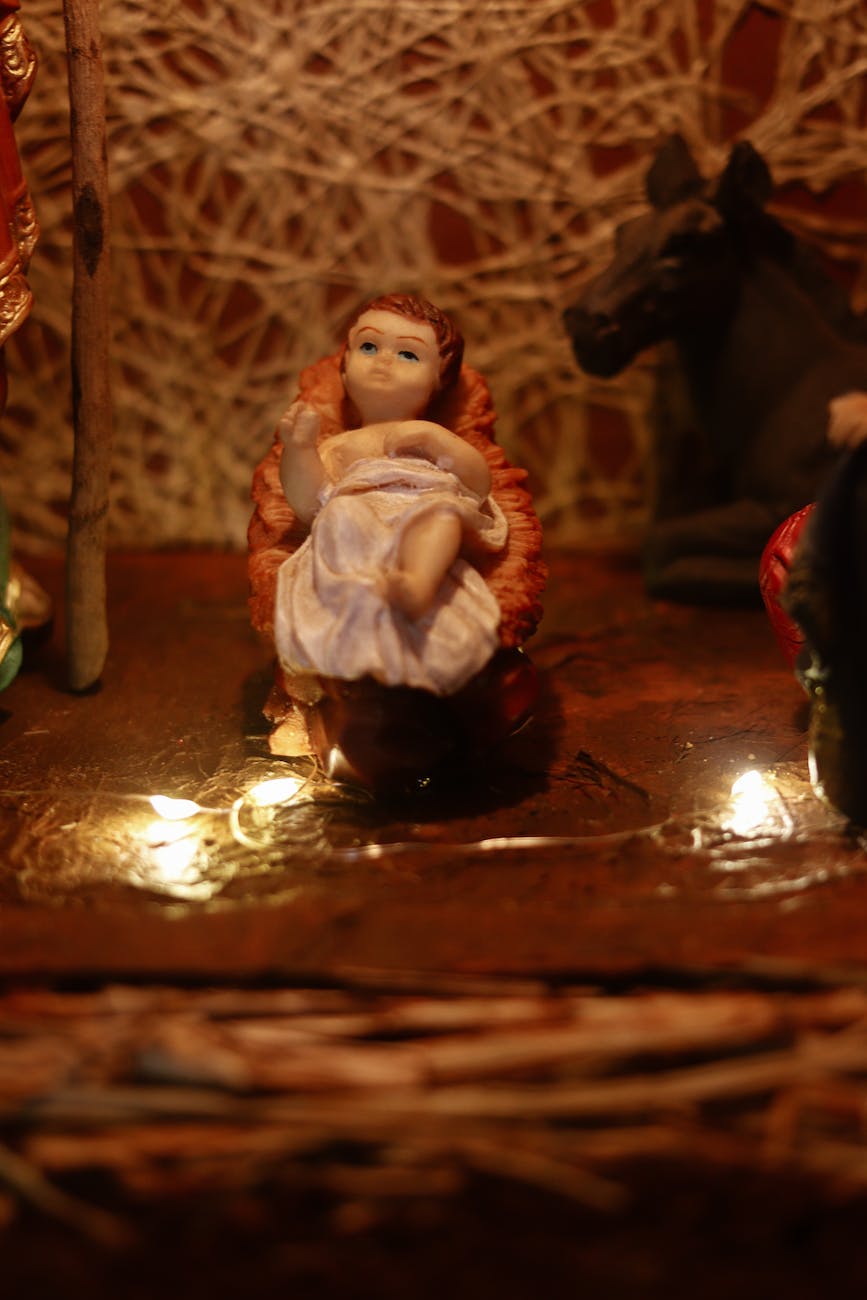
And among my grandma’s decorations was a small, slightly timeworn Nativity set. The figures have a few chips and cracks, a fragment missing here or there, and it’s just the bare essentials: Mary and Joseph and the baby Jesus in the manger, and a donkey and an ox. That’s it. No shepherds or angels or wise men. Just the Holy Family and a couple of animals attending them. At first I thought maybe some pieces were missing, that the scene felt incomplete, but now I have come to love the simplicity of the scene—how these few figures capture a quiet moment before the arrival of the angels with their songs and the clamoring shepherds with their questions. The donkey and the ox, it seems, are able to simply take the miracle in stride.

It’s interesting, as much as we love animals, that we don’t usually say much about the ones present on that wondrous night in Bethlehem, although they show up in nearly every depiction of the Nativity. If you read the text from Luke closely, you might be surprised to notice that no animals are explicitly mentioned. The Christ child is laid in a manger, a sort of feeding trough for livestock, but the creatures themselves are only implied by the setting.

In fact, it’s in the first chapter of Isaiah, and not in the Gospels, that we discover the donkey and the ox who eventually wandered their way into our collective imagination and into my grandmother’s Nativity set. They are found when the prophet says: 

The ox knows its master, the donkey its owner’s manger, but Israel does not know, my people do not understand.

The implication of Isaiah is that it’s the animals, embedded as they are within creation, who are able to recognize their true source of life and sustenance in ways that we humans, in our delusions of self-sufficiency, are not able to do. God longs that his people might be as trusting and dependent and open to his protection and providence as the donkey and the ox are to their caregivers. But are we? As we arrive at our Lord’s manger on Christmas, as we behold, in the flesh, the Redeemer of the Earth, do we finally understand who he is, what he offers, what he asks?

The question persists, and the donkey and the ox bear witness. In the early centuries of the church, the combination of Isaiah’s imagery and the nativity account were blended into a verse composed by an unknown author and chanted for centuries in Latin at the midnight prayer office on Christmas Day: O Magnum Mysterium. O Great Mystery. In English, it reads: 

O great mystery and wonderful sacrament, that animals should see the newborn Lord, lying in a manger! O blessed virgin, whose womb was worthy to bear the Lord Jesus Christ. Alleluia!

A simple verse, but it contains much to ponder. For it says that the Magnum Mysterium, the Great Mystery, is not just the birth of Jesus, but the witnesses to that birth—that it was the animals, before anyone else, who beheld the Lord in his manger. It was the animals, not the shepherds, not the wise men, who first saw their Creator enter his creation and then gathered in to greet him. Only the animals, wordless, attentive, uncalculating. They knew their master’s voice, they recognized their owner’s manger, and so they huddled close, sharing their solid warmth with him and his mother in the chill of that silent, holy night.

What can this scene teach us, we who still struggle to understand?

It is often said that our Savior being born into such a setting is a sign of God’s humility; that it is a great self-emptying of divine power to be born as a helpless infant, surrounded by animals, lying in a feeding trough. And God’s humility is indeed part of the Great Mystery of Christmas, but I think we miss something important if we just leave it at that. 

Because anyone who has worked with animals, or who has simply cared for and loved them, knows that they possess their own sort of wisdom, their own inherent dignity and grace. Not just the donkey and the ox, but all of God’s creatures play their own role in the vast network of interdependent life on this earth, each carrying in their very bones a knowledge of what they are, and what they must do to live, to flourish, to endure. Animals are different from us, but they are not lesser than us. 

And so perhaps for Christ to be born into their company is not so much about divine self-abasement as it is a sign of human reconnection with the fundamentals that shape and sustain all of life, including our own: birth, and death, and nourishment, and warmth, and companionship, and trust. All of us need these things. All of us can give these things. 

Perhaps the Great Mystery that we glimpse this night, alongside the animals at the manger, is not God’s weakness, but God’s true, elemental strength. For what is stronger than showing up in deep solidarity with creation? What is mightier than taking part in the persistent, generative power shared by all living things? 

What if the wonderful sacrament is not to be understood so much as Christ descending into a poor and helpless form, but as the Creator arising into his creation, emerging from the hidden depths of the cosmos, from the womb of his mother, from the cradle of eternity, to claim all the earth as his own beloved home, to name all living things as his kin—as sacred partners in the unfolding birth of the Kingdom? 

For it should not be lost on us that the very things Jesus will later name as our essential Christian vocation—feeding the hungry and thirsty; sheltering the weak; being present to the most vulnerable,—these things are not lofty theological propositions. They are creaturely things: old, and instinctive, and earthy. They are the basic stuff of life. And they are, O Magnum Mysterium, the very things that the animals offered Jesus that first night in Bethlehem.

For the ox knows its master, and the donkey its owner’s manger.

But the question remains: do we know? Do we understand yet? Or are we so overwhelmed by the seeming complexity of God, or the complexity of our world, that we have forgotten the ultimate simplicity of what is needed, what is given, what is required of us in this life: to tread lightly and compassionately upon this earth in union with all of creation? 

Might we, on this most blessed of nights, rediscover our truest selves? We who are made in the image of the God who now bears our image, too. We who are called only to love; called only to sustain one another, to sustain the earth, as he sustains us. O Great Mystery, that life— messy, tearstained, bleeding, breathing, fragile, undaunted, beautiful life—is itself the most wondrous sacrament of all.

In it, may we finally come to see that Christ is not born this night to save us from our humanity, nor to deliver us from the world he has made, but to inhabit these things fully, to love them fully, that we might gather alongside all creatures, to behold the majesty of God in the flesh, and to join our voices with the song of the angels and the bray of the donkey and the bellow of the ox, a chorus of unceasing praise. Tonight, may the whole world at last know its master, know its Lord’s manger, and thereby know itself for what it is—beloved, sustained, redeemed.

The Nativity scene is here, in our midst. Our Savior awaits. What the animals did first and best, let us do so now, too, with the joy that is fullness of life. 

Come, let us adore him.

Hands: A Christmas Eve Sermon

I preached this sermon on Christmas Eve, December 24, 2021, for Trinity Episcopal Church, Fort Wayne, IN.

Just over a year ago, I had the privilege of sitting at the hospital bed with two of our beloved parishioners, Dick and Vera, just before the end of Dick’s life. He was not really conscious at the time, but it was such a blessing, given all of the complications of hospital visitation these days, that Vera was able to be there in person with him to say goodbye after many decades of marriage. 

And there is one image from that afternoon that I think I will never forget—how Vera reached out to hold Dick’s hand, just as she had always done, and how, even though he was deep into his passage away from this life, his hand squeezed back, and his thumb gently caressed her hand. A memory that was deeper than consciousness, a memory of love so deeply inscribed into him that nothing, not even the approach of death, could inhibit its expression. When Vera also left us earlier this year, I thought of the two of them holding hands again in the new life that is promised to us, and it made me smile.

I remember, too, several years ago, holding my infant godson, so afraid I would drop him, so in awe that my life had even a small connection to the beauty and the possibility of this new life. I remember how his little fingers, tiny and determined, would wrap around my finger, surprisingly strong, an instinctive urge to hold on, to connect. His grasp felt like an inquiry, simple and direct: will you be there? Will you care for me? Is it true that I am not alone in this big, strange world? Can I hold onto you?

I think it might be said that from the beginning of our days to the very end, there is no gesture more fundamental than to reach out to the ones we love, to feel their fingers intertwined with ours. Because, if you think about it, this is what we always do—when we’re happy, when we’re frightened, when we’re falling in love, when we’re waiting for important news, when we can’t quite walk on our own strength, and when we must say goodbye for the last time: in all those moments of life when words fail us, we reach out, and we just hold hands. 

I think it can also be said that our journey of faith is much the same—like that famous image from the Sistine Chapel of Adam and God extending their hands towards one another at the moment of creation, their fingertips separated by an infinitely small distance—underneath all of our striving and our doubting, our seeking and our praying, we are extending our hand out into the deep, into the vast mystery of life, reaching out for something certain, something true, something that endures, something (or Someone) to hold onto. When all is said and done, we yearn, quite simply for a God who will reach back and clasp our hand and say, I am with you. Hold onto me.

And that is exactly what we are given on this night. A God whom we can hold onto. A God who holds onto us. All of the music and the lights, all the activity and the excitement, all the exhaustion and ambiguity and yearning that characterize both the holidays and life in general—all of it finds its answer here, in the birth of a child in Bethlehem, in the terrified wonder of the shepherds in the field, in the song of the heavenly host, in the courageous heart of a young mother, and in the tiny hand of an infant that reaches out, surprisingly strong, towards your own hand. It is the hand of God, holding yours in the cool and pregnant darkness, and it is the answer to your own questions: I am here, now. I will care for you. You are not alone in this big, strange world. You can hold onto me.

How else would love come to find us if not like this: in the flesh, in the way we most instinctively understand? How else could God close that infinite distance between the fingertips? Only like this, only by letting us, at last, take his real, incarnate hand. Only by becoming as one of us, in order to say,

I have always loved you, I have always been for you, ever since the beginning, but now I am with you, too. And I promise I will always be here to hold your hand. 

Even when everything else slips away, even when everything you counted on seems to disappear, I am here.  When you laugh and dance for joy, I will take your hand and dance with you. And when you are weak and afraid, I will be there, too, for my fingers are intertwined with yours now, my life is intertwined with yours now. Just hold on.

I don’t know about you, but in the uncertain times in which we find ourselves, when the preciousness and the precariousness of the present moment are both felt so keenly, I need this good news of Christmas more than ever. I need to be reminded that even in a broken world, there is hope, and that God is still with us. 

In the birth of Jesus–the birth of God among us –our outstretched hands brush against the glory of heaven. In the birth of Jesus, we find that the whole world is full of sacramental possibility, especially in those simple actions of love that make up our lives—the wound mended, the bread broken, the injustice addressed, and yes, the hand held. All, now, instruments of grace, because God has taken them on as the work of God’s own hands.

What a gift to be given. And what a gift to pass on to others. Because, essentially, that is what we are trying to do here at Trinity, as followers of this holy child of Bethlehem, this Savior born for us—we are showing up for one another and for our neighbors and for our community, especially the most vulnerable in our midst, extending our hands in love. We are facing life together, we are celebrating and mourning together, studying and praising together, hands clasped in prayer, hands clasped in greeting, hands clasped in solidarity, hands clasped in trust. 

All because, on this beautiful, silent night, when even the loveliest words ultimately fail to express the fullness of our joy, a hand reaches out to us, a tiny hand from the manger, yes, but in truth a hand reaching out from across eternity, down through garlands of stars, down through the centuries of longing, down from the hidden source of our deepest wonder. And it gently caresses our own, a love so deeply inscribed into it that not even death will inhibit its expression, holding us, softly, but firmly,

as if to say, quite simply,

It’s going to be ok. I am here. Just hold on. 

Ordinary: A Christmas Sermon

I preached this sermon on Christmas Day, 2020, at Trinity Episcopal Church, Fort Wayne, IN. The lectionary text cited is Luke 2:8-20.

Not quite as planned. A bit haphazard. Maybe somewhat underwhelming, even, after so much hope and expectation and hardship. Confusing and, for some, tinged with fear. And yet, somehow, in its startling ordinariness, still happening, still a quiet miracle, still infused with unspeakable grace. 

Am I describing how many of us have experienced the holiday season this year? Or am I speaking about the birth of the Messiah in Bethlehem over 2000 years ago? 

Yes.

On this Christmas, perhaps more than any in recent memory, we perceive the hidden, frank domesticity of the Nativity, for we, too, like the Holy Family, have been gathered in, with few options, seeking shelter above all else. 

But despite our recent immersion in the spare, the low-key, and the unadorned, it must be acknowledged that, even with all that we have learned and lost this year, with all the comforts foreclosed, we might still struggle to wrap our heads around the Savior of the world coming exactly in the way that he did—as an infant, born to an average family in a humble town, in a common peasant home, with the guest rooms past their capacity and animals crowded in for the night. Few expected, then or now, for the Messiah, the promised Holy One of God, to be, by all appearances, so very ordinary.

But so he was. A baby as fragile as any other, born with no particular privileges or advantages apparent, at a precarious moment in his people’s history. 

I know that I say to myself every year that I understand this, that I love how God came to us in suprising humility, but then I wonder, when I look at the habits of my life and when I look at what I am tempted by in the world around me: do I understand, really? Do I love him, just as he is, this child in the straw, who offers love, but not safety?

Because even now, even though we know better, even though we’ve told the story a thousand times and more, we still keep looking for Jesus to enter the world elsewhere—in a palace, in a capital city, among splendor and power and success.  We still admire and imitate the people who live and work in those places, and in our dominant western culture we tend to shape our values around their opinions and agendas. We long for the child of Bethlehem, but we keep looking for an emperor. 

And even in the history of the church this can be true, when we have tried to retroactively ennoble the Christ child in our imagination–ensconcing him in gilt and velvet and crowns, sometimes forgetting that these are subversive symbols of how he turns earthly values on their head, not actual depictions of his birth and life. 

But thankfully, blessedly, try as we might, we cannot escape the fact that he was not born as an actual king—and we are reminded in the Christmas story that God did not enter creation through the ornate front doors to be greeted by the servants, as it were, but instead came in the back way, through the service entrance, seen only by those who tend the sheep.  

And what good, good news it is that this is so. 

Because it means, for average people like you and me, that God was never interested in being unattainable. God was never interested in being insulated from us. God never wanted to be known as someone who is too busy, too important, to notice and regard with care the details of our lives. On the contrary, God was born in such an ordinary way to signify that it is here, in the midst of our vulnerable, complicated, boring, unimpressive, precious little days that he desired to make a dwelling place. 

He wanted his own life to be as plain and sweet as ours sometimes can be—a life of both chores and of chocolates—because he is Emmanuel—God WITH us—and that means with us through all of it: the good, the bad, and the long stretches of the simply OK. And thanks be to God that he visits us there, because most of our lives are made up of the simply OK, and I, for one, long to be known and loved even in those moments where I feel entirely uninteresting. 

The manner of Jesus’ birth is good news, also, because it means that we need not become impressive, powerful people in order to take part in God’s life or God’s mission. No matter what family we were born into, no matter how much money we make, no matter how many times we have failed or fallen down, we have not missed out on the chance to participate in the things that God truly cares about, because those are, in the end, quite ordinary things—feeding, clothing, visiting, listening, forgiving, remembering, grieving, rejoicing. They are the things that you can do wherever you are, no matter who you are. And the day that we realize that these things are all that God requires of us, that they are the elements of a truly important life…that is the day we are free. 

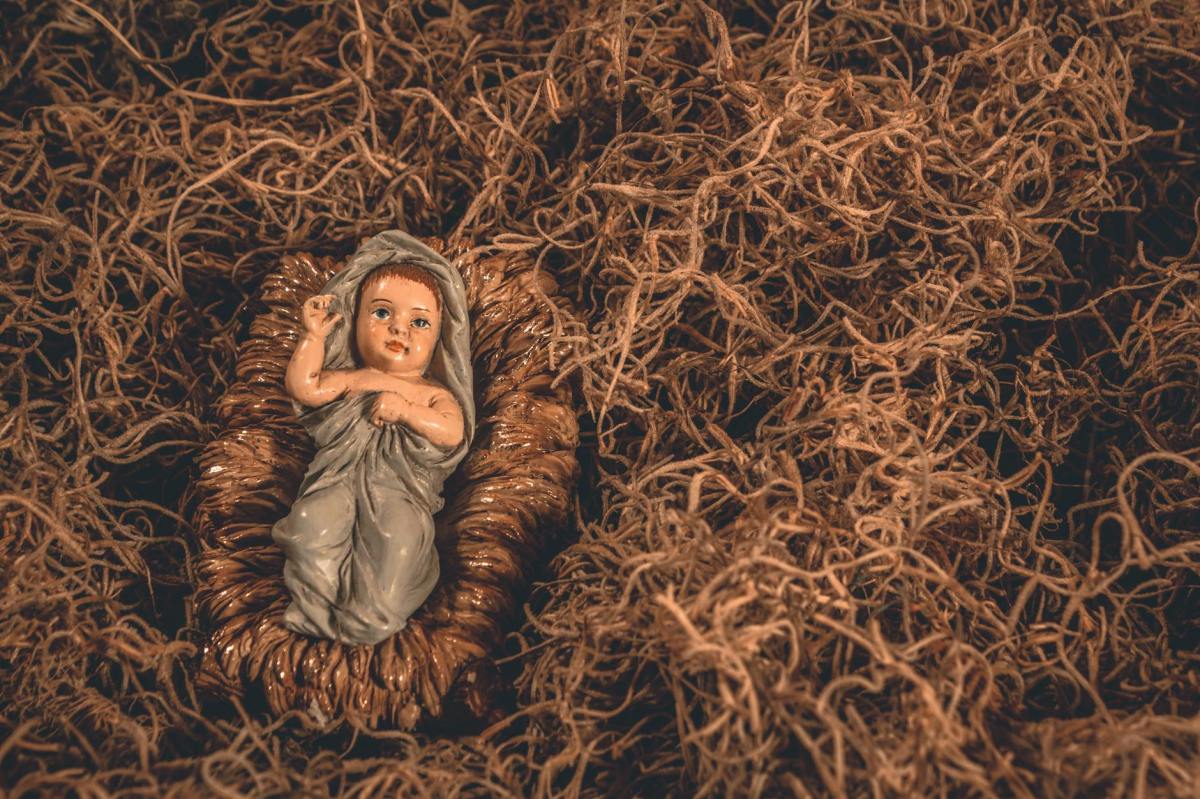
Let that day be today, this eminently ordinary day, as you gaze at a baby in the manger, with common shepherds as your companions. Let God’s humble birth, his little bed of hay, his quiet Mother, teach you that your life can be enough, will be enough, humble and little and quiet as it, too, might be, if you will only give over your love, your heart, to be pierced and shaped— not by the Savior we expected, but the Savior that we needed. The Savior of the everyday.

It is for him we say:

“Glory to God in the highest heaven,” AND glory to God in the lowliest birthing place.

“On earth peace,” AND in our ordinary hearts, peace, this Christmas day, and every day to come.