
Jesus & Johnny Appleseed: A Sermon

I preached this sermon on the First Sunday in Lent, February 18, 2024, at St. Anne Episcopal Church, West Chester, OH. The lectionary text cited is Mark 1:9-15.

I love quirky historical sites and stories and figures. So you won’t be too surprised to learn that back in 2019, when I was getting ready to move to Fort Wayne, Indiana to serve at my former parish, I was deeply excited to learn that the city is the final resting place of John Chapman, better known to the world as Johnny Appleseed. 

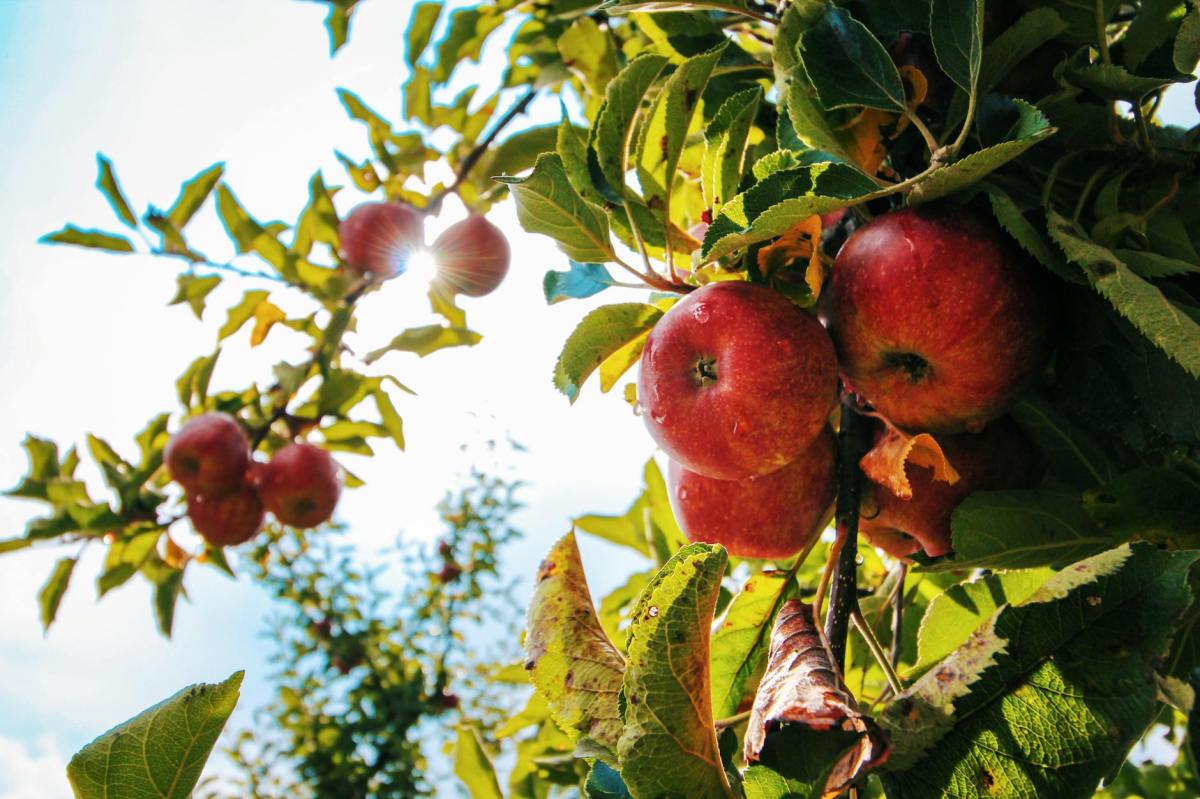
Many of you know probably know who Johnny Appleseed is, but just in case you don’t recall, he was a real person in American history who has taken on a somewhat legendary status. He roamed the countryside in the early 1800s, starting in his native New England and moving westward, introducing and cultivating apple orchards in regions where apples were previously unknown, including much of the Midwest.

And after a lifetime spent wandering about with his bag of seeds, in 1845, while visiting Fort Wayne, he died unexpectedly. So you can visit his gravesite there, and there is also a Johnny Appleseed Park & campground and a Johnny Appleseed Festival and the local baseball team is the Tincaps, in honor of the tin pot that Johnny supposedly wore as a hat.

And I recently discovered that there are a number of towns in Ohio, too, associated with Johnny: the Johnny Appleseed Museum is up in Urbana, and the last surviving tree planted by him still grows on a farm in northern Ohio. So there are a couple more road trips my partner, Matt, doesn’t know he’s signed up for yet! 

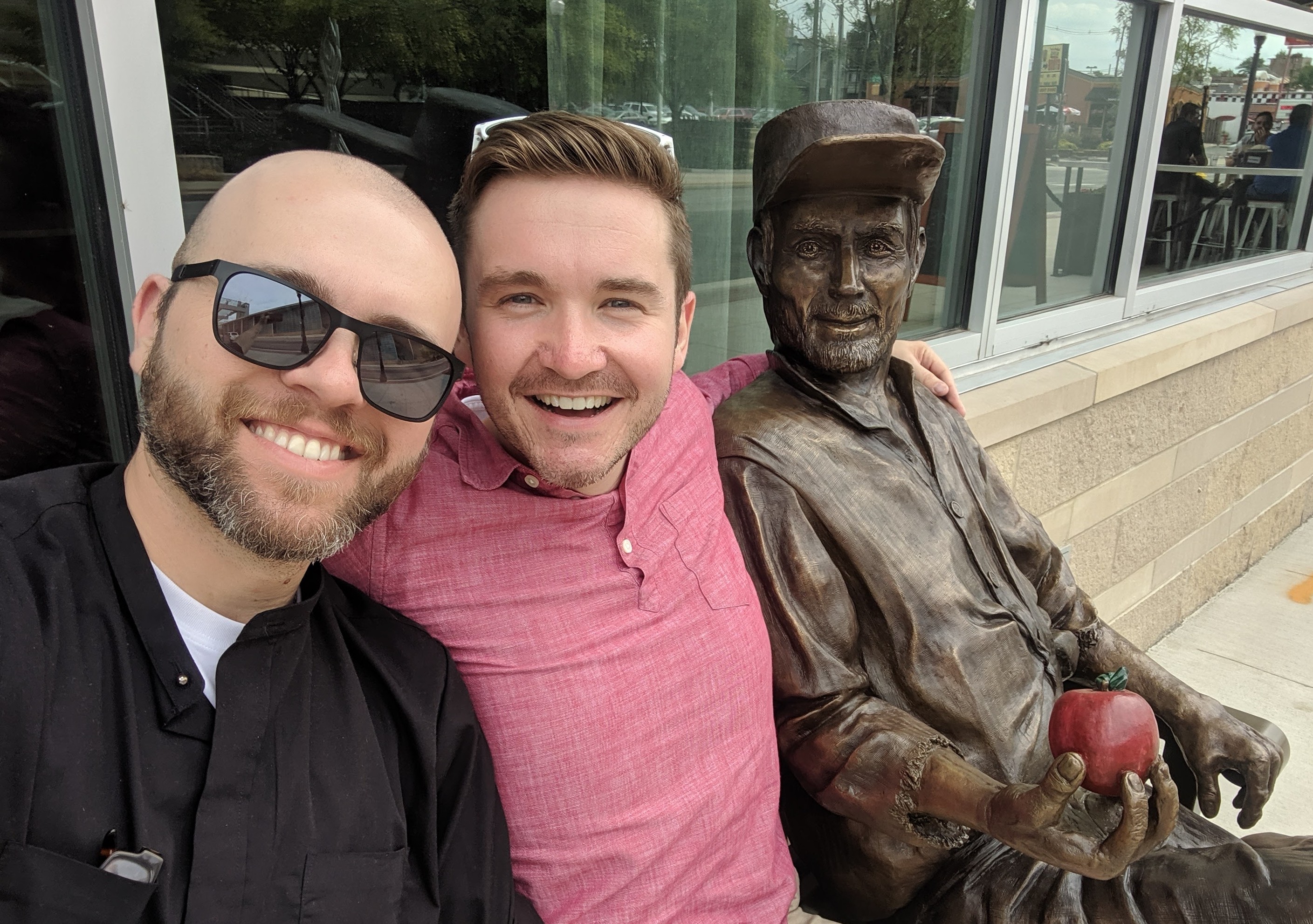
But hopefully he’ll be fine with it, because the very first picture that Matt and I ever took together, the first documentation of our relationship, right after we met, is a selfie of us sitting on a bench with a statue of Johnny Appleseed. So he has a very special place in our personal history, too!

And if you’re wondering why on earth I am going on about Johnny Appleseed on the First Sunday in Lent, well, one of the reasons I find him such fascinating figure–one worthy of our consideration here today–is that John Chapman, while unusual, was not just an eccentric driven purely by some strange obsession with apples. 

No, it so happens that he was a missionary, too, and by most accounts a kind and gentle one. He was a member of the Swedenborgian Church, a small Christian denomination that still exists, and as he traveled, planting and raising up small nurseries of apple seedlings, Johnny also distributed information about his Church, which was, especially for his time, a remarkably progressive and inclusive expression of Christianity. 

And these two things—his love of the land, his desire to carpet it with fruitful plantings; and his love of humanity, his desire to offer people a fruitful and life-giving message: these were all bound up together in his years of roaming the hills and valleys we now call home, and the sweet fragrance of his mission lingers even today.

But you know, long, long before John Chapman ever set out with his pamphlets and his seed bag, there was another man who set out on a similar sort of mission, out beyond his familiar homeland, out into the world, out into the wilderness, for purposes deemed strange by some at the time and yet which have left their own lingering sweetness. 

Of course, I am talking about Jesus of Nazareth, whom we encounter in today’s Gospel, driven by the Spirit, driven by the mysterious designs of God, out from the river’s edge an into an unknown, untamed place. He did not wear a tin cap, but we can be assured that people still didn’t know what to make of this man on a mission, propelled by his unconventional, radical form of love, his vision of a harvest that nobody else could quite imagine.

But we might wonder—if Jesus was the Son of God, if he was already God in the flesh, why did he first go on this journey into temptation we hear about today? What was the point of these 40 days in the wild? 

We could interpret it a number of ways, but it has not been lost on some observers that, especially in Mark’s version of Jesus’ trip into the wilderness, where he is tempted by Satan and is in the company of both wild beasts and ministering angels, that Jesus is, in some sense, not going somewhere new but going back somewhere that God knows very well. He is returning back to the Garden of Eden, where humanity first met the beasts and the angels and Satan, the one who tempts us away from our God-given place in creation. 

Let’s do a little imagining together. In this unnamed wilderness we hear about today, a tangle of wild plants and harsh sunlight, we might imagine Jesus stepping back through the rusted, broken gate of that original garden, now long abandoned. We might imagine the cherubim guarding the lost portals of Eden, lowering their flaming swords in deference to the Son of God passing through. 

We might imagine him walking amongst the derelict seed beds and the withered trees, meeting the wild beasts who no longer remember the names once given them by Adam. 

And perhaps we might imagine, too, Jesus encountering that ripe fruit of the tree of knowledge on an old gnarled branch—the fruit once bitten by the children of God, when they did not know the price of their hunger. 

And if this is so, if Jesus is, somehow, in the wilderness, also standing in the ruins of Eden and holding the fruit, bright and beguiling as a ripe apple, considering what to do with temptation, 

perhaps this is the purpose of his journey: to discover what Adam and Eve did not—that the fruit of the sacred tree, the fruit of the mind of God, wasn’t meant to be consumed for ourselves—it was meant to be shared. It was meant to be broken open and given away. It was meant to be spread throughout the world. Its seeds were meant to be planted far and wide. 

And so:

Jesus came to Galilee, proclaiming (we might say sowing) the good news of God… “The time is fulfilled, and the kingdom of God has come near; repent, and believe in the good news.”

Jesus is what John Chapman would become and what we are invited to be as well: planters of the seeds of God’s Kingdom. Our journey through Lent, our journey through life, isn’t meant to be one where we stay indoors and gorge ourselves on private spiritual insights, as if heaven were an apple pie baked for us to eat all by ourselves. 

No, we, too, are participants in the planting of a future harvest. Following in Jesus’ footsteps, we are the propagators of the seeds of Eden, the seeds of a paradise that is no longer lost to us. We, too, are a people called to carpet the land with the fruitful plantings of love and truth and mercy and knowledge and care—day by day, step by step, seed by seed. 

Now, I don’t imagine that most of us will take this Lent as an opportunity to put a tin cap on our heads and head out to roam the world as missionaries and seed-planters—though maybe the world would look a whole lot different if more of us did so in our own community. 

But what Jesus and Johnny Appleseed can teach us today is that small, faithful choices have transformative impacts. So maybe this Lent you will volunteer at our burgeoning neighborhood Laundry Ministry. Or maybe you will attend a Thursday Eucharist or a Bible study. 

Maybe you will write to your representatives and tell them to advocate for the poor, the hungry, the war-torn, the forgotten. Maybe you will call someone who is lonely or invite someone to church with you. Maybe you will simply tell someone that you love them, that you forgive them, that you see how hard they are trying, how far they have come. Maybe you will tell yourself these things. 

Maybe you will prune the overgrown bushes of paradise.

Maybe you will teach the wild beasts their long-forgotten names.

Maybe you will remember your own long-forgotten name: beloved Child, disciple, seed-bearer of the Kingdom of God.

And maybe, come Easter, we will already see the green shoots of something new growing up from the earth, from our hearts and our souls. If so, it will have been a good and holy Lent. 

You know, there is one more memorial to Johnny Appleseed, just down the road in Spring Grove Cemetery in Cincinnati. There is a statue of him, holding an apple sprig up to the sky, as if seeking a blessing upon it from heaven. And carved into the stone, there is a fitting summary of all that he was. It says:

SAINTLY IN HIS DAILY LIFE. HE LOVED LIFE IN ALL ITS FORMS AND HAD A JOYOUS WILL TO HELP THE EARTH YIELD ITS FRUITS.

The same could be said about the seed-planter from Nazareth. 

And someday, we pray, it might be said of us, too.

Greater Things: A Sermon

I preached this sermon on Sunday, January 14, 2024 at St. Anne Episcopal Church, West Chester, OH. The lectionary text cited is John 1:43-51.

This past week, we were in the process of finding a new person to clean our church buildings here at St. Anne, as our previous cleaner has moved on to other endeavors. And Greg, who graciously coordinated our interviews for someone new, joked to me in the midst of all of it that perhaps an exploration of cleaning services would work their way into this week’s sermon. 

So I was reflecting on this week’s Gospel passage, where Jesus is calling his disciples and then encounters Nathanael (who, by the way, most scholars agree is another name for the apostle Bartholomew)…and I know Greg was kidding… but I got to thinking…and yes, actually, there is a connection to be made. Really, when you come down to it, everything we do, everything that we encounter, for good or ill, the sublime and the mundane, is an opportunity to look for God looking back at us—you can indeed glimpse the Kingdom of heaven hidden among the mops and brooms and cleaning rags. 

My grandpa was a janitor for many years up in Michigan—he would clean the school buildings in the nighttime, when the halls were empty and the classrooms silent. He used to tell funny stories about some of his coworkers, and a few scary stories about things that went bump in the night in those old buildings. 

And even though, in that role, he was not necessarily seen or lauded by any of the students or teachers or administrators, and even though he never made a ton of money, it was clear that he took pride in his work, and that he knew that what he did was something that mattered—one of those hidden-yet-essential roles that keeps things going day after day, year after year.

The people like my grandpa, and like all those who clean up and repair and fix and tend—like our cleaning staff and like our sexton, Tim, and like many of you who volunteer to keep this place standing—these are the saints behind the scenes, the ones upon whom we all rely. 

Creation groans, and empires rise and fall, and the future might feel uncertain, and existential angst might swirl about like winter snow, but somewhere, at every hour of the day, there is someone who is nevertheless salting and shoveling the walks and mopping the floor and sweeping up the shattered pieces and doing all of the other little tasks that seem to say: this is what hope looks like. Because things may break, but it’s worth trying to put them back together again. And things may become a mess, but it’s worth scrubbing them down and starting anew each morning. 

My grandpa cleaned those school rooms knowing, of course, that they’d be dirty again the next day, but he also knew that future generations were being educated and formed in those hallways, and so I think he hoped to do his small part. He wanted those floors to gleam with the promise of what they carried. 

And it is a beautiful, sacred thing to care with such dogged persistence for some place, for some thing, to keep cleaning up the forgotten corners that gather dust and to mend the things that wear out.

We care for broken pipes and furnaces, just as we care for broken hearts and spirits—even though we know, in both cases, that the breaking is inevitable—because the caring itself is an act of resistance against the forces of decay and despair. It is a sign of our faith in a future time and place and reality where all of those small, loving, unremembered practicalities will have mattered, that they will have amounted to something greater than the sum of their parts, that they will be revealed, in truth, to have been the very foundation of the world.

For our lives have taken shape upon a thousand different floors that were mopped and swept by unseen hands. We have been  fed by the labors of people we will never see, liberated by the sacrifices of names we will never speak. Our world is sustained by so many things—so many gestures of care and selflessness and quiet courage—that we tend not to see. 

And in that sense, Nathanael in today’s Gospel is a bit like all of us. He is, we presume, a man who is keenly interested in knowing the Messiah, in experiencing for himself the way that God is going to act and manifest his glory in the world. 

But Nathanael, like many of us, is looking for the obvious, impressive sorts of signs. And upon hearing about this nobody named Jesus, from a small village in an unremarkable region of the country, Nathanael is decidedly not impressed. “Can anything good come from Nazareth?” he asks. Can the world be saved by a carpenter and his ragtag group of friends? Will oppressive empires fall to the power of the saw and the broom and the fishing net? Nathanael thinks not. 

It is only when he thinks Jesus has some superhuman psychic ability—claiming that he saw Nathanael sitting under a fig tree before they ever met—that he starts to get excited. Maybe this Jesus does have some impressive tricks up his sleeve after all. Maybe he is about to reveal himself as a mighty king in hiding, and the whole humble carpenter thing was a just a costume, a front for the real sort power that God’s Son must surely wield.

And then Jesus says to him, knowingly, lovingly, devastatingly—do you believe because I told you that I saw you under the fig tree? 

Do you still believe that God is like a magician?

Do you still believe that prayer is like a parlor trick?

Do you still believe it is the impressive, obvious forms of power that will save the world? 

Do you still believe that the Messiah will be like any other king, with swords and stratagems? 

Do you still believe that wars and the ones who wage them are the backbone of history or the gateway to an everlasting peace?

Do you still believe only in the world you can see in front of you? 

You will see greater things than these. 

You will see heaven opened you will begin to understand its true simplicity.

You will see the angels of God ascending and descending and the hidden, delicate interdependence of all creation and begin to understand true sustenance. 

You will see the tearstained faces of the oppressed and the marching of the peacemakers and the work of humble hands and the bravery of trampled hearts and you will begin to understand true blessedness. 

You will see the faith of the sick and the generosity of the widow and the fierce devotion of the parent and you will begin to understand true love.

You will see violence itself laid to waste, the nullification of the cross and the sword and the stone. You will see the dawn on the other side of death, and you will begin to understand true power.

You will see the unsung, unnoticed acts of care that renew the world each day and you will begin to understand true salvation. 

Do you believe because I told you that saw you under the fig tree?

Well, brace yourself.

Because you will see that, in the end, the world will indeed be saved by the carpenter, and the fisherman—and the janitor and the cook and the mechanic and the gardener. And empires will indeed yield to the power of the saw and broom and net and plow, because the most enduring thing in the world is the persistence of care, the unyielding dedication of the ones hidden in plain sight who clean up and patch over and refuse to let things fall apart—for they are the signs of the one true God, who is also hidden in plain sight, and who has been cleaning and patching and refusing to given up on us since the beginning of the world. 

The God who is, indeed, smiling back at us from amidst the mops and the brooms and the rags, who wants us to do nothing more than to care for what is in front of us, to fix what is broken, to make the world gleam with the promise of what it carries. 

Thanks be to God for the ones who already do this. Blessed are they. 

And, like Nathanael, blessed are we, when we finally see them. 

Obituaries: A Sermon

I preached this sermon on Sunday, September 26, 2021 at Trinity Episcopal Church, Fort Wayne, IN. The lectionary text cited is Mark 9:38-50.

I have always been moved by obituaries. I come across some of them in my role as a clergy person, of course, but even before then, they were of great interest to me—the way that the complexities of a human life are distilled down to a few essential details—the summary of a life’s work, the naming of a few enduring and precious relationships, and maybe a brief phrase or two that attempts to capture the lovely particularity of the person who has died. And whether they are long and eloquent or brief and matter-of-fact, obituaries all seem to convey the same basic message: this person mattered. They were loved. Someone, somewhere, remembers them fondly, with grateful tears.

And while it might sound strange to say so, what is also striking to me in the obituary is all the stuff that is not written down. We don’t generally find a long list of the person’s failings or their frustrating personality quirks.  And furthermore, there is never a rebuttal of the obituary: no pointed letter to the editor in the next day’s paper that says, actually, that guy was a real piece of work. And, for the most part, nobody is standing up at the funeral saying waving around the newspaper clipping, saying, we really need to set the record straight on all the mistakes she made during her life. 

Even though we know that people are complicated and sometimes infuriating, even though we often hurt one another in this life, we don’t do any of that. In the end, we let it be. We lay down our swords. 

Isn’t that remarkable, when you think about it? Especially when you consider all of the energy that can be expended over a lifetime of feuding and arguing and taking offense, only to realize that eventually, at the end, we will just put it to rest. We will, in most cases, release the frustrations and the enmity and try to forgive. 

I sometimes wonder what it would be like if I could muster the strength within myself to lay down my sword a little sooner, to accept the truth that, when all is said and done, my so-called enemies are not so different from me. I wonder how the relationship wounds I bear would change if I could skip ahead to that obituary state-of-mind, where judgment is tempered by the wisdom of letting go. 

But in the heat of the present moment, we are so quick to make distinctions and dividing lines, aren’t we? Especially when the world feels big and confusing and scary—we immediately jump to delineating various categories of “us” and “them.” And the suspicion and the rage we feel towards “them” whoever they are, it soothes us, in a pitiful sort of way, because it convinces us that we alone understand how the world ought to work, when in reality, we’re all just trying to figure it out together, and, in truth, both “us” and “them” are going home each night and kissing our loved ones, and washing the dishes, and catching our tired reflection in the mirror, and praying that tomorrow will be a little bit better than today.  We can forget that on some level we are all still children, a little bit afraid of the dark, searching for the light.

The disciples start to fall into this trap of forgetfulness in today’s Gospel passage—they hear about this exorcist who they have determined is apparently not “one of them” but who is casing out demons in the name of Jesus. And so the battle lines are drawn: How dare he! He’s clearly just out to make a name for himself, to grab the spotlight, to hog all the glory—someone should definitely write a letter to the editor and set the record straight. Can you imagine the nerve of this guy?

This is ironic, of course, because just a few passages earlier, these very same disciples were squabbling amongst themselves about which one of them was the greatest one acting in the name of Jesus. They are doing what comes all too easily to us: comparing, competing, refashioning the boundary lines to our greatest advantage.

But Jesus will have none of it. Do not stop this exorcist, he says, quite pragmatically. Whoever is not against us is for us. In other words: whatever this exorcist’s motivations are, in whatever manner you disciples have decided that he is outside the clique, the only truly important thing is that he, like you, has been caught up in the work of the Kingdom. And it is you, wayward disciples, it is you—so quick to determine who is in and who is out, so ready to draw battle lines between yourself and others—it is you who are distracting yourselves from the actual point of all this. It is you who have placed yourselves outside of God’s purposes.

Because the moment we decide who our enemies are and prepare for battle with them, we have already lost. And when we fight—and God knows how long and hard we have fought across the tired, staggering, bloody ages—is it not almost always true that, eventually, we end up standing at the gravestones of our supposed enemies, looking at the stony names inscribed therein—names once whispered on a mother’s smiling lips—and we say, with a sudden shock of grief or humility: oh, I see. This person was not my enemy. 

They mattered. They were loved. Someone remembers them fondly, with grateful tears.

Love does not divide the world into “us” and “them.” Love has no true enemy except for the practice of enmity itself, the lie of the great deceiver, and Jesus has already conquered that. What will it take for us to accept this, to live like this is true? What will it take to see one another as siblings and partners, and not as threats?

It will take letting go of fear. Fear of the unknown. Fear of people we do not understand. Fear of our own failures. Fear of our vulnerability in an uncertain world.

Letting go of that fear, though, requires us to face it. We must face the ways we have cultivated enmity within ourselves and within our world, and then choose a better way. And that is hard to do, especially when the world around us seems to thrive on division and mistrust. 

But again, that’s why I have a peculiar love for obituaries. Because they give us a sneak preview of what is going to happen with all of the division and posturing and the obsession with being right—none of it is going to matter. 

The only questions left, in the end, will be: how much did you love? How did you contribute to the flourishing of the world? How did you protect the vulnerable entrusted to your care? What was the unique radiance that sparkled behind your eyes? What small, meaningful things did you do in the name of Jesus?

And then, someday, when every obituary has been recorded; and when life is revealed, at last, for what it truly is; when all is made new; when “enemy” is no longer a word in the language of the human heart, on that day we will simply behold one another face to face and we  say: 

You matter. You are loved. And you, my sister, my brother, my friend, will be remembered, fondly, forever. And there will be no more tears.

Unforgotten: A Sermon

I preached this sermon on August 29, 2021 at Trinity Episcopal Church, Fort Wayne, IN. The lectionary text cited is Deuteronomy 4:1-2, 6-9.

Last week a group of us here at the church began our Sunday afternoon program for Confirmation, Reception, and Reaffirmation of Baptismal vows, and as I’ve been preparing the content for that, a couple folks have mentioned something that perhaps you have noticed, too: there are so many funny, obscure-sounding words that we use in the church and in the liturgy—hang around an Episcopal Church long enough, especially in the sacristy (itself one of those funny words) and you are liable to pick up a second language of sorts. In seminary my friends and I spent a lot of time making puns using liturgical vocabulary and I realized: Phil, you really need to get out a bit more, go see a movie, get a hobby or something. 

All that is to say, here is your liturgical vocab word of the day: anamnesis.

Anamnesis. Technically, this is that little portion of the prayer at the altar during the Eucharist where we say (or chant) together something like: Christ has died/Christ is risen/Christ will come again. This is the anamnesis—a word that could be translated as “a remembrance, an act of remembering”— because in that moment we are saying, together, what has happened in the story of our faith and what we trust will happen in the future. We are remembering and restating that past, that present, and that future promise together, with one voice, as one body.

But a more literal and perhaps more evocative translation of the word anamnesis, as a professor once told me, is found by splitting up its parts—amnesis (which means “to forget”—like the word amnesia) and the prefix an-, which means no or not.  So literally, Anamnesis is to not forget

Not simply happening to remember a nice, pleasant thing once in a while when we’re feeling nostalgic, but to firmly, resolutely choose to “not forget” to never forget what Christ has done and continues to do for us and in us and through us. 

The practice of anamnesis is to guard against forgetfulness—our own and the world’s—to lay claim upon the knowledge and the experience of something or someone—for us, Jesus— that is precious enough to reiterate, over and over and over again. In the anamnesis, we proclaim what is true and what is fundamental, in a world that is all too ready to forsake these things for the expediency of the moment. Sunday after Sunday…Mass after Mass…like a sustained note across the chaotic centuries: Christ has died. Christ is risen. Christ will come again.

Now more than ever, perhaps, it is easy to be forgetful. Bombarded by the news of the world; dizzied by rapidity with which one crisis follows another; caught up in the cacophany of competing claims upon our attention. We are so overstimulated that it is hard to keep it all straight, to sift through all the data, all the opinions, and to not lose sight of what is deep and persistent and real. 

I have joked more than once in recent weeks that on some days I don’t recall my name or what it is that I am supposed to be doing in any given moment, but there is some truth there in the joke, because at times I do think we forget our real identities in the mad scramble to keep up, to stay on top of things—we forget, in our fearful haste, what our true name is.

It is: Beloved; Child of God; Redeemed one; Liberated one; Peacemaker; Mercy-bearer; Branch upon the vine of Christ. 

If we’re not careful, if we don’t keep telling the story, we forget this.

“Take care and watch yourselves closely,” Moses tells Israel in today’s reading, “so as neither to forget the things that your eyes have seen nor to let them slip from your mind all the days of your life.” He knows, just as we do, that not forgetting is hard, but he also knows that it is essential if Israel is to bear the fruit of God’s promises. So he is saying, to them and to us:

Hold on to the memory of the God who called you out and delivered you from your despair. Hold on to the memory of the God who would not give you up, who fed you, who made a way for you where there was no way, who guided you into your true identity to be a sign of justice and peace to the nations. Hold on to this, beloved ones, because it is so easy to forget, it is so easy to cut yourself off from the truth of who you really are, who God has ordained that you will be. You have to keep telling the story, and you have to keep embodying the story, so that you will not forget. And in your not forgetting, in your anamnesis, even when you suffer—for you will suffer—you will yet remember that life is more than suffering. You will still sing the freedom songs of Zion, even in a foreign land.  You will not lose hope, because even through a thousand starless nights you will still remembver, still dream of what is possible. And you will not lose your way, not forever, because the unforgotten story will show you the way home. 

This is still our task, still our calling: to not forget the story. And to pass it on. To ensure that what God has done and continues to do remains unforgotten. If we do nothing else with our lives than that, we will have done something very good. 

That’s why we keep coming back, that’s why we keep learning all these funny church words and sitting through sermons and singing these same songs, and praying these same prayers over and over again—this is why we keep proclaiming, through every season, that Christ has died/Christ is risen/Christ will come again—because we need to remember that this is what is true. That in a world full of illusions and shadows, this is Truth itself.

And even if, someday, we forget everything else—our name, our accomplishments, the faces of our loved ones, the day or the month or the year, I pray to God that we will never forget the words of this place, the prayers ingrained upon our lips, the words of a story that tells how Love formed the stars, how Love Incarnate could not be killed, how Love’s Spirit has never left us. And I pray that even when we are dust, that the dust remembers the story still, that the earth trembles with the memory of this love that refuses to be forgotten. 

That is why we are here. Because Love refuses to be forgotten. Love is its own type of anamnesis. 

Remember that, when things in the world start to feel especially scary, as they can, and when things in your own life start to seem uncertain, remember that throughout all the ages, throughout all the rise and fall of history, throughout all the confusion and the mistakes and the distortions of the human heart—remember that Love refuses to be forgotten. It is the one thing that has never faded, never given up, never been vanquished. Love endures all things.

And that is the story we can’t forget.

Or, perhaps, better yet, that is the story that refuses to forget us.

Ghost Stories: A Sermon

I preached this sermon on June 27th, 2021 at Trinity Episcopal Church, Fort Wayne, IN. The lectionary text cited is Wisdom 1:13-15; 2:23-24 and Mark 5:21-43, wherein Jesus raises Jairus’ daughter and heals the woman with the hemorrhage.

I’ve used a bit of vacation time this month, and as it happens, both of the trips I took were to the mountains of Appalachia—first on a road trip through West Virginia and then down to the Blue Ridge mountains of North Carolina. If you’ve been down that way, you know that the land there takes hold of a person’s imagination in a potent way—down in those mountains, it can feel like the land retains its secrets, that the narrow valleys keep their own counsel, and while you may visit and you may explore the region, you will not ever completely see it or understand it.

I think that this mysteriousness and inaccessibility is probably part of the reason why Appalachia is famous for its ghost stories and its folklore—the storytelling tradition, nurtured in those relatively isolated mountain communities, is strong there, and it has been for centuries.

Now, one thing you might not know about me: I love a good ghost story, especially around the campfire on a summer’s night. My cousins and I used to frighten ourselves silly telling and retelling old family stories about apparitions and mysterious sights up in the north woods of Michigan. So when I was down south, I couldn’t help picking up a small collection of books about Appalachian folklore, just for fun, to see what sorts of tales are held within the folds of those evocative mountains. 

I even thought about sharing one with you this morning, but I figured it’s a little early in the day for that, so maybe we can plan a parish campfire sometime soon and swap stories then. 

Now, no matter what you think about ghosts, I think it’s safe to say that one reason people tell ghost stories—and have done so in nearly every human culture— is because we want to understand death. Death, of course, is all around us, it has touched and afflicted each of us deeply in various ways. 

And as those who must go on living in death’s midst, while the ones whom we love are lost to the valley of shadows, we often find ourselves living as a people haunted—haunted by memories, by regrets, by the words said or left unsaid, the deeds done or left undone. Our grief prowls in the night, whispering rumors of  our own annihilation. 

So in the face of death, we give death a face (or many faces, really) in the stories we tell, because we are desperate to understand, desperate to know if there is something beyond the finality that we perceive.

We tell ghost stories, in effect, to say to one another, “there is more to this world than what we can see. There is more than what we can understand.” And in the speaking of the mystery, we grope for meaning, for an assurance that the grave cannot contain the sum total of who we are and what we did in this life.

But although I love them and find them endlessly fascinating, here’s the trouble with ghost stories: as compelling as they can be, they are, ultimately, always about death. Death always wins, death always controls the narrative. And as such, ghost stories are about endings—about unfinished business or revenge or longing—and the ghosts we encounter are almost always conditioned permanently by the circumstances of their former life. 

These ghosts are stuck in one place, or focused on delivering a single message, or mired in grief over how they died. Their reference point is always looking backwards, towards who they once were, towards what used to be, because they are dead, and live no longer. So ghost stories can be thrilling, but they are not consoling. They possess little in the way of hope.

Which brings me to the point I want to make to you this morning: the gospel is not a ghost story. 

The gospel is not a ghost story. 

You might say ok, that’s a bit of a strange point to make. Sure, yeah, of course they’re not the same thing. But I invite you to think about this a bit more, about WHY the two are so very different from one another. 

Take today’s passage from Mark, filled with miraculous healings and a young girl brought back from the dead with only a touch and the words “Talitha, cum”–it is as fantastical as any Appalachian folktale, but here, Jesus does not show up and conjure a spirit or reveal a disembodied message from beyond the grave. On the contrary, he restores people to their actual life. He brings them back into the fullness of that life, to walk and talk and eat in broad daylight, to grow up, to know and be known by all those who love them. 

If this were a ghost story, there would be a note of finality, a sense of loss: the dead girl might appear and disappear, detached from her body, detached from her actual life, frozen forever in the haunted imagination of her family. Death would still maintain its hypnotic power over the narrative.

But that’s not what the gospel is about, because it’s not what God is about. “He is not the God of the dead, but of the living.”

In fact, we might say that the entire narrative of the New Testament is revolutionary in that it relegates death to a bit part, to the periphery, not as as an adversary coequal with God, but simply one final obstacle to be overcome by love’s ferocious power. As the author of Wisdom says:

God did not make death

And he does not delight in the death of the living

For he created all things so that they might exist.

The gospel is not a ghost story because a ghost story is conditioned by the parameters of death, and the gospel, in contrast, is defined by existence, by life’s eternal victory over the forces that seek to diminish or nullify it. 

And although the gospel does indeed contain wondrous and mysterious occurrences, it is a declaration of what is fundamentally real, of what God has done about death’s hold over us.

So if every ghost story ever told is really just a question about what it means to die, then the gospel is the answer: that in God, it means nothing, for death itself has died. 

Thus we are the inheritors of a new story, the one in which God is not interested in death, but in life—in the life of Jairus’ daughter, and that of the bleeding woman, and all the other lives that the world tends to marginalize or ignore. God is interested in your life and in mine, and in our life together. In the life of everyone who has ever lived. And God wants those lives to endure, to flourish, not to evaporate into the shadows.

So I have to remind myself, as much as I love those old ghost stories, not to live my life as if it is one. Not to be consumed by the past. Not to be conditioned by regret. Not to wander the earth like a lonely spirit, repeating the same old tired patterns. Not to entomb myself in the deadening effects of rage, apathy, and selfishness.

I have to remind myself that God, in Christ, came and lived like me so that I can live in God, forever. I have to remind myself that the gospel, not my personal ghosts or demons, but the GOSPEL, will shape the story of who I am, who I am becoming, and it will, by God’s grace, help me continue to thrive and grow within the One whose “righteousness is immortal.” The one who conquers death.

So no, the gospel is not a ghost story. And neither is your life, not now, not ever. You and I are alive; the ones whom we love and see no longer will be alive again; and God’s eternal life is welling up within us whenever we give ourselves over to it. It is as strong and true and mysterious and deep as the mountains.

Is that a story that you can tell, that you can live by? Are you able to lay down that which has haunted you, that which has held you back, that which has died, so that the One who lives might resurrect it?

I ask myself that question all the time, and I pray for the strength to say: yes. To let my story be his story, the one that ends with a beginning.

The story that ends with a voice saying, “Talitha, cum.” 

Get up, little child. 

Die no more, but live.

This is not a ghost story. 

Where are you?: A Sermon

I preached this sermon on June 6, 2021 at Trinity Episcopal Church, Fort Wayne. The primary text cited is Genesis 3:8-15.

I remember once when I was a little boy, I got into an argument with my dad. I don’t really recall what it was about, probably something unimportant. I just remember that in the middle of the argument, I ran out the back door into the yard and hid in some bushes. I guess I just wanted a quiet place to sulk and cry a little bit by myself.

But then my dad came out, looking for me, and the thing that I recall most clearly as I hid under the leaves, a little ball of fury, was the catch in his voice, a note of sadness and worry, as he called out my name, trying to find me. So I got over myself and crawled out, covered in dirt, and said, “here I am,” and he just looked at me, relieved, and said, “come inside.” And I did.

What a blessing it is, in our lives, to experience the kind of love that seeks us out and doesn’t abandon us to ourselves; the kind of love that sees past the fears and the frustrations of our petty, wounded hearts, the kind of love that looks at us unflinchingly and simply says, “it’s been a long day; come back inside.” 

I hope and pray that you have known and continue to know that kind of love in your life, whether from a parent, another family member, a partner, or a friend. I hope and I pray that that’s the sort of persistent, active, reconciling love we are practicing in our common life here at Trinity.

And I also hope that this is the sort of love that informs our understanding of today’s reading from Genesis 3, that pivotal moment when Adam and Eve are, themselves, hiding in the bushes after that fateful, perilous bite of ripened fruit.

“They heard the sound of the Lord God walking in the garden at the time of the evening breeze, and the man and his wife hid themselves from the presence of the Lord God among the trees of the garden. But the Lord God called to the man and said to him, “Where are you?”

Where are you? In those three words, I think we can learn everything we need to know about God’s disposition towards us, from that moment in Eden until this very day, wandering the solitary paths of paradise, searching for his children’s faces. 

Where are you? We have been formed in many different understandings of the nature of God’s love, but I hope, when you hear that question, you can hear, not the threatening yell of a vengeful authority figure, but that of a loving parent, that note of sadness and worry, the voice of one who knows that, yes, something has gone terribly wrong but is nonetheless fervently seeking you out, seeking a way to save you, looking for you in every shadowy corner, under every weeping branch where you might be cowering, seeking you and refusing to abandon you to the despair of your hiding place. 

Where are you? It is the question God has been asking every day since that breezy evening in Eden, since that point in time, for reasons we may never fully understand, when it became possible for us to estrange ourselves from God’s loving embrace. It is the question that underlies the record all of God’s fierce and wild emotions in the Old Testament—

God’s grief and rage over Israel’s waywardness—where are you?

God’s sense of betrayal over humanity’s failure to embody justice, mercy, and peace—where are you?

God’s heartbreak as bow down before the work of our own hands instead of Divine majesty, trembling under the weight of our own fears, all while our One True Love continues to call out—where are you? Where are you? Where are you? 

It is also the question that Jesus came to ask us, face to face: little children, my mother, my sisters, my brothers, I see you now with my own eyes, and you see me, but where are you, in your deepest heart? Do you even know? Do you remember where you belong?

And still, God is asking us that question. Still, God is waiting for us to reveal ourselves, to step forward and to offer the response that Adam and Eve never quite could, the response that a true relationship requires. The word for that response, in Biblical Hebrew is hineini

Hineini. Here I am. 

So much depends on us responding to this love that seeks us out, this love that calls to us in the cool evening breeze even as we keep hiding, even as the evening shadows fall down around us. 

Everything that can be good and true in this fractured world depends upon us saying, as Abraham and Moses and Mary all did: Here I am

Here I am, God.  Covered with dirt and leaves and tears, my best intentions gone awry, my understanding limited, my heart a little bit broken, but here I am, God. I can’t promise to be perfect, but here I am. I am afraid, God, sometimes too afraid to speak, but here I am.

I wonder what it would look like if we could each step out from our hiding places, the ones we’ve run to, the ones we’ve built up around ourselves, and step a little bit closer to one another, a little bit closer to that place where God stretches a hand out to us in the twilight, and I wonder if we might let that question and that answer, that call and response, guide the shape our lives. 

What if we said each day, Where are you? 

Where are you present in my life, God? And where is my neighbor, where is the stranger I forgot to welcome, where is the enemy whom I was taught to fear? Where is the deep, tender heart of the blessed earth, where is the hidden paradise, the love hidden in plain sight? How do I press my soul down into its embrace? Where are you?

And what if we also said each day, Here I am. Here I am, Lord. Here is my face, seeking your face. Here is my voice, speaking your unutterable name on my breath. Here is my body, and here is my mind, and here is my heart; may your Spirit mold them into vessels of your love. You don’t have to search or grieve for me any longer. Hineini. Here I am.

Where are you?

Here I am.

Perhaps this small conversation is the one God has been waiting to have with us for our entire life. Perhaps all God ever wanted was to find us, to bring us home, not back to the beginning, not back to Eden, for we know too much now, we are grown now, but back to our true home, which is within God’s very own heart.

You don’t have to hide from God anymore. We never truly did.

God is calling to you, and there isn’t anything to be afraid of now.

So get up. 

And say, “Here I am.”

And come inside. 

Dying: A Sermon

I preached this sermon on the Feast of All Saints, Sunday, November 1, 2020, at Trinity Episcopal Church, Fort Wayne, IN. The lectionary text cited is Matthew 5:1-12, wherein Jesus teaches the Beatitudes (“Blessed are the poor in spirit…”).

This is a sermon about dying, but it is not about death. 

Dying is all around us, especially now, in the late fall, when the night lengthens and the trees lose their color and the landscape quiets itself for a deep slumber. There is a sense of relinquishment at this time, a pang of letting go, deep in our bones, as the year, in equal measure of grace and resignation, gives itself over to an inevitable ending. 

And so it is not surprising that, in this hinge-point between abundance and absence, people turn their thoughts to the dead—the saintly dead, our beloved dead, as well as the more ambiguous spectres of our haunted imaginations. 

Allhallowtide, as this brief cluster of observances is known on the liturgical calendar—All Hallow’s Eve, All Saints Day, All Souls Day—is rooted in a consciousness older than the church, as old as the seasons itself, but it is also a particular opportunity for us, as Christians, to gather in the fading light of the year and to reckon with dying—how it shapes us, how we ought to live with it, what it can teach those of us who believe in a God who is willing to die for humanity. 

Other than perhaps the mournfulness of Ash Wednesday and Good Friday, Allhallowtide is one of the few instances in the church year when dying is brought to the forefront of our liturgical attention. We might attend a funeral, of course, but those services, at their core, are actually focused more on life—the earthly life of the one who has left us, and the resurrected life promised to each of us in the risen Christ. 

And so it is really just here, for these few days in the fall, that we as a Church consider what it means to die—and to die well—as a Christian. In a culture that tends to deny the reality of death altogether, this is actually rather courageous: the willingness to acknowledge, without succumbing to existential terror, that each of us must eventually die. 

And the saints, in their glory, help us with this. In remembering the saints of God on this feast day, we affirm that they are in Communion with the life of the Trinity, and one another, and with us, in a manner surpassing the mystery of death.

But at the same time we begin to understand that, more than anything, this blessed, living Communion is in fact largely characterized by a certain capacity for dying.

Again, dying, not just the state of death itself. The death of the body is an inescapable biological fact, one that is, of course, shared by all living things, the trembling king and the trembling autumn leaf alike. So it is not death per se that informs our connection to the Christian Saints, but dying as a verb, as a practice of faith, as a definitive pattern of release, of selflessness, of loving surrender, one that is and always has been intrinsic to the Christ-shaped response to life. 

As Paul describes in his letter to the Romans, we have been baptized into Christ’s death as well as his life, and thus we cannot separate the two; we cannot experience the Living of Jesus without also taking on the Dying of Jesus. Indeed, it is this dynamic tension between living and dying, of affirming and negating, that characterizes so much of Jesus’ teaching about what is real and true—and it’s everywhere once you look for it, including, I would argue, in our gospel passage for today, the Beatitudes.

At first glance, this passage doesn’t seem to have much to do with dying and everything to do with how to live. And so we might assume that we are given the Beatitudes on this feast day as a sort of instruction book for how to be “saintly,” as if we might just follow a few simple steps to achieve the holiness of the ones who have gone before us.

But on closer reading this interpretation starts to break down, because the Beatitudes don’t actually tell us what to do, in all times and all places. How precisely does one act poor in spirit? How do I most efficaciously practice meekness? How do we measure whether we have mourned successfully, or hungered and thirsted most efficiently for righteousness? How do we quantify adequate peacemaking and maximize our purity of heart? What sort of persecution should we aim for, exactly?

These questions are slightly absurd, of course, because blessedness is not a one-size fits all garment, and the Beatitudes are not just a code of conduct, a checklist of tasks for each of us to complete and compare against the progress of others. They are, instead, a cumulative illustration of what life looks like, what is true and enduring, once we have let every distraction and impediment to sanctity—to pure, holy being— die and fall away. The Beatitudes depict the spare essentials of God’s movement through creation—what is truly important once our delusions and denials have been stripped from us, by choice or circumstance. 

And so, more than being explicitly prescriptive, Jesus offers the Beatitudes to help us to discern how to practice dying while we still live—how to discern what to let go of so that there is more space for Christ within us. 

Whatever it is in ourselves and in our society that distorts this vision of blessedness, that is the thing which must be relinquished, cleared away, so that God’s mission of healing and mercy might assume its proper place in our lives. And then, as time passes and circumstances change, we must be willing to repeat the process, like the turning wheel of the seasons, letting something else pass away in order to welcome the urgent promise of new life.

This is what the saints have done, each of them in their own particular way: they have let die, lovingly, whatever it is within them that obstructs their pathway into the heart of God, and they have named and challenged those same obstructions in the world around them, clearing the way for the poor, the hungry, and the merciful. 

The saints are simply those Christians who have taken the gospel in full seriousness and have understood it in full joy: that dying opens the gate to new life—and that this is something as true in our small daily acts of dying to sin and selfishness as it is in the ultimate mystery of death and Resurrection. They are the practitioners of this Way of Love, this Way of Dying and Living, and they invite us to be strengthened and encouraged by their example, even if our own time, our own story, seems very different from theirs.

Because ultimately, there is just one story: the story of a falling leaf that nourishes the earth for the coming spring. The story of a grain of wheat which falls into the ground and dies but bears much fruit. The story of a God who taught us how to lay down our lives for love so that we might live in love eternally. It is the story of beatitude. It is the story of sainthood. It is God’s story, and your story, and mine, and ours. This day, and forever. 

“And”: A Sermon

I preached this sermon on Sunday, October 18, 2020 at Trinity Episcopal Church, Fort Wayne, IN. The lectionary text cited is Matthew 22:15-22:

The Pharisees went and plotted to entrap Jesus in what he said. So they sent their disciples to him, along with the Herodians, saying, “Teacher, we know that you are sincere, and teach the way of God in accordance with truth, and show deference to no one; for you do not regard people with partiality. Tell us, then, what you think. Is it lawful to pay taxes to the emperor, or not?” But Jesus, aware of their malice, said, “Why are you putting me to the test, you hypocrites? Show me the coin used for the tax.” And they brought him a denarius. Then he said to them, “Whose head is this, and whose title?” They answered, “The emperor’s.” Then he said to them, “Give therefore to the emperor the things that are the emperor’s, and to God the things that are God’s.” When they heard this, they were amazed; and they left him and went away.

“Tell us whose side you’re on,” the Pharisees and the Herodians are asking Jesus today. “Tell us who has the ultimate power: the God of Israel, or this Emperor to whom we owe our taxes?”

They are trying to trip Jesus up with this question, of course, because taking a side in this particular dispute will either undermine the Roman authorities (bad idea) or disappoint Jesus’ Judean followers. A perfect conundrum, his inquisitors assume. 

But do you remember that moment, early in his ministry, when the people of Nazareth get really angry at Jesus’s preaching and try to drive him off of a cliff, and then somehow, inexplicably, he simply “passed through the midst of them and went on his way”?

Yeah, he pretty much does the same thing here. Jesus is really good at transcending these no-win situations. His answer, as simple as it is, stuns the questioners—“Give therefore to the emperor the things that are the Emperor’s, and to God the things that are God’s.” It’s the first century equivalent of a mic drop–and so they just sort of shut up and go away. 

But I don’t think our takeway is simply that Jesus is really good at giving clever answers or getting himself out of a bind. No, what we see here is that Jesus brings an entirely different mindset to the world than that of his challengers. Unlike them, he does not see things as a choice between binaries—this world OR the next one, insiders OR outsiders, attentiveness to the realm of God OR Caesar. 

Instead, Jesus is someone who almost always operates in terms of “both/and.” He demonstrates, time and again, that a meaningful response to the complexities of the human condition require us to live in the tension of opposites, making space for both THIS thing and THAT thing, THIS person, and THAT person. We don’t get to opt out of loving God or our neighbor just because things are complicated and nuanced.

I had a professor in seminary, Caroline McCall, who taught us to drop the word “but” from our vocabulary when we were engaging in dialogue with one another—ie. I like what you said, BUT, I think my idea is better.  That is important, BUT this is more important.

Instead, she encouraged us to say “AND.” That is important. AND, this is also important.

I came to understand from Caroline’s teaching that this wasn’t just a strategy for civil discussion; it was a social and theological lens that allows for the coexistence of diverse values and perspectives. It is a way of communicating that invites more ideas into the circle, even paradoxical ideas, even ideas we might not agree with, and in doing so our hearts and our minds become just a bit more open, charitable, Christlike. I might disagree with you AND I am still committed to loving you.

And this is, in effect, what Jesus does to answer the Pharisees and the Herodians today. He is saying: take seriously the demands of the present social order AND love God and your neighbor with all your heart and soul and mind. Engage as a participant in this world, as imperfect and broken as it might be, AND never forget that God is breaking in, forging a new world all around you.  Do both. Be both.

Those who are committed to binaries, to zero-sum games, to seeing the world as winners and losers, are likely to be challenged by this. Still, as followers of the way of Jesus, we need to embody non-binary thinking now more than ever.

When we are confronted in our own lives by people who always try to force us into picking sides, into seeing the world as nothing more than a never ending power struggle in which we must vanquish our perceived enemies, we need to pause, and take a breath, and pass through their midst. Not out of fear or apathy, but because the answer to every question lies on the other side of our enmity.

And I know how tempting it is in these polarized times to pick a team, to pick a side, to think of everyone as either an ally or an enemy, but I am telling you this: if the church doesn’t lead the way in opting out of this binary way of thinking and categorizing the world, if people of faith and good conscience don’t do it, then it will not happen, and we will continue to grow more suspicious of one another and farther and farther apart, long past any particular election season or pandemic. And if we are suspicious and apart, we will never flourish, not one of us.  

The change has to begin here, now, among us and within us, because first and foremost we are citizens of God’s Kingdom, and that is a place fundamentally shaped by the word “AND”: a place that is just AND compassionate, free AND interdependent, abundant AND equitable. Rooted in history AND looking towards the future.

And you know what is so fantastic, so beautiful? It is that we are already doing this; we are already living in this spirit right here at Trinity. We demonstrate this every week by coming together with people—people similar to us and people very different from us—to turn our hearts towards God and one another and by saying YES: yes, life is hard, yes, the world can be angry and cruel, yes, I am exhausted and scared and money is tight and my relationship is on the rocks and my dog is sick and I am so tired of political ads on TV–

AND…

AND life is a gift, and God’s blessings are everywhere, and Christ is in the face of the person next to me, and how amazing it is to be alive today, to breathe the crisp fall air, and how good it is to strive for justice and mercy in this land, and how perfectly imperfect is this very moment, here in the presence of Jesus who is passing, lovingly passing through our midst, passing through our fears, passing through our binaries, guiding us out into the True Answer to every question.

How gut-wrenching it is to love him, to follow him where he goes AND how necessary, how grace-filled, how complete.

We will only glimpse God’s fullness, brothers and sisters and sibilings, when “AND” becomes the vocabulary of our hearts. When we live as though there is space enough for everyone, and mercy enough for everyone, and peace enough for everyone, and food and shelter and justice enough for everyone. There can be. There will be. Because no matter how many blustering emperors come and go from this earth, we worship a God who is ultimately on everyone’s side–a God who will not rest until the day we are all resting together. 

That day feels a long way off sometimes. A long way off.

And:

We will get there.

In the Marketplace: A Sermon

This sermon was preached online for Sunday, July 5, 2020 at Trinity Episcopal Church, Fort Wayne, IN. The lectionary text cited is Matthew 11:16-19, 25-30.

Jesus said to the crowd, “To what will I compare this generation? It is like children sitting in the marketplaces and calling to one another,

‘We played the flute for you, and you did not dance;
we wailed, and you did not mourn.’  (Matthew 11:16-17)

Outdoor markets are vibrant, wonderful places. If you have ever had the chance to visit one, especially a market in another country, I am sure you know what I mean. Whether you are wandering the mountain-town markets of Guatemala or the urban night markets of Hong Kong, or even spending a Saturday morning at the Fort Wayne Farmer’s Market, to visit one is to be surrounded by the smell of ripe fruit and spices and grilled meat; the sounds of haggling customers and music; a profusion of colors and textures spilling out into your field of vision, each stall offering an invitation to trail your fingers along the contours of the earth’s abundance and of human creativity. 

And, at the very same time, marketplaces are confusing, intimdating places, as well. The rules of negotiation are sometimes cryptic, the languages spoken might not be your own, the crowds can close in, and there is always the chance that you might take a wrong turn and end up lost amid a maze of counterfeit goods and beckoning strangers.

In their jumbled offering of both the delightful and the dangerous, markets are a microcosm of our common life—their sights and sounds represent the enticement of the ideas and experiences people exchange with one other, but they also signify the inherent risk of venturing beyond home, the vulnerability of relying on the trustworthiness of strangers, the calculated risk of enmeshing ourselves into a deep system of interdependence–one that extends far beyond simply finding a fair price for honey and housewares. 

In the commerce and connections we foster in the marketplace, we belong to one another; we take our place in the unpredictability and fluidity of life, and who we are and how we are in that space conveys–and ultimately shapes–the kind of world we wish to see prosper. Are we people of curiousity and fairness? Or of suspicion and exploitative self-interest? Do we engage in just and sustainable practices, or is the cheap bargain more alluring to us?

The marketplace reveals every option and allows us the freedom to choose. We might also say it places upon us the responsibilty of choosing, because our conduct in the public square is never just about ourselves; it has broad impact. 

And so we hear Jesus, this morning, comparing his generation to children, “sitting in the marketplaces and calling to one another,” children who say “we played the flute for you, and you did not dance; we wailed and you did not mourn.”

These children in Jesus’ analogy are disappointed because their companions have not engaged in the interplay of mutuality that a vibrant communal life requires; the signals of both celebration and grief, of flute and funeral dirge, have gone unheeded by those too busy, too distracted, or perhaps too self-conscious to respond to the opportunities that beckon in the public square. Their chiding reminds us that it is not enough to simply be present in the world—we must also choose how we are going to respond to it. Will we be attentive to the signs around us and shape our actions accordingly, or will we scurry through the market with our heads down, lost in our own impulses and hesitations?

In its immediate context, Jesus is using his market imagery to critique the crowd’s inability (or unwillingness) to discern the prophetic and proclamatory missions of John the Baptist and himself—like unresponsive children, Jesus sees them as a people who refuse to hear or respond to the signals given that the Kingdom of God is at hand, and that they should therefore listen and follow him, adopting the radically compassionate values of the new, Divine economy which he teaches and embodies.

But I would also say that Jesus’ critique continues to resonate for us today. Right now, in an historical moment when the marketplaces we inhabit are both physical and digital, we must continue to ask ourselves how we are showing up in those spaces—in every space wherein we take part in our expressions of common life. Our social media feeds. Our grocery stores and other businesses. Our political forums. Our parishes and our civic organizations. Although our physical presence has been limited in some of these places lately, we might take this as an opportunity to ponder the values which we will carry with us as we return.

And principal among those values, according to today’s Gospel? A willingness to listen, and look, and learn, and respond. We are asked to be brave, responsive participants in the marketplaces of the world—people who dance with the joyous and grieve with the injured. People who look for the signs of the Kingdom and take action to support its emergence. We are asked, in short, to be people who are all in for the world, who are so attuned to the colors and the sounds and the smells surrounding them that their love for God’s creation is, ultimately, the currency by which they trade. 

We just celebrated Independence Day in the United States, and given the strained fabric of our national life, you might feel a poignant mixture of gratitude and discomfort this year. In the current environment, celebration is tinged with grief and concern. Many of us in this country have been blessed with abundance and freedom, and others among us have been prevented from receiving their share of that same vision.

But imperfect as our union might be, this is nonetheless the marketplace in which we find ourselves. This is the world that requires our loving response. This is the moment we are given, both to dance and to mourn. Let us do both, and tomorrow, and the day after that, let us begin again.

Jesus, the Incarnate Lamentation of God

I offered this address as a video teaching on June 21, 2020, as part of a parish retreat, “The Transformative Power of Lament.” That video can be viewed here.

This weekend we have spent a great deal of time considering how and why we lament. We have talked about God’s ability to hear and hold our lament; about how God wants us to express our sorrow as one part of the deep fullness of what it means to be human. 

But what about God? Is God simply an impassive sort of figure, up there, who calmly, magnanimously receives our cries of grief and frustration with a cosmic pat on the head? Or does lamentation itself somehow bear the image of Divine Life? Can we say that God, that perfect Trinity of Love, is also a figure of lamentation?

Yes, I think we can. And as followers of Jesus, I would say that we must. Because in Jesus, in both his earthly life and in his passion and crucifixion, we see and hear God’s enfleshed lament. God’s anguish. God’s piteous tears.

The idea that God might have a lamentation to offer back to creation was intuited long before the Incarnation, of course. The tradition of the Hebrew prophets already bears the imprint of God’s sorrow over Israel’s brokenness

From the prophet Amos:

Hear this word that I take up over you in lamentation, O house of Israel:

Fallen, no more to rise,

is maiden Israel;

forsaken on her land,

with no one to raise her up.

For thus says the Lord God:

The city that marched out a thousand

shall have a hundred left,

and that which marched out a hundred

shall have ten left.

For thus says the Lord to the house of Israel:

Seek me and live. (Amos 5:1-4)

And then in Jesus, we hear something so very similar, uttered on the human lips of that very same God, who has come to be as one with creation, and thus issues a cry in his own voice: 

“If you, even you, had only recognized on this day the things that make for peace! But now they are hidden from your eyes. Indeed, the days will come upon you, when your enemies will set up ramparts around you and surround you, and hem you in on every side. They will crush you to the ground, you and your children within you, and they will not leave within you one stone upon another; because you did not recognize the time of your visitation from God.” (Luke 19:42-44)

That is, of course, the pathos of God from the very beginning of our story, from Eden, through the Exodus, to Calvary and beyond —an inability to be fully recognized by creation in those moments of visitation. The Father weeps, in a sense, over our inability to see his face clearly through the tears of our finitude; the Son weeps over the hardness of our hearts, ossified by fear and apathy; the Holy Spirit weeps over our inability to hear her crying out across the the desert, across the void of infinite closeness between us.

Thinking about God as a figure of lamentation changes a few things. First, it recasts a lot of the ideas about God’s “wrathfulness” in a new light. What would be like if you imagined all of those “angry” proclamations from God in Scripture as being, instead, expressions of deep grief, said through tears and sighs? Would that affect how you imagine God’s realationship with the world?

This should not be especially surprising, if we think about it, because as Christians, Jesus reveals precisely what God has to say to the world about its brokenness, unmediated through the prophets, and far from being an expression of vengeful anger or rage, it is an expression of lament. Somehow God knows, in Holy Wisdom, that lament is the necessary message. 

Why is this? 

The theologian and scholar Walter Brueggemann suggests that it is grief and lament, rather than rage, which God offers to us in Jesus because God understands that lament is the fundamental act which penetrates the numbing self-interest of systems of domination and death; it is God’s solidarity wtih us, God’s joining in our anguish and asking us to learn from anguish rather than acting out of denial. It is in taking up our cross that we encounter the narrow but certain path to wisdom and redemption. The way, the truth, and the life.  Thus it is Only lamentation—that which we express and that which we listen to from others—which can build compassion within us, soften our hearts, and open us up to the mystery of transformative love.  

As Brueggemann writes, “Newness comes precisely from expressed pain. Suffering made audible and visible produces hope, articulated grief is the gate of newness, and the history of Jesus is the history of entering into the pain and giving it voice” (The Prophetic Imagination, 91).

And so when we look at Jesus on the cross, the ultimate expression of God’s lamentation, we are looking at that gateway into newness. We are looking at the articulation of God’s grief over a broken creation, and of God’s deep longing to be so close to us that he is willing to be broken himself. And then, in the resurrection, the definitive evidence that lament, for all its power, is a prelude to something even more powerful: healing, liberation, and enduring life. 

But in Jesus we learn that it is a necessary prelude. There is no shortcut around Golgotha, no avoiding an intentional engagement with grief. This, in some ways, is one of Christianity’s unique contributions to the faith traditions of the world—that suffering is itself a wisdom path, a holy road, one that Divinity itself has trod.

It is not a road for the fainthearted, but it is also not one that we walk alone. God walks with us, and we walk it with each other, to encourage, to listen, to grieve, and to celebrate as one body.

So, as we conclude our retreat, the question is: are we willing to go down that road? Are we willing to go through the gate of newness that is the cross? Are we willing to articulate our grief, and respond to the grief of others? Are we willing to weep with Jesus at the edge of the city, to bear that same fierce love he does, for people, including ourselves, who have not recongized the things that make for peace?

If we are willing, then lamentation is where we begin. 

God bless you on the journey. I will see you out there.