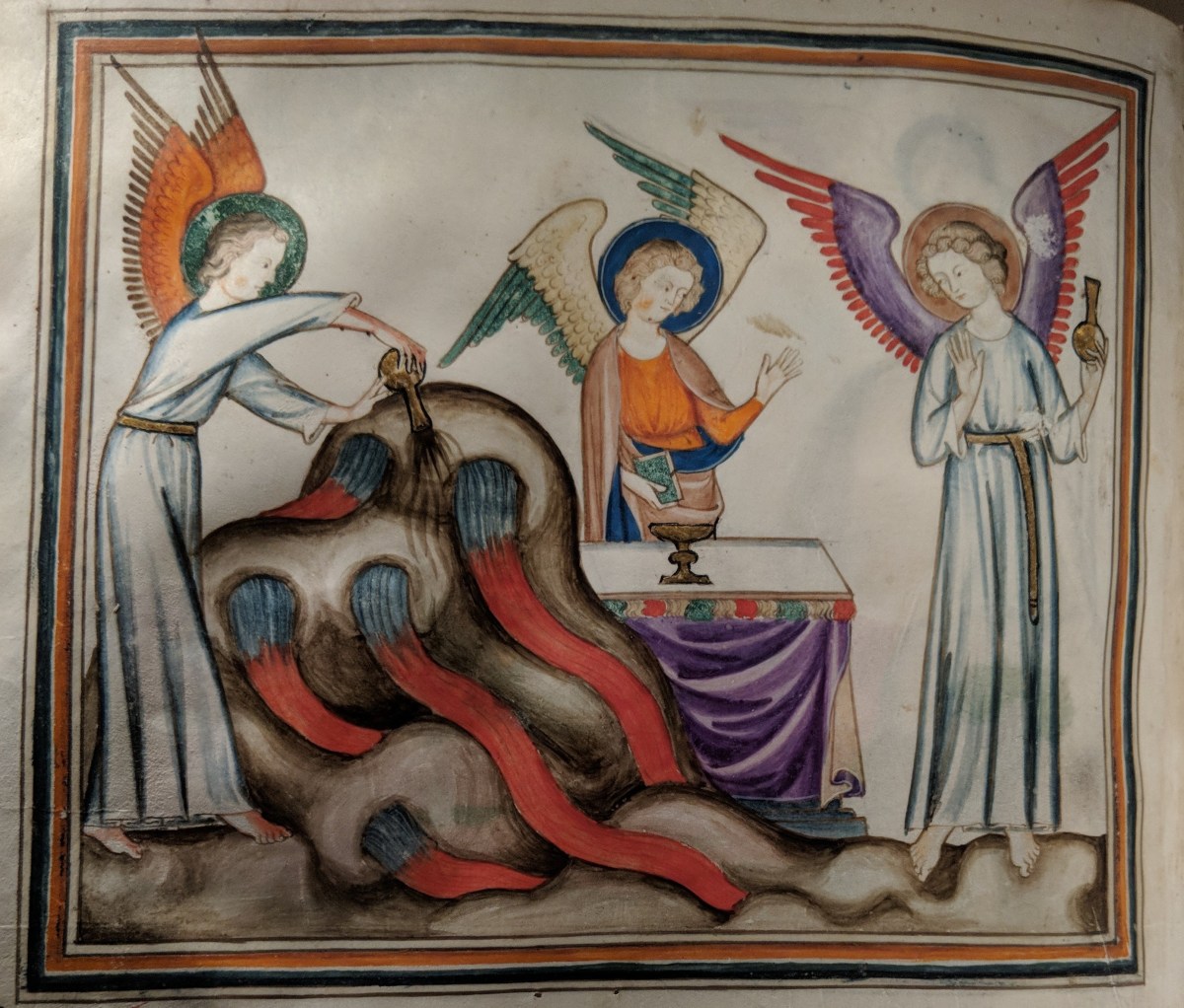
On Julian, God, and Gender: A Sermon

I preached this sermon today, the feast day of the English mystic Julian of Norwich, at All Saints Chapel, Church Divinity School of the Pacific, Berkeley, CA. The Gospel text cited is John 4:23-26.

When my mom was pregnant with me, she and my dad went about the usual business of considering baby names and preparing a nursery (mine was full-on Beatrix Potter characters). And in the early 1980’s, ultrasound predictions of an infant’s sex were not as common as they are today, so it was, for them, a matter of speculation whether I would be a boy or a girl. My mom was convinced that I was going to be a girl, and my name was going to be Ashley.

My parents had an artist friend around this same time who gave them an oil painting as a baby shower gift. It features a pastoral landscape with small human figures here and there: my dad carrying a fishing pole, and my mom standing by a bassinet with a little blond baby under a pink blanket.

After my birth (surprise! It’s a boy!) their friend changed the painting—brown hair, blue blanket. Now, in retrospect,could they could have kept it pink, and I’d have been perfectly happy with that! But I love that when I look closely at the painting now—it’s hanging in my room—you can still see little traces of the blond and the pink peeking through, the shadow of a different existence–a different, unrealized identity.

And I wonder about that other child who is not me—the Ashley who never arrived—and what her life would have been like, shaped by the expectations that are assigned to certain types of bodies. I am sure it would have been very, very different, and perhaps much harder in ways that I’ll never fully understand as a man.

And yet, in a way that I can’t fully explain, I still feel like I a carry a piece of Ashley inside of me; the part of my identity that doesn’t conform to some of the gender expectations that came along with that last-minute painting revision. Who we are is never quite as simple as appearances might indicate.

I tell you this story because it reminds me of the constructed nature of our identities, and especially of the ways in which our bodies and our genders and our  culturally-mediated self-understandings are always engaged in a process of becoming, from the moment we take our first breath, all the way up to our very last. Whatever labels have been assigned to us, rightly or wrongly,  and whatever identities we claim for ourselves, their meanings and significance can and will develop, both by the unfurling of our interior self-knowledge and by the changeable nature of our changing contexts. Who we are as social beings is always contingent, always being revealed ever more in its fullness. It is the journey of a lifetime, one that is never finished.

And that, I think, is as it must be, because the fullness of ourselves, the maximum horizon of our complex, nuanced personhood, is located in the heart of the God who draws us across time and space to a place as yet only partially revealed to us, as we are now, sitting here this morning. Today we might understand ourselves primarily as a seminary student, as a gay man, as a person of color, as a professor or a priest or spouse or child, or, in the case of our Gospel passage, as a Samaritan woman kneeling beside a well. And in our present contingency we know that we are also other things, other identities… some that we want to forget, and some that we yearn to become.  

But Jesus tells each of us today that the hour is coming, and is now here, when the “true worshippers” will worship the Father in Spirit and in truth. In other words, the hour is coming and is now here when we will understand that God loves the fullness of who we are —this is God’s truth; AND the hour is coming and is now here when we will understand that God’s loves the fullness of every other identity too, especially those that the world has called suspect or worthless—this is the work of the Spirit. And in this confluence of truth and Spirt, we will know perhaps for the very first time how SPACIOUS God truly is. How FREE God truly is. How the love of God includes all of us, as we are now, and as we are becoming.

Julian of Norwich, the deep lover of Christ, the medieval mystic, the earliest known woman author in the English language, the person whom the Church honors today, was intimately acquainted with the spaciousness of God’s identity. Her text, Revelations of Divine Love, which describes her ecstatic visions of Jesus’ passion and the Holy Trinity’s deep yearning for the salvation of all creation, is one of the most beautiful accounts of Christian wisdom ever recorded. It is also a text, written in the late 14th century, whose treatment of God’s gender and identity is so fluid and liberating that it challenges any notion that the language of patriarchy is the only appropriate way of speaking about God. She writes:

“So Jesus Christ…is our real Mother. We owe our being to him—and this is the essence of motherhood! God is as really our Mother as he is our Father. He showed this throughout, and particularly when he said that sweet word, ‘It is I.’ In other words, ‘It is I who am the strength and goodness of Fatherhood; I who am the wisdom of Motherhood; I who am light and grace and blessed love; I who am Trinity; I who am Unity; I who am the sovereign goodness of every single thing; I who enable you to love; I who enable you to long. It is I, the eternal satisfaction of every genuine desire.” (Revelations of Divine Love, 167).

I say take some of that and put it in the Book of Common Prayer revision.

What Julian saw, and what she blessed us with in recording her visions for posterity, was the capacity of God to take on multiple identities, each in its precious specificity, and in so doing, to show us that all such identities—every last one—are holy in themselves.

And so, no matter how we continue to grow in self-understanding through our lives and relationships—whether we end up claiming for ourselves a pink blanket or a blue blanket or perhaps we decide we don’t want to be confined by any color blanket at all, thank you very much—whatever our becoming looks like, God holds it. God loves it. God IS it.

God is our Mother and our Father and our Spouse and our Sibling. And God is Spirit and Truth, and God flows through our fluid identities, bolstering their unfolding current with Christ’s life-giving waters, as we travel together with Jesus towards something beautiful and vast and mysterious, something in which all of who we are, all of the ways we name ourselves, ALL OF IT is revealed in its magnificence—in a place where we will indeed and at last be “true worshippers” in the fullness of our hard-won, fully embodied truth.

I pray for that day. I long for it. I hope I’m courageous enough when I leave seminary in a few weeks to keep working towards it alongside each of you.

Julian is perhaps most famous for one particular quote from her text: “All shall be well, all shall be well, and all manner of thing shall be well.” It’s a lovely sentiment, but there’s an important clarification that must be made: these are not Julian’s own words. It is not a speculation on her part, or a vague, facile hope for the future. No, these are the words that Jesus speaks TO Julian in her vision, to assure her about the destiny of all creation.

And so Jesus says, to her and to us: All shall be well. ALL shall be well. All manner of thing—every person, every searching heart, every identity we name and encounter, every single thing—shall be well, in the fullness of what it is because it is OF GOD. It is OF SPIRIT AND TRUTH. That is our shared identity, commingled with all of those others we are carrying and discovering and painting in new layers over the landscapes of our lives.  Pink, blue, something else—it doesn’t matter. God is in all the colors. God is in every possibility.

All shall be well.

Only Questions: A Good Friday Sermon

This sermon was preached on Good Friday, April 19, 2019, at Christ Episcopal Church in Alameda, CA. 

Shortly before condemning Jesus to death, Pilate asks him–and thus unknowingly asks God–a bitter, heartbreaking , fundamental question, one that humanity has likely been asking from the very beginning: “what is truth?”

He receives no answer.

There is no answer to give that could be encapsulated into words. Truth, the very embodiment of Truth, is a bruised and battered face staring back into his own face, and it is beyond articulation.

Like Pilate and everyone else who participates in the crucifixion of God Incarnate, we are deep in a mystery now, a place where words are largely inadequate, where answers are few, where only questions prevail. We must tread carefully, for this is terrifying holy ground we stand upon today, Good Friday, and we should not profane it with endless speculation.

We are at the foot of the Cross, gazing up at Jesus, who in turn gazes back at us, blood and tears streaming down his face—and in this place, tidy, insightful observations about the nature of God and clever turns of phrase about sin and forgiveness and sacrifice all dry up like chaff and blow away in the wind.

The Cross rejects every attempt to understand it fully. It is not a place for self-assured theologizing or domesticated spiritualizing. It is a raw, awful, unspeakable place in which we find ourselves.

Last night, on Maundy Thursday, Jesus told us to love one another, and we did so. We washed one another’s feet and broke bread together with the best of intentions. We perceived that this was the proper way to live, to care, to be present in God’s kingdom. And on Easter we will no doubt come back together as a people renewed and forgiven for all the times we have failed to love, returning to our senses after this day of desperation and horror, and we will recommit ourselves to the fullness of life that God offers freely in the light of resurrection.

But today we are no-place. Today we have murdered the very best of our intentions to love. We have traveled to the Place of the Skull, the place where confidence is shattered like bone. Today we stand at the farthest point from comfort, the place where Jesus, God-With-Us, He who was the smiling babe in the manger, the youth in the temple, the wise teacher on the mountain, the Holy One, cries out to the Father for some sign of presence and receives…nothing. No answer. No words.

And in that silence we know what it is to forsake and to be forsaken.

Yes, we are deep in a mystery, one so strange and terrible that any attempt to sort it out, to prod at its depths, to explain it, results in cheap, brittle platitudes.

Think about of all the things that you should never, ever say when someone has experienced a great loss in their life: things like

“It’s all part of God’s plan.”

“Everythinghappens for a reason.”

“When one door closes, another one opens.”

These are things we say to each other that are usually more about soothing our own sense of confusion and fear rather than simply being present, deeply present, to the pain of another.

And yet these trite, hollow, inadvertently callous attempts at comfort are exactly what we so often apply to our encounter with Jesus on the Cross. We want to justify this awful thing, to make sense of it, to assure ourselves that God knew what God was doing the whole time. We approach Golgotha and see the crucified Christ writhing in agony and fear, and we say, to Him, as we do to others: “everything happens for a reason! Your suffering is part of God’s plan!”

And these words are like yet more nails, hammered and stammered into the endless void of His suffering.

The Church has done this since the beginning, in various ways. It’s only human, perhaps. We don’t like sitting with questions, and we rely too much on explanations.

Some of us want to reason the Cross away as God’s clever, elegant, brutal plan to atone for our sins, to make proper restitution for our brokenness, as if the cosmos were constructed like an accounting system or a court of law.

Or, equally tempting for some of us and yet equally limiting: we confine the Cross to the realm of  human political drama, as if Jesus was nothing more than an enlightened social justice prophet murdered by “conservative” religious authorities and imperial forces—those bad, unenlightened others that of course look nothing like us. As if the Cross was merely an unfortunate byproduct of a backwards political system rather than what it actually is: the fundamental, unanswerable question at the core of all the pain which we experience and inflict upon each other.

Every time we try to reconstruct the Cross in a way that suits us, in a way that provides easy answers, in a way that excuses us from the narrative, we are simply building another instrument of torture to re-crucify that which we cannot understand.

No more of this, I ask you. No more. Lay down your easy theories of atonement that taste of sour wine; stop casting lots for your competing theologies of the Cross. For one day, let us stop trying to figure it out. Look into the face of Christ crucified and let Him be all that He is, uncertain and frightening and heart-rending, the face of Truth.

And let that wordless recognition of Truth, terrible as it may be, let it be enough today, because it is all we are given. Just as with Pilate, Jesus has no further answers for us.

It is called Good Friday because it is God’s Friday—the day in which God presents us with a mystery, a deep mystery, a Man who is on a cross for reasons so strange and intimate that they are as distant as an all-consuming black hole, and yet as close as our own breath.

And yes, we know in our hearts that there is more to the story, and that perhaps soon, very soon, we will fumble our way toward the answer of the empty tomb and the radiant joy of something entirely new. But not now. Not yet.

What is truth, we ask? Look at the Cross. It is staring us in the face, wordless and unutterable. Approach it cautiously, without certainty. Touch it if you dare; look into the void and see God staring back at you. Today, this is all we have.


The Dust Matters: A Sermon

 I preached this sermon today, Ash Wednesday 2019, at Christ Church, Alameda, CA. The lectionary texts are Isaiah 58:1-12, 2 Corinthians 5:20-6:10 and Matthew 6:1-6,16-21.

It’s been almost seven years since my father died, quite unexpectedly, and one of the clearest things that I remember about flying home for his funeral was the shock of seeing the little black box that held his ashes, and looking in at them, and realizing that, physically speaking, this was all that was left of a man who had been so full of life and humor and compassion. And how surreal it was that the man who cradled me in his arms when I was a baby, I was now cradling in my arms as a box of dust. It defies my comprehension, even to this day.

And I was, then (and often still am), tempted to say—as I think we often do when someone dies—no, he’s not in there. This box of ashes is not actually him. This little box can’t contain the man whom I loved and admired, a person who lived so deeply, so fully, and so well. I am tempted to say these ashes are nothing but a shell, that they have nothing to do with that person. And yet…I took those ashes home with me, and for the longest time I would take them out and look at them, and I couldn’t let them go.

Why is that?

I ponder the same thing when I walk by columbariums like the one here in Christ Church, which holds a lifetime’s worth of love and memories in each quiet chamber, with a name engraved on the front. We stand before these rows of names and ashes, and we ask, “where are you? are you here in these chambers? Are you in my heart? Are you in a place beyond this place, somewhere I can’t even begin to imagine?”

The dust of our loved ones gives no answer to these questions. They rest, silently, like those ancient ruins mentioned in Isaiah, the foundations of many generations, placed lovingly in columbariums and cemeteries, scattered across land and sea. But while the dust does not answer us, it does bears witness, both to our own impermanent bodies and to our enduring bewilderment about what becomes of us, when we are no longer *this*. The Psalmist says, “God remembers that we are but dust,” and on days like today we try to remember that too, even as it remains inconceivable that all of our vitality and memory and longing could be so shockingly reducible, so small and earthbound.

But as inconceivable as it might be, we can’t seem to escape the dust. As much as we might like to, we can’t shake it off. We are drawn back to it, over and over again, because we know, intuitively, that whatever happens after death, this dust that was once our flesh somehow still matters. It is not easily forgotten or discarded.

I bring up this meditation on flesh and dust so that we might deeply consider the meaning of these ashes we are about to receive, and the fullness of what they symbolize. Too often in our tradition they are treated only as a sign of death or penitence, and we wash them off later in the day and move on until next year. If we leave it at that, I think we miss something beautiful. And this is especially important because our scripture readings warn us against practices of empty, unexamined piety.

Isaiah, for example, tells the people that true humility and repentance is found in loving each other, not just putting on sackcloth and ashes. And in the Gospel of Matthew, Jesus says that fasting and praying should be about an intimate connection with God, not a big gesture to show off to our neighbors. These texts starkly reject showy displays of piety…on the very day that we receive big dark smudged crosses on our foreheads and wear them out into the world.

So we must reckon with the significance of what we are doing here today, Ash Wednesday, to articulate why these ashes–and those ashes in the columbarium–matter, and what all this talk of ash and dust conveys, not just about the tradition of the church, but about our lives.

Our faith, as we often say, is Incarnational. That word, incarnate, literally means “into the flesh”. We affirm that God came into the flesh, human flesh, and lived among us as Jesus of Nazareth, himself a mortal man of dust, and somehow in our union with Jesus, God seeps into our dusty flesh, too. Through Jesus, the love of God has not just redeemed a “spirit” or “soul” within us, but has permeated our very bodies; we are like that watered garden of which Isaiah speaks, drenched in God, nourished by the spring whose waters never fail.

And this incarnational movement of God into our unremarkable flesh reveals something crucial about the language and symbol of Ash Wednesday: that this dust of which we are made—it MATTERS to God. The dusty remains of our loved ones, which seem so far removed from who they once were—they MATTER to God, too. Our bodies, mortal as they are, all matter to God, because they are caught up in the divine story of God, the divine story that is revealed and enacted  in our bodies, in relationship with one another.

We might be made of dust, but it is beloved, holy dust.

This dust makes up the fingers that we use to caress the face of our beloved;

This dust makes up the eyes that behold our children and grandchildren for the very first time;

This dust makes up the ears that we use to listen deeply to one another.

These small perishable parts of us MATTER to God, they are part of God’s indwelling in the substance of creation, and they tell a story of the goodness of being alive, of being human, of being part of one another.

From this perspective, the ashes we wear today are certainly not an empty act of piety, and they are far more, even, than a mark of penitence. They are a reminder–an affirmation–of what it means to be that which we are: a body that is at once dying and yet imbued with eternity, at once broken and yet redeemed by love. A body, as Paul says, which appears as having nothing, and yet possesses everything.

When I receive the mark on my forehead today, I will remember my father, whose ashes I finally let go and scattered into the ocean about a year ago, so that the dusty remnants of his kind eyes and his quiet smile might be carried on the waves, to dwell with God in the uttermost parts of the sea. With this smudge of ash, I am anointing myself with the dust of his memory, and with the conviction that his mortal life, his mortal body—and mine, and yours, and all the people who have come before us—will always matter to God. We are beloved, we are not forgotten, even when we become the silent dust, even as we wait, in hope, through the quiet season to come.

Poems on the Road

I’m on a night train heading through the Oregon wilderness, and I decided to share a couple poems I jotted down recently. I’ve been reflecting a lot on the spirituality of love and desire this past year, and these are small, imaginative windows into that journey, one from the perspective of Mary Magdalene, and the other from Judas Iscariot. Hope they resonate for you in some way. Peace, friends.

Magdalene

I needed you so much that
I whispered my deepest longings into a jar
And poured its dark sweetness upon your feet
Not that you would grant them, but
That you would absorb them into your self
My desire like sweat on your skin

I wept tears of love so pure and burning
that they felt like grief
Salt water sonnets
Braided through my hair like jewels or
Serpents

And just now
In the garden of re-encounter
Which never looks like the old days
When love was initial:
I saw
Briefly, ever so
The glimmer of my longing, and my tears
Transfigured into something selfless and whole
In you

Do not hold on
You said
Not because I shouldn’t love you
(Impossible)
But because my love
Reached its home in
Your heart
The sweetness and the salt are yours now
Ours now
The world’s now
Now, always
Anointing
Washing
Outpouring
Shameless
Free


Judas

You offered me the cup, said it was your blood.
Oh how I hated you, and loved you
For your generosity
When all I wanted was to bite your flesh and make you bleed from my desire.
You called me by name once
And I thought I loved you
Purely, selflessly
But now I know I wanted what i thought you were
What I needed you to be
Most beautiful of men
And when I realized that your inner light was as perfect as your shining face
I hated you, because I could not possess you for myself
Apple, flesh, my joy and sweet poison
They killed you and I thought I’d find relief
From your perfection
But there is no rest apart from you.
My tears are silver discs
And I weep, not for you, Who is peace itself
But for myself, because I realize
We could never have been united
Until I let you be Yourself. And I couldn’t.
My desire was misplaced.
I long for you still.
I will join you.
Beyond death, somehow, find me.

Sermon: A Tale of Two Liturgies

I preached this sermon today, November 27th, at All Saints Chapel, Church Divinity School of the Pacific, Berkeley, CA. It was given as my senior-year sermon for the Master of Divinity program. Lectionary texts are Revelation 14:14-20 and Luke 21:5-9.

“When you hear of wars and insurrections, do not be terrified; for these things must take place first, but the end will not follow immediately.” (Luke 21:9)

This morning, in the midst of these apocalyptic readings from Revelation and the Gospel of Luke, I felt called to share a word…about liturgy. If my time at CDSP has taught me anything, it’s that there is nothing—absolutely nothing—more essential for us to talk about than liturgy.

But I’m not being glib or preciously High-Church when I say this, nor am I just giving a shout-out to Dr. Meyers. Liturgies—understood broadly as those ongoing structures of relational action in which we participate—are what define us. The daily liturgies of our lives shape our reality and determine the parameters of our hope.

And so, in light of today’s Gospel passage, I would ask that we sit here a moment with Jesus, gazing up at the finely ornamented temple of 21st century life in this country, and I would ask us to consider the “wars and insurrections” of our time, and how they form a twisted, macabre liturgy of their own. A liturgy of Death.

In this liturgy, the hymns are composed with the staccato of gunshots, and incense rises up in clouds of tear gas. In this liturgy, the Gloria is sung to acclaim the power of whiteness and the prayers of the people read like a shopping list. In this liturgy the prophets preach the commodification of well-being and the anesthetic of endless, consumable content. This Death liturgy is the shiny, shambling procession toward the void of human possibility: the howling emptiness we sometimes call sin, and we perceive its highly effective “missional outreach” whenever we read the daily news headlines.

But this liturgy is not the exclusive possession of our age. Our compulsion for death, both physical and spiritual, has always been with us. The blood in the ground cries out to bear witness through the generations. And this is why Jesus tells us, “these things must happen.” Because we are enthralled by sin. Wars and insurrections and toppling temples must happen, not because God needs them or delights in them, but because they are the perverse oblation of the liturgy of Death, the destructive “work of the people” that inevitably occurs in the absence of God’s grace.

It is this liturgy of destruction that is attested, also, in the book of Revelation, where the harvest of the earth is crushed by God’s winepress. But lest we misread the text, we must remember: the blood that flows from the winepress is not that of the wicked in the hands of a vengeful deity, but the blood of the martyrs. We kill the martyrs. Like Christ before them, they are trampled by Death’s liturgical procession and their lives are poured out over the earth.

We see this already, every day. In the liturgy of Death, the innocent are slain on the altars of nationalism, economic exploitation, homophobia, misogyny…and the list goes on. And in our complicity, in the things we have done and left undone, we bow at the altar of death and drink the blood of our victims. It is a bitter cup, and in those last days it will taste like wrath to those who drink it. This is the liturgy to which we are bound.

Except…

We are here, now, because we have encountered and been reborn into a different liturgy. The liturgy of God’s love. The liturgy of Life with a capital L. This is what Christ offers us in his resurrected body: the promise of Life, and the absolute rebuke of humanity’s penchant for death and destruction. His empty tomb destroys the lie that Death’s liturgy leads to our final resting place, or that God’s ultimate posture is one of destruction. God is revealed in the resurrection of Jesus as God has always been—permanently creative, eternally life-giving, infinitely merciful.

And God’s liturgy is so beautiful, so poetic, because it takes the very instruments of Death’s liturgy and transforms them into signs of hope. The cross, an instrument of torture, becomes the banner of victory. The innocent blood poured out becomes the cup of life, the cup of forgiveness. And thus the winepress of the wrath of God is revealed for what it truly is: the beating, bleeding heart of Christ, spilling out, flooding the earth, inundating the liturgy of death, drowning it with life.

This is our choice then: which liturgy will we inhabit today? Will we orient our hearts toward the altar of Death, or that of Life?

We are here, at CDSP and in the Church, because no matter how loudly Death processes in the streets, we choose the liturgy of Life, over and over again. We have been given the gift of spending time here in this community, exploring the contours of God’s love, finding words to describe it and to share with those whom we will serve elsewhere. We are here to embody that Life-giving liturgy with one another, and to let it shape us. We are here, too, because we have seen the liturgy of Death, each in our own personal way. We have peered into the void, and we have heard God’s NO:

NO to death’s proclamation of expendability,

NO to its mockery of the life which God has declared good,

NO to its glittering idols of self-interest.

We have heard the NO to Death and we are saying Amen, Amen, Amen, come, Lord Jesus, come and give us Life once more.

When we choose to be swept up in the liturgy of Life, when we perceive its unconquerable movement, we come to understand Jesus’ words a bit better: these wars and insurrections must take place, this temple will fall, this river of blood must flow, but you, child of God, you do not have to be terrified, because you know that the Lord is not guiding us toward destruction, but is reshaping us, guiding us back into our proper relationship with Life. Death itself is the only thing that will be destroyed.

This is the Good News that our liturgy tells us. May we be ever mindful of its power, and ever grateful for its promise.

Waiting by the Road: A Sermon

I preached this sermon today, October 28th, at my field-education parish, Christ Episcopal Church, in Alameda, CA. The lectionary texts are Mark 10:46-52 and Jeremiah 31:7-9.


Bartimaeus is sitting by the road out of Jericho and into Jerusalem. He is waiting: waiting in darkness, waiting in despair, waiting in hope. He wants to go, somewhere, anywhere other than this place, where he is forgotten, invisible, little more than a breathing corpse, a ghostly figure in a home that has become more like a tomb.

At this very moment, there is a caravan of 7,000 refugees—men, women, children—walking north from Honduras, fleeing poverty and violence, trying to get to Mexico City, or the US, or anywhere they might have a chance to survive—anywhere other than a homeland where they cannot feed themselves, where they cannot protect their children—a home that, for them, has become more like a tomb.

There are countless families grieving today—11 people dead in a Pittsburgh synagogue, yet another horrific episode in a seemingly endless torrent of gun violence.  Lives, and bodies, and memories piled upon memories. We see the news, we feel fear and anger and helplessness, and sometimes we want to be somewhere, anywhere other than this time and place, where our beloved country, our home, has become more like a tomb.

And then all of the sudden, there is Jesus, passing by. He’s leaving Jericho, headed toward Jerusalem, on a mission. Bartimaeus hears that he is near, and from the depths of his soul he cries out—Jesus, Son of David, have mercy on me! This is the cry of a person who has nothing, who has been stripped of all presumption, all illusions of safety. It is the raw and urgent voice of Life itself, crying out to God for acknowledgment. It is a plea, a lament, and a demand to be seen.

The crowd tells him to be quiet, to keep the peace, to mind his place, but he will not—he cannot. Because at the end of the day Life is insistent. It asserts itself, no matter how much the structures around us try to squash it. Life speaks, and it speaks loudly.

Life says NO—we will not acquiesce to violence as the defining characteristic of our culture.

Life says NO—we will not be silent when leaders give in to corruption and complacency.

Life says NO-we will not sit in the dust on the side of the road and wait to die—we will get up, we will join the caravan, we will travel until we reach the place that God has promised for us, the one where, as the prophet Jeremiah tells us, all people are gathered together—those who are blind, those who can’t walk, those of us who are in labor, those who are Jewish, and homeless, and transgender, and everyone, everyone who cannot and will not be forgotten by God, because God SEES them, even when the world refuses to do so.

LIFE says we are on this journey together, and even though it might all look like shadow and darkness now, we will leave this valley of death where our home has become more like a tomb and we will spring up like Bartimaeus and we will throw off the cloak of our despair, and we will come forward, out into the light, out into presence of God who is the source of our life and the fulfillment of our longing.

Take heart! Get up! He is calling you!

And so Jesus asks Bartimaeus: What do you want me to do for you?

What do you want me to do for you? It is the question upon which our entire life depends. What would we have the Son of God do for us? The possibilities are infinite. We could ask him for an end to pain and hunger. We could ask him for consolation and courage. We could ask him for justice. We could ask him for peace. We could ask him to take us away from this place of death and towards the Kingdom of Life. And so we do, every time we pray.

But Bartimaeus knows what he wants, and it’s quite simple: he wants to see again. He wants to see the face of Jesus. He wants to see the dusty road and the people, he wants to see the world and get up and move in it, and in doing so to BE seen again by those around him, all those who have chosen to ignore him and told him to be quiet.

To see and be seen is to be in relationship, and to be in relationship is what it means to LIVE as God would have us live, rather than to merely exist. Bartimaeus knows that isolation is death, and he is not ready to die.  In restoring his sight, Jesus heals Bartimaeus’ physical infirmity, but, even more importantly, he restores him back into relationship with the world around him.  Bartimaeus’ home is no longer a tomb, but a place of possibility. With new vision, physical and spiritual, he joins the caravan to Jerusalem and walks toward Life.

We have been given that same vision—the vision of God’s dream for creation, the vision of Life restored to fullness in Jesus. And if the ever-mounting perils of contemporary life tell us anything, it is that this vision is precious, and often elusive. It is obscured every day by both tragedy and triviality. And so it is our responsibility, as Christians, to be the bearers—the stewards—of that vision. Stewardship is not about funding an institution—it is about ensuring that God’s vision of love and life will continue to be proclaimed in a world that often seems hell-bent on blinding us.

What would we have Jesus do for us? We, too, must ask him to see—to see the world as it can be and will be in God. We do that first by opening our hearts, as Bartimaeus did, and by asking for that vision to be restored to us, time and again, as we seek the face of Jesus. And then, having beheld that vision’s promise, we give everything we can give to it—our trust, our energy, our resources, our whole selves. We get up, and we go. We join the caravan. We follow were God leads us. This is the road you are invited to walk as part of this community, as part of Christ’s body. This is the road out of death and into life.

It has been a difficult week. And there will surely be more difficult weeks that we must face together.

We are sitting by the road out of Jericho and into Jerusalem. We are waiting: waiting in darkness, waiting in despair, waiting in hope. We want to go somewhere, anywhere other than this place, this home that has become like a tomb.

But take heart! Get up. He is calling you.

Half-Finished Life

On the coast of Scotland in the town of Oban, there is a church—a cathedral, in fact. It’s the most unusually constructed building I’ve ever seen. It started as a simple little brick structure, and then some years later the leaders had a grand vision of expanding it into a massive stone edifice. They had more vision than they had money, though, and when funds ran out, they’d only partially begun the addition.

Today, when you walk in, you can clearly see where the old building and the new were awkwardly joined—there are huge steel girders holding up the new section, and while these beams were probably meant to be temporary, they’re now just part of the interior. So far the whole thing has held together. You can see what it looks like in the photo attached to this post.

I feel a bit like that church building, and maybe you have have, too, at various points in your life. I want to be polished and put together, I don’t want the ugly interior structures showing. I want to be all incense and candles and beautiful music. Instead most days I feel like a half-finished project cobbled together from bits of false starts and broken dreams.

But you know what? God is still present.

God is still present in that half-finished cathedral, and in my half-finished life, and in yours. God doesn’t care about smooth walls and cohesive aesthetics. God isn’t worried if all you can put together is a misshapen hovel, as long as it’s built with love.

This might be self-evident to you, but goodness is it hard for me to accept. I have sought love and validation in every place where it cannot be found. I have spent years trying to be a Grand Cathedral sort of person–perfect, alluringly ornamented, trying to stand out, trying to earn the approval of teachers and lovers and friends. Not because they demanded it, but because I was convinced of the ancient lie: you will be complete when…When you know more. When you create more. When you look better. When you are more sophisticated. When you are admired.

God doesn’t care about any of it. Christ didn’t live, die and rise again so that I could achieve social respectability or admiring glances. So why, oh why, do I keep wanting it? I am weak, Lord. Help me be happy in the permanent construction zone that is life.

These months at Mirfield, and the events of my life therein, have definitely stripped me down to the steel girders. But I’ve learned about the dignity of silence. I’ve witnessed the beauty of consistency, in both prayer and work. Yes, I’ve felt the sting of loneliness and rejection, which is a small death, but also the warmth of kindness, which is a bit of resurrection.

These are good things. Necessary things. I wish them for you, too, to the extent that they draw you closer to the God Who loves you regardless of how well put-together you are.

There is so much more to say, but not now. For now I’m looking at those unsightly cathedral girders and reminding myself that what is humble is often what is strongest.

Home in just over six weeks. Pray for me, as I am for you.

Both Shepherd and Sheep: A Sermon

There is so much I could say and need to say about the experiences of the past few weeks, but I just don’t have the words at the moment. In the mean time, here is a sermon I offered yesterday, April 23rd, at my placement churches: St. Mary’s Mirfield and St. John’s Upper Hopton. The text is John 10:11-18, wherein Jesus describes himself as the Good Shepherd. 

As many of you know, I have been given the privilege of living and studying in the UK for the past few months as part of an exchange program between my seminary in California and the College of the Resurrection here in Mirfield. Getting to know the people and the landscapes of West Yorkshire has been a joy, but when we were given a break after Easter, I was eager to go a bit further afield.  And so I boarded a train to Scotland, determined to see as much as I could in a week.  And sightsee I did—I saw medieval cityscapes, glorious cathedrals and museums, Highland lochs, the holy island of Iona in the Inner Hebrides….and sheep.  Lots and lots of sheep.

Scottish sheep really have it made, as far as I’m concerned.  They are free to roam across those dramatic Highland landscapes, munching on wild grasses and heather, disturbed only occasionally by the odd passing tourist gawking out of a train window.  And while I was gawking at them, I noticed something interesting, which perhaps you have seen, too: the sheep are all marked.  They have splashes of color painted onto their fleece, some green, some blue, some red. I looked this up later, and I learned that these colors all have a practical purpose—they are called “Smit Marks”, and they are used by the sheep farmers to keep track of which sheep belong to them.  Since the countryside is open, and the sheep can roam wherever they like, these markings are a quick means of identification when it’s time for them to be gathered back in for shearing, etc.

The Scottish sheep, with their vibrant Smit Marks, were lingering in my mind’s eye as I pondered this week’s Gospel passage from John, in which Jesus describes himself as the Good Shepherd caring for his flock. It’s such an evocative image, isn’t it? One that is deeply ingrained in our idea of relationship with God—through the recitation of the beloved 23rd Psalm, in church art and in hymnody. It is an image of protection and guidance and self-giving love: the Lord is my Shepherd, I shall not want. The Good Shepherd lays down his life for the sheep. For us.

And we are marked, too, are we not?  Not with a streak of color on our backs, of course, but we have our own Smit Marks, indicating to whom we belong—they were placed on us in the water of baptism and the oil of anointing.  As it says in my favorite line in the service for Holy Baptism that we use in the Episcopal Church, we are “sealed by the Holy Spirit…and marked as Christ’s own forever.” No matter where we wander, no matter how far we stray into shadowy valleys or foreboding wilderness, we bear the mark that tells us who we are, and by Whom we are guided—Christ, the Good Shepherd, who stands on the brow of the hill at dusk and calls us home. It can be hard to see and the path is often rocky, but His lantern is lit for us to follow—it burns in the sanctuary of every church where his Eucharistic presence is encountered, and it illuminates every place where we, the people of God, pray and minister in His name.

It’s remarkable what you can discern from looking at a field of sheep!

There’s a catch, of course. If we were to simply bask in the image of Christ as the loving Shepherd and ourselves as his beloved flock, we’d only be getting part of the picture. Because Jesus is more than a model of a capable guardian and overseer; in fact our faith depends on the fact that he is much more than this.  As Saint Augustine asked, “What sayest Thou, O Lord, Thou good Shepherd? For You are the good Shepherd, who art also the good Lamb; at once Pastor and Pasturage, at once Lamb and Lion.” In the mystery of his death and resurrection, which we continue to marvel at this Easter season, we cannot forget that Jesus the Shepherd is also, paradoxically, the paschal lamb who was slain, who was given, if you’ll allow me to stretch the metaphor, his own Smit Mark by the Father to fulfill the plan of human salvation, and who was called home through the valley of the shadow of death in his glorious rising to new life.

This is the One whom we encounter in sacrament and prayer and service. The Shepherd who is the Lamb. The Lamb who is the Shepherd. Whose death was, in the light of the Resurrection, not a demonstration of God’s failure to care, but proof that God will do anything to gather us close into a merciful embrace.

If we follow this train of thought, though, there is one missing piece. Because if Christ is both the Good Shepherd AND the Lamb of God, then we, as people who share in his life, also share in this dual identity. We cannot merely see ourselves as sheep to be protected. As much as I envied those Scottish sheep in their pastoral idyll, I knew I had to continue on my journey, that I could not linger in the field. There was much to see, and much yet to be done. So it is for all of us. If we believe, as St. Paul claims, that it is not we who live but Christ who lives in us, then the Good Shepherd is the One who lives within us. The One Who must guide, and seek out, and yes, even lay down their life at the feet of those whom they serve. He is the one who animates our very beings. In the same moment that we are the beloved flock, you and I are also the brave, good shepherds of God’s mission. We were marked as such on the day of our baptism, when we were knit into Christ’s body, and it is an indelible mark. It cannot be undone. It is our vocation, each and every one of us.

So as we approach the table to take part in the banquet feast of the Lamb who was slain for us, let us remember the deep bond that has drawn us here, the bond of a Good Shepherd calling his flock back to him for rest and renewal. But let us remember, too, that by taking Him into ourselves, we have been transfigured by His abiding presence into shepherds. And so we, too, must seek the flock. We too must measure the worth of our lives by the amount of love we are willing to risk pouring out. We, too, must walk the landscape, lighting the way to guide others into safety.

The world is vast, more vast even than those Highland valleys, and there are many who are seeking home. Let us take up our staffs, light our lanterns, and call out. And may the Good Shepherd within each of us provide the words to pierce the silent gloom, to bring near those who wander towards the light.

The Joy of Normality

Temperamental spring is flirting with the landscape in Mirfield. In the past two weeks we’ve had snow blanketing the hillsides, unannounced rainstorms that drenched me on the way to morning prayer, and profusions of purple crocuses and yellow daffodils carpeting the parish churchyards. A bit like life itself, the weather in England is unpredictable, occasionally frustrating, and always beautiful.

Having been here almost two months (!) I’ve settled into a rhythm of prayer, study, meals, and periodic frivolity that feels more like a new home than like a “trip”. Given how disoriented and adrift I felt in the first couple of weeks, this change in itself feels like a miraculous revelation. It makes me realize how infrequently I am grateful for normality in my daily life back in California: always hungry for what is next, not for what simply is.

There was a piece I read long ago by the Buddhist teacher Thich Nhat Hanh that referred to this type of everyday gratitude as “the joy of no toothache.” In other words, it’s usually when we are in some type of acute pain that we finally recognize the joy that was already present in the pain-free status quo. Now that the discomforts of adjusting to life in Mirfield have mostly subsided, I am determined to relish the quiet happiness of simply being here.

But how to hold onto that sense of gratitude? For me, in this place, it has come about through a burgeoning sense of prayerful discipline. I am realizing more and more how the constancy of the Daily Offices (morning prayer, Eucharist, evening prayer, etc.) keeps me attentive to God and to the preciousness of the day at hand. Compared to my life back in the US, when I often let prayer become sidelined by academic anxieties, personal angst, and (let’s be honest) a lot of social media-driven idleness, now the rigor and structure of prayer is the framework upon which I build each day. I don’t always *want* to go and pray the Offices, but I must, and in maintaining that commitment, I find small but perceptible shifts in my heart, an accumulation of movements that are reorienting me towards the Divine presence in moments I might otherwise have missed it.

Robert Browning writes of this type of attentiveness in “Pippa’s Song”:

The year’s at the spring,

And day’s at the morn;

Morning’s at seven;

The hill-side’s dew-pearl’d;

The lark’s on the wing;

The snail’s on the thorn;

God’s in His heaven—

All’s right with the world!


The saints often express similar feelings about the miracle of the commonplace (think of St. Francis’ Canticle of the Sun). It is a mistake, I think, to sentimentalize or trivialize these types of observations. Deep satisfaction and delight in the everyday is not the same as naivety, nor is it complacency. To marvel at the poignancy of God’s abiding in the present does not preclude us from clear-eyed hope, from the work of reconciliation, or from the pursuit of justice; instead, it grounds us in pursuing those aims out of love, rather than fear and stridency.

Of all the things I am discovering at Mirfield—the joys of community, the need to take a more holistic view of priestly formation—one of the simplest and best is this experience of inhabiting the day prayerfully, non-anxiously, without a lot of worry about the future. This hasn’t come easily, but it is a change I have experienced quite dramatically in the past few weeks. I told someone recently that there is a bright line around my time here; beyond June 1st I am unsure of what life will hold, and I am suddenly, truly all right with that. If “faith is the assurance of things hoped for, the conviction of things not seen” (Hebrews 11:1) then I am experiencing faith anew here.

So, if I could offer any bit of advice for the perpetually stressed, among whom I have counted myself for many years, I would say this: forget dramatic transformations, and give yourself over to a gentle discipline of prayer. Focus less on an idealized, perfect end result, which is forever beyond our grasp anyway, and find something simple and immediate that will ground you in this day which God has made for us. It might be the Daily Offices, if you are Episcopalian/Anglican, or it might be something else. If you are already engaging in a practice along these lines, I’d love to hear about it in the comments!

Please know that in my daily prayers I am constantly lifting up your names. It is a great consolation to think of all the love that has permeated my life thus far, and I can only hope to give some of it back to God, through my relationships with you and through the worship that I offer up each day.

Peace, dear friends. You are in my heart always.

The Ancient and the New

It’s been one month since I arrived in Mirfield; as such, one quarter of my time here is already done. I can already sense little shifts in the landscape. The dawn is brighter as I walk up the hill to morning prayer; dusk lingers a bit longer in the church as we chant the psalms at evensong. There are changes inside of me, too. A bit less disoriented, a bit more confident of how I fit into this place.

So much has gone on since my last post. There was the somber and beautiful Ash Wednesday liturgy, when the priest drew a cross on my forehead with cool, damp ashes that had been sprinkled with holy water. A day of silent contemplation at the College to usher in Lent, during which I alternated between stillness and dizzying anxiety. A weekend trip to the ancient city of York, where I wandered alone through the medieval streets looking for a glimpse of a ghost or two. At the massive and magnificent York Minster I was stunned into silence, not simply because of its visual grandeur, but in recognition of the centuries and centuries of prayers that have been offered up into its lofty heights.  I felt alone, and yet deeply connected to that never-ending litany.

This journey thus far, with its ample opportunities for reflection, have made it very clear to me how I am still learning to be a disciple of Christ on the most basic levels: to look kindly upon myself and my flaws, and those of others; to trust that God actually loves me, personally, and not just as an abstraction; to recognize that grace is imbued into everything, whether I see it or not, because God is far more than I can see, or feel, or guess at. These are simple, incomprehensible truths. I know how much I still have to grow, and yet I am also seeing more clearly how becoming a priest is less about growth and more about fully inhabiting myself as God made me. We are not asked to be perfect as priests, but we are asked to be deeply, authentically ourselves, and that is the hardest thing of all sometimes. That goes for non-priests, too, of course.

Lest you think my entire month has been pensive introspection, there have been tons of joyful moments, too. Case in point: on Sunday afternoon I went to lunch with a classmate; we drove out into the countryside and the hills were so green and vast I wanted to cry. Afterwards we drove up to the Victoria Tower, an old observation structure perched far above the town of Huddersfield, and the wind was blowing and the clouds were scudding across the sky and I thought, yes, to be alive is a very good thing. To be here, breathing and breathless and crying from the wind and the wonder is exactly as it must be.  Come, Lord. Come, spring. I am broken open, and I am ready.