I preached this sermon on Sunday, November 16, 2025 at St. Anne Episcopal Church, West Chester, OH. The lectionary text cited is Luke 21:5-19.
Early in our relationship, as Matt and I got to know each other, we discovered an odd coincidence. Among our respective collections of personal mementos, we each have a single brick. Not a brick of gold, mind you, just an old, slightly crumbly, dusty brick. Kind of a strange thing for each of us to be carrying around through life, but so it is.
What’s more, these bricks we each have are both from old school buildings. Matt’s is from his elementary school, north of Dayton, which was torn down some years back. And mine is from a dilapidated portion of this massive old Victorian school building that was just out behind my grandparents’ house in Michigan—the Central School. I wasn’t a student there, but generations of Hoopers were.
Now the Central School was not a one-room schoolhouse, but more like a palace, or at least that’s how it looked to me when I was young. It occupied a whole city block and was made up of a bunch of wings and turrets and gables. I know Cincinnati still has some schools like that.
But eventually, in this increasingly small Michigan town, they closed it up for lack of money and students. By the time I was skulking around its perimeter as a kid, it was already boarded up and coming apart gently at the seams. And for whatever reason, this made me very sad.
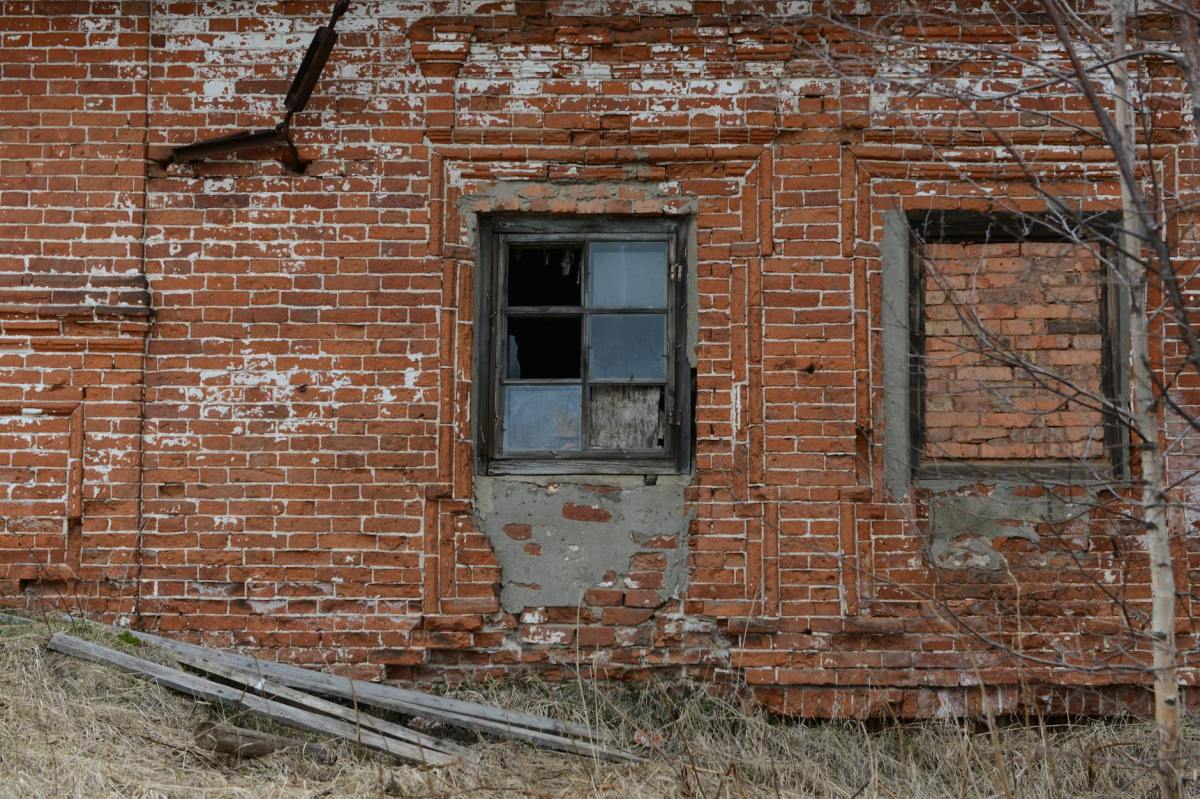
I remember as an 8 or 9 year old going to sit up against the old brick walls of the Central School in summer, feeling the heat of those brick walls radiate into my back, and I remember wishing, praying, even, that somehow it could all be saved, that it could be brought back to life. And I suppose, in that moment, that I was being given an inkling of mortality—how things and people can crumble, how certainties falter, and how not even brick walls can always withstand the onslaught of the years.
Years later, when a portion of the building was pulled down, a family member saved me a single brick, and though I am no longer a child, and I have seen many things fall apart in life, I confess I still can’t quite let that brick go. For me, it’s a holy relic.
You might have already guessed why I am talking about old buildings today, because in our Gospel passage, Jesus and those with him are also considering a building, though one that is far grander, even, than the Central School. They are walking near the Temple in Jerusalem, a structure whose importance would be hard to overstate for the Israelites in Jesus’ time.
The Temple was not just a place of worship or a focal point of national identity; it was, for those who worshipped there, the beating heart at the center of the world. It was the place which held God’s very presence, where they could lean their backs against the stone walls and sense that divine warmth radiating into their souls. It was one true and reliable thing to count on in a world that often takes so much away.
So if we want to understand and relate to the pathos of what Jesus says in this text, his dire prediction of falling stones and uncertain times and great sacrifices, you don’t have to be a 1st century Israelite.
You can simply imagine whatever or whomever or wherever is most precious to you—and how quickly, how shockingly the impermanence of what we love can be revealed to us. We know it is so, we know that nothing is permanent, and yet we cannot bear the thought of it any more than Jesus’ companions could. So we press our backs up against the proverbial bricks of whatever we love and feel their warmth and we pray for these things to never go away. We pray for something good to last forever, just this once.
Now, I know that this particular passage is usually interpreted in apocalyptic terms—a sort of “bad times are coming, so you better get right with God” type of message. And that’s ok, I guess.
But I can’t help but think that there is also a deeply human and pastoral dimension to Jesus’ observation here. I hear grief and empathy in his words.
Because remember two things: first, Jesus loved the Temple. He had his own childhood memories there in his Father’s house. And second, everything he is predicting about the Temple and the hardship of the disciples is about to happen in his own life first—accusation and punishment, defenselessness and destruction. Jesus’ own life, his body, is also the temple of God that will fall down and fall apart, long before this Temple of stone does.
And so I think that his observation is not so much a threat of divine wrath or apocalyptic comeuppance as it is an acknowledgment of our struggle in every age: we who have been laboring forever to hold up and hold onto everything we love, everything we have built, everything we fear to lose.
Jesus is telling us that he gets it, that he is right here with us as we press our backs against the crumbling bricks—of our homes, our health, our relationships, our country, our world. He sees us begging them not to fall down. He hears us praying for something good to last forever, just this once.
But here’s the thing, my friends—and this is perhaps the most important thing that Jesus can teach us in hard times: even if it does fall apart—whatever it is you love the most—even you fall apart—and even if we find ourselves, in shock, standing amidst the rubble of our own personal promised lands, even then, Jesus says, do not be terrified. Endure. I am with you. For I am not a God who requires a pristine temple to meet you. I am not a God who demands perfect composure in order to love you. I never was that. For I will be with you in the wreckage, too.
Even if all you have left is a single brick to remind you of what is good and loving and true in this life, that will be enough. Hold onto it. Hold onto me.
Some days, friends, some days I look around at the state of things, or I feel the pain of certain challenges in my own life, and indeed it feels like just a brick’s worth of hopefulness is all I’ve got to hold onto.
But here’s the real miracle of us doing this life of faith together: if I just show up holding my single brick, and if you show up holding yours, and if all of us show up with our own small fragments of love and truth and mercy, maybe we can put them together and build something altogether new. Maybe that’s exactly what Jesus was praying for his disciples to understand and to do.
Because that’s what I see you doing here at St. Anne, week by week and year by year. Things in life do change. Things in our world do fall apart. But that’s never the end of the story.
Because every prayer, every ministry idea, every leaky faucet fixed, every bit of food or friendship offered to a neighbor, every pledge made and every heart opened in unconditional welcome is one of us holding up a brick that still remains—a small, stubborn piece of hope we refuse to let go of, and it’s us saying, it’s not much by itself, but by God if we add them all up together, all these fragments, we could build something beautiful. Brick by brick by brick.
So let’s keep building.
As it happens, much of the Central School did not get torn down; by some miracle, part of it was converted into affordable rental housing and it has a whole new purpose now. I guess my childhood prayer was answered.
But I still hold onto that brick anyway—partially as a memento of the odd and sentimental kid I used to be, but also as a reminder that even among the ruins, there is still something good that remains. Something worth preserving. Something that can be rebuilt.
And if I could go back and find my 8 or 9 year old self, his back pressed up against the bricks, fearful of all the things that can fall apart, I think I’d tell him, don’t be terrified. You will learn how to endure, even if the walls come tumbling down all around you. Because that’s not the end of the story. It never is.
And it’s funny, but…I think God might want us, now, to hear the exact same thing.
 By Another Road