
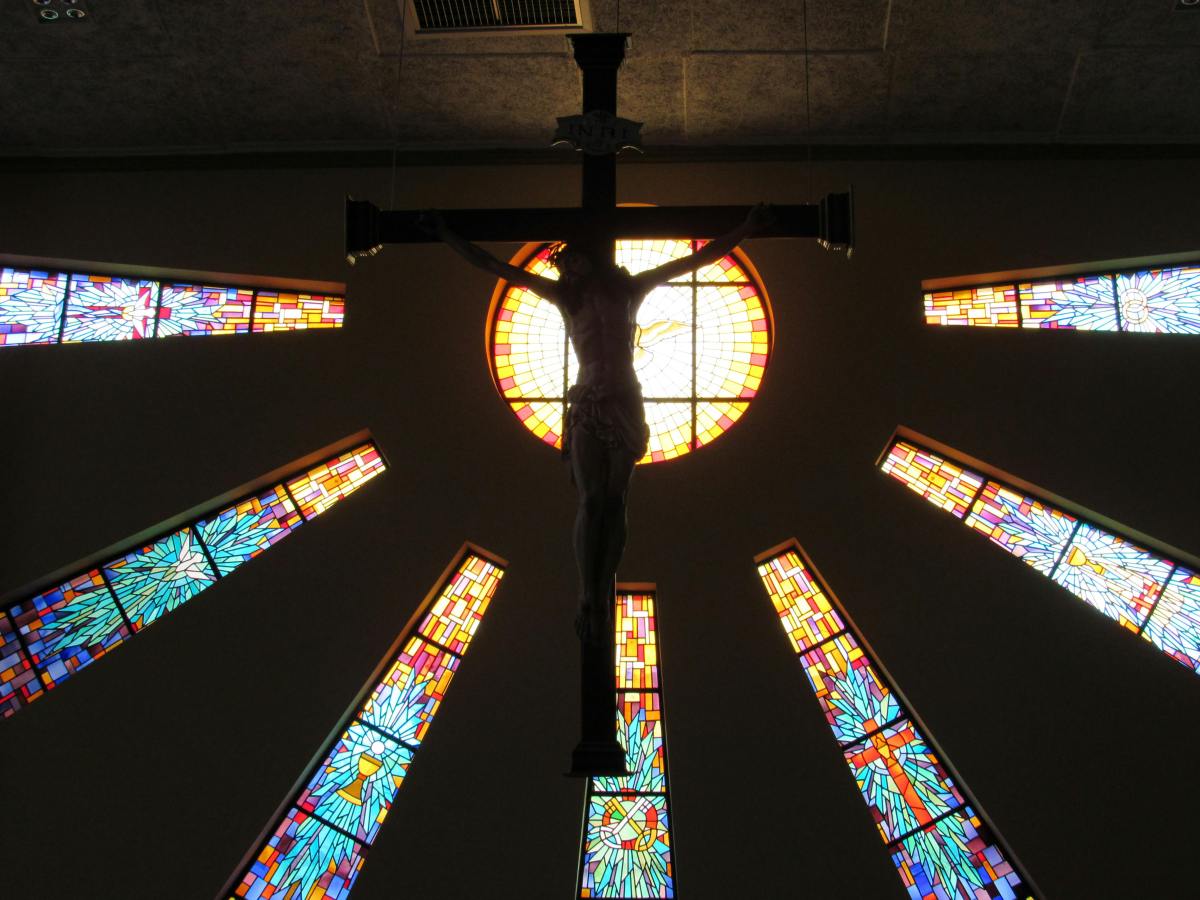
I preached this sermon on Palm Sunday, April 13, 2025 at St. Anne Episcopal Church, West Chester, OH. The lectionary text cited is Luke’s narrative of the Last Supper, Passion and Crucifixion of Jesus.
When you encounter hard things, sometimes it can be difficult to know exactly what to say. In such moments, our eloquence can crumble, leaving us wide eyed and silent like children.
Palm Sunday is always sort of like that for me. It’s hard to vocalize what it all means, this jumble of praise and fury. I imagine it was even more so for the disciples who watched from afar as their Lord, the Lord, succumbed to the senselessness of his death. I wonder what they said. I wonder what prayer was on their lips as they stood there watching, as he gave himself away, as the sun covered its face and the earth was darkened, its Creator flickering and faltering like a dying star.
I wonder if, in such an impossible moment, those disciples simply grasped at whatever prayer they knew best, as most of us do in desperate times. And for the majority of us, I would suspect the prayer that we know best and turn to is the Lord’s Prayer.
How many times have we prayed it? Impossible to number, like those flickering stars. I couldn’t even tell you exactly when I first learned the Lord’s Prayer. It’s just always sort of been there, rattling around in between my breath and my bones.
I’d suspect though, as reliable as it can be, for many of us, the Lord’s Prayer is almost too familiar We remember the words but forget the meaning. We become dulled to the boldness and intimacy of what it says about God and about being alive to God in this world that births and crucifies us. It is only in moments like this, like today, when all other words fail us, that the Lord’s Prayer returns to mind, like a life raft.
I’ve been thinking about the Lord’s Prayer lately for two reasons. The first is because, with the ups and downs of the world as it is, I sometimes need a life raft as I struggle to express whatever tempest of feelings fills my heart. In such instances, sometimes the old, familiar words are all I have to offer up. Thy kingdom come. Thy will be done.
The second reason, though, is because, as I was spending time this week with Luke’s narrative of the Last Supper and the Passion and the Crucifixion that we just heard, I realized something that I hadn’t before: woven into this narrative, like a hidden scaffolding that holds together Jesus’ final days, are all the elements of the Lord’s Prayer. In fact, if you look closely, you realize that Jesus quotes or enacts the prayer directly throughout the Passion narrative.
So let’s refresh our memory. Earlier in Luke, Jesus has taught his disciples to pray in this way:
Father, hallowed be your name. Your kingdom come, your will be done on earth as in heaven. Give us each day our daily bread. And forgive us our sins, for we ourselves forgive everyone indebted to us. And do not bring us to the time of trial.
And then, in today’s story, as we just heard, he does and says again all the things in this prayer. He gathers with his disciples and gives them bread. And he prays near the Mount of Olives, crying out to his Father who is in heaven and says, your will be done. And he asks his disciples, multiple times, to pray that they would not come into the time of trial. And then, finally, with his dying breath, he seeks forgiveness, for everyone. It is the Lord’s Prayer, every single piece of it.
In this Palm Sunday story—in the culmination of his earthly ministry—we see Jesus living the very same prayer he has been teaching. He is walking the walk. When he is experiencing his own pain, and fear, and doubts about why it all has be like this, and why people do what they do, and whether the ones he loves can carry on when he is gone, when in effect he has run out of anything else to say or know, he, too, falls back into the familiar words:
Thy kingdom come. Thy will be done.
And although it is a painful story; and although we are living through painful times, I find a sort of hopeful symmetry in the realization that God is praying the same prayer that God wants us to pray.
I find it rich with possibility and power, even, that when we call to mind those familiar old words, we are not just reciting something memorized as a child, but that we are somehow part of God’s own eternal prayer.
And that God, from the time before all our senseless crucifixions, from the very beginning, God has been offering himself to Creation in prayer, calling us by our names, seeking for earth and heaven to be one, desiring to give us bread and love and forgiveness.
I believe that God is still praying that prayer, today and every day, because God’s heart breaks not just for the Passion of Jesus, but for the passion and pain of every one of us who have trod the path of crumpled palms and broken dreams, hosannas caught in our throats, unsure of the words to speak.
Yes, with us and for us, Jesus is praying this prayer in Holy Week, and in the many hard, holy weeks that comprise our lives. The Lord’s Prayer is the Lord’s own prayer, you see. God is alongside us in the praying this week, and has been forever. And when we call to mind those familiar words, God is reflecting them back to us, saying,
My Child, who art of the dust,
Blessed is your name to which I call.
My kingdom is coming, so that our wills can be one
On earth as it is in heaven.
So eat the bread I give. It is more than enough for all your days.
And forgiveness is already yours if you receive it
And share it freely.
We have been through many trials and temptations together,
You and I,
But I have never left you.
And those things that are past will never define you,
because your deliverance is already at hand.
So take my hand.
In the same way that the Lord’s Prayer shapes and guides Jesus’ path to the Cross, I pray that this Holy Week will shape and guide your path through whatever you are facing in life. This week will reveal everything that Christianity is actually about, beyond the noise and the politics and the culture wars. It is the week when we learn what walking the walk really looks like.
Come and wade deep into these waters as much as you possibly can. We will watch, and listen, and grieve, and celebrate and yes, we will pray the Lord’s Prayer many times over, and all of this—all that Jesus is and all that he gives and all that he loses and all that he transforms—will become the hidden scaffolding of our souls, strengthening us for whatever might flicker or falter.
Because beneath and beyond the clamor and the confusion and the crumpled palms and the wide-eyed silences, only one thing abides, only one thing really can, in the end, be true:
The Kingdom, and the Power, and the Glory are God’s. Now and for ever.
And to that I can only say, Amen.
 By Another Road