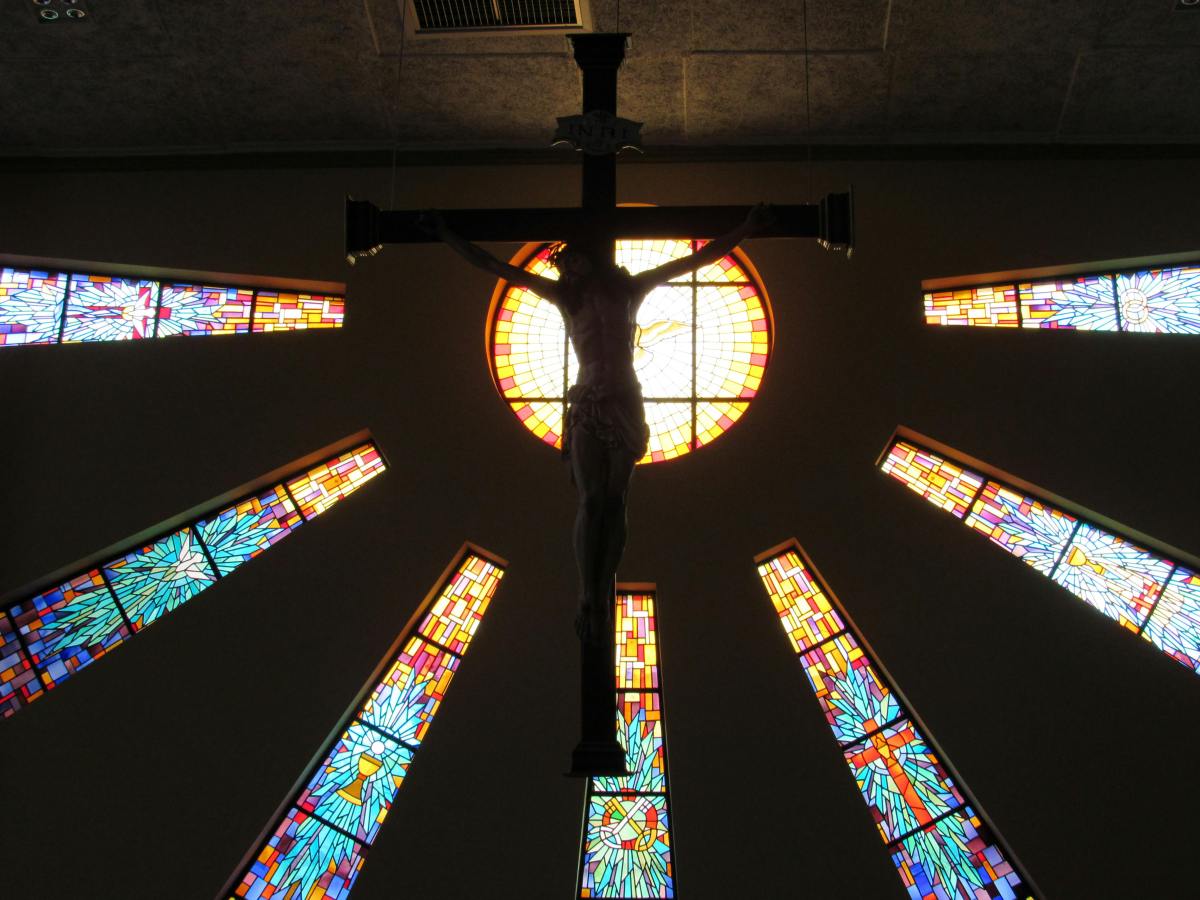

This is How it Ends: An Easter Sermon

I preached this sermon on Easter Day, April 20, 2025 at St. Anne Episcopal Church, West Chester, OH. The lectionary text cited is John 20:1-18, Mary’s encounter with the risen Jesus in a garden.

This is how it ends. THIS is how it ends. 

Take a look around you—at the morning light, at the flowers, and the flame that burns, refusing to be overtaken by darkness. Bathe in these rolling waves of alleluias, all of us here, together, finally, on the edge of a new day, standing in the risen light. If you take nothing else away from this moment, from this season, from this life, just hold on to the revelation all around you now: this is how it ends. 

Whatever else has ended, or is ending for you, or in this world, this is how it ultimately ends. Whatever you are afraid of, or angered by, or regretful of, take heart, because this is how it ends. Whatever grief you carry, whatever wrongs you can’t take back, whatever words you never got to say, this is how it ends. Whoever you have lost, whatever parts of yourself you have betrayed, whatever you are still trying to find, this is how it ends. Whatever seems to be falling down around us or fraying apart at the seams: remember, and believe, and taste and see, that this is how it actually ends. 

In this line of work, every day I hear and I feel, underneath all the words spoken and headlines blaring and the anxieties that pervade our church and our country and our time on this fragile earth, every day I hear the fear of endings. I hear that we are “in decline”, that we are losing ground, that we are coming apart, that everything we’ve loved and worked for is leaving us. 

I hear this across all spectrums of identity and ideology and outlook and circumstance. We have all been seized by this sense of an ending, a bad ending, and like Mary Magdalene we are, many days, stooped over by the weight of our tears.  Like her, we are wailing at the angels to give us back the things we love most, the things we cannot bear the ending of. 

But why are you weeping? Look around you, and see, and know again, or for the first time, the truth of Easter: this is how it ends

Whatever breaks, whatever dies, whatever unravels in us and around us—that is not the actual ending that God has in store for us. This is. Because our God is the God of Love and Life, our God is an Easter God, and we are Easter people, and on this clear and fragrant morning our Living, Loving Risen God emerges from the darkness, up among the flowers like a gardener, asking us to look, to look, and to see how the first green shoots of this new and deathless creation are rising right up all around us, right out of the wreckage of all those dreaded endings we fear.

So look! Stop your weeping and look!

Now, I love this moment of reunion between Mary Magdalene and Jesus; I find it one of the most poignant in all of Scripture. But I have also wondered sometimes if Mary felt like she got the brush off from Jesus. He’s in an awful hurry. 

Here she is, the only one who stuck around after the men left and went back home, here she is crying her heart out, suddenly reunited with her Lord and teacher and friend, and then through her blur of tears and joy and relief, Jesus is just like, “Girl, bye! I’ve got places to be. It’s Easter; I’ve got brunch plans. I love you, Mary, but kindly extricate yourself from my person.” 

Well, maybe he was a little more pastoral than that. But he doesn’t stick around long enough to explain or even to instruct. Because how can you really explain all of this. He simply needs her to look, to see, for that briefest, most crucial moment in human history: to see that, whatever has us bowed down in grief, this is how it ends. With you and I, and him, and everything alive, redeemed, renewed—and united with the One who made us. And on that day, oh what an Easter brunch it will be.

And this is important, especially now: that this glimpse, this Easter day that shows us how it all will end: this is meant for something far more than consolation. It is meant to EMBOLDEN us. It is meant to make us a little brave, a little feisty, because this ending means that we are free. We are free from despair. We are free from shame. We are free from death. We are free!

And Mary, well, she gets it. She understood the assignment. Because out of that garden she goes—she goes and she announces—she PROCLAIMS what she has seen. Oh yes, if you hadn’t noticed, the first APOSTOLIC PROCLAMATION of the risen Lord…the first human heralding of the new creation…is borne on a woman’s lips to the men hanging out at home. 

Because what has been cast down is being raised up and blessed are those who mourn for they shall be comforted; and blessed are the pure in heart for they, THEY shall see God; and blessed is she who has believed that the Lord would fulfill his promises to her!

And as Mary goes along proclaiming, mind you, the world still looks the way it always did. Caesar is still on his throne, and Pilate is in his judgment seat wondering what truth is, and the crowds who called for crucifixion still know not what they have done. And all around are all of those usual endings, endings, endings, and falling temples and crumbling nations. Oh yes, we’ve been here before. 

But Mary? Mary is emboldened now, because she stands at the center of a new world, she has seen, before anyone else, that this is how it ends. And when you know that this is how it ends, you can do anything that love requires, because there is nothing left to fear. 

Friends, Easter is the feast of fearlessness. It is the feast that invites us to not just cling to the hope of some good news someday, somehow, but to see it here, now, alive, in front of us and around us. It is the feast that asks us to stop wailing at angels, and to dry our tears and hike up our garments and chase after that good news. Proclaiming as we go this thing, this Person, this Risen One, this new world that we have glimpsed. 

And as we go, if we run into those petty tyrants of every age and the structures that prop them up, we will laugh, and we will stand in the streets and tell them: NO. You have no ultimate power. Because this is how it ends!

And if we see our beloved church changing through the years, we will cry out joyfully: it will be ok, because we are not limited by institutional realities, we are proclaimers of the Gospel of the Risen Lord, and this is how it ends!

And if we must say goodbye to each other along the way, as we certainly will in time, then we will say goodbye with tears and with tenderness but also with hope, because we know that this is how it ends. 

And frankly, even if society were to fracture all around us and we had to stand on the rubble of what has been built, even then, even then, like the generations before us, even then we will look for that green shoot rising up at the mouth of the empty tomb and we will point and say, LOOK. This is how it ends!  I have seen the Lord and this is how it ends!

Just like this. With love and truth and possibility, and resurrection, and a day that is not actually an ending at all, but a beginning. Look around you. This is the first glimpse of a new heaven and a new earth, with flowers, and a flame that will not be overtaken by darkness, and a torrent of unstoppable alleluias, and all of us together, finally, fully, always. 

So why are you weeping? This is how it ends. 

Failed: A Good Friday Sermon

Preached on Good Friday, April 18, 2025 at St. Anne Episcopal Church, West Chester, OH.

It is important that we speak plainly and honestly today. We owe that much to ourselves, and to him. There is no hiding, here. No pretty turns of phrase to evade the truth. 

No, the truth of Good Friday is simply this: We failed, God.

We failed today, fully and completely. We failed to see you. We failed to understand who you are and why you created us and why you came among us and what you asked of us. 

It was so simple, what you asked, but so impossible for us to accept: to love one another and to love you. 

But for so many reasons, and sometimes for no reason at all, we can’t do it. We don’t do it. And instead we crucify. And instead we are crucified. We fail. 

And oh, how we hate to admit it. We are so afraid of failure and shame. But somehow that fear of our own failure, that recoiling at our own limitations, is precisely what we lay upon others. We make them bleed the blood we are terrified of spilling. We make them die the death we are terrified of dying.

And so we have ended up here again, like clockwork, on another Golgotha, on that dusty hill which arises in every age, soaked with sorrow and strewn with cynicism. And we are bathed, today, in a grim, unflattering light, the sort of light that doesn’t illuminate so much as it lays bare. In the deathly light of Good Friday, every blemish and crack and wound in the body of creation is made plain in your body, Lord; your precious body, as it, too, fails. 

And we see here, in Jesus, upon this hill of sorrows, that, despite all our best efforts and biggest dreams, we don’t know how avoid failure in the end, not in the world as it is, because here death consumes even our greatest successes and highest ideals. It even consumes our God. 

So even if we give everything we have, like Jesus did, even if we practice peace and stay patient and never speak a hateful word, even if we do everything asked of us, still, it seems, the crucifier comes. The crucifier who is time and death and fear and fury.

Still he comes, with crosses freshly assembled to dole out. Still he comes, in his heavy boots, stomping on the harvest of our years. 

And still he comes, too, this crucifier, as a strange unwelcome traveler within us, welling up as the apathy and anger and resentment of our own hearts. We are the crucifier, too, somedays, even if we wish we weren’t. We must say that plainly, too.

Because so often, on any given Friday, good or otherwise, we choose to shrug or gawk or look away as the crucified ones continue to struggle through the streets of our own Jerusalems: draped in the flags of other nations or other identities, crowned with the thorns of prejudice, bearers of the burdens we’ve been taught to sneer at or dismiss. 

And if we are honest, really honest with ourselves, we’re often just relieved that it isn’t us.

And so on it goes, this passion play.

So yes, we have failed, God, and we can’t fully explain it. 

But it is necessary to say it, now, because really, what else can be said at the foot of your cross? There is no worldly victory here. No positive spin. There is no sly wink or nudge you give us that this is all just for show. This is simply what it appears to be. It is the opposite of love. And you, the One who is Love, you are gone. 

And that is that. 

But here’s the thing about today, God (and I am afraid, almost, to say it out loud, but I must, if we are speaking plainly.) Today is your encounter with failure, too, Lord. Your acceptance of your own failure. 

I’ve struggled to understand this or even put it into words, since you are eternal and unfailingly good, but I am realizing that Good Friday is nonetheless your own surrender to failure. 

Because you chose not just any death, but a shameful, embarrassing, degrading death. On the Cross, we see the fullness of your failure on the world’s terms. We see how creation could not bear the weight of you, how even your blessed flesh could not bear the weight of us. How you could not draw us back from our worst impulses.

You who–ever since your hungry children stumbled out of Eden with tearful eyes–you who have been trying to teach us how to undo the curse, how to find our way home. You who have parted seas and toppled tyrants and rained bread from heaven and crossed deserts and appeared in smoke and fire, all in the hopes of helping us find you again and find ourselves again…today is the shocking day when you say, my children, I have failed, too

Because you have come to us in every way possible. You have come as light and as fire and as word and now as a man. You have come as bread and as silence and as liberation, to show us, to show us, to show us, and still, still, still we are here again, on this dusty hill, unable to truly find each other. 

No matter what you have done til now, still, the crucifer comes.

And I am sorry, Jesus seems to say with his own parched lips, out of his own deep wounds. I am sorry that this has never quite worked. I am sorry that we always seem to end up here, on these many Golgothas. Because I promise you, you were created for so much more than a world full of crosses. I have wanted to give you so much more than this.

But now, it is finished. It is finished. 

On Good Friday, the saga of our long journey out of Eden is finished. It ends here, with us casting God from our garden, sending him away, weeping and hungry. It ends here.

And I realize that saying this might make us uncomfortable. Surely this is not the end of the story? We know there is more.

But it is very important, actually, that we let Good Friday be Good Friday, and nothing else. That we let it be the ending that it is. 

It is necessary, I think, after our long history of death and despair, to say that this particular story, this particular mode of endless disappointment—ours and Gods—ends today. 

Because perhaps we need to say goodbye here, us and God, here upon the dusty hill, upon the rubble of our failed dreams. Perhaps Jesus’ words are the most honest thing that we can say to one another today: it is finished. We tried, and it failed, but whatever this is, this world that crucifies truth, it must be finished. 

Because somewhere, out beyond time and terror and the Cross, somewhere within the mysterious alchemy of love and death and failure, only there and only then is something else possible, some truly good news that is not just a new chapter in this same, sad old story, but that’s a new story altogether. A new creation altogether. 

A different garden that is neither Eden nor our own, but a new world, a new life in which no one will ever be cast out. 

But whatever that looks like, whatever that new thing is that might yet be revealed from the depths of the tomb, we have to come here, first. We have to look into the face of our broken Lord, who tried so hard, who came so far, who loved so deeply. And we have to let him look at us, too: we who try so hard, who have come so far, who love so deeply, and yet are as broken as we’ve always been.

And today, for now, we have to let each other go.

I am sorry, Lord. I am sorry for all that we could not be to each other in the world as it is. I am sorry this is the ending of your time with us. 

But please, please let it not be the end

Let there be some new word spoken, some gentler, more kindly light revealed. Let there be something on the other side of all this failure. Let there be something plain and honest and good that does not always get crucified.

For whatever it is, we wait. 

For you, we wait. 

The Lord’s Own Prayer: A Palm Sunday Sermon

I preached this sermon on Palm Sunday, April 13, 2025 at St. Anne Episcopal Church, West Chester, OH. The lectionary text cited is Luke’s narrative of the Last Supper, Passion and Crucifixion of Jesus.

When you encounter hard things, sometimes it can be difficult to know exactly what to say. In such moments, our eloquence can crumble, leaving us wide eyed and silent like children. 

Palm Sunday is always sort of like that for me. It’s hard to vocalize what it all means, this jumble of praise and fury. I imagine it was even more so for the disciples who watched from afar as their Lord, the Lord, succumbed to the senselessness of his death. I wonder what they said. I wonder what prayer was on their lips as they stood there watching, as he gave himself away, as the sun covered its face and the earth was darkened, its Creator flickering and faltering like a dying star. 

I wonder if, in such an impossible moment, those disciples simply grasped at whatever prayer they knew best, as most of us do in desperate times. And for the majority of us, I would suspect the prayer that we know best and turn to is the Lord’s Prayer.

How many times have we prayed it? Impossible to number, like those flickering stars. I couldn’t even tell you exactly when I first learned the Lord’s Prayer. It’s just always sort of been there, rattling around in between my breath and my bones. 

I’d suspect though, as reliable as it can be, for many of us, the Lord’s Prayer is almost too familiar We remember the words but forget the meaning. We become dulled to the boldness and intimacy of  what it says about God and about being alive to God in this world that births and crucifies us. It is only in moments like this, like today, when all other words fail us, that the Lord’s Prayer returns to mind, like a life raft.

I’ve been thinking about the Lord’s Prayer lately for two reasons. The first is because, with the ups and downs of the world as it is, I sometimes need a life raft as I struggle to express whatever tempest of feelings fills my heart. In such instances, sometimes the old, familiar words are all I have to offer up. Thy kingdom come. Thy will be done.

The second reason, though, is because, as I was spending time this week with Luke’s narrative of the Last Supper and the Passion and the Crucifixion that we just heard, I realized something that I hadn’t before: woven into this narrative, like a hidden scaffolding that holds together Jesus’ final days, are all the elements of the Lord’s Prayer. In fact, if you look closely, you realize that Jesus quotes or enacts the prayer directly throughout the Passion narrative.

So let’s refresh our memory. Earlier in Luke, Jesus has taught his disciples to pray in this way:

Father, hallowed be your name. Your kingdom come, your will be done on earth as in heaven. Give us each day our daily bread. And forgive us our sins, for we ourselves forgive everyone indebted to us. And do not bring us to the time of trial.

And then, in today’s story, as we just heard, he does and says again all the things in this prayer. He gathers with his disciples and gives them bread. And he prays near the Mount of Olives, crying out to his Father who is in heaven and says, your will be done. And he asks his disciples, multiple times, to pray that they would not come into the time of trial. And then, finally, with his dying breath, he seeks forgiveness, for everyone. It is the Lord’s Prayer, every single piece of it. 

In this Palm Sunday story—in the culmination of his earthly ministry—we see Jesus living the very same prayer he has been teaching. He is walking the walk. When he is experiencing his own pain, and fear, and doubts about why it all has be like this, and why people do what they do, and whether the ones he loves can carry on when he is gone, when in effect he has run out of anything else to say or know, he, too, falls back into the familiar words:

Thy kingdom come. Thy will be done.

And although it is a painful story; and although we are living through painful times, I find a sort of hopeful symmetry in the realization that God is praying the same prayer that God wants us to pray. 

I find it rich with possibility and power, even, that when we call to mind those familiar old words, we are not just reciting something memorized as a child, but that we are somehow part of God’s own eternal prayer.

And that God, from the time before all our senseless crucifixions, from the very beginning, God has been offering himself to Creation in prayer, calling us by our names, seeking for earth and heaven to be one, desiring to give us bread and love and forgiveness.

I believe that God is still praying that prayer, today and every day, because God’s heart breaks not just for the Passion of Jesus, but for the passion and pain of every one of us who have trod the path of crumpled palms and broken dreams, hosannas caught in our throats, unsure of the words to speak. 

Yes, with us and for us, Jesus is praying this prayer in Holy Week, and in the many hard, holy weeks that comprise our lives. The Lord’s Prayer is the Lord’s own prayer, you see. God is alongside us in the praying this week, and has been forever. And when we call to mind those familiar words, God is reflecting them back to us, saying,

My Child, who art of the dust,

Blessed is your name to which I call.

My kingdom is coming, so that our wills can be one

On earth as it is in heaven.

So eat the bread I give. It is more than enough for all your days.

And forgiveness is already yours if you receive it

And share it freely.

We have been through many trials and temptations together,

You and I,

But I have never left you.

And those things that are past will never define you,

because your deliverance is already at hand. 

So take my hand.

In the same way that the Lord’s Prayer shapes and guides Jesus’ path to the Cross, I pray that this Holy Week will shape and guide your path through whatever you are facing in life. This week will reveal everything that Christianity is actually about, beyond the noise and the politics and the culture wars. It is the week when we learn what walking the walk really looks like.

Come and wade deep into these waters as much as you possibly can. We will watch, and listen, and grieve, and celebrate and yes, we will pray the Lord’s Prayer many times over, and all of this—all that Jesus is and all that he gives and all that he loses and all that he transforms—will become the hidden scaffolding of our souls, strengthening us for whatever might flicker or falter.

Because beneath and beyond the clamor and the confusion and the crumpled palms and the wide-eyed silences, only one thing abides, only one thing really can, in the end, be true:

The Kingdom, and the Power, and the Glory are God’s. Now and for ever.

And to that I can only say, Amen.

On Anger, & What To Do With It: A Sermon

I preached this sermon on Sunday, April 6 at St. Anne Episcopal Church, West Chester, OH. The text cited is John 12:1-8, Jesus’ anointing for burial by Mary of Bethany.

There’s an aspect of life—of faith, even—that we don’t talk much about on Sundays. Maybe it’s because we’ve been raised to be polite. Maybe it’s because, for very good reason, we hold fast to the proclamation of a loving and gracious God. But nonetheless, there’s something that we all contend with in our lives that’s probably worth talking about, and that’s anger

Are you feeling angry these days?

If not, at some point you surely have felt it, whether about the state of the world; the decisions of others; or the frustrations that tend to show up each day. Maybe you’ve felt anger at yourself for the things you wish you’d done differently but can’t take back. I know I have felt all this and more, though as a person who tries to remain centered and peaceful, I may not like to admit it. 

But anger is hard to avoid when our hopes are dashed or our deep fears encountered or our wounds touched. And some days we might wonder, if anger is so bad for us, why, Lord, do people keep giving me so many good opportunities to practice it??

It’s tough, though, because sometimes a bit of righteous anger feels appropriate. I get angry, for example, when folks demonize vulnerable groups of people who aren’t hurting them, people who are just trying to live their lives as best they can.

And I get angry, too, when I see how working-class communities like the one my family came from in rural Michigan have been dismissed and left behind by 21st century economics and culture.

And this is sillier, but I was even a bit angry last week when Cincinnati got passed over for the Sundance Film Festival because, essentially, some folks out west still consider the entire middle of the country a big blank space. I’m from California, but I consider myself a proud midwesterner now, so that riled me up a bit!

I cite these because anger, it seems, cuts across ideologies, politics, cultures, and identities. It is an equal-opportunity companion in this life. And there are plenty of late nights when I reflect on my own personal failures and I’m just angry at my own foolish self.

The question is, what do we do about it? 

In a cultural moment that seems so saturated by anger and its consorts—fear, anxiety, uncertainty, cynicism—the question of what to do with our anger, individual and collective, is both an ethical and an existential one. Ethical, because somehow we have to figure out how to live meaningfully in this world despite its frustrations. Existential, because Jesus calls us to be something more than the sum of our many angers. 

Lent is almost over, and we are in the foothills of Holy Week. Soon, through the Passion of Christ, we will bear witness to the the cost of humanity’s capacity for self-defeating anger. So it’s a good time to figure out what to do about the rage within us and amongst us, lest we keep on murdering the promise of the kingdom that still stands in our midst. 

In today’s Gospel reading, I think we are given two insights–two pathways–in our response to anger, though I don’t think that this story is usually viewed that way. 

Consider first Mary of Bethany—she who previously sat at Jesus’ feet while her sister Martha cooked and cleaned. Mary is not usually viewed as an angry person, but for the first time this week I found myself wondering if here, in this moment in the narrative, she actually is. 

Because I remember how angry I was when my father was dying—not angry at him, but angry that it had to happen at all. Angry that I had to watch his vitality slowly ebb away. And I know, too, how somethings the things we love the most also wound us the deepest. And so I wondered, maybe, if Mary’s anointing, her shattering of the precious jar, her wasteful smearing of fragrant oils, was not, as I have often assumed, some sort of calm, smiling ritual. 

Maybe there were angry tears streaming down her face as she did so. Maybe she was furious with grief that Jesus–her teacher, her Lord, the one who raised her brother from the dead, the one who could potentially make this mess of a world beautiful again—maybe she was furious that he was giving himself over, that he was surrendering himself to death at the hands of those same old persecutors who kill everything good. Maybe Mary was anointing him with holy anger as much as holy love. Because I find those two are often strange companions in the tangle of this life, where good things break and sure things falter and we must both rage and bless at the same time.

However (and this is essential) anoint him she does, even through her angry tears, because despite how disappointed Mary must be that Jesus will die, and that life does not conform to our expectations, she realizes in the way that only Wisdom can reveal that we must anoint our fierce anger at the world with an even fiercer love, rather than try to manipulate or abandon or destroy what disappoints us. 

Because to give into that temptation is to choose the other path in the story today—that of Judas, the betrayer, who is likely also disappointed that Jesus is not the sort of savior he imagined. But for Judas, it seems, the world is just a series of disputes to be bargained and negotiated and won, rather than a network of relationships to honor.

It may be tempting to navigate the world that way, with our understandable anger at the way things are (even Judas surely raged against the empire) but it is not the way of Jesus. It is not the way that will lead to the flourishing or health or peace that Jesus offers. Only the pouring out of our hearts, only the giving away of our costly love will ever lead us to the kingdom of Christ. 

So what do we do, friends, with the angers of our own life and times? How do we acknowledge all that we carry within ourselves but then, like Mary of Bethany, surrender it to our Lord? 

First, we have to name it—really name it. Maybe part of the problem in all our conditioning to be polite is that we tend to remain strangers with our anger. Maybe it would help to begin by writing down for ourselves the things that anger us. Not on social media, please, but just for ourselves. An accounting of our frustrations, our sorrows, our disappointments, and our fears. And then, as this Lent winds down, give them over to Jesus in prayer. 

Maybe it would help, like Mary, to undo your hair, and bend low, and smear the bittersweet fragrance of your rage and blessing on his feet. If you are disappointed that nothing seems like an easy fix, tell him. If you had hope for so much more from this life and from your fellow humans, tell him. If you don’t understand why crucifixion must be the path, and why we can’t have nice things, and why so many people suffer for no good reason at all, tell him. 

But I pray we will tell him, too, that in our anger, we will refuse to be apathetic or craven or cynical. That we’ll tell him we’re willing to love with our shattered jar and our shattered hearts. I promise you, he will understand.

And then, together, we will continue to go about the work of building a community and a world in which, even as we acknowledge our anger, we become a people who are not ultimately formed by it. A people who will not sell our hope for thirty pieces of silver or justify our anger on the backs of the poor, but who will anoint the present moment with our furious compassion. Even with tears in our eyes. 

Because every week, as we come to the table to feast on the shattered pieces of Christ’s body, we glimpse the truth: anger is persistent, yes, but love is eternal. And he will transform it all: our anger, our grief, our disappointment, our fear. He will transform it. 

Just ask Mary. Because in a couple of weeks’ time, we will see her again, but it will be in a garden, in the cool morning light, with the perfume of burial washed away by the scent of living, resurrected things. And she will cry very different tears. And maybe so will we.

And for once in the history of broken jars and broken hearts and all the things we do not understand, our anger, at last, will be forgotten.