
Greeting Cards: A Sermon

I preached this sermon on Sunday, February 23, 2025 at St. Anne Episcopal Church, West Chester, OH. The lectionary text cited is Genesis 45:3-11, 15 and Luke 6:27-38.

I was heartened during last week’s sermon when our preacher, Baker, confessed that he, too, has a penchant for accumulating books. It helped me feel a little bit better about my own endless accumulation! Though I like to say that am a collector of books, because that sounds so much more elegant than “hoarder of books” or “person who is constructing the leaning Tower of Pisa with books.” No, no, I’m a collector. So it’s fine.

Well, with that in mind, I’ll tell you there is something else I am a collector of—and I have stacks of them, too, squirreled away here and there—and that is old greeting cards. I have a tough time letting go of the cards that I’ve received. Whether it’s those I’ve been given as a priest, or for birthdays, or even the occasional thank you note…every so often I’ll open a drawer or a folder and there they’ll be, little bundles of time and relationship and memory. 

And just when I think, oh, I probably don’t need to hold onto these anymore, I’ll open one up and suddenly I am reading about how proud my dad was at my high school graduation, or some half-forgotten in-joke from a long lost college friend, or a Christmas greeting from a beloved parishioner who has since died. And I just slide them all back into the drawer. Really, I suppose I am a collector of heartfelt sentiments, but I am not ashamed of that. 

Because we need reminders sometimes, don’t we, of all the things that we have been to other people, and of all that they have been to us. And really, when you think about it, those greeting cards and other such notes are one of the few tangible signs we ever receive that this is indeed the case. They are evidence that we’re not, in fact, just isolated figures navigating the surface of the earth, but that we are of something, that our hearts and our bodies have been tethered to something, to someone. And in a lonely age, any such reminder is a precious, even sacred thing. 

Think about it: when we die, if a stranger were to go through our house and clear out most of our belongings—the clothes and the pots & pans and yes, even the books—it is only a few items, maybe just the greeting cards and the letters and the photos—that would actually tell the story of the love that has shaped our lives. Sobering thought, maybe, but clarifying, too, about what actually matters in this life. What is worth holding onto and what is worth saying to one another in the bit of time we are given.

And for me, few scenes in Scripture capture the preciousness and power of what is said to one another more so than this morning’s Old Testament reading. To set the scene, we are with a handful of isolated figures navigating the face of the earth—the elder brothers of Joseph, who have come to Egypt in the midst of a famine searching for food. Instead, they end up finding Joseph himself, whom they secretly sold into slavery many years before. Joseph is now a powerful figure in Pharaoh’s household, and at first the brothers don’t recognize him. 

But as we hear today, Joseph reveals his identity to them and, instead of exacting righteous revenge or punishment, he does something quite astounding. He pours out words of love. He forgives them and welcomes them and weeps upon them, and what he says is tender and generous and full of unexpected grace.

I’ll admit, sentimental as I am, Joseph’s decision here can still sound a bit unrealistic, the stuff of greeting card verses rather than real life. And that’s fair enough. Accountability for harm done is a real and important facet of healthy relationships, and there are plenty of examples of it in Scripture, too.

But what we might want to take away from this story is not simply that Joseph was a very nice person who did a very nice thing by letting his brothers off the hook, but that this narrative represents something deeper and more profound for the people who wrote it down. It captures something of Israel’s own fundamental, fragile hopes. 

They, too, often felt like people isolated on the face of the earth, and like those elder brothers consumed by hunger and regret, Israel prayed that they might one day hear God again saying to them: “come down to me, do not delay…you shall settle in the land…and you shall be near me, you and your children and your children’s children.”

And so what Joseph offers his brothers is what Israel itself longed to receive, and maybe what we all long to receive at our core—a word, an assurance, direct from God’s own heart, that says, “you are not an isolated figure, because you are mine, and I am yours and I, the one who Created you, weep for the love of you. And so no matter what has happened before, no matter what is broken, I your God will make it all fit together somehow. No matter how you have failed, no matter how far you’ve wandered, we are not lost to one another.”

This is not just sentimentality, but the reality of grace. And I think we wait our whole lives hoping to hear some version of it. It is why Jesus came as God Incarnate, to deliver the same message in person through his life, death, and resurrection. 

But there’s a twist with Jesus, of course (there always is)—because he invites us not just to receive the word of grace, but to live it. Jesus asks us to become the very word we long for. 

And that’s important to keep in mind when we hear Jesus’ seemingly impossible instruction on forgiveness and loving our enemies. Just as we might be incredulous at Joseph, so we might find ourselves skeptical of this teaching. Doesn’t Christ, of all people, know that the world is not so simple? How can we turn the other cheek and resist judgment, when there is so much hate and harm?

And Jesus looks at us and says, because that is what God does. And I, your Lord, have come for one thing: to invite you to participate in the life of God. 

And in that Life, God weeps for the love of you. God forgives you. God turns the other cheek to you. God refuses to give up on relationship with you, with anyone. And so if you would dare surrender to the fullness of the life of God…then so it will be for you. For all of us. For at last, in Christ, we will see as God sees and we will love as God loves.

You might even say we will become the people that our stacks of greeting cards say we are–that all of those thank you notes and letters of apology and kind greetings are what will endure of us, once everything else is stripped away.

To become the words we long to hear: this is, at its heart, what discipleship is. Like Joseph and Jesus before us, this is our participation in the life of God. It is God’s sentimental, foolish, stubborn, unabashed, greeting-card-worthy love, now pouring out of us. We who are so used to being strategic in our affections, careful in our compassion….Jesus says, no, the Christian life is something else. It is becoming an unashamed collector of heartfelt sentiments. It is stumbling over teetering stacks of forgiveness. It is letting grace accumulate in your desk drawers. It is to die with nothing but little bundles of faithfulness left behind as our legacy. It is the opposite of the way the world works, and that is the entire point.

So with this in mind, I have a proposal for you. It’s rather simple, maybe even silly, but so be it. This week, I propose that you go out and buy a greeting card and send it to someone. Maybe someone in this community you want to acknowledge. Maybe a friend or a family member whom you haven’t talked to in a while. Maybe even to someone you need to forgive,

Whoever it is, send them a card with a little note, saying whatever it is that you need to say. I wonder what would happen if you did. 

It might be that years from now, when most of our other things have fallen apart or been given away, that this part of you will endure. It might be that your notes will still be tucked away somewhere, precious and sacred, a reminder that you were tethered to something, to someone for this brief moment while we navigated the face of the earth together. And that somehow, even with all that is broken all around us, we still fit together, and wept upon each other for love, and at last became the words we longed to hear.

Because God knows: that’s the one thing worth holding onto.
Jackrabbit: A Sermon

I preached this sermon on Sunday, February 9, 2025 at St. Anne Episcopal Church, West Chester, OH. The lectionary texts cited are Isaiah 6:1-13 and Luke 5:1-11.

Fun fact about me: at least three or four times, I’ve traveled the remnants of Route 66, that famous old highway which once stretched from Chicago to Los Angeles. A lot of the roadside attractions and cafes and motels from its heyday in the 40s and 50s have been lost to time, but even now it’s a beautiful and worthwhile trip, a sort of pilgrimage road across America, where odd wonders abound.

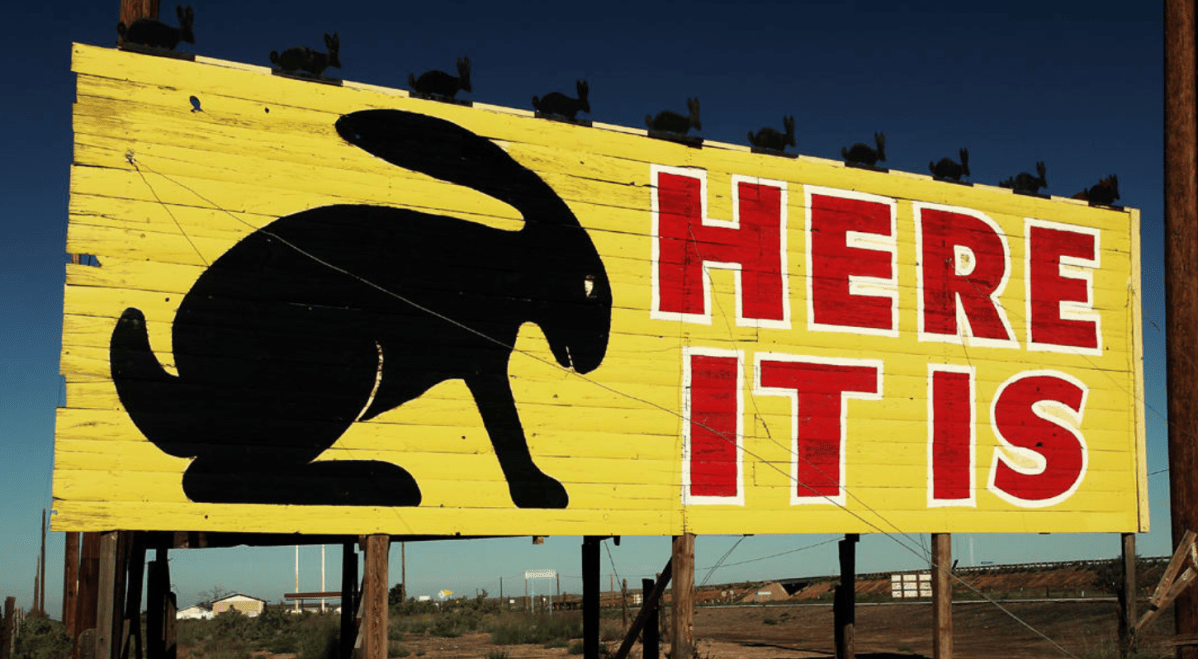
For example, as you drive across northeastern Arizona, just a bit south of Navajoland, you might notice these signs along the desert highway. They’re ambiguous, just old wooden billboards painted bright yellow, no words, just the silhouette of a big black rabbit and a number of miles counting down. 

150 miles, one sign says…and then 100….and 50….and 10…and as you drive across the empty landscape with not much else to look at, you find yourself overly invested in these mysterious signs, wondering, what exactly are we counting down to? What is that big rabbit all about? What or who is waiting out there across the desert, across the hours and the miles and long, winding road?

So you can imagine that, by the time you get to the end of the countdown, you have to pull off the highway to see whatever this thing is that has been tantalizing, taunting, beckoning you. And as you arrive at the exit, there’s one last sign, bigger than all the rest, still bright yellow like the noonday sun with that big black rabbit and big red letters that spell out, at last, three words: HERE. IT. IS.

That’s all the sign says. Here it is.

And you better believe, like countless travelers before us, we turned off the highway to see what IT is. Nothing would have stopped me. 

And do you know what’s there, shimmering in the desert sun, under the gaze of the big black rabbit?

A gift shop. 

Yes, it’s just a gift shop. Mildly disappointing, perhaps. It’s the Jackrabbit Trading Post and it’s been there since 1949 offering t-shirts and cold drinks and restrooms for all those wide-eyed pilgrims.

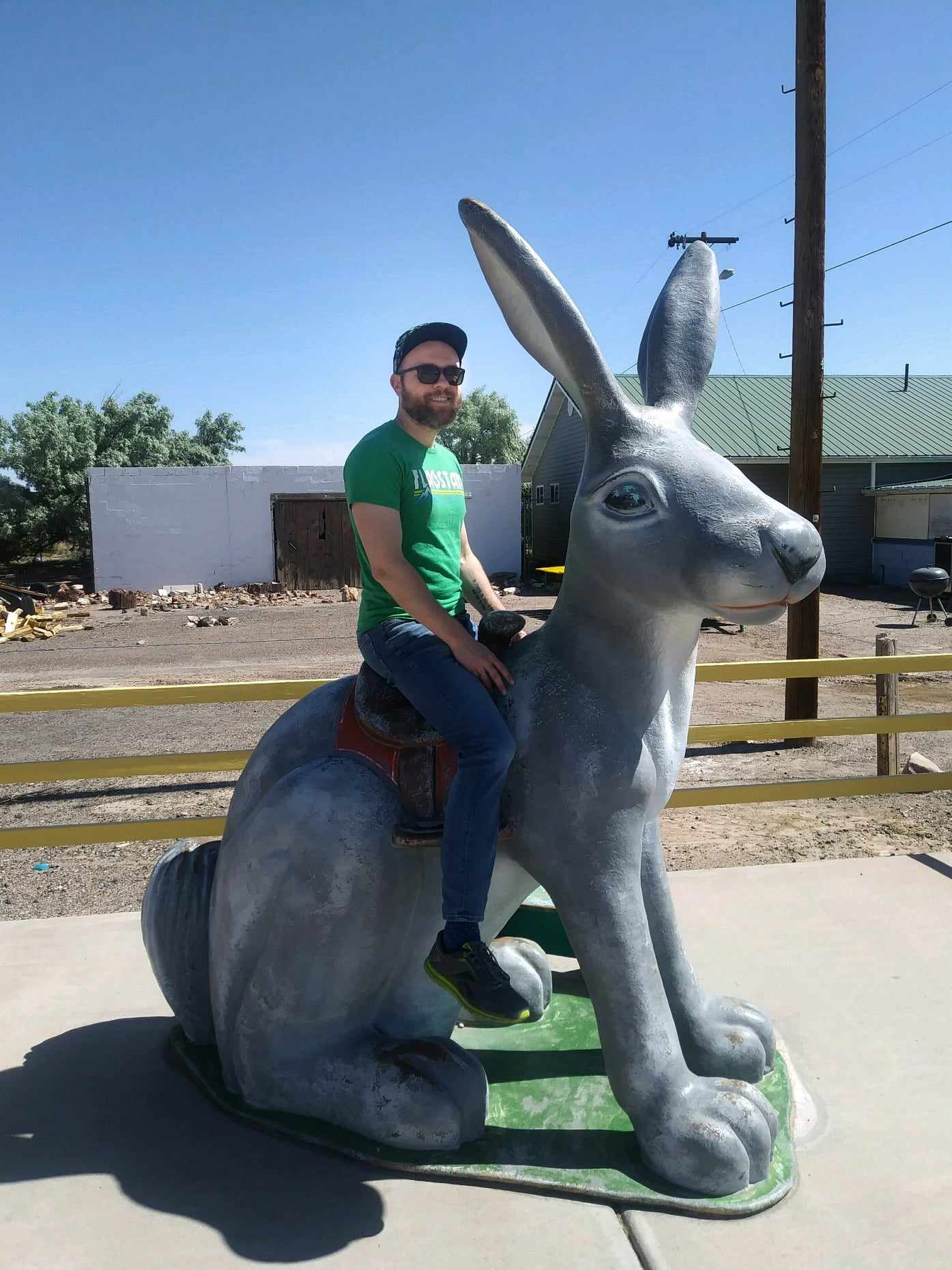
But if that sounds underwhelming, fear not. Because there’s also a big statue of a jackrabbit in the parking lot, with a saddle attached to it, that you can mount for a completely absurd photo of yourself. And did I get up on that jackrabbit every single time I’ve stopped there, including when I was 35 years old? You bet your life I did!

Because, well, why not? Maybe the sign is right after all. Here it is, five miles outside of Joseph City, Arizona…as good a place as any to find whatever it is we’ve been looking for in this life. 

As the years go by, I’ve found a sort of contemplative wisdom in that phrase, here it is. Especially when things don’t go quite the way I thought they would.

Bad diagnosis? Bad breakup? Tough election outcome? Before I can act purposefully, I have to start by saying, well, here it is. And, since it has always been true before, I also have to trust that God is not done with me just yet. In the meantime, the best I can do is to just get up on the jackrabbit so to speak, and accept the invitation of the present moment. 

Because here it is, this moment we’ve been given. And there’s still abundant life to be found here. Besides, what I notice so often in Scripture is that that the mildly disappointing and the foolish and the transcendent often converge in surprising ways.

As it happens, we have two such stories in our readings this morning—two call stories where somebody gets less than what they bargained for. Here’s what I mean.

First there’s Isaiah. Forget the billboards, he’s just had a vision of the throne of God, a glimpse of the heavenly court singing the same song we do during the Eucharist, Holy, Holy, Holy Lord. And he’s been touched by the burning coal of truth and he feels ready. HERE I AM he cries out. HERE IT IS! Here is my time to shine, my opportunity to tell the world exactly how powerful God is!

But God says, no. That’s not quite how this works. In fact, the people will not hear you. They will not understand. No, as they tend to do, the people will look for other, smaller, more alluring salvations, the ones promised by the forces of this world with better marketing. No, God says, you, my prophet, you will be left alone in the dry desert, sitting up there on your jackrabbit, the cars whizzing past you. But even though you won’t understand it, I am asking you to get up on there anyway. Here it is.

And then there’s Simon Peter, who sees Jesus perform the miraculous sign of abundant fish at Lake Gennesaret. Peter, like Isaiah, is both impressed and overwhelmed by this show of power, and he tells Jesus, “go away from me Lord, for I am a sinful man,” but we can also imagine he’s pretty excited to be in proximity to the One who can do such things. He may feel unworthy, but he wants to be among the inner circle of such a Lord. 

But as we will come to see, Jesus does not end up saving the world through abundant displays of power. The fish thing is a bit of a head fake. Not because God can’t do impressive things, but because Jesus chooses not to, and it’s in the self-limiting, foolish weakness of God that true salvation becomes possible for us all. A Messiah who rides on the back of a donkey, which is not a jackrabbit, but pretty close.

And those, like Peter, who have been counting down the miles til their glimpse of the Messiah, are destined to be mildly disappointed, at least for a little while. But here it is.

God says to all of us still clamoring for an impressive sort of divinity who is nothing more than the satisfaction of our desires—God says, no. That’s not quite how this works. 

I am the God of forgotten things…of forgotten trading posts and forgotten people on the side of the road. I am not in the halls of power and privilege and plenty. I am waiting for you out on the wilderness road, waiting to share a drink and a meal with you, out under the ramshackle sign that says, HERE IT IS. Here is what salvation is, at the intersection of the sublime and the absurd. Waiting for those brave, holy fools who understand that sometimes in this life, you just have to get up on the jackrabbit and go with it. 

And really, we do.

In such a time as we are living through now, friends—a time of political crisis and climate crisis and cultural crisis, when Neo-Nazis are trying to set up their own signs above our highways and when it can feel like we are many miles from home—in such a time as this, we run a great risk as disciples of Jesus.

We run the risk of being so burdened by fear that we lose our ability to respond to the present moment with what it requires: defiant, purposeful joy. We run the risk of letting despair make us small and hard and cynical and incurious, terrified of the future and longing for the past, unable to get on with the somewhat absurd work of hope and love here, now, where it is needed. We cannot let that happen. We will not let that happen here.

At the risk of exhausting the metaphor, we need to get up on the jackrabbit—to clamber up onto the unapologetic foolishness of our proclamation, which is that Christ’s mercy and peace and kindness are more substantive than the evil we see. And even if it’s not as impressive or mighty as some of the other narratives out there, we have to go with it. Because that proclamation is the only thing that will save us.

And as for the ones who try to put up the billboards of hate and fear and petty grievance to lure people in—to them we point to our own unambiguous signs—to the Cross of Christ crucified for love’s sake and to the Risen Christ who defeated hatred for love’s sake, and we say, HERE IT IS. Here is the truth about about this world: foolish and transcendent and sometimes mildly disappointing, yes, but also lovely and good and worth not giving up on. Worth following. Worth looking a bit foolish for.

So, like those who have been called before us, here we are, too, Lord. Here we are, only beginning to understand what You are all about. Here we are, praying and serving and speaking truth and caring for our weary neighbors. Here we are, counting down the miles, trusting your promise, the one that waits for us at the end of the many lonely roads we have traveled.

Here we are, ready to just go with it, ready to speak your name and get up on that jackrabbit and tell the world, tell anyone who will listen—

Here it is. You who have been longing for whatever is on the other side of fear and disappointment. 

Here it is.